
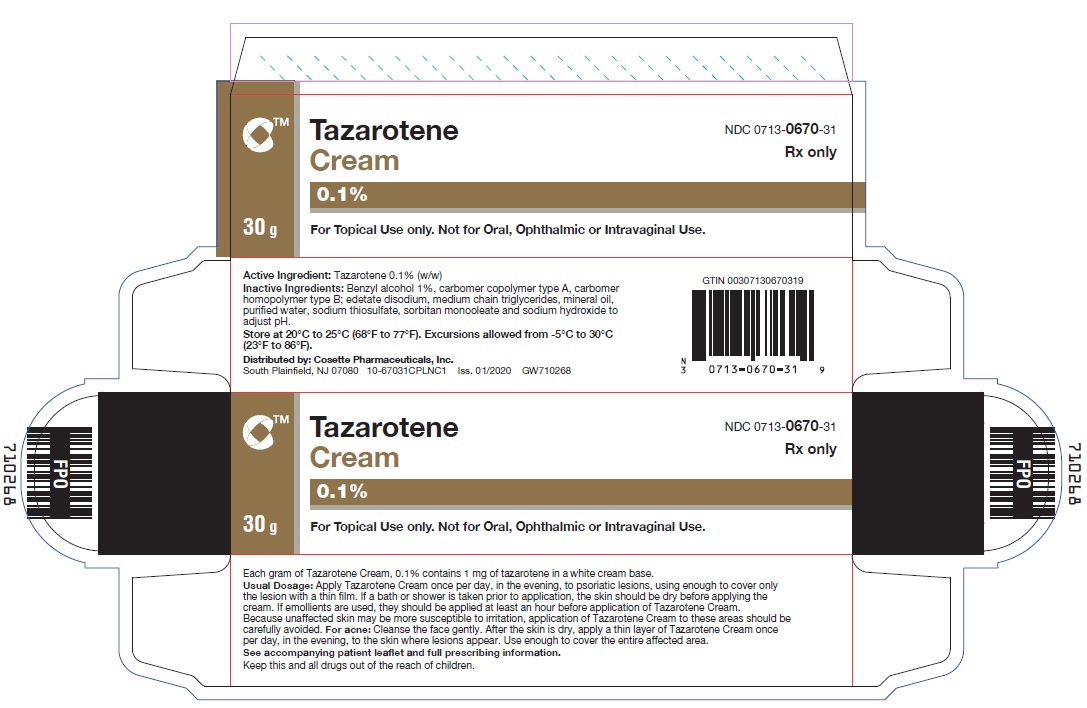
Tazarotene 1 mg/g Cream — NDC 0713-0670-31 (Billing 00713-0670-31)
This is a package of Tazarotene 1 mg/g Cream from Cosette Pharmaceuticals, Inc., marketed since Dec 2017 and currently FDA-listed; retail pharmacies pay about $1.92 per g (NADAC). It is the main listing for this product, which comes in 2 package sizes.
NDC database record
One package, one record: these facts belong to NDC 0713-0670-31 alone.
- Record
- FDA NDC Directory package listing · Human prescription drug
- Code segments
- 0713 labeler · 0670 product · 31 package
- Package marketed since
- Dec 22, 2017
- Sample package
- No — commercial package
- Listing certified through
- Dec 31, 2026
- Barcode (UPC-A, from the NDC)
- 3 0713067031 9
- Medicaid fills, this package
- 7,230 prescriptions in the last four reported quarters
- FDA record last changed
- Jul 24, 2026
Identity & classification
Regulatory identifiers FDA, NLM and CMS codes for this package
Drug-database identifiers Medi-Span GPI and First Databank GCN / HICL / AHFS classification
- GSN (GCN sequence number): 046984
- GCN: 85363
- GPI-14 (Medi-Span): 90250070003730
- HICL (First Databank): 013315
- AHFS class code: 84:28.00.00
- RxCUI (RxNorm): 313200
Where does this data come from?
- FDA openFDA NDC Directory · synced Oct 8, 2026
- FDA label on DailyMed · label index refreshed Oct 6, 2026
- RxNorm (NLM RxNav) · catalog refreshed Oct 1, 2026
- Medi-Span GPI (licensed)
- First Databank (licensed) · refreshed Oct 8, 2026
RxNorm drug class
This medicine belongs to the Retinoid class.
Where does this data come from?
- RxClass (NLM) · catalog refreshed Oct 1, 2026
Clinical
Tazarotene (Tazorac, Fabior) is used to treat acne. Tazarotene (Tazorac) is also used to treat psoriasis (a skin disease in which red, scaly patches form on some areas of the body). Tazarotene (Avage) is used to reduce facial wrinkling and discoloration in patients who are also using other skin care and sunlight avoidance programs. Tazarotene is in a class of medications called retinoids. It works to treat acne and psoriasis by slowing skin cell overgrowth and decreasing skin cell inflammation, which can lead to acne or psoriasis. It works to reduce facial wrinkles and discoloration by causing...
Read the full MedlinePlus article ↗- Tazarotene cream is designed to help reduce the look of fine facial wrinkles, blotchy skin discoloration (patches that are lighter or darker than normal), and flat pigmented spots...
- What exactly does tazarotene cream do for my skin?
- Take off any makeup first and make sure your skin is completely dry before you put it on. Then apply just a pea-sized amount — that's really all you need — and spread it lightly ov...
- Yes, some burning, redness, peeling, and itching are very common when you first start using tazarotene — your skin is adjusting to a retinoid, and that takes time. Keeping up with...
Patient education
Supplement & herbal interactions
Some supplements/herbs that may interact with Tazarotene — tap one for details:
Tazarotene may be associated with lower levels of 1 nutrient — worth a chat with your pharmacist, not a cause for alarm.
Where does this data come from?
- MedlinePlus (NLM) · refreshed Oct 1, 2026
- FDA label on DailyMed · label index refreshed Oct 6, 2026
Ask a licensed pharmacist directly — free, answered by our team.
Pricing
A drug doesn't have one price. Each row is a different public payment system, and none is what you'd pay at the counter — that depends on your insurance. The ⓘ on each row explains what it measures.
| Price system | Per g | Per package |
|---|---|---|
| Retail pharmacies payNADAC · weekly | $1.925 | $57.74 / 30 g |
| Medicaid paysCMS SDUD · 12 mo | $2.44 | $73.34 / 30 g |
| Medicare drug plans payPart D · Q2 2026 | $3.37 | $100.96 / 30 g |
Where does this data come from?
- CMS NADAC weekly file · file of Oct 7, 2026
- CMS ASP pricing files · refreshed Sep 20, 2026
- CMS Medicaid State Drug Utilization Data · through Q1 2026
- CMS Part D plan pricing files · refreshed Sep 24, 2026
- VA National Acquisition Center price file
Packaging — all sizes for this product
| Package NDC | Description | Per unit | Per pack | Marketing start | Marketing end | Status |
|---|---|---|---|---|---|---|
| 00713-0670-31 You're viewing this Main listing | 1 TUBE in 1 CARTON / 30 g in 1 TUBE | $1.92 / g | $57.73 | 2017-12-22 | — | Active |
| 00713-0670-60 0713-0670-60 | 1 TUBE in 1 CARTON / 60 g in 1 TUBE | $1.85 / g | $110.95 | 2017-12-22 | — | Active |
Per g, this pack runs about 4% above the cheapest pack (NDC 00713-0670-60, $1.85 vs $1.92 NADAC).
In Medicaid, this is the most-dispensed pack of this product — about 70% of fills over the last four reported quarters. See all packs ↓
Pack size FAQ
What quantity is in this package?
What NDC number is used to bill for this package of Tazarotene 1 mg/g Cream?
Prices are the latest CMS NADAC pharmacy acquisition cost per NDC; per-pack figures are per-unit × pack quantity, shown only when the pack is denominated in the same measure NADAC prices.
Therapeutic equivalents
| Product | Labeler | Pack | NADAC/unit | TE | Status | Price vs. this |
|---|---|---|---|---|---|---|
| Tazarotene 1 mg/gthis 00713-0670-31 | Cosette | 1 tube | $1.924 | AB | Availability likely | — |
| Tazarotene 1 mg/g 51672-1373-02 | Sun | 1 tube | $1.924 | AB | Availability likely | — |
| Tazarotene 1 mg/g 68308-0745-30 | Mayne | 1 tube | $1.924 | AB | Availability likely | — |
| Tazarotene 1 mg/g 45802-0442-01 | Padagis | 1 tube | $5.715 | AB | Availability likely | +197% |
| Tazarotene 1 mg/g 00713-0804-31 | Cosette | 1 tube | $6.504 | AB | Availability likely | +238% |
| Tazarotene 1 mg/g 51672-1374-02 | Sun | 1 tube | — | AB | FDA listed | — |
| Tazarotene 1 mg/g 72162-2202-03 | Bryant | 1 tube | — | AB | FDA listed | — |
| Trilitas 1 mg/g 87143-0200-30 | Perfero | 1 tube | — | AB | FDA listed | — |
Where does this data come from?
- FDA openFDA NDC Directory · synced Oct 8, 2026
- FDA Orange Book · refreshed Oct 3, 2026
- CMS NADAC weekly file · file of Oct 7, 2026
Availability & generic status
This product is an FDA-approved generic. Other versions of the same drug are listed under Therapeutic equivalents, least expensive first.
Where does this data come from?
- FDA Orange Book · refreshed Oct 3, 2026
What it looks like
Where does this data come from?
- FDA label on DailyMed · label index refreshed Oct 6, 2026
Inactive Ingredients / Excipients
Inactive ingredients, also called excipients, are components of the drug product other than the active ingredient. They may include fillers, dyes, coatings, preservatives, flavors, or other formulation ingredients.
🧪 Avoiding an ingredient? See Tazarotene Topical inactive ingredients by manufacturer: every current product's list side by side, so you can ask your pharmacy for the version that does not list it.
💡 Tap an ingredient (hover on desktop) to see what it is and why it’s used.
-
UNII LKG8494WBH
Benzyl alcohol is a clear liquid used as a preservative and solvent in medicines. It helps prevent bacterial and fungal growth and dissolves other ingredients to create uniform liquid formulations.
-
UNII 71DD5V995L
A synthetic polymer derived from acrylic acid, crosslinked to form a gel-like substance. It thickens formulations, improves texture, and helps distribute active ingredients evenly in topical products like creams and gels.
-
UNII HHT01ZNK31
Carbomer Homopolymer Type B is a synthetic polymer made from acrylic acid. It absorbs water and forms a gel, so it's used in medicines as a thickener, suspending agent, and to help create a smooth texture in creams, gels, and lotions.
-
UNII 7FLD91C86K
Edetate disodium is a chemical compound that binds and removes certain metal ions. In medicines, it acts as a preservative and stabilizer by preventing metals like calcium from interfering with the product's shelf life and consistency.
-
UNII C9H2L21V7U
A fat derived from coconut or palm oil containing shorter fatty acid chains. It serves as a solvent and carrier to help dissolve or suspend active ingredients, improving absorption and stability in liquid formulations.
-
UNII T5L8T28FGP
Mineral oil is a clear, odorless liquid derived from crude oil. It acts as a lubricant and emollient in medications, helping pills slide smoothly during manufacturing and aiding moisture retention in topical products.
-
UNII 55X04QC32I
A strong alkaline chemical used to adjust and maintain the pH balance of liquid medicines. It helps keep the medicine stable and ensures it stays effective during storage.
-
UNII HX1032V43M
Sodium thiosulfate is a salt compound used in medicines as a buffer and pH regulator. It helps stabilize the medication and may also serve as a preservative or antioxidant to maintain product quality.
-
UNII 06XEA2VD56
Sorbitan oleate is an emulsifier derived from sorbitol and oleic acid. It helps mix oil and water-based ingredients together and keeps them from separating in the medicine.
-
UNII 059QF0KO0R
Water is a liquid solvent that dissolves and mixes ingredients together in liquid medicines, syrups, and injections. It helps distribute the active drug evenly throughout the product.
10 inactive ingredients listed in the exact product block matched to this NDC.
Where does this data come from?
ingredient classCode="IACT" elements from the exact product block matched by this NDC. Label-section narrative from DailyMed / the openFDA label index is shown separately when available.- FDA label on DailyMed · label index refreshed Oct 6, 2026
- FDA openFDA NDC Directory · synced Oct 8, 2026
Inactive ingredient FAQ
Are inactive ingredients the same for every manufacturer?
Why might an inactive ingredient be missing?
Can inactive ingredients matter?
Manufacturer & labeler
More NDCs from Cosette Pharmaceuticals, Inc. labeler code 00713
- Triamcinolone Acetonide 1 mg/g Paste NDC 0713-0655-40
- Clobetasol Propionate .5 mg/g Ointment NDC 0713-0656-15
- Betamethasone Dipropionate .5 mg/g Cream NDC 0713-0659-15
- Desonide .5 mg/g Cream NDC 0713-0661-15
- Fluocinonide .5 mg/g Cream NDC 0713-0663-15
- Fluocinonide .5 mg/g Cream NDC 0713-0664-15
- Triamcinolone Acetonide 1 mg/mL Lotion NDC 0713-0676-53
- Nystatin 100000 [USP'U]/g Cream NDC 0713-0678-15
- Gentamicin Sulfate 1 mg/g Ointment NDC 0713-0682-15
- Gentamicin Sulfate 1 mg/g Cream NDC 0713-0683-15
- Nystatin 100000 [USP'U]/g Ointment NDC 0713-0686-15
- Fluocinolone Acetonide .25 mg/g Cream NDC 0713-0709-15
Where does this data come from?
- FDA openFDA NDC Directory · synced Oct 8, 2026
- Drugs@FDA
Full prescribing information FDA SPL
🎯 Indications and Usage ▾
1 INDICATIONS AND USAGE Tazarotene cream 0.05% and 0.1% is a retinoid indicated for the topical treatment of plaque psoriasis. ( 1.1 ) Tazarotene cream 0.1% is indicated for the topical treatment of acne vulgaris. ( 1.2 )
1.1Plaque Psoriasis Tazarotene cream, 0.05% and 0.1% are indicated for the topical treatment of patients with plaque psoriasis.
1.2Acne Vulgaris Tazarotene cream, 0.1% is also indicated for the topical treatment of patients with acne vulgaris.
⏱️ Dosage and Administration ▾
2 DOSAGE AND ADMINISTRATION Apply a thin layer of tazarotene cream only to the affected area once daily in the evening. ( 2.1 , 2.2 ) Not for ophthalmic, oral, or intravaginal use. ( 2.2 ) If contact with eyes occurs, rinse thoroughly with water. ( 2.2 )
2.1Important Administration Instructions Tazarotene cream is for topical use only. Tazarotene cream is not for ophthalmic, oral, or intravaginal use. If contact with mucous membranes occurs, rinse thoroughly with water [see Warnings and Precautions ( 5.2 )] . Wash hands thoroughly after application.
2.2Psoriasis It is recommended that treatment starts with tazarotene cream, 0.05%, with strength increased to 0.1% if tolerated and medically indicated. Apply a thin film (2 mg/cm 2 ) of tazarotene cream once per day, in the evening, to cover only the psoriatic lesions. If a bath or shower is taken prior to application, the skin should be dry before applying the cream.
If emollients are used, they should be applied at least an hour before application of tazarotene cream. Because unaffected skin may be more susceptible to irritation, application of tazarotene cream to these areas should be carefully avoided.
2.3Acne Cleanse the face gently. After the skin is dry, apply a thin layer (2 mg/cm 2 ) of tazarotene cream 0.1% once per day, in the evening, to the skin areas where acne lesions appear. Use enough to cover the entire affected area. Use effective sunscreens and wear protective clothing while using tazarotene cream [see Warnings and Precautions ( 5.3 )].
💊 Dosage Forms and Strengths ▾
3 DOSAGE FORMS AND STRENGTHS Cream, 0.05% and 0.1%. Each gram of tazarotene cream, 0.05% and 0.1% contains 0.5 mg and 1 mg of tazarotene, respectively in a white to off-white cream base. Cream, 0.05% and 0.1%. ( 3 )
⛔ Contraindications ▾
4 CONTRAINDICATIONS Tazarotene cream is contraindicated in: Pregnancy. Retinoids may cause fetal harm when administered to a pregnant female [see Warnings and Precautions ( 5.1 ), Use in Specific Populations ( 8.1 , 8.3 )] . Individuals who have known hypersensitivity to any of its components [see Warnings and Precautions ( 5.2 )] . Pregnancy ( 4 , 8.1 ) Hypersensitivity ( 4 )
⚠️ Warnings and Cautions ▾
5 WARNINGS AND PRECAUTIONS Embryofetal Toxicity: Tazarotene cream contains tazarotene, which is a teratogenic substance. Tazarotene cream is contraindicated in pregnancy. Females of child-bearing potential should have a negative pregnancy test within 2 weeks prior to initiating treatment and use an effective method of contraception during treatment.
( 5.1 ) Local Irritation: Some individuals may experience excessive pruritus, burning, skin redness or peeling. If these effects occur, discontinue until the integrity of the skin has been restored, or reduce dosing interval, or in the case of psoriasis, may switch to the lower concentration. Tazarotene cream should not be used on eczematous skin, as it may cause severe irritation.
( 5.2 ) Photosensitivity and Risk for Sunburn: Avoid exposure to sunlight, sunlamps, and weather extremes. Wear sunscreen daily. Tazarotene cream should be administered with caution if the patient is also taking drugs known to be photosensitizers.
( 5.3 )
5.1Embryofetal Toxicity Systemic exposure to tazarotenic acid is dependent upon the extent of the body surface area treated. In patients treated topically over sufficient body surface area, exposure could be in the same order of magnitude as in orally treated animals. Although there may be less systemic exposure in the treatment of acne of the face alone due to less surface area for application, tazarotene is a teratogenic substance, and it is not known what level of exposure is required for teratogenicity in humans [see Clinical Pharmacology ( 12.3 )] .
There were thirteen reported pregnancies in subjects who participated in the clinical trials for topical tazarotene. Nine of the subjects were found to have been treated with topical tazarotene, and the other four had been treated with vehicle. One of the subjects who was treated with tazarotene cream elected to terminate the pregnancy for non-medical reasons unrelated to treatment.
The other eight pregnant women who were inadvertently exposed to topical tazarotene during clinical trials subsequently delivered apparently healthy babies. As the exact timing and extent of exposure in relation to the gestation times are not certain, the significance of these findings is unknown. Females of Child-bearing Potential Females of child-bearing potential should be warned of the potential risk and use adequate birth-control measures when tazarotene cream is used.
The possibility that a female of child-bearing potential is pregnant at the time of institution of therapy should be considered. A negative result for pregnancy test should be obtained within 2 weeks prior to tazarotene cream therapy. Tazarotene cream therapy should begin during a menstrual period [see Use in Specific Populations ( 8.1 )] .
5.2Local Irritation and Hypersensitivity Reactions Local tolerability reactions (including blistering and skin desquamation) and hypersensitivity adverse reactions (including urticaria) have been observed with topical tazarotene. Application of tazarotene cream may cause excessive irritation in the skin of certain sensitive individuals. Some individuals may experience excessive pruritus, burning, skin redness or peeling.
If these effects occur, the medication should either be discontinued until the integrity of the skin is restored, or the dosing should be reduced to an interval the patient can tolerate. However, efficacy at reduced frequency of application has not been established. Alternatively, patients with psoriasis who are being treated with the 0.1% concentration can be switched to the lower concentration.
Frequency of application should be closely monitored by careful observation of the clinical therapeutic response and skin tolerance. Therapy can be resumed, or the drug concentration or frequency of application can be increased as the patient becomes able to tolerate treatment. Concomitant topical medications and cosmetics that have a strong drying effect should be avoided.
It is also advisable to "rest" a p… [Excerpted — this section continues on DailyMed.]
🤒 Adverse Reactions ▾
6 ADVERSE REACTIONS The following serious adverse reactions are discussed in more detail in other sections of the labeling: Embryofetal toxicity [see Warnings and Precautions ( 5.1 )] Photosensitivity and Risk of Sunburn [see Warnings and Precautions ( 5.3 )] Plaque psoriasis: Most common adverse reactions occurring in 10 to 23% of patients are pruritus, erythema, and burning. ( 6.1 ) Acne Vulgaris: Most common adverse reactions occurring in 10 to 30% of patients are desquamation, dry skin, erythema, and burning sensation.
( 6.1 ) To report SUSPECTED ADVERSE REACTIONS, contact Cosette Pharmaceuticals, Inc. at 1-800-922-1038 or FDA at 1-800-FDA-1088 or www.fda.gov/medwatch.
6.1Clinical Trials Experience Because clinical trials are conducted under widely varying conditions, adverse reaction rates observed in the clinical trials of a drug cannot be directly compared to rates in the clinical trials of another drug and may not reflect the rates observed in clinical practice. In human dermal safety trials, tazarotene cream, 0.05% and 0.1% did not induce allergic contact sensitization, phototoxicity, or photoallergy. Psoriasis The most frequent adverse reactions reported with tazarotene cream, 0.05% and 0.1% occurring in 10 to 23% of subjects, in descending order, included pruritus, erythema, and burning.
Reactions occurring in greater than 1 to less than 10% of subjects, in descending order, included irritation, desquamation, stinging, contact dermatitis, dermatitis, eczema, worsening of psoriasis, skin pain, rash, hypertriglyceridemia, dry skin, skin inflammation, and peripheral edema. Tazarotene cream, 0.1% was associated with a greater degree of local irritation than the 0.05% cream. The rates of irritation adverse reactions reported during psoriasis trials with tazarotene cream, 0.1% were 0.1-0.4% higher than those reported for tazarotene cream, 0.05%.
Acne The most frequent adverse reactions reported during clinical trials with tazarotene cream 0.1% in the treatment of acne, occurring in 10-30% of subjects, in descending order included desquamation, dry skin, erythema, and burning sensation. Reactions occurring in 1 to 5% of subjects included pruritus, irritation, face pain, and stinging.
6.2Postmarketing Experience The following adverse reactions have been identified during post approval use of tazarotene. Because these reactions are reported voluntarily from a population of uncertain size, it is not always possible to reliably estimate their frequency or establish a causal relationship to drug exposure. Skin and subcutaneous tissue disorders : blister, dermatitis, urticaria, skin exfoliation, skin discoloration (including skin hyperpigmentation or skin hypopigmentation), swelling at or near application sites, and pain.
🔄 Drug Interactions ▾
7 DRUG INTERACTIONS No formal drug-drug interaction studies were conducted with tazarotene cream. In a trial of 27 healthy female subjects between the ages of 20-55 years receiving a combination oral contraceptive tablet containing 1 mg norethindrone and 35 mcg ethinyl estradiol, concomitant use of tazarotene administered as 1.1 mg orally (mean ± SD C max and AUC 0-24 of tazarotenic acid were 28.9 ± 9.4 ng/mL and 120.6 ± 28.5 ng·hr/mL) did not affect the pharmacokinetics of norethindrone and ethinyl estradiol over a complete cycle.
The impact of tazarotene on the pharmacokinetics of progestin only oral contraceptives (i.e., minipills) has not been evaluated.
👥 Use in Specific Populations ▾
8 USE IN SPECIFIC POPULATIONS
8.1Pregnancy Risk Summary Based on data from animal reproduction studies, retinoid pharmacology, and the potential for systemic absorption, tazarotene cream may cause fetal harm when administered to a pregnant female and is contraindicated during pregnancy. Safety in pregnant females has not been established. The potential risk to the fetus outweighs the potential benefit to the mother from tazarotene cream during pregnancy; therefore, tazarotene cream should be discontinued as soon as pregnancy is recognized [see Contraindications ( 4 ), Warnings and Precautions ( 5.1 ), Clinical Pharmacology ( 12.3 )].
Limited case reports of pregnancy in females enrolled in clinical trials for tazarotene cream have not established a clear association with tazarotene and major birth defects or miscarriage risk. Because the exact timing and extent of exposure in relation to the gestational age are not certain, the significance of these findings is unknown . In animal reproduction studies with pregnant rats, tazarotene dosed topically during organogenesis at 2 times the maximum systemic exposure in subjects treated with the maximum recommended human dose (MRHD) of tazarotene cream, 0.1% resulted in reduced fetal body weights and reduced skeletal ossification.
In animal reproduction studies with pregnant rabbits dosed topically with tazarotene gel at 26 times the maximum systemic exposure in subjects treated with the MRHD of tazarotene cream, 0.1%, there was a single incident of known retinoid malformations, including spina bifida, hydrocephaly, and heart anomalies. In animal reproduction studies with pregnant rats and rabbits, tazarotene dosed orally during organogenesis at 2 and 52 times, respectively, the maximum systemic exposure in subjects treated with the MRHD of tazarotene cream, 0.1% resulted in malformations, fetal toxicity, developmental delays, and/or behavioral delays .
In pregnant rats, tazarotene dosed orally prior to mating through early gestation resulted in decreased litter size, decreased numbers of live fetuses, decreased fetal body weights, and increased malformations at doses approximately 7 times higher than the maximum systemic exposure in subjects treated with the MRHD of tazarotene cream, 0.1% [see Data ]. The background risk of major birth defects and miscarriage for the indicated population is unknown. Adverse outcomes in pregnancy occur regardless of the health of the mother or the use of medications.
In the U.S. general population, the estimated background risk of major birth defects and miscarriage in clinically recognized pregnancies is 2-4% and 15-20%, respectively. Data Animal Data In rats, a tazarotene gel, 0.05% formulation dosed topically during gestation days 6 through 17 at 0.25 mg/kg/day, which represented 2 times the maximum systemic exposure in subjects treated with the MRHD of tazarotene cream, 0.1% (i.e . , 2 mg/cm 2 over a 15% body surface area), resulted in reduced fetal body weights and reduced skeletal ossification.
Rabbits dosed topically with 0.25 mg/kg/day tazarotene gel, which represented 26 times the maximum systemic exposure in subjects treated with MRHD of tazarotene cream, 0.1%, during gestation days 6 through 18, had a single incident of known retinoid malformations, including spina bifida, hydrocephaly, and heart anomalies. When tazarotene was given orally to animals, developmental delays were seen in rats, and malformations and post-implantation loss were observed in rats and rabbits at doses representing 2 and 52 times, respectively, the maximum systemic exposure seen in subjects treated with the MRHD of tazarotene cream, 0.1%.
In female rats orally administered 2 mg/kg/day of tazarotene from 15 days before mating through gestation day 7, which represented 7 times the maximum systemic exposure in subjects treated with the MRHD of tazarotene cream, 0.1%, classic developmental effects of retinoids were observed including decreased number of implantation sit… [Excerpted — this section continues on DailyMed.]
🤰 Pregnancy ▾
8.1Pregnancy Risk Summary Based on data from animal reproduction studies, retinoid pharmacology, and the potential for systemic absorption, tazarotene cream may cause fetal harm when administered to a pregnant female and is contraindicated during pregnancy. Safety in pregnant females has not been established. The potential risk to the fetus outweighs the potential benefit to the mother from tazarotene cream during pregnancy; therefore, tazarotene cream should be discontinued as soon as pregnancy is recognized [see Contraindications ( 4 ), Warnings and Precautions ( 5.1 ), Clinical Pharmacology ( 12.3 )].
Limited case reports of pregnancy in females enrolled in clinical trials for tazarotene cream have not established a clear association with tazarotene and major birth defects or miscarriage risk. Because the exact timing and extent of exposure in relation to the gestational age are not certain, the significance of these findings is unknown . In animal reproduction studies with pregnant rats, tazarotene dosed topically during organogenesis at 2 times the maximum systemic exposure in subjects treated with the maximum recommended human dose (MRHD) of tazarotene cream, 0.1% resulted in reduced fetal body weights and reduced skeletal ossification.
In animal reproduction studies with pregnant rabbits dosed topically with tazarotene gel at 26 times the maximum systemic exposure in subjects treated with the MRHD of tazarotene cream, 0.1%, there was a single incident of known retinoid malformations, including spina bifida, hydrocephaly, and heart anomalies. In animal reproduction studies with pregnant rats and rabbits, tazarotene dosed orally during organogenesis at 2 and 52 times, respectively, the maximum systemic exposure in subjects treated with the MRHD of tazarotene cream, 0.1% resulted in malformations, fetal toxicity, developmental delays, and/or behavioral delays .
In pregnant rats, tazarotene dosed orally prior to mating through early gestation resulted in decreased litter size, decreased numbers of live fetuses, decreased fetal body weights, and increased malformations at doses approximately 7 times higher than the maximum systemic exposure in subjects treated with the MRHD of tazarotene cream, 0.1% [see Data ]. The background risk of major birth defects and miscarriage for the indicated population is unknown. Adverse outcomes in pregnancy occur regardless of the health of the mother or the use of medications.
In the U.S. general population, the estimated background risk of major birth defects and miscarriage in clinically recognized pregnancies is 2-4% and 15-20%, respectively. Data Animal Data In rats, a tazarotene gel, 0.05% formulation dosed topically during gestation days 6 through 17 at 0.25 mg/kg/day, which represented 2 times the maximum systemic exposure in subjects treated with the MRHD of tazarotene cream, 0.1% (i.e . , 2 mg/cm 2 over a 15% body surface area), resulted in reduced fetal body weights and reduced skeletal ossification.
Rabbits dosed topically with 0.25 mg/kg/day tazarotene gel, which represented 26 times the maximum systemic exposure in subjects treated with MRHD of tazarotene cream, 0.1%, during gestation days 6 through 18, had a single incident of known retinoid malformations, including spina bifida, hydrocephaly, and heart anomalies. When tazarotene was given orally to animals, developmental delays were seen in rats, and malformations and post-implantation loss were observed in rats and rabbits at doses representing 2 and 52 times, respectively, the maximum systemic exposure seen in subjects treated with the MRHD of tazarotene cream, 0.1%.
In female rats orally administered 2 mg/kg/day of tazarotene from 15 days before mating through gestation day 7, which represented 7 times the maximum systemic exposure in subjects treated with the MRHD of tazarotene cream, 0.1%, classic developmental effects of retinoids were observed including decreased number of implantation sites, decreased litter size, dec… [Excerpted — this section continues on DailyMed.]
🧒 Pediatric Use ▾
8.3Females and Males of Reproductive Potential Pregnancy Testing Pregnancy testing is recommended for females of reproductive potential within 2 weeks prior to initiating tazarotene cream therapy which should begin during a menstrual period. Contraception Females Based on animal studies, tazarotene cream may cause fetal harm when administered to a pregnant woman [see Use in Specific Populations ( 8.1 )]. Advise females of reproductive potential to use effective contraception during treatment with tazarotene cream.
🧓 Geriatric Use ▾
8.4Pediatric Use The safety and efficacy of tazarotene cream have not been established in patients with psoriasis under the age of 18 years, or in patients with acne under the age of 12 years.
🆘 Overdosage ▾
10 OVERDOSAGE Excessive topical use of tazarotene cream, 0.05% and 0.1% may lead to marked redness, peeling, or discomfort [see Warnings and Precautions ( 5.2 )] . Tazarotene cream, 0.05% and 0.1% are not for oral use. Oral ingestion of the drug may lead to the same adverse effects as those associated with excessive oral intake of Vitamin A (hypervitaminosis A) or other retinoids.
If oral ingestion occurs, the patient should be monitored, and appropriate supportive measures should be administered as necessary.
🧬 Clinical Pharmacology ▾
12 CLINICAL PHARMACOLOGY
12.1Mechanism of Action Tazarotene is a retinoid prodrug which is converted to its active form, the carboxylic acid of tazarotene, by deesterification. Tazarotenic acid binds to all three members of the retinoic acid receptor (RAR) family: RARα RARβ, and RAR γ , but shows relative selectivity for RARβ, and RAR γ and may modify gene expression. The clinical significance of these findings is unknown.
12.3Pharmacokinetics Following topical application, tazarotene undergoes esterase hydrolysis to form its active metabolite, tazarotenic acid. Little parent compound could be detected in the plasma. Tazarotenic acid was highly bound to plasma proteins (greater than 99%).
Tazarotene and tazarotenic acid were metabolized to sulfoxides, sulfones and other polar metabolites which were eliminated through urinary and fecal pathways. The half-life of tazarotenic acid was approximately 18 hours, following topical application of tazarotene to normal, acne or psoriatic skin. In a multiple dose trial with a once daily dose for 14 consecutive days in 9 psoriatic subjects (male=5; female=4), measured doses of tazarotene cream, 0.1% were applied by medical staff to involved skin without occlusion (5 to 35% of total body surface area: mean ± SD: 14 ± 11%).
The C max of tazarotenic acid was 2.31 ± 2.78 ng/mL occurring 8 hours after the final dose, and the AUC 0-24h was 31.2 ± 35.2 ng·hr/mL on day 15 in the five subjects who were administered clinical doses of 2 mg cream/cm 2 . During clinical trials with tazarotene cream, 0.05% or 0.1% treatment for plaque psoriasis, three out of 139 subjects with their systemic exposure monitored had detectable plasma tazarotene concentrations, with the highest value at 0.09 ng/mL. Tazarotenic acid was detected in 78 out of 139 subjects (LLOQ = 0.05 ng/mL).
Three subjects using tazarotene cream 0.1% had plasma tazarotenic acid concentrations greater than 1 ng/mL. The highest value was 2.4 ng/mL. However, because of the variations in the time of blood sampling, the area of psoriasis involvement, and the dose of tazarotene applied, actual maximal plasma levels are unknown.
Tazarotene cream 0.1% was applied once daily to either the face (N=8) or to 15% of body surface area (N=10) of female subjects with moderate to severe acne vulgaris. The mean C max and AUC values of tazarotenic acid peaked at day 15 for both dosing groups during a 29 day treatment period. Mean C max and AUC 0-24h values of tazarotenic acid from subjects in the 15% body surface area dosing group were more than 10 times higher than those from subjects in the face-only dosing group.
The single highest C max throughout the trial period was 1.91 ng/mL on day 15 in the exaggerated dosing group. In the face-only group, the mean ± SD values of C max and AUC 0-24h of tazarotenic acid on day 15 were 0.10 ± 0.06 ng/mL and 1.54 ± 1.01 ng·hr/mL, respectively, whereas in the 15% body surface area dosing group, the mean ± SD values of C max and AUC 0-24h of tazarotenic acid on day 15 were 1.20 ± 0.41 ng/mL and 17.01 ± 6.15 ng·hr/mL, respectively. The steady state pharmacokinetics of tazarotenic acid had been reached by day 8 in the face-only and by day 15 in the 15% body surface area dosing groups.
In a Phase 3 clinical trial, tazarotene cream, 0.1% was applied once daily for 12 weeks to each of 48 subjects (22 females and 26 males) with facial acne vulgaris. The mean ± SD values of plasma tazarotenic acid at weeks 4 and 8 were 0.078 ± 0.073 ng/mL (N=47) and 0.052 ± 0.037 ng/mL (N=42), respectively. The highest observed individual plasma tazarotenic acid concentration was 0.41 ng/mL at week 4 from a female subject.
The magnitude of plasma tazarotenic acid concentrations appears to be independent of gender, age, and body weight.
🧬 Mechanism of Action ▾
12.1Mechanism of Action Tazarotene is a retinoid prodrug which is converted to its active form, the carboxylic acid of tazarotene, by deesterification. Tazarotenic acid binds to all three members of the retinoic acid receptor (RAR) family: RARα RARβ, and RAR γ , but shows relative selectivity for RARβ, and RAR γ and may modify gene expression. The clinical significance of these findings is unknown.
📦 How Supplied / Storage and Handling ▾
16 HOW SUPPLIED/STORAGE AND HANDLING Tazarotene cream is a white to off-white cream available in concentrations of 0.05% and 0.1%. It is supplied in a collapsible aluminum tube with a tamper-evident aluminum membrane over the opening and a white polypropylene screw cap, in 30 g and 60 g sizes. Tazarotene Cream, 0.05% Tazarotene Cream, 0.1% 30 g NDC 0713-0765-31 NDC 0713-0670-31 60 g NDC 0713-0765-60 NDC 0713-0670-60 Storage: Store at 20°C to 25°C (68°F to 77°F).
Excursions permitted from -5°C to 30°C (23°F to 86°F).
📋 Description ▾
11 DESCRIPTION Tazarotene cream, 0.05% and 0.1% is for topical use and contains the active ingredient, tazarotene. Each gram of tazarotene cream, 0.05% and 0.1% contains 0.5 mg and 1 mg of tazarotene, respectively in a white to off-white cream base. Tazarotene is a member of the acetylenic class of retinoids.
Chemically, tazarotene is ethyl 6-[(4,4-dimethylthiochroman-6-yl)ethynyl]nicotinate. The compound has an empirical formula of C 21 H 21 NO 2 S and molecular weight of 351.46. The structural formula is shown below: Tazarotene cream contains the following inactive ingredients: benzyl alcohol 1%; carbomer copolymer type A; carbomer homopolymer type B; edetate disodium; medium chain triglycerides; mineral oil; purified water; sodium hydroxide; sodium thiosulfate; and sorbitan monooleate. structural formula
💬 Information for Patients ▾
17 PATIENT COUNSELING INFORMATION Advise the patient to read the FDA-approved patient labeling ( Patient Information ). Embryofetal Toxicity Inform females of reproductive potential of the potential risk to a fetus. Advise these patients to use effective contraception during treatment with tazarotene cream.
Advise patients to inform their healthcare provider of a known or suspected pregnancy [see Warnings and Precautions ( 5.1 ) and Use in Specific Populations ( 8.1 , 8.3 )] . Photosensitivity and Risk of Sunburn Advise patients to avoid excessive sun exposure and to use of sunscreens and protective measures (hat, visor). Advise patients to avoid using tazarotene if also taking other medicines may increase sensitivity to sunlight.
Important Administration Instructions Advise the patient of the following: For the patient with psoriasis, apply tazarotene cream only to psoriasis skin lesions, avoiding uninvolved skin. If undue irritation (redness, peeling, or discomfort) occurs, reduce frequency of application or temporarily interrupt treatment. Treatment may be resumed once irritation subsides [see Dosage and Administration ( 2.1 )].
Moisturizers may be used as frequently as desired. Patients with psoriasis may use a cream or lotion to soften or moisten skin at least 1 hour before applying tazarotene cream. Avoid contact with the eyes.
If tazarotene cream gets in or near eyes, rinse thoroughly with water. Seek medical attention if eye irritation continues. Tazarotene cream is for topical use only.
Do not apply to eyes, mouth, or other mucous membrane. Not for ophthalmic, oral, or intravaginal use. Wash hands thoroughly after applying tazarotene cream.
Distributed by: Cosette Pharmaceuticals, Inc. South Plainfield, NJ 07080 Revised: 12/2023 8-TAZCPLNC1 VC7727
🍼 Nursing Mothers ▾
8.2Lactation Risk Summary There is no information regarding the presence of tazarotene in human milk, the effects on the breastfed infant, or the effects on milk production. After single topical doses of 14 C-tazarotene gel to the skin of lactating rats, radioactivity was detected in rat milk. The lack of clinical data during lactation precludes a clear determination of the risk of tazarotene cream to an infant during lactation; therefore, the developmental and health benefits of breastfeeding should be considered along with the mother’s clinical need for tazarotene cream and any potential adverse effects on the breastfed child from tazarotene cream or from the underlying maternal condition.
🧬 Pharmacokinetics ▾
12.3Pharmacokinetics Following topical application, tazarotene undergoes esterase hydrolysis to form its active metabolite, tazarotenic acid. Little parent compound could be detected in the plasma. Tazarotenic acid was highly bound to plasma proteins (greater than 99%).
Tazarotene and tazarotenic acid were metabolized to sulfoxides, sulfones and other polar metabolites which were eliminated through urinary and fecal pathways. The half-life of tazarotenic acid was approximately 18 hours, following topical application of tazarotene to normal, acne or psoriatic skin. In a multiple dose trial with a once daily dose for 14 consecutive days in 9 psoriatic subjects (male=5; female=4), measured doses of tazarotene cream, 0.1% were applied by medical staff to involved skin without occlusion (5 to 35% of total body surface area: mean ± SD: 14 ± 11%).
The C max of tazarotenic acid was 2.31 ± 2.78 ng/mL occurring 8 hours after the final dose, and the AUC 0-24h was 31.2 ± 35.2 ng·hr/mL on day 15 in the five subjects who were administered clinical doses of 2 mg cream/cm 2 . During clinical trials with tazarotene cream, 0.05% or 0.1% treatment for plaque psoriasis, three out of 139 subjects with their systemic exposure monitored had detectable plasma tazarotene concentrations, with the highest value at 0.09 ng/mL. Tazarotenic acid was detected in 78 out of 139 subjects (LLOQ = 0.05 ng/mL).
Three subjects using tazarotene cream 0.1% had plasma tazarotenic acid concentrations greater than 1 ng/mL. The highest value was 2.4 ng/mL. However, because of the variations in the time of blood sampling, the area of psoriasis involvement, and the dose of tazarotene applied, actual maximal plasma levels are unknown.
Tazarotene cream 0.1% was applied once daily to either the face (N=8) or to 15% of body surface area (N=10) of female subjects with moderate to severe acne vulgaris. The mean C max and AUC values of tazarotenic acid peaked at day 15 for both dosing groups during a 29 day treatment period. Mean C max and AUC 0-24h values of tazarotenic acid from subjects in the 15% body surface area dosing group were more than 10 times higher than those from subjects in the face-only dosing group.
The single highest C max throughout the trial period was 1.91 ng/mL on day 15 in the exaggerated dosing group. In the face-only group, the mean ± SD values of C max and AUC 0-24h of tazarotenic acid on day 15 were 0.10 ± 0.06 ng/mL and 1.54 ± 1.01 ng·hr/mL, respectively, whereas in the 15% body surface area dosing group, the mean ± SD values of C max and AUC 0-24h of tazarotenic acid on day 15 were 1.20 ± 0.41 ng/mL and 17.01 ± 6.15 ng·hr/mL, respectively. The steady state pharmacokinetics of tazarotenic acid had been reached by day 8 in the face-only and by day 15 in the 15% body surface area dosing groups.
In a Phase 3 clinical trial, tazarotene cream, 0.1% was applied once daily for 12 weeks to each of 48 subjects (22 females and 26 males) with facial acne vulgaris. The mean ± SD values of plasma tazarotenic acid at weeks 4 and 8 were 0.078 ± 0.073 ng/mL (N=47) and 0.052 ± 0.037 ng/mL (N=42), respectively. The highest observed individual plasma tazarotenic acid concentration was 0.41 ng/mL at week 4 from a female subject.
The magnitude of plasma tazarotenic acid concentrations appears to be independent of gender, age, and body weight.
🔬 Clinical Studies ▾
14 CLINICAL STUDIES In two 12-week vehicle-controlled clinical trials, tazarotene cream, 0.05% and 0.1% was significantly more effective than vehicle in reducing the severity of stable plaque psoriasis. Tazarotene cream 0.1% and 0.05% demonstrated superiority over vehicle cream as early as 1 week and 2 weeks, respectively, after starting treatment. In these trials, the primary efficacy endpoint was “clinical success,” defined as the proportion of subjects with none, minimal, or mild overall lesional assessment at Week 12, and shown in Table 1 . “Clinical success” was also significantly greater with tazarotene cream, 0.05% and 0.1% versus vehicle at most follow-up visits.
Table 1. Subject Numbers and Percentages for Overall Lesional Assessment Scores and “Clinical Success” at Baseline (BL), End of Treatment (Week 12) and 12 Weeks After Stopping Therapy (Week 24) # in Two Controlled Clinical Trials for Psoriasis 0 no plaque elevation above normal skin level; may have residual non-erythematous discoloration; no psoriatic scale 1 essentially flat with possible trace elevation; may have up to moderate erythema (red coloration); no psoriatic scale 2 slight but definite elevation of plaque above normal skin level; may have up to moderate erythema (red coloration); fine scales with some lesions partially covered 3 moderate elevation with rounded or sloped edges to plaque; moderate erythema (red coloration); somewhat coarser scales with most lesions partially covered 4 marked elevation with hard, sharp edges to plaque; severe erythema (very red coloration); thick scales with virtually all lesions covered and a rough surface 5 very marked elevation with very hard, sharp edges to plaque; very severe erythema (extreme red coloration); very coarse, thick scales with all lesions covered and a very rough surface Clinical Success defined as an overall lesional assessment score of none, minimal, or mild. # Trial 1 had post-treatment period observations for 12 weeks after stopping therapy, which were not part of Trial 2. * Denotes statistically significant difference for "Clinical Success" compared with vehicle.
Tazarotene Cream, 0.05% Tazarotene Cream, 0.1% Vehicle Cream Trial 1 N=218 Trial 2 N=210 Trial 1 N=221 Trial 2 N=211 Trial 1 N=229 Trial 2 N=214 Score BL Wk 12 Wk 24 BL Wk 12 BL Wk 12 Wk 24 BL Wk 12 BL Wk 12 Wk 24 BL Wk 12 None (0) 0 1 (0.5%) 1 (0.5%) 0 2 (1%) 0 0 0 0 6 (3%) 0 0 1 (0.4%) 0 1 (0.5%) Minimal (1) 0 11 (5%) 12 (6%) 0 7 (3%) 0 12 (5%) 14 (6%) 0 11 (5%) 0 7 (3%) 6 (3%) 0 1 (0.5%) Mild (2) 0 79 (36%) 60 (28%) 0 76 (36%) 0 75 (34%) 53 (24%) 0 90 (43%) 0 49 (21%) 43 (19%) 0 54 (25%) Moderate (3) 141 (65%) 86 (39%) 90 (41%) 100 (48%) 74 (35%) 122 (55%) 97 (44%) 107 (48%) 96 (45%) 62 (29%) 139 (61%) 119 (52%) 114 (50%) 97 (45%) 99 (46%) Severe (4) 69 (32%) 39 (18%) 51 (23%) 80 (38%) 36 (17%) 91 (41%) 36 (16%) 46 (21%) 86 (41%) 29 (14%) 81 (35%) 51 (22%) 61 (27%) 93 (44%) 47 (22%) Very Severe (5) 8 (4%) 2 (0.9%) 4 (2%) 30 (14%) 15 (7%) 8 (4%) 1 (0.5%) 1 (0.5%) 29 (14%) 13 (6%) 9 (4%) 3 (1%) 4 (2%) 24 (11%) 12 (6%) "Clinical Success" 0 91 (42%*) 73 (33%*) 0 85 (40%*) 0 87 (39%*) 67 (30%*) 0 107 (51%*) 0 56 (24%) 50 (22%) 0 56 (26%) At the end of 12 weeks of treatment, tazarotene cream, 0.05% and 0.1% was consistently superior to vehicle in reducing the plaque thickness of psoriasis.
Improvements in erythema and scaling were generally significantly greater with tazarotene cream, 0.05% and 0.1% than with vehicle. Tazarotene cream, 0.1% was also generally more effective than tazarotene cream, 0.05% in reducing the severity of the individual signs of disease. However, tazarotene cream, 0.1% was associated with a greater degree of local irritation than tazarotene cream, 0.05% Table 2.
Mean Decreases in Plaque Elevation, Scaling and Erythema in Two Controlled Clinical Trials for Psoriasis Tazarotene Cream, 0.05% Tazarotene Cream, 0.1% Vehicle Cream Lesion Trunk/Arm/ Leg lesions Knee/Elbow lesions All Treated Trunk/Arm/ Leg lesions Knee/El… [Excerpted — this section continues on DailyMed.]
🧪 Nonclinical Toxicology ▾
13 NONCLINICAL TOXICOLOGY
13.1Carcinogenesis, Mutagenesis, Impairment of Fertility Carcinogenesis A long-term study of tazarotene following oral administration of 0.025, 0.050, and 0.125 mg/kg/day to rats showed no indications of increased carcinogenic risks. Based on pharmacokinetic data from a shorter term study in rats, the highest dose of 0.125 mg/kg/day was anticipated to give systemic exposure in the rat equivalent to 0.6 times that seen in a psoriatic patient treated with 0.1% tazarotene cream at 2 mg/kg/cm 2 over a 35% body surface area in a controlled pharmacokinetic study.
This estimated systemic exposure in rats was 2 times the maximum systemic exposure in acne patients treated with tazarotene cream, 0.1% cream at 2 mg/cm 2 over a 15% body surface area. A long-term topical application study of up to 0.1% of tazarotene in a gel formulation in mice terminated at 88 weeks showed that dose levels of 0.05, 0.125, 0.25, and 1 mg/kg/day (reduced to 0.5 mg/kg/day for males after 41 weeks due to severe dermal irritation) revealed no apparent carcinogenic effects when compared to vehicle control animals.
Systemic exposures at the highest dose was 3.9 times that seen in a psoriatic patient treated with 0.1% tazarotene cream at 2 mg/cm 2 over a 35% body surface area in a controlled pharmacokinetic study, and 13 times the maximum systemic exposure in acne patients treated with tazarotene cream, 0.1% at 2 mg/cm 2 over a 15% body surface area. In evaluation of photo co-carcinogenicity, median time to onset of tumors was decreased, and the number of tumors increased in hairless mice following chronic topical dosing with intercurrent exposure to ultraviolet radiation at tazarotene concentrations of 0.001%, 0.005%, and 0.01% in a gel formulation for up to 40 weeks.
Mutagenesis Tazarotene was found to be non-mutagenic in the Ames assay and did not produce structural chromosomal aberrations in a human lymphocyte assay. Tazarotene was non-mutagenic in the CHO/HGPRT mammalian cell forward gene mutation assay and was non-clastogenic in the in vivo mouse micronucleus test. Impairment of Fertility No impairment of fertility occurred in rats when male animals were treated for 70 days prior to mating and female animals were treated for 14 days prior to mating and continuing through gestation and lactation with topical doses of tazarotene gel up to 0.125 mg/kg/day.
Based on data from another study, the systemic drug exposure in the rat would be equivalent to 0.6 times that observed in a psoriatic patient treated with 0.1% tazarotene cream at 2 mg/cm 2 over a 35% body surface area in a controlled pharmacokinetic study, and 2 times the maximum systemic exposure in acne patients treated with tazarotene cream, 0.1% at 2 mg/cm 2 over a 15% body surface area. No impairment of mating performance or fertility was observed in male rats treated for 70 days prior to mating with oral doses of up to 1 mg/kg/day tazarotene.
That dose produced a systemic exposure that was 1.9 times that observed in a psoriatic patient treated with 0.1% tazarotene cream at 2 mg/cm 2 over a 35% body surface area, and 6.3 times the maximum systemic exposure in acne patients treated with tazarotene cream, 0.1% at 2 mg/cm 2 over a 15% body surface area. No impairment of mating performance or fertility was observed in female rats treated for 15 days prior to mating and continuing through gestation day 7 with oral doses up to 2 mg/kg/day of tazarotene. However, there was a significant decrease in the number of estrous stages and an increase in developmental effects at that dose [see Use in Specific Populations ( 8.1 )] .
That dose produced a systemic exposure that was 3.4 times that observed in a psoriatic patient treated with 0.1% tazarotene cream at 2 mg/cm 2 over a 35% body surface area and 11 times the maximum systemic exposure in acne patients treated with tazarotene cream, 0.1% at 2 mg/cm 2 over a 15% body surface area. Reproductive capabilities of F1 animals, including F2 s… [Excerpted — this section continues on DailyMed.]
📄 Carcinogenesis, Mutagenesis, Impairment of Fertility ▾
13.1Carcinogenesis, Mutagenesis, Impairment of Fertility Carcinogenesis A long-term study of tazarotene following oral administration of 0.025, 0.050, and 0.125 mg/kg/day to rats showed no indications of increased carcinogenic risks. Based on pharmacokinetic data from a shorter term study in rats, the highest dose of 0.125 mg/kg/day was anticipated to give systemic exposure in the rat equivalent to 0.6 times that seen in a psoriatic patient treated with 0.1% tazarotene cream at 2 mg/kg/cm 2 over a 35% body surface area in a controlled pharmacokinetic study.
This estimated systemic exposure in rats was 2 times the maximum systemic exposure in acne patients treated with tazarotene cream, 0.1% cream at 2 mg/cm 2 over a 15% body surface area. A long-term topical application study of up to 0.1% of tazarotene in a gel formulation in mice terminated at 88 weeks showed that dose levels of 0.05, 0.125, 0.25, and 1 mg/kg/day (reduced to 0.5 mg/kg/day for males after 41 weeks due to severe dermal irritation) revealed no apparent carcinogenic effects when compared to vehicle control animals.
Systemic exposures at the highest dose was 3.9 times that seen in a psoriatic patient treated with 0.1% tazarotene cream at 2 mg/cm 2 over a 35% body surface area in a controlled pharmacokinetic study, and 13 times the maximum systemic exposure in acne patients treated with tazarotene cream, 0.1% at 2 mg/cm 2 over a 15% body surface area. In evaluation of photo co-carcinogenicity, median time to onset of tumors was decreased, and the number of tumors increased in hairless mice following chronic topical dosing with intercurrent exposure to ultraviolet radiation at tazarotene concentrations of 0.001%, 0.005%, and 0.01% in a gel formulation for up to 40 weeks.
Mutagenesis Tazarotene was found to be non-mutagenic in the Ames assay and did not produce structural chromosomal aberrations in a human lymphocyte assay. Tazarotene was non-mutagenic in the CHO/HGPRT mammalian cell forward gene mutation assay and was non-clastogenic in the in vivo mouse micronucleus test. Impairment of Fertility No impairment of fertility occurred in rats when male animals were treated for 70 days prior to mating and female animals were treated for 14 days prior to mating and continuing through gestation and lactation with topical doses of tazarotene gel up to 0.125 mg/kg/day.
Based on data from another study, the systemic drug exposure in the rat would be equivalent to 0.6 times that observed in a psoriatic patient treated with 0.1% tazarotene cream at 2 mg/cm 2 over a 35% body surface area in a controlled pharmacokinetic study, and 2 times the maximum systemic exposure in acne patients treated with tazarotene cream, 0.1% at 2 mg/cm 2 over a 15% body surface area. No impairment of mating performance or fertility was observed in male rats treated for 70 days prior to mating with oral doses of up to 1 mg/kg/day tazarotene.
That dose produced a systemic exposure that was 1.9 times that observed in a psoriatic patient treated with 0.1% tazarotene cream at 2 mg/cm 2 over a 35% body surface area, and 6.3 times the maximum systemic exposure in acne patients treated with tazarotene cream, 0.1% at 2 mg/cm 2 over a 15% body surface area. No impairment of mating performance or fertility was observed in female rats treated for 15 days prior to mating and continuing through gestation day 7 with oral doses up to 2 mg/kg/day of tazarotene. However, there was a significant decrease in the number of estrous stages and an increase in developmental effects at that dose [see Use in Specific Populations ( 8.1 )] .
That dose produced a systemic exposure that was 3.4 times that observed in a psoriatic patient treated with 0.1% tazarotene cream at 2 mg/cm 2 over a 35% body surface area and 11 times the maximum systemic exposure in acne patients treated with tazarotene cream, 0.1% at 2 mg/cm 2 over a 15% body surface area. Reproductive capabilities of F1 animals, including F2 survival and development, w… [Excerpted — this section continues on DailyMed.]
📄 Patient Package Insert ▾
Patient Information TAZAROTENE (taz-AR-oh-teen) Cream, 0.05% and 0.1% This Patient Information has been approved by the U.S. Food and Drug Administration. Revised: 12/2023 Important information : Tazarotene cream is for use on skin only.
Do not use tazarotene cream in your eyes, mouth, or vagina. What is the most important information I should know about tazarotene cream? Tazarotene cream may cause birth defects if used during pregnancy.
Females must not be pregnant when they start using tazarotene cream or become pregnant during treatment with tazarotene cream. For females who are able to get pregnant: Your doctor will order a pregnancy test for you within 2 weeks before you begin treatment with tazarotene cream to be sure that you are not pregnant. Your doctor will decide when to do the test.
Begin treatment with tazarotene cream during a normal menstrual period. Use an effective form of birth control during treatment with tazarotene cream. Talk with your doctor about birth control options that may be used to prevent pregnancy during treatment with tazarotene cream.
Stop using tazarotene cream and tell your doctor right away if you become pregnant while using tazarotene cream. What is tazarotene cream? Tazarotene cream 0.05% and 0.1% is a prescription medicine used on the skin (topical) to treat people with plaque psoriasis.
Tazarotene cream 0.1% is also used on the skin to treat people with acne vulgaris. It is not known if tazarotene cream is safe and effective for: the treatment of plaque psoriasis in children under 18 years of age the treatment of acne vulgaris in children under 12 years of age Who should not use tazarotene cream? Do not use tazarotene cream if you: are pregnant or plan to become pregnant.
See " What is the most important information I should know about tazarotene cream? " at the beginning of this leaflet. are allergic to tazarotene or any of the ingredients in tazarotene cream. See the end of this leaflet for a complete list of ingredients in tazarotene cream. What should I tell my doctor before using tazarotene cream?
Before you use tazarotene cream, tell your doctor about all of your medical conditions, including if you: have eczema or any other skin problems are breastfeeding or plan to breastfeed. It is not known if tazarotene cream passes into your breast milk. Talk to your doctor about using tazarotene cream while breastfeeding.
Tell your doctor about all the medicines you take, including prescription and over-the-counter medicines, vitamins, and herbal supplements. Certain medicines, vitamins, or supplements may make your skin more sensitive to sunlight . Also, tell your doctor about any cosmetics you use, including moisturizers, creams, lotions, or products that can dry out your skin.
How should I use tazarotene cream? Use tazarotene cream exactly as your doctor tells you to use it. Apply tazarotene cream 1 time each day, in the evening.
Do not get tazarotene cream in your eyes, on your eyelids, or in your mouth. If tazarotene cream gets in or near your eyes, rinse them well with water. Call your doctor or get medical help if you have eye irritation that does not go away.
Wash your hands after applying tazarotene cream. Follow these instructions for applying tazarotene cream: If you have psoriasis: If you shower or bathe before applying tazarotene cream, your skin should be dry before applying the cream. You may use a cream or lotion to soften or moisten your skin at least 1 hour before you apply tazarotene cream.
Apply a thin layer of tazarotene cream to cover only the psoriasis lesions. If you have acne: Gently wash and dry your face before applying tazarotene cream. Apply a thin layer of tazarotene cream to cover only the acne lesions.
If you swallow tazarotene cream, call your doctor or go to the nearest hospital emergency room right away. What should I avoid while using tazarotene cream? Avoid sunlight, including sunlamps, during treatment with tazarotene cream.
Tazarotene cream can make yo… [Excerpted — this section continues on DailyMed.]
📄 Package Label / Principal Display Panel ▾
PRINCIPAL DISPLAY PANEL NDC 0713-0670-31 Tazarotene Cream 0.1% 30 g Rx only For Topical Use only - Not for Oral, Ophthalmic or Intravaginal Use. Cosette Pharmaceuticals, Inc. NDC 0713-0670-60 Tazarotene Cream 0.1% 60 g Rx only For Topical Use only - Not for Oral, Ophthalmic or Intravaginal Use. Cosette Pharmaceuticals, Inc. 30 g Carton 60 g Carton
PRINCIPAL DISPLAY PANEL NDC 0713-0765-31 Tazarotene Cream 0.05% 30 g Rx only For Topical Use only. Not for Ophthalmic Use. Cosette Pharmaceuticals, Inc. NDC 0713-0765-60 Tazarotene Cream 0.05% 60 g Rx only For Topical Use only. Not for Ophthalmic Use. Cosette Pharmaceuticals, Inc. 30g.jpg 60g.jpg