
Zoryve roflumilast 3 mg/g Cream — NDC 80610-130-60 (Billing 80610-0130-60)
This is a package of Zoryve roflumilast 3 mg/g Cream from Arcutis Biotherapeutics, Inc., marketed since Jul 2022 and currently FDA-listed; retail pharmacies pay about $15.38 per g (NADAC). It is the main listing for this product, which comes in 2 package sizes.
NDC database record
One package, one record: these facts belong to NDC 80610-130-60 alone.
- Record
- FDA NDC Directory package listing · Human prescription drug
- Code segments
- 80610 labeler · 130 product · 60 package
- Package marketed since
- Jul 29, 2022
- Sample package
- No — commercial package
- Listing certified through
- Dec 31, 2027
- Barcode (UPC-A, from the NDC)
- 3 8061013060 2
- Medicaid fills, this package
- 34,470 prescriptions in the last four reported quarters
- FDA record last changed
- Aug 13, 2026
Identity & classification
Regulatory identifiers FDA, NLM and CMS codes for this package
Drug-database identifiers Medi-Span GPI and First Databank GCN / HICL / AHFS classification
- GSN (GCN sequence number): 083653
- GCN: 52657
- HICL (First Databank): 037123
- AHFS class code: 48:32.00.00
- RxCUI (RxNorm): 2608534
Where does this data come from?
- FDA openFDA NDC Directory · synced Oct 8, 2026
- FDA label on DailyMed · label index refreshed Oct 6, 2026
- RxNorm (NLM RxNav) · catalog refreshed Oct 1, 2026
- Medi-Span GPI (licensed)
- First Databank (licensed) · refreshed Oct 8, 2026
RxNorm drug class
This medicine belongs to the Phosphodiesterase 4 Inhibitor class.
Where does this data come from?
- RxClass (NLM) · catalog refreshed Oct 1, 2026
Clinical
Roflumilast is used in people with severe chronic obstructive pulmonary disease (COPD; a group of diseases that affect the lungs and airways) to reduce the number of episodes or worsening of COPD symptoms. Roflumilast is in a class of medications called phosphodiesterase inhibitors. It works by decreasing swelling in the lungs.
Read the full MedlinePlus article ↗- The tablets (Daliresp or generic roflumilast) lower the chance of flare-ups in severe COPD with chronic bronchitis. The Zoryve cream and foam are skin products for conditions such...
- No. The tablets are not a bronchodilator and don't relieve sudden breathing trouble. Keep using your rescue treatment as your doctor directs.
- Can I use the tablets for sudden shortness of breath?
- Take one tablet by mouth once a day, with or without food. Your doctor may start you on a lower dose for the first 4 weeks, but that is not the effective dose. Follow your prescrib...
Patient education
Supplement & herbal interactions
Some supplements/herbs that may interact with Roflumilast — tap one for details:
Where does this data come from?
- MedlinePlus (NLM) · refreshed Oct 1, 2026
- FDA label on DailyMed · label index refreshed Oct 6, 2026
Ask a licensed pharmacist directly — free, answered by our team.
Pricing
A drug doesn't have one price. Each row is a different public payment system, and none is what you'd pay at the counter — that depends on your insurance. The ⓘ on each row explains what it measures.
| Price system | Per g | Per package |
|---|---|---|
| Retail pharmacies payNADAC · weekly | $15.384 | $923.03 / 60 g |
| Medicaid paysCMS SDUD · 12 mo | $15.06 | $903.61 / 60 g |
| Medicare drug plans payPart D · Q2 2026 | $16.28 | $976.94 / 60 g |
Where does this data come from?
- CMS NADAC weekly file · file of Oct 7, 2026
- CMS ASP pricing files · refreshed Sep 20, 2026
- CMS Medicaid State Drug Utilization Data · through Q1 2026
- CMS Part D plan pricing files · refreshed Sep 24, 2026
- VA National Acquisition Center price file
Packaging — all sizes for this product
| Package NDC | Description | Per unit | Per pack | Marketing start | Marketing end | Status |
|---|---|---|---|---|---|---|
| 80610-0130-60 You're viewing this Main listing | 1 TUBE in 1 CARTON / 60 g in 1 TUBE | $15.38 / g | $923.03 | 2022-07-29 | — | Active |
| 80610-0130-96 80610-130-96 | 6 TUBE in 1 CARTON / 5 g in 1 TUBE | — | — | 2022-07-29 | — | Active |
In Medicaid, this is the most-dispensed pack of this product — about 100% of fills over the last four reported quarters. See all packs ↓
Pack size FAQ
What quantity is in this package?
What NDC number is used to bill for this package of Zoryve roflumilast 3 mg/g Cream?
Prices are the latest CMS NADAC pharmacy acquisition cost per NDC; per-pack figures are per-unit × pack quantity, shown only when the pack is denominated in the same measure NADAC prices.
Therapeutic equivalents
| Product | Labeler | Pack | NADAC/unit | TE | Status | Price vs. this |
|---|---|---|---|---|---|---|
| Zoryve 3 mg/gthis 80610-0130-60 | Arcutis | 1 tube | $15.384 | — | Availability likely | — |
Where does this data come from?
- FDA openFDA NDC Directory · synced Oct 8, 2026
- FDA Orange Book · refreshed Oct 3, 2026
- CMS NADAC weekly file · file of Oct 7, 2026
Availability & generic status
We did not find an FDA-approved generic match for this exact strength, form and route. Patent/protection dates below may affect future generic timing.
Why the date isn’t exact: Generic timing can change because patents may be challenged, settled, licensed, added, removed, or worked around with a narrower label — and FDA approval does not always mean a pharmacy can get the generic today.
🛈 What do these terms mean?
- Patent
- Legal protection listed in the Orange Book that may delay generic approval or launch. Issued by the U.S. Patent & Trademark Office.
- Substance patent
- Covers the active drug molecule itself — the hardest to design around. A generic generally can’t launch until it expires.
- Formulation (product) patent
- Covers a specific formulation or dosage form. A generic can sometimes work around it with a different formulation.
- Method-of-use patent
- A patent covering one specific approved use of the drug — not necessarily the whole molecule. A generic can sometimes launch with a “skinny label” that carves out the protected use and keeps the others.
- Skinny label
- A generic label that omits a still-patented use when the FDA allows it — letting a generic reach the market for the unprotected uses.
- Exclusivity
- FDA-granted marketing protection, separate from patents — e.g. 5-yr new chemical entity, 7-yr orphan drug, or a +6-month pediatric extension.
- Paragraph IV
- A generic applicant’s formal challenge to a listed patent. It can potentially lead to earlier generic entry, but often involves litigation or a settlement.
- RLD / RS
- Reference Listed Drug — the brand product the FDA uses as the reference for generic applications. Reference Standard — the product the FDA expects generics to compare against in bioequivalence testing.
- TE / AB rating
- FDA therapeutic-equivalence rating. An AB rating generally means the FDA considers a generic therapeutically equivalent to — and substitutable for — the brand.
- LOE (loss of exclusivity)
- The latest patent or exclusivity currently listed — the loss-of-exclusivity / latest-listed-protection date shown on this page. Paragraph-IV challenges and settlements can move the real date earlier; FDA approval and a manufacturer’s decision to market can move it later.
Built from the FDA Orange Book. The bars above are scaled to each protection’s expiry; the red LOE marker is the last one to lapse.
| Patent | Type | Use code | Expires |
|---|---|---|---|
| US 11129818 ↗ | Method of use | U-3712 | Aug 25, 2037 |
| US 9907788 ↗ | Method of use | U-3712 | Jun 7, 2037 |
| US 9907788 ↗ | Method of use | U-3408 | Jun 7, 2037 |
| US 11129818 ↗ | Method of use | U-3408 | Aug 25, 2037 |
| US 12310956 ↗ | Method of use | U-4301 | Jun 7, 2037 |
| US 12005051 ↗ | Method of use | U-3970 | Jun 7, 2037 |
| US 11992480 ↗ | Method of use | U-3970 | Jun 7, 2037 |
| US 11819496 ↗ | Method of use | U-3970 | Jun 7, 2037 |
| US 11129818 ↗ | Method of use | U-3970 | Aug 25, 2037 |
| US 11992480 ↗ | Method of use | U-4301 | Jun 7, 2037 |
| US 11819496 ↗ | Method of use | U-4301 | Jun 7, 2037 |
| US 12005051 ↗ | Method of use | U-4301 | Jun 7, 2037 |
| US 11129818 ↗ | Method of use | U-4301 | Aug 25, 2037 |
| US 9907788 ↗ | Method of use | U-4301 | Jun 7, 2037 |
| US 12310956 ↗ | Method of use | U-3970 | Jun 7, 2037 |
| US 9907788 ↗ | Method of use | U-3970 | Jun 7, 2037 |
| US 11819496 ↗ | Method of use | U-3748 | Jun 7, 2037 |
| US 12310956 ↗ | Method of use | U-4578 | Jun 7, 2037 |
| US 12005051 ↗ | Method of use | U-4578 | Jun 7, 2037 |
| US 11992480 ↗ | Method of use | U-4578 | Jun 7, 2037 |
| US 11819496 ↗ | Method of use | U-4578 | Jun 7, 2037 |
| US 11129818 ↗ | Method of use | U-4578 | Aug 25, 2037 |
| US 9907788 ↗ | Method of use | U-4578 | Jun 7, 2037 |
| US 10940142 ↗ | Drug product | — | Jun 7, 2037 |
| US 12257242 ↗ | Drug product | — | Jun 7, 2037 |
| US 12220409 ↗ | Drug product | — | Jun 7, 2037 |
| US 12042487 ↗ | Drug product | — | Jun 7, 2037 |
| US 12011437 ↗ | Drug product | — | Jun 7, 2037 |
| US 12005052 ↗ | Drug product | — | Jun 7, 2037 |
| US 12042487 ↗ | Drug product | — | Jun 7, 2037 |
| US 9884050 ↗ | Drug product | — | Jun 7, 2037 |
| US 12016848 ↗ | Drug product | — | Jun 7, 2037 |
| US 10940142 ↗ | Drug product | — | Jun 7, 2037 |
| US 12016848 ↗ | Drug product | — | Jun 7, 2037 |
| US 12220409 ↗ | Drug product | — | Jun 7, 2037 |
| US 12336983 ↗ | Drug product | — | Jun 7, 2037 |
| US 12011437 ↗ | Drug product | — | Jun 7, 2037 |
| US 10940142 ↗ | Drug product | — | Jun 7, 2037 |
| US 9884050 ↗ | Drug product | — | Jun 7, 2037 |
| US 12005052 ↗ | Drug product | — | Jun 7, 2037 |
| US 12042487 ↗ | Drug product | — | Jun 7, 2037 |
| US 12336983 ↗ | Drug product | — | Jun 7, 2037 |
| US 12005052 ↗ | Drug product | — | Jun 7, 2037 |
| US 11793796 ↗ | Drug product | — | Jun 7, 2037 |
| US 11793796 ↗ | Drug product | — | Jun 7, 2037 |
| US 12220409 ↗ | Drug product | — | Jun 7, 2037 |
| US 12336983 ↗ | Drug product | — | Jun 7, 2037 |
| US 12257242 ↗ | Drug product | — | Jun 7, 2037 |
| US 12257242 ↗ | Drug product | — | Jun 7, 2037 |
| US 12016848 ↗ | Drug product | — | Jun 7, 2037 |
| US 9884050 ↗ | Drug product | — | Jun 7, 2037 |
| US 12011437 ↗ | Drug product | — | Jun 7, 2037 |
| US 11793796 ↗ | Drug product | — | Jun 7, 2037 |
| Code | What it grants | Expires |
|---|---|---|
| NPP | New Patient Population | Jun 29, 2029 |
| NPP | New Patient Population | Oct 5, 2026 |
| NS | New Strength | Jul 9, 2027 |
| NS | New Strength | Oct 4, 2028 |
Is there a generic version of ZORYVE 0.3% CREAM?
The FDA approved a generic — why can’t I get it at my pharmacy yet?
Why do different websites show different generic release dates?
What does “FDA listed” mean?
What does a patent or protection date mean here?
What does “current Orange Book estimate” mean?
Can a generic come out before the last patent expires?
Can a generic come out after the listed dates?
What is the difference between patents and exclusivity?
Why are there multiple patent dates?
Where does this data come from?
- FDA Orange Book · refreshed Oct 3, 2026
What it looks like
Where does this data come from?
- FDA label on DailyMed · label index refreshed Oct 6, 2026
Inactive Ingredients / Excipients
Inactive ingredients, also called excipients, are components of the drug product other than the active ingredient. They may include fillers, dyes, coatings, preservatives, flavors, or other formulation ingredients.
🧪 Avoiding an ingredient? See Roflumilast inactive ingredients by manufacturer: every current product's list side by side, so you can ask your pharmacy for the version that does not list it.
💡 Tap an ingredient (hover on desktop) to see what it is and why it’s used.
-
UNII 099WOY1SA3
A synthetic emulsifier and solubilizer derived from cetyl and stearyl alcohols. It helps blend oil and water-based ingredients together and improves how medicines dissolve or spread in formulations.
-
UNII 4O6GCK4CTJ
A waxy substance derived from plant or animal oils that acts as an emulsifier and thickener. It helps blend water and oil ingredients together and gives the product a smooth, stable texture.
-
UNII 2DMT128M1S
A waxy solid derived from plant or animal sources. It acts as an emulsifier to blend oil and water components, and also thickens the medicine to give it the right texture and consistency.
-
UNII A1A1I8X02B
A clear liquid solvent derived from ethylene glycol. It helps dissolve active ingredients and improve how the medicine flows and mixes in liquid formulations.
-
UNII KEH0A3F75J
Hexylene glycol is a clear liquid alcohol used as a solvent and preservative in medicines. It helps dissolve other ingredients and keeps the product stable during storage.
-
UNII QTT17582CB
A strong acid used to adjust and maintain the proper pH level in liquid medicines, ensuring stability and preventing breakdown of active ingredients.
-
UNII 8CRQ2TH63M
Isopropyl palmitate is an oily liquid derived from palm oil. It acts as an emollient and lubricant in medicines, helping soften the skin or improve how the product spreads and flows.
-
UNII A2I8C7HI9T
Methylparaben is a preservative derived from benzoic acid that prevents growth of bacteria, fungi, and mold in medicines. It extends the product's shelf life and maintains safety during storage.
-
UNII Z8IX2SC1OH
Propylparaben is a chemical preservative used to prevent bacterial and fungal growth in medicines and personal care products. It helps extend shelf life and maintain product safety during storage.
-
UNII 55X04QC32I
A strong alkaline chemical used to adjust and maintain the pH balance of liquid medicines. It helps keep the medicine stable and ensures it stays effective during storage.
-
UNII 059QF0KO0R
Water is a liquid solvent that dissolves and mixes ingredients together in liquid medicines, syrups, and injections. It helps distribute the active drug evenly throughout the product.
-
UNII B6E5W8RQJ4
White petrolatum is a purified mineral oil product used as a lubricant and skin protectant in medications. It helps pills slide through manufacturing equipment and can soften or protect the skin when applied topically.
12 inactive ingredients listed in the exact product block matched to this NDC.
Where does this data come from?
ingredient classCode="IACT" elements from the exact product block matched by this NDC. Label-section narrative from DailyMed / the openFDA label index is shown separately when available.- FDA label on DailyMed · label index refreshed Oct 6, 2026
- FDA openFDA NDC Directory · synced Oct 8, 2026
Inactive ingredient FAQ
Are inactive ingredients the same for every manufacturer?
Why might an inactive ingredient be missing?
Can inactive ingredients matter?
Manufacturer & labeler
More NDCs from Arcutis Biotherapeutics, Inc. labeler code 80610
Where does this data come from?
- FDA openFDA NDC Directory · synced Oct 8, 2026
- Drugs@FDA
Full prescribing information FDA SPL
🎯 Indications and Usage ▾
1 INDICATIONS AND USAGE ZORYVE cream is a phosphodiesterase 4 inhibitor: Plaque Psoriasis ZORYVE cream, 0.3%, is indicated for the topical treatment of plaque psoriasis, including intertriginous areas, in adult and pediatric patients 2 years of age and older. ( 1.1 ) Atopic Dermatitis ZORYVE cream, 0.15%, is indicated for the topical treatment of mild to moderate atopic dermatitis in adult and pediatric patients 6 years of age and older. ( 1.2 ) ZORYVE cream, 0.05%, is indicated for the topical treatment of mild to moderate atopic dermatitis in pediatric patients 2 to 5 years of age.
( 1.2 )
1.1Plaque Psoriasis ZORYVE ® cream, 0.3%, is indicated for topical treatment of plaque psoriasis, including intertriginous areas, in adult and pediatric patients 2 years of age and older.
1.2Atopic Dermatitis ZORYVE cream, 0.15%, is indicated for topical treatment of mild to moderate atopic dermatitis in adult and pediatric patients 6 years of age and older. ZORYVE cream, 0.05%, is indicated for topical treatment of mild to moderate atopic dermatitis in pediatric patients 2 to 5 years of age.
⏱️ Dosage and Administration ▾
2 DOSAGE AND ADMINISTRATION Plaque Psoriasis Use ZORYVE cream, 0.3%, for the treatment of plaque psoriasis in adult and pediatric patients 2 years of age and older. Atopic Dermatitis Use ZORYVE cream, 0.15%, for the treatment of mild to moderate atopic dermatitis in adult and pediatric patients 6 years of age and older. Use ZORYVE cream, 0.05%, for the treatment of mild to moderate atopic dermatitis in pediatric patients 2 to 5 years of age.
Administration Instructions Apply ZORYVE cream to affected areas once daily and rub in completely. Wash hands after application. ZORYVE cream is for topical use only and not for ophthalmic, oral, or intravaginal use.
For topical use only. ( 2 ) Not for ophthalmic, oral, or intravaginal use. ( 2 ) Plaque Psoriasis Apply ZORYVE cream, 0.3%, once daily to affected areas.
( 2 ) Atopic Dermatitis Adult and Pediatric Patients 6 Years of Age and Older Apply ZORYVE cream, 0.15%, once daily to affected areas. ( 2 ) Pediatric Patients 2 to 5 Years of Age Apply ZORYVE cream, 0.05%, once daily to affected areas. ( 2 )
💊 Dosage Forms and Strengths ▾
3 DOSAGE FORMS AND STRENGTHS Cream, 0.3%: 3 mg of roflumilast per gram of white to off-white cream in 60-gram tubes. Cream, 0.15%: 1.5 mg of roflumilast per gram of white to off-white cream in 60-gram tubes. Cream, 0.05%: 0.5 mg of roflumilast per gram of white to off-white cream in 60-gram tubes.
Cream, 0.3%: 3 mg of roflumilast per gram in 60-gram tubes. ( 3 ) Cream, 0.15%: 1.5 mg of roflumilast per gram in 60-gram tubes. ( 3 ) Cream, 0.05%: 0.5 mg of roflumilast per gram in 60-gram tubes.
( 3 )
⛔ Contraindications ▾
4 CONTRAINDICATIONS ZORYVE cream is contraindicated in patients with moderate to severe liver impairment (Child-Pugh B or C) [see Use in Specific Populations (8.6) , Clinical Pharmacology (12.3) ] . Moderate to severe liver impairment (Child-Pugh B or C). ( 4 )
🤒 Adverse Reactions ▾
6 ADVERSE REACTIONS The most common adverse reactions (reported in ≥1% of subjects) are: Plaque Psoriasis: diarrhea, headache, insomnia, nausea, application site pain, upper respiratory tract infection, and urinary tract infection. ( 6.1 ) Atopic Dermatitis: headache, nausea, application site pain, diarrhea, vomiting, upper respiratory tract infection, rhinitis, and conjunctivitis. ( 6.1 ) To report SUSPECTED ADVERSE REACTIONS, contact Arcutis Biotherapeutics, Inc. at 1-844-692-6729 or FDA at 1-800-FDA-1088 or www.fda.gov/medwatch.
6.1Clinical Trials Experience Because clinical trials are conducted under widely varying conditions, adverse reaction rates observed in the clinical trials of a drug cannot be directly compared to rates in the clinical trials of another drug and may not reflect the rates observed in practice. Plaque Psoriasis Adult and Pediatric Subjects 6 Years of Age and Older In two multicenter, randomized, double-blind, vehicle-controlled trials (DERMIS-1 and DERMIS-2), 881 adult and pediatric subjects 6 years of age or older with plaque psoriasis were treated with ZORYVE cream, 0.3%, or vehicle cream once daily for 8 weeks [see Clinical Studies (14.1) ] .
The proportion of subjects who discontinued treatment due to an adverse reaction was 1.0% for subjects treated with ZORYVE cream, 0.3%, and 1.3% for subjects treated with vehicle cream. The most common adverse reaction that led to discontinuation of ZORYVE cream, 0.3%, was application site urticaria (0.3%). Table 1 presents adverse reactions that occurred in at least 1% of subjects treated with ZORYVE cream, 0.3%, and for which the rate exceeded the rate for vehicle cream.
Table 1: Adverse Reactions Reported in ≥1% of Adult and Pediatric Subjects 6 Years of Age and Older with Plaque Psoriasis Treated with ZORYVE Cream, 0.3%, (and More Frequently than Vehicle Cream) for 8 Weeks in Trials DERMIS-1 and DERMIS-2 Adverse Reaction ZORYVE Cream, 0.3% (N=576) n (%) Vehicle Cream (N=305) n (%) Diarrhea 18 (3.1) 0 (0.0) Headache 14 (2.4) 3 (1.0) Insomnia 8 (1.4) 2 (0.7) Nausea 7 (1.2) 1 (0.3) Application site pain 6 (1.0) 1 (0.3) Upper respiratory tract infection 6 (1.0) 1 (0.3) Urinary tract infection 6 (1.0) 2 (0.7) In 644 subjects 6 years of age and older with plaque psoriasis who continued treatment with ZORYVE cream, 0.3%, for up to 64 weeks in open-label extension trials, the adverse reaction profile was consistent with that observed in vehicle-controlled trials.
Pediatric Subjects 2 to 5 Years of Age The safety of ZORYVE cream, 0.3%, once daily was assessed in an open-label trial for up to 24 weeks. The adverse reaction profile in pediatric subjects 2 years to 5 years of age with plaque psoriasis was consistent with that observed in adult and pediatric subjects 6 years of age and older. Atopic Dermatitis Adult and Pediatric Subjects 6 Years of Age and Older In two multicenter, randomized, double-blind, vehicle-controlled trials (INTEGUMENT-1 and INTEGUMENT-2), 1336 adult and pediatric subjects 6 years of age or older with mild to moderate atopic dermatitis were treated with ZORYVE cream, 0.15%, or vehicle cream once daily for 4 weeks [see Clinical Studies (14.2) ] .
The proportion of subjects who discontinued treatment due to an adverse reaction was 1.6% for subjects treated with ZORYVE cream, 0.15%, and 1.1% for subjects treated with vehicle cream. Table 2 presents adverse reactions that occurred in at least 1% of subjects treated with ZORYVE cream, 0.15%, and for which the rate exceeded the rate for vehicle cream. Table 2: Adverse Reactions Reported in ≥1% of Adult and Pediatric Subjects 6 Years of Age and Older with Atopic Dermatitis Treated with ZORYVE Cream, 0.15%, (and More Frequently than Vehicle Cream) for 4 Weeks in Trials INTEGUMENT-1 and INTEGUMENT-2 Adverse Reaction ZORYVE Cream, 0.15% (N=885) n (%) Vehicle Cream (N=451) n (%) Headache 26 (2.9) 4 (0.9) Nausea 17 (1.9) 2 (0.4) Application site pain 13 (1.5) 3 (0.7) Diarrhea 13 (1.5) 2 (0.4) Vomiting 1… [Excerpted — this section continues on DailyMed.]
🔄 Drug Interactions ▾
7 DRUG INTERACTIONS Co-administration of roflumilast with systemic CYP3A4 inhibitors or dual inhibitors that inhibit both CYP3A4 and CYP1A2 simultaneously may increase roflumilast systemic exposure and may result in increased adverse reactions. If these products are co-administered with ZORYVE cream, weigh the potential for increased adverse reactions against benefit. ( 7.1 ) Co-administration of roflumilast with oral contraceptives containing gestodene and ethinyl estradiol may increase roflumilast systemic exposure and may result in increased adverse reactions.
If these products are co-administered with ZORYVE cream, weigh the potential for increased adverse reactions against benefit. ( 7.1 )
7.1Effects of Other Drugs on ZORYVE Cream Drugs that Inhibit Cytochrome P450 (CYP) Enzymes No formal drug-drug interaction studies were conducted with ZORYVE cream; however, the co-administration of roflumilast with systemic CYP3A4 inhibitors or dual inhibitors that inhibit both CYP3A4 and CYP1A2 simultaneously may increase roflumilast systemic exposure and may result in increased adverse reactions. If these products are co-administered with ZORYVE cream, weigh the potential for increased adverse reactions against benefit [see Clinical Pharmacology (12.3) ] .
Oral Contraceptives Containing Gestodene and Ethinyl Estradiol The co-administration of roflumilast with oral contraceptives containing gestodene and ethinyl estradiol may increase roflumilast systemic exposure and may result in increased adverse reactions. If these products are co-administered with ZORYVE cream, weigh the potential for increased adverse reactions against benefit [see Clinical Pharmacology (12.3) ] .
👥 Use in Specific Populations ▾
8 USE IN SPECIFIC POPULATIONS
8.1Pregnancy Risk Summary There are insufficient data available on the use of ZORYVE cream in pregnant women to inform a drug-associated risk of major birth defects, miscarriage, or other adverse maternal or fetal outcomes. In animal reproduction studies, roflumilast administered orally to pregnant rats and rabbits during the period of organogenesis produced no fetal structural abnormalities at doses up to 36 and 31 times the maximum recommended human dose (MRHD), respectively. Roflumilast induced post-implantation loss in rats at oral doses greater than or equal to 12 times the MRHD.
Roflumilast induced stillbirth and decreased pup viability in mice at oral doses 19 and 59 times the MRHD, respectively. Roflumilast has been shown to adversely affect pup post-natal development when dams were treated with an oral dose 59 times the MRHD during pregnancy and lactation periods in mice ( see Data ). The background risk of major birth defects and miscarriage for the indicated population is unknown.
In the U.S. general population, the estimated background risk of major birth defects and miscarriage in clinically recognized pregnancies is 2% to 4% and 15% to 20%, respectively. Clinical Considerations Labor or Delivery Avoid using ZORYVE cream during labor and delivery. There are no human studies that have investigated effects of ZORYVE cream on preterm labor or labor at term; however, animal studies showed that oral roflumilast disrupted the labor and delivery process in mice.
Data Animal Data In an embryo-fetal development study, pregnant rats were dosed orally during the period of organogenesis with up to 1.8 mg/kg/day roflumilast (36 times the MRHD on a mg/m 2 basis). No evidence of structural abnormalities or effects on survival rates were observed. Roflumilast did not affect embryo-fetal development at a maternal oral dose of 0.2 mg/kg/day (4 times the MRHD on a mg/m 2 basis).
In a fertility and embryo-fetal development study, male rats were dosed orally with up to 1.8 mg/kg/day roflumilast for 10 weeks and females for 2 weeks prior to pairing and throughout the organogenesis period. Roflumilast induced pre- and post-implantation loss at maternal oral doses greater than or equal to 0.6 mg/kg/day (12 times the MRHD on a mg/m 2 basis). Roflumilast did not cause fetal structural abnormalities at maternal oral doses up to 1.8 mg/kg/day (35 times the MRHD on a mg/m 2 basis).
In an embryo-fetal development study in rabbits, pregnant does were dosed orally with 0.8 mg/kg/day roflumilast during the period of organogenesis. Roflumilast did not cause fetal structural abnormalities at the maternal oral doses of 0.8 mg/kg/day (31 times the MRHD on a mg/m 2 basis). In pre- and post-natal developmental studies in mice, dams were dosed orally with up to 12 mg/kg/day roflumilast during the period of organogenesis and lactation.
Roflumilast induced stillbirth and decreased pup viability at maternal oral doses greater than 2 mg/kg/day and 6 mg/kg/day, respectively (19 and 59 times the MRHD on a mg/m 2 basis, respectively). Roflumilast induced delivery retardation in pregnant mice at maternal oral doses greater than 2 mg/kg/day (19 times the MRHD on a mg/m 2 basis). Roflumilast decreased pup rearing frequencies at a maternal oral dose of 6 mg/kg/day during pregnancy and lactation (59 times the MRHD on a mg/m 2 basis).
Roflumilast also decreased survival and forelimb grip reflex and delayed pinna detachment in mouse pups at a maternal oral dose of 12 mg/kg/day (116 times the MRHD on a mg/m 2 basis).
8.2Lactation Risk Summary There are no data on the presence of roflumilast or its metabolite in human milk, the effects on the breastfed infant, or the effects on milk production. Roflumilast and/or its metabolites are excreted into the milk of lactating rats ( see Data ). When a drug is present in animal milk, it is likely that the drug will be present in human milk.
The developmental and health benefits of breastfeeding s… [Excerpted — this section continues on DailyMed.]
🤰 Pregnancy ▾
8.1Pregnancy Risk Summary There are insufficient data available on the use of ZORYVE cream in pregnant women to inform a drug-associated risk of major birth defects, miscarriage, or other adverse maternal or fetal outcomes. In animal reproduction studies, roflumilast administered orally to pregnant rats and rabbits during the period of organogenesis produced no fetal structural abnormalities at doses up to 36 and 31 times the maximum recommended human dose (MRHD), respectively. Roflumilast induced post-implantation loss in rats at oral doses greater than or equal to 12 times the MRHD.
Roflumilast induced stillbirth and decreased pup viability in mice at oral doses 19 and 59 times the MRHD, respectively. Roflumilast has been shown to adversely affect pup post-natal development when dams were treated with an oral dose 59 times the MRHD during pregnancy and lactation periods in mice ( see Data ). The background risk of major birth defects and miscarriage for the indicated population is unknown.
In the U.S. general population, the estimated background risk of major birth defects and miscarriage in clinically recognized pregnancies is 2% to 4% and 15% to 20%, respectively. Clinical Considerations Labor or Delivery Avoid using ZORYVE cream during labor and delivery. There are no human studies that have investigated effects of ZORYVE cream on preterm labor or labor at term; however, animal studies showed that oral roflumilast disrupted the labor and delivery process in mice.
Data Animal Data In an embryo-fetal development study, pregnant rats were dosed orally during the period of organogenesis with up to 1.8 mg/kg/day roflumilast (36 times the MRHD on a mg/m 2 basis). No evidence of structural abnormalities or effects on survival rates were observed. Roflumilast did not affect embryo-fetal development at a maternal oral dose of 0.2 mg/kg/day (4 times the MRHD on a mg/m 2 basis).
In a fertility and embryo-fetal development study, male rats were dosed orally with up to 1.8 mg/kg/day roflumilast for 10 weeks and females for 2 weeks prior to pairing and throughout the organogenesis period. Roflumilast induced pre- and post-implantation loss at maternal oral doses greater than or equal to 0.6 mg/kg/day (12 times the MRHD on a mg/m 2 basis). Roflumilast did not cause fetal structural abnormalities at maternal oral doses up to 1.8 mg/kg/day (35 times the MRHD on a mg/m 2 basis).
In an embryo-fetal development study in rabbits, pregnant does were dosed orally with 0.8 mg/kg/day roflumilast during the period of organogenesis. Roflumilast did not cause fetal structural abnormalities at the maternal oral doses of 0.8 mg/kg/day (31 times the MRHD on a mg/m 2 basis). In pre- and post-natal developmental studies in mice, dams were dosed orally with up to 12 mg/kg/day roflumilast during the period of organogenesis and lactation.
Roflumilast induced stillbirth and decreased pup viability at maternal oral doses greater than 2 mg/kg/day and 6 mg/kg/day, respectively (19 and 59 times the MRHD on a mg/m 2 basis, respectively). Roflumilast induced delivery retardation in pregnant mice at maternal oral doses greater than 2 mg/kg/day (19 times the MRHD on a mg/m 2 basis). Roflumilast decreased pup rearing frequencies at a maternal oral dose of 6 mg/kg/day during pregnancy and lactation (59 times the MRHD on a mg/m 2 basis).
Roflumilast also decreased survival and forelimb grip reflex and delayed pinna detachment in mouse pups at a maternal oral dose of 12 mg/kg/day (116 times the MRHD on a mg/m 2 basis).
🧒 Pediatric Use ▾
8.4Pediatric Use Plaque Psoriasis The safety and effectiveness of ZORYVE cream, 0.3%, for the topical treatment of plaque psoriasis, including intertriginous areas, have been established in pediatric patients 2 years of age and older. Use of ZORYVE cream, 0.3%, for this indication is supported by data from: Two 8-week, vehicle-controlled, safety and efficacy trials in adults and 18 subjects 6 to 17 years of age, of whom 11 received ZORYVE cream, 0.3%; One open-label, safety trial in 21 pediatric subjects 2 to 5 years of age with up to 25% BSA involvement who applied ZORYVE cream, 0.3%, up to 24 weeks; With additional safety and pharmacokinetic (PK) data from: Open-label trials of 2- and 24-weeks duration which included 25 subjects 12 to 17 years of age treated with ZORYVE cream, 0.3%; Two 4-week, open-label, safety and PK studies which included 20 pediatric subjects 6 to 11 years of age and 10 pediatric subjects 2 to 5 years of age, treated with ZORYVE cream, 0.3% [see Adverse Reactions (6.1) , Clinical Pharmacology (12.3) , Clinical Studies (14.1) ] .
The safety and effectiveness of ZORYVE cream, 0.3%, have not been established in pediatric patients younger than 2 years of age. Atopic Dermatitis ZORYVE Cream, 0.15% The safety and effectiveness of ZORYVE cream, 0.15%, for the topical treatment of mild to moderate atopic dermatitis have been established in pediatric patients 6 years of age and older. Use of ZORYVE cream, 0.15%, in this age group is supported by data from two 4-week, vehicle-controlled, safety and efficacy trials which included 615 subjects 6 to 17 years of age, of whom 406 received ZORYVE cream, 0.15%, [see Clinical Pharmacology (12.3) , Clinical Studies (14.2) ] .
Use of ZORYVE cream, 0.15%, in pediatric patients 6 years of age and older is also supported by data from 481 pediatric subjects treated with ZORYVE cream, 0.15%, in open-label trials, of which 104 were treated for 52 weeks. In an open-label PK trial in 36 pediatric subjects 2 to 16 years of age, following topical administration of roflumilast cream, 0.15%, once daily for 2 weeks, mean systemic exposure of roflumilast and roflumilast N-oxide in subjects 2 to 5 years of age was approximately 3.2-fold and 5.2-fold higher, respectively, compared to subjects 12 to 16 years of age, and approximately 2-fold and 2.3-fold higher, respectively, compared to subjects 6 to 11 years of age.
The safety and effectiveness of ZORYVE cream, 0.15%, have not been established in pediatric patients younger than 6 years of age. ZORYVE Cream, 0.05% The safety and effectiveness of ZORYVE cream, 0.05%, for the topical treatment of mild to moderate atopic dermatitis have been established in pediatric patients 2 to 5 years of age. Use of ZORYVE cream, 0.05%, in this age group is supported by data from one 4-week, vehicle-controlled, safety and efficacy trial which included 652 subjects 2 to 5 years of age, of whom 437 received ZORYVE cream, 0.05%, [see Clinical Pharmacology (12.3) , Clinical Studies (14.2) ] .
Use of ZORYVE cream, 0.05%, in pediatric patients 2 to 5 years of age is also supported by data from 572 pediatric subjects treated with ZORYVE cream, 0.05%, in open-label trials, of whom 353 were treated for 52 weeks. The safety and effectiveness of ZORYVE cream, 0.05%, have not been established in pediatric patients younger than 2 years of age and older than 6 years of age.
🧓 Geriatric Use ▾
8.5Geriatric Use There were 184 patients 65 years of age and older in clinical studies for plaque psoriasis and atopic dermatitis [see Clinical Studies (14.1 , 14.2) ] . Plaque Psoriasis Of the 576 patients treated with ZORYVE cream, 0.3%, in the 2 controlled clinical studies for plaque psoriasis, 56 (9.7%) were 65 to 74 years of age and 21 (3.7%) were 75 years of age and older. No overall differences in safety or effectiveness were observed between these subjects and younger subjects.
Other reported clinical experience has not identified differences in responses between the geriatric and younger patients, but greater sensitivity of some older individuals cannot be ruled out. Atopic Dermatitis Of the 885 patients treated with ZORYVE cream, 0.15%, in the 2 controlled clinical studies for atopic dermatitis, 36 (4.1%) were 65 to 74 years of age and 8 (0.9%) were 75 years of age and older. No overall differences in safety or effectiveness were observed between these subjects and younger subjects.
Other reported clinical experience has not identified differences in responses between the geriatric and younger patients, but greater sensitivity of some older individuals cannot be ruled out.
🧬 Clinical Pharmacology ▾
12 CLINICAL PHARMACOLOGY
12.1Mechanism of Action Roflumilast and its active metabolite (roflumilast N-oxide) are inhibitors of PDE4. Roflumilast and roflumilast N-oxide inhibition of PDE4 (a major cyclic 3′,5′-adenosine monophosphate [cyclic AMP] metabolizing enzyme) activity leads to accumulation of intracellular cyclic AMP. The specific mechanism(s) by which roflumilast exerts its therapeutic action is not well defined.
12.2Pharmacodynamics Pharmacodynamics of ZORYVE cream in the treatment of plaque psoriasis and atopic dermatitis are unknown.
12.3Pharmacokinetics Absorption Following application of ZORYVE cream, the plasma concentration versus time profile was relatively flat, generally with a peak-to-trough ratio less than 2. Plaque Psoriasis The PK of ZORYVE cream, 0.3%, was assessed in 18 adult and 6 pediatric subjects 13 to 16 years of age with plaque psoriasis and a mean ± SD body surface area (BSA) involvement of 26.8 ± 6.80% and 13.0 ± 3.58% in adult and pediatric subjects, respectively. In this study, on average, subjects applied 3 to 6.5 g of ZORYVE cream, 0.3%, once daily for 15 days.
Plasma concentrations of roflumilast and roflumilast N-oxide (see Metabolism ) were quantifiable in all but two subjects at Day 15. In adults, the mean ± SD systemic exposure (AUC 0-24 ) was 72.7 ± 53.1 and 628 ± 648 h∙ng/mL for roflumilast and the N-oxide metabolite, respectively. In pediatric subjects (13 to 16 years of age), the mean ± SD AUC 0-24 was 25.1 ± 24.0 and 140 ± 179 h∙ng/mL for roflumilast and the N-oxide metabolite, respectively.
The PK of ZORYVE cream, 0.3%, was assessed in 10 pediatric subjects (6 to 11 years of age) with at least mild plaque psoriasis and a mean ± SD BSA involvement of 10.9 ± 6.56%. The 14-day mean ± SD extrapolated AUC 0-24 was 75.6 ± 87.3 and 693 ± 986 h∙ng/mL for roflumilast and the N-oxide metabolite, respectively. In another study, the PK of ZORYVE cream, 0.3%, was assessed in 9 pediatric subjects (2 to 5 years of age) with at least mild plaque psoriasis and a mean ± SD BSA involvement of 9.44 ± 5.57%.
The 14-day mean ± SD extrapolated AUC 0-24 was 51.6 ± 29.9 and 539 ± 372 h∙ng/mL for roflumilast and the N-oxide metabolite, respectively. Atopic Dermatitis The PK of ZORYVE cream, 0.15%, was assessed in 12 pediatric subjects 12 to 16 years of age and 13 pediatric subjects 6 to 11 years of age with atopic dermatitis and a mean ± SD BSA involvement of 33.7 ± 14.8% and 43.5 ± 10.5%, respectively. On average, subjects applied 8.2 to 10.5 g of ZORYVE cream, 0.15%, once daily.
In pediatric subjects 12 to 16 years of age, the Day 14 mean ± SD systemic exposure (AUC 0-24 ) was 62.9 ± 53.0 and 336 ± 310 h∙ng/mL for roflumilast and the N-oxide metabolite, respectively. In pediatric subjects 6 to 11 years of age, the Day 14 mean ± SD AUC 0-24 was 102 ± 96.5 and 743 ± 710 h∙ng/mL for roflumilast and the N-oxide metabolite, respectively. The PK of ZORYVE cream, 0.05%, was assessed in 9 pediatric subjects 2 to 5 years of age with atopic dermatitis and a mean ± SD BSA involvement of 42.4 ± 6.21%.
On average, subjects applied 5.2 g of ZORYVE cream, 0.05%, once daily. In pediatric subjects 2 to 5 years of age, the Day 14 mean ± SD systemic exposure (AUC 0-24 ) was 47.2 ± 27.4 and 338 ± 280 h∙ng/mL for roflumilast and the N-oxide metabolite, respectively. Distribution Plasma protein binding of roflumilast and its N-oxide metabolite is approximately 99% and 97%, respectively.
Elimination The plasma clearance after short-term intravenous infusion of roflumilast is on average about
9.6L/h. Following topical administration, the half-lives of roflumilast and the N-oxide metabolite were 4.0 and 4.6 days, respectively. Metabolism Roflumilast is extensively metabolized via Phase I (cytochrome P450) and Phase II (conjugation) reactions.
The N-oxide metabolite is the only major metabolite observed in the plasma of humans. Following oral administration, roflumilast and roflumilast N-oxide account for the majority (87.5%… [Excerpted — this section continues on DailyMed.]
🧬 Mechanism of Action ▾
12.1Mechanism of Action Roflumilast and its active metabolite (roflumilast N-oxide) are inhibitors of PDE4. Roflumilast and roflumilast N-oxide inhibition of PDE4 (a major cyclic 3′,5′-adenosine monophosphate [cyclic AMP] metabolizing enzyme) activity leads to accumulation of intracellular cyclic AMP. The specific mechanism(s) by which roflumilast exerts its therapeutic action is not well defined.
📦 How Supplied / Storage and Handling ▾
16 HOW SUPPLIED/STORAGE AND HANDLING How Supplied ZORYVE (roflumilast) cream is a white to off-white cream supplied as follows: Cream, 0.3%: 3 mg of roflumilast per gram supplied in 60-gram aluminum tubes (NDC 80610-130-60). Cream, 0.15%: 1.5 mg of roflumilast per gram supplied in 60-gram aluminum tubes (NDC 80610-115-60). Cream, 0.05%: 0.5 mg of roflumilast per gram supplied in 60-gram aluminum tubes (NDC 80610-105-60).
Storage and Handling Store at 20°C to 25°C (68°F to 77°F); excursions permitted between 15°C and 30°C (59°F and 86°F). [See USP Controlled Room Temperature]
📦 Storage and Handling ▾
Storage and Handling Store at 20°C to 25°C (68°F to 77°F); excursions permitted between 15°C and 30°C (59°F and 86°F). [See USP Controlled Room Temperature]
📋 Description ▾
11 DESCRIPTION ZORYVE (roflumilast) cream is a white to off-white cream for topical use. The active ingredient, roflumilast, is a phosphodiesterase 4 (PDE4) inhibitor. Roflumilast is described chemically as 3-cyclopropylmethoxy- N -(3,5-dichloropyridin-4-yl)-4-(difluoromethoxy)benzamide.
The empirical formula is C 17 H 14 Cl 2 F 2 N 2 O 3, and the molecular weight is 403.21. The structural formula is represented below: Roflumilast is practically insoluble in water and hexane, sparingly soluble in ethanol, and freely soluble in acetone. Each gram of cream, 0.05%, 0.15%, or 0.3%, contains 0.5 mg, 1.5 mg, or 3 mg of roflumilast, respectively, in a cream base containing ceteareth-10 phosphate, cetearyl phosphate, cetostearyl alcohol, diethylene glycol monoethyl ether, hexylene glycol, isopropyl palmitate, methylparaben, propylparaben, purified water, sodium hydroxide, and white petrolatum.
Hydrochloric acid may have been added to adjust pH. Chemical Structure
💬 Information for Patients ▾
17 PATIENT COUNSELING INFORMATION Advise the patient or caregiver to read the FDA-approved patient labeling (Patient Information). Administration Instructions Advise patients or caregivers that ZORYVE cream is for topical use only and is not for ophthalmic, oral, or intravaginal use. Instruct patients and caregivers to wash hands after applying ZORYVE cream.
Lactation Advise the patient to use ZORYVE cream on the smallest area of skin and for the shortest duration possible while breastfeeding. Instruct the patient who is breastfeeding not to apply ZORYVE cream directly to the nipple or areola to avoid direct infant exposure. Instruct the patient to avoid inadvertent contact of treated areas with infant skin [see Use in Specific Populations (8.2) ] .
🧬 Pharmacokinetics ▾
12.3Pharmacokinetics Absorption Following application of ZORYVE cream, the plasma concentration versus time profile was relatively flat, generally with a peak-to-trough ratio less than 2. Plaque Psoriasis The PK of ZORYVE cream, 0.3%, was assessed in 18 adult and 6 pediatric subjects 13 to 16 years of age with plaque psoriasis and a mean ± SD body surface area (BSA) involvement of 26.8 ± 6.80% and 13.0 ± 3.58% in adult and pediatric subjects, respectively. In this study, on average, subjects applied 3 to 6.5 g of ZORYVE cream, 0.3%, once daily for 15 days.
Plasma concentrations of roflumilast and roflumilast N-oxide (see Metabolism ) were quantifiable in all but two subjects at Day 15. In adults, the mean ± SD systemic exposure (AUC 0-24 ) was 72.7 ± 53.1 and 628 ± 648 h∙ng/mL for roflumilast and the N-oxide metabolite, respectively. In pediatric subjects (13 to 16 years of age), the mean ± SD AUC 0-24 was 25.1 ± 24.0 and 140 ± 179 h∙ng/mL for roflumilast and the N-oxide metabolite, respectively.
The PK of ZORYVE cream, 0.3%, was assessed in 10 pediatric subjects (6 to 11 years of age) with at least mild plaque psoriasis and a mean ± SD BSA involvement of 10.9 ± 6.56%. The 14-day mean ± SD extrapolated AUC 0-24 was 75.6 ± 87.3 and 693 ± 986 h∙ng/mL for roflumilast and the N-oxide metabolite, respectively. In another study, the PK of ZORYVE cream, 0.3%, was assessed in 9 pediatric subjects (2 to 5 years of age) with at least mild plaque psoriasis and a mean ± SD BSA involvement of 9.44 ± 5.57%.
The 14-day mean ± SD extrapolated AUC 0-24 was 51.6 ± 29.9 and 539 ± 372 h∙ng/mL for roflumilast and the N-oxide metabolite, respectively. Atopic Dermatitis The PK of ZORYVE cream, 0.15%, was assessed in 12 pediatric subjects 12 to 16 years of age and 13 pediatric subjects 6 to 11 years of age with atopic dermatitis and a mean ± SD BSA involvement of 33.7 ± 14.8% and 43.5 ± 10.5%, respectively. On average, subjects applied 8.2 to 10.5 g of ZORYVE cream, 0.15%, once daily.
In pediatric subjects 12 to 16 years of age, the Day 14 mean ± SD systemic exposure (AUC 0-24 ) was 62.9 ± 53.0 and 336 ± 310 h∙ng/mL for roflumilast and the N-oxide metabolite, respectively. In pediatric subjects 6 to 11 years of age, the Day 14 mean ± SD AUC 0-24 was 102 ± 96.5 and 743 ± 710 h∙ng/mL for roflumilast and the N-oxide metabolite, respectively. The PK of ZORYVE cream, 0.05%, was assessed in 9 pediatric subjects 2 to 5 years of age with atopic dermatitis and a mean ± SD BSA involvement of 42.4 ± 6.21%.
On average, subjects applied 5.2 g of ZORYVE cream, 0.05%, once daily. In pediatric subjects 2 to 5 years of age, the Day 14 mean ± SD systemic exposure (AUC 0-24 ) was 47.2 ± 27.4 and 338 ± 280 h∙ng/mL for roflumilast and the N-oxide metabolite, respectively. Distribution Plasma protein binding of roflumilast and its N-oxide metabolite is approximately 99% and 97%, respectively.
Elimination The plasma clearance after short-term intravenous infusion of roflumilast is on average about
9.6L/h. Following topical administration, the half-lives of roflumilast and the N-oxide metabolite were 4.0 and 4.6 days, respectively. Metabolism Roflumilast is extensively metabolized via Phase I (cytochrome P450) and Phase II (conjugation) reactions.
The N-oxide metabolite is the only major metabolite observed in the plasma of humans. Following oral administration, roflumilast and roflumilast N-oxide account for the majority (87.5%) of total dose administered in plasma. Roflumilast was not detectable in urine, while roflumilast N-oxide was only a trace metabolite (less than 1%).
Other conjugated metabolites such as roflumilast N-oxide glucuronide and 4-amino-3,5-dichloropyridine N-oxide were detected in urine. While roflumilast is 3 times more potent than roflumilast N-oxide at inhibition of the PDE4 enzyme in vitro , the plasma AUC of roflumilast N-oxide on average is approximately 8-fold greater than the plasma AUC of roflumilast following topical administration. A similar… [Excerpted — this section continues on DailyMed.]
🧬 Pharmacodynamics ▾
12.2Pharmacodynamics Pharmacodynamics of ZORYVE cream in the treatment of plaque psoriasis and atopic dermatitis are unknown.
🔬 Clinical Studies ▾
14 CLINICAL STUDIES
14.1Plaque Psoriasis Adult and Pediatric Subjects 6 Years of Age and Older Two multicenter, randomized, double-blind, vehicle-controlled trials (DERMIS-1 [NCT04211363] and DERMIS-2 [NCT04211389]) enrolled a total of 881 adult and pediatric subjects 6 years of age or older with mild to severe plaque psoriasis. Subjects were randomized 2:1 to receive ZORYVE cream, 0.3%, or vehicle cream applied topically once daily for 8 weeks. The median age of the trial population was 47 years (range 6 to 88 years of age).
The trial population was 64% male and 36% female; 82.3% were White, 7.1% Asian, 3.6% Black or African American, 0.9% Native Hawaiian or Other Pacific Islander, 0.7% American Indian or Alaska Native, 0.5% more than one race, 3.3% other races, and 1.6% with missing racial information. For ethnicity, 75.7% of subjects identified as Not Hispanic or Latino, 24.1% identified as Hispanic or Latino, and 0.2% were unknown. The median body surface area (BSA) affected of the trial population was 5.5% (range 2% to 20%).
At baseline, 16% of subjects had an Investigator Global Assessment (IGA) score of 2 (mild), 76% had an IGA score of 3 (moderate), and 8% had an IGA score of 4 (severe). One hundred seventy-nine (20%) subjects had a baseline intertriginous IGA (I-IGA) score of 2 or higher (mild), and 678 (77%) subjects had a baseline Worst Itch Numeric Rating Scale (WI-NRS) score of 4 or higher on a scale of 0 to 10. The primary endpoint was the proportion of subjects who achieved IGA treatment success at Week 8 (Table 4).
Success was defined as a score of "Clear" (0) or "Almost Clear" (1), plus a 2-grade improvement from baseline. Table 4: IGA Treatment Success IGA treatment success was defined as an IGA score of "Clear" (0) or "Almost Clear" (1), plus a 2-grade IGA score improvement from baseline at Week 8 (Multiple Imputation). at Week 8 in Adult and Pediatric Subjects 6 Years of Age and Older with Mild to Severe Plaque Psoriasis in Trials DERMIS-1 and DERMIS-2 DERMIS-1 DERMIS-2 ZORYVE Cream, 0.3% Vehicle Cream ZORYVE Cream, 0.3% Vehicle Cream Subjects randomized N=286 N=153 N=290 N=152 Abbreviations: CI = Confidence Interval IGA success 41.5% 5.8% 36.7% 7.1% Difference from vehicle (95% CI) Treatment difference and 95% CI are based on the CMH method stratified by site, baseline IGA, and baseline intertriginous involvement.
39.7% (32.4%, 47.0%) 29.5% (21.5%, 37.6%) Secondary endpoints included the proportion of subjects that achieved I-IGA success at Week 8 and WI-NRS success sequentially at Weeks 8, 4, and 2 (see Figure 1 ). WI-NRS success was defined as a reduction of at least 4 points from baseline in subjects with a baseline WI-NRS score of at least 4. Figure 1: WI-NRS Success WI-NRS success is a reduction of at least 4 points in subjects with a WI-NRS score of 4 or higher at baseline.
Over Time in Adult and Pediatric Subjects 12 Years of Age and Older with Mild to Severe Plaque Psoriasis in Trials DERMIS-1 and DERMIS-2 † The treatment difference at Week 2 in DERMIS-1 was not statistically significant. Among subjects with an I-IGA score of at least 2 (mild) at baseline (approximately 22% of subjects in DERMIS-1 and 19% in DERMIS-2), there was a higher percentage of subjects who achieved I-IGA success at Week 8 in the group who received ZORYVE cream, 0.3%, compared to the group who received vehicle cream (DERMIS-1: 71.5% vs.
13.8%; DERMIS-2: 67.5% vs. 17.4%). Figure 1
14.2Atopic Dermatitis Adult and Pediatric Subjects 6 Years of Age and Older Two multicenter, randomized, double-blind, vehicle-controlled trials (INTEGUMENT-1 [NCT04773587] and INTEGUMENT-2 [NCT04773600]) enrolled a total of 1337 adult and pediatric subjects 6 years of age and older (615 subjects were 6 to 17 years of age) with mild to moderate atopic dermatitis. Subjects were randomized 2:1 to receive ZORYVE cream, 0.15%, or vehicle cream applied once daily for 4 weeks. The median age of the trial population was 20 years (range 6 to 91 years of a… [Excerpted — this section continues on DailyMed.]
🧪 Nonclinical Toxicology ▾
13 NONCLINICAL TOXICOLOGY
13.1Carcinogenesis, Mutagenesis, Impairment of Fertility Long-term studies were conducted in hamsters and mice with roflumilast to evaluate its carcinogenic potential. In 2-year oral gavage carcinogenicity studies, roflumilast treatment resulted in dose-related, statistically significant increases in the incidence of undifferentiated carcinomas of nasal epithelium in hamsters at doses greater than or equal to 8 mg/kg/day (12 times the MRHD on an AUC basis). The tumorigenicity of roflumilast appears to be attributed to a reactive metabolite of 4-amino-3,5-dichloropyridine N-oxide (ADCP N-oxide).
No evidence of tumorigenicity was observed in mice at roflumilast oral doses up to 12 and 18 mg/kg/day in females and males, respectively (11 and 17 times the MRHD, respectively, on an AUC basis). In a 2-year dermal mouse carcinogenicity study, no evidence of carcinogenicity was observed at topical doses of roflumilast cream up to 1% applied at 2 mL/kg/day (4 times the MRHD on an AUC basis). Roflumilast tested positive in an in vivo mouse micronucleus test, but negative in the following assays: the Ames test, an in vitro chromosome aberration assay in human lymphocytes, an in vitro HPRT assay with V79 cells, an in vitro micronucleus test with V79 cells, a DNA adduct formation assay in rat nasal mucosa, liver, and testes, and an in vivo mouse bone marrow chromosome aberration assay.
Roflumilast N-oxide was negative in the Ames test and an in vitro micronucleus test with V79 cells. In a fertility study, oral roflumilast decreased fertility rates in male rats at 1.8 mg/kg/day (35 times the MRHD on a mg/m 2 basis). The male rats also showed increases in the incidence of tubular atrophy, degeneration in the testis, and spermiogenic granuloma in the epididymides.
No effect on rat fertility rate or male reproductive organ morphology was observed at 0.6 mg/kg/day (12 times the MRHD on a mg/m 2 basis). In a female fertility study, no effect on fertility was observed up to the highest roflumilast dose of 1.5 mg/kg/day in rats (29 times the MRHD on a mg/m 2 basis).
📄 Carcinogenesis, Mutagenesis, Impairment of Fertility ▾
13.1Carcinogenesis, Mutagenesis, Impairment of Fertility Long-term studies were conducted in hamsters and mice with roflumilast to evaluate its carcinogenic potential. In 2-year oral gavage carcinogenicity studies, roflumilast treatment resulted in dose-related, statistically significant increases in the incidence of undifferentiated carcinomas of nasal epithelium in hamsters at doses greater than or equal to 8 mg/kg/day (12 times the MRHD on an AUC basis). The tumorigenicity of roflumilast appears to be attributed to a reactive metabolite of 4-amino-3,5-dichloropyridine N-oxide (ADCP N-oxide).
No evidence of tumorigenicity was observed in mice at roflumilast oral doses up to 12 and 18 mg/kg/day in females and males, respectively (11 and 17 times the MRHD, respectively, on an AUC basis). In a 2-year dermal mouse carcinogenicity study, no evidence of carcinogenicity was observed at topical doses of roflumilast cream up to 1% applied at 2 mL/kg/day (4 times the MRHD on an AUC basis). Roflumilast tested positive in an in vivo mouse micronucleus test, but negative in the following assays: the Ames test, an in vitro chromosome aberration assay in human lymphocytes, an in vitro HPRT assay with V79 cells, an in vitro micronucleus test with V79 cells, a DNA adduct formation assay in rat nasal mucosa, liver, and testes, and an in vivo mouse bone marrow chromosome aberration assay.
Roflumilast N-oxide was negative in the Ames test and an in vitro micronucleus test with V79 cells. In a fertility study, oral roflumilast decreased fertility rates in male rats at 1.8 mg/kg/day (35 times the MRHD on a mg/m 2 basis). The male rats also showed increases in the incidence of tubular atrophy, degeneration in the testis, and spermiogenic granuloma in the epididymides.
No effect on rat fertility rate or male reproductive organ morphology was observed at 0.6 mg/kg/day (12 times the MRHD on a mg/m 2 basis). In a female fertility study, no effect on fertility was observed up to the highest roflumilast dose of 1.5 mg/kg/day in rats (29 times the MRHD on a mg/m 2 basis).
📄 Patient Package Insert ▾
Patient Information ZORYVE ® (zor-EEV) (roflumilast) cream This Patient Information has been approved by the U.S. Food and Drug Administration. Revised: 6/2026 v5 Important information: ZORYVE cream is for use on the skin (topical use) only.
Do not use ZORYVE cream in your eyes, mouth, or vagina. What is ZORYVE cream? ZORYVE cream 0.3% is a prescription medicine used on the skin (topical), including in areas with skin folds, to treat plaque psoriasis in adults and children 2 years of age and older.
It is not known if ZORYVE cream 0.3% is safe and effective in children with plaque psoriasis younger than 2 years of age. ZORYVE cream 0.15% is a prescription medicine used on the skin (topical) to treat mild to moderate eczema (atopic dermatitis) in adults and children 6 years of age and older. It is not known if ZORYVE cream 0.15% is safe and effective in children with mild to moderate eczema (atopic dermatitis) younger than 6 years of age.
ZORYVE cream 0.05% is a prescription medicine used on the skin (topical) to treat mild to moderate eczema (atopic dermatitis) in children 2 to 5 years of age. It is not known if ZORYVE cream 0.05% is safe and effective in children with mild to moderate eczema (atopic dermatitis) younger than 2 years of age and older than 6 years of age. Do not use ZORYVE cream if you have certain liver problems.
Before using ZORYVE cream, tell your healthcare provider about all of your medical conditions, including if you: have liver problems. are pregnant or plan to become pregnant. It is not known if ZORYVE cream will harm your unborn baby. are breastfeeding or plan to breastfeed. It is not known if ZORYVE cream passes into your breast milk.
Talk to your healthcare provider about the best way to feed your baby during treatment with ZORYVE cream. Breastfeeding women using ZORYVE cream should use it on the smallest area of the skin and for the shortest time needed. Do not apply ZORYVE cream directly to the nipple or areola to avoid contact with your baby.
Avoid direct skin contact of treated areas with your baby if ZORYVE cream is applied to your chest. Tell your healthcare provider about the medicines you take, including prescription and over-the-counter medicines, vitamins, and herbal supplements. How should I use ZORYVE cream?
Use ZORYVE cream exactly as your healthcare provider tells you to use it. Apply ZORYVE cream to the affected areas 1 time a day. Rub the cream in completely until you no longer see it on your skin.
Wash your hands after applying ZORYVE cream. If someone else applies ZORYVE cream for you, they should wash their hands after applying it. What are the possible side effects of ZORYVE cream?
The most common side effects of ZORYVE cream 0.3% in adults and children 2 years of age and older treated for plaque psoriasis include: diarrhea headache trouble sleeping nausea application site pain upper respiratory tract infections urinary tract infections (UTIs) The most common side effects of ZORYVE cream 0.15% in adults and children 6 years of age and older treated for atopic dermatitis include: headache nausea application site pain diarrhea vomiting The most common side effects of ZORYVE cream 0.05% in children 2 to 5 years of age treated for atopic dermatitis include: upper respiratory tract infections diarrhea vomiting stuffy or runny nose red or swollen eyes (like "pink eye") headache These are not all of the possible side effects of ZORYVE cream.
Call your doctor for medical advice about side effects. You may report side effects to FDA at 1-800-FDA-1088. You may also report side effects to Arcutis Biotherapeutics, Inc. by calling 1-844-692-6729.
How should I store ZORYVE cream? Store ZORYVE cream at room temperature between 68°F and 77°F (20°C to 25°C). Keep ZORYVE cream and all medicines out of the reach of children.
General information about the safe and effective use of ZORYVE cream. Medicines are sometimes prescribed for purposes other than those listed in a Patient Information leaflet. Do… [Excerpted — this section continues on DailyMed.]
📄 Recent Major Changes ▾
Indications and Usage, Plaque Psoriasis ( 1.1 ) 6/2026 Indications and Usage, Atopic Dermatitis ( 1.2 ) 10/2025 Dosage and Administration ( 2 ) 6/2026
📄 Package Label / Principal Display Panel ▾
PRINCIPAL DISPLAY PANEL - 60 g Tube Carton - NDC 80610-130-60 NDC 80610-130-60 ZORYVE ® (roflumilast) cream 0.3% For Topical Use Only Not for oral, ophthalmic, or intravaginal use Rx Only Net Wt. 60 g ARCUTIS ® PRINCIPAL DISPLAY PANEL - 60 g Tube Carton - NDC 80610-130-60
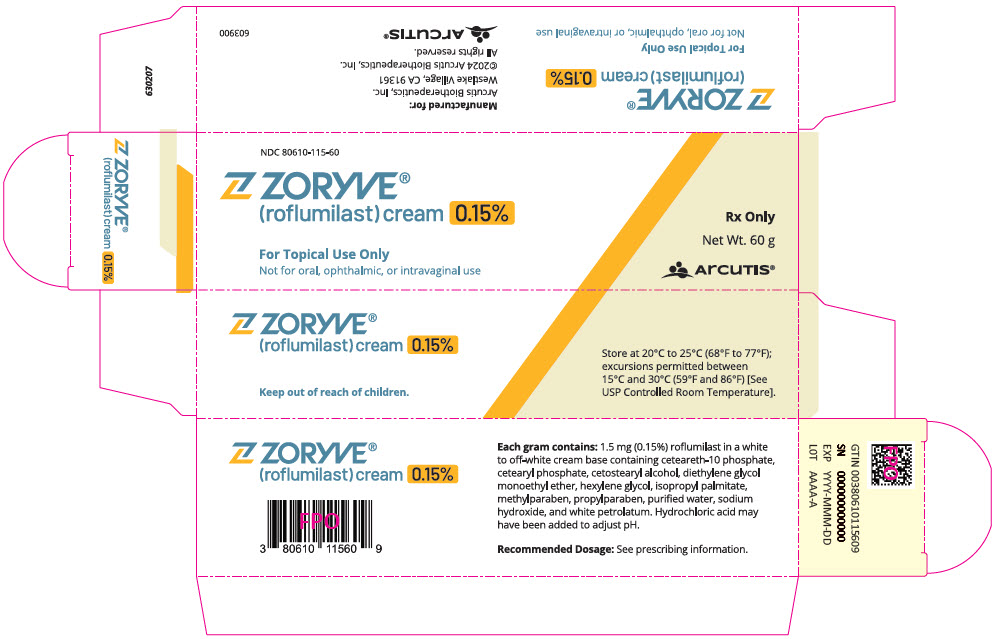
PRINCIPAL DISPLAY PANEL - 60 g Tube Carton - NDC 80610-115-60 NDC 80610-115-60 ZORYVE ® (roflumilast) cream 0.15% For Topical Use Only Not for oral, ophthalmic, or intravaginal use Rx Only Net Wt. 60 g ARCUTIS ® PRINCIPAL DISPLAY PANEL - 60 g Tube Carton - NDC 80610-115-60
PRINCIPAL DISPLAY PANEL - 60 g Tube Carton - NDC 80610-105-60 NDC 80610-105-60 ZORYVE ® (roflumilast) cream 0.05% For Topical Use Only Not for oral, ophthalmic, or intravaginal use Rx Only Net Wt. 60 g ARCUTIS ® PRINCIPAL DISPLAY PANEL - 60 g Tube Carton - NDC 80610-105-60