
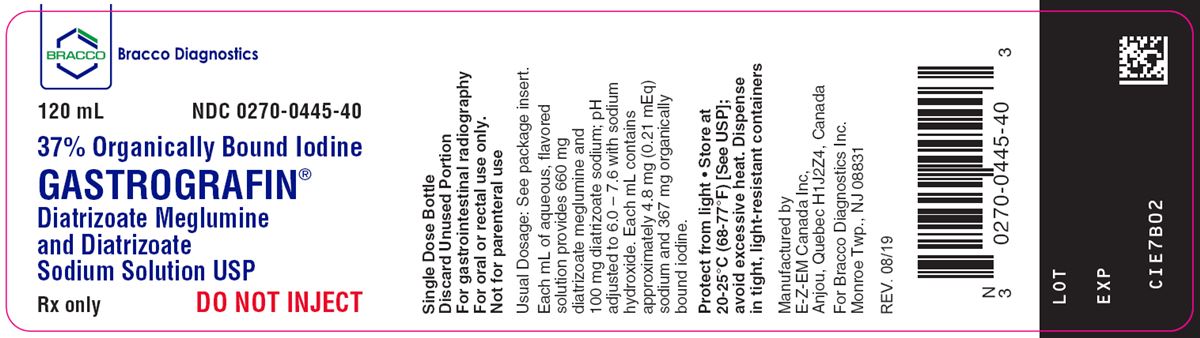
Gastrografin diatrizoate meglumine and diatrizoate sodium 660 mg/mL; 100 mg/mL Liquid — NDC 0270-0445-35 (Billing 00270-0445-35)
This is a package of Gastrografin diatrizoate meglumine and diatrizoate sodium 660 mg/mL; 100 mg/mL Liquid from Bracco Diagnostics Inc, marketed since Feb 1958 and currently FDA-listed. It is the main listing for this product, which comes in 2 package sizes.
NDC database record
One package, one record: these facts belong to NDC 0270-0445-35 alone.
- Record
- FDA NDC Directory package listing · Human prescription drug
- Code segments
- 0270 labeler · 0445 product · 35 package
- Package marketed since
- Apr 1, 2005
- Sample package
- No — commercial package
- Listing certified through
- Dec 31, 2026
- Barcode (UPC)
- 0302700445403
- FDA record last changed
- Jul 24, 2026
Past resolved recalls for this product (1)
Identity & classification
Regulatory identifiers FDA, NLM and CMS codes for this package
Drug-database identifiers Medi-Span GPI and First Databank GCN / HICL / AHFS classification
- GSN (GCN sequence number): 008270
- GCN: 89190
- GPI-14 (Medi-Span): 94402015302050
- HICL (First Databank): 003693
- AHFS class code: 36:68.00.00
Where does this data come from?
- FDA openFDA NDC Directory · synced Oct 1, 2026
- FDA label on DailyMed · label index refreshed Oct 5, 2026
- RxNorm (NLM RxNav) · catalog refreshed Oct 1, 2026
- Medi-Span GPI (licensed)
- First Databank (licensed) · refreshed Oct 1, 2026
Clinical
Patient education
Supplement & herbal interactions
Where does this data come from?
- MedlinePlus (NLM) · refreshed Oct 1, 2026
- FDA label on DailyMed · label index refreshed Oct 5, 2026
Ask a licensed pharmacist directly — free, answered by our team.
Pricing
A drug doesn't have one price. Each row is a different public payment system, and none is what you'd pay at the counter — that depends on your insurance. The ⓘ on each row explains what it measures.
| Price system | Per mL | Per package |
|---|---|---|
| Retail pharmacies payNADAC · weekly | Not in the retail survey — common for institutional, discontinued, or low-volume packs. | |
| Medicaid paysCMS SDUD · 12 mo | No recent Medicaid claims on file for this NDC — rare and low-volume NDCs are suppressed in the public data. | |
| Medicare drug plans payPart D · quarterly | No Part D plan price is available for this NDC in our data. | |
| Medicare Part B allowsASP · Q9963 | $0.214 / Q9963 unit | — |
Where does this data come from?
- CMS NADAC weekly file
- CMS ASP pricing files · refreshed Sep 20, 2026
- CMS Medicaid State Drug Utilization Data · refreshed Oct 5, 2026
- CMS Part D plan pricing files · refreshed Sep 24, 2026
- VA National Acquisition Center price file
Billing & reimbursement
Where does this data come from?
- CMS ASP NDC-HCPCS crosswalk · refreshed Sep 22, 2026
- DMEPDAC NDC-HCPCS crosswalk
- openFDA NSDE billing units · refreshed Sep 7, 2026
Packaging — all sizes for this product
| Package NDC | Description | Marketing start | Marketing end | Status |
|---|---|---|---|---|
| 00270-0445-35 You're viewing this Main listing | 24 BOTTLE in 1 BOX / 30 mL in 1 BOTTLE | 2005-04-01 | — | Active |
| 00270-0445-40 0270-0445-40 | 12 BOTTLE in 1 BOX / 120 mL in 1 BOTTLE | 1958-02-26 | — | Active |
Pack size FAQ
What quantity is in this package?
What NDC number is used to bill for this package of Gastrografin diatrizoate meglumine and diatrizoate sodium 660 mg/mL; 100 mg/mL Liquid?
Therapeutic equivalents
| Product | Labeler | Pack | NADAC/unit | TE | Status | Price vs. this |
|---|---|---|---|---|---|---|
| Gastrografin 660 mg/mL; 100 mg/mLthis 00270-0445-35 | Bracco | 24 bottles | — | AA | FDA listed | — |
| Diatrizoate Meglumine and Diatrizoate Sodium 660 mg/mL; 100 mg/mL 53041-0688-03 | Guardian | 120 ml | — | AA | FDA listed | — |
| Diatrizoate Meglumine and Diatrizoate Sodium 660 mg/mL; 100 mg/mL 53041-0690-03 | Guardian | 120 ml | — | AA | FDA listed | — |
| Diatrizoate Meglumine and Diatrizoate Sodium 660 mg/mL; 100 mg/mL 31722-0019-12 | Camber | 12 bottles | — | AA | FDA listed | — |
Where does this data come from?
- FDA openFDA NDC Directory · synced Oct 1, 2026
- FDA Orange Book · refreshed Oct 3, 2026
- CMS NADAC weekly file
Availability & generic status
The FDA lists approved generic versions of this medicine, but that does not always mean a pharmacy can get one today. Patent rules, launch agreements, supply and pricing can affect when generics actually arrive.
Where does this data come from?
- FDA Orange Book · refreshed Oct 3, 2026
What it looks like
Where does this data come from?
- FDA label on DailyMed · label index refreshed Oct 5, 2026
Inactive Ingredients / Excipients
Inactive ingredients, also called excipients, are components of the drug product other than the active ingredient. They may include fillers, dyes, coatings, preservatives, flavors, or other formulation ingredients.
💡 Tap an ingredient (hover on desktop) to see what it is and why it’s used.
-
0.403 mg / 1 mL
UNII 7FLD91C86K
Edetate disodium is a chemical compound that binds and removes certain metal ions. In medicines, it acts as a preservative and stabilizer by preventing metals like calcium from interfering with the product's shelf life and consistency.
-
2.77 mg / 1 mL
UNII SB8ZUX40TY
Saccharin sodium is an artificial sweetener made from saccharin salt. It's added to medicines to improve taste, especially in liquid formulations for children or bitter drugs.
-
3.22 mg / 1 mL
UNII 1Q73Q2JULR
Sodium citrate is a salt derived from citric acid. It works as a buffer to maintain the medicine's pH level and may also help improve taste or act as a preservative in the formulation.
3 inactive ingredients listed in the exact product block matched to this NDC.
Where does this data come from?
ingredient classCode="IACT" elements from the exact product block matched by this NDC. Label-section narrative from DailyMed / the openFDA label index is shown separately when available.- FDA label on DailyMed · label index refreshed Oct 5, 2026
- FDA openFDA NDC Directory · synced Oct 1, 2026
Inactive ingredient FAQ
Are inactive ingredients the same for every manufacturer?
Why might an inactive ingredient be missing?
Can inactive ingredients matter?
Manufacturer & labeler
More NDCs from Bracco Diagnostics Inc labeler code 00270
- Choletec Mebrofenin 45 mg Injection, Powder, Lyophilized, For Solution NDC 0270-0083-20
- CardioGen-82 Rubidium Chloride RB-82 150 mCi Injection, Solution NDC 0270-0091-01
- Cystografin diatrizoate meglumine 300 mg/mL Injection, Solution NDC 0270-0149-57
- KINEVAC sincalide 5 ug/5mL Injection, Powder, Lyophilized, For Solution NDC 0270-0556-15
- ProHance gadoteridol 279.3 mg/mL Injection, Solution NDC 0270-1111-01
- ISOVUE 200 IOPAMIDOL 408 mg/mL Injection, Solution NDC 0270-1314-15
- ISOVUE 300 IOPAMIDOL 612 mg/mL Injection, Solution NDC 0270-1315-25
- ISOVUE 370 IOPAMIDOL 755 mg/mL Injection, Solution NDC 0270-1316-04
- ISOVUE 250 IOPAMIDOL 510 mg/mL Injection, Solution NDC 0270-1317-02
Where does this data come from?
- FDA openFDA NDC Directory · synced Oct 1, 2026
- Drugs@FDA
Full prescribing information FDA SPL
🎯 Indications and Usage ▾
INDICATIONS AND USAGE Gastrografin (Diatrizoate Meglumine and Diatrizoate Sodium Solution) is indicated for radiographic examination of segments of the gastrointestinal tract (esophagus, stomach, proximal small intestine, and colon). The preparation is particularly indicated when a more viscous agent such as barium sulfate, which is not water-soluble, is not feasible or is potentially dangerous. Gastrografin may also be used as an adjunct to contrast enhancement in computed tomography of the torso (body imaging); the preparation is indicated, in conjunction with intravenous administration of a radiopaque contrast agent, when unenhanced imaging may not provide sufficient definition in distinguishing normal loops of bowel from adjacent organs or areas of suspected pathology.
⏱️ Dosage and Administration ▾
DOSAGE AND ADMINISTRATION General This medium is not to be used for the preparation of solutions for parenteral administration. Oral or rectal administration only. Discard any unused portion after procedure.
The routine preparatory measures employed for barium studies are also appropriate for this agent. For pediatric and severely cachectic patients the maintenance of an intravenous fluid line may be advisable. Radiographic Examination of Segments of the Gastrointestinal Tract Oral Administration: Adult oral dosage may range from 30 to 90 mL (11 to 33 g iodine), depending on the nature of the examination and the size of the patient.
For infants and children less than 5 years of age, 30 mL (11 g iodine) are usually adequate; for children 5 to 10 years of age, the suggested dose is 60 mL (22 g iodine). These pediatric doses may be diluted 1:1, if desired, with water, carbonated beverage, milk, or mineral oil. When used in infants, the solution may be given in a nursing bottle.
Pediatric doses may also be used in dehydrated and/or debilitated adult patients. A 1:1 dilution is also recommended when the contrast medium is used in elderly cachectic individuals. For very young (under 10 kg) and debilitated children the dose should be diluted: 1 part Gastrografin (Diatrizoate Meglumine and Diatrizoate Sodium Solution) in 3 parts water is recommended.
For Enemas or Enterostomy Instillations: Gastrografin should be diluted when it is used for enemas and enterostomy instillations. When used as an enema, the suggested dilution for adults is 240 mL (88 g iodine) in 1,000 mL of tap water. For children under 5 years of age, a 1:5 dilution in tap water is suggested; for children over 5 years of age, 90 mL (33 g iodine) in 500 mL of tap water is a suitable dilution.
Tomography (Body Imaging) A usual adult dose is 240 mL of a dilute Gastrografin solution prepared by diluting 25 mL (9.17 g iodine) to one liter with tap water. Less dilute solutions [up to 77 mL (28.26 g iodine) diluted to one liter with tap water] may be used when indicated. The dose is administered orally about 15 to 30 minutes prior to imaging in order to permit the contrast medium to reach the pelvic loops.
⛔ Contraindications ▾
CONTRAINDICATIONS Do not administer to patients with a known hypersensitivity to Gastrografin or any of its components.
⚠️ Warnings ▾
WARNINGS Dehydration: Administration of hypertonic Gastrografin solutions may lead to hypovolemia and hypotension due to fluid loss from the intestine. A 1 in 4.6 (1:4.6) dilution of Gastrografin yields an approximately isotonic 16.5 percent diatrizoate salts solution; less dilute solutions are hypertonic and may lead to intraluminal movement of fluid with resulting hypovolemia. In young or debilitated children and in elderly cachectic persons, the loss of plasma fluid may be sufficient to cause a shock-like state.
If Gastrografin is used in infants and children (under 10 kg) or in dehydrated or debilitated patients, the solution must be prepared using the specific dilutions described in DOSAGE AND ADMINISTRATION . In debilitated patients and in patients with electrolyte imbalances, postprocedural monitoring of hydration, serum osmolarity, electrolytes and clinical status is essential. In pediatric or severely debilitated patients, the maintenance of an open intravenous fluid line for rehydration may be advisable should hypotension or shock supervene.
Electrolyte disturbances must be corrected prior to the administration of any hypertonic Gastrografin solutions. Aspiration: Aspiration of Gastrografin into the trachea and airways may result in serious pulmonary complications including, pulmonary edema, pneumonitis or death Bronchial entry of any orally administered contrast medium causes a copious osmotic effusion. Therefore, avoid use of Gastrografin in patients with esophagotracheal fistula and minimize risks for pulmonary aspiration in all patients.
If Gastrografin is given by nasogastric tube, the position of the tube in the stomach must be verified before administration. Anaphylactic reactions: Anaphylactic reactions, including fatalities, have been reported with the use of Gastrografin. Patients at increased risk include those with a history of a previous reaction to a contrast medium, patients with a known sensitivity to iodine, and patients with a known clinical hypersensitivity (bronchial asthma, hay fever, and food allergies).
Medical personnel trained in the treatment of anaphylactic reactions and the necessary drugs and medical equipment should always be readily available when Gastrografin is used.
🤒 Adverse Reactions ▾
ADVERSE REACTIONS Most adverse reactions to enteral diagnostic radiopaque agents are mild and transitory. Nausea, vomiting and/or diarrhea, urticaria with erythema, hypoxia, acute dyspnea, tachyarrhythmia, and anaphylaxis have occurred following ingestion of the contrast medium, particularly when high concentrations of large volumes of solution are administered. Severe changes in serum osmolarity and electrolyte concentrations may produce shock-like states (see WARNINGS ).
It should be kept in mind that serious or anaphylactoid reactions that may occur with intravascular administration of radiopaque contrast agents are theoretically possible following administration by other routes.
🔄 Drug / Laboratory Test Interactions ▾
Drug/Laboratory Test Interactions Thyroid Function Tests The results of protein bound iodine (PBI) and radioactive iodine uptake studies, which depend on iodine estimations, will not accurately reflect thyroid function for six months, and possibly as long as one year, following the administration of diagnostic enteral radiopaque media. Thyroid function tests, if indicated, generally should be performed prior to the administration of any iodinated agent. However, thyroid function can be evaluated after use of these agents by using T 3 resin uptake and total or free thyroxine (T 4 ) assays which are not dependent on iodine estimations.
Pancreatic Tests Small quantities of contrast medium in the intestinal tract may cause false low trypsin values when determined spectrophotometrically. Therefore, duodenal instillation should not precede pancreatic function tests involving spectrophotometric trypsin assays. Any test which might be affected by contrast media should be performed prior to administration of the contrast medium.
🤰 Pregnancy ▾
Pregnancy When administered intravenously, diatrizoate salts cross the placenta and are evenly distributed in fetal tissues. No teratogenic effects attributable to diatrizoate meglumine or diatrizoate sodium have been observed in teratology studies performed in animals. There are, however, no adequate and well-controlled studies in pregnant women.
Because small amounts of these agents may be absorbed, and animal teratology studies are not always predictive of human response, these agents should be used during pregnancy only when clearly needed. Procedures including radiation involve a certain risk related to the exposure of the fetus.
🧒 Pediatric Use ▾
Pediatric Use See WARNINGS , and PRECAUTIONS, General . Local injury to the colonic mucosa, particularly in the presence of underlying disease which interferes with intestinal viability, has been reported in cases where recommended doses and dilutions (see DOSAGE AND ADMINISTRATION ) were not used; when extemporaneous dosage is elected, the polysorbate 80 level in the dose may be a contributing factor to injury.
🆘 Overdosage ▾
OVERDOSAGE See WARNINGS regarding potential hypovolemia, hypotension, or shock. The maintenance of an open intravenous fluid line for rehydration may be advisable. See DOSAGE AND ADMINISTRATION for appropriate doses and dilutions. Treatment of an overdose should be directed toward the support of all vital functions, and prompt institution of symptomatic therapy.
🧬 Clinical Pharmacology ▾
CLINICAL PHARMACOLOGY The most important characteristic of contrast media is the iodine content. The relatively high atomic weight of iodine contributes sufficient radiodensity for radiographic contrast with surrounding tissues. Diagnostic enteral radiopaque agents have few known pharmacological effects.
Diatrizoate meglumine and diatrizoate sodium exert a mild laxative effect attributable to their high osmolarity. Diatrizoate meglumine and diatrizoate sodium are sparingly absorbed from the intact gastrointestinal tract, and therefore permit gastrointestinal opacification and delineation after oral or rectal administration. Oral administration is used for radiographic evaluation of the esophagus, stomach and proximal small intestine.
Rectal administration is used for examination of the colon; however, visualization of the distal small bowel is generally unsatisfactory, since the hypertonicity of the medium causes intraluminal diffusion of water with subsequent dilution of the medium. Enough absorption from the gastrointestinal tract to permit incidental visualization of the urinary tract has been reported; this should also be considered when thyroid testing is being contemplated, since iodine-mediated thyrotropic effects may occur (see PRECAUTIONS ).
📦 How Supplied / Storage and Handling ▾
HOW SUPPLIED Gastrografin (Diatrizoate Meglumine and Diatrizoate Sodium Solution USP) is available in packages of: Twenty-four 30 mL single dose bottles (NDC 0270-0445-35). Twelve 120 mL single dose bottles (NDC 0270-0445-40). Storage Protect from light. Store at 20-25°C (68-77°F) [See USP]; avoid excessive heat.
📦 Storage and Handling ▾
Storage Protect from light. Store at 20-25°C (68-77°F) [See USP]; avoid excessive heat.
📋 Description ▾
DESCRIPTION Gastrografin (Diatrizoate Meglumine and Diatrizoate Sodium Solution) is a palatable lemon-flavored water-soluble iodinated radiopaque contrast medium for oral or rectal administration only. Each mL contains 660 mg diatrizoate meglumine and 100 mg diatrizoate sodium; pH has been adjusted to 6.0 to 7.6 with sodium hydroxide. Each mL contains approximately 4.8 mg (0.21 mEq) sodium and 367 mg organically bound iodine.
Inactive ingredients: edetate disodium, flavor, polysorbate 80, purified water, saccharin sodium, simethicone, and sodium citrate. Diatrizoate meglumine is designated chemically as 1-deoxy-1-(methylamino)-D-glucitol 3,5-diacetamido-2,4,6-triiodo-benzoate (salt); diatrizoate sodium is monosodium 3, 5-diacetamido-2,4,6-triiodobenzoate. Structural formulas: Gastrografin Structure
💬 Information for Patients ▾
Information for the Patient Patients should receive the following information and instructions: This drug has been prescribed to perform an x-ray of the gastrointestinal tract. Inform the physician if pregnant or if allergic to iodine, any foods, or x-ray materials. The iodine in diatrizoate salts may interfere with some thyroid tests if these are needed in the future.
Inform the attending physician at that time about this gastrointestinal study. This drug may cause abdominal cramping, nausea, vomiting, diarrhea, skin rashes, itching, heartburn, dizziness, or headache in some patients, but most reactions are mild and pass quickly.
⚠️ Precautions ▾
PRECAUTIONS General Diagnostic procedures which involve the use of radiopaque contrast agents should be carried out under the direction of personnel with the prerequisite training and with a thorough knowledge of the particular procedure to be performed. Appropriate facilities should be available for coping with any complication of administration, as well as for treatment of reaction to the contrast medium (see ADVERSE REACTIONS , and PRECAUTIONS, Information for the Patient ). Rectal administration of undiluted Gastrografin (Diatrizoate Meglumine and Diatrizoate Sodium Solution) in any patient, particularly with large doses and/or in those with overdistention, has been reported to be associated with mucosal irritation.
Cases of hyperthyroidism have been reported with the use of oral contrast media. Some of these patients reportedly had multinodular goiters which may have been responsible for the increased hormone synthesis in response to excess iodine. Administration of an intravascular iodinated radiopaque diagnostic agent to a hyperthyroid patient precipitated thyroid storm; a similar situation could follow administration of oral preparations of iodides.
Therefore, caution should be exercised when administering enteral gastrointestinal radiopaque agents to hyperthyroid and euthyroid goiterous patients. Consideration should be given to the potential for precipitation of water-soluble contrast agents under conditions that may promote hyperacidity (i.e., fasting, emotional upset, or stress). Harmful effects directly attributable to precipitate formation have not been reported.
However, the possibility of interpreting the precipitate radiologically as an anatomical abnormality (i.e., ulceration of the stomach or small intestine) or injury, should be kept in mind. Information for the Patient Patients should receive the following information and instructions: This drug has been prescribed to perform an x-ray of the gastrointestinal tract. Inform the physician if pregnant or if allergic to iodine, any foods, or x-ray materials.
The iodine in diatrizoate salts may interfere with some thyroid tests if these are needed in the future. Inform the attending physician at that time about this gastrointestinal study. This drug may cause abdominal cramping, nausea, vomiting, diarrhea, skin rashes, itching, heartburn, dizziness, or headache in some patients, but most reactions are mild and pass quickly.
Drug/Laboratory Test Interactions Thyroid Function Tests The results of protein bound iodine (PBI) and radioactive iodine uptake studies, which depend on iodine estimations, will not accurately reflect thyroid function for six months, and possibly as long as one year, following the administration of diagnostic enteral radiopaque media. Thyroid function tests, if indicated, generally should be performed prior to the administration of any iodinated agent. However, thyroid function can be evaluated after use of these agents by using T 3 resin uptake and total or free thyroxine (T 4 ) assays which are not dependent on iodine estimations.
Pancreatic Tests Small quantities of contrast medium in the intestinal tract may cause false low trypsin values when determined spectrophotometrically. Therefore, duodenal instillation should not precede pancreatic function tests involving spectrophotometric trypsin assays. Any test which might be affected by contrast media should be performed prior to administration of the contrast medium.
Carcinogenesis, Mutagenesis, Impairment of Fertility Long-term studies in animals have not been performed to evaluate carcinogenic or mutagenic potential, or possible impairment of fertility in males or females. Pregnancy When administered intravenously, diatrizoate salts cross the placenta and are evenly distributed in fetal tissues. No teratogenic effects attributable to diatrizoate meglumine or diatrizoate sodium have been observed in teratology studies performed in animals.
There are, however, no adequate and well-controll… [Excerpted — this section continues on DailyMed.]
🍼 Nursing Mothers ▾
Nursing Mothers Diatrizoate meglumine is excreted in breast milk following intravascular administration. Because small amounts of enteral gastrointestinal radiopaque agents may be absorbed following oral or rectal administration, caution should be exercised when they are administered to a nursing woman.
📄 Carcinogenesis, Mutagenesis, Impairment of Fertility ▾
Carcinogenesis, Mutagenesis, Impairment of Fertility Long-term studies in animals have not been performed to evaluate carcinogenic or mutagenic potential, or possible impairment of fertility in males or females.
📄 Package Label / Principal Display Panel ▾
Gastrografin ® 120 mL Label NDC 0270-0445-40 Gastrografin label 120ml
Gastrografin ® 12 x 120 mL Bottles Label NDC 0270–0445–40 Gastrografin label 12x120
About this NDC listing & data coverage
What data is (and isn’t) available for this NDC — tap to expand
| NDC identity (package / product / labeler codes) | ✓ Available |
| Labeler | ✓ Available |
| Product & package description | ✓ Available |
| Marketing category & status | ✓ Available |
| Active ingredient / dosage form / route | ✓ Available |
| FDA label (SPL via DailyMed) | ✓ Available |
| Package photos | ✓ Available |
| Inactive ingredients (structured) | ✓ Available |
| NADAC pharmacy acquisition price (CMS) | — Not published for this NDC CMS publishes NADAC only for NDCs reported in its retail-pharmacy survey. |
| Orange Book / therapeutic-equivalence data | ✓ Available |
| HCPCS J-code billing crosswalk | ✓ Available |
| Medicaid utilization (CMS SDUD) | — Not published for this NDC CMS reports utilization only for NDCs with Medicaid claims above its privacy threshold. |