
HomeNDC LookupIngredientsAzelastine Hcl › 00280-0065-02
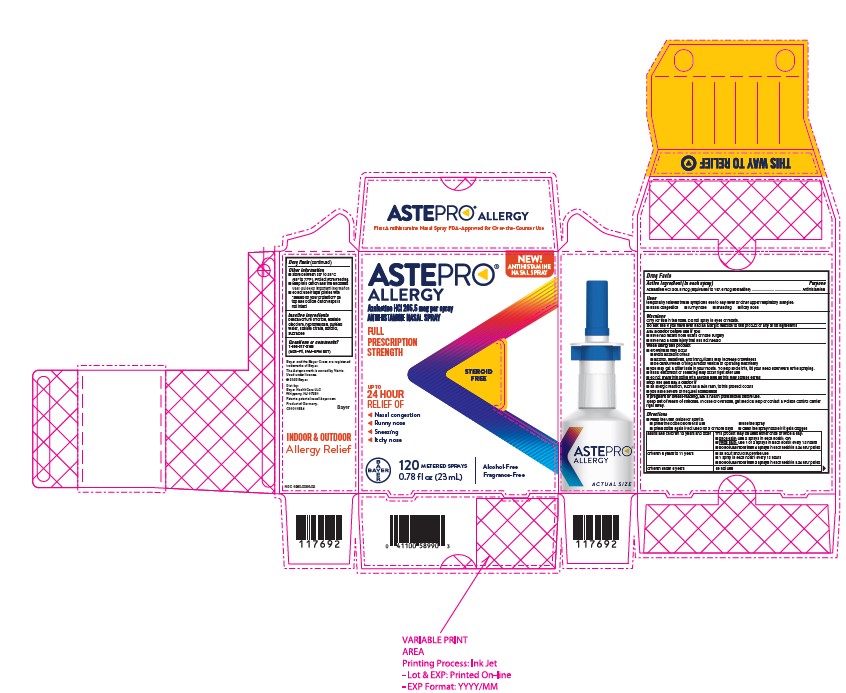
Astepro Allergy Azelastine HCl 205.5 ug Spray, Metered — NDC 00280-0065-02 package photo

Astepro Allergy Azelastine HCl 205.5 ug Spray, Metered

by Bayer HealthCare LLC. · 120 CARTON in 1 BOTTLE (0280-0065-02) / 1 SPRAY, METERED in 1 CARTON
NDC 00280-0065-02
🏷️ FDA NDC (as labeled) 0280-0065-02 billing pads the labeler segment with a zero
This package
Contains1 spray, metered in 1 carton Pack sizes7 compare ↓
OTC Brand On market Non-controlled
🗂️ Data synced Jul 24, 2026 · sources: openFDA · FDA label (DailyMed) · FDA Orange & Purple Book · First Databank · CMS NADAC, ASP, Medicare & Medicaid · RxNorm
📋 All sources & update times →

🆔 Identity & classification

FDA NDC (as labeled) 0280-0065-02
Product NDC 0280-0065
11-digit billing NDC 00280006502
NCPDP billing unit ML — per mL (volume)
RxCUI 1797883, 1797884
UNII 0L591QR10I
Application # NDA213872
SPL Set ID e0640846-19a6-7f79-e053-2995a90a8176
Established class (EPC) Histamine-1 Receptor Antagonist
Mechanism of action Histamine H1 Receptor Antagonists
DEA schedule Non-controlled
Marketing category NDA
Marketing status On market
FDA listing status Listed (active directory)
Marketing start 2022-06-27
Route NASAL
Dosage form SPRAY, METERED
Substance AZELASTINE HYDROCHLORIDE
GCN Seq No 065577
GCN 27584
HICL code 007607
Ingredient (HICL) Azelastine Hcl
HIC1 code Q
Therapeutic class — broad (HIC1) Ear/Eye/Nose/Rectum/Topical/Vagina/Other
HIC2 code Q7
Therapeutic class — intermediate (HIC2) Nasal Preparations
HIC3 code Q7E
Therapeutic class — specific (HIC3) Nasal Antihistamine
AHFS code 04:08.00.00
AHFS class Second Generation Antihistamines
FDB label name ASTEPRO ALLERGY 205.5MCG SPRAY
FDB brand name Astepro Allergy
Legend status O — Over-the-counter (OTC) drug or device
Why two NDCs? The FDA registers this code as 0280-0065-02 — a 4-4-2 layout, and that's what's printed on the package and shown on DailyMed. For insurance claims, every NDC is standardized to a uniform 11-digit 5-4-2 format by adding a zero to the labeler segment → 00280-0065-02. Same drug, same package — only the format differs.
Where does this data come from?
Identifiers from the FDA openFDA NDC Directory and Structured Product Labeling; RxCUI from RxNorm (NLM); GPI from Medi-Span; GCN / HIC / AHFS / legend from First Databank.

🏷️ RxNorm drug class

This medicine belongs to the Histamine-1 Receptor Antagonist class.

Pharmacologic class Histamine-1 Receptor Antagonist
Drug family (ATC) Antiallergic agents, excl. corticosteroids, Other antihistamines for systemic use, Other antiallergics
How it works Histamine H1 Receptor Antagonists
Where does this data come from?
Therapeutic classes from RxNorm RxClass (U.S. National Library of Medicine) — Established Pharmacologic Class (FDA), ATC drug family (WHO) and mechanism of action, matched by this product’s RxCUI.

🏭 Manufacturer & labeler

LabelerBayer HealthCare LLC.
Application holderBAYER HEALTHCARE CONSUMER CARE
FDA applicationNDA213872 (NDA)
Labeler code00280
First marketedJun 2022
Product typeHuman Otc Drug
Portfolio240 products on file
The labeler markets the product; the application holder owns the FDA approval. They’re often the same company but can differ (e.g. a repackager or an authorized generic). A mailing address / phone appears here when the manufacturer includes it in the product’s FDA label (not all do).
Where does this data come from?
Labeler, application holder and registered establishment from the FDA openFDA NDC Directory and Drugs@FDA; address/contact from the product’s FDA label.

🩺 Clinical

Label name ASTEPRO ALLERGY 205.5MCG SPRAY Ingredient Azelastine Hcl
📗 Our plain-language guide HelloPharmacist
  • It treats two types of nasal conditions. The first is seasonal allergic rhinitis — that's hay fever, where your nose runs, you sneeze, and you feel congested because of allergens l...
  • What exactly does azelastine nasal spray treat?
  • It can, yes — drowsiness is one of the more common side effects. This is especially important to know before you drive or operate any machinery. Alcohol, sedatives, and tranquilize...
  • That bitter taste is very common with azelastine — it's just how the medication tastes, and it's not a sign anything's wrong. A simple trick: tilt your head slightly downward while...
📖 Read our full Azelastine Nasal Spray guide →
Where does this data come from?
Plain-language summary from MedlinePlus (U.S. National Library of Medicine); supplement & herbal interactions and nutrient depletion data from the Natural Medicines database; our full guide is HelloPharmacist editorial content.

🧪 Inactive Ingredients / Excipients

Inactive ingredients, also called excipients, are components of the drug product other than the active ingredient. They may include fillers, dyes, coatings, preservatives, flavors, or other formulation ingredients.

💡 Tap an ingredient (hover on desktop) to see what it is and why it’s used.

  • UNII F5UM2KM3W7
    Benzalkonium chloride is a chemical compound that works as a preservative and antimicrobial agent in medications. It prevents bacterial and fungal growth in liquid formulations to keep the product safe during storage and use.
  • UNII 7FLD91C86K
    Edetate disodium is a chemical compound that binds and removes certain metal ions. In medicines, it acts as a preservative and stabilizer by preventing metals like calcium from interfering with the product's shelf life and consistency.
  • UNII 3NXW29V3WO
    Hypromellose is a plant-based thickener made from cellulose. It's used in medicines as a binder to hold ingredients together, a coating for tablets, and a thickener for liquids.
  • UNII 1Q73Q2JULR
    Sodium citrate is a salt derived from citric acid. It works as a buffer to maintain the medicine's pH level and may also help improve taste or act as a preservative in the formulation.
  • UNII 506T60A25R
    Sorbitol is a natural sugar alcohol derived from glucose. It serves as a sweetener, humectant, and bulking agent in medications to improve taste and help maintain moisture in the product.
  • UNII 96K6UQ3ZD4
    Sucralose is a synthetic sweetener made from sugar. It's added to medicines to improve taste without adding calories, helping make bitter or unpleasant-tasting drugs easier to take.
  • UNII 059QF0KO0R
    Water is a liquid solvent that dissolves and mixes ingredients together in liquid medicines, syrups, and injections. It helps distribute the active drug evenly throughout the product.

7 inactive ingredients listed in the exact product block matched to this NDC.

The official label also statesInactive ingredients benzalkonium chloride, edetate disodium, hypromellose, purified water, sodium citrate, sorbitol, sucralose

Label-section wording can be broader than the structured product block and may mention additional formulation ingredients.

Where does this data come from?
Data sourced from official FDA Structured Product Labeling (SPL) via DailyMedingredient classCode="IACT" elements from the exact product block matched by this NDC. Label-section narrative from DailyMed / the openFDA label index is shown separately when available.

Inactive ingredient FAQ

Are inactive ingredients the same for every manufacturer?
No. Inactive ingredients can differ by manufacturer, dosage form, strength, and package / product version.
Why might an inactive ingredient be missing?
Some SPLs do not provide a complete structured inactive-ingredient list, and older or unusual labels may only include the information in narrative text.
Can inactive ingredients matter?
Yes. They can matter for allergies, intolerances, dyes, gluten / lactose concerns, preservatives, and formulation differences — but confirm with a pharmacist or the manufacturer when it’s clinically important.

💲 Pricing

A drug doesn't have one price. Each row is a different public payment system, and none is what you'd pay at the counter — that depends on your insurance. The ⓘ on each row explains what it measures.

Price systemPer mLPer package
Retail pharmacies payNADAC · weekly Not in the retail survey — common for institutional, discontinued, or low-volume packs.
Medicaid paysCMS SDUD · 12 mo No recent Medicaid claims on file for this NDC — rare and low-volume NDCs are suppressed in the public data.
Medicare drug plans payPart D · quarterly No Part D plan price is available for this NDC in our data.
ℹ️
No price is published for this exact package yet. CMS surveys NADAC per package size, so a different pack of the same drug often has one.
Where does this data come from?
NADAC (National Average Drug Acquisition Cost) is the CMS weekly pharmacy-acquisition-cost survey — what pharmacies pay. ASP (Average Sales Price) is the CMS Medicare Part B drug-payment file, published quarterly. Medicaid pays is computed by us from CMS State Drug Utilization Data (total reimbursed ÷ units, trailing 12 months) — gross of rebates and inclusive of dispensing fees, so it reflects what Medicaid paid, not an acquisition cost. Medicare drug plans pay is the median negotiated point-of-sale unit cost across plans listing this NDC in the CMS quarterly Prescription Drug Plan pricing files, before rebates. The VA pays is the federal contract price (FSS, and the statutory Big 4 ceiling where listed) from the VA National Acquisition Center pharmaceutical price file. All are free public government data; each measures a different payer, so the figures are not directly comparable.

🔁 Therapeutic equivalents

ProductLabelerPackNADAC/unitTEStatusPrice vs. this
Astepro Allergy 205.5 ugthis 00280-0065-02 Bayer 1 bottle FDA listed
Children Astepro Allergy 205.5 ug 00280-0066-01 Bayer 1 bottle FDA listed
Azelastine Hydrochloride 205.5 ug 00363-0653-02 Walgreens 120 sprays FDA listed
Azelastine Hydrochloride 205.5 ug 51316-0840-01 CVS 1 bottle FDA listed
Azelastine Hydrochloride 205.5 ug 58602-0020-07 Aurohealth 1 bottle FDA listed
Azelastine Hydrochloride 205.5 ug 69168-0478-02 Allegiant 2 bottles FDA listed
Azelastine Hydrochloride 205.5 ug 69168-0479-64 Allegiant 1 bottle FDA listed
Azelastine HCl 205.5 ug 69238-2147-03 Amneal 1 bottle FDA listed
About this product: this is the brand-name version. Some generic versions are approved by the FDA, but we could not confirm current pharmacy availability from our pricing/market data.
Where does this data come from?
Equivalents are other NDCs of the same ingredient, form and route from the openFDA NDC Directory, ranked least-expensive-first by NADAC. Therapeutic-equivalence (AB) ratings come from the FDA Orange Book; biologics use the FDA Purple Book for biosimilar & interchangeable status.

Availability & generic status

🏛️
2021
First FDA approval
Jun 2021
📍
2026
Currently FDA-listed
5 years listed
🛡️
2028
Latest patent/protection listed
not a guaranteed launch date
🔒Generic approved by FDA, but pharmacy availability is not confirmed

The FDA lists approved generic versions of this medicine, but that does not always mean a pharmacy can get one today. Patent rules, launch agreements, supply and pricing can affect when generics actually arrive.

🛡️ Latest patent/protection date listed: FDA patent/protection data lists protections through Jun 2028. This may affect when a full generic version becomes widely available, but it is not a guaranteed launch date.
📅 FDA approved Jun 17, 2021 RLD RS ⏳ ~1.7 yr to latest listed protection

Why the date isn’t exact: Generic timing can change because patents may be challenged, settled, licensed, added, removed, or worked around with a narrower label — and FDA approval does not always mean a pharmacy can get the generic today.

Patents & exclusivity — FDA Orange Book
US 8071073 — drug product
2021 2023 2025 2027
Today
LOE
Substance patent Formulation patent Method-of-use patent Exclusivity Pediatric +6mo
🏛️FDA exclusivity
FDA-granted marketing protection. It’s separate from patents and may be shorter than patent protection.
🧪Product / substance patents
Patents covering the active ingredient, product, formulation, or related drug features.
🎯Method-of-use patents
Patents covering specific approved uses. These can sometimes be carved out with a “skinny label,” but not always.
🛈 What do these terms mean?
Patent
Legal protection listed in the Orange Book that may delay generic approval or launch. Issued by the U.S. Patent & Trademark Office.
Substance patent
Covers the active drug molecule itself — the hardest to design around. A generic generally can’t launch until it expires.
Formulation (product) patent
Covers a specific formulation or dosage form. A generic can sometimes work around it with a different formulation.
Method-of-use patent
A patent covering one specific approved use of the drug — not necessarily the whole molecule. A generic can sometimes launch with a “skinny label” that carves out the protected use and keeps the others.
Skinny label
A generic label that omits a still-patented use when the FDA allows it — letting a generic reach the market for the unprotected uses.
Exclusivity
FDA-granted marketing protection, separate from patents — e.g. 5-yr new chemical entity, 7-yr orphan drug, or a +6-month pediatric extension.
Paragraph IV
A generic applicant’s formal challenge to a listed patent. It can potentially lead to earlier generic entry, but often involves litigation or a settlement.
RLD / RS
Reference Listed Drug — the brand product the FDA uses as the reference for generic applications. Reference Standard — the product the FDA expects generics to compare against in bioequivalence testing.
TE / AB rating
FDA therapeutic-equivalence rating. An AB rating generally means the FDA considers a generic therapeutically equivalent to — and substitutable for — the brand.
LOE (loss of exclusivity)
The latest patent or exclusivity currently listed — the loss-of-exclusivity / latest-listed-protection date shown on this page. Paragraph-IV challenges and settlements can move the real date earlier; FDA approval and a manufacturer’s decision to market can move it later.

Built from the FDA Orange Book. The bars above are scaled to each protection’s expiry; the red LOE marker is the last one to lapse.

Listed patents (2)
PatentTypeUse codeExpires
US 8071073 ↗ Drug product Jun 4, 2028
Common questions
Is there a generic version of ASTEPRO ALLERGY 205.5MCG SPRAY?
Yes — an FDA-approved generic equivalent is listed in the FDA Orange Book for ASTEPRO ALLERGY 205.5MCG SPRAY. See the alternatives section for substitutable, lower-cost products.
The FDA approved a generic — why can’t I get it at my pharmacy yet?
FDA approval and pharmacy availability are two different things. The FDA can approve a generic years before it actually reaches pharmacies, because the brand company may still hold patents or have a settlement that delays the launch. A manufacturer also has to choose to make and sell it, and have supply ready. So a drug can be “FDA-approved generic exists” and still be brand-only at the counter today.
Why do different websites show different generic release dates?
Generic availability is not based on one single date. Some sources use the first exclusivity expiration, some use the last product patent, and others use the latest method-of-use patent. Patent challenges, settlements, licenses, and label carve-outs can also change the real-world launch date. This page shows the underlying Orange Book dates so you can see why estimates may differ.
What does “FDA listed” mean?
It means the product appears in the FDA’s official NDC directory. That’s a good sign a product exists and is intended for the U.S. market, but on its own it does not confirm a pharmacy can fill it today. Where we have recent retail pricing data (NADAC) for a product, we label it “Availability likely” instead.
What does a patent or protection date mean here?
It’s the latest date currently listed in the FDA Orange Book for a patent or exclusivity on the brand product. It can affect when a full generic version becomes widely available — but it is not a guaranteed generic launch date. Generics sometimes arrive earlier (through a settlement or patent challenge) or later (a manufacturer still has to make and sell one).
What does “current Orange Book estimate” mean?
It means we are using the latest patent and exclusivity dates currently listed in the FDA Orange Book. It is not a guaranteed launch date.
Can a generic come out before the last patent expires?
Sometimes. A generic company may challenge a patent, settle with the brand manufacturer, receive a license, or obtain approval with a narrower label that avoids a patented use. In other cases, the last listed protection may delay full-label generic competition.
Can a generic come out after the listed dates?
Yes. Even after patents or exclusivity expire, a generic still needs FDA approval and a manufacturer must choose to market it. Supply, litigation, business decisions, or regulatory issues can delay actual availability.
What is the difference between patents and exclusivity?
Patents are legal protections usually issued by the U.S. Patent and Trademark Office. FDA exclusivity is marketing protection granted by the FDA. They are separate, and either one can affect generic timing.
Why are there multiple patent dates?
One drug can have several patents covering different things: the active ingredient, a formulation, a manufacturing process, or a specific approved use. That is why a page may show several expiration dates instead of one simple generic date.
Built from FDA Orange Book patent and exclusivity data. Dates are refreshed from public FDA data when available; the marker is max(latest patent expiry, latest exclusivity expiry). Paragraph-IV settlements and first-filer 180-day exclusivity can shift the real date; a method-of-use patent may allow an earlier skinny-label generic for non-protected indications. Generic launch timing is an estimate, not a guarantee.
Where does this data come from?
Patents and exclusivity from the FDA Orange Book (small-molecule drugs), refreshed from public FDA data. Generic launch timing is an estimate, not a guarantee.

📊 Medicare Part D spend CMS · PART D · 2026 (Q1)

Medicare Part D (outpatient prescription) spending for Azelastine HCl (matched by generic name) — the program that covers self-administered drugs. 11 manufacturers.
⚠️ Drug-level data: CMS publishes Part D spending by drug, not by NDC — these figures combine every manufacturer, strength and package size sold under the name Azelastine HCl. That’s a different level of aggregation than the Medicaid card above, which is specific to this exact 11-digit NDC (pack size included), so the two aren’t directly comparable.
Period
Total Part D spend
$21.79M
Claims incl. refills
972.7K
Beneficiaries
721.5K
Spend / beneficiary
$30.20
Spend / claim
$22.40
Trend by period
💵 About the dollar figures: spending is what Part D plans paid before confidential manufacturer rebates, so the program’s real net cost is lower. A blank patient count means fewer than 11 people — CMS hides counts that small to protect privacy. Source: CMS Medicare Quarterly Part D Spending by Drug (data.cms.gov), updated quarterly.

🔬 Reported adverse events (FAERS)

Read carefully: FAERS reports are voluntary and unverified. Counts are not incidence, do not establish causation, are subject to reporting bias, and cannot be used to compare one drug to another. Shown for signal context only. Reports for Astepro Allergy (this brand).

Top reported reactions

Fatigue98
Headache78
Diarrhoea73
Nausea73
Dizziness60
Dyspnoea53
Pneumonia51

Age at onset

Child2
Adolescent3
Adult112
Elderly111

Reporter sex

1,382 reports
Male · 35%
Female · 65%
Unknown · 0%

Serious outcomes

Hospitalization275
Death76
Disabling33
Life-threatening26
Reports over time (by year) — tap or hover for the count & year
2020 2022 2024 2026 182 0
Most recent year is provisional (FAERS lags ~3 months).
Where does this data come from?
Adverse-event reports from the FDA Adverse Event Reporting System (FAERS) via openFDA. FAERS reports are voluntary and unverified — counts are not incidence and don’t establish causation.

📦 Packaging — all sizes for this product

Package NDCDescription Marketing startStatus
00280-0065-01 60 CARTON in 1 BOTTLE (0280-0065-01) / 1 SPRAY, METERED in 1 CARTON 2022-07-05 Active
00280-0065-02 You're viewing this 120 CARTON in 1 BOTTLE (0280-0065-02) / 1 SPRAY, METERED in 1 CARTON 2022-07-05 Active
00280-0065-03 120 PACKAGE in 1 BOTTLE (0280-0065-03) / 3 SPRAY, METERED in 1 PACKAGE 2022-07-05 Active
00280-0065-04 200 CARTON in 1 BOTTLE (0280-0065-04) / 1 SPRAY, METERED in 1 CARTON 2022-07-05 Active
00280-0065-09 120 CARTON in 1 BOTTLE (0280-0065-09) / 2 SPRAY, METERED in 1 CARTON 2022-07-05 Active
00280-0065-10 22 CARTON in 1 BOTTLE (0280-0065-10) / 1 SPRAY, METERED in 1 CARTON 2022-07-05 Active
00280-0065-05 22 CARTON in 1 BOTTLE (0280-0065-05) / 1 SPRAY, METERED in 1 CARTON 2023-01-24 Active

Pack size FAQ

What quantity is in NDC 00280-0065-02?
NDC 00280-0065-02 is listed by the FDA — 120 carton in 1 bottle / 1 spray, metered in 1 carton.
What NDC number is used to bill for this package of Astepro Allergy Azelastine HCl 205.5 ug Spray, Metered?
Bill NDC 00280-0065-02 — the 11-digit billing format is 00280006502. Pharmacy and medical claims use the 11-digit form; the FDA label may print a shorter form of the same code.

🧭 About this NDC listing & data coverage

Over-the-counter (OTC) product
What data is (and isn’t) available for this NDC — tap to expand
NDC identity (package / product / labeler codes) ✓ Available
Labeler ✓ Available
Product & package description ✓ Available
Marketing category & status ✓ Available
Active ingredient / dosage form / route ✓ Available
FDA label (SPL via DailyMed) ✓ Available
Package photos ✓ Available
Inactive ingredients (structured) ✓ Available
NADAC pharmacy acquisition price (CMS) — Not published for this NDC CMS publishes NADAC only for NDCs reported in its retail-pharmacy survey.
Orange Book / therapeutic-equivalence data ✓ Available
HCPCS J-code billing crosswalk — Not published for this NDC Most self-administered / retail products have no J-code — that is normal.
Medicaid utilization (CMS SDUD) — Not published for this NDC CMS reports utilization only for NDCs with Medicaid claims above its privacy threshold.
“Not published” reflects what the public FDA / CMS / NLM sources provide for this exact package code — it is a property of the data feeds, not a judgment about the product.

Questions about this listing

Why is there no price listed?
The pricing shown on our NDC pages comes from CMS NADAC, a voluntary survey of retail community pharmacy invoices. CMS does not publish a NADAC for every NDC — packages outside the retail survey (institutional and hospital products, bulk packages, discontinued items, and many OTC items) may never receive one. A missing price reflects the survey's scope, not this product's actual cost, and does not mean the product is free or unavailable.
Is the NDC printed on the package the same as the 11-digit billing NDC?
Yes, they identify this exact package in different formats. The FDA registers it as 0280-0065-02, which is what is printed on the packaging and shown on DailyMed. Insurance claims use a fixed 11-digit 5-4-2 format, so the short segment is padded with a leading zero: 00280-0065-02, written without dashes as 00280006502. The Identity section at the top of this page lists every form of this code.
What do the three segments of this NDC mean?
In 00280-0065-02, the first segment (00280) is the labeler code FDA assigned to Bayer HealthCare LLC.; the middle segment (0065) identifies this specific product — its ingredient, strength, and dosage form; and the last segment (02) identifies this exact package size and type. Together they name one specific package of one specific product.
Is this package still being marketed?
Yes, per the latest FDA NDC Directory data on this page: this package is listed as actively marketed, with no marketing end date reported by Bayer HealthCare LLC.. Listing status can change — the directory data on this page refreshes weekly.
Does this product come in other package sizes?
Yes — the FDA directory lists 6 other package presentations of this same product, including 1 bottle (00280-0065-01), 1 bottle (00280-0065-03), 1 bottle (00280-0065-04). Each has its own NDC and its own page — see the package list near the top of this page.
Who lists this product with the FDA?
Bayer HealthCare LLC. is the labeler of record for this NDC — the company under whose FDA-assigned code the package is listed. The labeler may be the manufacturer itself or a distributor marketing the product under its own code.
Do I need a prescription for this product?
This NDC is listed with FDA as an over-the-counter product, so it does not require a prescription. Follow the package directions, and ask your pharmacist if you are unsure whether it is right for you.
This page identifies an FDA-listed package (the NDC) and reports public regulatory and pricing data about the listing. It is reference information, not a medical recommendation — talk to your pharmacist or prescriber about your own medication.
Where does this data come from?
Listing facts (marketing category, packager status, marketing dates) from the FDA openFDA NDC Directory; label availability from DailyMed; pricing coverage from CMS NADAC; equivalence scope from the FDA Orange Book.

📄 FDA label — Drug Facts FDA SPL

The complete FDA label for this product — the official Drug Facts labeling, verbatim, section by section. Jump with a chip, search within the label, or expand everything.
🎯 Indications and Usage 22 words

Uses Uses temporarily relieves these symptoms due to hay fever or other upper respiratory allergies: nasal congestion runny nose sneezing itchy nose

⏱️ Dosage and Administration 134 words

Directions Read the User Guide for how to: prime the bottle before first use prime bottle again if not used for 3 or more days use the spray clean the spray nozzle if it gets clogged adults and children 12 years and older This product may be used either once or twice a day: once daily : use 2 sprays in each nostril; OR twice daily : use 1 or 2 sprays in each nostril every 12 hours do not use more than 4 sprays in each nostril in a 24 hour period children 6 years to 11 years an adult should supervise use 1 spray in each nostril every 12 hours do not use more than 2 sprays in each nostril in a 24 hour period children under 6 years do not use

⚠️ Warnings 181 words

Warnings Only for use in the nose. Do not spray in eyes or mouth. Do not use if you have ever had an allergic reaction to this product or any of its ingredients.

Ask a doctor before use if you have had recent nose ulcers or nose surgery have had a nose injury that has not healed When using this product drowsiness may occur avoid alcoholic drinks alcohol, sedatives, and tranquilizers may increase drowsiness be careful when driving a motor vehicle or operating machinery you may get a bitter taste in your mouth. To help avoid this, tilt your head downward while spraying. nasal discomfort or sneezing may occur right after use do not share this bottle with anyone else as this may spread germs Stop use and ask a doctor if an allergic reaction, such as a skin rash, to this product occurs you have severe or frequent nosebleeds If pregnant or breast-feeding, ask a health professional before use.

Keep out of reach of children. In case of overdose, get medical help or contact a Poison Control Center right away.

🧪 Active Ingredient 11 words

Active ingredient Azelastine HCl 205.5 mcg (equivalent to 187.6 mcg azelastine)

🧪 Inactive Ingredients 13 words

Inactive ingredients benzalkonium chloride, edetate disodium, hypromellose, purified water, sodium citrate, sorbitol, sucralose

🎯 Purpose 2 words

Purpose Antihistamine

Source: FDA Structured Product Labeling, mirrored from DailyMed / openFDA. Prefer the government’s original formatting? View this label on DailyMed ↗
For educational and professional reference only — not medical advice. Pricing reflects published NADAC and CMS ASP (free public data) and may differ from your acquisition cost; always verify before billing or dispensing.