
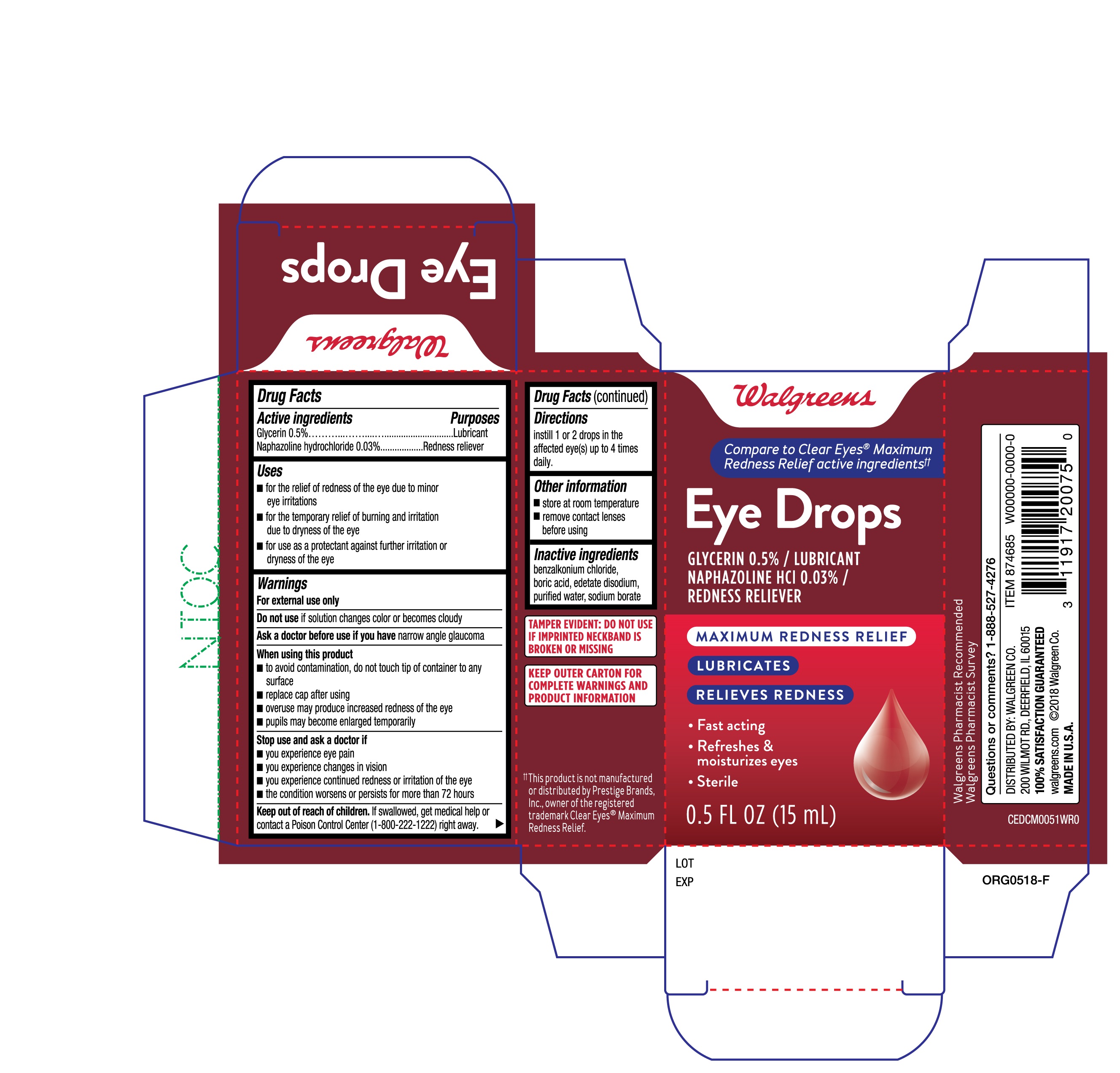
Walgreens Eye Drops Maximum Redness Relief 15mL Glycerin, Naphazoline HCI .03 g/100mL; .5 g/100mL Solution/ Drops — NDC 0363-4546-01 (Billing 00363-4546-01)
This is a package of Walgreens Eye Drops Maximum Redness Relief 15mL Glycerin, Naphazoline HCI .03 g/100mL; .5 g/100mL Solution/ Drops from Walgreen Company, marketed since Oct 2019 and currently FDA-listed. It is this product's only package size.
Identity & classification
Regulatory identifiers FDA, NLM and CMS codes for this package
- RxCUI (RxNorm): 1235200
Where does this data come from?
- FDA openFDA NDC Directory · synced Oct 1, 2026
- FDA label on DailyMed · label index refreshed Oct 1, 2026
- RxNorm (NLM RxNav) · catalog refreshed Oct 1, 2026
- Medi-Span GPI (licensed)
- First Databank (licensed) · refreshed Oct 1, 2026
RxNorm drug class
This medicine belongs to the Non-Standardized Chemical Allergen class.
Where does this data come from?
- RxClass (NLM) · catalog refreshed Oct 1, 2026
Clinical
Walgreens Eye Drops Maximum Redness Relief is an over-the-counter eye drop solution marketed under FDA's OTC monograph rules for ophthalmic decongestants. Naphazoline hydrochloride functions as a decongestant and is typically used to relieve redness and minor eye irritation. Glycerin is a humectant commonly included in eye drops to help lubricate and soothe the eye surface. This product is intended for topical application directly to the eye.
Patient education
Supplement & herbal interactions
Where does this data come from?
- MedlinePlus (NLM) · refreshed Oct 1, 2026
- FDA label on DailyMed · label index refreshed Oct 1, 2026
Ask a licensed pharmacist directly — free, answered by our team.
Pricing
A drug doesn't have one price. Each row is a different public payment system, and none is what you'd pay at the counter — that depends on your insurance. The ⓘ on each row explains what it measures.
| Price system | Per mL | Per package |
|---|---|---|
| Retail pharmacies payNADAC · weekly | Not in the retail survey — common for institutional, discontinued, or low-volume packs. | |
| Medicaid paysCMS SDUD · 12 mo | No recent Medicaid claims on file for this NDC — rare and low-volume NDCs are suppressed in the public data. | |
| Medicare drug plans payPart D · quarterly | No Part D plan price is available for this NDC in our data. | |
Where does this data come from?
- CMS NADAC weekly file
- CMS ASP pricing files · refreshed Sep 20, 2026
- CMS Medicaid State Drug Utilization Data · refreshed Oct 3, 2026
- CMS Part D plan pricing files · refreshed Sep 24, 2026
- VA National Acquisition Center price file
Packaging — all sizes for this product
| Package NDC | Description | Marketing start | Marketing end | Status |
|---|---|---|---|---|
| 00363-4546-01 You're viewing this Main listing | 1 BOTTLE, DROPPER in 1 BOX / 15 mL in 1 BOTTLE, DROPPER | 2019-10-10 | — | Active |
Therapeutic equivalents
Where does this data come from?
- FDA openFDA NDC Directory · synced Oct 1, 2026
- FDA Orange Book · refreshed Sep 3, 2026
- CMS NADAC weekly file
Availability & generic status
We did not find an FDA-approved generic match for this exact strength, form and route.
Where does this data come from?
- FDA Orange Book · refreshed Sep 3, 2026
Inactive Ingredients / Excipients
Inactive ingredients, also called excipients, are components of the drug product other than the active ingredient. They may include fillers, dyes, coatings, preservatives, flavors, or other formulation ingredients.
💡 Tap an ingredient (hover on desktop) to see what it is and why it’s used.
-
UNII F5UM2KM3W7
Benzalkonium chloride is a chemical compound that works as a preservative and antimicrobial agent in medications. It prevents bacterial and fungal growth in liquid formulations to keep the product safe during storage and use.
-
UNII R57ZHV85D4
Boric acid is a weak acid derived from boron. In medicines, it typically serves as a buffer to help maintain the product's pH level and may act as a preservative in certain formulations.
-
UNII 7FLD91C86K
Edetate disodium is a chemical compound that binds and removes certain metal ions. In medicines, it acts as a preservative and stabilizer by preventing metals like calcium from interfering with the product's shelf life and consistency.
-
UNII 91MBZ8H3QO
Sodium borate is an inorganic salt compound used in medicines as a buffer to help maintain a stable pH level, and sometimes as a mild preservative or cleansing agent in topical formulations.
-
UNII 059QF0KO0R
Water is a liquid solvent that dissolves and mixes ingredients together in liquid medicines, syrups, and injections. It helps distribute the active drug evenly throughout the product.
5 inactive ingredients listed in the exact product block matched to this NDC.
Label-section wording can be broader than the structured product block and may mention additional formulation ingredients.
Where does this data come from?
ingredient classCode="IACT" elements from the exact product block matched by this NDC. Label-section narrative from DailyMed / the openFDA label index is shown separately when available.- FDA label on DailyMed · label index refreshed Oct 1, 2026
- FDA openFDA NDC Directory · synced Oct 1, 2026
Inactive ingredient FAQ
Are inactive ingredients the same for every manufacturer?
Why might an inactive ingredient be missing?
Can inactive ingredients matter?
Manufacturer & labeler
Where does this data come from?
- FDA openFDA NDC Directory · synced Oct 1, 2026
- Drugs@FDA
FDA label — Drug Facts FDA SPL
🎯 Indications and Usage ▾
Uses • for the relief of redness of the eye due to minor eye irritations • for the temporary relief of burning and irritation due to dryness of the eye • for use as a protectant against further irritation or dryness of the eye
⏱️ Dosage and Administration ▾
Directions instill 1 or 2 drops in the affected eye(s) up to 4 times daily.
⚠️ Warnings ▾
Warnings For external use only Do not use if solution changes color or becomes cloudy Ask a doctor before use if you have narrow angle glaucoma When using this product • to avoid contamination, do not touch tip of container to any surface • replace cap after using • overuse may produce increased redness of the eye • pupils may become enlarged temporarily Stop use and ask a doctor if • you experience eye pain • you experience changes in vision • you experience continued redness or irritation of the eye • the condition worsens or persists for more than 72 hours Keep out of reach of children.
If swallowed, get medical help or contact a Poison Control Center (1-800-222-1222) right away.
🧪 Active Ingredient ▾
Active ingredients Glycerin 0.5% Naphazoline hydrochloride 0.03%
🧪 Inactive Ingredients ▾
Inactive ingredients benzalkonium chloride, boric acid, edetate disodium, purified water, sodium borate
🎯 Purpose ▾
Purposes Lubricant Redness Reliever
📄 Do Not Use ▾
Do not use if solution changes color or becomes cloudy
📄 Ask a Doctor Before Use If ▾
Ask a doctor before use if you have narrow angle glaucoma
📄 When Using This Product ▾
When using this product • to avoid contamination, do not touch tip of container to any surface • replace cap after using • overuse may produce increased redness of the eye • pupils may become enlarged temporarily
📄 Stop Use and Ask a Doctor If ▾
Stop use and ask a doctor if • you experience eye pain • you experience changes in vision • you experience continued redness or irritation of the eye • the condition worsens or persists for more than 72 hours
📄 Keep Out of Reach of Children ▾
Keep out of reach of children. If swallowed, get medical help or contact a Poison Control Center (1-800-222-1222) right away.
📄 Other Information ▾
Other information • store at room temperature • remove contact lenses before using
📄 Package Label / Principal Display Panel ▾
Walgreens Eye Drops Maximum Redness Relief 15mL Walgreens Eye Drops Maximum Redness Relief 15mL
About this NDC listing & data coverage
What data is (and isn’t) available for this NDC — tap to expand
| NDC identity (package / product / labeler codes) | ✓ Available |
| Labeler | ✓ Available |
| Product & package description | ✓ Available |
| Marketing category & status | ✓ Available |
| Active ingredient / dosage form / route | ✓ Available |
| FDA label (SPL via DailyMed) | ✓ Available |
| Package photos | ✓ Available |
| Inactive ingredients (structured) | ✓ Available |
| NADAC pharmacy acquisition price (CMS) | — Not published for this NDC CMS publishes NADAC only for NDCs reported in its retail-pharmacy survey. |
| Orange Book / therapeutic-equivalence data | — Not published for this NDC Applies only to products approved under an NDA/ANDA; many listings are out of scope. |
| HCPCS J-code billing crosswalk | — Not published for this NDC Most self-administered / retail products have no J-code — that is normal. |
| Medicaid utilization (CMS SDUD) | — Not published for this NDC CMS reports utilization only for NDCs with Medicaid claims above its privacy threshold. |