
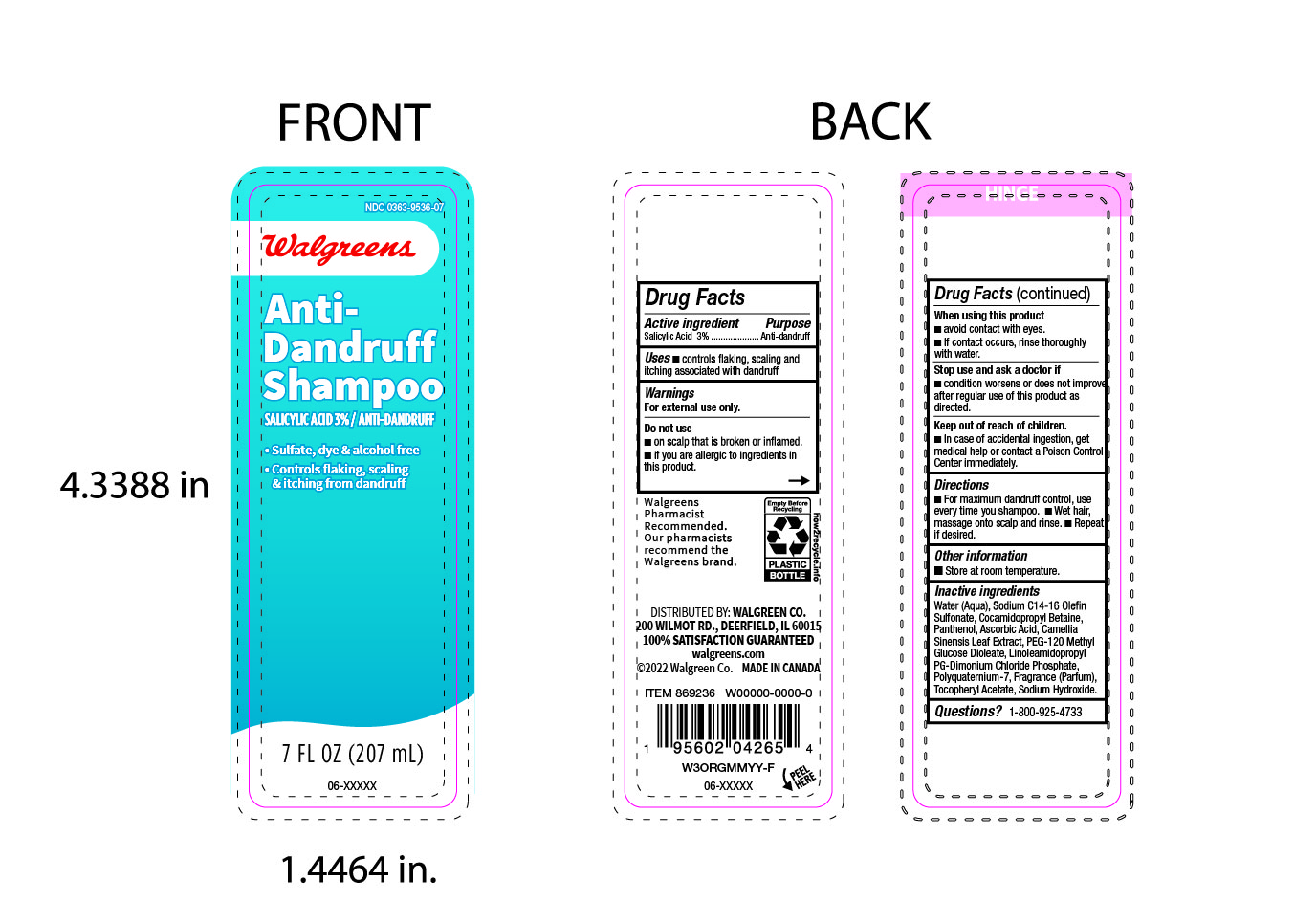
Walgreens Salicylic Acid 30 mg/mL Lotion/Shampoo, 207 mL — NDC 0363-9536-07 (Billing 00363-9536-07)
This is a package of 207 mL of Walgreens Salicylic Acid 30 mg/mL Lotion/Shampoo from Walgreens, marketed since Nov 2022 and currently FDA-listed. It is this product's only package size.
Identity & classification
Regulatory identifiers FDA, NLM and CMS codes for this package
- RxCUI (RxNorm): 205023
Where does this data come from?
- FDA openFDA NDC Directory · synced Oct 1, 2026
- FDA label on DailyMed · label index refreshed Oct 1, 2026
- RxNorm (NLM RxNav) · catalog refreshed Oct 1, 2026
- Medi-Span GPI (licensed)
- First Databank (licensed) · refreshed Oct 1, 2026
RxNorm drug class
This medicine belongs to the Salicylic acid and derivatives class.
Where does this data come from?
- RxClass (NLM) · catalog refreshed Oct 1, 2026
Clinical
Topical salicylic acid is used to help clear and prevent pimples and skin blemishes in people who have acne. Topical salicylic acid is also used to treat skin conditions that involve scaling or overgrowth of skin cells such as psoriasis (a skin disease in which red, scaly patches form on some areas of the body), ichthyoses (inborn conditions that cause skin dryness and scaling), dandruff, corns, calluses, and warts on the hands or feet. Topical salicylic acid should not be used to treat genital warts, warts on the face, warts with hair growing from them, warts in the nose or mouth, moles, or b...
Read the full MedlinePlus article ↗- It is used in a facial routine for acne-prone and oil-prone skin. The routine includes a cleanser, serum, toner and emulsion. Salicylic acid helps loosen and shed dead skin cells.
- Use the cleanser morning and evening, and the serum in the morning after cleansing. Use the toner in the evening on dry skin, and the emulsion at night after cleansing. Avoid your...
- Mild stinging, burning, itching, dryness and extra peeling can happen. If dryness or peeling bothers you, try using the serum or toner every other day. If it gets excessive, stop a...
- It is best not to. Using another topical acne medication at the same time makes irritation and dryness more likely. If you get irritated, use only one at a time.
Patient education
Supplement & herbal interactions
Where does this data come from?
- MedlinePlus (NLM) · refreshed Oct 1, 2026
- FDA label on DailyMed · label index refreshed Oct 1, 2026
Ask a licensed pharmacist directly — free, answered by our team.
Pricing
A drug doesn't have one price. Each row is a different public payment system, and none is what you'd pay at the counter — that depends on your insurance. The ⓘ on each row explains what it measures.
| Price system | Per g | Per package |
|---|---|---|
| Retail pharmacies payNADAC · weekly | Not in the retail survey — common for institutional, discontinued, or low-volume packs. | |
| Medicaid paysCMS SDUD · 12 mo | No recent Medicaid claims on file for this NDC — rare and low-volume NDCs are suppressed in the public data. | |
| Medicare drug plans payPart D · quarterly | No Part D plan price is available for this NDC in our data. | |
Where does this data come from?
- CMS NADAC weekly file
- CMS ASP pricing files · refreshed Sep 20, 2026
- CMS Medicaid State Drug Utilization Data · refreshed Oct 3, 2026
- CMS Part D plan pricing files · refreshed Sep 24, 2026
- VA National Acquisition Center price file
Packaging — all sizes for this product
| Package NDC | Description | Marketing start | Marketing end | Status |
|---|---|---|---|---|
| 00363-9536-07 You're viewing this Main listing | 207 mL in 1 BOTTLE, PLASTIC | 2022-11-02 | — | Active |
Therapeutic equivalents
Where does this data come from?
- FDA openFDA NDC Directory · synced Oct 1, 2026
- FDA Orange Book · refreshed Sep 3, 2026
- CMS NADAC weekly file
Availability & generic status
We did not find an FDA-approved generic match for this exact strength, form and route.
Where does this data come from?
- FDA Orange Book · refreshed Sep 3, 2026
Inactive Ingredients / Excipients
Inactive ingredients, also called excipients, are components of the drug product other than the active ingredient. They may include fillers, dyes, coatings, preservatives, flavors, or other formulation ingredients.
💡 Tap an ingredient (hover on desktop) to see what it is and why it’s used.
-
UNII 9E8X80D2L0
A synthetic form of vitamin E used as an antioxidant and preservative in medications. It helps prevent the active ingredients from degrading when exposed to oxygen or light.
-
UNII PQ6CK8PD0R
Ascorbic acid, also known as vitamin C, is a white crystalline powder. It serves as an antioxidant to prevent degradation of other ingredients and may also function as a preservative in the formulation.
-
UNII W2ZU1RY8B0
A plant extract from green tea leaves. It's used as an antioxidant ingredient to help preserve the medicine and maintain its stability during storage.
-
UNII 5OCF3O11KX
A plant-derived surfactant made from coconut oil. It helps mix oil and water ingredients together in the formulation and can improve how the medicine spreads or feels on the skin.
-
UNII 329LCV5BTF
A blend of fragrance compounds used to add pleasant smell to the medicine. Fragrances mask bitter or unpleasant tastes and odors, making the medication easier to take.
-
UNII 5Q87K461JO
A synthetic conditioning agent derived from linoleic acid and propylene glycol. It works as an antistatic agent and hair conditioner in topical formulations, helping reduce friction and improve product spreadability.
-
UNII WV9CM0O67Z
Panthenol is a humectant and skin-conditioning agent derived from pantothenic acid. It's added to medicines to help retain moisture and soothe skin irritation.
-
UNII YM0K64F20V
A synthetic emulsifier derived from polyethylene glycol and glucose. It helps blend oil and water-based ingredients together and improves the texture and spreadability of the product.
-
UNII 0L414VCS5Y
A synthetic polymer used as a film-former and conditioning agent. It helps create a protective coating on hair or skin surfaces and improves texture and manageability in topical formulations.
-
UNII O9W3D3YF5U
A synthetic surfactant derived from petroleum-based olefins. It helps dissolve or suspend active ingredients and other substances in liquid formulations, improving how the medicine mixes and flows.
-
UNII 55X04QC32I
A strong alkaline chemical used to adjust and maintain the pH balance of liquid medicines. It helps keep the medicine stable and ensures it stays effective during storage.
-
UNII 059QF0KO0R
Water is a liquid solvent that dissolves and mixes ingredients together in liquid medicines, syrups, and injections. It helps distribute the active drug evenly throughout the product.
12 inactive ingredients listed in the exact product block matched to this NDC.
Label-section wording can be broader than the structured product block and may mention additional formulation ingredients.
Where does this data come from?
ingredient classCode="IACT" elements from the exact product block matched by this NDC. Label-section narrative from DailyMed / the openFDA label index is shown separately when available.- FDA label on DailyMed · label index refreshed Oct 1, 2026
- FDA openFDA NDC Directory · synced Oct 1, 2026
Inactive ingredient FAQ
Are inactive ingredients the same for every manufacturer?
Why might an inactive ingredient be missing?
Can inactive ingredients matter?
Manufacturer & labeler
Where does this data come from?
- FDA openFDA NDC Directory · synced Oct 1, 2026
- Drugs@FDA
FDA label — Drug Facts FDA SPL
🎯 Indications and Usage ▾
Controls flaking , scaling and itching from dandruff
⏱️ Dosage and Administration ▾
For maximum dandruff control, use every time you shampoo. wet hair, massage onto scalp and rinse. Repeat if desired.
⚠️ Warnings ▾
For external use only on scalp that is broken or inflammed if you are allergic to ingredients in this product avoid contact with eyes. if contact occurs, rinse thoroughly with water. Stop use and ask a doctor if condition worsens or does not improve after regular use of this product as directed.
📦 Storage and Handling ▾
Store at room temperature.
🧪 Active Ingredient ▾
Salicylic Acid 3%
🧪 Inactive Ingredients ▾
Water, Sodium C14-16 Olefin Sulfonate, Cocamidopropyl Betaine, Panthenol, Ascrobic Acid, Camellia Sinensis Leaf Extract, PEG-120 Methyl Glucose Dioleate, Linoleamidopropyl PG-Dimonium Chloride Phosphate, Polyquaternium-7, Fragrance (parfum), Tocopheryl Acetate, Sodium Hydroxide
🎯 Purpose ▾
Dandruff control
📄 Do Not Use ▾
on scalp that is broken or inflammed if you are allergic to ingredients in this product
📄 Ask a Doctor Before Use If ▾
Stop use and ask a doctor if condition worsens or does not improve after regular use of this product as directed.
📄 When Using This Product ▾
avoid contact with eyes. if contact occurs, rinse thoroughly with water.
📄 Keep Out of Reach of Children ▾
in case of accidental ingestion, get medical help or contact a poison control centre immediately .
📄 Package Label / Principal Display Panel ▾
7 oz
Medicare Part D spend CMS · PART D · 2026 (Q1)
About this NDC listing & data coverage
What data is (and isn’t) available for this NDC — tap to expand
| NDC identity (package / product / labeler codes) | ✓ Available |
| Labeler | ✓ Available |
| Product & package description | ✓ Available |
| Marketing category & status | ✓ Available |
| Active ingredient / dosage form / route | ✓ Available |
| FDA label (SPL via DailyMed) | ✓ Available |
| Package photos | ✓ Available |
| Inactive ingredients (structured) | ✓ Available |
| NADAC pharmacy acquisition price (CMS) | — Not published for this NDC CMS publishes NADAC only for NDCs reported in its retail-pharmacy survey. |
| Orange Book / therapeutic-equivalence data | — Not published for this NDC Applies only to products approved under an NDA/ANDA; many listings are out of scope. |
| HCPCS J-code billing crosswalk | — Not published for this NDC Most self-administered / retail products have no J-code — that is normal. |
| Medicaid utilization (CMS SDUD) | — Not published for this NDC CMS reports utilization only for NDCs with Medicaid claims above its privacy threshold. |