
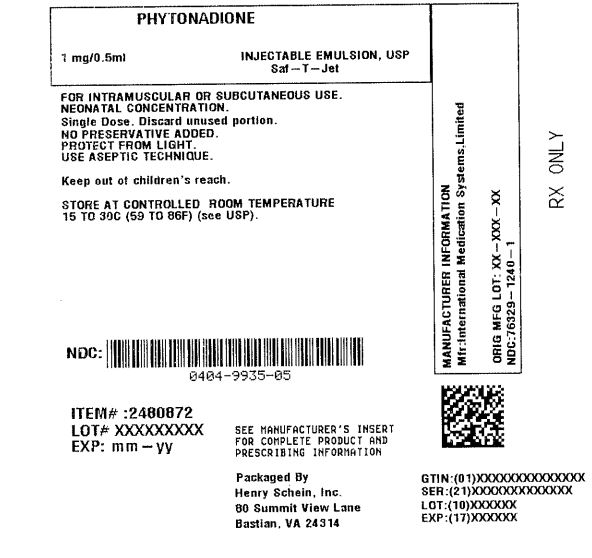
PHYTONADIONE 1 mg/.5mL Injection, Emulsion, 1 syringe — NDC 0404-9935-05 (Billing 00404-9935-05)
This is a package of 1 syringe of PHYTONADIONE 1 mg/.5mL Injection, Emulsion from Henry Schein, Inc., marketed since Jan 2022 and currently FDA-listed. It is this product's only package size.
NDC database record
One package, one record: these facts belong to NDC 0404-9935-05 alone.
- Record
- FDA NDC Directory package listing · Human prescription drug
- Code segments
- 0404 labeler · 9935 product · 05 package
- Package marketed since
- Jan 13, 2022
- Sample package
- No — commercial package
- Listing certified through
- Dec 31, 2026
- Barcode (UPC-A, from the NDC)
- 3 0404993505 8
- FDA record last changed
- Jul 24, 2026
Other active recalls for Phytonadione (different manufacturers) — 1 · tap to view
Identity & classification
Regulatory identifiers FDA, NLM and CMS codes for this package
- RxCUI (RxNorm): 727625
Where does this data come from?
- FDA openFDA NDC Directory · synced Oct 8, 2026
- FDA label on DailyMed · label index refreshed Oct 6, 2026
- RxNorm (NLM RxNav) · catalog refreshed Oct 1, 2026
- Medi-Span GPI (licensed)
- First Databank (licensed) · refreshed Oct 8, 2026
RxNorm drug class
This medicine belongs to the Warfarin Reversal Agent class.
Where does this data come from?
- RxClass (NLM) · catalog refreshed Oct 1, 2026
Clinical
- It's vitamin K1. It helps your blood clot when vitamin K is low or blocked, for example by a blood thinner like warfarin, some antibiotics, or conditions that limit absorption. The...
- The tablets are taken by mouth, and your prescriber may add bile salts if your body doesn't make enough bile. The injection is given by a healthcare professional, preferably under...
- It isn't instant. Your INR may take 1 to 8 hours to improve, and after an IV dose a normal INR is often reached in about 12 to 14 hours. If bleeding is severe, you may need other t...
- Some people feel dizzy, flushed, or sweaty, notice an odd taste, or have a fast heartbeat. Injection-site soreness can happen. Get emergency help for trouble breathing, chest pain,...
Patient education
Supplement & herbal interactions
Where does this data come from?
- MedlinePlus (NLM) · refreshed Oct 1, 2026
- FDA label on DailyMed · label index refreshed Oct 6, 2026
Ask a licensed pharmacist directly — free, answered by our team.
Pricing
A drug doesn't have one price. Each row is a different public payment system, and none is what you'd pay at the counter — that depends on your insurance. The ⓘ on each row explains what it measures.
| Price system | Per mL | Per package |
|---|---|---|
| Retail pharmacies payNADAC · weekly | Not in the retail survey — common for institutional, discontinued, or low-volume packs. | |
| Medicaid paysCMS SDUD · 12 mo | No recent Medicaid claims on file for this NDC — rare and low-volume NDCs are suppressed in the public data. | |
| Medicare drug plans payPart D · quarterly | No Part D plan price is available for this NDC in our data. | |
| Medicare Part B allowsASP · J3430 | $3.253 / J3430 unit | — |
Where does this data come from?
- CMS NADAC weekly file
- CMS ASP pricing files · refreshed Sep 20, 2026
- CMS Medicaid State Drug Utilization Data · refreshed Oct 8, 2026
- CMS Part D plan pricing files · refreshed Sep 24, 2026
- VA National Acquisition Center price file
Billing & reimbursement
Where does this data come from?
- CMS ASP NDC-HCPCS crosswalk · refreshed Sep 22, 2026
- DMEPDAC NDC-HCPCS crosswalk
- openFDA NSDE billing units · refreshed Oct 7, 2026
Packaging — all sizes for this product
| Package NDC | Description | Marketing start | Marketing end | Status |
|---|---|---|---|---|
| 00404-9935-05 You're viewing this Main listing | 1 BOX in 1 BAG / 1 SYRINGE in 1 BOX / .5 mL in 1 SYRINGE | 2022-01-13 | — | Active |
Therapeutic equivalents
| Product | Labeler | Pack | NADAC/unit | TE | Status | Price vs. this |
|---|---|---|---|---|---|---|
| Phytonadione 1 mg/.5mLthis 00404-9935-05 | Henry | 1 syringe | — | AB1 | FDA listed | — |
| Phytonadione 1 mg/.5mL 25021-0505-70 | Sagent | 10 syringes | — | AB1 | FDA listed | — |
| Phytonadione 1 mg/.5mL 46708-0826-05 | Alembic | 1 syringe | — | AB1 | FDA listed | — |
| Phytonadione 1 mg/.5mL 62332-0826-05 | Alembic | 1 syringe | — | AB1 | FDA listed | — |
| Phytonadione 1 mg/.5mL 69097-0003-96 | Cipla | 10 syringes | — | AB1 | FDA listed | — |
| Phytonadione 1 mg/.5mL 70095-0154-02 | Sun | 1 syringe | — | AB1 | FDA listed | — |
| phytonadione 1 mg/.5mL 70121-1682-07 | Amneal | 1 syringe | — | AB1 | FDA listed | — |
| Phytonadione 1 mg/.5mL 76329-1240-01 | International | 1 syringe | — | AB1 | FDA listed | — |
| Phytonadione 1 mg/.5mL 81607-0020-02 | Orbicular | 1 syringe | — | AB1 | FDA listed | — |
Where does this data come from?
- FDA openFDA NDC Directory · synced Oct 8, 2026
- FDA Orange Book · refreshed Oct 3, 2026
- CMS NADAC weekly file
Availability & generic status
This product is an FDA-approved generic. Other versions of the same drug are listed under Therapeutic equivalents, least expensive first.
Where does this data come from?
- FDA Orange Book · refreshed Oct 3, 2026
Inactive Ingredients / Excipients
Inactive ingredients, also called excipients, are components of the drug product other than the active ingredient. They may include fillers, dyes, coatings, preservatives, flavors, or other formulation ingredients.
🧪 Avoiding an ingredient? See Phytonadione inactive ingredients by manufacturer: every current product's list side by side, so you can ask your pharmacy for the version that does not list it.
Where does this data come from?
IACT rows and label-wide narrative are kept separate; availability and product-level specificity depend on the submitted label.- FDA label on DailyMed · label index refreshed Oct 6, 2026
- FDA openFDA NDC Directory · synced Oct 8, 2026
Inactive ingredient FAQ
Are inactive ingredients the same for every manufacturer?
Why might an inactive ingredient be missing?
Can inactive ingredients matter?
Manufacturer & labeler
More NDCs from Henry Schein, Inc. labeler code 00404
- NALOXONE HYDROCHLORIDE .4 mg/mL Injection, Solution NDC 0404-9923-01
- NAROPIN ropivacaine hydrochloride 5 mg/mL Injection, Solution NDC 0404-9924-30
- Nitroglycerin 5 mg/mL Injection, Solution NDC 0404-9928-10
- ONDANSETRON 2 mg/mL Injection NDC 0404-9930-02
- Phenylephrine Hydrochloride 10 mg/mL Injection NDC 0404-9931-99
- Phenytoin Sodium 50 mg/mL Injection NDC 0404-9932-02
- Potassium Chloride 2 meq/mL Injection, Solution, Concentrate NDC 0404-9936-10
- Potassium Chloride 149 mg/mL Injection, Solution, Concentrate NDC 0404-9937-10
- PRECEDEX DEXMEDETOMIDINE HYDROCHLORIDE 100 ug/mL Injection, Solution, Concentrate NDC 0404-9938-02
- PROMETHAZINE HYDROCHLORIDE 25 mg/mL Injection NDC 0404-9940-01
- Promethazine Hydrochloride 25 mg/mL Injection NDC 0404-9941-01
- Promethazine Hydrochloride 50 mg/mL Injection NDC 0404-9942-01
Where does this data come from?
- FDA openFDA NDC Directory · synced Oct 8, 2026
- Drugs@FDA
Full prescribing information FDA SPL
🚨 Boxed Warning ▾
BOXED WARNING WARNING – HYPERSENSITIVITY REACTIONS WITH INTRAVENOUS AND INTRAMUSCULAR USE Fatal hypersensitivity reactions, including anaphylaxis, have occurred during and immediately after intravenous and intramuscular injection of Phytonadione Injectable Emulsion. Reactions have occurred despite dilution to avoid rapid intravenous infusion and upon first dose. Avoid the intravenous and intramuscular routes of administration unless the subcutaneous route is not feasible and the serious risk is justified [see WARNING AND PRECAUTIONS(5.1)].
🎯 Indications and Usage ▾
1 INDICATIONS AND USAGE
1.1Treatment of Hypoprothrombinemia Due to Vitamin K Deficiency or Interference Phytonadione Injectable Emulsion, USP is indicated for the treatment of the following coagulation disorders which are due to faulty formation of factors II, VII, IX and X when caused by vitamin K deficiency or interference with vitamin K activity; anticoagulant-induced hypoprothrombinemia caused by coumarin or indanedione derivatives; hypoprothrombinemia due to antibacterial therapy; hypoprothrombinemia secondary to factors limiting absorption or synthesis of vitamin K, e.g., obstructive jaundice, biliary fistula, sprue, ulcerative colitis, celiac disease, intestinal resection, cystic fibrosis of the pancreas, and regional enteritis; other drug-induced hypoprothrombinemia where it is definitely shown that the result is due to interference with vitamin K metabolism, e.g., salicylates.
1.2Prophylaxis and Treatment of Vitamin K-Deficiency Bleeding in Neonates Phytonadione Injectable Emulsion, USP is indicated for prophylaxis and treatment of vitamin K-deficiency bleeding in neonates. Phytonadione Injectable Emulsion, USP is a vitamin K replacement indicated for the treatment of the following coagulation disorders which are due to faulty formation of factors II, VII, IX and X when cause by vitamin K deficiency or interference with vitamin K activity. Anticoagulant-induced hypoprothrombinemia deficiency caused by coumarin or indanedione derivatives; (1.1) Hypoprothrombinemia due to antibacterial therapy; (1.1) Hypoprothrombinemia secondary to factors limiting absorption or synthesis of vitamin K, e.g., obstructive jaundice, biliary fistula, sprue, ulcerative colitis, celiac disease, intestinal resection, cystic fibrosis of the pancreas, and regional enteritis; (1.1)
⏱️ Dosage and Administration ▾
2 DOSAGE AND ADMINISTRATION
2.1Dosing Considerations Whenever possible, administer Phytonadione Injectable Emulsion, USP by the subcutaneous route [see Boxed Warning ] . When intravenous administration is unavoidable, inject the drug very slowly, not exceeding 1 mg per minute [see Warnings and Precautions (5.1)] . Monitor international normalized ratio (INR) regularly and as clinical conditions indicate.
Use the lowest dose of Phytonadione Injectable Emulsion, USP. The coagulant effects of Phytonadione Injectable Emulsion, USP are not immediate; improvement of INR may take 1-8 hours. Interim use of whole blood or component therapy may also be necessary if bleeding is severe.
When Phytonadione Injectable Emulsion is used to correct excessive anticoagulant-induced hypoprothrombinemia, anticoagulant therapy still being indicated, the patient is again faced with the clotting hazards existing prior to starting the anticoagulant therapy. Phytonadione Injectable Emulsion is not a clotting agent, but overzealous therapy with Phytonadione Injectable Emulsion may restore conditions which originally permitted thromboembolic phenomena. Dosage should be kept as low as possible, and INR should be checked regularly as clinical conditions indicate.
2.2Recommended Dosage for Coagulation Disorders from Vitamin K Deficiency or Interference The recommended dosage of Phytonadione Injectable Emulsion is based on whether the hypoprothrombinemia is anticoagulant-induced (e.g., due to coumarin or indanedione derivatives) or non-anticoagulant-induced (e.g., due to antibiotics; salicylates or other drugs; factors limiting absorption or synthesis) as follows: Anticoagulant-induced Hypoprothrombinemia : Phytonadione Injectable Emulsion 2.5 mg to 10 mg or more subcutaneously, intramuscularly, or intravenously.
Up to 25 mg to 50 mg may be administered as a single dose. Repeated large doses of Phytonadione Injectable Emulsion are not warranted in liver disease if the initial response is unsatisfactory. Failure to respond to Phytonadione Injectable Emulsion may indicate that the condition being treated is inherently unresponsive to Phytonadione Injectable Emulsion.
Hyppoprothrombinemia Due to Other Causes (Non-Anticoagulation-Induced Hypoprothrombinemia : Phytonadione Injectable Emulsion 2.5 mg to 25 mg or more intravenously, intramuscularly, or subcutaneously. Up to 50 mg may be administered as a single dose. Evaluate INR after 6-8 hours, and repeat dose if INR remains prolonged.
Modify subsequent dosage (amount and frequency) based on the INR or clinical condition.
2.3Recommended Dosage for Prophylaxis and Treatment of Vitamin K Deficiency Bleeding in Neonates Prophylaxis of Vitamin K-Deficiency Bleeding in Neonates The recommended dosage of Phytonadione Injectable Emulsion is 0.5 mg to 1 mg within one hour of birth for a single dose. Treatment of Vitamin K Deficiency Bleeding in Neonates The recommended dosage of Phytonadione Injectable Emulsion is 1 mg given either subcutaneously or intramuscularly. Consider higher doses if the mother has been receiving oral anticoagulants.
A failure to respond (shortening of the INR in 2 to 4 hours) may indicate another diagnosis or coagulation disorder.
2.4Directions for Dilution Dilute Phytonadione Injectable Emulsion with 0.9% Sodium Chloride Injection, 5% Dextrose Injection, or 5% Dextrose and Sodium Chloride Injection. When diluted, start administration of Phytonadione Injectable Emulsion immediately after dilution. Discard unused portions of diluted solution as well as unused contents of the vial.
Protect Phytonadione Injectable Emulsion from light at all times. Parenteral drug products should be inspected visually for particulate matter and discoloration prior to administration, whenever solution and container permit. Administer Phytonadione Injectable Emulsion, USP by the subcutaneous route, whenever possible.
(2.1) When intravenous administration is unavoidable, inject the drug very slowly, not exceeding 1 m… [Excerpted — this section continues on DailyMed.]
💊 Dosage Forms and Strengths ▾
3 DOSAGE FORMS AND STRENGTHS Injection: 1 mg/0.5 mL single-dose vial and a SAF-T-Jet vial injector. Injection: 1 mg/0.5 mL single-dose vial and a SAF-T-Jet vial injector. (3)
⛔ Contraindications ▾
4 CONTRAINDICATIONS Hypersensitivity to phytonadione or any other component of this medication [see WARNING AND PRECAUTIONS (5.1)]. Hypersensitivity to any component of this medication. (4)
⚠️ Warnings and Cautions ▾
5 WARNINGS AND PRECAUTIONS
5.1Hypersensitivity Reactions Fatal and severe hypersensitivity reactions, including anaphylaxis, have occurred with intravenous or intramuscular administration of Phytonadione Injectable Emulsion. Reactions have occurred despite dilution to avoid rapid intravenous infusion and upon first dose. These reactions have included shock, cardiorespiratory arrest, flushing, diaphoresis, chest pain, tachycardia, cyanosis, weakness, and dyspnea.
Administer Phytonadione Injectable Emulsion subcutaneously whenever feasible. Avoid the intravenous and intramuscular routes of administration unless the subcutaneous route is not feasible and the serious risk is justified [see DOSAGE AND ADMINISTRATION (2.1)].
5.3Cutaneous Reactions Parenteral administration of vitamin K replacements (including Phytonadione Injectable Emulsion) may cause cutaneous reactions. Reactions have included eczematous reactions, scleroderma-like patches, urticaria, and delayed-type hypersensitivity reactions. Time of onset ranged from 1 day to a year after parenteral administration.
Discontinue Phytonadione Injectable Emulsion for skin reactions and institute medical management. Cutaneous Reactions: May occur with parenteral use. Discontinue drug and manage medically.
(5.3)
🤒 Adverse Reactions ▾
6 ADVERSE REACTIONS The following serious adverse reactions are described elsewhere in the labeling: • Hypersensitivity Reactions [see WARNING AND PRECAUTIONS (5.1)] • Cutaneous Reactions [see WARNING AND PRECAUTIONS (5.3)]
6.1Clinical Trials and Post-Marketing Experience Because clinical trials are conducted under widely varying conditions, adverse reaction rates observed in the clinical trials of a drug cannot be directly compared to rates in the clinical trials of another drug and may not reflect the rates observed in practice. The following adverse reactions have been identified during post-apporval use of Phytonadione Injectable Emulsion. Because these reactions were reported voluntarily from a population of uncertain size, it is not always possible to reliably estimate their frequency or establish a causal relationship to drug exposure.
Cardiac Disorders: Tachycardia, hypotension. General disorders and administration site conditions: Generalized flushing; pain, swelling, and tenderness at injection site. Hepatobiliary Disorders: Hyperbilirubinemia Immune System Disorders: Fatal hypersensitivity reactions, anaphylactic reactions.
Neurologic: Dysgeusia, dizziness. Pulmonary: Dyspnea. Skin and Subcutaneous Tissue Disorders: Erythema, pruritic plaques, scleroderma-like lesions, erythema perstans.
Vascular: Cyanosis. Most common adverse reactions are cyanosis, diaphoresis, dizziness, dysgeusia, dyspnea, flushing, hypotension and tachycardia. (6) To report SUSPECTED ADVERSE REACTIONS, contact Amphastar Pharmaceuticals, Inc. at 1-800-423-4136, or FDA at 1-800-FDA-1088 or www.fda.gov/medwatch .
🔄 Drug Interactions ▾
7 DRUG INTERACTIONS Anticoagulants Phytonadione Injectable Emulsion may induce temporary resistance to prothrombin-depressing anticoagulants, especially when larger doses of Phytonadione Injectable Emulsion are used. Should this occur, higher doses of anticoagulant therapy may be needed when resuming anticoagulant therapy, or a change in therapy to a different class of anticoagulant may be necessary (i.e., heparin sodium). Phytonadione Injectable Emulsion does not affect the anticoagulant action of heparin.
Anticoagulants: May induce temporary resistance to prothrombin-depressing anticoagulants. (7)
👥 Use in Specific Populations ▾
8 USE IN SPECIFIC POPULATIONS
8.1Pregnancy Risk Summary Published studies with the use of phytonadione during pregnancy have not reported a clear association with phytonadione and adverse developmental outcomes (see Data ) . There are maternal and fetal risks associated with vitamin K deficiency during pregnancy ( see Clinical Considerations) . Animal reproduction studies have not been conducted with phytonadione.
The estimated background risk for the indicated population is unknown. All pregnancies have a background risk of birth defect, loss, or other adverse outcomes. In the U.S. general population, the estimated background risk of major birth defects and miscarriage in clinically recognized pregnancies is 2-4% and 15-20%, respectively.
Clinical Considerations Disease-associated maternal and/or embryo/fetal risk Pregnant women with vitamin K deficiency hypoprothrombinemia may be at an increased risk for bleeding diatheses during pregnancy and hemorrhagic events at delivery. Subclinical maternal vitamin K deficiency during pregnancy has been implicated in rare cases of fetal intracranial hemorrhage. Data Human Data Phytonadione has been measured in cord blood of infants whose mothers were treated with phytonadione during pregnancy in concentrations lower than seen in maternal plasma.
Administration of vitamin K 1 to pregnant women shortly before delivery increased both maternal and cord blood concentrations. Published data do not report a clear association with phytonadione and adverse maternal or fetal outcomes when used during pregnancy. However, these studies cannot definitively establish the absence of any risk because of methodologic limitations including small sample size and lack of blinding.
Animal Data In pregnant rats receiving vitamin K 1 orally, fetal plasma and liver concentrations increased following administration, supporting placental transfer.
8.2Lactation Risk Summary If available, preservative-free Phytonadione is recommended when Phytonadione is needed during lactation [see USE IN SPECIFIC POPULATION (8.4)]. Phytonadione is present in breastmilk. There are no data on the effects of Phytonadione Injectable Emulsion on the breastfed child or on milk production.
The developmental and health benefits of breastfeeding should be considered along with the clinical need for Phytonadione Injectable Emulsion and any potential adverse effects on the breastfed child from Phytonadione Injectable Emulsion or from the underlying maternal condition.
8.4Pediatric Use The safety and effectiveness of Phytonadione Injectable Emulsion for prophylaxis and treatment of vitamin K deficiency have been established in neonates. Use of phytonadione injection for prophylaxis and treatment of vitamin K deficiency is based on published clinical studies. Pregnancy: If available, use the preservative-free formulation in pregnant women.
(8.1) Lactation: If available, use the preservative-free formulation in lactating women. (8.2) Pediatric Use: The safety and effectiveness of Phytonadione Injectable Emulsion in pediatric patients from 6 months from 17 years have not been established. (8.4) See 17 for PATIENT COUNSELING INFORMATION.
08/2023
🆘 Overdosage ▾
10 OVERDOSAGE Hemolysis, jaundice, and hyperbilirubinemia in newborns, particuarly in premature infants, may result from Phytonadione Injectable Emulsion overdose.
🧬 Clinical Pharmacology ▾
12 CLINCIAL PHARMACOLOGY
12.1Mechanism of Action Phytonadione Injectable Emulsion aqueous colloidal solution of vitamin K 1 for parenteral injection, possesses the same type and degree of activity as does naturally-occurring vitamin K, which is necessary for the production via the liver of active prothrombin (factor II), proconvertin (factor VII), plasma thromboplastin component (factor IX), and Stuart factor (factor X). Vitamin K is an essential cofactor for a microsomal enzyme that catalyzes the post-translational carboxylation of multiple, specific, peptide-bound glutamic acid residues in inactive hepatic precursors of factors II, VII, IX, and X.
The resulting gamma-carboxy-glutamic acid residues convert the precursors into active coagulation factors that are subsequently secreted by liver cells into the blood. In normal animals and humans, phytonadione is virtually devoid of activity. However, in animals and humans deficient in vitamin K, the pharmacological action of vitamin K is related to its normal physiological function, that is, to promote the hepatic biosynthesis of vitamin K dependent clotting factors.
12.2Pharmacodynamics The action of the aqueous dispersion, when administered intravenously, is generally detectable within an hour or two and hemorrhage is usually controlled within 3 to 6 hours. A normal INR may often be obtained in 12 to 14 hours.
12.3Pharmacokinetics Absorption: Phytonadione is readily absorbed following intramuscular administration. Distribution: After absorption, phytonadione is initially concentrated in the liver, but the concentration declines rapidly. Very little vitamin K accumulates in tissues. Elimination: Little is known about the metabolic fate of vitamin K. Almost no free unmetabolized vitamin K appears in bile or urine.
📦 How Supplied / Storage and Handling ▾
16 HOW SUPPLIED/STORAGE AND HANDLING Phytonadione Injectable Emulsion, USP is a yellow, sterile, aqueous colloidal solution and is supplied in unit use packages containing one single-dose vial and a SAF-T-Jet® vial injector, 27 G. x ½ needle. Phytonadione Injectable Emulsion USP, 1 mg in 0.5 mL Stock No. 1240 NDC 76329-1240-1 Store at 20° to 25°C (68° to 77°F); excursions permitted to 15° to 30°C (59° to 86°F) [see USP Controlled Room Temperature].
Protect Phytonadione Injectable Emulsion, USP from light. Store container in closed original carton until contents have been used. Product repackaged by: Henry Schein, Inc., Bastian, VA 24314 From Original Manufacturer/Distributor's NDC and Unit of Sale To Henry Schein Repackaged Product NDC and Unit of Sale Total Strength/Total Volume (Concentration) per unit NDC 76329-1240-1 10 individual cartons shrink wrapped as a group of 10 cartons NDC 0404-9935-05 1 unit use package containing one single-dose vial and a SAF-T-Jet® vial injector in a bag (Vial bears NDC 76329-1240-1) 1 mg in 0.5 mL Image1.jpg
📋 Description ▾
11 DESCRIPTION Phytonadione is a vitamin K replacement, which is a clear, yellow to amber, viscous, odorless or nearly odorless liquid. It is insoluble in water, soluble in chloroform and slightly soluble in ethanol. It has a molecular weight of 450.70.
Phytonadione is 2-methyl-3-phytyl-1, 4-naphthoquinone. Its empirical formula is C31H46O2 and its molecular structure is: Phytonadione Injectable Emulsion, USP injection is a yellow, sterile, aqueous colloidal solution of vitamin K 1 , with a pH of 3.5 to 7.0, available for injection by the intravenous, intramuscular, and subcutaneous routes. Phytonadione Injectable Emulsion, USP is available in 1 mg (1 mg/0.5 mL) single-dose vials.
Each 0.5 mL of Phytonadione Injectable Emulsion, USP contains the following inactive ingredients: 10 mg polysorbate 80, 10.4 mg propylene glycol, 0.17 mg sodium acetate anhydrous, and 0.00002 mL glacial acetic acid. Additional glacial acetic acid or sodium acetate anhydrous may have been added to adjust pH to meet USP limits of 3.5 to 7.0. Formula1.jpg
🧪 Nonclinical Toxicology ▾
13 NONCLINICAL TOXICOLOGY SECTION
13.1Carcinogenesis, Mutagenesis, Impairment of Fertility Studies of carcinogenicity, genotoxicity or impairment of fertility have not been conducted with phytonadione.
📄 Package Label / Principal Display Panel ▾
SAMPLE PACKAGE LABEL Label1.jpg
About this NDC listing & data coverage
What data is (and isn’t) available for this NDC — tap to expand
| NDC identity (package / product / labeler codes) | ✓ Available |
| Labeler | ✓ Available |
| Product & package description | ✓ Available |
| Marketing category & status | ✓ Available |
| Active ingredient / dosage form / route | ✓ Available |
| FDA label (SPL via DailyMed) | ✓ Available |
| Package photos | ✓ Available |
| Inactive ingredients (structured) | — Not published for this NDC The labeler did not submit a structured excipient list, or no SPL is available. |
| NADAC pharmacy acquisition price (CMS) | — Not published for this NDC CMS publishes NADAC only for NDCs reported in its retail-pharmacy survey. |
| Orange Book / therapeutic-equivalence data | ✓ Available |
| HCPCS J-code billing crosswalk | ✓ Available |
| Medicaid utilization (CMS SDUD) | — Not published for this NDC CMS reports utilization only for NDCs with Medicaid claims above its privacy threshold. |