
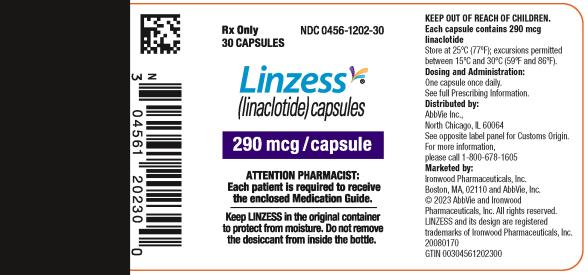
Linzess linaclotide 290 ug Capsule, Gelatin Coated, 30-count — NDC 0456-1202-30 (Billing 00456-1202-30)
This is a package of 30 capsules of Linzess linaclotide 290 ug Capsule, Gelatin Coated from Allergan, Inc., marketed since Sep 2012 and currently FDA-listed; retail pharmacies pay about $9.02 per capsule (NADAC). It is the main listing for this product, which comes in 3 package sizes.
NDC database record
One package, one record: these facts belong to NDC 0456-1202-30 alone.
- Record
- FDA NDC Directory package listing · Human prescription drug
- Code segments
- 0456 labeler · 1202 product · 30 package
- Package marketed since
- Sep 8, 2012
- Sample package
- No — commercial package
- Listing certified through
- Dec 31, 2027
- Billing quantity
- 30 EA per package
- Barcode (UPC)
- 0304561203307, 0304561202300, 0304561201303
- Medicaid fills, this package
- 282,219 prescriptions in the last four reported quarters
- FDA record last changed
- Jul 24, 2026
Identity & classification
Regulatory identifiers FDA, NLM and CMS codes for this package
Drug-database identifiers Medi-Span GPI and First Databank GCN / HICL / AHFS classification
- GSN (GCN sequence number): 069923
- GCN: 33188
- GPI-14 (Medi-Span): 52557050000140
- HICL (First Databank): 039583
- AHFS class code: 56:18.12.00
- RxCUI (RxNorm): 1307409
Where does this data come from?
- FDA openFDA NDC Directory · synced Oct 1, 2026
- FDA label on DailyMed · label index refreshed Oct 5, 2026
- RxNorm (NLM RxNav) · catalog refreshed Oct 1, 2026
- Medi-Span GPI (licensed)
- First Databank (licensed) · refreshed Oct 1, 2026
RxNorm drug class
This medicine belongs to the Guanylate Cyclase-C Agonist class.
Where does this data come from?
- RxClass (NLM) · catalog refreshed Oct 1, 2026
Clinical
Linaclotide is used to treat irritable bowel syndrome with constipation (IBS-C; a condition that causes stomach pain or cramps, bloating, and infrequent or difficult passage of stools). It is also used to treat certain types of constipation in adults and children 6 years of age and older. Linaclotide is in a class of medications called guanylate cyclase-C agonists. It works by increasing the movement of food and waste through the stomach and intestines.
Read the full MedlinePlus article ↗- Good question. Unlike most laxatives that work by drawing water into the gut from the outside or stimulating gut muscles, Linzess activates a specific receptor on your intestinal l...
- What exactly does Linzess do — how is it different from a regular laxative?
- It does matter. Take Linzess on an empty stomach, at least 30 minutes before your first meal of the day, and try to take it at the same time every day. If you take it right after a...
- When should I take it, and does it matter if I eat first?
Patient education
Supplement & herbal interactions
Some supplements/herbs that may interact with Linaclotide — tap one for details:
Where does this data come from?
- MedlinePlus (NLM) · refreshed Oct 1, 2026
- FDA label on DailyMed · label index refreshed Oct 5, 2026
Ask a licensed pharmacist directly — free, answered by our team.
Pricing
A drug doesn't have one price. Each row is a different public payment system, and none is what you'd pay at the counter — that depends on your insurance. The ⓘ on each row explains what it measures.
| Price system | Per ea | Per package |
|---|---|---|
| Retail pharmacies payNADAC · weekly | $9.015 | $270.46 / 30 capsules |
| Medicaid paysCMS SDUD · 12 mo | $16.32 | $489.54 / 30 capsules |
| Medicare drug plans payPart D · Q2 2026 | $9.04 | $271.21 / 30 capsules |
Where does this data come from?
- CMS NADAC weekly file · file of Sep 30, 2026
- CMS ASP pricing files · refreshed Sep 20, 2026
- CMS Medicaid State Drug Utilization Data · through Q1 2026
- CMS Part D plan pricing files · refreshed Sep 24, 2026
- VA National Acquisition Center price file
Packaging — all sizes for this product
| Package NDC | Description | Per unit | Per pack | Marketing start | Marketing end | Status |
|---|---|---|---|---|---|---|
| 00456-1202-04 0456-1202-04 | 1 BOTTLE in 1 CARTON / 4 CAPSULE, GELATIN COATED in 1 BOTTLE Sample | — | — | 2012-09-08 | — | Active |
| 00456-1202-30 You're viewing this Main listing | 1 BOTTLE in 1 CARTON / 30 CAPSULE, GELATIN COATED in 1 BOTTLE | $9.02 / ea | $270.46 | 2012-09-08 | — | Active |
| 00456-1202-07 0456-1202-07 | 1 BOTTLE in 1 CARTON / 7 CAPSULE, GELATIN COATED in 1 BOTTLE Sample | — | — | 2019-05-17 | — | Active |
In Medicaid, this is the most-dispensed pack of this product — about 100% of fills over the last four reported quarters. See all packs ↓
Pack size FAQ
What quantity is in this package?
How does this package differ from NDC 00456-1202-04?
What NDC number is used to bill for this package of Linzess linaclotide 290 ug Capsule, Gelatin Coated?
Prices are the latest CMS NADAC pharmacy acquisition cost per NDC; per-pack figures are per-unit × pack quantity, shown only when the pack is denominated in the same measure NADAC prices.
Therapeutic equivalents
| Product | Labeler | Pack | NADAC/unit | TE | Status | Price vs. this |
|---|---|---|---|---|---|---|
| Linzess 290 ugthis 00456-1202-30 | Allergan, | 30 capsules | $9.015 | — | Availability likely | — |
Where does this data come from?
- FDA openFDA NDC Directory · synced Oct 1, 2026
- FDA Orange Book · refreshed Oct 3, 2026
- CMS NADAC weekly file · file of Sep 30, 2026
Availability & generic status
The FDA lists approved generic versions of this medicine, but that does not always mean a pharmacy can get one today. Patent rules, launch agreements, supply and pricing can affect when generics actually arrive.
Why the date isn’t exact: Generic timing can change because patents may be challenged, settled, licensed, added, removed, or worked around with a narrower label — and FDA approval does not always mean a pharmacy can get the generic today.
🛈 What do these terms mean?
- Patent
- Legal protection listed in the Orange Book that may delay generic approval or launch. Issued by the U.S. Patent & Trademark Office.
- Substance patent
- Covers the active drug molecule itself — the hardest to design around. A generic generally can’t launch until it expires.
- Formulation (product) patent
- Covers a specific formulation or dosage form. A generic can sometimes work around it with a different formulation.
- Method-of-use patent
- A patent covering one specific approved use of the drug — not necessarily the whole molecule. A generic can sometimes launch with a “skinny label” that carves out the protected use and keeps the others.
- Skinny label
- A generic label that omits a still-patented use when the FDA allows it — letting a generic reach the market for the unprotected uses.
- Exclusivity
- FDA-granted marketing protection, separate from patents — e.g. 5-yr new chemical entity, 7-yr orphan drug, or a +6-month pediatric extension.
- Paragraph IV
- A generic applicant’s formal challenge to a listed patent. It can potentially lead to earlier generic entry, but often involves litigation or a settlement.
- RLD / RS
- Reference Listed Drug — the brand product the FDA uses as the reference for generic applications. Reference Standard — the product the FDA expects generics to compare against in bioequivalence testing.
- TE / AB rating
- FDA therapeutic-equivalence rating. An AB rating generally means the FDA considers a generic therapeutically equivalent to — and substitutable for — the brand.
- LOE (loss of exclusivity)
- The latest patent or exclusivity currently listed — the loss-of-exclusivity / latest-listed-protection date shown on this page. Paragraph-IV challenges and settlements can move the real date earlier; FDA approval and a manufacturer’s decision to market can move it later.
Built from the FDA Orange Book. The bars above are scaled to each protection’s expiry; the red LOE marker is the last one to lapse.
| Patent | Type | Use code | Expires |
|---|---|---|---|
| US 7304036 ↗ | Drug substance | U-1278 | Aug 30, 2026 |
| US 9708371 ↗ | Method of use | U-1515 | Aug 16, 2033 |
| US 7304036 ↗ | Drug substance | U-1278 | Aug 30, 2026 |
| US 9708371 ↗ | Method of use | U-1515 | Aug 16, 2033 |
| US 9708371 ↗ | Method of use | U-1516 | Aug 16, 2033 |
| US 8748573 ↗ | Method of use | U-1516 | Oct 30, 2031 |
| US 8748573 ↗ | Method of use | U-1515 | Oct 30, 2031 |
| US 7304036 ↗ | Drug substance | U-1516 | Aug 30, 2026 |
| US 8748573 ↗ | Method of use | U-1516 | Oct 30, 2031 |
| US 7304036 ↗ | Drug substance | U-1516 | Aug 30, 2026 |
| US 8933030 ↗ | Method of use | U-1516 | Feb 17, 2031 |
| US 9708371 ↗ | Method of use | U-1516 | Aug 16, 2033 |
| US 8748573 ↗ | Method of use | U-1515 | Oct 30, 2031 |
| US 10702576 ↗ | Method of use | U-1516 | Aug 11, 2031 |
| US 9708371 ↗ | Method of use | U-3644 | Aug 16, 2033 |
| US 8933030 ↗ | Method of use | U-3644 | Feb 17, 2031 |
| US 10702576 ↗ | Method of use | U-3644 | Aug 11, 2031 |
| US 7304036 ↗ | Drug substance | U-3644 | Aug 30, 2026 |
| US 7304036 ↗ | Drug substance | U-4345 | Aug 30, 2026 |
| US 8933030 ↗ | Method of use | U-4345 | Feb 17, 2031 |
| US 9708371 ↗ | Method of use | U-4345 | Aug 16, 2033 |
| US 8748573 ↗ | Method of use | U-4345 | Oct 30, 2031 |
| US 7304036 ↗ | Drug substance | U-1516 | Aug 30, 2026 |
| US 10702576 ↗ | Method of use | U-4566 | Aug 11, 2031 |
| US 9708371 ↗ | Method of use | U-4566 | Aug 16, 2033 |
| US 8933030 ↗ | Method of use | U-4566 | Feb 17, 2031 |
| US 7304036 ↗ | Drug substance | U-4566 | Aug 30, 2026 |
| US 8933030 ↗ | Drug product | — | Feb 17, 2031 |
| US 8802628 ↗ | Drug product | — | Oct 30, 2031 |
| US 10675325 ↗ | Drug product | — | Aug 11, 2031 |
| US 8802628 ↗ | Drug product | — | Oct 30, 2031 |
| US 8802628*PED ↗ | Drug product | — | Apr 30, 2032 |
| US 8802628*PED ↗ | Drug product | — | Apr 30, 2032 |
| US 7304036*PED ↗ | Drug product | — | Feb 28, 2027 |
| US 7304036*PED ↗ | Drug product | — | Feb 28, 2027 |
| US 8748573*PED ↗ | Drug product | — | Apr 30, 2032 |
| US 8748573*PED ↗ | Drug product | — | Apr 30, 2032 |
| US 9708371*PED ↗ | Drug product | — | Feb 16, 2034 |
| US 9708371*PED ↗ | Drug product | — | Feb 16, 2034 |
| US 9708371*PED ↗ | Drug product | — | Feb 16, 2034 |
| US 8933030*PED ↗ | Drug product | — | Aug 17, 2031 |
| US 8933030*PED ↗ | Drug product | — | Aug 17, 2031 |
| US 7304036*PED ↗ | Drug product | — | Feb 28, 2027 |
| US 8933030*PED ↗ | Drug product | — | Aug 17, 2031 |
| US 10675325*PED ↗ | Drug product | — | Feb 11, 2032 |
| US 10702576*PED ↗ | Drug product | — | Feb 11, 2032 |
| Code | What it grants | Expires |
|---|---|---|
| I-921 | New indication (3-year) | Jun 12, 2026 |
| NPP | New Patient Population | Nov 4, 2028 |
| I-921 | New indication (3-year) | Jun 12, 2026 |
| NPP | New Patient Population | May 21, 2029 |
| PED | Pediatric Exclusivity (+6 months) | May 4, 2029 |
Is there a generic version of LINZESS 290 MCG CAPSULE?
The FDA approved a generic — why can’t I get it at my pharmacy yet?
Why do different websites show different generic release dates?
What does “FDA listed” mean?
What does a patent or protection date mean here?
What does “current Orange Book estimate” mean?
Can a generic come out before the last patent expires?
Can a generic come out after the listed dates?
What is the difference between patents and exclusivity?
Why are there multiple patent dates?
Where does this data come from?
- FDA Orange Book · refreshed Oct 3, 2026
What it looks like
Where does this data come from?
- FDA label on DailyMed · label index refreshed Oct 5, 2026
Inactive Ingredients / Excipients
Inactive ingredients, also called excipients, are components of the drug product other than the active ingredient. They may include fillers, dyes, coatings, preservatives, flavors, or other formulation ingredients.
🧪 Avoiding an ingredient? See Linaclotide inactive ingredients by manufacturer: every current product's list side by side, so you can ask your pharmacy for the version that does not list it.
💡 Tap an ingredient (hover on desktop) to see what it is and why it’s used.
-
UNII M4I0D6VV5M
Calcium chloride is a salt compound that acts as a firming agent and source of calcium ions in medications. It's used in formulations to help maintain tablet structure, improve texture, or serve as a buffering agent.
-
UNII OP1R32D61U
Microcrystalline cellulose is a purified form of cellulose, a natural fiber from plant sources. It acts as a binder and filler in tablets and capsules, helping hold ingredients together and give the medicine its shape and size.
-
UNII 2G86QN327L
Gelatin is a protein derived from animal collagen, commonly used in medicines as a gelling agent and capsule material. It helps create soft or hard capsule shells that hold and release medication, and can also thicken liquid formulations.
-
UNII 3NXW29V3WO
Hypromellose is a plant-based thickener made from cellulose. It's used in medicines as a binder to hold ingredients together, a coating for tablets, and a thickener for liquids.
-
UNII GMW67QNF9C
Leucine is an amino acid derived from natural sources. It acts as a glidant and flow agent in powders and tablets, helping the medicine move smoothly during manufacturing and packaging.
-
UNII 15FIX9V2JP
Titanium dioxide is a bright white mineral powder commonly used as a colorant and opacifying agent. It makes pills and tablets white or lighter in color and helps make coatings non-transparent.
6 inactive ingredients listed in the exact product block matched to this NDC.
Where does this data come from?
ingredient classCode="IACT" elements from the exact product block matched by this NDC. Label-section narrative from DailyMed / the openFDA label index is shown separately when available.- FDA label on DailyMed · label index refreshed Oct 5, 2026
- FDA openFDA NDC Directory · synced Oct 1, 2026
Inactive ingredient FAQ
Are inactive ingredients the same for every manufacturer?
Why might an inactive ingredient be missing?
Can inactive ingredients matter?
Manufacturer & labeler
More NDCs from Allergan, Inc. labeler code 00456
- vilazodone hydrochloride 10 mg Tablet NDC 0456-1111-00
- Viibryd vilazodone hydrochloride 20 mg Tablet NDC 0456-1120-30
- vilazodone hydrochloride 20 mg Tablet NDC 0456-1121-00
- Viibryd vilazodone hydrochloride 40 mg Tablet NDC 0456-1140-30
- vilazodone hydrochloride 40 mg Tablet NDC 0456-1141-00
- Linzess linaclotide 145 ug Capsule, Gelatin Coated NDC 0456-1201-04
- Linzess linaclotide 72 ug Capsule, Gelatin Coated NDC 0456-1203-04
- linaclotide 145 ug Capsule, Gelatin Coated NDC 0456-1204-00
- linaclotide 290 ug Capsule, Gelatin Coated NDC 0456-1205-00
- linaclotide 72 ug Capsule, Gelatin Coated NDC 0456-1206-00
- Namzaric memantine hydrochloride and donepezil 7 mg; 10 mg Capsule NDC 0456-1207-30
- memantine hydrochloride and donepezil 7 mg; 10 mg Capsule NDC 0456-1208-00
Where does this data come from?
- FDA openFDA NDC Directory · synced Oct 1, 2026
- Drugs@FDA
Full prescribing information FDA SPL
🚨 Boxed Warning ▾
WARNING: RISK OF SERIOUS DEHYDRATION IN PEDIATRIC PATIENTS LESS THAN 2 YEARS OF AGE LINZESS is contraindicated in patients less than 2 years of age; in nonclinical studies in neonatal mice, administration of a single, clinically relevant adult oral dose of linaclotide caused deaths due to dehydration [see Contraindications ( 4 ), Warnings and Precautions ( 5.1 ), Use in Specific Populations ( 8.4 )]. WARNING: RISK OF SERIOUS DEHYDRATION IN PEDIATRIC PATIENTS LESS THAN 2 YEARS OF AGE See full prescribing information for complete boxed warning.
LINZESS is contraindicated in patients less than 2 years of age; in neonatal mice, linaclotide caused deaths due to dehydration. ( 4 , 5.1 , 8.4 )
🎯 Indications and Usage ▾
1 INDICATIONS AND USAGE LINZESS is indicated for the treatment of: • irritable bowel syndrome with constipation (IBS-C) in adults and pediatric patients 7 years of age and older • chronic idiopathic constipation (CIC) in adults • functional constipation (FC) in pediatric patients 2 years of age and older LINZESS is a guanylate cyclase-C agonist indicated for treatment of: Irritable bowel syndrome with constipation (IBS-C) in adults and pediatric patients 7 years of age and older. ( 1 ) Chronic idiopathic constipation (CIC) in adults.
( 1 ) Functional constipation (FC) in pediatric patients 2 years of age and older. ( 1 )
⏱️ Dosage and Administration ▾
2 DOSAGE AND ADMINISTRATION The recommended dosage in adults is: IBS-C : 290 mcg orally once daily. ( 2.1 ) CIC : 145 mcg orally once daily or 72 mcg orally once daily based on individual presentation or tolerability. ( 2.1 ) The recommended dosage in pediatric patients: 7 years of age and older with IBS-C : 145 mcg orally once daily.
( 2.1 ) 2 years of age and older with FC : 72 mcg orally once daily. ( 2.1 ) Administration Instructions ( 2.2 ): Take on empty stomach at least 30 minutes prior to a meal at approximately the same time each day. Do not crush or chew LINZESS capsule or capsule contents.
For patients who have difficulty swallowing capsules whole or those with a nasogastric or gastrostomy tube, see full prescribing information for instructions for opening the capsule and administering with applesauce or water.
2.1Recommended Dosage Irritable Bowel Syndrome with Constipation (IBS-C) : The recommended dosage of LINZESS is: • Adults : 290 mcg orally once daily • Pediatric patients 7 years of age and older : 145 mcg orally once daily Chronic Idiopathic Constipation (CIC) in Adults The recommended dosage of LINZESS in adults is 145 mcg orally once daily. A dosage of 72 mcg once daily may be used based on individual presentation or tolerability. Functional Constipation (FC) in Pediatric Patients 2 Years of Age and Older The recommended dosage of LINZESS in pediatric patients 2 years of age and older is 72 mcg orally once daily.
2.2Preparation and Administration Instructions • Take LINZESS on an empty stomach, at least 30 minutes prior to a meal at approximately the same time each day. • If a dose is missed, skip the missed dose and take the next dose at the regular time. Do not take 2 doses at the same time. • Do not crush or chew LINZESS capsule or capsule contents. • Swallow LINZESS capsule whole. • For patients who are unable to swallow the capsule whole, LINZESS capsules can be opened and administered orally in either applesauce or with water or administered with water via a nasogastric or gastrostomy tube.
Sprinkling of LINZESS beads on other soft foods or in other liquids has not been tested. Oral Administration in Applesauce Place one teaspoonful of room-temperature applesauce into a clean container. Open the capsule.
Sprinkle the entire contents (beads) on applesauce. Consume the entire contents immediately. Do not chew the beads.
Do not store the bead-applesauce mixture for later use. Oral Administration in Water Pour approximately 30 mL of room-temperature bottled water into a clean cup. Open the capsule.
Sprinkle the entire contents (beads) into the water. Gently swirl beads and water for at least 20 seconds. Swallow the entire mixture of beads and water immediately.
Add another 30 mL of water to any beads remaining in cup, swirl for 20 seconds, and swallow immediately. Do not store the bead-water mixture for later use. Note: The drug is coated on the surface of the beads and will dissolve off the beads into the water.
The beads will remain visible and will not dissolve. Therefore, it is not necessary to consume all the beads to deliver the complete dose. Administration with Water via a Nasogastric or Gastrostomy Tube Open the capsule and empty the beads into a clean container with 30 mL of room-temperature bottled water.
Mix by gently swirling beads for at least 20 seconds. Draw-up the beads and water mixture into an appropriately sized catheter-tipped syringe and apply rapid and steady pressure (10 mL/10 seconds) to dispense the syringe contents into the tube. Add another 30 mL of water to any beads remaining in the container and repeat the process.
After administering the bead-water mixture, flush nasogastric/ gastrostomy tube with a minimum of 10 mL of water. Note: It is not necessary to flush all the beads through to deliver the complete dose.
💊 Dosage Forms and Strengths ▾
3 DOSAGE FORMS AND STRENGTHS LINZESS capsules are white to off-white opaque: 72 mcg; gray imprint “FL 72” 145 mcg; gray imprint “FL 145” 290 mcg; gray imprint “FL 290” Capsules: 72 mcg, 145 mcg and 290 mcg ( 3 )
⛔ Contraindications ▾
4 CONTRAINDICATIONS LINZESS is contraindicated in: Patients less than 2 years of age due to the risk of serious dehydration [see Warnings and Precautions ( 5.1 ), Use in Specific Populations ( 8.4 )] . Patients with known or suspected mechanical gastrointestinal obstruction. Patients less than 2 years of age. ( 4 , 5.1 , 8.4 ) Patients with known or suspected mechanical gastrointestinal obstruction. ( 4 )
⚠️ Warnings and Cautions ▾
5 WARNINGS AND PRECAUTIONS Diarrhea: Patients may experience severe diarrhea. If severe diarrhea occurs, suspend dosing and rehydrate the patient. ( 5.2 )
5.1Risk of Serious Dehydration in Pediatric Patients Less Than 2 Years of Age LINZESS is contraindicated in patients less than 2 years of age. In neonatal mice (human age equivalent of approximately 0 to 28 days), linaclotide increased fluid secretion as a consequence of age-dependent elevated GC-C agonism which was associated with increased mortality within the first 24 hours due to dehydration. There was no age-dependent trend in GC-C intestinal expression in a clinical study of children 2 to less than 18 years of age; however, there are insufficient data available on GC-C intestinal expression in children less than 2 years of age to assess the risk of developing diarrhea and its potentially serious consequences in these patients [see Warnings and Precautions ( 5.2 ) and Use in Specific Populations ( 8.4 ) ] .
5. 2 Diarrhea In adults, diarrhea was the most common adverse reaction of LINZESS-treated patients in the pooled IBS-C and CIC double-blind placebo-controlled trials. The incidence of diarrhea was similar between the IBS-C and CIC populations.
Severe diarrhea was reported in 2% of adult patients with IBS-C or CIC treated with LINZESS 145 mcg or 290 mcg once daily, and in <1% of adult patients with CIC treated with LINZESS 72 mcg once daily [see Adverse Reactions ( 6.1 )] . In pediatric patients, diarrhea was also the most common adverse reaction in clinical trials of patients 7 to 17 years of age with IBS-C and 6 to 17 years of age with FC treated with LINZESS [see Adverse Reactions ( 6.1 )]. • In a double-blind trial of patients 7 to 17 years of age with IBS-C, diarrhea was reported in 7% and 8% of patients treated with LINZESS 145 mcg and 290 mcg once daily, respectively.
One severe case of diarrhea was reported in the IBS-C trial at a dosage higher than the recommended LINZESS 145 mcg once daily dosage for IBS-C. • In a double-blind trial of patients 6 to 17 years of age with FC treated with LINZESS 72 mcg once daily, diarrhea was reported in 4% of patients, and one case of severe diarrhea was reported. In post-marketing experience, severe diarrhea associated with dizziness, syncope, hypotension and electrolyte abnormalities (hypokalemia and hyponatremia) requiring hospitalization or intravenous fluid administration have been reported in patients treated with LINZESS.
If severe diarrhea occurs, suspend dosing and rehydrate the patient.
🤒 Adverse Reactions ▾
6 ADVERSE REACTIONS Most common adverse reactions (≥2%) reported in adult patients with IBS-C or CIC are: diarrhea, abdominal pain, flatulence and abdominal distension. ( 6.1 ) Most common adverse reaction (≥2%) reported in pediatric patients 7 to 17 years of age with IBS-C and 6 to 17 years of age with FC is diarrhea. ( 6.1 ) To report SUSPECTED ADVERSE REACTIONS, contact AbbVie, Inc. at 1-800-633-9110 or FDA at 1-800-FDA-1088 or www.fda.gov/medwatch.
6.1Clinical Trials Experience Because clinical trials are conducted under widely varying conditions, adverse reaction rates observed in the clinical trials of a drug cannot be directly compared with rates in the clinical trials of another drug and may not reflect the rates observed in practice. Demographic characteristics were comparable between treatment groups in all studies [see Clinical Studies ( 14.1 , 14.2 , 14.3 , 14.4 , 14.5 )] . Irritable Bowel Syndrome with Constipation (IBS-C) in Adults Most Common Adverse Reactions The data described below reflect exposure to LINZESS in the two placebo-controlled clinical trials involving 1605 adult patients with IBS-C (Trials 1 and 2) [see Clinical Studies ( 14.1 )] .
Patients were randomized to receive placebo or 290 mcg LINZESS once daily on an empty stomach for up to 26 weeks. Table 1 provides the incidence of adverse reactions reported in at least 2% of IBS-C patients in the LINZESS treatment group and at an incidence that was greater than in the placebo group. Table 1: Most Common Adverse Reactions a in Two Placebo-Controlled Trials (1 and 2) in Adult Patients with IBS-C Adverse Reactions LINZESS 290 mcg [N=807] % Placebo [N=798] % Gastrointestinal Diarrhea Abdominal pain b Flatulence Abdominal distension 20 7 4 2 3 5 2 1 Infections and Infestations Viral Gastroenteritis 3 1 Nervous System Disorders Headache 4 3 a: Reported in at least 2% of LINZESS-treated patients and at an incidence greater than placebo b: “Abdominal pain” term includes abdominal pain, upper abdominal pain, and lower abdominal pain.
Adverse reactions in an additional placebo-controlled trial in 614 IBS-C patients randomized to placebo or LINZESS 290 mcg once daily on an empty stomach for 12 weeks (Trial 6) were similar to those in Table 1. Diarrhea Diarrhea was the most commonly reported adverse reaction of the LINZESS-treated patients in the pooled IBS-C pivotal placebo-controlled trials. In these trials, 20% of LINZESS-treated patients reported diarrhea compared to 3% of placebo-treated patients.
Severe diarrhea was reported in 2% of the LINZESS-treated patients versus less than 1% of the placebo-treated patients, and 5% of LINZESS-treated patients discontinued due to diarrhea vs less than 1% of placebo-treated patients. The majority of reported cases of diarrhea started within the first 2 weeks of LINZESS treatment [see Warnings and Precautions ( 5.2 )] . Adverse Reactions Leading to Discontinuation In placebo-controlled trials in patients with IBS-C, 9% of patients treated with LINZESS and 3% of patients treated with placebo discontinued prematurely due to adverse reactions.
In the LINZESS-treatment group, the most common reasons for discontinuation due to adverse reactions were diarrhea (5%) and abdominal pain (1%). In comparison, less than 1% of patients in the placebo group withdrew due to diarrhea or abdominal pain. Adverse Reactions Leading to Dose Reductions In the open-label, long-term trials, 2147 patients with IBS-C received 290 mcg of LINZESS daily for up to 18 months.
In these trials, 29% of patients had their dose reduced or suspended secondary to adverse reactions, the majority of which were diarrhea or other GI adverse reactions. Less Common Adverse Reactions Defecation urgency, fecal incontinence, vomiting, and gastroesophageal reflux disease were reported in <2% of patients in the LINZESS-treatment group and at an incidence greater than in the placebo treatment group. IBS- C in Pediatric Patients 7 Years of Age and Older The safety of LI… [Excerpted — this section continues on DailyMed.]
👥 Use in Specific Populations ▾
8 USE IN SPECIFIC POPULATIONS 8. 1 Pregnancy Risk Summary Linaclotide and its active metabolite are negligibly absorbed systemically following oral administration [see Clinical Pharmacology ( 12.3 )] , and maternal use is not expected to result in fetal exposure to the drug. The available data on LINZESS use in pregnant women are not sufficient to inform any drug-associated risk for major birth defects and miscarriage.
In animal developmental studies, no effects on embryo-fetal development were observed with oral administration of linaclotide in rats and rabbits during organogenesis at doses much higher than the maximum recommended human dosage. Severe maternal toxicity associated with effects on fetal morphology were observed in mice ( see Data ) . The estimated background risk of major birth defects and miscarriage for the indicated population is unknown.
All pregnancies have a background risk of birth defect, loss, or other adverse outcomes. In the United States general population, the estimated background risk of major birth defects and miscarriage in clinically recognized pregnancies is 2% to 4% and 15% to 20%, respectively. Data Animal Data The potential for linaclotide to cause harm to embryo-fetal development was studied in rats, rabbits and mice.
In pregnant mice, oral dose levels of at least 40,000 mcg/kg/day given during organogenesis produced severe maternal toxicity including death, reduction of gravid uterine and fetal weights, and effects on fetal morphology. Oral doses of 5,000 mcg/kg/day did not produce maternal toxicity or any adverse effects on embryo-fetal development in mice. Oral administration of up to 100,000 mcg/kg/day in rats and 40,000 mcg/kg/day in rabbits during organogenesis produced no maternal toxicity and no effects on embryo-fetal development.
Additionally, oral administration of up to 100,000 mcg/kg/day in rats during organogenesis through lactation produced no developmental abnormalities or effects on growth, learning and memory, or fertility in the offspring through maturation. The maximum recommended human dose is approximately 5 mcg/kg/day, based on a 60-kg body weight. Limited systemic exposure to linaclotide was achieved in animals during organogenesis (AUC = 40, 640, and 25 ng•hr/mL in rats, rabbits, and mice, respectively, at the highest dose levels).
Linaclotide and its active metabolite are not measurable in human plasma following administration of the recommended clinical dosages. Therefore, animal and human doses should not be compared directly for evaluating relative exposure.
8.2Lactation Risk Summary Linaclotide and its active metabolite were not detected in the milk of lactating women (see Data). In adults, concentrations of linaclotide and its active metabolite were below the limit of quantitation in plasma following multiple doses of LINZESS [see Clinical Pharmacology ( 12.3 ) ] . Maternal use of LINZESS is not expected to result in exposure to linaclotide or its active metabolite in breastfed infants.
There is no information on the effects of linaclotide or its active metabolite on milk production. The developmental and health benefits of breastfeeding should be considered along with the mother’s clinical need for LINZESS and any potential adverse effects on the breastfed infant from LINZESS or from the underlying maternal condition. Data Following oral administration of 72 mcg, 145 mcg, or 290 mcg of LINZESS once daily for 3 days to breastfeeding mothers taking linaclotide therapeutically, the concentrations of linaclotide and its metabolite were below the limits of quantitation (<0.25 ng/mL and <1 ng/mL, respectively) in all breast milk samples collected over 24 hours.
8.4Pediatric Use LINZESS is contraindicated in patients less than 2 years of age due to the risk of serious dehydration. In nonclinical studies, deaths occurred within 24 hours in neonatal mice (human age equivalent of approximately 0 to 28 days) following oral administration of linaclotide which increase… [Excerpted — this section continues on DailyMed.]
🤰 Pregnancy ▾
8. 1 Pregnancy Risk Summary Linaclotide and its active metabolite are negligibly absorbed systemically following oral administration [see Clinical Pharmacology ( 12.3 )] , and maternal use is not expected to result in fetal exposure to the drug. The available data on LINZESS use in pregnant women are not sufficient to inform any drug-associated risk for major birth defects and miscarriage.
In animal developmental studies, no effects on embryo-fetal development were observed with oral administration of linaclotide in rats and rabbits during organogenesis at doses much higher than the maximum recommended human dosage. Severe maternal toxicity associated with effects on fetal morphology were observed in mice ( see Data ) . The estimated background risk of major birth defects and miscarriage for the indicated population is unknown.
All pregnancies have a background risk of birth defect, loss, or other adverse outcomes. In the United States general population, the estimated background risk of major birth defects and miscarriage in clinically recognized pregnancies is 2% to 4% and 15% to 20%, respectively. Data Animal Data The potential for linaclotide to cause harm to embryo-fetal development was studied in rats, rabbits and mice.
In pregnant mice, oral dose levels of at least 40,000 mcg/kg/day given during organogenesis produced severe maternal toxicity including death, reduction of gravid uterine and fetal weights, and effects on fetal morphology. Oral doses of 5,000 mcg/kg/day did not produce maternal toxicity or any adverse effects on embryo-fetal development in mice. Oral administration of up to 100,000 mcg/kg/day in rats and 40,000 mcg/kg/day in rabbits during organogenesis produced no maternal toxicity and no effects on embryo-fetal development.
Additionally, oral administration of up to 100,000 mcg/kg/day in rats during organogenesis through lactation produced no developmental abnormalities or effects on growth, learning and memory, or fertility in the offspring through maturation. The maximum recommended human dose is approximately 5 mcg/kg/day, based on a 60-kg body weight. Limited systemic exposure to linaclotide was achieved in animals during organogenesis (AUC = 40, 640, and 25 ng•hr/mL in rats, rabbits, and mice, respectively, at the highest dose levels).
Linaclotide and its active metabolite are not measurable in human plasma following administration of the recommended clinical dosages. Therefore, animal and human doses should not be compared directly for evaluating relative exposure.
🧒 Pediatric Use ▾
8.4Pediatric Use LINZESS is contraindicated in patients less than 2 years of age due to the risk of serious dehydration. In nonclinical studies, deaths occurred within 24 hours in neonatal mice (human age equivalent of approximately 0 to 28 days) following oral administration of linaclotide which increased fluid secretion as a consequence of age-dependent elevated GC-C agonism resulting in rapid and severe dehydration (see Juvenile Animal Toxicity Data ) . In a clinical GC-C ontogeny study in children 6 months to less than 18 years of age (N=99) to measure GC-C mRNA expression levels in duodenal and colonic samples to evaluate the risk of diarrhea and severe dehydration due to GC-C agonism, there was insufficient data on GC-C intestinal expression to assess the risk of developing diarrhea and its potentially serious consequences in children less than 2 years of age [see Warnings and Precautions ( 5.1 )] .
Functional Constipation (FC) The safety and effectiveness of LINZESS for the treatment of FC have been established in pediatric patients 2 years of age and older. Use of LINZESS for this indication is supported by evidence from adequate and well-controlled studies in adults and pediatric patients 2 to 17 years of age. The safety of LINZESS in adult and pediatric patients in these clinical studies was similar [see Adverse Reactions ( 6.1 ) and Clinical Studies ( 14.4 , 14.5 )] .
The safety and effectiveness of LINZESS for the treatment of FC have not been established in pediatric patients less than 2 years of age. Irritable Bowel Syndrome with Constipation (IBS-C) The safety and effectiveness of LINZESS for the treatment of IBS-C have been established in pediatric patients 7 years of age and older. Use of LINZESS for this indication is supported by evidence from adequate and well-controlled studies in adults and pediatric patients 7 to 17 years of age.
The safety of LINZESS in adult and pediatric patients in these clinical studies was similar [see Adverse Reactions ( 6.1 ) and Clinical Studies ( 14.2 )] . The safety and effectiveness of LINZESS for the treatment of IBS-C have not been established in pediatric patients less than 7 years of age. Juvenile Animal Toxicity Data In toxicology studies in neonatal mice, oral administration of linaclotide at 10 mcg/kg/day caused deaths on post-natal day 7 (human age equivalent of approximately 0 to 28 days).
These deaths were due to rapid and severe dehydration produced by significant fluid shifts into the intestinal lumen resulting from GC-C agonism in neonatal mice [see Contraindications ( 4 ) and Warnings and Precautions ( 5.1 )] . Tolerability to linaclotide increases with age in juvenile mice. In 2-week-old mice, linaclotide was well tolerated at a dose of 50 mcg/kg/day, but deaths occurred after a single oral dose of 100 mcg/kg.
In 3-week-old mice, linaclotide was well tolerated at 100 mcg/kg/day, but deaths occurred after a single oral dose of 600 mcg/kg.
🧓 Geriatric Use ▾
8.5Geriatric Use Irritable Bowel Syndrome with Constipation (IBS-C) Of 2219 IBS-C patients in the placebo-controlled clinical studies of LINZESS (Trials 1, 2, and 6), 154 (7%) were 65 years of age and over, while 34 (2%) were 75 years and over. Clinical studies of LINZESS did not include sufficient numbers of patients aged 65 years and over to determine whether they respond differently from younger patients. Chronic Idiopathic Constipation (CIC) Of 2498 CIC patients in the placebo-controlled clinical studies of LINZESS (Trials 3, 4, and 5), 273 (11%) were 65 years of age and over, while 56 (2%) were 75 years and over.
Clinical studies of LINZESS did not include sufficient numbers of patients aged 65 and over to determine whether they respond differently from younger patients. In general, dose selection for an elderly patient should be cautious reflecting the greater frequency of decreased hepatic, renal or cardiac function and of concomitant disease or other drug therapy.
🆘 Overdosage ▾
10 OVERDOSAGE Single LINZESS doses of 2897 mcg were administered to 22 healthy subjects; the safety profile in these subjects was consistent with that in the overall LINZESS-treated population, with diarrhea being the most commonly reported adverse reaction.
🧬 Clinical Pharmacology ▾
12 CLINICAL PHARMACOLOGY
12.1Mechanism of Action Linaclotide is structurally related to human guanylin and uroguanylin and functions as a guanylate cyclase-C (GC-C) agonist. Both linaclotide and its active metabolite bind to GC-C and act locally on the luminal surface of the intestinal epithelium. Activation of GC-C results in an increase in both intracellular and extracellular concentrations of cyclic guanosine monophosphate (cGMP).
Elevation in intracellular cGMP stimulates secretion of chloride and bicarbonate into the intestinal lumen, mainly through activation of the cystic fibrosis transmembrane conductance regulator (CFTR) ion channel, resulting in increased intestinal fluid and accelerated transit. In animal models, linaclotide has been shown to both accelerate GI transit and reduce intestinal pain. In an animal model of visceral pain, linaclotide reduced abdominal muscle contraction and decreased the activity of pain-sensing nerves by increasing extracellular cGMP.
12.2Pharmacodynamics Food Effect Taking LINZESS immediately after a high fat breakfast resulted in looser stools and a higher stool frequency compared with taking it in the fasted state [see Dosage and Administration ( 2.1 , 2.2 )] . In clinical trials, LINZESS was administered on an empty stomach, at least 30 minutes before a meal, at approximately the same time each day.
12.3Pharmacokinetics Absorption LINZESS is minimally absorbed with negligible systemic availability following oral administration. Concentrations of linaclotide and its active metabolite in plasma are below the limit of quantitation after oral doses of 72 mcg, 145 mcg, or 290 mcg were administered. Therefore, standard pharmacokinetic parameters such as area under the curve (AUC), maximum concentration (C max ), and half-life (t ½ ) cannot be calculated.
Food Effect Neither linaclotide nor its active metabolite were detected in the plasma following administration of LINZESS 290 mcg once daily for 7 days both in the non-fed and fed state in healthy subjects. Distribution Given that linaclotide plasma concentrations following recommended oral doses are not measurable, linaclotide is not expected to be distributed to tissues to any clinically relevant extent. Elimination Metabolism Linaclotide is metabolized within the gastrointestinal tract to its principal, active metabolite by loss of the terminal tyrosine moiety.
Both linaclotide and the metabolite are proteolytically degraded within the intestinal lumen to smaller peptides and naturally occurring amino acids. Excretion Active peptide recovery in the stool samples of fed and fasted healthy subjects following administration of LINZESS 290 mcg once daily for seven days averaged about 5% (fasted) and about 3% (fed) and all of it as the active metabolite. Specific Populations Renal and Hepatic Impairment Renal or hepatic impairment is not expected to affect the clearance of linaclotide or the active metabolite because linaclotide metabolism occurs within the gastrointestinal tract and plasma concentrations are not measurable in plasma following administration of the recommended dosage.
Drug Interaction Studies No drug-drug interaction studies have been conducted with LINZESS. Systemic exposures of drug and active metabolite are negligible following oral administration. Linaclotide does not interact with the cytochrome P450 enzyme system based on the results of in vitro studies.
In addition, linaclotide does not interact with common efflux and uptake transporters (including the efflux transporter P-glycoprotein (P-gp)). Based on these in vitro data no drug-drug interactions through modulation of CYP enzymes or common transporters are anticipated.
🧬 Mechanism of Action ▾
12.1Mechanism of Action Linaclotide is structurally related to human guanylin and uroguanylin and functions as a guanylate cyclase-C (GC-C) agonist. Both linaclotide and its active metabolite bind to GC-C and act locally on the luminal surface of the intestinal epithelium. Activation of GC-C results in an increase in both intracellular and extracellular concentrations of cyclic guanosine monophosphate (cGMP).
Elevation in intracellular cGMP stimulates secretion of chloride and bicarbonate into the intestinal lumen, mainly through activation of the cystic fibrosis transmembrane conductance regulator (CFTR) ion channel, resulting in increased intestinal fluid and accelerated transit. In animal models, linaclotide has been shown to both accelerate GI transit and reduce intestinal pain. In an animal model of visceral pain, linaclotide reduced abdominal muscle contraction and decreased the activity of pain-sensing nerves by increasing extracellular cGMP.
📦 How Supplied / Storage and Handling ▾
16 HOW SUPPLIED/STORAGE AND HANDLING How Supplied LINZESS Capsule Strength Description Packaging NDC number 72 mcg White to off-white opaque hard gelatin capsules with gray imprint “FL 72” Bottle of 30 0456-1203-30 145 mcg White to off-white opaque hard gelatin capsules with gray imprint "FL 145" Bottle of 30 0456-1201-30 290 mcg White to off-white opaque hard gelatin capsules with gray imprint "FL 290" Bottle of 30 0456-1202-30 Storage Store at 25°C (77°F); excursions permitted between 15°C and 30°C (59°F and 86°F) [see USP Controlled Room Temperature].
Keep LINZESS in the original container. Do not subdivide or repackage. Protect from moisture.
Do not remove desiccant from the container. Keep bottles tightly closed in a dry place.
📋 Description ▾
11 DESCRIPTION LINZESS (linaclotide) is a guanylate cyclase-C (GC-C) agonist. Linaclotide is a 14-amino acid peptide with the following chemical name: L-cysteinyl-L-cysteinyl-L-glutamyl-L-tyrosyl-L-cysteinyl-L-cysteinyl-L-asparaginyl-L-prolyl-L-alanyl-L-cysteinyl-L-threonyl-glycyl-L-cysteinyl-L-tyrosine, cyclic (1-6), (2-10), (5-13)-tris (disulfide). The molecular formula of linaclotide is C 59 H 79 N 15 O 21 S 6 and its molecular weight is 1526.8.
The amino acid sequence for linaclotide is shown below: Linaclotide is an amorphous, white to off-white powder. It is slightly soluble in water and aqueous sodium chloride (0.9%). LINZESS contains linaclotide-coated beads in hard gelatin capsules.
LINZESS is available as 72 mcg, 145 mcg and 290 mcg capsules for oral administration. The inactive ingredients of LINZESS 72 mcg capsules include: calcium chloride dihydrate, L-histidine, microcrystalline cellulose, polyvinyl alcohol, and talc. The components of the capsule shell include gelatin and titanium dioxide.
The inactive ingredients of LINZESS 145 mcg and 290 mcg capsules include: calcium chloride dihydrate, hypromellose, L-leucine, and microcrystalline cellulose. The components of the capsule shell include gelatin and titanium dioxide. LINZESS (linaclotide) is a guanylate cyclase-C (G-CC) agonist.
Linaclotide is a 14-amino acid peptide with the following chemical name: L-cysteinyl-L-cysteinyl-L-glutamyl-L-tyrosyl-L-cysteinyl-L-cysteinyl-L-asparaginyl-L-prolyl-L-alanyl-L-cysteinyl-L-threonyl-glycyl-L-cysteinyl-L-tyrosine, cyclic (1-6), (2-10), (5-13)-tris (disulfide).
💬 Information for Patients ▾
17 PATIENT COUNSELING INFORMATION Advise the patient to read the FDA-approved patient labeling ( Medication Guide ). Advise patients: Diarrhea To stop LINZESS and contact their healthcare provider if they experience unusual or severe abdominal pain, and/or severe diarrhea, especially if in combination with hematochezia or melena [see Warnings and Precautions ( 5.2 )] . Accidental Ingestion Accidental ingestion of LINZESS in children especially in patients less than 2 years of age may result in severe diarrhea and dehydration.
Instruct patients to take steps to store LINZESS securely and out of reach of children, and to dispose of unused LINZESS [see Contraindications ( 4 ), Warnings and Precautions ( 5.1 , 5.2 )]. Administration and Handling Instructions To take LINZESS once daily on an empty stomach at least 30 minutes prior to a meal at approximately the same time each day [see Dosage and Administration ( 2.2 )]. If a dose is missed, skip the missed dose and take the next dose at the regular time.
Do not take 2 doses at the same time. To swallow LINZESS capsules whole. Do not crush or chew capsules or capsule contents.
For patients who are unable to swallow the capsule whole, LINZESS capsules can be opened and administered orally in either applesauce or with bottled water or administered with water via a nasogastric or gastrostomy tube, as described in the Medication Guide. To keep LINZESS in the original container. Do not subdivide or repackage.
Protect from moisture. Do not remove desiccant from the container. Keep bottles closed tightly in a dry place .
Marketed by: AbbVie, Inc. North Chicago, IL 60064 Ironwood Pharmaceuticals, Inc. Boston, MA, 02110 © 2026 AbbVie and Ironwood Pharmaceuticals, Inc.
All rights reserved. LINZESS and its design are registered trademarks of Ironwood Pharmaceuticals, Inc. For more information, go to www.LINZESS.com or call 1-800-633-9110.
20101179
💬 Medication Guide ▾
MEDICATION GUIDE LINZESS ® (lin-ZESS) (linaclotide) c apsules , for oral use What is the most important information I should know about LINZESS? Do not give LINZESS to children who are less than 2 years of age. It may harm them.
See the section “ What are the possible side effects of LINZESS? ” for more information about side effects. What is LINZESS? LINZESS is a prescription medicine used to treat: irritable bowel syndrome with constipation (IBS-C) in adults and in children and adolescents 7 years of age and older. a type of constipation called chronic idiopathic constipation (CIC) in adults. “Idiopathic” means the cause of the constipation is unknown. functional constipation in children and adolescents 2 years of age and older.
It is not known if LINZESS is safe and effective in children with functional consti p ation less than 2 years of age or in children with I BS-C less than 7 years of age . Who should not take LINZESS? Do not give LINZESS to children who are less than 2 years of age.
LINZESS can cause severe diarrhea and your child could get severe dehydration (loss of a large amount of body water and salt). Do not take LINZESS if a healthcare provider has told you that you have a bowel blockage (intestinal obstruction). Before you take LINZESS, tell your healthcare provider about all of your medical conditions, including if you: are pregnant or plan to become pregnant.
It is not known if LINZESS will harm your unborn baby. are breastfeeding or plan to breastfeed. You and your healthcare provider should decide if you will take LINZESS and breastfeed. Tell your healthcare provider about all the medicines you take , including prescription and over-the-counter medicines, vitamins and herbal supplements.
How should I take LINZESS? Take LINZESS exactly as your healthcare provider tells you to take it. Take LINZESS 1 time each day on an empty stomach, at least 30 minutes before a meal, at approximately the same time each day.
You should also wait 30 minutes before eating a meal if you take LINZESS with applesauce or mixed with water. If you miss a dose, skip the missed dose. Just take the next dose at your regular time.
Do not take 2 doses at the same time. LINZESS capsules should be swallowed whole. Do not crush or chew LINZESS.
If you cannot swallow LINZESS capsules whole, you may open the LINZESS capsule and sprinkle the LINZESS beads over applesauce or mix LINZESS with bottled water before swallowing. It is not known if LINZESS is safe and effective when sprinkled on other foods or mixed with other liquids. Taking LINZESS in applesauce: Place 1 teaspoon of room temperature applesauce into a clean container.
Open the LINZESS capsule and sprinkle all of the LINZESS beads onto the applesauce. Swallow all of the LINZESS beads and applesauce right away. Do not keep the applesauce for later use.
Do not chew the LINZESS beads. Taking LINZESS in water: Pour 1 ounce (30 mL) of room temperature bottled water into a clean cup. Open the LINZESS capsule and sprinkle all of the LINZESS beads into the cup of water.
Gently swirl the beads and water for at least 20 seconds. Swallow all of the LINZESS beads and water mixture right away. Do not keep the mixture for later use.
If you see any LINZESS beads left in the cup, add another 1 ounce (30 mL) of water to the beads in the cup, swirl for at least 20 seconds, and swallow right away. Taking LINZESS in a nasogastric or gastrostomy feeding tube: Gather the supplies you will need to take your LINZESS dose. Your healthcare provider should tell you what size catheter tipped syringe you will need for your dose.
Ask your healthcare provider if you have any questions about how to give LINZESS the right way. Open the LINZESS capsule and pour all of the LINZESS beads into a clean container with 1 ounce (30 mL) of room temperature bottled water. Gently swirl the beads and water for at least 20 seconds.
Remove the plunger from the catheter tipped syringe, and then pour the LINZESS bead and water mix… [Excerpted — this section continues on DailyMed.]
🧬 Pharmacokinetics ▾
12.3Pharmacokinetics Absorption LINZESS is minimally absorbed with negligible systemic availability following oral administration. Concentrations of linaclotide and its active metabolite in plasma are below the limit of quantitation after oral doses of 72 mcg, 145 mcg, or 290 mcg were administered. Therefore, standard pharmacokinetic parameters such as area under the curve (AUC), maximum concentration (C max ), and half-life (t ½ ) cannot be calculated.
Food Effect Neither linaclotide nor its active metabolite were detected in the plasma following administration of LINZESS 290 mcg once daily for 7 days both in the non-fed and fed state in healthy subjects. Distribution Given that linaclotide plasma concentrations following recommended oral doses are not measurable, linaclotide is not expected to be distributed to tissues to any clinically relevant extent. Elimination Metabolism Linaclotide is metabolized within the gastrointestinal tract to its principal, active metabolite by loss of the terminal tyrosine moiety.
Both linaclotide and the metabolite are proteolytically degraded within the intestinal lumen to smaller peptides and naturally occurring amino acids. Excretion Active peptide recovery in the stool samples of fed and fasted healthy subjects following administration of LINZESS 290 mcg once daily for seven days averaged about 5% (fasted) and about 3% (fed) and all of it as the active metabolite. Specific Populations Renal and Hepatic Impairment Renal or hepatic impairment is not expected to affect the clearance of linaclotide or the active metabolite because linaclotide metabolism occurs within the gastrointestinal tract and plasma concentrations are not measurable in plasma following administration of the recommended dosage.
Drug Interaction Studies No drug-drug interaction studies have been conducted with LINZESS. Systemic exposures of drug and active metabolite are negligible following oral administration. Linaclotide does not interact with the cytochrome P450 enzyme system based on the results of in vitro studies.
In addition, linaclotide does not interact with common efflux and uptake transporters (including the efflux transporter P-glycoprotein (P-gp)). Based on these in vitro data no drug-drug interactions through modulation of CYP enzymes or common transporters are anticipated.
🧬 Pharmacodynamics ▾
12.2Pharmacodynamics Food Effect Taking LINZESS immediately after a high fat breakfast resulted in looser stools and a higher stool frequency compared with taking it in the fasted state [see Dosage and Administration ( 2.1 , 2.2 )] . In clinical trials, LINZESS was administered on an empty stomach, at least 30 minutes before a meal, at approximately the same time each day.
🔬 Clinical Studies ▾
14 CLINICAL STUDIES
14.1Irritable Bowel Syndrome with Constipation (IBS-C) in Adults The efficacy of LINZESS for the treatment of IBS-C was established in two double-blind, placebo-controlled, randomized, multicenter trials in adult patients (Trials 1 (NCT00948818) and 2 (NCT00938717)). A total of 800 patients in Trial 1 and 804 patients in Trial 2 [overall mean age of 44 years (range 18 to 87 years), 90% female, 77% white, 19% black, and 12% Hispanic] received treatment with LINZESS 290 mcg or placebo once daily and were evaluated for efficacy.
All patients met Rome II criteria for IBS and were required, during the 2-week baseline period, to meet the following criteria: a mean abdominal pain score of at least 3 on a 0-to-10-point numeric rating scale less than 3 complete spontaneous bowel movements (CSBMs) per week [a CSBM is a spontaneous bowel movement (SBM) that is associated with a sense of complete evacuation; a SBM is a bowel movement occurring in the absence of laxative use], and less than or equal to 5 SBMs per week. The trial designs were identical through the first 12 weeks, and thereafter differed only in that Trial 1 included a 4-week randomized withdrawal (RW) period, and Trial 2 continued for 14 additional weeks (total of 26 weeks) of double-blind treatment.
During the trials, patients were allowed to continue stable doses of bulk laxatives or stool softeners but were not allowed to take laxatives, bismuth, prokinetic agents, or other drugs to treat IBS-C or chronic constipation. Efficacy of LINZESS was assessed using overall responder analyses and change-from-baseline endpoints. Results for endpoints were based on information provided daily by patients in diaries.
The 4 primary efficacy responder endpoints were based on a patient being a weekly responder for either at least 9 out of the first 12 weeks of treatment or at least 6 out of the first 12 weeks of treatment. For the 9 out of 12 weeks combined primary responder endpoint, a patient had to have at least a 30% reduction from baseline in mean abdominal pain, at least 3 CSBMs and an increase of at least 1 CSBM from baseline, all in the same week, for at least 9 out of the first 12 weeks of treatment. Each of the 2 components of the 9 out of 12 weeks combined responder endpoint, abdominal pain and CSBMs, was also a primary endpoint.
For the 6 out of 12 weeks combined primary responder endpoint, a patient had to have at least a 30% reduction from baseline in mean abdominal pain and an increase of at least 1 CSBM from baseline, all in the same week, for at least 6 out of the first 12 weeks of treatment. To be considered a responder for this analysis, patients did not have to have at least 3 CSBMs per week. The efficacy results for the 9 out of 12 weeks and the 6 out of 12 weeks responder endpoints are shown in Tables 3 and 4, respectively.
In both trials, the proportion of patients who were responders to LINZESS 290 mcg was statistically significantly higher than with placebo. Table 3: Efficacy Responder Rates in Two Placebo-Controlled Trials of Adults with IBS-C (Trials 1 and 2): At Least 9 Out of 12 Weeks Trial 1 Trial 2 LINZESS 290 mcg Once Daily (N=405) Placebo (N=395) Treatment Difference [95% CI] LINZESS 290 mcg Once Daily (N=401) Placebo (N=403) Treatment Difference [95% CI] Combined Responder* (Abdominal Pain and CSBM Responder) 12% 5% 7% [3.2%, 10.9%] 13% 3% 10% [6.1%, 13.4%] Abdominal Pain Responder* (≥ 30% Abdominal Pain Reduction) 34% 27% 7% [0.9%, 13.6%] 39% 20% 19% [13.2%, 25.4%] CSBM Responder* (≥ 3 CSBMs and Increase ≥1 CSBM from Baseline) 20% 6% 13% [8.6%, 17.7%] 18% 5% 13% [8.7%, 17.3%] * Primary Endpoints Note: Analyses based on first 12 weeks of treatment for both Trials 1 and 2 CI =Confidence Interval Table 4: Efficacy Responder Rates in Two Placebo-Controlled Trials of Adults with IBS-C (Trials 1 and 2): At Least 6 Out of 12 Weeks Trial 1 Trial 2 LINZESS 290 mcg Once Daily (N=405) Placebo (N=395) Treatment Difference [95% CI] LINZESS 290… [Excerpted — this section continues on DailyMed.]
🧪 Nonclinical Toxicology ▾
13 NONCLINICAL TOXICOLOGY
13.1Carcinogenesis, Mutagenesis, Impairment of Fertility Carcinogenesis In 2-year carcinogenicity studies, linaclotide was not tumorigenic in rats at doses up to 3500 mcg/kg/day or in mice at doses up to 6000 mcg/kg/day. The maximum recommended human dose is approximately 5 mcg/kg/day based on a 60-kg body weight. Limited systemic exposure to linaclotide and its active metabolite was achieved at the tested dose levels in animals, whereas no detectable exposure occurred in humans.
Therefore, animal and human doses should not be compared directly for evaluating relative exposure. Mutagenesis Linaclotide was not genotoxic in an in vitro bacterial reverse mutation (Ames) assay or in the in vitro chromosomal aberration assay in cultured human peripheral blood lymphocytes. Impairment of Fertility Linaclotide had no effect on fertility or reproductive function in male and female rats at oral doses of up to 100,000 mcg/kg/day.
📄 Carcinogenesis, Mutagenesis, Impairment of Fertility ▾
13.1Carcinogenesis, Mutagenesis, Impairment of Fertility Carcinogenesis In 2-year carcinogenicity studies, linaclotide was not tumorigenic in rats at doses up to 3500 mcg/kg/day or in mice at doses up to 6000 mcg/kg/day. The maximum recommended human dose is approximately 5 mcg/kg/day based on a 60-kg body weight. Limited systemic exposure to linaclotide and its active metabolite was achieved at the tested dose levels in animals, whereas no detectable exposure occurred in humans.
Therefore, animal and human doses should not be compared directly for evaluating relative exposure. Mutagenesis Linaclotide was not genotoxic in an in vitro bacterial reverse mutation (Ames) assay or in the in vitro chromosomal aberration assay in cultured human peripheral blood lymphocytes. Impairment of Fertility Linaclotide had no effect on fertility or reproductive function in male and female rats at oral doses of up to 100,000 mcg/kg/day.
📄 Recent Major Changes ▾
Indications and Usage ( 1 ) 5/2026 Dosage and Administration, Recommended Dosage ( 2.1 ) 5/2026 Warnings and Precautions, Diarrhea ( 5.2 ) 5/2026
📄 Package Label / Principal Display Panel ▾
PRINCIPAL DISPLAY PANEL NDC 0456-1203-30 Rx Only 30 CAPSULES Linzess (linaclotide) capsules 72 mcg/capsule ATTENTION PHARMACIST: Each patient is required to receive the enclosed Medication Guide . Keep LINZESS in the original container to protect from moisture. Do not remove the desiccant from inside the bottle.
PRINCIPAL DISPLAY PANEL NDC 0456-1203-30 Rx Only 30 CAPSULES Linzess (linaclotide) capsules 72 mcg/capsule ATTENTION PHARMACIST: Each patient is required to receive the enclosed Medication Guide. Keep LINZESS in the original container to protect from moisture. Do not remove the desiccant from inside the bottle.
PRINCIPAL DISPLAY PANEL NDC 0456-1201-30 Rx Only 30 CAPSULES Linzess (linaclotide) capsules 145 mcg/capsule ATTENTION PHARMACIST: Each patient is required to receive the enclosed Medication Guide . Keep LINZESS in the original container to protect from moisture. Do not remove the desiccant from inside the bottle.
PRINCIPAL DISPLAY PANEL NDC 0456-1201-30 Rx Only 30 CAPSULES Linzess (linaclotide) capsules 145 mcg/capsule ATTENTION PHARMACIST: Each patient is required to receive the enclosed Medication Guide. Keep LINZESS in the original container to protect from moisture. Do not remove the desiccant from inside the bottle.
PRINCIPAL DISPLAY PANEL NDC 0456-1202-30 Rx Only 30 CAPSULES Linzess (linaclotide) capsules 290 mcg/capsule ATTENTION PHARMACIST: Each patient is required to receive the enclosed Medication Guide . Keep LINZESS in the original container to protect from moisture. Do not remove the desiccant from inside the bottle.
PRINCIPAL DISPLAY PANEL NDC 0456-1202-30 Rx Only 30 CAPSULES Linzess (linaclotide) capsules 290 mcg/capsule ATTENTION PHARMACIST: Each patient is required to receive the enclosed Medication Guide. Keep LINZESS in the original container to protect from moisture. Do not remove the desiccant from inside the bottle.