
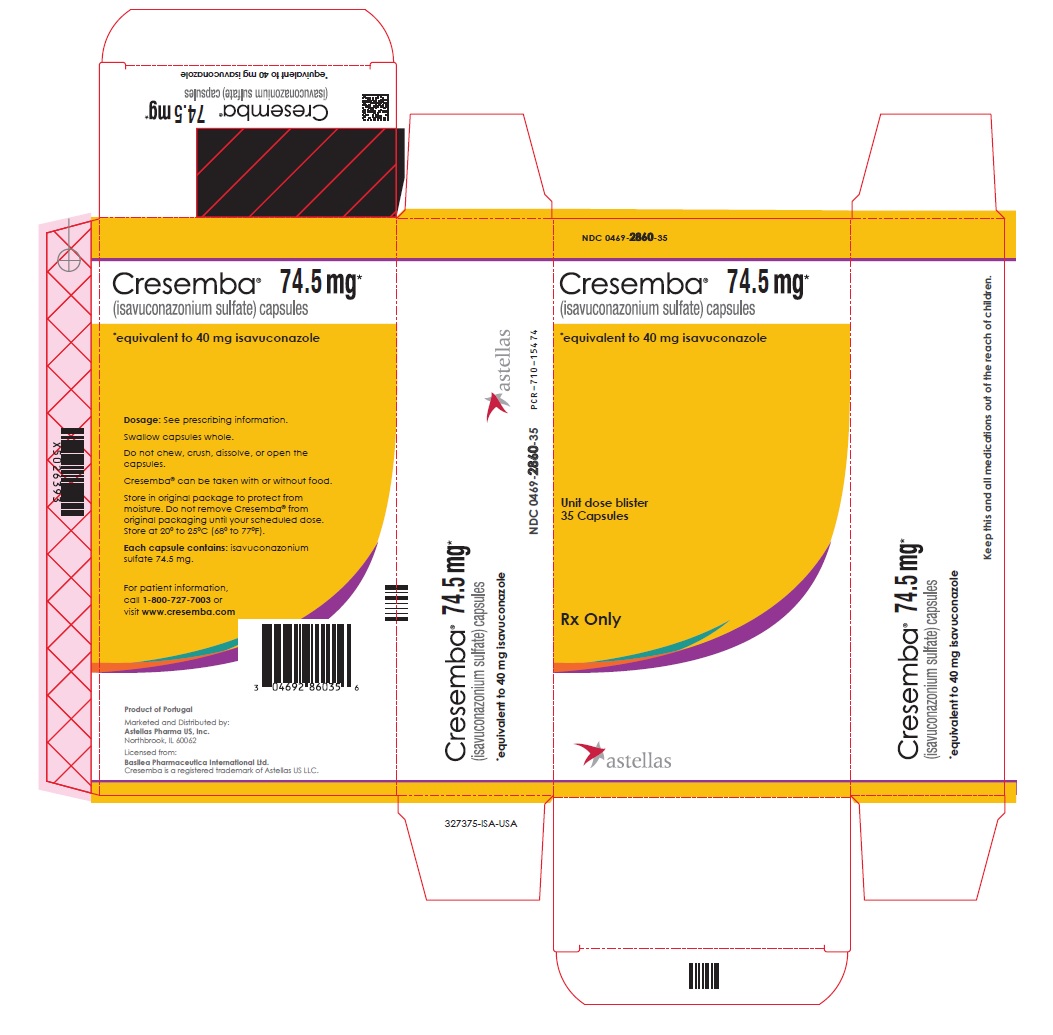
Cresemba isavuconazonium sulfate 40 mg Capsule, 35-count — NDC 0469-2860-35 (Billing 00469-2860-35)
This is a package of 35 capsules of Cresemba isavuconazonium sulfate 40 mg Capsule from Astellas Pharma US, Inc., marketed since Nov 2022 and currently FDA-listed. It is this product's only package size.
NDC database record
One package, one record: these facts belong to NDC 0469-2860-35 alone.
- Record
- FDA NDC Directory package listing · Human prescription drug
- Code segments
- 0469 labeler · 2860 product · 35 package
- Package marketed since
- Nov 22, 2022
- Sample package
- No — commercial package
- Listing certified through
- Dec 31, 2026
- Billing quantity
- 35 EA per package
- Barcode (UPC-A, from the NDC)
- 3 0469286035 6
- Medicaid fills, this package
- 61 prescriptions in the last four reported quarters
- FDA record last changed
- Jul 24, 2026
Identity & classification
Regulatory identifiers FDA, NLM and CMS codes for this package
Drug-database identifiers Medi-Span GPI and First Databank GCN / HICL / AHFS classification
- GSN (GCN sequence number): 085265
- GCN: 54696
- GPI-14 (Medi-Span): 11407030110115
- HICL (First Databank): 041817
- AHFS class code: 08:14.08.00
- RxCUI (RxNorm): 1608327
Where does this data come from?
- FDA openFDA NDC Directory · synced Oct 1, 2026
- FDA label on DailyMed · label index refreshed Oct 3, 2026
- RxNorm (NLM RxNav) · catalog refreshed Oct 1, 2026
- Medi-Span GPI (licensed)
- First Databank (licensed) · refreshed Oct 1, 2026
Clinical
Isavuconazonium is used to treat serious fungal infections such as invasive aspergillosis (a fungal infection that begins in the lungs and spreads through the bloodstream to other organs) and invasive mucormycosis (a fungal infection that usually begins in the sinuses, brain, or lungs) in adults and children 6 years of age and older who weigh at least 35 pounds (16 kg). Isavuconazonium is in a class of medications called azole antifungals. It works by slowing the growth of fungi that cause infection.
Read the full MedlinePlus article ↗- Isavuconazonium injection (Cresemba) treats two serious fungal infections: invasive aspergillosis and invasive mucormycosis. The injection can be used in adults and children 1 year...
- A healthcare professional gives it as an IV infusion that lasts at least 1 hour through a special filter. You start with doses every 8 hours for the first 2 days. After that, it is...
- The most common are nausea, vomiting, diarrhea, headache, low potassium, and changes in liver blood tests. Your team will check your liver tests during treatment.
- Speak up during the infusion if you feel dizzy, short of breath, chilled, or tingly, or if you notice hives, flushing, or swelling. Severe allergic reactions have been reported wit...
Patient education
Supplement & herbal interactions
Some supplements/herbs that may interact with Isavuconazonium Sulfate — tap one for details:
Where does this data come from?
- MedlinePlus (NLM) · refreshed Oct 1, 2026
- FDA label on DailyMed · label index refreshed Oct 3, 2026
Ask a licensed pharmacist directly — free, answered by our team.
Pricing
A drug doesn't have one price. Each row is a different public payment system, and none is what you'd pay at the counter — that depends on your insurance. The ⓘ on each row explains what it measures.
| Price system | Per each | Per package |
|---|---|---|
| Retail pharmacies payNADAC · weekly | Not in the retail survey — common for institutional, discontinued, or low-volume packs. | |
| Medicaid paysCMS SDUD · 12 mo | $46.33 | $1,621.57 / 35 capsule |
| Medicare drug plans payPart D · Q2 2026 | $48.43 | $1,695.07 / 35 capsule |
Where does this data come from?
- CMS NADAC weekly file
- CMS ASP pricing files · refreshed Sep 20, 2026
- CMS Medicaid State Drug Utilization Data · through Q1 2026
- CMS Part D plan pricing files · refreshed Sep 24, 2026
- VA National Acquisition Center price file
Packaging — all sizes for this product
| Package NDC | Description | Marketing start | Marketing end | Status |
|---|---|---|---|---|
| 00469-2860-35 You're viewing this Main listing | 35 BLISTER PACK in 1 CARTON / 1 CAPSULE in 1 BLISTER PACK | 2022-11-22 | — | Active |
Therapeutic equivalents
| Product | Labeler | Pack | NADAC/unit | TE | Status | Price vs. this |
|---|---|---|---|---|---|---|
| Cresemba 40 mgthis 00469-2860-35 | Astellas | 35 capsules | — | — | FDA listed | — |
Where does this data come from?
- FDA openFDA NDC Directory · synced Oct 1, 2026
- FDA Orange Book · refreshed Oct 3, 2026
- CMS NADAC weekly file
Availability & generic status
We did not find an FDA-approved generic match for this exact strength, form and route. Patent/protection dates below may affect future generic timing.
Why the date isn’t exact: Generic timing can change because patents may be challenged, settled, licensed, added, removed, or worked around with a narrower label — and FDA approval does not always mean a pharmacy can get the generic today.
🛈 What do these terms mean?
- Patent
- Legal protection listed in the Orange Book that may delay generic approval or launch. Issued by the U.S. Patent & Trademark Office.
- Substance patent
- Covers the active drug molecule itself — the hardest to design around. A generic generally can’t launch until it expires.
- Formulation (product) patent
- Covers a specific formulation or dosage form. A generic can sometimes work around it with a different formulation.
- Method-of-use patent
- A patent covering one specific approved use of the drug — not necessarily the whole molecule. A generic can sometimes launch with a “skinny label” that carves out the protected use and keeps the others.
- Skinny label
- A generic label that omits a still-patented use when the FDA allows it — letting a generic reach the market for the unprotected uses.
- Exclusivity
- FDA-granted marketing protection, separate from patents — e.g. 5-yr new chemical entity, 7-yr orphan drug, or a +6-month pediatric extension.
- Paragraph IV
- A generic applicant’s formal challenge to a listed patent. It can potentially lead to earlier generic entry, but often involves litigation or a settlement.
- RLD / RS
- Reference Listed Drug — the brand product the FDA uses as the reference for generic applications. Reference Standard — the product the FDA expects generics to compare against in bioequivalence testing.
- TE / AB rating
- FDA therapeutic-equivalence rating. An AB rating generally means the FDA considers a generic therapeutically equivalent to — and substitutable for — the brand.
- LOE (loss of exclusivity)
- The latest patent or exclusivity currently listed — the loss-of-exclusivity / latest-listed-protection date shown on this page. Paragraph-IV challenges and settlements can move the real date earlier; FDA approval and a manufacturer’s decision to market can move it later.
Built from the FDA Orange Book. The bars above are scaled to each protection’s expiry; the red LOE marker is the last one to lapse.
| Patent | Type | Use code | Expires |
|---|---|---|---|
| US 10603280 ↗ | Drug product | — | Sep 14, 2027 |
| US 10206879 ↗ | Drug product | — | Sep 14, 2027 |
| US 6812238 ↗ | Drug substance | — | Oct 31, 2025 |
| US 6812238 ↗ | Drug substance | — | Oct 31, 2025 |
| US 10206879 ↗ | Drug product | — | Sep 14, 2027 |
| US 10603280 ↗ | Drug product | — | Sep 14, 2027 |
| US 6812238*PED ↗ | Drug product | — | Apr 30, 2026 |
| US 10603280*PED ↗ | Drug product | — | Mar 14, 2028 |
| US 10206879*PED ↗ | Drug product | — | Mar 14, 2028 |
| US 10603280*PED ↗ | Drug product | — | Mar 14, 2028 |
| US 10206879*PED ↗ | Drug product | — | Mar 14, 2028 |
| US 6812238*PED ↗ | Drug product | — | Apr 30, 2026 |
| Code | What it grants | Expires |
|---|---|---|
| NPP | New Patient Population | Dec 8, 2026 |
| ODE-305 | Orphan Drug Exclusivity (7-year) | Mar 6, 2022 |
| ODE-454 | Orphan Drug Exclusivity (7-year) | Dec 8, 2030 |
| ODE-458 | Orphan Drug Exclusivity (7-year) | Dec 8, 2030 |
| ODE-90 | Orphan Drug Exclusivity (7-year) | Mar 6, 2022 |
| NPP | New Patient Population | Dec 8, 2026 |
| ODE* | Orphan Drug Exclusivity (7-year) | Mar 6, 2022 |
| ODE-454 | Orphan Drug Exclusivity (7-year) | Dec 8, 2030 |
| ODE-458 | Orphan Drug Exclusivity (7-year) | Dec 8, 2030 |
| PED | Pediatric Exclusivity (+6 months) | Sep 6, 2022 |
| PED | Pediatric Exclusivity (+6 months) | Sep 6, 2022 |
| PED | Pediatric Exclusivity (+6 months) | Jun 8, 2031 |
| PED | Pediatric Exclusivity (+6 months) | Jun 8, 2031 |
| PED | Pediatric Exclusivity (+6 months) | Jun 8, 2027 |
| PED | Pediatric Exclusivity (+6 months) | Jun 8, 2027 |
| PED | Pediatric Exclusivity (+6 months) | Sep 6, 2022 |
| PED | Pediatric Exclusivity (+6 months) | Jun 8, 2031 |
| PED | Pediatric Exclusivity (+6 months) | Jun 8, 2031 |
| GAIN | Qualified Infectious Disease Product (+5-year) | Sep 6, 2027 |
| GAIN | Qualified Infectious Disease Product (+5-year) | Sep 6, 2027 |
| GAIN | Qualified Infectious Disease Product (+5-year) | Sep 6, 2027 |
Is there a generic version of CRESEMBA 74.5 MG CAPSULE?
The FDA approved a generic — why can’t I get it at my pharmacy yet?
Why do different websites show different generic release dates?
What does “FDA listed” mean?
What does a patent or protection date mean here?
What does “current Orange Book estimate” mean?
Can a generic come out before the last patent expires?
Can a generic come out after the listed dates?
What is the difference between patents and exclusivity?
Why are there multiple patent dates?
Where does this data come from?
- FDA Orange Book · refreshed Oct 3, 2026
What it looks like
Where does this data come from?
- FDA label on DailyMed · label index refreshed Oct 3, 2026
Inactive Ingredients / Excipients
Inactive ingredients, also called excipients, are components of the drug product other than the active ingredient. They may include fillers, dyes, coatings, preservatives, flavors, or other formulation ingredients.
Where does this data come from?
IACT rows and label-wide narrative are kept separate; availability and product-level specificity depend on the submitted label.- FDA label on DailyMed · label index refreshed Oct 3, 2026
- FDA openFDA NDC Directory · synced Oct 1, 2026
Inactive ingredient FAQ
Are inactive ingredients the same for every manufacturer?
Why might an inactive ingredient be missing?
Can inactive ingredients matter?
Manufacturer & labeler
More NDCs from Astellas Pharma US, Inc. labeler code 00469
- Veozah fezolinetant 45 mg Tablet, Film Coated NDC 0469-2460-28
- Myrbetriq mirabegron 25 mg Tablet, Film Coated, Extended Release NDC 0469-2601-07
- Myrbetriq mirabegron 50 mg Tablet, Film Coated, Extended Release NDC 0469-2602-07
- mirabegron 1 kg/kg Powder NDC 0469-2603-01
- Veozah fezolinetant 45 mg Tablet, Film Coated NDC 0469-2660-30
- Veozah fezolinetant 45 mg Tablet, Film Coated NDC 0469-2760-28
- Prograf Tacrolimus 5 mg/mL Injection, Solution NDC 0469-3016-01
- AmBisome amphotericin B 50 mg/12.5mL Injection, Powder, Lyophilized, For Solution NDC 0469-3051-30
- Mycamine Micafungin sodium 10 mg/mL Injection, Powder, Lyophilized, For Solution NDC 0469-3250-10
- VYLOY ZOLBETUXIMAB 20 mg/mL Injection, Powder, For Suspension NDC 0469-3425-10
- VYLOY ZOLBETUXIMAB 20 mg/mL Injection, Powder, For Suspension NDC 0469-4425-30
- Myrbetriq mirabegron 8 mg/mL Granule, For Suspension, Extended Release NDC 0469-5020-99
Where does this data come from?
- FDA openFDA NDC Directory · synced Oct 1, 2026
- Drugs@FDA
Full prescribing information FDA SPL
🎯 Indications and Usage ▾
1 INDICATIONS AND USAGE CRESEMBA ® is an azole antifungal indicated for the treatment of: Invasive aspergillosis ( 1.1 ) and Invasive mucormycosis ( 1.2 ) as follows: • CRESEMBA for injection : adults and pediatric patients 1 year of age and older • CRESEMBA capsules : adults and pediatric patients 6 years of age and older who weigh 16 kilograms (kg) and greater
1.1Invasive Aspergillosis CRESEMBA ® is indicated for the treatment of invasive aspergillosis as follows: CRESEMBA for injection : adults and pediatric patients 1 year of age and older [see Clinical Studies ( 14.1 ) and Clinical Pharmacology ( 12.4 )] CRESEMBA capsules : adults and pediatric patients 6 years of age and older who weigh 16 kilograms (kg) and greater [see Dosage and Administration ( 2.3 ) Clinical Studies ( 14.1 ) and Clinical Pharmacology ( 12.4 )]
1.2Invasive Mucormycosis CRESEMBA is indicated for the treatment of invasive mucormycosis as follows: CRESEMBA for injection : adults and pediatric patients 1 year of age and older [see Clinical Studies ( 14.1 ) and Clinical Pharmacology ( 12.3 , 12.4 )] CRESEMBA capsules : adults and pediatric patients 6 years of age and older who weigh 16 kg and greater [see Dosage and Administration ( 2.3 )], Clinical Studies ( 14.1 ) and Clinical Pharmacology ( 12.3 , 12.4 )]
1.3Usage Specimens for fungal culture and other relevant laboratory studies (including histopathology) to isolate and identify causative organism(s) should be obtained prior to initiating antifungal therapy. Therapy may be instituted before the results of the cultures and other laboratory studies are known. However, once these results become available, antifungal therapy should be adjusted accordingly.
⏱️ Dosage and Administration ▾
2 DOSAGE AND ADMINISTRATION Important Administration Instructions: • CRESEMBA for injection is intended for use in patients who are 1 year of age and older ( 2.1 , 2.3 ). • CRESEMBA for injection via nasogastric (NG) tube administration is intended for use by patients who are 6 years of age and older and weighing 16 kg and greater. ( 2.1 , 2.6 ). • CRESEMBA for injection must be administered through an in-line filter over a minimum of 1 hour. ( 2.1 , 2.5 ). • CRESEMBA capsules are intended for use in patients who are 6 years of age and older and weighing 16 kg and greater ( 2.1 , 2.3 ). • CRESEMBA capsules can be taken with or without food.
( 2.1 ). Recommended Dosage in Adult Patients ( 2.2 ): Recommended Dosage for CRESEMBA in Adult Patients ( 2.2 ) Dosage Form Loading Dose Maintenance Dose Start maintenance doses 12 to 24 hours after the last loading dose CRESEMBA for Injection, 372 mg/vial 372 mg of isavuconazonium sulfate per vial One reconstituted vial (372 mg) intravenously every 8 hours for 6 doses (48 hours) One reconstituted vial (372 mg) intravenously once daily CRESEMBA Capsules, 186 mg 186 mg of isavuconazonium sulfate per capsule Two 186 mg capsules (372 mg) orally every 8 hours for 6 doses (48 hours) Two 186 mg capsules (372 mg) orally once daily CRESEMBA Capsules, 74.5 mg 74.5 mg of isavuconazonium sulfate per capsule Five 74.5 mg capsules (372 mg) orally every 8 hours for 6 doses (48 hours) Five 74.5 mg capsules (372 mg) orally once daily Recommended Dosage in Pediatric Patients ( 2.3 ): • The maximum of any individual loading or daily maintenance dose to be administered to any pediatric patient is 372 mg of CRESEMBA.
( 2.3 ) Recommended Dosage for CRESEMBA in Pediatric Patients ( 2.3 ) Dosage Form Age Body Weight (kg) Loading Dose Maintenance Dose Start maintenance doses 12 to 24 hours after the last loading dose CRESEMBA for Injection, 372 mg/vial 372 mg of isavuconazonium sulfate per vial 1 to less than 3 years of age less than 18 kg 15 mg/kg intravenously every 8 hours for 6 doses (48 hours) 15 mg/kg intravenously once daily 3 to less than 18 years of age less than 37 kg 10 mg/kg intravenously every 8 hours for 6 doses (48 hours) 10 mg/kg intravenously once daily greater than or equal to 37 kg One reconstituted vial (372 mg) intravenously every 8 hours for 6 doses (48 hours) One reconstituted vial (372 mg) intravenously once daily CRESEMBA Capsules, 74.5 mg 74.5 mg of isavuconazonium sulfate per capsule 6 to less than 18 years of age 16 kg to less than 18 kg Two capsules (149 mg) orally every 8 hours for 6 doses (48 hours) Two capsules (149 mg) orally once daily 18 kg to less than 25 kg Three capsules (223.5 mg) orally every 8 hours for 6 doses (48 hours) Three capsules (223.5 mg) orally once daily 25 kg to less than 32kg Four capsules (298 mg) orally every 8 hours for 6 doses (48 hours) Four capsules (298 mg) orally once daily greater than or equal to 32 kg Five 74.5 mg capsules (372 mg) orally every 8 hours for 6 doses (48 hours) Five 74.5 mg capsules (372 mg) orally once daily
2.1Important Administration Instructions for CRESEMBA CRESEMBA for Injection • CRESEMBA for injection is intended for use in patients who are 1 year of age and older [see Dosage and Administration ( 2.2 and 2.3 )]. • Intravenous formulation must be administered via an infusion set with an in-line filter (pore size 0.2 to 1.2 micron). • Infuse the intravenous formulation over a minimum of 1 hour in 250 mL of a compatible diluent, to reduce the risk for infusion-related reactions. Do not administer as an intravenous bolus injection. • Do not infuse CRESEMBA with other intravenous medications. • Flush intravenous lines with 0.9% sodium chloride injection, USP or 5% dextrose injection, USP prior to and after infusion of CRESEMBA. • After dilution of the intravenous formulation, avoid unnecessary vibration or vigorous shaking of the solution.
Do not use a pneumatic transport system. Nasogastric Tube Administration of CRESEMBA for Inje… [Excerpted — this section continues on DailyMed.]
💊 Dosage Forms and Strengths ▾
3 DOSAGE FORMS AND STRENGTHS CRESEMBA Capsules CRESEMBA 74.5 mg isavuconazonium sulfate (equivalent to 40 mg of isavuconazole) capsules are opaque and have a Swedish orange (reddish-brown) body imprinted with the Astellas logo in black ink and a Swedish orange cap imprinted with “557” in black ink. CRESEMBA 186 mg isavuconazonium sulfate (equivalent to 100 mg of isavuconazole) capsules are opaque, elongated and have a Swedish orange (reddish-brown) body imprinted with the Astellas logo in black ink and a white cap imprinted with “766” in black ink.
CRESEMBA for Injection Each single-dose vial of CRESEMBA for injection contains 372 mg isavuconazonium sulfate (equivalent to 200 mg of isavuconazole). CRESEMBA for injection is supplied in a single-dose vial as a sterile lyophilized white to yellow powder. • CRESEMBA for injection is supplied in a single-dose vial as a sterile lyophilized powder containing 372 mg of isavuconazonium sulfate (equivalent to 200 mg of isavuconazole). ( 3 ) • CRESEMBA capsules: 74.5 mg of isavuconazonium sulfate (equivalent to 40 mg of isavuconazole), 186 mg of isavuconazonium sulfate (equivalent to 100 mg of isavuconazole).
( 3 )
⛔ Contraindications ▾
4 CONTRAINDICATIONS • CRESEMBA is contraindicated in persons with known hypersensitivity to isavuconazole. • Coadministration of strong CYP3A4 inhibitors, such as ketoconazole or high-dose ritonavir (400 mg every 12 hours), with CRESEMBA is contraindicated because strong CYP3A4 inhibitors can significantly increase the plasma concentration of isavuconazole [see Drug Interactions ( 7 ) and Clinical Pharmacology ( 12.3 )] . • Coadministration of strong CYP3A4 inducers, such as rifampin, carbamazepine, St. John’s wort, or long acting barbiturates with CRESEMBA is contraindicated because strong CYP3A4 inducers can significantly decrease the plasma concentration of isavuconazole [see Drug Interactions ( 7 ) and Clinical Pharmacology ( 12.3 )] . • CRESEMBA shortened the QTc interval in a concentration-related manner.
CRESEMBA is contraindicated in patients with familial short QT syndrome [see Clinical Pharmacology ( 12.2 )] . • Hypersensitivity to CRESEMBA. ( 4 ) • Coadministration with strong CYP3A4 inhibitors, such as ketoconazole or high-dose ritonavir. ( 4 , 7 ) • Coadministration with strong CYP3A4 inducers, such as rifampin, carbamazepine, St.
John’s wort, or long acting barbiturates. ( 4 , 7 ) • Use in patients with familial short QT syndrome. ( 4 )
⚠️ Warnings and Cautions ▾
5 WARNINGS AND PRECAUTIONS • Hepatic Adverse Drug Reactions: Serious hepatic reactions have been reported. Evaluate liver-related laboratory tests at the start and during the course of CRESEMBA therapy. ( 5.1 ) • Infusion-related reactions were reported during intravenous administration of CRESEMBA.
Discontinue the infusion if these reactions occur. ( 5.2 ) • Hypersensitivity Reactions: Anaphylactic reactions, with fatal outcome, have been reported during treatment with CRESEMBA. Serious skin reactions, such as Stevens-Johnson syndrome, have been reported during treatment with other azole antifungal agents.
Discontinue CRESEMBA if anaphylactic or serious skin reactions occur, and initiate supportive treatment as needed. ( 5.3 ) • Embryo-Fetal Toxicity: CRESEMBA may cause fetal harm when administered to a pregnant woman. Advise pregnant women of the potential risk to the fetus.
Advise females of reproductive potential to use an effective method of contraception. ( 5.4 , 8.1 , 8.3 ) • Drug Interactions: Review patient’s concomitant medications. Several drugs may significantly alter isavuconazole concentrations.
Isavuconazole may alter concentrations of several drugs. ( 5.5 , 7 , 12.3 ) • Drug Particulates: Intravenous formulation may form insoluble particulates following reconstitution. Administer CRESEMBA through an in-line filter.
( 2.4 , 5.6 )
5.1Hepatic Adverse Drug Reactions Hepatic adverse drug reactions (e.g., elevations in alanine aminotransferase (ALT), aspartate aminotransferase (AST), alkaline phosphatase, total bilirubin) have been reported in clinical trials. The elevations in liver-related laboratory tests were generally reversible and did not require discontinuation of CRESEMBA. Cases of more severe hepatic adverse drug reactions including hepatitis, cholestasis or hepatic failure including death have been reported in patients with serious underlying medical conditions (e.g., hematologic malignancy) during treatment with azole antifungal agents, including CRESEMBA.
Evaluate liver-related laboratory tests at the start and during the course of CRESEMBA therapy. Monitor patients who develop abnormal liver-related laboratory tests during CRESEMBA therapy for the development of more severe hepatic injury. Discontinue CRESEMBA if clinical signs and symptoms consistent with liver disease develop that may be attributable to CRESEMBA [see Adverse Reactions ( 6.1 )] .
5.2Infusion-Related Reactions Infusion-related reactions including hypotension, dyspnea, chills, dizziness, paresthesia, and hypoesthesia were reported during intravenous administration of CRESEMBA. Discontinue the infusion if these reactions occur [see Adverse Reactions ( 6.1 )] .
5.3Hypersensitivity Reactions Anaphylactic Reactions Anaphylactic reactions, with fatal outcome, have been reported during treatment with CRESEMBA. Symptoms including dyspnea, hypotension, generalized erythema with flushing, and urticaria have been reported in such cases often soon after the initiation of treatment. Severe Skin Reactions Severe skin reactions, such as Stevens-Johnson syndrome, have been reported during treatment with other azole antifungal agents.
Discontinue CRESEMBA if a patient develops an anaphylactic or severe cutaneous adverse reaction and initiate supportive treatment as needed. There is no information regarding cross-sensitivity between CRESEMBA and other azole antifungal agents though cross-sensitivity between other triazole agents has been reported. When prescribing CRESEMBA to patients with hypersensitivity to other azoles, monitor for signs and symptoms of hypersensitivity reactions.
5.4Embryo-Fetal Toxicity Based on findings from animal reproduction studies, CRESEMBA may cause fetal harm when administered to a pregnant woman. Advise pregnant women of the potential risk to a fetus. Perinatal mortality was significantly increased in the offspring of pregnant rats dosed orally with isavuconazonium sulfate at 90 mg/kg/day (less than half the maintenance… [Excerpted — this section continues on DailyMed.]
🤒 Adverse Reactions ▾
6 ADVERSE REACTIONS The following are discussed in more detail in other sections of the labeling: • Hepatic Adverse Drug Reactions [see Warnings and Precautions ( 5.1 )] • Infusion-Related Reactions [see Warnings and Precautions ( 5.2 )] • Hypersensitivity Reactions [see Warnings and Precautions ( 5.3 )] • Embryo-Fetal Toxicity [see Warnings and Precautions ( 5.4 )] • Adult Patients: The most frequent adverse reactions in adult patients were nausea, vomiting, diarrhea, headache, elevated liver chemistry tests, hypokalemia, constipation, dyspnea, cough, peripheral edema, and back pain.
( 6.1 ) • Pediatric Patients: The most frequent adverse reactions in pediatric patients were diarrhea, abdominal pain, vomiting, elevated liver chemistry tests, rash, nausea, pruritus, and headache. ( 6.1 ) To report SUSPECTED ADVERSE REACTIONS, contact Astellas Pharma US, Inc. at 1-800-727-7003 or FDA at 1-800-FDA-1088 or www.fda.gov/medwatch .
6.1Clinical Trial Experience Because clinical trials are conducted under widely varying conditions, adverse reaction rates observed in clinical trials of CRESEMBA cannot be directly compared to rates in clinical trials of another drug and may not reflect the rates observed in practice. Clinical Trials Experience in Adult Patients A total of 403 adult patients were exposed to CRESEMBA in two clinical trials. The most frequently reported adverse reactions among CRESEMBA-treated patients were nausea (26%), vomiting (25%), diarrhea (22%), headache (17%), elevated liver chemistry tests (16%), hypokalemia (14%), constipation (13%), dyspnea (12%), cough (12%), peripheral edema (11%), and back pain (10%).
Serious adverse reactions occurred in 223/403 (55%) of patients and 56/403 (14%) of patients permanently discontinued treatment with CRESEMBA due to an adverse reaction in the two trials. The adverse reactions which most often led to permanent discontinuation of CRESEMBA therapy during the clinical trials were confusional state (0.7%), acute renal failure (0.7%), increased blood bilirubin (0.5%), convulsion (0.5%), dyspnea (0.5%), epilepsy (0.5%), respiratory failure (0.5%), and vomiting (0.5%). Patients in the clinical trials were immunocompromised with underlying conditions including hematological malignancy, neutropenia post-chemotherapy, graft-versus-host disease, and hematopoietic stem cell transplant.
The patient population was 61% male, had a mean age of 51 years (range 17-92, including 85 patients aged greater than 65 years), and was 79% White and 3% Black. One hundred forty-four (144) patients had a duration of CRESEMBA therapy of greater than 12 weeks, with 52 patients receiving CRESEMBA for over six months. In Trial 1, a randomized, double-blind, active-controlled clinical trial for treatment of invasive aspergillosis, treatment‑emergent adverse reactions occurred in 247/257 (96%), and 255/259 (99%) patients in the CRESEMBA and voriconazole treatment groups, respectively.
Adverse reactions resulting in permanent discontinuation were reported in 37 (14%) CRESEMBA-treated patients and 59 (23%) voriconazole-treated patients. Table 3 includes selected adverse reactions which were reported at an incidence of ≥ 5% during CRESEMBA therapy in Trial 1. In Trial 2, an open-label, non-comparative trial of CRESEMBA in patients with invasive aspergillosis and renal impairment or invasive mucormycosis, adverse reactions occurred in 139/146 (95%) of patients in the CRESEMBA treatment group.
Adverse reactions resulting in permanent discontinuation were reported in 19 (13%) CRESEMBA‑treated patients. The frequencies and types of adverse reactions observed in CRESEMBA-treated patients were similar between Trial 1 and Trial 2. Table 3.
Selected Adverse Reactions with Rates of 5% or Greater in CRESEMBA-treated Patients in Trial 1 System Organ Class Adverse Reactions Trial 1 CRESEMBA (N=257) n (%) Voriconazole (N=259) n (%) Gastrointestinal disorders Nausea 71 (27.6) 78 (30.1) Vomiting 64 (24.9) 73 (28.2) Diarrhea 61 (23… [Excerpted — this section continues on DailyMed.]
🔄 Drug Interactions ▾
7 DRUG INTERACTIONS Isavuconazole is a sensitive substrate of CYP3A4. CYP3A4 inhibitors or inducers may alter the plasma concentrations of isavuconazole. Isavuconazole is a moderate inhibitor of CYP3A4, and a mild inhibitor of P-glycoprotein (P-gp), and organic cation transporter 2 (OCT2).
Drug interaction studies were conducted to investigate the effect of coadministered drugs on the pharmacokinetics of isavuconazole and the effect of isavuconazole on the pharmacokinetics of coadministered drugs [see Clinical Pharmacology ( 12.3 )] . Table 4. Drug(s) Affecting Pharmacokinetics of CRESEMBA Recommendation Comments Ketoconazole Contraindicate coadministration of all potent CYP3A4 inhibitors There is more than a 5-fold increase in exposure of isavuconazole upon coadministration with ketoconazole [see Clinical Pharmacology ( 12.3 )] .
Lopinavir/ritonavir 400 mg of lopinavir in combination with 100 mg of ritonavir. Caution is advised when CRESEMBA is coadministered with lopinavir/ritonavir There is a 96% increase in exposure of isavuconazole when coadministered with lopinavir/ritonavir [see Clinical Pharmacology ( 12.3 )] . Rifampin Contraindicate coadministration of all potent CYP3A4 inducers There is a 97% decrease in exposure of isavuconazole upon coadministration with rifampin [see Clinical Pharmacology ( 12.3 )] .
Table 5. The Effect of CRESEMBA on the Pharmacokinetics of Other Drugs Recommendation Comments Lopinavir/ritonavir 400 mg of lopinavir in combination with 100 mg of ritonavir. Use with Caution Concomitant administration of lopinavir/ritonavir and CRESEMBA resulted in decreased exposure of lopinavir and ritonavir that could possibly result in loss of antiviral efficacy [see Clinical Pharmacology ( 12.3 )] .
Atorvastatin Use with Caution Caution should be used when atorvastatin is used with CRESEMBA due to a potential increase in atorvastatin exposure. Monitor patients for adverse reactions that are typical of atorvastatin [see Clinical Pharmacology ( 12.3 )] . Cyclosporine Use with Caution Concomitant administration of CRESEMBA and cyclosporine results in increase in cyclosporine exposure.
Monitor drug concentrations of cyclosporine and adjust dose as needed [see Clinical Pharmacology ( 12.3 )] . Sirolimus Use with Caution Concomitant administration of CRESEMBA and sirolimus results in increase in sirolimus exposure. Monitor drug concentrations of sirolimus and adjust dose as needed [see Clinical Pharmacology ( 12.3 )] .
Tacrolimus Use with Caution Concomitant administration of CRESEMBA and tacrolimus results in increase in tacrolimus exposure. Monitor drug concentrations of tacrolimus and adjust dose as needed [see Clinical Pharmacology ( 12.3 )] . Midazolam Use with Caution Concomitant administration of CRESEMBA and midazolam results in increase in midazolam exposure.
Consider dose reduction of midazolam when isavuconazole is coadministered [see Clinical Pharmacology ( 12.3 )] . Bupropion Use with Caution Concomitant administration of CRESEMBA and bupropion results in decrease in bupropion exposure. Dose increase of bupropion may be necessary when coadministered with CRESEMBA, but should not exceed the maximum recommended dose [see Clinical Pharmacology ( 12.3 )] .
Mycophenolate Mofetil Use with Caution Concomitant administration of CRESEMBA and MMF results in increase in MMF exposure. Patients receiving CRESEMBA concurrently with MMF should be monitored for MPA-related toxicities [see Clinical Pharmacology ( 12.3 )] . Digoxin Use with Caution Concomitant administration of CRESEMBA and digoxin results in increase in digoxin exposure.
Serum digoxin concentrations should be monitored and used for titration when dosed concurrently with CRESEMBA [see Clinical Pharmacology ( 12.3 )] . Vincristine Avoid Concomitant Use Avoid concomitant use with CRESEMBA in pediatric and adult patients. CRESEMBA is predicted to have a less than 2‑fold increase in vincristine exposure in pediatric and adult patients [see Clinical Pharmacol… [Excerpted — this section continues on DailyMed.]
👥 Use in Specific Populations ▾
8 USE IN SPECIFIC POPULATIONS • Breastfeeding should be discontinued during treatment with CRESEMBA. ( 8.2 ) • Use in patients with severe hepatic impairment only when the benefits outweigh the risks; clinical monitoring for CRESEMBA‑related adverse reactions is recommended. ( 8.7 )
8.1Pregnancy Risk Summary Based on findings from animal studies, CRESEMBA may cause fetal harm when administered to a pregnant woman. There are no available human data on the use of CRESEMBA in pregnant women to evaluate for a drug-associated risk of major birth defects, miscarriage or adverse maternal or fetal outcomes. In animal reproduction studies, perinatal mortality was increased in the offspring of pregnant rats dosed orally with isavuconazonium sulfate at approximately 0.5 times the clinical exposure during pregnancy through the weaning period.
In animal studies when isavuconazonium chloride was administered by oral gavage to pregnant rats and rabbits during organogenesis at exposures corresponding to less than the human maintenance dose, increases in the incidences of multiple skeletal abnormalities, including rudimentary cervical ribs and fused zygomatic arches, were observed (see Data). Advise pregnant women of the potential risk to a fetus [see Warnings and Precautions ( 5.4 )] . The estimated background risk of major birth defects and miscarriage for the indicated populations are unknown.
All pregnancies have a background risk of birth defect, loss, or other adverse outcomes. In the U.S. general population, the estimated background risk of major birth defects and miscarriage in clinically recognized pregnancies is 2 to 4% and 15 to 20%, respectively. Data Animal Data Isavuconazonium chloride administration during organogenesis (gestational days 6-17 in rats and gestational days 6-18 in rabbits) was associated with dose-related increases in the incidences of rudimentary cervical ribs in rats and rabbits at 30 and 45 mg/kg, respectively, equivalent to about 0.2 and 0.1 times of the clinical exposure based on AUC comparisons.
In rats, dose-related increases in the incidences of zygomatic arch fusion and supernumerary ribs/rudimentary supernumerary ribs were also noted at 30 mg/kg and above, equivalent to 0.2 times the human AUC. Skeletal abnormalities have also been observed in embryo-fetal development studies of other azole antifungal agents. Isavuconazonium sulfate increased perinatal mortality in the pups when orally administered to pregnant rats during pregnancy and lactation (gestational day 6 through postpartum day 20) at doses up to 90 mg/kg/day (approximately 0.5 times the clinical exposure based on AUC comparison).
No effect on the duration of pregnancy or delivery was seen in the pups at this same dose.
8.2Lactation Risk Summary There are no data on the presence of isavuconazole in human milk, the effects on the breastfed infant or the effects on milk production. Isavuconazole was present in the milk of lactating rats following intravenous administration. When a drug is present in animal milk, it is likely that the drug will be present in human milk. Therefore, breastfeeding should be discontinued during treatment with CRESEMBA.
8.3Females and Males of Reproductive Potential Contraception CRESEMBA may cause embryo-fetal harm when administered to pregnant women [see Warnings and Precautions ( 5.4 ) and Use in Specific Populations ( 8.1 )]. Advise female patients of reproductive potential to use effective contraception during treatment with CRESEMBA and for 28 days after the final dose.
8.4Pediatric Use Invasive Aspergillosis The safety and effectiveness of CRESEMBA for injection for the treatment of invasive aspergillosis have been established in pediatric patients 1 year of age and older. The safety and effectiveness of CRESEMBA capsules for the treatment of invasive aspergillosis have been established in pediatric patients 6 year of age and older weighing 16 kg and greater. Use of CRESEMBA in this age group for treatment of… [Excerpted — this section continues on DailyMed.]
🤰 Pregnancy ▾
8.1Pregnancy Risk Summary Based on findings from animal studies, CRESEMBA may cause fetal harm when administered to a pregnant woman. There are no available human data on the use of CRESEMBA in pregnant women to evaluate for a drug-associated risk of major birth defects, miscarriage or adverse maternal or fetal outcomes. In animal reproduction studies, perinatal mortality was increased in the offspring of pregnant rats dosed orally with isavuconazonium sulfate at approximately 0.5 times the clinical exposure during pregnancy through the weaning period.
In animal studies when isavuconazonium chloride was administered by oral gavage to pregnant rats and rabbits during organogenesis at exposures corresponding to less than the human maintenance dose, increases in the incidences of multiple skeletal abnormalities, including rudimentary cervical ribs and fused zygomatic arches, were observed (see Data). Advise pregnant women of the potential risk to a fetus [see Warnings and Precautions ( 5.4 )] . The estimated background risk of major birth defects and miscarriage for the indicated populations are unknown.
All pregnancies have a background risk of birth defect, loss, or other adverse outcomes. In the U.S. general population, the estimated background risk of major birth defects and miscarriage in clinically recognized pregnancies is 2 to 4% and 15 to 20%, respectively. Data Animal Data Isavuconazonium chloride administration during organogenesis (gestational days 6-17 in rats and gestational days 6-18 in rabbits) was associated with dose-related increases in the incidences of rudimentary cervical ribs in rats and rabbits at 30 and 45 mg/kg, respectively, equivalent to about 0.2 and 0.1 times of the clinical exposure based on AUC comparisons.
In rats, dose-related increases in the incidences of zygomatic arch fusion and supernumerary ribs/rudimentary supernumerary ribs were also noted at 30 mg/kg and above, equivalent to 0.2 times the human AUC. Skeletal abnormalities have also been observed in embryo-fetal development studies of other azole antifungal agents. Isavuconazonium sulfate increased perinatal mortality in the pups when orally administered to pregnant rats during pregnancy and lactation (gestational day 6 through postpartum day 20) at doses up to 90 mg/kg/day (approximately 0.5 times the clinical exposure based on AUC comparison).
No effect on the duration of pregnancy or delivery was seen in the pups at this same dose.
🧒 Pediatric Use ▾
8.4Pediatric Use Invasive Aspergillosis The safety and effectiveness of CRESEMBA for injection for the treatment of invasive aspergillosis have been established in pediatric patients 1 year of age and older. The safety and effectiveness of CRESEMBA capsules for the treatment of invasive aspergillosis have been established in pediatric patients 6 year of age and older weighing 16 kg and greater. Use of CRESEMBA in this age group for treatment of invasive aspergillosis is supported by evidence from one adequate and well-controlled trial in adult patients and additional pharmacokinetic and safety data in pediatric patients 1 year of age and older [see Clinical Pharmacology ( 12.3 )].
Adverse reactions in this pediatric population were similar to those reported in the adult population [see Adverse Reactions ( 6.1 )]. The safety and effectiveness of CRESEMBA capsules for treatment of invasive aspergillosis have not been established in pediatric patients younger than 6 years of age or who weigh less than 16 kg because the oral route of administration was not assessed in this pediatric patient age cohort. The safety and effectiveness of CRESEMBA for treatment of invasive aspergillosis in pediatric patients less than 1 year of age have not been established.
Invasive Mucormycosis The safety and effectiveness of CRESEMBA for injection for the treatment of invasive mucormycosis have been established in pediatric patients 1 year of age and older. The safety and effectiveness of CRESEMBA capsules for the treatment of invasive mucormycosis have been established in pediatric patients 6 year of age and older weighing 16 kg and greater. Use of CRESEMBA in this age group for treatment of invasive mucormycosis is supported by one open-label trial in adult patients with invasive mucormycosis, a retrospective review of survival data for adult patients with untreated invasive mucormycosis, and additional pharmacokinetic and safety data in pediatric patients 1 year of age and older [see Clinical Pharmacology ( 12.3 )] .
Adverse reactions in this pediatric population were similar to those reported in the adult population [ see Adverse Reactions ( 6.1 )]. The safety and effectiveness of CRESEMBA capsules for treatment of invasive mucormycosis have not been established in pediatric patients younger than 6 years of age who weigh less than 16 kg because the oral route of administration was not assessed in this pediatric patient age cohort. The safety and effectiveness of CRESEMBA for treatment of invasive mucormycosis in pediatric patients less than 1 year of age have not been established.
🧓 Geriatric Use ▾
8.5Geriatric Use Of the 547 patients who received CRESEMBA in the Phase 2 and 3 trials, 86 (16%) of patients were greater than 65 years of age and 20 (4%) were greater than 75 years of age. The pharmacokinetics of isavuconazole are comparable in young and elderly subjects (65 years of age and older) [see Clinical Pharmacology ( 12.3 )] . No dose adjustment of CRESEMBA is needed in elderly patients.
No overall differences in safety or effectiveness were observed between these subjects and younger subjects, and other reported clinical experience has not identified differences in responses between the elderly and younger patients, but greater sensitivity of some older individuals cannot be ruled out.
🆘 Overdosage ▾
10 OVERDOSAGE During clinical studies, total daily CRESEMBA doses higher than the recommended dose regimen were associated with an increased rate of adverse reactions. At supratherapeutic doses (three times the recommended maintenance dose) evaluated in a thorough QT study, there were proportionally more treatment-emergent adverse reactions than in the therapeutic dose group (maintenance dose) for the following: headache, dizziness, paresthesia, somnolence, disturbance in attention, dysgeusia, dry mouth, diarrhea, oral hypoesthesia, vomiting, hot flush, anxiety, restlessness, palpitations, tachycardia, photophobia and arthralgia.
Adverse reactions leading to discontinuation of study drug occurred in 7 of 39 (17.9%) subjects in the supratherapeutic dose group. Isavuconazole is not removed by hemodialysis. There is no specific antidote for isavuconazole.
Treatment should be supportive with appropriate monitoring.
🧬 Clinical Pharmacology ▾
12 CLINICAL PHARMACOLOGY
12.1Mechanism of Action Isavuconazonium sulfate is the prodrug of isavuconazole, an azole antifungal [see Microbiology ( 12.4 )] .
12.2Pharmacodynamics Pharmacokinetic/Pharmacodynamic Relationship In patients treated with CRESEMBA for invasive aspergillosis in a controlled trial, there was no significant association between plasma AUC or plasma isavuconazole concentration and efficacy. Cardiac Electrophysiology The effect on QTc interval of multiple doses of CRESEMBA capsules was evaluated. CRESEMBA was administered as 2 capsules (equivalent to 200 mg isavuconazole) three times daily on days 1 and 2 followed by either 2 capsules or 6 capsules (equivalent to 600 mg isavuconazole) once daily for 13 days in a randomized, placebo- and active-controlled (moxifloxacin 400 mg single-dose), four-treatment-arm, parallel study in 160 healthy subjects.
Isavuconazole resulted in dose-related shortening of the QTc interval. For the 2-capsule dosing regimen, the least squares mean (LSM) difference from placebo was -13.1 msec at 2 hours postdose [90% CI: -17.1, -9.1 msec]. Increasing the dose to 6 capsules resulted in an LSM difference from placebo of -24.6 msec at 2 hours postdose [90% CI: -28.7, -20.4].
CRESEMBA was not evaluated in combination with other drugs that reduce the QTc interval, so the additive effects are not known.
12.3Pharmacokinetics General Pharmacokinetics In healthy subjects, the pharmacokinetics of isavuconazole following oral administration of CRESEMBA capsules at isavuconazole equivalent doses up to 600 mg per day (6 capsules) are dose proportional ( Table 6 ). Based on a population pharmacokinetics analysis of healthy subjects and patients, the mean plasma half-life of isavuconazole was 130 hours and the mean volume of distribution (V ss ) was approximately 450 L following intravenous administration. Table 6.
Steady State Pharmacokinetic Parameters of Isavuconazole Following Administration of 186 mg CRESEMBA Capsules Parameter CRESEMBA 186 mg 2 Capsules Each capsule contains the equivalent of 100 mg of isavuconazole. (n = 37) CRESEMBA 186 mg 6 Capsules (n = 32) C max (mg/L) Mean SD CV % 7.5 1.9 25.2 20.0 3.6 17.9 t max (hr) Median Range 3.0 2.0 – 4.0 4.0 2.0 –
4.0AUC (mg•hr/L) Mean SD CV % 121.4 35.8 29.5 352.8 72.0
20.4Following oral administration of CRESEMBA capsules at an isavuconazole equivalent dose of 200 mg in 66 fasted healthy male subjects, a single dose administration of two 186 mg CRESEMBA capsules and five 74.5 mg CRESEMBA capsules exhibited a mean (SD) C max and AUC of 3.3 (0.6) mg/L and 112.2 (30.3) mg·hr/L, respectively, and 3.3 (0.6) mg/L and 118.0 (33.1) mg·hr/L, respectively. Absorption After oral administration of CRESEMBA in healthy volunteers, the active moiety, isavuconazole, generally reaches maximum plasma concentrations (C max ) 2 hours to 3 hours after single and multiple dosing.
The absolute bioavailability of isavuconazole following oral administration of CRESEMBA is 98%. No significant concentrations of the prodrug or inactive cleavage product were seen in plasma after oral administration. Following intravenous administration of CRESEMBA, maximal plasma concentrations of the prodrug and inactive cleavage product were detectable during infusion and declined rapidly following the end of administration.
The prodrug was below the level of detection by 1.25 hours after the start of a one-hour infusion. The total exposure of the prodrug based on AUC was less than 1% that of isavuconazole. The inactive cleavage product was quantifiable in some subjects up to 8 hours after the start of infusion.
The total exposure of inactive cleavage product based on AUC was approximately 1.3% that of isavuconazole. CRESEMBA given orally as an intravenous solution administered via nasogastric (NG) tube provides systemic isavuconazole exposure that is similar to the oral capsule ( Table 7 ). Table 7.
Statistical Comparison of Plasma Pharmacokinetics of Isavuconazole Following Single… [Excerpted — this section continues on DailyMed.]
🧬 Mechanism of Action ▾
12.1Mechanism of Action Isavuconazonium sulfate is the prodrug of isavuconazole, an azole antifungal [see Microbiology ( 12.4 )] .
📦 How Supplied / Storage and Handling ▾
16 HOW SUPPLIED/STORAGE AND HANDLING
16.1How Supplied CRESEMBA Capsules CRESEMBA (isavuconazonium sulfate) 74.5 mg capsules are supplied as opaque capsules and have a Swedish orange (reddish-brown) body imprinted with the Astellas logo in black ink and a Swedish orange cap imprinted with “557” in black ink. Each capsule contains 74.5 mg isavuconazonium sulfate (equivalent to 40 mg of isavuconazole) and is packaged as follows: 35-count carton (contains seven individual aluminum child-resistant blister packs of 5 capsules per sheet with desiccant) NDC 0469-2860-35 CRESEMBA (isavuconazonium sulfate) 186 mg capsules are supplied as opaque and elongated capsules and have a Swedish orange (reddish-brown) body imprinted with the Astellas logo in black ink and a white cap imprinted with “766” in black ink.
Each capsule contains 186 mg isavuconazonium sulfate (equivalent to 100 mg of isavuconazole) and is packaged as follows: 14-count carton (contains two individual aluminum child-resistant blister packs of 7 capsules per sheet with desiccant) NDC 0469-0520-02 CRESEMBA for Injection CRESEMBA (isavuconazonium sulfate) for injection is supplied as white to yellow sterile lyophilized powder containing 372 mg isavuconazonium sulfate (equivalent to 200 mg isavuconazole) in a single-dose vial and is packaged as follows: Individually packaged single-dose vial NDC 0469-0420-01
16.2Storage and Handling CRESEMBA Capsules Store CRESEMBA capsules at 20°C to 25°C (68°F to 77°F) in the original packaging to protect from moisture. Excursions are permitted from 15°C to 30°C (59°F to 86°F) [See USP Controlled Room Temperature]. CRESEMBA for Injection Store CRESEMBA for injection unreconstituted vials at 2°C to 8°C (36°F to 46°F) in a refrigerator.
CRESEMBA for injection is a single-dose vial of unpreserved sterile lyophile. Following reconstitution of the lyophile with water for injection USP, the reconstituted solution should be used immediately, or stored between 5°C to 25°C (41°F to 77°F) for a maximum of 1 hour prior to preparation of the patient infusion solution [see Dosage and Administration ( 2.4 )] . The prepared infusion solution should be kept for not more than 6 hours at room temperature [20°C to 25°C (68°F to 77°F)] or 24 hours at 2°C to 8°C (36°F to 46°F) prior to use [see Dosage and Administration ( 2.5 )] .
For nasogastric tube use, the reconstituted solution should be stored between 5°C to 25°C (41°F to 77°F) and used within 1 hour of reconstitution [see Dosage and Administration ( 2.6 )] .
📋 Description ▾
11 DESCRIPTION CRESEMBA contains isavuconazonium sulfate, which is the prodrug of isavuconazole, an azole antifungal drug. Isavuconazonium sulfate drug substance is an amorphous, white to yellowish-white powder. The chemical name of isavuconazonium sulfate is glycine, N -methyl-, [2-[[[1-[1-[(2 R ,3 R )-3-[4-(4-cyanophenyl)-2-thiazolyl]-2-(2,5-difluorophenyl)-2-hydroxybutyl]-4 H -1,2,4-triazolium-4-yl]ethoxy]carbonyl]methylamino]-3-pyridinyl]methyl ester, sulfate (1:1).
The empirical formula is C 35 H 35 F 2 N 8 O 5 S·HSO 4 , the molecular weight is 814.84 and the structural formula is: CRESEMBA Capsules CRESEMBA (isavuconazonium sulfate) 74.5 mg capsules are available for oral administration. Each CRESEMBA capsule contains 74.5 mg isavuconazonium sulfate, equivalent to 40 mg isavuconazole. The inactive ingredients include black iron oxide, colloidal silicon dioxide, disodium edetate, gellan gum, hypromellose, magnesium citrate, microcrystalline cellulose, potassium acetate, potassium hydroxide, propylene glycol, purified water, red iron oxide, shellac, sodium lauryl sulfate, stearic acid, strong ammonia solution, talc and titanium dioxide.
CRESEMBA (isavuconazonium sulfate) 186 mg capsules are available for oral administration. Each CRESEMBA capsule contains 186 mg isavuconazonium sulfate, equivalent to 100 mg isavuconazole. The inactive ingredients include black iron oxide, colloidal silicon dioxide, disodium edetate, gellan gum, hypromellose, magnesium citrate, microcrystalline cellulose, potassium acetate, potassium hydroxide, propylene glycol, purified water, red iron oxide, shellac, sodium lauryl sulfate, stearic acid, strong ammonia solution, talc and titanium dioxide.
CRESEMBA for Injection CRESEMBA (isavuconazonium sulfate) for injection is available for intravenous administration. CRESEMBA for injection is a white to yellow sterile, lyophilized powder containing 372 mg isavuconazonium sulfate, equivalent to 200 mg isavuconazole, per vial. Inactive ingredients included in each vial are 96 mg mannitol and sulfuric acid for pH adjustment.
Isavuconazonium sulfate Structural Formula
💬 Information for Patients ▾
17 PATIENT COUNSELING INFORMATION Advise the patient to read the FDA-approved patient labeling ( Patient Information ). Important Administration Instructions Advise patients that CRESEMBA can be taken with or without food. Each capsule should be swallowed whole.
Do not chew, crush, dissolve, or open the capsules [see Dosage and Administration 2.1 ]. Drug Interactions Advise patients to inform their physician if they are taking other drugs or before they begin taking other drugs as certain drugs can decrease or increase the plasma concentrations of CRESEMBA [see Warnings and Precautions ( 5.5 )] . CRESEMBA can decrease or increase the plasma concentrations of other drugs [see Drug Interactions ( 7 )] .
Pregnancy Advise patients to inform their physician if they are pregnant, plan to become pregnant, or are nursing [see Warnings and Precautions ( 5.4 ) and Pregnancy ( 8.1 )] . Allergic Reactions Advise patients to inform their physician immediately if they have ever had an allergic reaction to isavuconazole or other antifungal medicines such as ketoconazole, fluconazole, itraconazole, posaconazole, or voriconazole. Advise patients to discontinue CRESEMBA and seek immediate medical attention if any signs or symptoms of severe allergic reaction occur [see Warnings and Precautions ( 5.3 )] .
Marketed and Distributed by: Astellas Pharma US, Inc. Northbrook, IL 60062 CRESEMBA is a registered trademark of Astellas US LLC. Licensed from: Basilea Pharmaceutica International Ltd.
02625-ISA-USA
🧬 Pharmacokinetics ▾
12.3Pharmacokinetics General Pharmacokinetics In healthy subjects, the pharmacokinetics of isavuconazole following oral administration of CRESEMBA capsules at isavuconazole equivalent doses up to 600 mg per day (6 capsules) are dose proportional ( Table 6 ). Based on a population pharmacokinetics analysis of healthy subjects and patients, the mean plasma half-life of isavuconazole was 130 hours and the mean volume of distribution (V ss ) was approximately 450 L following intravenous administration. Table 6.
Steady State Pharmacokinetic Parameters of Isavuconazole Following Administration of 186 mg CRESEMBA Capsules Parameter CRESEMBA 186 mg 2 Capsules Each capsule contains the equivalent of 100 mg of isavuconazole. (n = 37) CRESEMBA 186 mg 6 Capsules (n = 32) C max (mg/L) Mean SD CV % 7.5 1.9 25.2 20.0 3.6 17.9 t max (hr) Median Range 3.0 2.0 – 4.0 4.0 2.0 –
4.0AUC (mg•hr/L) Mean SD CV % 121.4 35.8 29.5 352.8 72.0
20.4Following oral administration of CRESEMBA capsules at an isavuconazole equivalent dose of 200 mg in 66 fasted healthy male subjects, a single dose administration of two 186 mg CRESEMBA capsules and five 74.5 mg CRESEMBA capsules exhibited a mean (SD) C max and AUC of 3.3 (0.6) mg/L and 112.2 (30.3) mg·hr/L, respectively, and 3.3 (0.6) mg/L and 118.0 (33.1) mg·hr/L, respectively. Absorption After oral administration of CRESEMBA in healthy volunteers, the active moiety, isavuconazole, generally reaches maximum plasma concentrations (C max ) 2 hours to 3 hours after single and multiple dosing.
The absolute bioavailability of isavuconazole following oral administration of CRESEMBA is 98%. No significant concentrations of the prodrug or inactive cleavage product were seen in plasma after oral administration. Following intravenous administration of CRESEMBA, maximal plasma concentrations of the prodrug and inactive cleavage product were detectable during infusion and declined rapidly following the end of administration.
The prodrug was below the level of detection by 1.25 hours after the start of a one-hour infusion. The total exposure of the prodrug based on AUC was less than 1% that of isavuconazole. The inactive cleavage product was quantifiable in some subjects up to 8 hours after the start of infusion.
The total exposure of inactive cleavage product based on AUC was approximately 1.3% that of isavuconazole. CRESEMBA given orally as an intravenous solution administered via nasogastric (NG) tube provides systemic isavuconazole exposure that is similar to the oral capsule ( Table 7 ). Table 7.
Statistical Comparison of Plasma Pharmacokinetics of Isavuconazole Following Single Oral Dose Administration of 2 Capsules of 186 mg (Equivalent to 200 mg Isavuconazole) and Single Intravenous Solution Dose Administration of 372 mg (Equivalent to 200 mg Isavuconazole) via Nasogastric (NG) Tube in Healthy Adult Subjects Under Fasted Conditions CRESEMBA IV Solution via NG Tube CRESEMBA Oral Capsules NG Tube/Oral Capsule Pharmacokinetic Parameter N Mean (%CV) N Mean (%CV) GMR (90% CI) C max (mg/L) 13 2.3 (23.6) 13 2.2 (26.7) 105.34 (89-124) AUC 0-72hr (mg·hr/L) 13 34.9 (22.1) 13 35.8 (24.6) 97.81 (93-103) AUC 0-∞ (mg·hr/L) 12 98.1 (44.5) 12 100.1 (46.8) 99.27 (93-106) GMR = Geometric least-squares mean ratio; CI = confidence interval Effect of Food Coadministration of CRESEMBA equivalent to isavuconazole 400 mg oral dose with a high-fat meal reduced isavuconazole C max by 9% and increased AUC by 9%.
CRESEMBA can be taken with or without food. Distribution Isavuconazole is extensively distributed with a mean steady state volume of distribution (V ss ) of approximately 450 L. Isavuconazole is highly protein bound (greater than 99%), predominantly to albumin.
Elimination Metabolism In in vitro studies isavuconazonium sulfate is rapidly hydrolyzed in blood to isavuconazole by esterases, predominantly by butylcholinesterase. Isavuconazole is a substrate of cytochrome P450 enzymes 3A4 and 3A5. Following single doses of [cyano 14 C] i… [Excerpted — this section continues on DailyMed.]
🔬 Clinical Studies ▾
14 CLINICAL STUDIES
14.1Treatment of Invasive Aspergillosis Trial 1 was a randomized, double-blind, non-inferiority active controlled trial which evaluated the safety and efficacy of CRESEMBA versus voriconazole for primary treatment of invasive fungal disease caused by Aspergillus species or other filamentous fungi. Eligible patients had proven, probable, or possible invasive fungal infections per European Organisation for Research and Treatment of Cancer/Mycoses Study Group (EORTC/MSG) criteria 1 . Patients were stratified by history of allogeneic bone marrow transplant, uncontrolled malignancy at baseline, and by geographic region.
The mean age of patients was 51 years (range 17-87) and the majority were Caucasians (78%), male (60%), with fungal disease involving the lungs (95%). At least one Aspergillus species was identified in 30% of the subjects; A. fumigatus and A. flavus were the most common pathogens identified. There were few patients with other Aspergillus species: A. niger, A. sydowii , A. terreus, and A. westerdijkiae .
Baseline risk factors are presented in Table 9 . Table 9. Baseline Risk Factors in Intent-To-Treat (ITT ITT includes all randomized patients who received at least one dose of study drug. ) Population CRESEMBA N=258 n (%) Voriconazole N=258 n (%) Hematologic Malignancy 211 (82) 222 (86) Allogeneic Hematopoietic Stem Cell Transplant 54 (21) 51 (20) Neutropenia Neutropenia defined as less than 500 cells/mm 3 .
163 (63) 175 (68) Corticosteroid Use 48 (19) 39 (15) T-Cell Immunosuppressant Use 111 (43) 109 (42) Patients randomized to receive CRESEMBA treatment were administered a loading dose intravenously of 372 mg of isavuconazonium sulfate (equivalent to 200 mg of isavuconazole) every 8 hours for the first 48 hours. Beginning on Day 3, patients received intravenous or oral therapy of 372 mg of isavuconazonium sulfate (equivalent to 200 mg of isavuconazole) once daily. Patients randomized to receive voriconazole treatment were administered voriconazole intravenously with a loading dose of 6 mg/kg every 12 hours for the first 24 hours followed by 4 mg/kg intravenously every 12 hours for the following 24 hours.
Therapy could then be switched to an oral formulation of voriconazole at a dose of 200 mg every 12 hours. In this trial, the protocol-defined maximum treatment duration was 84 days. Mean treatment duration was 47 days for both treatment groups, of which 8 to 9 days was by an intravenous route of administration.
All-cause mortality through Day 42 in the overall population (ITT) was 18.6% in the CRESEMBA treatment group and 20.2% in the voriconazole treatment group for an adjusted treatment difference of -1.0% with 95% confidence interval of -8.0% to 5.9%. Similar results were seen in patients with proven or probable invasive aspergillosis confirmed by serology, culture or histology (see Table 10 ). Table 10.
All-Cause Mortality Through Day 42 CRESEMBA Voriconazole N All-cause Mortality n (%) N All-cause Mortality n (%) Difference Adjusted treatment difference (CRESEMBA-voriconazole) by Cochran-Mantel-Haenszel method stratified by the randomization factors. (95% CI)% ITT 258 48 (18.6) 258 52 (20.2) -1.0 (-8.0, 5.9) Proven or Probable Invasive Aspergillosis 123 23 (18.7) 108 24 (22.2) -2.7 (-13.6, 8.2) Overall success at End-of-Treatment (EOT) was assessed by a blinded, independent Data Review Committee (DRC) using pre-specified clinical, mycological, and radiological criteria.
In the subgroup of patients with proven or probable invasive aspergillosis confirmed by serology, culture or histology, overall success at EOT was seen in 35% of CRESEMBA-treated patients compared to 38.9% of voriconazole-treated patients (see Table 11 ). Table 11. Overall Response Success at End-of-Treatment CRESEMBA Voriconazole N Success n (%) N Success n (%) Difference Adjusted treatment difference (CRESEMBA-voriconazole) by Cochran-Mantel-Haenszel method stratified by the randomization factors.
(95% CI)% Proven or Proba… [Excerpted — this section continues on DailyMed.]
🧪 Nonclinical Toxicology ▾
13 NONCLINICAL TOXICOLOGY
13.1Carcinogenesis, Mutagenesis, Impairment of Fertility Carcinogenesis In a 2-year rat carcinogenicity study and a 2-year mouse carcinogenicity study, dose-related increases in hepatocellular adenomas and/or carcinomas were observed in male and female B6C3F1/Crl mice, and male, but not female Han Wistar rats at doses as low as 0.1 times the exposure seen in humans administered the maintenance dose. Hepatic hemangiomas were increased in female mice at 300 mg/kg, at an exposure similar to the maintenance dose. Hepatoblastoma were increased in male mice at 100 mg/kg, about 0.4 times the systemic exposures based on AUC comparisons.
Thyroid follicular cell adenomas were observed in male and female rats at doses as low as 60 mg/kg in male rats (about 0.2 times the human clinical maintenance dose). The relevance of the rat thyroid tumors to human carcinogenic risk remains unclear. A significant increase in the incidence of skin fibromas was seen in male rats at 300 mg/kg, exposures 0.8 times the human exposure at the human clinical maintenance dose.
Uterine adenocarcinomas were observed in female rats at 200 mg/kg, at systemic exposures similar to the human exposure at the human clinical maintenance dose. Mutagenesis No mutagenic or clastogenic effects were detected in the in vitro bacterial reverse mutation assay and the in vivo bone marrow micronucleus assay in rats. Impairment of Fertility Oral administration of isavuconazonium sulfate did not affect the fertility in male or female rats treated at doses up to 90 mg/kg/day (approximately 0.3 times the systemic exposure at the human clinical maintenance dose).
📄 Carcinogenesis, Mutagenesis, Impairment of Fertility ▾
13.1Carcinogenesis, Mutagenesis, Impairment of Fertility Carcinogenesis In a 2-year rat carcinogenicity study and a 2-year mouse carcinogenicity study, dose-related increases in hepatocellular adenomas and/or carcinomas were observed in male and female B6C3F1/Crl mice, and male, but not female Han Wistar rats at doses as low as 0.1 times the exposure seen in humans administered the maintenance dose. Hepatic hemangiomas were increased in female mice at 300 mg/kg, at an exposure similar to the maintenance dose. Hepatoblastoma were increased in male mice at 100 mg/kg, about 0.4 times the systemic exposures based on AUC comparisons.
Thyroid follicular cell adenomas were observed in male and female rats at doses as low as 60 mg/kg in male rats (about 0.2 times the human clinical maintenance dose). The relevance of the rat thyroid tumors to human carcinogenic risk remains unclear. A significant increase in the incidence of skin fibromas was seen in male rats at 300 mg/kg, exposures 0.8 times the human exposure at the human clinical maintenance dose.
Uterine adenocarcinomas were observed in female rats at 200 mg/kg, at systemic exposures similar to the human exposure at the human clinical maintenance dose. Mutagenesis No mutagenic or clastogenic effects were detected in the in vitro bacterial reverse mutation assay and the in vivo bone marrow micronucleus assay in rats. Impairment of Fertility Oral administration of isavuconazonium sulfate did not affect the fertility in male or female rats treated at doses up to 90 mg/kg/day (approximately 0.3 times the systemic exposure at the human clinical maintenance dose).
📚 References ▾
15 REFERENCES 1. DePauw, B., Walsh, T.J., Donnelly, J.P., et al. (2008) Revised Definitions of Invasive Fungal Disease from the European Organization for Research and Treatment of Cancer Invasive Fungal Infections Quadrature Group and National Institute of Allergy and Infectious Diseases Mycoses Study Group (EORTC/MSG) consensus group. Clinical Infectious Diseases 46:1813-1821.
📄 Patient Package Insert ▾
Patient Information CRESEMBA® (Crē sem’ bah) (isavuconazonium sulfate) capsules, for oral use CRESEMBA® (Crē sem’ bah) (isavuconazonium sulfate) for injection, for intravenous use Read this Patient Information before you or your child start taking CRESEMBA and each time you or your child get a refill. There may be new information. This information does not take the place of talking with your or your child’s healthcare provider about your medical condition or your treatment.
What is CRESEMBA? CRESEMBA is a prescription medicine used to treat certain types of fungal infections in the blood or body called invasive aspergillosis and invasive mucormycosis as follows: • CRESEMBA for injection : adults and children 1 year of age and older • CRESEMBA capsules : adults and children 6 years of age and older who weigh 35 pounds (16 kg) or more It is not known if CRESEMBA capsules are safe and effective in children younger than 6 years of age or who are 6 years of age and older but weigh less than 35 pounds (16 kg).
It is not known if CRESEMBA is safe and effective in children under 1 year of age. Who should not take CRESEMBA? Do not take CRESEMBA if you or your child: • are allergic to CRESEMBA or any of the ingredients.
See the end of this Patient Information leaflet for a complete list of ingredients in CRESEMBA. • are taking any of the following medicines: o ketoconazole o high-dose ritonavir o rifampin o carbamazepine o St. John’s wort (herbal supplement) o long-acting barbiturates • have a genetic problem that affects the electrical system of the heart (familial short QT syndrome). Talk to your or your child’s healthcare provider or pharmacist if you are not sure if you are taking any of these medicines or have any of the conditions listed above.
Do not start taking new medicines without talking to your or your child’s healthcare provider or pharmacist. Before you or your child take CRESEMBA, tell your healthcare provider about all of your medical conditions, including if you or your child: • have or ever had an abnormal heart rate or rhythm. Your healthcare provider may order a test to check your heart (ECG) before starting CRESEMBA. • have liver problems.
Your healthcare provider may do blood tests to make sure you can take CRESEMBA. • have ever had an allergic reaction to other antifungal medicines such as ketoconazole, fluconazole, itraconazole, voriconazole or posaconazole. • are pregnant or plan to become pregnant. CRESEMBA may harm your unborn baby. Talk to your healthcare provider if you are pregnant or plan to become pregnant.
Women who can become pregnant should use effective birth control while taking CRESEMBA and for 28 days after the last CRESEMBA dose. Talk to your healthcare provider about birth control methods that may be right for you. • are breastfeeding or plan to breastfeed. CRESEMBA can pass into your breast milk and may harm your baby.
Talk to your healthcare provider about the best way to feed your baby if you take CRESEMBA. Tell your healthcare provider about all the medicines you or your child take, including prescription and over-the-counter medicines, vitamins, and herbal supplements. CRESEMBA may affect the way other medicines work, and other medicines may affect how CRESEMBA works and can cause side effects.
Ask your or your child’s healthcare provider or pharmacist for a list of these medicines if you are not sure. Know the medicines you or your child take. Keep a list of them with you to show your or your child’s healthcare provider and pharmacist when you get a new medicine.
How should I take CRESEMBA? • Take CRESEMBA exactly as your or your child’s healthcare provider tells you to take it. • Do not stop taking CRESEMBA until your or your child’s healthcare provider tells you to. • If you or your child take too much CRESEMBA, call your healthcare provider or go to the nearest hospital emergency room right away. • CRESEMBA capsules can be taken with or without food. • Swallow CRESEMBA capsules whole. D… [Excerpted — this section continues on DailyMed.]
📄 Package Label / Principal Display Panel ▾
Package/Label Display Panel – CRESEMBA capsules 186 mg – blister carton label NDC 0469-0520-02 CRESEMBA ® (isavuconazonium sulfate) capsules 186 mg* *equivalent to 100 mg isavuconazole Unit dose blister 14 Capsules Rx Only Cresemba (isavuconazonium sulfate) capsules 186 mg blister carton label
Package/Label Display Panel - CRESEMBA for injection 372 mg – individual vial carton label NDC 0469-0420-01 CRESEMBA ® (isavuconazonium sulfate) for injection 372 mg* *equivalent to 200 mg isavuconazole For Intravenous Infusion Only Use an in-line filter during infusion Carefully read the preparation and administration instructions prior to use Single Dose Vial Discard unused portion Rx Only Cresemba (isavuconazonium sulfate) for injection 372 mg individual vial carton label
Package/Label Display Panel – CRESEMBA capsules 74.5 mg – blister carton label NDC 0469-2860-35 CRESEMBA ® (isavuconazonium sulfate) capsules 74.5 mg* *equivalent to 40 mg isavuconazole Unit dose blister 35 Capsules Rx Only Cresemba (isavuconazonium sulfate) capsules 74.5 mg blister carton label
Medicaid utilization & spend
Medicare Part D spend CMS · PART D · 2026 (Q1)
About this NDC listing & data coverage
What data is (and isn’t) available for this NDC — tap to expand
| NDC identity (package / product / labeler codes) | ✓ Available |
| Labeler | ✓ Available |
| Product & package description | ✓ Available |
| Marketing category & status | ✓ Available |
| Active ingredient / dosage form / route | ✓ Available |
| FDA label (SPL via DailyMed) | ✓ Available |
| Package photos | ✓ Available |
| Inactive ingredients (structured) | — Not published for this NDC The labeler did not submit a structured excipient list, or no SPL is available. |
| NADAC pharmacy acquisition price (CMS) | — Not published for this NDC CMS publishes NADAC only for NDCs reported in its retail-pharmacy survey. |
| Orange Book / therapeutic-equivalence data | ✓ Available |
| HCPCS J-code billing crosswalk | — Not published for this NDC Most self-administered / retail products have no J-code — that is normal. |
| Medicaid utilization (CMS SDUD) | ✓ Available |