
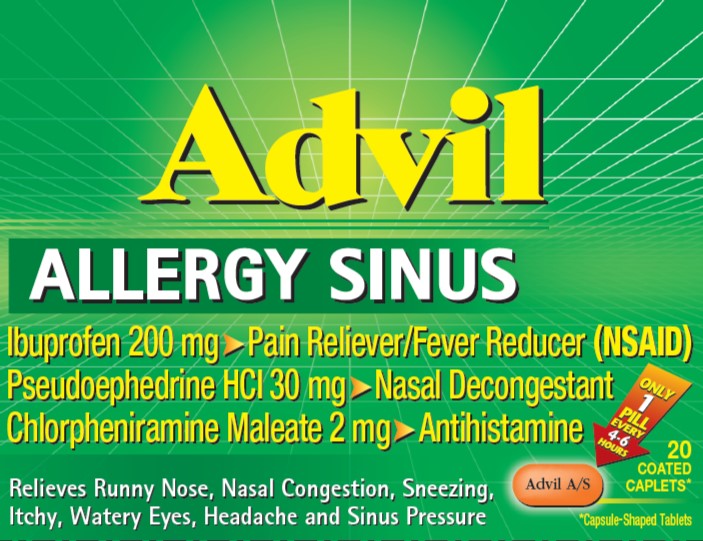
ADVIL ALLERGY SINUS chlorpheniramine maleate, ibuprofen, pseudoephedrine HCl 2 mg; 200 mg; 30 mg Tablet, Coated
🆔 Identity & classification
Where does this data come from?
🏷️ RxNorm drug class
This medicine belongs to the Histamine-1 Receptor Antagonist class.
Where does this data come from?
🏭 Manufacturer & labeler
Where does this data come from?
🩺 Clinical
Chlorpheniramine is used to treat allergy symptoms: sneezing runny nose itchy nose or throat red, itchy, watery eyes Chlorpheniramine is in a class of medications called antihistamines. It works by blocking the action of histamine, a substance in the body that causes allergic symptoms.
Read the full MedlinePlus article ↗- Each ingredient targets a different set of symptoms. Chlorpheniramine is an antihistamine that helps with runny nose, sneezing, and itchy, watery eyes. Pseudoephedrine is a deconge...
- What exactly does this medication do — why does it have three ingredients?
- Yes, chlorpheniramine — the antihistamine — can cause drowsiness. Be careful driving or operating machinery while you're taking it. Alcohol, sedatives, and tranquilizers will make...
- You should talk to a doctor before using this product during pregnancy. This is especially important at 20 weeks of pregnancy or later — using ibuprofen at that stage can cause pro...
Patient education
Supplement & herbal interactions
Where does this data come from?
Ask a licensed pharmacist directly — free, answered by our team.
💊 What it looks like
Where does this data come from?
🧪 Inactive Ingredients / Excipients
Inactive ingredients, also called excipients, are components of the drug product other than the active ingredient. They may include fillers, dyes, coatings, preservatives, flavors, or other formulation ingredients.
💡 Tap an ingredient (hover on desktop) to see what it is and why it’s used.
-
UNII R12CBM0EIZ
A natural wax derived from a Brazilian palm tree, used as a coating and polish on tablets and capsules. It creates a smooth, shiny finish that protects the medicine and improves appearance.
-
UNII M28OL1HH48
Croscarmellose sodium is a plant-based substance derived from cellulose. It acts as a disintegrant, helping tablets and capsules break down quickly in the digestive system so the medicine can be absorbed.
-
UNII WZB9127XOA
A synthetic red dye used to color medications and make them easier to identify. It serves as a colorant in tablets, capsules, and liquid formulations.
-
UNII H77VEI93A8
A synthetic yellow dye used to color medications. It helps identify the drug and make it visually distinctive, with no effect on how the medicine works.
-
UNII R8WTH25YS2
Glyceryl dibehenate is a wax-like substance made from behenate fatty acids and glycerol. It functions as a binder and release-control agent in tablets and capsules, helping hold ingredients together and regulate how quickly the medicine dissolves and releases in your body.
-
UNII 3NXW29V3WO
Hypromellose is a plant-based thickener made from cellulose. It's used in medicines as a binder to hold ingredients together, a coating for tablets, and a thickener for liquids.
-
UNII OP1R32D61U
Microcrystalline cellulose is a purified form of cellulose, a natural fiber from plant sources. It acts as a binder and filler in tablets and capsules, helping hold ingredients together and give the medicine its shape and size.
-
UNII VH2XOU12IE
Polydextrose is a synthetic polymer made from dextrose (sugar) that acts as a bulking agent and filler in medicines. It helps give tablets and capsules proper volume and texture while often adding slight sweetness.
-
UNII 3WJQ0SDW1A
Polyethylene glycol is a synthetic liquid or solid polymer used in medicines as a solvent, lubricant, and humectant. It helps dissolve active ingredients, reduces friction during manufacturing, and retains moisture in the final product.
-
UNII ETJ7Z6XBU4
Silicon dioxide is a naturally occurring mineral used as a glidant and anti-caking agent. It helps powder ingredients flow smoothly and prevents clumping during manufacturing and storage.
-
UNII O8232NY3SJ
A plant-based carbohydrate derived from corn kernels. It acts as a filler to add bulk, a binder to hold ingredients together, and a disintegrant to help the tablet break apart in your stomach for absorption.
-
UNII 15FIX9V2JP
Titanium dioxide is a bright white mineral powder commonly used as a colorant and opacifying agent. It makes pills and tablets white or lighter in color and helps make coatings non-transparent.
12 inactive ingredients listed in the exact product block matched to this NDC.
Label-section wording can be broader than the structured product block and may mention additional formulation ingredients.
Where does this data come from?
ingredient classCode="IACT" elements from the exact product block matched by this NDC. Label-section narrative from DailyMed / the openFDA label index is shown separately when available.Inactive ingredient FAQ
Are inactive ingredients the same for every manufacturer?
Why might an inactive ingredient be missing?
Can inactive ingredients matter?
💲 Pricing
A drug doesn't have one price. Each row is a different public payment system, and none is what you'd pay at the counter — that depends on your insurance. The ⓘ on each row explains what it measures.
| Price system | Per each | Per package |
|---|---|---|
| Retail pharmacies payNADAC · weekly | Not in the retail survey — common for institutional, discontinued, or low-volume packs. | |
| Medicaid paysCMS SDUD · 12 mo | No recent Medicaid claims on file for this NDC — rare and low-volume NDCs are suppressed in the public data. | |
| Medicare drug plans payPart D · quarterly | No Part D plan price is available for this NDC in our data. | |
Where does this data come from?
🔁 Therapeutic equivalents
| Product | Labeler | Pack | NADAC/unit | TE | Status | Price vs. this |
|---|---|---|---|---|---|---|
| Advil Allergy Sinus 2 mg/1; 200 mg/1; 30 mgthis 00573-0188-10 | Haleon | 1 tablet | — | — | FDA listed | — |
Where does this data come from?
⏳ Availability & generic status
We did not find an FDA-approved generic match for this exact strength, form and route. Patent/protection dates below may affect future generic timing.
Why the date isn’t exact: Generic timing can change because patents may be challenged, settled, licensed, added, removed, or worked around with a narrower label — and FDA approval does not always mean a pharmacy can get the generic today.
🛈 What do these terms mean?
- Patent
- Legal protection listed in the Orange Book that may delay generic approval or launch. Issued by the U.S. Patent & Trademark Office.
- Substance patent
- Covers the active drug molecule itself — the hardest to design around. A generic generally can’t launch until it expires.
- Formulation (product) patent
- Covers a specific formulation or dosage form. A generic can sometimes work around it with a different formulation.
- Method-of-use patent
- A patent covering one specific approved use of the drug — not necessarily the whole molecule. A generic can sometimes launch with a “skinny label” that carves out the protected use and keeps the others.
- Skinny label
- A generic label that omits a still-patented use when the FDA allows it — letting a generic reach the market for the unprotected uses.
- Exclusivity
- FDA-granted marketing protection, separate from patents — e.g. 5-yr new chemical entity, 7-yr orphan drug, or a +6-month pediatric extension.
- Paragraph IV
- A generic applicant’s formal challenge to a listed patent. It can potentially lead to earlier generic entry, but often involves litigation or a settlement.
- RLD / RS
- Reference Listed Drug — the brand product the FDA uses as the reference for generic applications. Reference Standard — the product the FDA expects generics to compare against in bioequivalence testing.
- TE / AB rating
- FDA therapeutic-equivalence rating. An AB rating generally means the FDA considers a generic therapeutically equivalent to — and substitutable for — the brand.
- LOE (loss of exclusivity)
- The latest patent or exclusivity currently listed — the loss-of-exclusivity / latest-listed-protection date shown on this page. Paragraph-IV challenges and settlements can move the real date earlier; FDA approval and a manufacturer’s decision to market can move it later.
Built from the FDA Orange Book. The bars above are scaled to each protection’s expiry; the red LOE marker is the last one to lapse.
| Patent | Type | Use code | Expires |
|---|---|---|---|
| US 7863287 ↗ | Drug product | — | Feb 28, 2027 |
Is there a generic version of ADVIL ALLERGY SINUS CAPLET?
The FDA approved a generic — why can’t I get it at my pharmacy yet?
Why do different websites show different generic release dates?
What does “FDA listed” mean?
What does a patent or protection date mean here?
What does “current Orange Book estimate” mean?
Can a generic come out before the last patent expires?
Can a generic come out after the listed dates?
What is the difference between patents and exclusivity?
Why are there multiple patent dates?
Where does this data come from?
🔬 Reported adverse events (FAERS)
Top reported reactions
Age at onset
Reporter sex
Serious outcomes
Where does this data come from?
📦 Packaging — all sizes for this product
| Package NDC | Description | Marketing start | Status |
|---|---|---|---|
| 00573-0188-10 You're viewing this | 20 BLISTER PACK in 1 CARTON (0573-0188-10) / 1 TABLET, COATED in 1 BLISTER PACK | 2002-12-20 | Active |
🧭 About this NDC listing & data coverage
What data is (and isn’t) available for this NDC — tap to expand
| NDC identity (package / product / labeler codes) | ✓ Available |
| Labeler | ✓ Available |
| Product & package description | ✓ Available |
| Marketing category & status | ✓ Available |
| Active ingredient / dosage form / route | ✓ Available |
| FDA label (SPL via DailyMed) | ✓ Available |
| Package photos | ✓ Available |
| Inactive ingredients (structured) | ✓ Available |
| NADAC pharmacy acquisition price (CMS) | — Not published for this NDC CMS publishes NADAC only for NDCs reported in its retail-pharmacy survey. |
| Orange Book / therapeutic-equivalence data | ✓ Available |
| HCPCS J-code billing crosswalk | — Not published for this NDC Most self-administered / retail products have no J-code — that is normal. |
| Medicaid utilization (CMS SDUD) | — Not published for this NDC CMS reports utilization only for NDCs with Medicaid claims above its privacy threshold. |
Questions about this listing
Why is there no price listed?
Is the NDC printed on the package the same as the 11-digit billing NDC?
What do the three segments of this NDC mean?
Is this package still being marketed?
Who lists this product with the FDA?
Do I need a prescription for this product?
Where does this data come from?
📄 FDA label — Drug Facts FDA SPL
🎯 Indications and Usage ▾
Uses temporarily relieves these symptoms associated with hay fever or other upper respiratory allergies, and the common cold: runny nose itchy, watery eyes itching of the nose or throat sneezing nasal congestion sinus pressure headache minor aches and pains fever
⏱️ Dosage and Administration ▾
Directions do not take more than directed the smallest effective dose should be used adults: take 1 caplet every 4-6 hours while symptoms persist. do not take more than 6 caplets in any 24-hour period, unless directed by a doctor children under 12 years of age: do not use
⚠️ Warnings ▾
Warnings Allergy alert: Ibuprofen may cause a severe allergic reaction, especially in people allergic to aspirin. Symptoms may include: hives facial swelling asthma (wheezing) shock skin reddening rash blisters If an allergic reaction occurs, stop use and seek medical help right away. Stomach bleeding warning: This product contains an NSAID, which may cause severe stomach bleeding.
The chance is higher if you: are age 60 or older have had stomach ulcers or bleeding problems take a blood thinning (anticoagulant) or steroid drug take other drugs containing prescription or nonprescription NSAIDs [aspirin, ibuprofen, naproxen, or others] have 3 or more alcoholic drinks every day while using this product take more or for a longer time than directed Heart attack and stroke warning: NSAIDs, except aspirin, increase the risk of heart attack, heart failure, and stroke. These can be fatal. The risk is higher if you use more than directed or for longer than directed.
Do not use in children under 12 years of age if you have ever had an allergic reaction to any other pain reliever/fever reducer right before or after heart surgery if you are now taking a prescription monoamine oxidase inhibitor (MAOI) (certain drugs for depression, psychiatric, or emotional conditions, or Parkinson's disease), or for 2 weeks after stopping the MAOI drug. If you do not know if your prescription drug contains an MAOI, ask a doctor or pharmacist before taking this product. Ask a doctor before use if you have a breathing problem such as emphysema or chronic bronchitis stomach bleeding warning applies to you you have problems or serious side effects from taking pain relievers or fever reducers you have a history of stomach problems, such as heartburn you have high blood pressure, heart disease, liver cirrhosis, kidney disease, asthma, thyroid disease, diabetes, glaucoma, trouble urinating due to an enlarged prostate gland, or had a stroke you are taking a diuretic Ask a doctor or pharmacist before use if you are under a doctor's care for any serious condition taking sedatives or tranquilizers taking any other product that contains pseudoephedrine, chlorpheniramine or any other nasal decongestant or antihistamine taking aspirin for heart attack or stroke, because ibuprofen may decrease this benefit of aspirin taking any other drug When using this product take with food or milk if stomach upset occurs avoid alcoholic drinks be careful when driving a motor vehicle or operating machinery drowsiness may occur alcohol, sedatives, and tranquilizers may increase drowsiness Stop use and ask a doctor if you experience any of the following signs of stomach bleeding: feel faint vomit blood have bloody or black stools have stomach pain that does not get better you have symptoms of heart problems or stroke: chest pain trouble breathing weakness in one part or side of body slurred speech leg swelling fever gets worse or lasts more than 3 days nasal congestion lasts for more than 7 days redness or swelling is present in the painful area you get nervous, dizzy, or sleepless symptoms continue or get worse any new symptoms appear If pregnant or breast-feeding, ask a health professional before use.
It is especially important not to use ibuprofen at 20 weeks or later in pregnancy unless definitely directed to do so by a doctor because it may cause problems in the unborn child or complications during delivery. Keep out of reach of children. In case of overdose, get medical help or contact a Poison Control Center right away.
🧪 Active Ingredient ▾
Active ingredients (in each caplet) Chlorpheniramine maleate 2 mg Ibuprofen 200 mg (NSAID)* Pseudoephedrine HCl 30 mg *nonsteroidal anti-inflammatory drug
🧪 Inactive Ingredients ▾
Inactive ingredients carnauba wax, colloidal silicon dioxide, corn starch, croscarmellose sodium, FD&C red no. 40 aluminum lake, FD&C yellow no. 6 aluminum lake, glyceryl behenate, hypromellose, microcrystalline cellulose, pharmaceutical ink, polydextrose, polyethylene glycol, pregelatinized starch, silicon dioxide, titanium dioxide
🎯 Purpose ▾
Purposes Antihistamine Pain reliever/fever reducer Nasal decongestant