
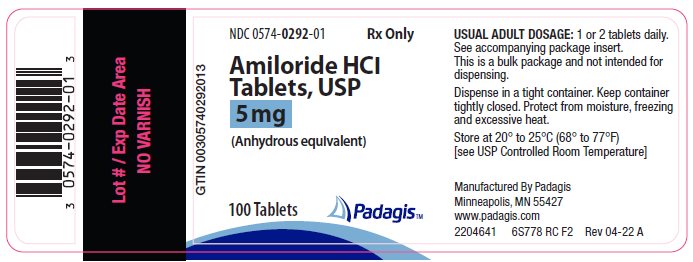
amiloride hydrochloride 5 mg Tablet, 100-count — NDC 0574-0292-01 (Billing 00574-0292-01)
This is a package of 100 tablets of amiloride hydrochloride 5 mg Tablet from Padagis US LLC, marketed since Apr 2009 and currently FDA-listed; retail pharmacies pay about $0.1901 per tablet (NADAC). It is this product's only package size.
NDC database record
One package, one record: these facts belong to NDC 0574-0292-01 alone.
- Record
- FDA NDC Directory package listing · Human prescription drug
- Code segments
- 0574 labeler · 0292 product · 01 package
- Package marketed since
- Apr 6, 2009
- Sample package
- No — commercial package
- Listing certified through
- Dec 31, 2026
- Billing quantity
- 100 EA per package
- Barcode (UPC-A, from the NDC)
- 3 0574029201 3
- Medicaid fills, this package
- 16,385 prescriptions in the last four reported quarters
- FDA record last changed
- Jul 24, 2026
Identity & classification
Regulatory identifiers FDA, NLM and CMS codes for this package
Drug-database identifiers Medi-Span GPI and First Databank GCN / HICL / AHFS classification
- GSN (GCN sequence number): 008227
- GCN: 27700
- GPI-14 (Medi-Span): 37500010100305
- HICL (First Databank): 003667
- AHFS class code: 40:28.16.00
- RxCUI (RxNorm): 977880
Where does this data come from?
- FDA openFDA NDC Directory · synced Oct 8, 2026
- FDA label on DailyMed · label index refreshed Oct 6, 2026
- RxNorm (NLM RxNav) · catalog refreshed Oct 1, 2026
- Medi-Span GPI (licensed)
- First Databank (licensed) · refreshed Oct 8, 2026
RxNorm drug class
This medicine belongs to the Potassium-sparing Diuretic class.
Where does this data come from?
- RxClass (NLM) · catalog refreshed Oct 1, 2026
Clinical
Amiloride is usually used in combination with other diuretics ('water pills') to treat high blood pressure and heart failure in patients who have low amounts of potassium in their bodies or for whom low potassium levels in the body could be dangerous. Amiloride is in a class of medications called diuretics. It works by causing the kidneys to get rid of unneeded water and salt from the body into the urine, but reduces the loss of potassium. High blood pressure is a common condition, and when not treated it can cause damage to the brain, heart, blood vessels, kidneys, and other parts of the body...
Read the full MedlinePlus article ↗- It's usually added to another diuretic for heart failure or high blood pressure. Its job is to keep your potassium from dropping too low, or bring it back up if it has.
- Take it by mouth with food, as your prescriber directs. It's normally added to your other diuretic. Your doctor may adjust it based on your blood tests.
- Most people tolerate it well. Some get nausea, appetite loss, gas, stomach pain, diarrhea, headache, dizziness, fatigue, muscle cramps or a mild rash.
- High potassium. It can be dangerous and may cause tingling, muscle weakness, tiredness or a slow heartbeat. Call your doctor right away if you notice these, and keep your blood-tes...
Patient education
Supplement & herbal interactions
Amiloride may be associated with lower levels of 1 nutrient — worth a chat with your pharmacist, not a cause for alarm.
Where does this data come from?
- MedlinePlus (NLM) · refreshed Oct 1, 2026
- FDA label on DailyMed · label index refreshed Oct 6, 2026
Ask a licensed pharmacist directly — free, answered by our team.
Pricing
A drug doesn't have one price. Each row is a different public payment system, and none is what you'd pay at the counter — that depends on your insurance. The ⓘ on each row explains what it measures.
| Price system | Per ea | Per package |
|---|---|---|
| Retail pharmacies payNADAC · weekly | $0.190 | $19.01 / 100 tablets |
| Medicaid paysCMS SDUD · 12 mo | $0.2748 | $27.48 / 100 tablets |
| Medicare drug plans payPart D · Q2 2026 | $0.2193 | $21.93 / 100 tablets |
Where does this data come from?
- CMS NADAC weekly file · file of Oct 7, 2026
- CMS ASP pricing files · refreshed Sep 20, 2026
- CMS Medicaid State Drug Utilization Data · through Q1 2026
- CMS Part D plan pricing files · refreshed Sep 24, 2026
- VA National Acquisition Center price file
Packaging — all sizes for this product
| Package NDC | Description | Marketing start | Marketing end | Status |
|---|---|---|---|---|
| 00574-0292-01 You're viewing this Main listing | 100 TABLET in 1 BOTTLE | 2009-04-06 | — | Active |
Therapeutic equivalents
| Product | Labeler | Pack | NADAC/unit | TE | Status | Price vs. this |
|---|---|---|---|---|---|---|
| amiloride hydrochloride 5 mgthis 00574-0292-01 | Padagis | 100 tablets | $0.190 | AB | Availability likely | — |
| Amiloride Hydrochloride 5 mg 42794-0005-02 | Sigmapharm | 100 tablets | $0.190 | AB | Availability likely | — |
| Amiloride Hydrochloride 5 mg 49884-0117-01 | Par | 100 tablets | $0.190 | AB | Availability likely | — |
| Amiloride Hydrochloride 5 mg 63629-2114-01 | Bryant | 1000 tablets | — | AB | Discontinued | — |
Where does this data come from?
- FDA openFDA NDC Directory · synced Oct 8, 2026
- FDA Orange Book · refreshed Oct 3, 2026
- CMS NADAC weekly file · file of Oct 7, 2026
Availability & generic status
FDA-approved generic versions are listed, and recent pricing/market data suggests they may be available — see Therapeutic equivalents.
Where does this data come from?
- FDA Orange Book · refreshed Oct 3, 2026
What it looks like
Where does this data come from?
- FDA label on DailyMed · label index refreshed Oct 6, 2026
Inactive Ingredients / Excipients
Inactive ingredients, also called excipients, are components of the drug product other than the active ingredient. They may include fillers, dyes, coatings, preservatives, flavors, or other formulation ingredients.
🧪 Avoiding an ingredient? See Amiloride inactive ingredients by manufacturer: every current product's list side by side, so you can ask your pharmacy for the version that does not list it.
💡 Tap an ingredient (hover on desktop) to see what it is and why it’s used.
-
UNII L11K75P92J
A mineral salt made from calcium and phosphate. It acts as a filler and binder in tablets to add bulk and help hold the medicine together in solid form.
-
UNII EWQ57Q8I5X
Lactose monohydrate is a natural sugar derived from milk. It serves as a filler and binder in tablets and capsules, helping create the proper size, texture, and consistency of the medicine.
-
UNII 70097M6I30
Magnesium stearate is a salt made from magnesium and stearic acid, a fatty substance. It's used in tablets and capsules as a lubricant and glidant to help ingredients flow smoothly during manufacturing and prevent sticking.
-
UNII O8232NY3SJ
A plant-based carbohydrate derived from corn kernels. It acts as a filler to add bulk, a binder to hold ingredients together, and a disintegrant to help the tablet break apart in your stomach for absorption.
4 inactive ingredients listed in the exact product block matched to this NDC.
Where does this data come from?
ingredient classCode="IACT" elements from the exact product block matched by this NDC. Label-section narrative from DailyMed / the openFDA label index is shown separately when available.- FDA label on DailyMed · label index refreshed Oct 6, 2026
- FDA openFDA NDC Directory · synced Oct 8, 2026
Inactive ingredient FAQ
Are inactive ingredients the same for every manufacturer?
Why might an inactive ingredient be missing?
Can inactive ingredients matter?
Manufacturer & labeler
More NDCs from Padagis US LLC labeler code 00574
- Trospium Chloride ER 60 mg Capsule, Extended Release NDC 0574-0118-30
- Trospium Chloride 20 mg Tablet, Film Coated NDC 0574-0145-60
- Midazolam Hydrochloride 2 mg/mL Syrup NDC 0574-0150-04
- benazepril hydrochloride and hydrochlorothiazide 20 mg; 25 mg Tablet NDC 0574-0228-01
- benazepril hydrochloride and hydrochlorothiazide 20 mg; 12.5 mg Tablet NDC 0574-0229-01
- Paroxetine 7.5 mg Capsule NDC 0574-0279-30
- hydromorphone hydrochloride 8 mg Tablet, Extended Release NDC 0574-0293-01
- hydromorphone hydrochloride 12 mg Tablet, Extended Release NDC 0574-0294-01
- hydromorphone hydrochloride 16 mg Tablet, Extended Release NDC 0574-0295-01
- hydromorphone hydrochloride 32 mg Tablet, Extended Release NDC 0574-0297-01
- ACTIDOSE activated charcoal 208 mg/mL Suspension NDC 0574-0520-04
- ACTIDOSE AQUA activated charcoal 208 mg/mL Suspension NDC 0574-0521-04
Where does this data come from?
- FDA openFDA NDC Directory · synced Oct 8, 2026
- Drugs@FDA
Full prescribing information FDA SPL
🚨 Boxed Warning ▾
Like other potassium-conserving agents, amiloride may cause hyperkalemia (serum potassium levels greater than 5.5 mEq per liter) which, if uncorrected, is potentially fatal. Hyperkalemia occurs commonly (about 10%) when amiloride is used without a kaliuretic diuretic. This incidence is greater in patients with renal impairment, diabetes mellitus (with or without recognized renal insufficiency), and in the elderly.
When amiloride HCl is used concomitantly with a thiazide diuretic in patients without these complications, the risk of hyperkalemia is reduced to about 1-2 percent. It is thus essential to monitor serum potassium levels carefully in any patient receiving amiloride, particularly when it is first introduced, at the time of diuretic dosage adjustments, and during any illness that could affect renal function.
🎯 Indications and Usage ▾
INDICATIONS AND USAGE Amiloride HCl is indicated as adjunctive treatment with thiazide diuretics or other kaliuretic-diuretic agents in congestive heart failure or hypertension to: a. help restore normal serum potassium levels in patients who develop hypokalemia on the kaliuretic diuretic b. prevent development of hypokalemia in patients who would be exposed to particular risk if hypokalemia were to develop, e.g., digitalized patients or patients with significant cardiac arrhythmias. The use of potassium-conserving agents is often unnecessary in patients receiving diuretics for uncomplicated essential hypertension when such patients have a normal diet.
Amiloride HCl has little additive diuretic or anti-hypertensive effect when added to a thiazide diuretic. Amiloride HCl should rarely be used alone. It has weak (compared with thiazides) diuretic and antihypertensive effects.
Used as single agents, potassium sparing diuretics, including amiloride HCl, result in an increased risk of hyperkalemia (approximately 10% with amiloride). Amiloride HCl should be used alone only when persistent hypokalemia has been documented and only with careful titration of the dose and close monitoring of serum electrolytes.
⏱️ Dosage and Administration ▾
DOSAGE AND ADMINISTRATION Amiloride HCl should be administered with food. Amiloride HCl, one 5 mg tablet daily, should be added to the usual antihypertensive or diuretic dosage of a kaliuretic diuretic. The dosage may be increased to 10 mg per day, if necessary.
More than two 5 mg tablets of amiloride HCl daily usually are not needed, and there is little controlled experience with such doses. If persistent hypokalemia is documented with 10 mg, the dose can be increased to 15 mg, then 20 mg, with careful monitoring of electrolytes. In treating patients with congestive heart failure after an initial diuresis has been achieved, potassium loss may also decrease and the need for amiloride HCl should be re-evaluated.
Dosage adjustment may be necessary. Maintenance therapy may be on an intermittent basis. If it is necessary to use amiloride HCl alone (See INDICATIONS ), the starting dosage should be one 5 mg tablet daily.
This dosage may be increased to 10 mg per day, if necessary. More than two 5 mg tablets usually are not needed, and there is little controlled experience with such doses. If persistent hypokalemia is documented with 10 mg, the dose can be increased to 15 mg, then 20 mg, with careful monitoring of electrolytes.
⛔ Contraindications ▾
CONTRAINDICATIONS Hyperkalemia Amiloride HCl should not be used in the presence of elevated serum potassium levels (greater than 5.5 mEq per liter). Antikaliuretic Therapy or Potassium Supplementation Amiloride HCl should not be given to patients receiving other potassium-conserving agents, such as spironolactone or triamterene. Potassium supplementation in the form of medication, potassium-containing salt substitutes or a potassium-rich diet should not be used with amiloride HCl except in severe and/or refractory cases of hypokalemia.
Such concomitant therapy can be associated with rapid increases in serum potassium levels. If potassium supplementation is used, careful monitoring of the serum potassium level is necessary. Impaired Renal Function Anuria, acute or chronic renal insufficiency, and evidence of diabetic nephropathy are contraindications to the use of amiloride HCl.
Patients with evidence of renal functional impairment (blood urea nitrogen [BUN] levels over 30 mg per 100 mL or serum creatinine levels over 1.5 mg per 100 mL) or diabetes mellitus should not receive the drug without careful, frequent and continuing monitoring of serum electrolytes, creatinine, and BUN levels. Potassium retention associated with the use of an anti-kaliuretic agent is accentuated in the presence of renal impairment and may result in the rapid development of hyperkalemia. Hypersensitivity Amiloride HCl is contraindicated in patients who are hypersensitive to this product.
⚠️ Warnings ▾
WARNINGS Hyperkalemia Like other potassium-conserving agents, amiloride may cause hyperkalemia (serum potassium levels greater than 5.5 mEq per liter) which, if uncorrected, is potentially fatal. Hyperkalemia occurs commonly (about 10%) when amiloride is used without a kaliuretic diuretic. This incidence is greater in patients with renal impairment, diabetes mellitus (with or without recognized renal insufficiency), and in the elderly.
When amiloride HCl is used concomitantly with a thiazide diuretic in patients without these complications, the risk of hyperkalemia is reduced to about 1-2 percent. It is thus essential to monitor serum potassium levels carefully in any patient receiving amiloride, particularly when it is first introduced, at the time of diuretic dosage adjustments, and during any illness that could affect renal function. The risk of hyperkalemia may be increased when potassium-conserving agents, including amiloride HCl, are administered concomitantly with an angiotensin-converting enzyme inhibitor, an angiotensin II receptor antagonist, cyclosporine or tacrolimus.
(See PRECAUTIONS, Drug Interactions .) Warning signs or symptoms of hyperkalemia include paresthesias, muscular weakness, fatigue, flaccid paralysis of the extremities, bradycardia, shock, and ECG abnormalities. Monitoring of the serum potassium level is essential because mild hyperkalemia is not usually associated with an abnormal ECG. When abnormal, the ECG in hyperkalemia is characterized primarily by tall, peaked T waves or elevations from previous tracings.
There may also be lowering of the R wave and increased depth of the S wave, widening and even disappearance of the P wave, progressive widening of the QRS complex, prolongation of the PR interval, and ST depression. Treatment of hyperkalemia: If hyperkalemia occurs in patients taking amiloride HCl, the drug should be discontinued immediately. If the serum potassium level exceeds 6.5 mEq per liter, active measures should be taken to reduce it.
Such measures include the intravenous administration of sodium bicarbonate solution or oral or parenteral glucose with a rapid-acting insulin preparation. If needed, a cation exchange resin such as sodium polystyrene sulfonate may be given orally or by enema. Patients with persistent hyperkalemia may require dialysis.
Diabetes Mellitus In diabetic patients, hyperkalemia has been reported with the use of all potassium-conserving diuretics, including amiloride HCl, even in patients without evidence of diabetic nephropathy. Therefore, amiloride HCl should be avoided, if possible, in diabetic patients and, if it is used, serum electrolytes and renal function must be monitored frequently. Amiloride HCl should be discontinued at least three days before glucose tolerance testing.
Metabolic or Respiratory Acidosis Antikaliuretic therapy should be instituted only with caution in severely ill patients in whom respiratory or metabolic acidosis may occur, such as patients with cardiopulmonary disease or poorly controlled diabetes. If amiloride HCl is given to these patients, frequent monitoring of acid-base balance is necessary. Shifts in acid-base balance alter the ratio of extracellular/intracellular potassium, and the development of acidosis may be associated with rapid increases in serum potassium levels.
🤒 Adverse Reactions ▾
ADVERSE REACTIONS Amiloride HCl is usually well tolerated and, except for hyperkalemia (serum potassium levels greater than 5.5 mEq per liter — see WARNINGS ), significant adverse effects have been reported infrequently. Minor adverse reactions were reported relatively frequently (about 20%) but the relationship of many of the reports to amiloride HCl is uncertain and the overall frequency was similar in hydrochlorothiazide treated groups. Nausea/anorexia, abdominal pain, flatulence, and mild skin rash have been reported and probably are related to amiloride.
Other adverse experiences that have been reported with amiloride are generally those known to be associated with diuresis, or with the underlying disease being treated. The adverse reactions for amiloride HCl listed in the following table have been arranged into two groups: (1) incidence greater than one percent; and (2) incidence one percent or less. The incidence for group (1) was determined from clinical studies conducted in the United States (837 patients treated with amiloride HCl).
The adverse effects listed in group (2) include reports from the same clinical studies and voluntary reports since marketing. The probability of a causal relationship exists between amiloride HCl and these adverse reactions, some of which have been reported only rarely. Incidence > 1% Incidence ≤ 1% Body as a Whole Headache* Weakness Fatigability Weakness Fatigability Back pain Chest pain Neck/shoulder ache Pain, extremities Cardiovascular None Angina pectoris Orthostatic hypotension Arrhythmia Palpitation Digestive Nausea/anorexia* Diarrhea* Vomiting* Abdominal pain Gas pain Appetite changes Constipation Diarrhea* Vomiting* Abdominal pain Gas pain Appetite changes Constipation Jaundice GI bleeding Abdominal fullness GI disturbance Thirst Heartburn Flatulence Dyspepsia Metabolic Elevated serum potassium levels (> 5.5 mEq per liter)** None Skin None Skin rash Itching Dryness of mouth Pruritus Alopecia Musculoskeletal Muscle cramps Joint pain Leg ache Nervous Dizziness Encephalopathy Encephalopathy Paresthesia Tremors Vertigo Psychiatric None Nervousness Mental confusion Insomnia Decreased libido Depression Somnolence Respiratory Cough Dyspnea Dyspnea Shortness of breath Special Senses None Visual disturbances Nasal congestion Tinnitus Increased intraocular pressure Urogenital Impotence Polyuria Dysuria Urinary frequency Bladder spasms Gynecomastia *Reactions occurring in 3% to 8% of patients treated with amiloride HCl.
(Those reactions occurring in less than 3% of the patients are unmarked.) **See WARNINGS . Causal Relationship Unknown Other reactions have been reported but occurred under circumstances where a causal relationship could not be established. However, in these rarely reported events, that possibility cannot be excluded.
Therefore, these observations are listed to serve as alerting information to physicians. Activation of probable pre-existing peptic ulcer Aplastic anemia Neutropenia Abnormal liver function
🔄 Drug Interactions ▾
Drug Interactions When amiloride HCl is administered concomitantly with an angiotensin-converting enzyme inhibitor, an angiotensin II receptor antagonist, cyclosporine or tacrolimus, the risk of hyperkalemia may be increased. Therefore, if concomitant use of these agents is indicated because of demonstrated hypokalemia, they should be used with caution and with frequent monitoring of serum potassium. (See WARNINGS .) Lithium generally should not be given with diuretics because they reduce its renal clearance and add a high risk of lithium toxicity.
Read circulars for lithium preparations before use of such concomitant therapy. In some patients, the administration of a non-steroidal anti-inflammatory agent can reduce the diuretic, natriuretic, and antihypertensive effects of loop, potassium-sparing and thiazide diuretics. Therefore, when amiloride HCl and non-steroidal anti-inflammatory agents are used concomitantly, the patient should be observed closely to determine if the desired effect of the diuretic is obtained.
Since indomethacin and potassium-sparing diuretics, including amiloride HCl, may each be associated with increased serum potassium levels, the potential effects on potassium kinetics and renal function should be considered when these agents are administered concurrently.
🤰 Pregnancy ▾
Pregnancy Teratogenicity studies with amiloride HCl in rabbits and mice given 20 and 25 times the maximum human dose, respectively, revealed no evidence of harm to the fetus, although studies showed that the drug crossed the placenta in modest amounts. Reproduction studies in rats at 20 times the expected maximum daily dose for humans showed no evidence of impaired fertility. At approximately 5 or more times the expected maximum daily dose for humans, some toxicity was seen in adult rats and rabbits and a decrease in rat pup growth and survival occurred.
There are, however, no adequate and well-controlled studies in pregnant women. Because animal reproduction studies are not always predictive of human response, this drug should be used during pregnancy only if clearly needed.
🧒 Pediatric Use ▾
Pediatric Use Safety and effectiveness in pediatric patients have not been established.
🧓 Geriatric Use ▾
Geriatric Use Clinical studies of amiloride HCl did not include sufficient numbers of subjects aged 65 and over to determine whether they respond differently from younger subjects. Other reported clinical experience has not identified differences in responses between the elderly and younger patients. In general, dose selection for an elderly patient should be cautious, usually starting at the low end of the dosing range, reflecting the greater frequency of decreased hepatic, renal or cardiac function, and of concomitant disease or other drug therapy.
This drug is known to be substantially excreted by the kidney, and the risk of toxic reactions to this drug may be greater in patients with impaired renal function. Because elderly patients are more likely to have decreased renal function, care should be taken in dose selection, and it may be useful to monitor renal function. (See CONTRAINDICATIONS, Impaired Renal Function .)
🆘 Overdosage ▾
OVERDOSAGE No data are available in regard to overdosage in humans. The oral LD 50 of amiloride hydrochloride (calculated as the base) is 56 mg/kg in mice and 36 to 85 mg/kg in rats, depending on the strain. It is not known whether the drug is dialyzable.
The most likely signs and symptoms to be expected with overdosage are dehydration and electrolyte imbalance. These can be treated by established procedures. Therapy with amiloride HCl should be discontinued and the patient observed closely.
There is no specific antidote. Emesis should be induced or gastric lavage performed. Treatment is symptomatic and supportive.
If hyperkalemia occurs, active measures should be taken to reduce the serum potassium levels.
🧬 Clinical Pharmacology ▾
CLINICAL PHARMACOLOGY Amiloride HCl is a potassium-conserving (antikaliuretic) drug that possesses weak (compared with thiazide diuretics) natriuretic, diuretic, and antihypertensive activity. These effects have been partially additive to the effects of thiazide diuretics in some clinical studies. When administered with a thiazide or loop diuretic, amiloride HCl has been shown to decrease the enhanced urinary excretion of magnesium which occurs when a thiazide or loop diuretic is used alone.
Amiloride HCl has potassium-conserving activity in patients receiving kaliuretic-diuretic agents. Amiloride HCl is not an aldosterone antagonist and its effects are seen even in the absence of aldosterone. Amiloride HCl exerts its potassium sparing effect through the inhibition of sodium reabsorption at the distal convoluted tubule, cortical collecting tubule and collecting duct; this decreases the net negative potential of the tubular lumen and reduces both potassium and hydrogen secretion and their subsequent excretion.
This mechanism accounts in large part for the potassium sparing action of amiloride. Amiloride HCl usually begins to act within 2 hours after an oral dose. Its effect on electrolyte excretion reaches a peak between 6 and 10 hours and lasts about 24 hours.
Peak plasma levels are obtained in 3 to 4 hours and the plasma half-life varies from 6 to 9 hours. Effects on electrolytes increase with single doses of amiloride HCl up to approximately 15 mg. Amiloride HCl is not metabolized by the liver but is excreted unchanged by the kidneys.
About 50 percent of a 20 mg dose of amiloride HCl is excreted in the urine and 40 percent in the stool within 72 hours. Amiloride HCl has little effect on glomerular filtration rate or renal blood flow. Because amiloride HCl is not metabolized by the liver, drug accumulation is not anticipated in patients with hepatic dysfunction, but accumulation can occur if the hepatorenal syndrome develops.
📦 How Supplied / Storage and Handling ▾
HOW SUPPLIED Amiloride HCl Tablets, 5 mg, are off-white to light yellow, diamond-shaped, compressed tablets, embossed with "P291". They are supplied in bottles of 100 (NDC 0574-0292-01). STORAGE Protect from moisture, freezing and excessive heat. Store at 20° to 25°C (68° to 77°F) [see USP Controlled Room Temperature].
📦 Storage and Handling ▾
STORAGE Protect from moisture, freezing and excessive heat. Store at 20° to 25°C (68° to 77°F) [see USP Controlled Room Temperature].
📋 Description ▾
DESCRIPTION Amiloride HCl, an antikaliuretic-diuretic agent, is a pyrazine-carbonyl-guanidine that is unrelated chemically to other known antikaliuretic or diuretic agents. It is the salt of a moderately strong base (pKa 8.7). It is designated chemically as 3,5-diamino-6-chloro- N -(diaminomethylene) pyrazinecarboxamide monohydrochloride, dihydrate and has a molecular weight of 302.12.
Its empirical formula is C 6 H 8 ClN 7 O•HCl•2H 2 O and its structural formula is: Amiloride HCl is available for oral use as tablets containing 5 mg of anhydrous amiloride HCl. Each tablet contains the following inactive ingredients: calcium phosphate, lactose, magnesium stearate and starch. Chemical Structure
⚠️ Precautions ▾
PRECAUTIONS General Electrolyte Imbalance and BUN Increases Hyponatremia and hypochloremia may occur when amiloride HCl is used with other diuretics and increases in BUN levels have been reported. These increases usually have accompanied vigorous fluid elimination, especially when diuretic therapy was used in seriously ill patients, such as those who had hepatic cirrhosis with ascites and metabolic alkalosis, or those with resistant edema. Therefore, when amiloride HCl is given with other diuretics to such patients, careful monitoring of serum electrolytes and BUN levels is important.
In patients with pre-existing severe liver disease, hepatic encephalopathy, manifested by tremors, confusion, and coma, and increased jaundice, have been reported in association with diuretics, including amiloride HCl. Drug Interactions When amiloride HCl is administered concomitantly with an angiotensin-converting enzyme inhibitor, an angiotensin II receptor antagonist, cyclosporine or tacrolimus, the risk of hyperkalemia may be increased. Therefore, if concomitant use of these agents is indicated because of demonstrated hypokalemia, they should be used with caution and with frequent monitoring of serum potassium.
(See WARNINGS .) Lithium generally should not be given with diuretics because they reduce its renal clearance and add a high risk of lithium toxicity. Read circulars for lithium preparations before use of such concomitant therapy. In some patients, the administration of a non-steroidal anti-inflammatory agent can reduce the diuretic, natriuretic, and antihypertensive effects of loop, potassium-sparing and thiazide diuretics.
Therefore, when amiloride HCl and non-steroidal anti-inflammatory agents are used concomitantly, the patient should be observed closely to determine if the desired effect of the diuretic is obtained. Since indomethacin and potassium-sparing diuretics, including amiloride HCl, may each be associated with increased serum potassium levels, the potential effects on potassium kinetics and renal function should be considered when these agents are administered concurrently. Carcinogenicity, Mutagenicity, Impairment of Fertility There was no evidence of a tumorigenic effect when amiloride HCl was administered for 92 weeks to mice at doses up to 10 mg/kg/day (25 times the maximum daily human dose).
Amiloride HCl has also been administered for 104 weeks to male and female rats at doses up to 6 and 8 mg/kg/day (15 and 20 times the maximum daily dose for humans, respectively) and showed no evidence of carcinogenicity. Amiloride HCl was devoid of mutagenic activity in various strains of Salmonella typhimurium with or without a mammalian liver microsomal activation system (Ames test). Pregnancy Teratogenicity studies with amiloride HCl in rabbits and mice given 20 and 25 times the maximum human dose, respectively, revealed no evidence of harm to the fetus, although studies showed that the drug crossed the placenta in modest amounts.
Reproduction studies in rats at 20 times the expected maximum daily dose for humans showed no evidence of impaired fertility. At approximately 5 or more times the expected maximum daily dose for humans, some toxicity was seen in adult rats and rabbits and a decrease in rat pup growth and survival occurred. There are, however, no adequate and well-controlled studies in pregnant women.
Because animal reproduction studies are not always predictive of human response, this drug should be used during pregnancy only if clearly needed. Nursing Mothers Studies in rats have shown that amiloride is excreted in milk in concentrations higher than those found in blood, but it is not known whether amiloride HCl is excreted in human milk. Because many drugs are excreted in human milk and because of the potential for serious adverse reactions in nursing infants from amiloride HCl, a decision should be made whether to discontinue nursing or to discontinue the drug, taking into account the importance of the drug to the… [Excerpted — this section continues on DailyMed.]
🍼 Nursing Mothers ▾
Nursing Mothers Studies in rats have shown that amiloride is excreted in milk in concentrations higher than those found in blood, but it is not known whether amiloride HCl is excreted in human milk. Because many drugs are excreted in human milk and because of the potential for serious adverse reactions in nursing infants from amiloride HCl, a decision should be made whether to discontinue nursing or to discontinue the drug, taking into account the importance of the drug to the mother.
📄 Carcinogenesis, Mutagenesis, Impairment of Fertility ▾
Carcinogenicity, Mutagenicity, Impairment of Fertility There was no evidence of a tumorigenic effect when amiloride HCl was administered for 92 weeks to mice at doses up to 10 mg/kg/day (25 times the maximum daily human dose). Amiloride HCl has also been administered for 104 weeks to male and female rats at doses up to 6 and 8 mg/kg/day (15 and 20 times the maximum daily dose for humans, respectively) and showed no evidence of carcinogenicity. Amiloride HCl was devoid of mutagenic activity in various strains of Salmonella typhimurium with or without a mammalian liver microsomal activation system (Ames test).
📄 Package Label / Principal Display Panel ▾
PRINCIPAL DISPLAY PANEL - 5 mg Tablets NDC 0574-0292-01 Rx Only Amiloride HCl Tablets, USP 5 mg (Anhydrous equivalent) 100 TABLETS The following image is a placeholder representing the product identifier that is either affixed or imprinted on the drug package label during the packaging operation. label serialization-template.jpg