
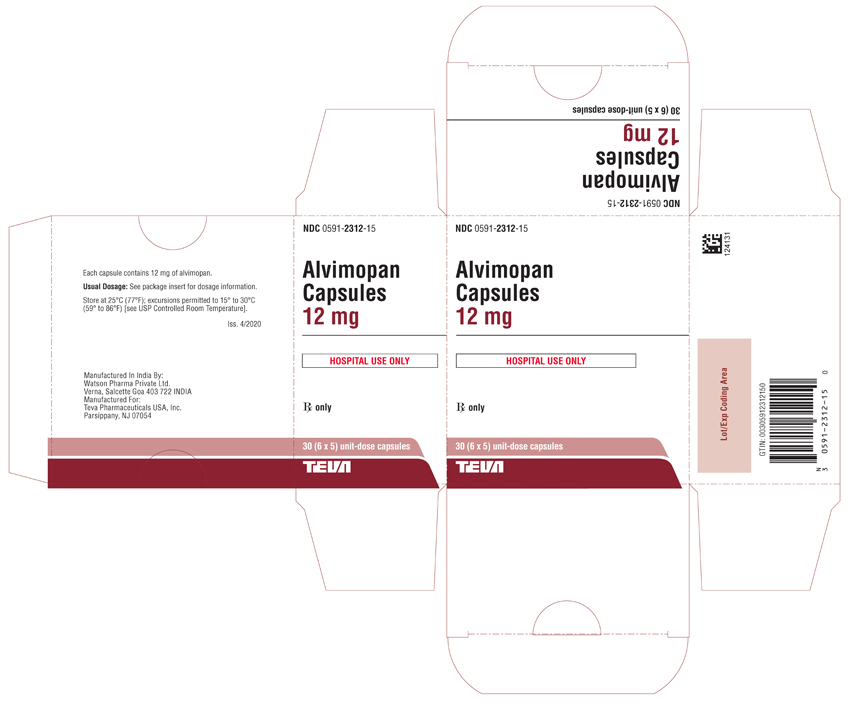
Alvimopan 12 mg Capsule, 30-count — NDC 0591-2312-15 (Billing 00591-2312-15)
This is a package of 30 capsules of Alvimopan 12 mg Capsule from Actavis Pharma, Inc., marketed since Oct 2020 and currently FDA-listed.
NDC database record
One package, one record: these facts belong to NDC 0591-2312-15 alone.
- Record
- FDA NDC Directory package listing · Drug for further processing
- Code segments
- 0591 labeler · 2312 product · 15 package
- Listing certified through
- Dec 31, 2026
- Billing quantity
- 30 EA per package
- Barcode (UPC-A, from the NDC)
- 3 0591231215 0
- FDA record last changed
- Oct 1, 2026
Identity & classification
Regulatory identifiers FDA, NLM and CMS codes for this package
Drug-database identifiers Medi-Span GPI and First Databank GCN / HICL / AHFS classification
- GSN (GCN sequence number): 064325
- GCN: 13285
- GPI-14 (Medi-Span): 52580010000120
- HICL (First Databank): 035795
- AHFS class code: 56:18.04.00
Where does this data come from?
- FDA openFDA NDC Directory · synced Oct 1, 2026
- FDA label on DailyMed · label index refreshed Oct 6, 2026
- RxNorm (NLM RxNav) · catalog refreshed Oct 1, 2026
- Medi-Span GPI (licensed)
- First Databank (licensed) · refreshed Oct 1, 2026
Clinical
- It helps your digestive system wake up faster after certain bowel surgeries where part of the bowel is removed and reconnected. It's meant to shorten the time to gut recovery.
- You'll get it in the hospital only. You get one capsule before surgery, then twice a day after surgery until you go home, for no more than 7 days and 15 doses. You can take it with...
- In a 12-month study of people on long-term opioids, more heart attacks were seen with alvimopan. A cause hasn't been proven, and short-term use hasn't shown this. Still, it's restr...
- The most common one in trials was indigestion. Let your nurse know about belly pain, cramping, diarrhea, nausea or vomiting, and report chest pain right away.
Patient education
Supplement & herbal interactions
Some supplements/herbs that may interact with Alvimopan — tap one for details:
Where does this data come from?
- MedlinePlus (NLM) · refreshed Oct 1, 2026
- FDA label on DailyMed · label index refreshed Oct 6, 2026
Ask a licensed pharmacist directly — free, answered by our team.
Pricing
A drug doesn't have one price. Each row is a different public payment system, and none is what you'd pay at the counter — that depends on your insurance. The ⓘ on each row explains what it measures.
| Price system | Per each | Per package |
|---|---|---|
| Retail pharmacies payNADAC · weekly | Not in the retail survey — common for institutional, discontinued, or low-volume packs. | |
| Medicaid paysCMS SDUD · 12 mo | No recent Medicaid claims on file for this NDC — rare and low-volume NDCs are suppressed in the public data. | |
| Medicare drug plans payPart D · quarterly | No Part D plan price is available for this NDC in our data. | |
Where does this data come from?
- CMS NADAC weekly file
- CMS ASP pricing files · refreshed Sep 20, 2026
- CMS Medicaid State Drug Utilization Data · refreshed Oct 8, 2026
- CMS Part D plan pricing files · refreshed Sep 24, 2026
- VA National Acquisition Center price file
Packaging — all sizes for this product
| Package NDC | Description | Marketing start | Marketing end | Status |
|---|---|---|---|---|
| 00591-2312-15 You're viewing this | 30 BLISTER PACK in 1 CARTON / 1 CAPSULE in 1 BLISTER PACK | 2020-12-01 | — | Active |
| 00591-2312-00 0591-2312-00 Main listing | 20000 CAPSULE in 1 BOX | — | — | Active |
Pack size FAQ
What quantity is in this package?
How does this package differ from NDC 00591-2312-00?
What NDC number is used to bill for this package of Alvimopan 12 mg Capsule?
Therapeutic equivalents
| Product | Labeler | Pack | NADAC/unit | TE | Status | Price vs. this |
|---|---|---|---|---|---|---|
| Alvimopan 12 mg 00054-0668-82 | Hikma | 30 capsules | — | AB | FDA listed | — |
| Alvimopan 12 mg 00254-3012-55 | Par | 30 capsules | — | AB | FDA listed | — |
| Alvimopan 12 mgthis 00591-2312-15 | Actavis | 30 capsules | — | — | FDA listed | — |
| Alvimopan 12 mg 51407-0870-33 | Golden | 30 capsules | — | AB | FDA listed | — |
Where does this data come from?
- FDA openFDA NDC Directory · synced Oct 1, 2026
- FDA Orange Book · refreshed Oct 3, 2026
- CMS NADAC weekly file
Availability & generic status
The FDA lists approved generic versions of this medicine, but that does not always mean a pharmacy can get one today. Patent rules, launch agreements, supply and pricing can affect when generics actually arrive.
Where does this data come from?
- FDA Orange Book · refreshed Oct 3, 2026
Inactive Ingredients / Excipients
Inactive ingredients, also called excipients, are components of the drug product other than the active ingredient. They may include fillers, dyes, coatings, preservatives, flavors, or other formulation ingredients.
🧪 Avoiding an ingredient? See Alvimopan inactive ingredients by manufacturer: every current product's list side by side, so you can ask your pharmacy for the version that does not list it.
💡 Tap an ingredient (hover on desktop) to see what it is and why it’s used.
-
UNII 5138Q19F1X
Ammonia is a colorless gas made from nitrogen and hydrogen. It's used in medicines as a pH buffer to maintain the correct acidity level and help keep the product stable.
-
UNII XM0M87F357
A dark iron oxide compound that gives medicines their black or dark color. It's used as a colorant in tablets and capsules to help identify the product and make it visually distinctive.
-
UNII 2G86QN327L
Gelatin is a protein derived from animal collagen, commonly used in medicines as a gelling agent and capsule material. It helps create soft or hard capsule shells that hold and release medication, and can also thicken liquid formulations.
-
UNII G2M7P15E5P
Polyethylene glycol 3350 is a synthetic polymer used as a solvent, humectant, and thickening agent in medicines. It helps dissolve other ingredients, retain moisture in the product, and achieve the desired consistency.
-
UNII WZH3C48M4T
Potassium hydroxide is a strong alkaline chemical used in medicines to adjust and maintain the pH level of liquid formulations, helping keep the product stable and the active ingredients effective.
-
UNII 6DC9Q167V3
Propylene glycol is a clear liquid derived from petroleum or vegetable sources. It acts as a solvent, humectant, and preservative in medicines, helping dissolve active ingredients and maintain product stability.
-
UNII 46N107B71O
Shellac is a natural resin secreted by the lac beetle. It's used as a coating on tablets and capsules to control how quickly the medicine dissolves and to improve appearance and stability.
-
UNII 368GB5141J
A detergent and foaming agent derived from coconut or palm oil. In medications, it helps break down and mix oil and water-based ingredients, aids in tablet disintegration, and improves how the drug dissolves and spreads in the mouth or digestive system.
-
UNII 15FIX9V2JP
Titanium dioxide is a bright white mineral powder commonly used as a colorant and opacifying agent. It makes pills and tablets white or lighter in color and helps make coatings non-transparent.
9 inactive ingredients listed in the exact product block matched to this NDC.
Where does this data come from?
ingredient classCode="IACT" elements from the exact product block matched by this NDC. Label-section narrative from DailyMed / the openFDA label index is shown separately when available.- FDA label on DailyMed · label index refreshed Oct 6, 2026
- FDA openFDA NDC Directory · synced Oct 1, 2026
Inactive ingredient FAQ
Are inactive ingredients the same for every manufacturer?
Why might an inactive ingredient be missing?
Can inactive ingredients matter?
Manufacturer & labeler
More NDCs from Actavis Pharma, Inc. labeler code 00591
- Ramelteon 8 mg Tablet NDC 0591-2191-00
- Mesalamine 1.2 g Tablet, Delayed Release NDC 0591-2245-22
- scopolamine 1 mg/3d System NDC 0591-2258-04
- Propafenone Hydrochloride 225 mg Capsule, Extended Release NDC 0591-2285-00
- Propafenone Hydrochloride 325 mg Capsule, Extended Release NDC 0591-2286-00
- Propafenone Hydrochloride 425 mg Capsule, Extended Release NDC 0591-2287-00
- Metaxalone 800 mg Tablet NDC 0591-2341-01
- Ambrisentan 5 mg Tablet, Film Coated NDC 0591-2405-00
- Ambrisentan 10 mg Tablet, Film Coated NDC 0591-2406-00
- Isotretinoin 10 mg Capsule NDC 0591-2433-15
- Isotretinoin 20 mg Capsule NDC 0591-2434-15
- Isotretinoin 30 mg Capsule NDC 0591-2435-15
Where does this data come from?
- FDA openFDA NDC Directory · synced Oct 1, 2026
- Drugs@FDA
Full FDA label FDA SPL
🚨 Boxed Warning ▾
WARNING: POTENTIAL RISK OF MYOCARDIAL INFARCTION WITH LONG-TERM USE: FOR SHORT-TERM HOSPITAL USE ONLY There was a greater incidence of myocardial infarction in alvimopan-treated patients compared to placebo-treated patients in a 12-month clinical trial, although a causal relationship has not been established. In short-term trials with alvimopan, no increased risk of myocardial infarction was observed [see Warnings and Precautions ( 5.1 )] . Because of the potential risk of myocardial infarction with long-term use, alvimopan is available only through a restricted program for short-term use (15 doses) under a Risk Evaluation and Mitigation Strategy (REMS) called the Alvimopan REMS Program [see Warnings and Precautions ( 5.1 , 5.2 )] .
WARNING: POTENTIAL RISK OF MYOCARDIAL INFARCTION WITH LONG-TERM USE: FOR SHORT-TERM HOSPITAL USE ONLY See full prescribing information for complete boxed warning. Increased incidence of myocardial infarction was seen in a clinical trial of patients taking alvimopan for long-term use. ( 5.1 ) Alvimopan capsules are available only through a restricted program for short-term use (15 doses) called the Alvimopan REMS Program.
( 5.1 , 5.2 )
🎯 Indications and Usage ▾
1 INDICATIONS AND USAGE Alvimopan capsules are indicated to accelerate the time to upper and lower gastrointestinal recovery following surgeries that include partial bowel resection with primary anastomosis. Alvimopan capsules are an opioid antagonist indicated to accelerate the time to upper and lower gastrointestinal recovery following surgeries that include partial bowel resection with primary anastomosis. ( 1 )
⏱️ Dosage and Administration ▾
2 DOSAGE AND ADMINISTRATION For hospital use only. The recommended adult dosage of alvimopan capsules is 12 mg administered 30 minutes to 5 hours prior to surgery followed by 12 mg twice daily beginning the day after surgery until discharge for a maximum of 7 days. Patients should not receive more than 15 doses of alvimopan capsules.
Alvimopan capsules can be taken with or without food [see Clinical Pharmacology ( 12.3 )]. For hospital use only. ( 2 ) The recommended dosage is 12 mg administered 30 minutes to 5 hours prior to surgery followed by 12 mg twice daily beginning the day after surgery until discharge for a maximum of 7 days.
Patients should not receive more than 15 doses of alvimopan capsules. ( 2 )
💊 Dosage Forms and Strengths ▾
3 DOSAGE FORMS AND STRENGTHS Capsules: 12 mg white to off-white, hard gelatin capsules printed with “ 2312 ” on body of the capsule. Capsules: 12 mg ( 3 )
⛔ Contraindications ▾
4 CONTRAINDICATIONS Alvimopan capsules are contraindicated in patients who have taken therapeutic doses of opioids for more than 7 consecutive days immediately prior to taking alvimopan capsules [see Warnings and Precautions ( 5.3 )] . Patients who have taken therapeutic doses of opioids for more than 7 consecutive days prior to taking alvimopan capsules. ( 4 )
⚠️ Warnings and Cautions ▾
5 WARNINGS AND PRECAUTIONS Myocardial Infarction: A higher number of myocardial infarctions was reported in patients treated with alvimopan 0.5 mg twice daily compared with placebo in a 12-month study in patients treated with opioids for chronic non-cancer pain, although a causal relationship with long-term use has not been established. ( 5.1 ) Gastrointestinal Adverse Reactions in Opioid Tolerant Patients: Patients recently exposed to opioids may be more sensitive to the effects of alvimopan and experience gastrointestinal adverse reactions (e.g., abdominal pain, nausea and vomiting, and diarrhea).
( 5.3 ) Patients with Severe Hepatic Impairment: Increased risk of serious adverse reactions due to higher plasma concentrations; use is not recommended. ( 5.4 , 8.6 ) Patients with End-Stage Renal Disease: No studies have been conducted; use is not recommended. ( 5.5 , 8.7 ) Patients with Complete Gastrointestinal Obstruction: No studies have been conducted in patients with complete gastrointestinal obstruction or in patients who have surgery for correction of complete bowel obstruction; use is not recommended.
( 5.6 ) Patients with Pancreatic and Gastric Anastomoses: No studies have been conducted; use is not recommended. ( 5.7 )
5.1Potential Risk of Myocardial Infarction with Long-Term Use There were more reports of myocardial infarctions in patients treated with alvimopan 0.5 mg twice daily compared with placebo-treated patients in a 12-month study of patients treated with opioids for chronic non-cancer pain (alvimopan 0.5 mg, n=538; placebo, n=267). In this study, the majority of myocardial infarctions occurred between 1 and 4 months after initiation of treatment. This imbalance has not been observed in other studies of alvimopan in patients treated with opioids for chronic pain, nor in patients treated within the surgical setting, including patients undergoing surgeries that included bowel resection who received alvimopan 12 mg twice daily for up to 7 days (the indicated dose and patient population; alvimopan 12 mg, n=1,142; placebo, n=1,120).
A causal relationship with alvimopan with long-term use has not been established. Alvimopan capsules are available only through a program under a REMS that restricts use to enrolled hospitals [see Warnings and Precautions ( 5.2 )] .
5.2Alvimopan REMS Program Alvimopan capsules are available only through a program called the Alvimopan REMS Program that restricts use to enrolled hospitals because of the potential risk of myocardial infarction with long-term use of alvimopan capsules [see Warnings and Precautions ( 5.1 )] . Notable requirements of the Alvimopan REMS Program include the following: Alvimopan capsules are available only for short-term (15 doses) use in hospitalized patients. Only hospitals that have enrolled in and met all of the requirements for the Alvimopan REMS Program may use alvimopan capsules.
To enroll in the Alvimopan REMS Program, an authorized hospital representative must acknowledge that: hospital staff who prescribe, dispense, or administer alvimopan capsules have been provided the educational materials on the need to limit use of alvimopan capsules to short-term, inpatient use; patients will not receive more than 15 doses of alvimopan capsules; and alvimopan capsules will not be dispensed to patients after they have been discharged from the hospital. Further information is available at www.alvimopanREMS.com or 1-800-278-0340.
5.3Gastrointestinal-Related Adverse Reactions in Opioid-Tolerant Patients Patients recently exposed to opioids are expected to be more sensitive to the effects of mu-opioid receptor antagonists, such as alvimopan. Since alvimopan acts peripherally, clinical signs and symptoms of increased sensitivity would be related to the gastrointestinal tract (e.g., abdominal pain, nausea and vomiting, diarrhea). Patients receiving more than 3 doses of an opioid within the week prior to surgery were not studied in the postoperative ileus clinical tri… [Excerpted — this section continues on DailyMed.]
🤒 Adverse Reactions ▾
6 ADVERSE REACTIONS The following clinically significant adverse reactions are described elsewhere in the labeling: Potential Risk of Myocardial Infarction with Long-Term Use [see Warnings and Precautions ( 5.1 )] Gastrointestinal-Related Adverse Reactions in Opioid-Tolerant Patients [see Warnings and Precautions ( 5.3 )] Risk of Serious Adverse Reactions in Patients with Severe Hepatic Impairment [see Warnings and Precautions ( 5.4 )] Risk of Serious Adverse Reactions in Patients with Complete Gastrointestinal Obstruction [see Warnings and Precautions ( 5.6 )] Risk of Serious Adverse Reactions in Pancreatic and Gastric Anastomoses [see Warnings and Precautions ( 5.7) ] Most common adverse reaction (≥1.5%): dyspepsia.
( 6.1 ) To report SUSPECTED ADVERSE REACTIONS, contact Teva Pharmaceuticals USA, Inc., at 1-888-838-2872 or FDA at 1-800-FDA-1088 or www.fda.gov/medwatch.
6.1Clinical Trials Experience Because clinical trials are conducted under widely varying conditions, adverse reaction rates observed in the clinical trials of a drug cannot be compared directly with rates in the clinical trials of another drug and may not reflect the rates observed in clinical practice. The adverse event information from clinical trials does, however, provide a basis for identifying the adverse events that appear to be related to drug use and for approximating rates. The data described below reflect exposure to alvimopan 12 mg in 1,793 patients in 10 placebo-controlled studies.
The population was 19 to 97 years old, 64% were female, and 84% were Caucasian; 64% were undergoing a surgery that included bowel resection. The first dose of alvimopan was administered 30 minutes to 5 hours before the scheduled start of surgery and then twice daily until hospital discharge (or for a maximum of 7 days of postoperative treatment). Among alvimopan-treated patients undergoing surgeries that included a bowel resection, the most common adverse reaction (incidence ≥1.5%) occurring with a higher frequency than placebo was dyspepsia (alvimopan, 1.5%; placebo, 0.8%).
Adverse reactions are events that occurred after the first dose of study medication treatment and within 7 days of the last dose of study medication or events present at baseline that increased in severity after the start of study medication treatment.
🔄 Drug Interactions ▾
7 DRUG INTERACTIONS
7.1Effects of Alvimopan on Intravenous Morphine Coadministration of alvimopan does not appear to alter the pharmacokinetics of morphine and its metabolite, morphine-6-glucuronide, to a clinically significant degree when morphine is administered intravenously. Dosage adjustment for intravenously administered morphine is not necessary when it is coadministered with alvimopan.
7.2Effects of Concomitant Acid Blockers or Antibiotics A population pharmacokinetic analysis suggests that the pharmacokinetics of alvimopan were not affected by concomitant administration of acid blockers (proton pump inhibitors (PPIs), histamine-2 (H 2 ) receptor antagonists) or antibiotics. No dosage adjustments are necessary in patients taking acid blockers or antibiotics with alvimopan.
👥 Use in Specific Populations ▾
8 USE IN SPECIFIC POPULATIONS Hepatic Impairment: Monitor patients with mild-to-moderate impairment for gastrointestinal adverse reactions. ( 8.6 ) Renal Impairment: Monitor patients with mild-to-severe impairment for gastrointestinal adverse reactions. ( 8.7 ) Race/Ethnicity: Monitor Japanese patients for gastrointestinal adverse reactions. ( 8.8 )
8.1Pregnancy Risk Summary Available data regarding use of alvimopan in pregnant women are limited, and are insufficient to inform a drug-associated risk of major birth defects, miscarriage or adverse maternal or fetal outcomes. No fetal harm was observed in animal reproduction studies with oral administration of alvimopan during organogenesis to pregnant rats at doses 68 to 136 times the recommended human oral dose, or with intravenous administration during organogenesis to pregnant rats and pregnant rabbits at doses 3.4 to 6.8 times, and 5 to 10 times, respectively, the recommended human oral dose (see Data).
The estimated background risk of major birth defects and miscarriage for the indicated population is unknown. All pregnancies have a background risk of birth defect, loss, or other adverse outcomes. In the U.S. general population, the estimated background risk of major birth defects and miscarriage in clinically recognized pregnancies is 2% to 4% and 15% to 20%, respectively.
Data Animal Data Embryo-fetal studies were performed in pregnant rats during organogenesis (gestation days 7 through 19, or 20) at oral doses up to 200 mg/kg/day (about 68 to 136 times the recommended human oral dose based on body surface area) and at intravenous doses up to 10 mg/kg/day (about 3.4 to 6.8 times the recommended human oral dose based on body surface area). A study in pregnant rabbits during organogenesis (gestation days 6 through 18) at intravenous doses up to 15 mg/kg/day (about 5 to 10 times the recommended human oral dose based on body surface area) revealed no evidence of harm to the fetus due to alvimopan.
In an intravenous pre- and postnatal development study (gestation day 7 through lactation day 20) in rats, alvimopan did not cause any adverse effect on pre- and postnatal development at doses up to 10 mg/kg/day (about 6.8 times the recommended human oral dose based on body surface area).
8.2Lactation Risk Summary There are no data on the presence of alvimopan in human milk, the effects on the breastfed infant, or the effects on milk production. Alvimopan and its ‘metabolite’ are detected in the milk of lactating rats following intravenous administration (see Data) . It is unknown if alvimopan is present in rat milk following oral administration.
The developmental and health benefits of breastfeeding should be considered along with the mother's clinical need for alvimopan and any potential adverse effects on the breastfed child from alvimopan or from the underlying maternal condition. Data Following intravenous administration of alvimopan to lactating rats at 10 mg/kg/day, concentrations of alvimopan and its ‘metabolite’ in the milk were approximately 15- and 0.11-fold, respectively, the concentration of alvimopan in maternal plasma at 1-hour post-dose.
8.4Pediatric Use Safety and effectiveness in pediatric patients have not been established.
8.5Geriatric Use Of the total number of patients in 6 clinical efficacy studies treated with alvimopan 12 mg or placebo, 46% were 65 years of age and over, while 18% were 75 years of age and over. No overall differences in safety or effectiveness were observed between these patients and younger patients, and other reported clinical experience has not identified differences in responses between the elderly and younger patients, but greater sensitivity of some older individuals cannot be ruled out. No dosage adjustment based on increased age is required [see Clinical Pharmacology ( 12.3 )] .
8.6Hepatic Impairment Alvimopan is not recommended for use in patients with severe hepatic impairment. Dosage adjustment is not required for patients wi… [Excerpted — this section continues on DailyMed.]
🤰 Pregnancy ▾
8.1Pregnancy Risk Summary Available data regarding use of alvimopan in pregnant women are limited, and are insufficient to inform a drug-associated risk of major birth defects, miscarriage or adverse maternal or fetal outcomes. No fetal harm was observed in animal reproduction studies with oral administration of alvimopan during organogenesis to pregnant rats at doses 68 to 136 times the recommended human oral dose, or with intravenous administration during organogenesis to pregnant rats and pregnant rabbits at doses 3.4 to 6.8 times, and 5 to 10 times, respectively, the recommended human oral dose (see Data).
The estimated background risk of major birth defects and miscarriage for the indicated population is unknown. All pregnancies have a background risk of birth defect, loss, or other adverse outcomes. In the U.S. general population, the estimated background risk of major birth defects and miscarriage in clinically recognized pregnancies is 2% to 4% and 15% to 20%, respectively.
Data Animal Data Embryo-fetal studies were performed in pregnant rats during organogenesis (gestation days 7 through 19, or 20) at oral doses up to 200 mg/kg/day (about 68 to 136 times the recommended human oral dose based on body surface area) and at intravenous doses up to 10 mg/kg/day (about 3.4 to 6.8 times the recommended human oral dose based on body surface area). A study in pregnant rabbits during organogenesis (gestation days 6 through 18) at intravenous doses up to 15 mg/kg/day (about 5 to 10 times the recommended human oral dose based on body surface area) revealed no evidence of harm to the fetus due to alvimopan.
In an intravenous pre- and postnatal development study (gestation day 7 through lactation day 20) in rats, alvimopan did not cause any adverse effect on pre- and postnatal development at doses up to 10 mg/kg/day (about 6.8 times the recommended human oral dose based on body surface area).
🧒 Pediatric Use ▾
8.4Pediatric Use Safety and effectiveness in pediatric patients have not been established.
🧓 Geriatric Use ▾
8.5Geriatric Use Of the total number of patients in 6 clinical efficacy studies treated with alvimopan 12 mg or placebo, 46% were 65 years of age and over, while 18% were 75 years of age and over. No overall differences in safety or effectiveness were observed between these patients and younger patients, and other reported clinical experience has not identified differences in responses between the elderly and younger patients, but greater sensitivity of some older individuals cannot be ruled out. No dosage adjustment based on increased age is required [see Clinical Pharmacology ( 12.3 )] .
🧬 Clinical Pharmacology ▾
12 CLINICAL PHARMACOLOGY
12.1Mechanism of Action Alvimopan is a selective antagonist of the cloned human µ-opioid receptor with a Ki of 0.4 nM (0.2 ng/mL) and no measurable opioid-agonist effects in standard pharmacologic assays. The dissociation of [ 3 H]-alvimopan from the human µ-opioid receptor is slower than that of other opioid ligands, consistent with its higher affinity for the receptor. At concentrations of 1 to 10 µM, alvimopan demonstrated no activity at any of over 70 non-opioid receptors, enzymes, and ion channels.
Postoperative ileus is the impairment of gastrointestinal motility after intra-abdominal surgery or other, non-abdominal surgeries. Postoperative ileus affects all segments of the gastrointestinal tract and may last from 5 to 6 days, or even longer. This may potentially delay gastrointestinal recovery and hospital discharge until its resolution.
It is characterized by abdominal distention and bloating, nausea, vomiting, pain, accumulation of gas and fluids in the bowel, and delayed passage of flatus and defecation. Postoperative ileus is the result of a multifactorial process that includes inhibitory sympathetic input and release of hormones, neurotransmitters, and other mediators (e.g., endogenous opioids). A component of postoperative ileus also results from an inflammatory reaction and the effects of opioid analgesics.
Morphine and other µ-opioid receptor agonists are universally used for the treatment of acute postsurgical pain; however, they are known to have an inhibitory effect on gastrointestinal motility and may prolong the duration of postoperative ileus. Following oral administration, alvimopan antagonizes the peripheral effects of opioids on gastrointestinal motility and secretion by competitively binding to gastrointestinal tract µ-opioid receptors. The antagonism produced by alvimopan at opioid receptors is evident in isolated guinea pig ileum preparations in which alvimopan competitively antagonizes the effects of morphine on contractility.
Alvimopan achieves this selective gastrointestinal opioid antagonism without reversing the central analgesic effects of µ-opioid agonists.
12.2Pharmacodynamics In an exploratory study in healthy subjects, alvimopan 12 mg administered twice a day reduced the delay in small and large bowel transit induced by codeine 30 mg administered 4 times a day, as measured by gastrointestinal scintigraphy. In the same study, concomitant alvimopan did not reduce the delay in gastric emptying induced by codeine. Cardiac Electrophysiology At a dosage of 24 mg twice daily (two times the approved recommended dosage) for 7 days, alvimopan does not prolong the QT interval to any clinically relevant extent.
The potential for QTc effects at higher doses has not been studied.
12.3Pharmacokinetics Following oral administration of alvimopan, an amide hydrolysis compound is present in the systemic circulation, which is considered a product exclusively of intestinal flora metabolism. This compound is referred to as the ‘metabolite’. It is also a mu-opioid receptor antagonist with a Ki of 0.8 nM (0.3 ng/mL).
Absorption Following oral administration of alvimopan capsules in healthy plasma subjects, the alvimopan concentration peaked at approximately 2 hours post-dose. No significant accumulation in the concentration of alvimopan was observed following twice daily dosing. The mean peak plasma concentration was 10.98 (±6.43) ng/mL and mean AUC 0-12h was 40.2 (±22.5) ng•h/mL after dosing of alvimopan at 12 mg twice daily for 5 days.
The absolute bioavailability was estimated to be 6% (range, 1% to 19%). There was a delay in the appearance of the ‘metabolite’, which had a median T max of 36 hours following administration of a single dose of alvimopan. Concentrations of the ‘metabolite’ were highly variable between subjects and within a subject.
The ‘metabolite’ accumulated after multiple doses of alvimopan. The mean C max for the ‘metabolite’ after alvimopan 12 mg twice daily for 5… [Excerpted — this section continues on DailyMed.]
🧬 Mechanism of Action ▾
12.1Mechanism of Action Alvimopan is a selective antagonist of the cloned human µ-opioid receptor with a Ki of 0.4 nM (0.2 ng/mL) and no measurable opioid-agonist effects in standard pharmacologic assays. The dissociation of [ 3 H]-alvimopan from the human µ-opioid receptor is slower than that of other opioid ligands, consistent with its higher affinity for the receptor. At concentrations of 1 to 10 µM, alvimopan demonstrated no activity at any of over 70 non-opioid receptors, enzymes, and ion channels.
Postoperative ileus is the impairment of gastrointestinal motility after intra-abdominal surgery or other, non-abdominal surgeries. Postoperative ileus affects all segments of the gastrointestinal tract and may last from 5 to 6 days, or even longer. This may potentially delay gastrointestinal recovery and hospital discharge until its resolution.
It is characterized by abdominal distention and bloating, nausea, vomiting, pain, accumulation of gas and fluids in the bowel, and delayed passage of flatus and defecation. Postoperative ileus is the result of a multifactorial process that includes inhibitory sympathetic input and release of hormones, neurotransmitters, and other mediators (e.g., endogenous opioids). A component of postoperative ileus also results from an inflammatory reaction and the effects of opioid analgesics.
Morphine and other µ-opioid receptor agonists are universally used for the treatment of acute postsurgical pain; however, they are known to have an inhibitory effect on gastrointestinal motility and may prolong the duration of postoperative ileus. Following oral administration, alvimopan antagonizes the peripheral effects of opioids on gastrointestinal motility and secretion by competitively binding to gastrointestinal tract µ-opioid receptors. The antagonism produced by alvimopan at opioid receptors is evident in isolated guinea pig ileum preparations in which alvimopan competitively antagonizes the effects of morphine on contractility.
Alvimopan achieves this selective gastrointestinal opioid antagonism without reversing the central analgesic effects of µ-opioid agonists.
📦 How Supplied / Storage and Handling ▾
16 HOW SUPPLIED/STORAGE AND HANDLING Alvimopan capsules, 12 mg, are white to off-white, hard gelatin capsules printed with “ 2312 ” on body of the capsule. Alvimopan capsules are available as follows for hospital use only: Carton containing 30 (6 x 5) unit-dose capsules NDC 0591-2312-15 Store at 25°C (77°F); excursions permitted to 15° to 30°C (59° to 86°F) [see USP Controlled Room Temperature].
📋 Description ▾
11 DESCRIPTION Alvimopan capsules contain alvimopan, an opioid antagonist. Chemically, alvimopan is the single stereoisomer [[2(S)-[[4( R )-(3-hydroxyphenyl)-3( R ),4-dimethyl-1-piperidinyl]methyl]-1-oxo-3-phenylpropyl]amino]acetic acid dihydrate. It has the following structural formula: Alvimopan is a white to light beige powder with a molecular weight of 460.54, and the empirical formula is C 25 H 32 N 2 O 4 •2H 2 O.
It has a solubility of <0.1 mg/mL in water or buffered solutions between pH 3.0 and 9.0, 1 to 5 mg/mL in buffered solutions at pH 1.2, and 10 to 25 mg/mL in aqueous
0.1N sodium hydroxide. At physiological pH, alvimopan is zwitterionic, a property that contributes to its low solubility. Alvimopan capsules for oral administration contain 12 mg of alvimopan on an anhydrous basis suspended in the inactive ingredient polyethylene glycol 3350.
The capsule shell contains gelatin, sodium lauryl sulfate, and titanium dioxide. The imprinting ink contains black iron oxide, potassium hydroxide, propylene glycol, shellac, and strong ammonia solution. 1
💬 Information for Patients ▾
17 PATIENT COUNSELING INFORMATION Recent Use of Opioids Inform patients that they must disclose long-term or intermittent opioid pain therapy to their healthcare provider, including any use of opioids in the week prior to receiving alvimopan. Inform patients that recent use of opioids may make them more susceptible to adverse reactions to alvimopan, primarily those limited to the gastrointestinal tract (e.g., abdominal pain, nausea and vomiting, diarrhea). Hospital Use Only Inform patients that alvimopan capsules are available only through a program called the Alvimopan REMS Program under a REMS that restricts use to enrolled hospitals because of the potential risk of myocardial infarction with long-term use of alvimopan.
Alvimopan capsules are for hospital use only for no more than 7 days after their bowel resection surgery. Most Common Adverse Reaction Inform patients that the most common adverse reaction with alvimopan in patients undergoing surgeries that include bowel resection is dyspepsia. Brands listed are the trademarks of their respective owners.
Manufactured In India By: Watson Pharma Private Ltd. Verna, Salcette Goa 403 722 INDIA Manufactured For: Teva Pharmaceuticals USA, Inc. Parsippany, NJ 07054 Rev.
A 1/2021
🧬 Pharmacokinetics ▾
12.3Pharmacokinetics Following oral administration of alvimopan, an amide hydrolysis compound is present in the systemic circulation, which is considered a product exclusively of intestinal flora metabolism. This compound is referred to as the ‘metabolite’. It is also a mu-opioid receptor antagonist with a Ki of 0.8 nM (0.3 ng/mL).
Absorption Following oral administration of alvimopan capsules in healthy plasma subjects, the alvimopan concentration peaked at approximately 2 hours post-dose. No significant accumulation in the concentration of alvimopan was observed following twice daily dosing. The mean peak plasma concentration was 10.98 (±6.43) ng/mL and mean AUC 0-12h was 40.2 (±22.5) ng•h/mL after dosing of alvimopan at 12 mg twice daily for 5 days.
The absolute bioavailability was estimated to be 6% (range, 1% to 19%). There was a delay in the appearance of the ‘metabolite’, which had a median T max of 36 hours following administration of a single dose of alvimopan. Concentrations of the ‘metabolite’ were highly variable between subjects and within a subject.
The ‘metabolite’ accumulated after multiple doses of alvimopan. The mean C max for the ‘metabolite’ after alvimopan 12 mg twice daily for 5 days was 35.73 ± 35.29 ng/mL. Concentrations of alvimopan and its ‘metabolite’ are higher (approximately 1.9-fold and 1.4-fold, respectively) in postoperative ileus patients than in healthy subjects.
Effect of Food: A high-fat meal decreased the extent and rate of alvimopan absorption. The C max and AUC were decreased by approximately 38% and 21%, respectively, and the T max was prolonged by approximately 1 hour. The clinical significance of this decreased bioavailability is unknown.
In postoperative ileus clinical trials, the preoperative dose of alvimopan was administered in a fasting state. Subsequent doses were given without regard to meals. Distribution The steady-state volume of distribution of alvimopan was estimated to be 30±10 L.
Plasma protein binding of alvimopan and its ‘metabolite’ was independent of concentration over ranges observed clinically and averaged 80% and 94%, respectively. Both alvimopan and the ‘metabolite’ were bound to albumin and not to alpha-1 acid glycoprotein. Elimination Metabolism and Excretion: In vitro data suggest that alvimopan is not a substrate of CYP enzymes.
The average plasma clearance for alvimopan was 402 (±89) mL/min. Renal excretion accounted for approximately 35% of total clearance. There was no evidence that hepatic metabolism was a significant route for alvimopan elimination.
Biliary secretion was considered the primary pathway for alvimopan elimination. Unabsorbed drug and unchanged alvimopan resulting from biliary excretion were then hydrolyzed to its ‘metabolite’ by gut microflora. The ‘metabolite’ was eliminated in the feces and in the urine as unchanged ‘metabolite’, the glucuronide conjugate of the ‘metabolite’, and other minor metabolites.
The mean terminal phase half-life of alvimopan after multiple oral doses of alvimopan ranged from 10 to 17 hours. The terminal half-life of the ‘metabolite’ ranged from 10 to 18 hours. Specific Populations Geriatric Patients: The pharmacokinetics of alvimopan, but not its ‘metabolite’, were related to age, but this effect was not clinically significant and does not warrant dosage adjustment based on increased age.
Racial or Ethnic Groups: The pharmacokinetic characteristics of alvimopan were not affected by Hispanic or Black race. Plasma ‘metabolite’ concentrations were lower in Black and Hispanic patients (by 43% and 82%, respectively) than in Caucasian patients following alvimopan administration. These changes are not considered to be clinically significant in surgical patients.
Japanese healthy male subjects had an approximately 2-fold increase in plasma alvimopan concentrations, but no change in ‘metabolite’ pharmacokinetics. The pharmacokinetics of alvimopan have not been studied in subjects of other East Asian ancestry. Dosage adjus… [Excerpted — this section continues on DailyMed.]
🧬 Pharmacodynamics ▾
12.2Pharmacodynamics In an exploratory study in healthy subjects, alvimopan 12 mg administered twice a day reduced the delay in small and large bowel transit induced by codeine 30 mg administered 4 times a day, as measured by gastrointestinal scintigraphy. In the same study, concomitant alvimopan did not reduce the delay in gastric emptying induced by codeine. Cardiac Electrophysiology At a dosage of 24 mg twice daily (two times the approved recommended dosage) for 7 days, alvimopan does not prolong the QT interval to any clinically relevant extent.
The potential for QTc effects at higher doses has not been studied.
🔬 Clinical Studies ▾
14 CLINICAL STUDIES The efficacy of alvimopan in the management of postoperative ileus was evaluated in 6 multicenter, randomized, double-blind, parallel-group, placebo-controlled studies: 5 U.S. studies (Studies 1 to 4 and 6) and 1 non-U.S. study (Study 5). Patients 18 years of age or older undergoing partial large or small bowel resection surgery with primary anastomosis for colorectal or small bowel disease, total abdominal hysterectomy, or radical cystectomy for bladder cancer (in this procedure, resected segments of bowel are used for reconstruction of the urinary tract) under general anesthesia were randomly assigned to receive oral doses of alvimopan 12 mg or matching placebo.
The initial dose was administered at least 30 minutes and up to 5 hours prior to the scheduled start of surgery for most patients, and subsequent doses were administered twice daily beginning on the first postoperative day and continued until hospital discharge or a maximum of 7 days. There were no limitations on the type of general anesthesia used, but intrathecal or epidural opioids or anesthetics were prohibited. All patients in the U.S. studies were scheduled to receive intravenous patient-controlled opioid analgesia.
In the non-U.S. study, patients were scheduled to receive opioids either by intravenous patient-controlled opioid analgesia or bolus parenteral administration (intravenous or intramuscular). In all studies, there was no restriction on the type of opioid used or the duration of intravenous patient-controlled opioid analgesia. A standardized accelerated postoperative care pathway was implemented: early nasogastric tube removal (before the first postoperative dose); early ambulation (day following surgery); early diet advancement (liquids offered the day following surgery for patients undergoing bowel resection and by the third day following surgery for patients undergoing radical cystectomy; solids by the second day following surgery for patients undergoing bowel resection and by the fourth day following surgery for patients undergoing radical cystectomy), as tolerated.
Patients who received more than 3 doses of an opioid (regardless of route) during the 7 days prior to surgery and patients with complete bowel obstruction or who were scheduled for a total colectomy, colostomy, or ileostomy were excluded. The primary endpoint for all studies was time to achieve resolution of postoperative ileus, a clinically defined composite measure of both upper and lower gastrointestinal recovery. Although both 2-component (GI2: toleration of solid food and first bowel movement) and 3-component (GI3: toleration of solid food and either first flatus or bowel movement) endpoints were used in all studies, GI2 is presented as it represents the most objective and clinically relevant measure of treatment response in patients undergoing surgeries that include a bowel resection.
The time from the end of surgery to when the discharge order was written represented the length of hospital stay. In the 6 studies, 1,058 patients who underwent a surgery that included a bowel resection received placebo (not including 157 for total abdominal hysterectomy) and 1,096 patients received alvimopan 12 mg (not including 143 for total abdominal hysterectomy). The efficacy of alvimopan following total abdominal hysterectomy has not been established.
Therefore, the following data are presented only for surgeries that included a bowel resection (i.e., bowel resection or radical cystectomy). Bowel Resection or Radical Cystectomy: A total of 2,154 patients underwent a surgery that included a bowel resection. The average age was 62 years, 54% were males, and 89% were Caucasian.
The most common indications for surgery were colon or rectal cancer/malignancy, bladder cancer, and diverticular disease. In the non-U.S. bowel resection study (Study 5), average daily postoperative opioid consumption was approximately 50% lower and the use of non-opioid analgesics substantially higher,… [Excerpted — this section continues on DailyMed.]
🧪 Nonclinical Toxicology ▾
13 NONCLINICAL TOXICOLOGY
13.1Carcinogenesis, Mutagenesis, Impairment of Fertility Carcinogenesis: Two-year carcinogenicity studies were conducted with alvimopan in CD-1 mice at oral doses up to 4000 mg/kg/day and in Sprague-Dawley ® rats at oral doses up to 500 mg/kg/day. Oral administration of alvimopan for 104 weeks produced significant increases in the incidences of fibroma, fibrosarcoma, and sarcoma in the skin/subcutis, and of osteoma/osteosarcoma in bones of female mice at 4000 mg/kg/day (about 674 times the recommended human dose based on body surface area).
In rats, oral administration of alvimopan for 104 weeks did not produce any tumor up to 500 mg/kg/day (about 166 times the recommended human dose based on body surface area). Mutagenesis: Alvimopan was not genotoxic in the Ames test, the mouse lymphoma cell (L5178Y/TK +/− ) forward mutation test, the Chinese Hamster Ovary (CHO) cell chromosome aberration test, or the mouse micronucleus test. The pharmacologically active ‘metabolite’ was negative in the Ames test, chromosome aberration test in CHO cells, and mouse micronucleus test.
Impairment of Fertility: Alvimopan at intravenous doses up to 10 mg/kg/day (about 3.4 to 6.8 times the recommended human oral dose based on body surface area) was found to have no adverse effect on fertility and reproductive performance of male or female rats.
📄 Carcinogenesis, Mutagenesis, Impairment of Fertility ▾
13.1Carcinogenesis, Mutagenesis, Impairment of Fertility Carcinogenesis: Two-year carcinogenicity studies were conducted with alvimopan in CD-1 mice at oral doses up to 4000 mg/kg/day and in Sprague-Dawley ® rats at oral doses up to 500 mg/kg/day. Oral administration of alvimopan for 104 weeks produced significant increases in the incidences of fibroma, fibrosarcoma, and sarcoma in the skin/subcutis, and of osteoma/osteosarcoma in bones of female mice at 4000 mg/kg/day (about 674 times the recommended human dose based on body surface area).
In rats, oral administration of alvimopan for 104 weeks did not produce any tumor up to 500 mg/kg/day (about 166 times the recommended human dose based on body surface area). Mutagenesis: Alvimopan was not genotoxic in the Ames test, the mouse lymphoma cell (L5178Y/TK +/− ) forward mutation test, the Chinese Hamster Ovary (CHO) cell chromosome aberration test, or the mouse micronucleus test. The pharmacologically active ‘metabolite’ was negative in the Ames test, chromosome aberration test in CHO cells, and mouse micronucleus test.
Impairment of Fertility: Alvimopan at intravenous doses up to 10 mg/kg/day (about 3.4 to 6.8 times the recommended human oral dose based on body surface area) was found to have no adverse effect on fertility and reproductive performance of male or female rats.
📄 Recent Major Changes ▾
RECENT MAJOR CHANGES Boxed Warning 11/2020 Warnings and Precautions ( 5.2 ) 11/2020
📄 Package Label / Principal Display Panel ▾
PACKAGE LABEL PRINCIPAL DISPLAY PANEL NDC 0591-2312-15 Alvimopan Capsules 12 mg HOSPITAL USE ONLY Rx only 30 (6 x 5) unit-dose capsules 1
About this NDC listing & data coverage
What "drug for further processing" means
FDA lists this package under the "drug for further processing" marketing category: Actavis Pharma, Inc. supplies it to other companies for further processing or repackaging (blister cards that are later repackaged or co-packaged are a common example). The units themselves are a finished dosage form — which is why pricing or Medicaid data can still appear — but this exact package code may not be the presentation a retail pharmacy dispenses.
What data is (and isn’t) available for this NDC — tap to expand
| NDC identity (package / product / labeler codes) | ✓ Available |
| Labeler | ✓ Available |
| Product & package description | ✓ Available |
| Marketing category & status | ✓ Available |
| Active ingredient / dosage form / route | ✓ Available |
| FDA label (SPL via DailyMed) | ✓ Available |
| Package photos | ✓ Available |
| Inactive ingredients (structured) | ✓ Available |
| NADAC pharmacy acquisition price (CMS) | — Not published for this NDC CMS publishes NADAC only for NDCs reported in its retail-pharmacy survey. |
| Orange Book / therapeutic-equivalence data | — Not published for this NDC Applies only to products approved under an NDA/ANDA; many listings are out of scope. |
| HCPCS J-code billing crosswalk | — Not published for this NDC Most self-administered / retail products have no J-code — that is normal. |
| Medicaid utilization (CMS SDUD) | — Not published for this NDC CMS reports utilization only for NDCs with Medicaid claims above its privacy threshold. |