
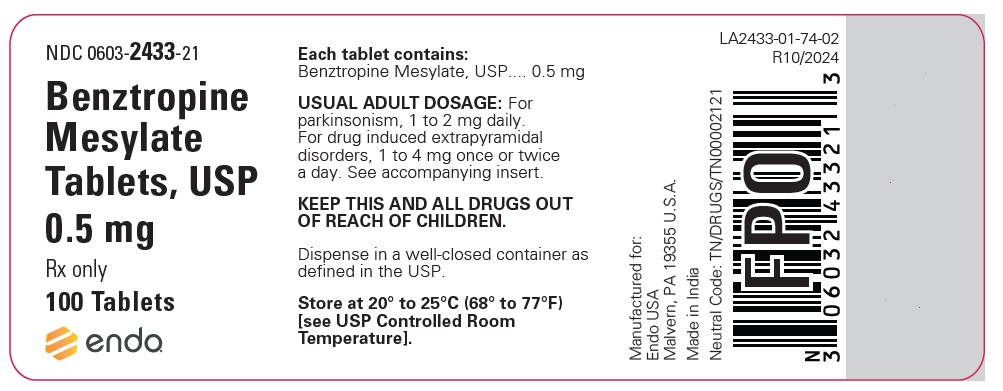
Benztropine Mesylate 2 mg Tablet, 100-count
🆔 Identity & classification
Where does this data come from?
🏷️ RxNorm drug class
This medicine belongs to the Anticholinergic class.
Where does this data come from?
🏭 Manufacturer & labeler
Where does this data come from?
🩺 Clinical
- Benztropine helps reduce the stiffness, tremors, and movement problems that come with parkinsonism. It works by blocking certain chemical signals in the brain that are out of balan...
- What exactly is benztropine supposed to do for me?
- This medication has a long-lasting effect, so many people do best taking their full dose at bedtime — it can help you move more comfortably during the night and make it easier to g...
- Should I take my tablet in the morning or at night?
Patient education
Supplement & herbal interactions
Where does this data come from?
Ask a licensed pharmacist directly — free, answered by our team.
💊 What it looks like
Where does this data come from?
🧪 Inactive Ingredients / Excipients
Inactive ingredients, also called excipients, are components of the drug product other than the active ingredient. They may include fillers, dyes, coatings, preservatives, flavors, or other formulation ingredients.
💡 Tap an ingredient (hover on desktop) to see what it is and why it’s used.
-
UNII O7TSZ97GEP
A mineral compound that serves as a filler and binding agent in tablets and capsules. It adds bulk to the medicine and helps hold ingredients together during manufacturing.
-
UNII OP1R32D61U
Microcrystalline cellulose is a purified form of cellulose, a natural fiber from plant sources. It acts as a binder and filler in tablets and capsules, helping hold ingredients together and give the medicine its shape and size.
-
UNII M28OL1HH48
Croscarmellose sodium is a plant-based substance derived from cellulose. It acts as a disintegrant, helping tablets and capsules break down quickly in the digestive system so the medicine can be absorbed.
-
UNII EWQ57Q8I5X
Lactose monohydrate is a natural sugar derived from milk. It serves as a filler and binder in tablets and capsules, helping create the proper size, texture, and consistency of the medicine.
-
UNII 70097M6I30
Magnesium stearate is a salt made from magnesium and stearic acid, a fatty substance. It's used in tablets and capsules as a lubricant and glidant to help ingredients flow smoothly during manufacturing and prevent sticking.
5 inactive ingredients listed in the exact product block matched to this NDC.
Where does this data come from?
ingredient classCode="IACT" elements from the exact product block matched by this NDC. Label-section narrative from DailyMed / the openFDA label index is shown separately when available.Inactive ingredient FAQ
Are inactive ingredients the same for every manufacturer?
Why might an inactive ingredient be missing?
Can inactive ingredients matter?
💲 Pricing
A drug doesn't have one price. Each row is a different public payment system, and none is what you'd pay at the counter — that depends on your insurance. The ⓘ on each row explains what it measures.
| Price system | Per ea | Per package |
|---|---|---|
| Retail pharmacies payNADAC · weekly | $0.091 | $9.06 / 100 tablets |
| Medicaid paysCMS SDUD · 12 mo | $0.2525 | $25.25 / 100 tablets |
| Medicare drug plans payPart D · Q2 2026 | $0.1636 | $16.36 / 100 tablets |
Where does this data come from?
🔁 Therapeutic equivalents
| Product | Labeler | Pack | NADAC/unit | TE | Status | Price vs. this |
|---|---|---|---|---|---|---|
| Benztropine Mesylate 2 mgthis 00603-2435-21 | Endo | 100 tablets | $0.091 | AA | Availability likely | — |
| Benztropine Mesylate 2 mg 00904-7290-61 | Major | 100 tablets | $0.091 | AA | Availability likely | — |
| Benztropine Mesylate 2 mg 11534-0169-09 | SUNRISE | 100 tablets | $0.091 | AA | Availability likely | — |
| Benztropine Mesylate 2 mg 50228-0227-01 | ScieGen | 100 tablets | $0.091 | AA | Availability likely | — |
| Benztropine Mesylate 2 mg 62135-0142-01 | Chartwell | 100 tablets | $0.091 | AA | Availability likely | — |
| Benztropine Mesylate 2 mg 68084-0389-01 | American | 100 tablets | $0.091 | AA | Availability likely | — |
| Benztropine Mesylate 2 mg 69315-0138-01 | Leading | 100 tablets | $0.091 | AA | Availability likely | — |
| Benztropine Mesylate 2 mg 70752-0125-10 | QUAGEN | 100 tablets | $0.091 | AA | Availability likely | — |
| Benztropine Mesylate 2 mg 00615-8478-39 | NCS | 30 tablets | — | AA | FDA listed | — |
| Benztropine Mesylate 2 mg 10135-0815-01 | Marlex | 100 tablets | — | AA | FDA listed | — |
| Benztropine Mesylate 2 mg 61919-0128-30 | DIRECT | 30 tablets | — | AA | FDA listed | — |
| Benztropine Mesylate 2 mg 67046-0040-03 | Coupler | 30 tablets | — | AA | FDA listed | — |
| Benztropine Mesylate 2 mg 67046-1675-03 | Coupler | 30 tablets | — | AA | FDA listed | — |
| Benztropine Mesylate 2 mg 69097-0832-02 | Cipla | 30 tablets | — | — | FDA listed | — |
| Benztropine Mesylate 2 mg 70518-2677-00 | REMEDYREPACK | 30 tablets | — | AA | FDA listed | — |
| Benztropine Mesylate 2 mg 72162-1154-01 | Bryant | 100 tablets | — | AA | FDA listed | — |
| Benztropine Mesylate 2 mg 72162-2596-00 | Bryant | 1000 tablets | — | AA | FDA listed | — |
Where does this data come from?
⏳ Availability & generic status
This product is an FDA-approved generic. Other versions of the same drug are listed under Therapeutic equivalents, least expensive first.
Where does this data come from?
🗺️ Medicaid utilization & spend
💊 Medicaid utilization by pack size
📊 Medicare Part D spend CMS · PART D · 2026 (Q1)
🔬 Reported adverse events (FAERS)
Top reported reactions
Age at onset
Reporter sex
Serious outcomes
Where does this data come from?
📦 Packaging — all sizes for this product
| Package NDC | Description | Per unit | Per pack | Marketing start | Status |
|---|---|---|---|---|---|
| 00603-2435-10 | 10 TABLET in 1 BOTTLE, PLASTIC (0603-2435-10) | — | — | 2022-03-17 | Discontinued by firm |
| 00603-2435-21 You're viewing this | 100 TABLET in 1 BOTTLE, PLASTIC (0603-2435-21) | $0.0906 / ea | $9.06 | 2022-03-17 | Active |
| 00603-2435-32 | 1000 TABLET in 1 BOTTLE, PLASTIC (0603-2435-32) | $0.0906 / ea | $90.59 | 2022-03-17 | Active |
You're viewing one of 3 pack sizes for this product.
This pack has the lowest per-ea cost of the 2 priced pack sizes ($0.0906 NADAC).
In Medicaid, this is the most-dispensed pack of this product — about 66% of fills over the last four reported quarters. See all packs ↓
Pack size FAQ
What quantity is in NDC 00603-2435-21?
What is the difference between NDC 00603-2435-21 and NDC 00603-2435-10?
What NDC number is used to bill for this package of Benztropine Mesylate 2 mg Tablet?
Prices are the latest CMS NADAC pharmacy acquisition cost per NDC; per-pack figures are per-unit × pack quantity, shown only when the pack is denominated in the same measure NADAC prices.
📄 Full prescribing information FDA SPL
🎯 Indications and Usage ▾
INDICATIONS AND USAGE For use as an adjunct in the therapy of all forms of parkinsonism. Useful also in the control of extrapyramidal disorders (except tardive dyskinesia – see PRECAUTIONS ) due to neuroleptic drugs (e.g., phenothiazines).
⏱️ Dosage and Administration ▾
DOSAGE AND ADMINISTRATION Benztropine mesylate tablets should be used when patients are able to take oral medication. Because of cumulative action, therapy should be initiated with a low dose which is increased gradually at five- or six-day intervals to the smallest amount necessary for optimal relief. Increases should be made in increments of 0.5 mg, to a maximum of 6 mg, or until optimal results are obtained without excessive adverse reactions.
Postencephalitic and Idiopathic Parkinsonism The usual daily dose is 1 to 2 mg with a range of 0.5 to 6 mg orally. As with any agent used in parkinsonism, dosage must be individualized according to age and weight, and the type of parkinsonism being treated. Generally, older patients, and thin patients cannot tolerate large doses.
Most patients with postencephalitic parkinsonism need fairly large doses and tolerate them well. Patients with a poor mental outlook are usually poor candidates for therapy. In idiopathic parkinsonism, therapy may be initiated with a single daily dose of 0.5 to 1 mg at bedtime.
In some patients, this will be adequate; in others 4 to 6 mg a day may be required. In postencephalitic parkinsonism, therapy may be initiated in most patients with 2 mg a day in one or more doses. In highly sensitive patients, therapy may be initiated with 0.5 mg at bedtime, and increased as necessary.
Some patients experience greatest relief by taking the entire dose at bedtime; others react more favorably to divided doses, two to four times a day. Frequently, one dose a day is sufficient, and divided doses may be unnecessary or undesirable. The long duration of action of this drug makes it particularly suitable for bedtime medication when its effects may last throughout the night, enabling patients to turn in bed during the night more easily, and to rise in the morning.
When benztropine mesylate is started, do not terminate therapy with other antiparkinsonian agents abruptly. If the other agents are to be reduced or discontinued, it must be done gradually. Many patients obtain greatest relief with combination therapy.
Benztropine mesylate may be used concomitantly with carbidopa-levodopa, or with levodopa, in which case periodic dosage adjustment may be required in order to maintain optimum response. Drug-Induced Extrapyramidal Disorders In treating extrapyramidal disorders due to neuroleptic drugs (e.g., phenothiazines), the recommended dosage is 1 to 4 mg once or twice a day orally. Dosage must be individualized according to the need of the patient.
Some patients require more than recommended; others do not need as much. When extrapyramidal disorders develop soon after initiation of treatment with neuroleptic drugs (e.g., phenothiazines), they are likely to be transient. One to 2 mg of benztropine mesylate tablets two or three times a day usually provides relief within one or two days.
After one or two weeks the drug should be withdrawn to determine the continued need for it. If such disorders recur, benztropine mesylate can be reinstituted. Certain drug-induced extrapyramidal disorders that develop slowly may not respond to benztropine mesylate.
Postencephalitic and Idiopathic Parkinsonism The usual daily dose is 1 to 2 mg with a range of 0.5 to 6 mg orally. As with any agent used in parkinsonism, dosage must be individualized according to age and weight, and the type of parkinsonism being treated. Generally, older patients, and thin patients cannot tolerate large doses.
Most patients with postencephalitic parkinsonism need fairly large doses and tolerate them well. Patients with a poor mental outlook are usually poor candidates for therapy. In idiopathic parkinsonism, therapy may be initiated with a single daily dose of 0.5 to 1 mg at bedtime.
In some patients, this will be adequate; in others 4 to 6 mg a day may be required. In postencephalitic parkinsonism, therapy may be initiated in most patients with 2 mg a day in one or more doses. In highly sensitive patients, therapy ma…
⛔ Contraindications ▾
CONTRAINDICATIONS Hypersensitivity to benztropine mesylate tablets. Because of its atropine-like side effects, this drug is contraindicated in pediatric patients under three years of age, and should be used with caution in older pediatric patients.
⚠️ Warnings ▾
WARNINGS Safe use in pregnancy has not been established. Benztropine mesylate may impair mental and/or physical abilities required for performance of hazardous tasks, such as operating machinery or driving a motor vehicle. When benztropine mesylate is given concomitantly with phenothiazines, haloperidol, or other drugs with anticholinergic or antidopaminergic activity, patients should be advised to report gastrointestinal complaints, fever or heat intolerance promptly.
Paralytic ileus, hyperthermia and heat stroke, all of which have sometimes been fatal, have occurred in patients taking anticholinergic-type antiparkinsonism drugs, including benztropine mesylate, in combination with phenothiazines and/or tricyclic antidepressants. Since benztropine mesylate contains structural features of atropine, it may produce anhidrosis. For this reason, it should be administered with caution during hot weather, especially when given concomitantly with other atropine-like drugs to the chronically ill, the alcoholic, those who have central nervous system disease, and those who do manual labor in a hot environment.
Anhidrosis may occur more readily when some disturbance of sweating already exists. If there is evidence of anhidrosis, the possibility of hyperthermia should be considered. Dosage should be decreased at the discretion of the physician so that the ability to maintain body heat equilibrium by perspiration is not impaired.
Severe anhidrosis and fatal hyperthermia have occurred.
🤒 Adverse Reactions ▾
ADVERSE REACTIONS The adverse reactions below, most of which are anticholinergic in nature, have been reported and within each category are listed in order of decreasing severity. Cardiovascular Tachycardia. Digestive Paralytic ileus, constipation, vomiting, nausea, dry mouth.
If dry mouth is so severe that there is difficulty in swallowing or speaking, or loss of appetite and weight, reduce dosage or discontinue the drug temporarily. Slight reduction in dosage may control nausea and still give sufficient relief of symptoms. Vomiting may be controlled by temporary discontinuation, followed by resumption at a lower dosage.
Nervous System Toxic psychosis, including confusion, disorientation, memory impairment, visual hallucinations; exacerbation of pre-existing psychotic symptoms; nervousness; depression; listlessness; numbness of fingers. Special Senses Blurred vision, dilated pupils. Urogenital Urinary retention, dysuria.
Metabolic/Immune or Skin Occasionally, an allergic reaction, e.g., skin rash, develops. If this cannot be controlled by dosage reduction, the medication should be discontinued. Other Heat stroke, hyperthermia, fever.
🔄 Drug Interactions ▾
Drug Interactions Antipsychotic drugs such as phenothiazines or haloperidol; tricyclic antidepressants (see WARNINGS ).
🧒 Pediatric Use ▾
Pediatric Use Because of the atropine-like side effects, benztropine mesylate should be used with caution in pediatric patients over three years of age (see CONTRAINDICATIONS ).
🆘 Overdosage ▾
OVERDOSAGE Manifestations May be any of those seen in atropine poisoning or antihistamine overdosage; CNS depression, preceded or followed by stimulation; confusion; nervousness; listlessness; intensification of mental symptoms or toxic psychosis in patients with mental illness being treated with neuroleptic drugs (e.g., phenothiazines); hallucinations (especially visual); dizziness; muscle weakness; ataxia; dry mouth; mydriasis, blurred vision; palpitations; tachycardia; elevated blood pressure; nausea; vomiting; dysuria; numbness of fingers; dysphagia; allergic reactions, e.g., skin rash; headache; hot, dry, flushed skin; delirium; coma; shock; convulsions; respiratory arrest; anhidrosis; hyperthermia; glaucoma; constipation.
Treatment Physostigmine salicylate, 1 to 2 mg, SC or IV, reportedly will reverse symptoms of anticholinergic intoxication. * A second injection may be given after 2 hours if required. Otherwise treatment is symptomatic and supportive. Induce emesis or perform gastric lavage (contraindicated in precomatose convulsive, or psychotic states).
Maintain respiration. A short-acting barbiturate may be used for CNS excitement, but with caution to avoid subsequent depression; supportive care for depression (avoid convulsant stimulants such as picrotoxin, pentylenetetrazol, or bemegride); artificial respiration for severe respiratory depression; a local miotic for mydriasis and cycloplegia; ice bags or other cold applications and alcohol sponges for hyperpyrexia, a vasopressor and fluids for circulatory collapse. Darken room for photophobia.
Manifestations May be any of those seen in atropine poisoning or antihistamine overdosage; CNS depression, preceded or followed by stimulation; confusion; nervousness; listlessness; intensification of mental symptoms or toxic psychosis in patients with mental illness being treated with neuroleptic drugs (e.g., phenothiazines); hallucinations (especially visual); dizziness; muscle weakness; ataxia; dry mouth; mydriasis, blurred vision; palpitations; tachycardia; elevated blood pressure; nausea; vomiting; dysuria; numbness of fingers; dysphagia; allergic reactions, e.g., skin rash; headache; hot, dry, flushed skin; delirium; coma; shock; convulsions; respiratory arrest; anhidrosis; hyperthermia; glaucoma; constipation.
Treatment Physostigmine salicylate, 1 to 2 mg, SC or IV, reportedly will reverse symptoms of anticholinergic intoxication. * A second injection may be given after 2 hours if required. Otherwise treatment is symptomatic and supportive. Induce emesis or perform gastric lavage (contraindicated in precomatose convulsive, or psychotic states).
Maintain respiration. A short-acting barbiturate may be used for CNS excitement, but with caution to avoid subsequent depression; supportive care for depression (avoid convulsant stimulants such as picrotoxin, pentylenetetrazol, or bemegride); artificial respiration for severe respiratory depression; a local miotic for mydriasis and cycloplegia; ice bags or other cold applications and alcohol sponges for hyperpyrexia, a vasopressor and fluids for circulatory collapse. Darken room for photophobia.
🧬 Clinical Pharmacology ▾
CLINICAL PHARMACOLOGY Benztropine mesylate possesses both anticholinergic and antihistaminic effects, although only the former have been established as therapeutically significant in the management of parkinsonism. In the isolated guinea pig ileum, the anticholinergic activity of this drug is about equal to that of atropine; however, when administered orally to unanesthetized cats, it is only about half as active as atropine. In laboratory animals, its antihistaminic activity and duration of action approach those of pyrilamine maleate.
📦 How Supplied / Storage and Handling ▾
HOW SUPPLIED Benztropine Mesylate Tablets, USP are available as follows: 0.5 mg: white, round, flat-faced beveled edge, scored tablets, debossed "2325" on one side and debossed "V" on the reverse side, supplied in bottles of 10, 100 and 1000. 1 mg: white, oval, scored tablets, debossed "2326" on one side and debossed "V" on the reverse side, supplied in bottles of 10, 100 and 1000. 2 mg: white, round, flat-faced beveled edge, scored tablets, debossed "2327" on one side and debossed "V" on the reverse side, supplied in bottles of 10, 100 and 1000.
Dispense in a well-closed container as defined in the USP. Store at 20° to 25°C (68° to 77°F) [see USP Controlled Room Temperature]. * Duvoisin, R.C.; Katz, R.J.; Amer. Med.
Ass. 206:1963–1965, Nov. 25, 1968.
📦 Storage and Handling ▾
Dispense in a well-closed container as defined in the USP. Store at 20° to 25°C (68° to 77°F) [see USP Controlled Room Temperature].
📋 Description ▾
DESCRIPTION Benztropine mesylate is a synthetic compound containing structural features found in atropine and diphenhydramine. It is a crystalline white powder, very soluble in water, designated as 3α-(Diphenylmethoxy)-1αH, 5αH-tropane methanesulfonate, with the following structural formula: Each tablet, for oral administration, contains 0.5 mg, 1 mg or 2 mg of benztropine mesylate. Each tablet contains the following inactive ingredients: croscarmellose sodium, dibasic calcium phosphate, lactose monohydrate, magnesium stearate and microcrystalline cellulose.
This is an image of the structural formula for benztropine.