
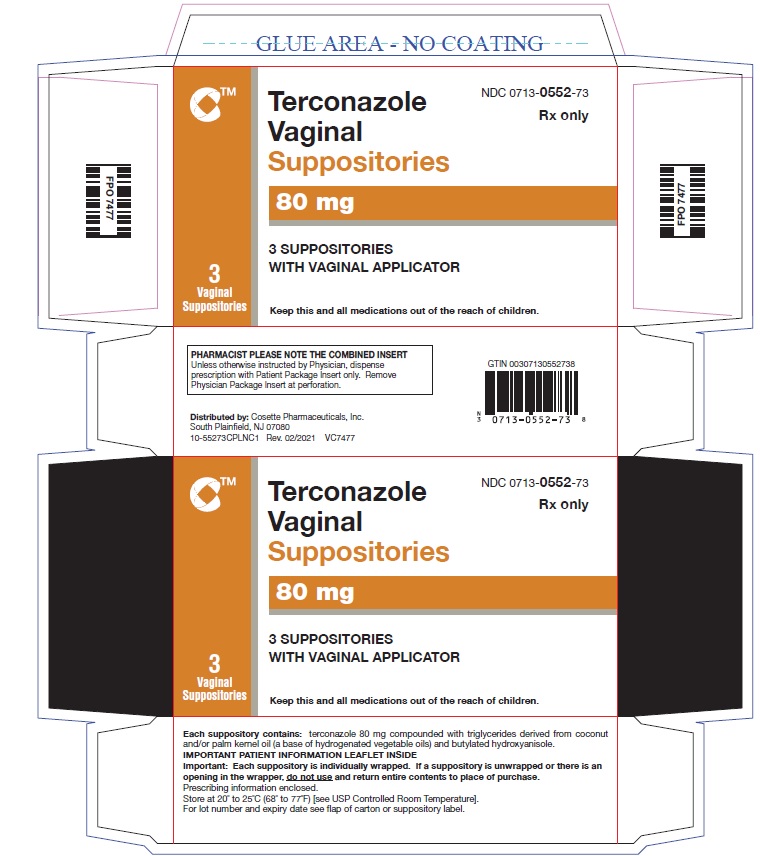
Terconazole 80 mg Suppository, 3 suppositories
Past resolved recalls for this product (1)
🆔 Identity & classification
Where does this data come from?
🏷️ RxNorm drug class
This medicine belongs to the Azole Antifungal class.
Where does this data come from?
🏭 Manufacturer & labeler
Where does this data come from?
🩺 Clinical
Terconazole is used to treat fungal and yeast infections of the vagina. This medication is sometimes prescribed for other uses; ask your doctor or pharmacist for more information.
Read the full MedlinePlus article ↗- Terconazole treats vaginal yeast infections — specifically those caused by a fungus called Candida. It comes as a vaginal cream or a vaginal suppository, and both work the same way...
- You insert terconazole vaginally — either using the applicator with the cream or inserting the suppository — once each night at bedtime for three nights in a row. It is not taken b...
- How do I use it, and how long does treatment last?
- The most common side effects are headache, genital burning or itching, painful periods, and abdominal discomfort. These are generally manageable. However, if you develop skin irrit...
Patient education
Supplement & herbal interactions
Some supplements/herbs that may interact with Terconazole — tap one for details:
Where does this data come from?
Ask a licensed pharmacist directly — free, answered by our team.
💊 What it looks like
Where does this data come from?
🧪 Inactive Ingredients / Excipients
Inactive ingredients, also called excipients, are components of the drug product other than the active ingredient. They may include fillers, dyes, coatings, preservatives, flavors, or other formulation ingredients.
💡 Tap an ingredient (hover on desktop) to see what it is and why it’s used.
-
UNII REK4960K2U
Butylated hydroxyanisole is a synthetic preservative that prevents oils and fats in medicines from spoiling or becoming rancid. It keeps the medicine stable and extends its shelf life.
-
UNII Q9L0O73W7L
Coconut oil is a natural fat extracted from coconut fruit. It's used in medicines as a lubricant, emollient, or carrier to help dissolve or deliver active ingredients smoothly through the formulation.
-
UNII B0S90M0233
Palm kernel oil is a natural fat extracted from palm seeds. It's used in medicines as a lubricant and binder to help tablets hold together and flow smoothly during manufacturing.
3 inactive ingredients listed in the exact product block matched to this NDC.
Where does this data come from?
ingredient classCode="IACT" elements from the exact product block matched by this NDC. Label-section narrative from DailyMed / the openFDA label index is shown separately when available.Inactive ingredient FAQ
Are inactive ingredients the same for every manufacturer?
Why might an inactive ingredient be missing?
Can inactive ingredients matter?
💲 Pricing
A drug doesn't have one price. Each row is a different public payment system, and none is what you'd pay at the counter — that depends on your insurance. The ⓘ on each row explains what it measures.
| Price system | Per ea | Per package |
|---|---|---|
| Retail pharmacies payNADAC · weekly | $18.623 | $55.87 / 3 suppository |
| Medicaid paysCMS SDUD · 12 mo | $20.66 | $61.98 / 3 suppository |
| Medicare drug plans payPart D · Q2 2026 | $24.30 | $72.90 / 3 suppository |
Where does this data come from?
🔁 Therapeutic equivalents
| Product | Labeler | Pack | NADAC/unit | TE | Status | Price vs. this |
|---|---|---|---|---|---|---|
| Terconazole 80 mgthis 00713-0552-73 | Cosette | 3 suppositories | $18.623 | AB | Availability likely | — |
| Terconazole 80 mg 45802-0717-08 | Padagis | 3 suppositories | $18.623 | AB | Availability likely | — |
| Terconazole 80 mg 51672-1330-03 | Sun | 3 suppositories | — | AB | FDA listed | — |
Where does this data come from?
⏳ Availability & generic status
This product is an FDA-approved generic. Other versions of the same drug are listed under Therapeutic equivalents, least expensive first.
Where does this data come from?
🗺️ Medicaid utilization & spend
📊 Medicare Part D spend CMS · PART D · 2026 (Q1)
📦 Packaging — all sizes for this product
| Package NDC | Description | Marketing start | Status |
|---|---|---|---|
| 00713-0552-73 You're viewing this | 3 BLISTER PACK in 1 CARTON (0713-0552-73) / 1 SUPPOSITORY in 1 BLISTER PACK | 2015-09-25 | Active |
📄 Full prescribing information FDA SPL
🎯 Indications and Usage ▾
INDICATIONS AND USAGE Terconazole Vaginal Suppositories, 80 mg is indicated for the local treatment of vulvovaginal candidiasis (moniliasis). As this product is effective only for vulvovaginitis caused by the genus Candida , the diagnosis should be confirmed by KOH smears and/or cultures.
⏱️ Dosage and Administration ▾
DOSAGE AND ADMINISTRATION One Terconazole Vaginal Suppository (80 mg terconazole) should be administered intravaginally once daily at bedtime for three consecutive days. Before prescribing another course of therapy, the diagnosis should be reconfirmed by smears and/or cultures and other pathogens commonly associated with vulvovaginitis ruled out. The therapeutic effect of terconazole vaginal suppositories is not affected by menstruation.
⛔ Contraindications ▾
CONTRAINDICATIONS Patients known to be hypersensitive to terconazole or to any of the components of the suppositories.
⚠️ Warnings ▾
WARNINGS Anaphylaxis and toxic epidermal necrolysis have been reported during terconazole therapy. Terconazole therapy should be discontinued if anaphylaxis or toxic epidermal necrolysis develops.
🤒 Adverse Reactions ▾
ADVERSE REACTIONS Adverse Reactions from Clinical Trials Because clinical trials are conducted under widely varying conditions, adverse reaction rates observed in the clinical trials of a drug cannot be directly compared to rates in the clinical trials of another drug and may not reflect the rates observed in clinical practice. During controlled clinical studies conducted in the United States, 284 patients with vulvovaginal candidiasis were treated with terconazole 80 mg vaginal suppositories. Based on comparative analyses with placebo (295 patients), the adverse experiences considered adverse reactions most likely related to terconazole 80 mg vaginal suppositories were headache (30.3% vs.
20.7% with placebo) and pain of the female genitalia (4.2% vs. 0.7% with placebo). Adverse reactions that have also been reported but were not statistically significantly different from placebo were burning (15.2% vs.
11.2% with placebo) and body pain (3.9% vs. 1.7% with placebo). Fever (2.8% vs.
1.4% with placebo) and chills (1.8% vs. 0.7% with placebo) have also been reported. The adverse drug experience on terconazole most frequently causing discontinuation was burning (2.5% vs.
1.4% with placebo) and pruritus (1.8% vs. 1.4% with placebo). Post-marketing Experience The following adverse drug reactions have been first identified during post-marketing experience with terconazole:.
Because these reactions are reported voluntarily from a population of uncertain size, it is not always possible to reliably estimate their frequency or establish a causal relationship to drug exposure. General: Asthenia, Influenza-Like Illness consisting of multiple listed reactions including fever and chills, nausea, vomiting, myalgia, arthralgia, malaise Immune: Hypersensitivity, Anaphylaxis, Face Edema Nervous: Dizziness Respiratory: Bronchospasm Skin: Rash, Toxic Epidermal Necrolysis, Urticaria To report SUSPECTED ADVERSE REACTIONS, contact Cosette Pharmaceuticals, Inc. at 1-800-922-1038 or FDA at 1-800-FDA-1088 or www.fda.gov/medwatch.
🔄 Drug Interactions ▾
Drug Interactions The therapeutic effect of this product is not affected by oral contraceptive usage.
🤰 Pregnancy ▾
Pregnancy Teratogenic Effects Pregnancy Category C There was no evidence of teratogenicity when terconazole was administered orally up to 40 mg/kg/day (25× the recommended intravaginal human dose of the suppository formulation) in rats, or 20 mg/kg/day in rabbits, or subcutaneously up to 20 mg/kg/day in rats. Dosages at or below 10 mg/kg/day produced no embryotoxicity; however, there was a delay in fetal ossification at 10 mg/kg/day in rats. There was some evidence of embryotoxicity in rabbits and rats at 20 to 40 mg/kg.
In rats, this was reflected as a decrease in litter size and number of viable young and reduced fetal weight. There was also delay in ossification and an increased incidence of skeletal variants. The no-effect dose of 10 mg/kg/day resulted in a mean peak plasma level of terconazole in pregnant rats of 0.176 mcg/mL which exceeds by 17 times the mean peak plasma level (0.010 mcg/mL) seen in normal subjects after intravaginal administration of terconazole 80 mg vaginal suppository.
This safety assessment does not account for possible exposure of the fetus through direct transfer to terconazole from the irritated vagina by diffusion across amniotic membranes. Since terconazole is absorbed from the human vagina, it should not be used in the first trimester of pregnancy unless the physician considers it essential to the welfare of the patient. Terconazole may be used during the second and third trimester if the potential benefit outweighs the possible risks to the fetus.
🧒 Pediatric Use ▾
Pediatric Use Safety and efficacy in children have not been established.
🧓 Geriatric Use ▾
Geriatric Use Clinical studies of terconazole vaginal suppositories did not include sufficient numbers of subjects aged 65 and over to determine whether they respond differently from younger subjects. Other reported clinical experience has not identified differences in responses between the elderly and younger patients.
🆘 Overdosage ▾
OVERDOSAGE In the rat, the oral LD 50 values were found to be 1741 and 849 mg/kg for the male and female, respectively. The oral LD 50 values for the male and female dog were ≅1280 and ≥640 mg/kg, respectively. In the event of oral ingestion of suppository or cream, supportive and symptomatic measures should be carried out. If the cream is accidentally applied to the eyes, wash with clean water or saline and seek medical attention if symptoms persist.
🧬 Clinical Pharmacology ▾
CLINICAL PHARMACOLOGY Absorption Following a single intravaginal application of a suppository containing 240 mg 14 C-terconazole to healthy women, approximately 70% (range: 64 to 76%) of terconazole remains in the vaginal area during the suppository retention period (16 hours); approximately 10% (range: 5 to 16%) of the administered radioactivity was absorbed systemically over 7 days. Maximum plasma concentrations of terconazole occur 5 to 10 hours after intravaginal application of the cream or suppository. Systemic exposure to terconazole is approximately proportional to the applied dose, whether as the cream or suppository.
The rate and extent of absorption of terconazole are similar in patients with vulvovaginal candidiasis (pregnant or non-pregnant) and healthy subjects. Distribution Terconazole is highly protein bound (94.9%) in human plasma and the degree of binding is independent of drug concentration over the range of 0.01 to 5.0 mcg/mL. Metabolism Systemically absorbed terconazole is extensively metabolized (>95%).
Elimination Across various studies in healthy women, after single or multiple intravaginal administration of terconazole as the cream or suppository/ovule, the mean elimination half-life of unchanged terconazole ranged from 6.4 to 8.5 hours. Following a single intravaginal administration of a suppository containing 240 mg 14 C-terconazole to hysterectomized or tubal ligated women, approximately 3 to 10% (mean ± SD: 5.7 ± 3.0%) of the administered radioactivity was eliminated in the urine and 2.0 to 6% (mean ± SD: 4.2 ± 1.6%) was eliminated in the feces during the 7-day collection period.
Multiple Dosing There is no significant increase in maximum plasma concentration or overall exposure (AUC) after multiple daily applications of the cream for 7 days or suppositories for 3 days. Photosensitivity reactions were observed in some normal volunteers following repeated dermal application of terconazole 2% and 0.8% creams under conditions of filtered artificial ultraviolet light. Photosensitivity reactions have not been observed in U.S. and foreign clinical trials in patients who were treated with terconazole suppositories or vaginal cream (0.4% and 0.8%).
Microbiology Mechanism of action Terconazole, an azole antifungal agent, inhibits fungal cytochrome P-450-mediated 14 alpha-lanosterol demethylase enzyme. This enzyme functions to convert lanosterol to ergosterol. The accumulation of 14 alpha-methyl sterols correlates with the subsequent loss of ergosterol in the fungal cell wall and may be responsible for the antifungal activity of terconazole.
Mammalian cell demethylation is less sensitive to terconazole inhibition. Activity in vitro Terconazole exhibits antifungal activity in vitro against Candida albicans and other Candida species. The MIC values of terconazole against most Lactobacillus spp. typically found in the human vagina were ≥128 mcg/mL; therefore these beneficial bacteria are not affected by drug treatment.
🧬 Mechanism of Action ▾
Mechanism of action Terconazole, an azole antifungal agent, inhibits fungal cytochrome P-450-mediated 14 alpha-lanosterol demethylase enzyme. This enzyme functions to convert lanosterol to ergosterol. The accumulation of 14 alpha-methyl sterols correlates with the subsequent loss of ergosterol in the fungal cell wall and may be responsible for the antifungal activity of terconazole. Mammalian cell demethylation is less sensitive to terconazole inhibition.
📦 How Supplied / Storage and Handling ▾
HOW SUPPLIED Terconazole Vaginal Suppositories 80 mg are available as 2.5 g, elliptically-shaped white to off-white suppositories in packages of three with a vaginal applicator. NDC 0713-0552-73 Store at 20°- 25°C (68°- 77°F) [see USP Controlled Room Temperature].
📦 Storage and Handling ▾
Store at 20°- 25°C (68°- 77°F) [see USP Controlled Room Temperature].
📋 Description ▾
DESCRIPTION Terconazole Vaginal Suppositories are white to off-white suppositories for intravaginal administration containing 80 mg of the antifungal agent terconazole, cis -1-[ p -[[2-(2,4-Dichlorophenyl)-2-(1 H -1,2,4-triazol-1-ylmethyl)-1, 3-dioxolan-4-yl]methoxy]phenyl]-4-isopropylpiperazine, in triglycerides derived from coconut and/or palm kernel oil (a base of hydrogenated vegetable oils) and butylated hydroxyanisole. The structural formula of terconazole is as follows: TERCONAZOLE C 26 H 31 Cl 2 N 5 O 3 Terconazole, a triazole derivative, is a white to almost white powder with a molecular weight of 532.47.
It is insoluble in water; sparingly soluble in ethanol; and soluble in butanol. Chemical Structure