
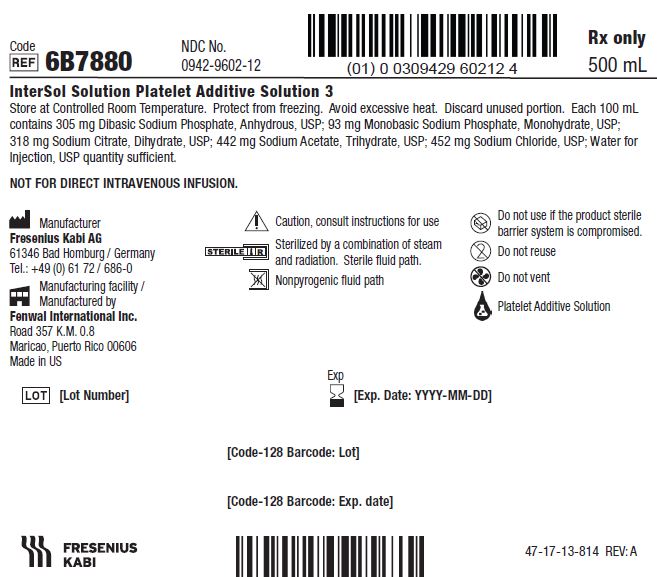
InterSol Platelet Additive 3 452 mg/100mL; 442 mg/100mL; 318 mg/100mL; 305 mg/100mL; 93 mg/100mL Solution, 500 mL — NDC 0942-9602-12 (Billing 00942-9602-12)
This is a package of 500 mL of InterSol Platelet Additive 3 452 mg/100mL; 442 mg/100mL; 318 mg/100mL; 305 mg/100mL; 93 mg/100mL Solution from Fenwal, Inc., marketed since Jun 2019 and currently FDA-listed. It is this product's only package size.
NDC database record
One package, one record: these facts belong to NDC 0942-9602-12 alone.
- Record
- FDA NDC Directory package listing · Human prescription drug
- Code segments
- 0942 labeler · 9602 product · 12 package
- Package marketed since
- Jun 5, 2019
- Sample package
- No — commercial package
- Listing certified through
- Dec 31, 2026
- Barcode (UPC-A, from the NDC)
- 3 0942960212 4
- FDA record last changed
- Aug 27, 2026
Identity & classification
Regulatory identifiers FDA, NLM and CMS codes for this package
Where does this data come from?
- FDA openFDA NDC Directory · synced Oct 8, 2026
- FDA label on DailyMed · label index refreshed Oct 8, 2026
- RxNorm (NLM RxNav) · catalog refreshed Oct 8, 2026
- Medi-Span GPI (licensed)
- First Databank (licensed) · refreshed Oct 8, 2026
Clinical
Patient education
Supplement & herbal interactions
Where does this data come from?
- MedlinePlus (NLM) · refreshed Oct 8, 2026
- FDA label on DailyMed · label index refreshed Oct 8, 2026
Ask a licensed pharmacist directly — free, answered by our team.
Pricing
A drug doesn't have one price. Each row is a different public payment system, and none is what you'd pay at the counter — that depends on your insurance. The ⓘ on each row explains what it measures.
| Price system | Per mL | Per package |
|---|---|---|
| Retail pharmacies payNADAC · weekly | Not in the retail survey — common for institutional, discontinued, or low-volume packs. | |
| Medicaid paysCMS SDUD · 12 mo | No recent Medicaid claims on file for this NDC — rare and low-volume NDCs are suppressed in the public data. | |
| Medicare drug plans payPart D · quarterly | No Part D plan price is available for this NDC in our data. | |
Where does this data come from?
- CMS NADAC weekly file
- CMS ASP pricing files · refreshed Sep 20, 2026
- CMS Medicaid State Drug Utilization Data · refreshed Oct 9, 2026
- CMS Part D plan pricing files · refreshed Sep 24, 2026
- VA National Acquisition Center price file
Packaging — all sizes for this product
| Package NDC | Description | Marketing start | Marketing end | Status |
|---|---|---|---|---|
| 00942-9602-12 You're viewing this Main listing | 500 mL in 1 BAG | 2019-06-05 | — | Active |
Therapeutic equivalents
| Product | Labeler | Pack | NADAC/unit | TE | Status | Price vs. this |
|---|---|---|---|---|---|---|
| InterSol 452 mg/100mL; 442 mg/100mL; 318 mg/100mL; 305 mg/100mL; 93 mg/100mLthis 00942-9602-12 | Fenwal, | 500 ml | — | — | FDA listed | — |
Where does this data come from?
- FDA openFDA NDC Directory · synced Oct 8, 2026
- FDA Orange Book · refreshed Oct 3, 2026
- CMS NADAC weekly file
Availability & generic status
We did not find an FDA-approved generic match for this exact strength, form and route.
Where does this data come from?
- FDA Orange Book · refreshed Oct 3, 2026
Inactive Ingredients / Excipients
Inactive ingredients, also called excipients, are components of the drug product other than the active ingredient. They may include fillers, dyes, coatings, preservatives, flavors, or other formulation ingredients.
💡 Tap an ingredient (hover on desktop) to see what it is and why it’s used.
-
UNII 059QF0KO0R
Water is a liquid solvent that dissolves and mixes ingredients together in liquid medicines, syrups, and injections. It helps distribute the active drug evenly throughout the product.
1 inactive ingredient listed in the exact product block matched to this NDC.
Where does this data come from?
ingredient classCode="IACT" elements from the exact product block matched by this NDC. Label-section narrative from DailyMed / the openFDA label index is shown separately when available.- FDA label on DailyMed · label index refreshed Oct 8, 2026
- FDA openFDA NDC Directory · synced Oct 8, 2026
Inactive ingredient FAQ
Are inactive ingredients the same for every manufacturer?
Why might an inactive ingredient be missing?
Can inactive ingredients matter?
Manufacturer & labeler
More NDCs from Fenwal, Inc. labeler code 00942
- CPDA-1 2 g/63mL; 1.66 g/63mL; 188 mg/63mL; 140 mg/63mL; 17.3 mg/63mL Solution NDC 0942-9394-01
- CPDA-1 Anticoagulant Citrate Phosphate Dextrose Adenine 2 g/63mL; 1.66 g/63mL; 188 mg/63mL; 140 mg/63mL; 17.3 mg/63mL Solution NDC 0942-9398-02
- Sodium Citrate Blood-Pack Units, (PL 146 Plastic) Anticoagulant Sodium Citrate Solution 4 g/100mL Solution NDC 0942-9504-10
- Sodium Citrate Blood-Pack Units, (PL 146 Plastic) Anticoagulant Sodium Citrate Solution 4 g/100mL Solution NDC 0942-9505-10
- Sodium Citrate Blood-Pack Units, (PL 146 Plastic) Anticoagulant Sodium Citrate Solution 4 g/100mL Solution NDC 0942-9506-25
- InterSol Platelet Additive 3 452 mg/100mL; 442 mg/100mL; 318 mg/100mL; 305 mg/100mL; 93 mg/100mL Solution NDC 0942-9601-12
- Solucion InterSol Solucion aditiva para plaquetas 3 452 mg/100mL; 442 mg/100mL; 318 mg/100mL; 305 mg/100mL; 93 mg/100mL Solution NDC 0942-9603-12
- InterSol Platelet Additive 3 452 mg/100mL; 442 mg/100mL; 318 mg/100mL; 93 mg/100mL; 305 mg/100mL Solution NDC 0942-9605-01
Where does this data come from?
- FDA openFDA NDC Directory · synced Oct 8, 2026
- Drugs@FDA
Full prescribing information FDA SPL
🎯 Indications and Usage ▾
Rx only Store at Controlled Room Temperature. Protect from freezing. Avoid excessive heat.
Definition of "Controlled Room Temperature": "A temperature maintained thermostatically that encompasses the usual and customary working environment of 20° to 25°C (68° to 77°F); that results in a mean kinetic temperature calculated to be not more than 25°C; and that allows for excursions between 15°C and 30°C (59° and 86°F) that are experienced in pharmacies, hospitals, and warehouses. Provided the mean kinetic temperature remains in the allowed range, transient spikes up to 40°C are permitted as long as they do not exceed 24 hours ...
The mean kinetic temperature is a calculated value that may be used as an isothermal storage temperature that simulates the non isothermal effects of storage temperature variations." Reference: United States Pharmacopeia, General Notices. United States Pharmacopeial Convention, Inc. 12601 Twinbrook Parkway, Rockville, MD.
Dispose of waste in appropriate biohazard container or according to local regulatory requirements. Indications and Usage: InterSol solution is an isotonic solution designed to replace a proportion of the plasma used in the storage of leukoreduced apheresis platelets under standard blood banking conditions. There is no direct therapeutic effect to be expected from the formulation.
The solution should never be infused directly into a patient. InterSol platelets are leukocyte-reduced apheresis platelet concentrates that are stored in a mix of 65% InterSol and 35% plasma, nominal. InterSol platelets prepared within the ranges described in the apheresis system Operator's Manuals may be stored for up to 5 days at 20-24°C, with continuous agitation.
⏱️ Dosage and Administration ▾
Dosage and Administration: InterSol solution is to be used with the AMICUS Separator System or the TRIMA ACCEL system. For full instructions on the use of InterSol solution, see the Operator's Manual for the respective platelet collection system.
💊 Dosage Forms and Strengths ▾
Dosage Forms and Strengths: InterSol solution is provided as a 500 mL sterile and non-pyrogenic solution in a non-PVC plastic container with a sterile and non-pyrogenic fluid path. Each 100 mL contains 305 mg Dibasic Sodium Phosphate, Anhydrous, USP; 93 mg Monobasic Sodium Phosphate, Monohydrate, USP; 318 mg Sodium Citrate, Dihydrate, USP; 442 mg Sodium Acetate, Trihydrate, USP; 452 mg Sodium Chloride, USP; Water for Injection, USP quantity sufficient.
⛔ Contraindications ▾
Contraindications: InterSol solution is added to apheresis-derived leukoreduced platelet concentrates after the apheresis procedure is complete. It is not for direct intravenous infusion. There are no known contraindications associated with the use of InterSol solution for the preparation of InterSol platelets.
⚠️ Warnings and Cautions ▾
Warnings and Precautions: • InterSol solution is NOT FOR DIRECT INTRAVENOUS INFUSION. • Do not use if particulate matter is present or if the solution is cloudy. • Do not use if the container is damaged, leaking or if there is any visible sign of deterioration. • Do not vent. • Do not reuse. Discard unused or partially used InterSol solution. • Protect from sharp objects. • Verify that the InterSol solution has been securely attached to the PAS Connector line to avoid disconnection and leaks.
🤒 Adverse Reactions ▾
Adverse Reactions: InterSol solution is added to leukoreduced platelet concentrates after the apheresis procedure is complete. It is not for direct intravenous infusion. InterSol solution is not expected to cause adverse events other than those normally associated with platelet transfusion.
🆘 Overdosage ▾
Overdosage: InterSol solution is used as a storage solution for platelet concentrates and it is not for direct intravenous infusion.
🧬 Clinical Pharmacology ▾
Clinical Pharmacology: InterSol solution is used as a storage solution for platelet concentrates and it is not for direct intravenous infusion. This solution has no pharmacological effect.
📦 How Supplied / Storage and Handling ▾
How Supplied/Storage and Handling : 500 mL sterile solution in a non-PVC plastic container with a sterile, non-pyrogenic fluid path. The InterSol solution container is supplied in a vented plastic overwrap covering that serves as a dust cover for the container. The dust cover is not a sterility barrier and is not an element that defines the expiration date of the InterSol product.
TRIMA ACCEL is a trademarks of Terumo BCT, Inc. © 2018 Fresenius Kabi AG. All rights reserved. Fresenius Kabi AG 61346 Bad Homburg / Germany Tel.: +49 (0) 61 72 / 686-0 www.fresenius-kabi.com symbols
📋 Description ▾
Description: InterSol solution is an isotonic solution designed to replace a proportion of the plasma used in the storage of platelets. The solution contains constituents that are naturally occurring components present in many cellular systems: sodium acetate as a nutrient, sodium citrate to prevent platelet clumping and activation, sodium phosphate for buffering and sodium chloride for osmolarity. InterSol solution does not have a pharmacological effect in vivo, but rather acts to provide the appropriate environment and nutrients in lieu of a portion of the plasma normally used for the storage of platelets.
🔬 Clinical Studies ▾
Clinical Studies: In Vitro Biochemical and Functional Evaluations AMICUS-derived, leukoreduced platelets InterSol platelet concentrates (n=70) prepared using the AMICUS separator and stored for 5 days showed a median and mean pH value on Day 5 of 7.2 and 7.2 ± 0.1 (range: 6.9-7.5), respectively, with a lower non-parametric 95%/95% tolerance limit of 6.9. Supplemental in vitro assessments of InterSol platelets and AMICUS-derived leukoreduced platelets stored in 100% plasma are presented in Table 2. InterSol platelets irradiated (n=18) at either 2500 or 2800 cGray (dependent on site procedures) were compared to non-irradiated InterSol platelets.
At the end of storage on Day 5 the platelet yields of the irradiated products were concentrated between 2.5 x 10 11 to 3.5 x 10 11 and included one product with a yield less than2.5 x 10 11 and two products with yields greater than 3.5 x 10 11 . In vitro testing is not predictive of in vivo performance, which was not evaluated. Summary statistics are presented in Table 3.
In Vivo Recovery and Survival in Healthy Subjects AMICUS-derived, leukoreduced platelets In vivo evaluation of InterSol platelets at Day 5 (n=33) compared to a fresh platelet control resulted in a mean percent recovery of 46.4 ± 11.9 percent and 58.0 ± 10.7 percent and mean survival of 5.7 ± 1.4 days and 8.0 ± 1.4 days, respectively. The in vivo data collected were used to calculate the upper limit of a two-sided 95% confidence interval of the mean percent recovery of the algebraic expression (0.66 x Fresh – 5 Day), and of the mean percent survival (days) of the algebraic expression (0.58 x Fresh – 5 Day).
The upper bound of the two-sided 95% confidence intervals for recovery and survival on Day 5 was –4.6 and –0.6 respectively and met the requirement of less than 0. Post-Market Transfusion-Related Adverse Events (AE) Study AMICUS-derived, leukoreduced platelets An open label, non-randomized, retrospective medical record review study was performed in 6 centers to demonstrate that the overall rate of transfusion-related AEs in patients receiving InterSol Platelet transfusions was not more than double the rate in patients receiving apheresis platelets stored in 100% plasma (Plasma Platelets).
The study categorized adverse transfusion reactions according to the definitions outlined by the Biovigilance Component of the National Healthcare Safety Network (NHSN) System. All sites that participated were required to have systems in place to observe transfusion-related AEs and to record when no transfusion-related AE was observed. An independent Clinical Events Committee (CEC) blinded to platelet type and study site adjudicated the reported events.
Patients were prescribed platelet transfusions per each site’s standard practice. The type of platelet unit the patient received was based on the site’s inventory at the time the transfusion was ordered. Site personnel observed the platelet transfusion recipient following their standard procedures.
Signs and symptoms of a potential transfusion-related reaction were noted using existing reporting systems. A total of 14,005 transfusions from 6 study sites were included in the final analysis. A total of 4,160 InterSol Platelet transfusions were given to a total of 1,444 patients, and 9,845 Plasma Platelet transfusions were given to 2,202 patients.
There were 165 CEC-adjudicated adverse reactions reported. Of those, 23 events were associated with InterSol Platelets and 142 events were associated with Plasma Platelets. Overall, 1.13% of all transfusions resulted in an AE.
The percentage of InterSol Platelet transfusions which led to AEs was 0.55%, while 1.37% of Plasma Platelet transfusions resulted in AEs. The 97.5% upper confidence limit for the relative risk of transfusion-related AE associated with InterSol Platelets relative to Plasma Platelets was 0.66, indicating that the study objective of ruling out a doubling of transfusion-related AEs for InterSol vs. Plasma Platelets was met.
T… [Excerpted — this section continues on DailyMed.]
🔒 Drug Abuse and Dependence ▾
Drug Abuse / Dependence: InterSol solution is used as a storage solution for platelet concentrates and has no pharmacological effect.
📄 Package Label / Principal Display Panel ▾
PACKAGE/LABEL PRINCIPAL DISPLAY PANEL 6b7880lbl
About this NDC listing & data coverage
What data is (and isn’t) available for this NDC — tap to expand
| NDC identity (package / product / labeler codes) | ✓ Available |
| Labeler | ✓ Available |
| Product & package description | ✓ Available |
| Marketing category & status | ✓ Available |
| Active ingredient / dosage form / route | ✓ Available |
| FDA label (SPL via DailyMed) | ✓ Available |
| Package photos | ✓ Available |
| Inactive ingredients (structured) | ✓ Available |
| NADAC pharmacy acquisition price (CMS) | — Not published for this NDC CMS publishes NADAC only for NDCs reported in its retail-pharmacy survey. |
| Orange Book / therapeutic-equivalence data | — Not published for this NDC Applies only to products approved under an NDA/ANDA; many listings are out of scope. |
| HCPCS J-code billing crosswalk | — Not published for this NDC Most self-administered / retail products have no J-code — that is normal. |
| Medicaid utilization (CMS SDUD) | — Not published for this NDC CMS reports utilization only for NDCs with Medicaid claims above its privacy threshold. |