
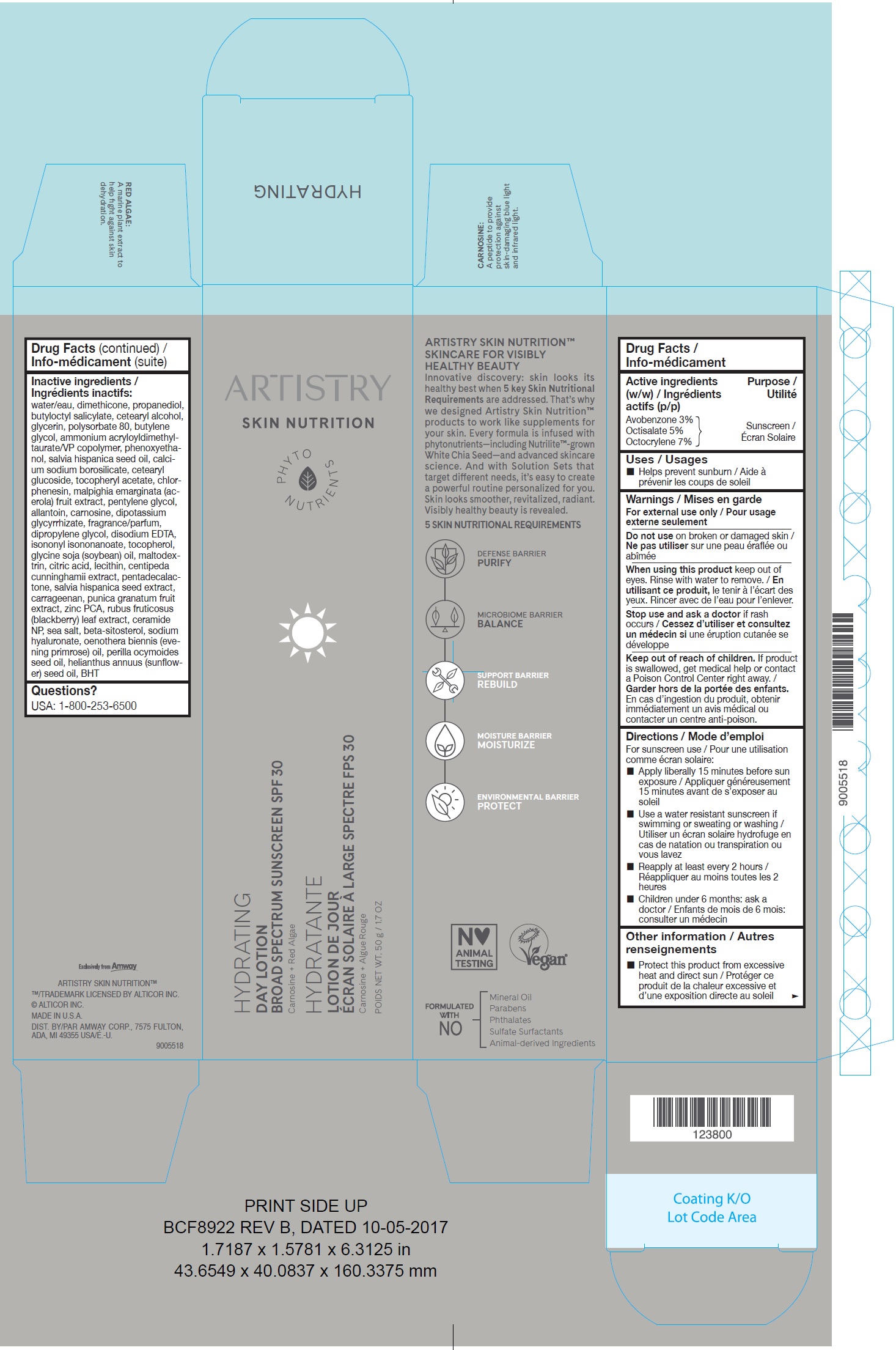
Artistry Skin Nutrition HYDRATING Day AVOBENZONE, OCTISALATE, OCTOCRYLENE 30 mg/g; 50 mg/g; 70 mg/g Lotion — NDC 10056-041-00 (Billing 10056-0041-00)
This is a package of Artistry Skin Nutrition HYDRATING Day AVOBENZONE, OCTISALATE, OCTOCRYLENE 30 mg/g; 50 mg/g; 70 mg/g Lotion from Access Business Group LLC, marketed since Apr 2021 and currently FDA-listed. It is this product's only package size.
Identity & classification
Regulatory identifiers FDA, NLM and CMS codes for this package
Where does this data come from?
- FDA openFDA NDC Directory · synced Oct 1, 2026
- FDA label on DailyMed · label index refreshed Oct 1, 2026
- RxNorm (NLM RxNav) · catalog refreshed Oct 1, 2026
- Medi-Span GPI (licensed)
- First Databank (licensed) · refreshed Oct 1, 2026
Clinical
This is a topical lotion marketed as an over-the-counter monograph sunscreen product under FDA guidelines. It contains three UV filter ingredients: avobenzone, octisalate, and octocrylene. These chemical sunscreen agents are commonly used together to absorb and filter ultraviolet light from the sun. The product is formulated as a daytime moisturizing lotion intended for application to the skin.
Patient education
Supplement & herbal interactions
Where does this data come from?
- MedlinePlus (NLM) · refreshed Oct 1, 2026
- FDA label on DailyMed · label index refreshed Oct 1, 2026
Ask a licensed pharmacist directly — free, answered by our team.
Pricing
A drug doesn't have one price. Each row is a different public payment system, and none is what you'd pay at the counter — that depends on your insurance. The ⓘ on each row explains what it measures.
| Price system | Per g | Per package |
|---|---|---|
| Retail pharmacies payNADAC · weekly | Not in the retail survey — common for institutional, discontinued, or low-volume packs. | |
| Medicaid paysCMS SDUD · 12 mo | No recent Medicaid claims on file for this NDC — rare and low-volume NDCs are suppressed in the public data. | |
| Medicare drug plans payPart D · quarterly | No Part D plan price is available for this NDC in our data. | |
Where does this data come from?
- CMS NADAC weekly file
- CMS ASP pricing files · refreshed Sep 20, 2026
- CMS Medicaid State Drug Utilization Data · refreshed Oct 2, 2026
- CMS Part D plan pricing files · refreshed Sep 24, 2026
- VA National Acquisition Center price file
Packaging — all sizes for this product
| Package NDC | Description | Marketing start | Marketing end | Status |
|---|---|---|---|---|
| 10056-0041-00 You're viewing this Main listing | 1 TUBE in 1 CARTON / 50 g in 1 TUBE | 2021-04-04 | — | Active |
Therapeutic equivalents
| Product | Labeler | Pack | NADAC/unit | TE | Status | Price vs. this |
|---|---|---|---|---|---|---|
| Artistry Skin Nutrition HYDRATING Day 30 mg/g; 50 mg/g; 70 mg/gthis 10056-0041-00 | Access | 1 tube | — | — | FDA listed | — |
| Artistry Skin Nutrition RENEWING Reactivation Day Cream SPF 30 30 mg/g; 50 mg/g; 70 mg/g 10056-0050-00 | Access | 1 tube | — | — | FDA listed | — |
| Artistry Skin Nutrition RENEWING Reactivation Day SPF 30 30 mg/g; 50 mg/g; 70 mg/g 10056-0051-00 | Access | 1 tube | — | — | FDA listed | — |
Where does this data come from?
- FDA openFDA NDC Directory · synced Oct 1, 2026
- FDA Orange Book · refreshed Sep 3, 2026
- CMS NADAC weekly file
Availability & generic status
We did not find an FDA-approved generic match for this exact strength, form and route.
Where does this data come from?
- FDA Orange Book · refreshed Sep 3, 2026
Inactive Ingredients / Excipients
Inactive ingredients, also called excipients, are components of the drug product other than the active ingredient. They may include fillers, dyes, coatings, preservatives, flavors, or other formulation ingredients.
💡 Tap an ingredient (hover on desktop) to see what it is and why it’s used.
-
UNII 9E8X80D2L0
A synthetic form of vitamin E used as an antioxidant and preservative in medications. It helps prevent the active ingredients from degrading when exposed to oxygen or light.
-
UNII S347WMO6M4
Beta-sitosterol is a plant-derived sterol (waxy substance from vegetable oils and seeds). In medicines, it acts as an emulsifier or thickening agent to help blend oil and water-based ingredients and improve texture.
-
UNII XDD2WEC9L5
Acerola is a natural powder made from acerola cherry fruit. It's used in medicines as a source of vitamin C and as a sweetener and flavor ingredient to improve taste.
-
UNII 344S277G0Z
Allantoin is a naturally derived compound that helps soften and soothe skin. In medicines, it works as a skin-conditioning agent and may help support wound healing and reduce irritation in topical formulations.
-
UNII W59H9296ZG
A synthetic polymer made from acrylic compounds and vinylpyrrolidone. It works as a film-former and thickener in topical products, helping create a smooth texture and improve how the medication spreads on skin.
-
UNII 1P9D0Z171K
BHT is a synthetic antioxidant that prevents fats and oils in medicines from breaking down and becoming rancid. It helps keep the product stable and effective during storage.
-
UNII 3XUS85K0RA
Butylene glycol is a clear liquid derived from petroleum or plants that acts as a humectant, solvent, and preservative booster in medicines. It helps keep formulations stable, dissolve active ingredients, and maintain moisture in topical products.
-
UNII 2EH13UN8D3
A synthetic compound used as a solvent and penetration enhancer in topical formulations. It helps dissolve active ingredients and allows them to penetrate the skin more effectively.
-
UNII 8HO6PVN24W
Carnosine is a naturally occurring compound made from two amino acids. In medicines, it may serve as a buffer to help maintain the product's pH stability.
-
UNII 5C69YCD2YJ
Carrageenan is a natural thickener and stabilizer extracted from red seaweed. It's used in medicines to create gel-like textures, improve consistency, and help keep ingredients from separating during storage.
-
UNII 4370DF050B
Ceramide NP is a waxy, lipid-based substance that mimics natural skin oils. It's used in topical formulations as an emollient and skin-conditioning agent to help soften, smooth, and protect the skin barrier.
-
UNII 09FUA47KNA
Cetearyl glucoside is a plant-derived surfactant made from vegetable oils and glucose. It helps oils and water mix together in creams and lotions, and can also soften and smooth the skin feel of the product.
-
UNII 2DMT128M1S
A waxy solid derived from plant or animal sources. It acts as an emulsifier to blend oil and water components, and also thickens the medicine to give it the right texture and consistency.
-
UNII MC2LH51BO7
A plant-derived oil extracted from chia seeds, used as an emollient and vehicle in topical or oral formulations. It helps deliver active ingredients and may improve product texture or absorption.
-
UNII I670DAL4SZ
A preservative that fights bacteria and fungi. It keeps medicines and topical products stable and safe from microbial contamination during storage and use.
-
UNII 2968PHW8QP
A weak organic acid derived from citrus fruits or made through fermentation. It works as a buffer to control pH, a preservative to extend shelf life, and a flavoring agent in medications.
-
UNII 92RU3N3Y1O
Dimethicone is a silicone-based oil that acts as an anti-foaming agent and lubricant in medicines. It reduces gas bubbles in liquid formulations and helps coat and protect the stomach lining when ingested.
-
UNII E107L85C40
Dipropylene glycol is a clear liquid made from propylene glycol. It acts as a solvent and humectant in medicines, helping dissolve active ingredients and retain moisture in the formulation.
-
UNII 8NLQ36F6MM
Edetate disodium anhydrous is a chemical compound that binds to metal ions in a medicine. It's used as a stabilizer to prevent unwanted chemical reactions and help keep the drug product effective during storage.
-
UNII 3Q9L08K71N
Evening primrose oil is a plant-based oil extracted from evening primrose seeds. It's used in medications as an emollient and to improve texture and absorption in soft capsule formulations.
-
UNII PDC6A3C0OX
Glycerin is a clear, thick liquid derived from plant oils or fats. It acts as a humectant to retain moisture, a sweetener, and a solvent in medications.
-
UNII CA2Y0FE3FX
A salt derived from licorice root extract, used as a flavoring agent and sweetener. It may also help soothe and protect mucous membranes in throat lozenges and cough products.
-
UNII YSE9PPT4TH
Hyaluronate sodium is a natural carbohydrate that holds moisture. It's used in medicines as a lubricant, thickener, and moisture-retaining agent to improve texture and delivery of the active ingredient.
-
UNII S4V5BS6GCX
A synthetic oily liquid used as an emollient and solvent in topical medications. It helps dissolve active ingredients and creates a smooth, spreadable texture on the skin.
-
UNII 7CVR7L4A2D
A starch-derived carbohydrate produced by breaking down corn, potato, or tapioca starch. It functions as a filler and binder to give the medicine bulk and texture, and sometimes as a mild sweetener or texture enhancer in powders and tablets.
-
UNII OK17S3S98K
A waxy, fatty substance derived from plant or animal sources. It acts as a lubricant and glidant to help the medicine flow smoothly during manufacturing and tablet compression.
-
UNII 50C1307PZG
Pentylene glycol is a humectant and preservative helper derived from petroleum or plant sources. It draws moisture into the product and helps prevent bacterial growth, keeping medicines stable during storage.
-
UNII 322MS57V7Z
A plant-derived oil from perilla seeds. It's used as an emollient and skin-conditioning agent to help soften and smooth the product's texture.
-
UNII HIE492ZZ3T
Phenoxyethanol is a synthetic preservative and antimicrobial agent used to prevent bacterial and fungal growth in medicines and cosmetic products, extending shelf life and maintaining product safety.
-
UNII 6OZP39ZG8H
Polysorbate 80 is a synthetic emulsifier derived from sorbitol and oleic acid. It helps mix oil and water-based ingredients together in medications and improves how the product disperses in the body.
-
UNII 56687D1Z4D
A natural plant extract from pomegranate fruit, used as a flavor and color ingredient to enhance taste and appearance in medicines.
-
UNII 5965N8W85T
Propanediol is a clear liquid organic compound derived from vegetable sources or synthesized chemically. It acts as a humectant to retain moisture, a solvent to dissolve active ingredients, and a preservative booster in liquid medications and supplements.
-
UNII YQ2S06L8S9
A plant extract from blackberry leaves used as a flavoring agent and natural colorant in medicines. It may also help preserve the product and provide mild astringent properties to the formulation.
-
UNII 87GE52P74G
Sea salt is sodium chloride harvested from seawater. It acts as a flavoring agent and preservative in medications, helping enhance taste and prevent microbial growth.
-
UNII 241ATL177A
Soybean oil is a natural plant oil derived from soybean seeds. It's used in medicines as a solvent and carrier to help dissolve or suspend active ingredients and improve how the body absorbs them.
-
UNII 3W1JG795YI
Sunflower oil is a natural vegetable oil derived from sunflower seeds. It serves as a solvent, lubricant, and carrier in medicines, helping dissolve active ingredients and improve how the medication flows and absorbs in the body.
-
UNII R0ZB2556P8
Tocopherol is a form of vitamin E derived from plant oils. It acts as an antioxidant in medicines to prevent oils and fats from breaking down and spoiling during storage.
-
UNII 059QF0KO0R
Water is a liquid solvent that dissolves and mixes ingredients together in liquid medicines, syrups, and injections. It helps distribute the active drug evenly throughout the product.
-
UNII C32PQ86DH4
Zinc PCA is a zinc salt of pyroglutamic acid, a naturally occurring amino acid derivative. It's used in medications as a skin-conditioning agent and to help maintain product stability and texture in topical formulations.
39 inactive ingredients listed in the exact product block matched to this NDC.
Label-section wording can be broader than the structured product block and may mention additional formulation ingredients.
Where does this data come from?
ingredient classCode="IACT" elements from the exact product block matched by this NDC. Label-section narrative from DailyMed / the openFDA label index is shown separately when available.- FDA label on DailyMed · label index refreshed Oct 1, 2026
- FDA openFDA NDC Directory · synced Oct 1, 2026
Inactive ingredient FAQ
Are inactive ingredients the same for every manufacturer?
Why might an inactive ingredient be missing?
Can inactive ingredients matter?
Manufacturer & labeler
Where does this data come from?
- FDA openFDA NDC Directory · synced Oct 1, 2026
- Drugs@FDA
FDA label — Drug Facts FDA SPL
🎯 Indications and Usage ▾
Uses Helps prevent sunburn
⏱️ Dosage and Administration ▾
Directions For sunscreen use Apply liberally 15 minutes before sun exposure Use a water resistant sunscreen if swimming or sweating or washing Reapply at least every 2 hours Children under 6 months: ask a doctor
⚠️ Warnings ▾
Warnings For external use only Do not use on broken or damaged skin When using this product keep out of eyes. Rinse with water to remove. Stop use and ask a doctor if rash occurs Keep out of reach of children. If product is swallowed, get medical help or contact a Poison Control Center right away.
🧪 Active Ingredient ▾
Active ingredients (w/w) Avobenzone 3% Octisalate 5% Octocrylene 7% Purpose Sunscreen
🧪 Inactive Ingredients ▾
Inactive ingredients water, dimethicone, propanediol, butyloctyl salicylate, cetearyl alcohol, glycerin, polysorbate 80, butylene glycol, ammonium acryloyldimethyltaurate/ VP copolymer, phenoxyethanol, salvia hispanica seed oil, calcium sodium borosilicate, cetearyl glucoside, tocopheryl acetate, chlorphenesin, malpighia emarginata (acerola) fruit extract, pentylene glycol, allantoin, carnosine, dipotassium glycyrrhizate, fragrance/parfum, dipropylene glycol, disodium EDTA, isononyl isononanoate, , tocopherol, glycine soja (soybean) oil, maltodextrin, citric acid, lecithin, centipeda cunninghamii extract, pentadecalactone, salvia hispanica seed extract, carrageenan, punica granatum fruit extract, zinc PCA, rubus fruticosus (blackberry) leaf extract, ceramide NP, sea salt, beta-sitosterol, sodium hyaluronate, oenothera biennis (evening primrose) oil, perilla ocymoides seed oil, helianthus annuus (sunflower) seed oil, BHT
🎯 Purpose ▾
Purpose Sunscreen
📄 Do Not Use ▾
Do not use on broken or damaged skin
📄 When Using This Product ▾
When using this product keep out of eyes. Rinse with water to remove.
📄 Stop Use and Ask a Doctor If ▾
Stop use and ask a doctor if rash occurs
📄 Keep Out of Reach of Children ▾
Keep out of reach of children. If product is swallowed, get medical help or contact a Poison Control Center right away.
📄 Questions or Comments ▾
Questions? USA: 1-800-253-6500
📄 Package Label / Principal Display Panel ▾
Package Labeling: Label2 Tube2
Reported adverse events (FAERS)
Top reported reactions
Reporter sex
Where does this data come from?
About this NDC listing & data coverage
What data is (and isn’t) available for this NDC — tap to expand
| NDC identity (package / product / labeler codes) | ✓ Available |
| Labeler | ✓ Available |
| Product & package description | ✓ Available |
| Marketing category & status | ✓ Available |
| Active ingredient / dosage form / route | ✓ Available |
| FDA label (SPL via DailyMed) | ✓ Available |
| Package photos | ✓ Available |
| Inactive ingredients (structured) | ✓ Available |
| NADAC pharmacy acquisition price (CMS) | — Not published for this NDC CMS publishes NADAC only for NDCs reported in its retail-pharmacy survey. |
| Orange Book / therapeutic-equivalence data | — Not published for this NDC Applies only to products approved under an NDA/ANDA; many listings are out of scope. |
| HCPCS J-code billing crosswalk | — Not published for this NDC Most self-administered / retail products have no J-code — that is normal. |
| Medicaid utilization (CMS SDUD) | — Not published for this NDC CMS reports utilization only for NDCs with Medicaid claims above its privacy threshold. |