
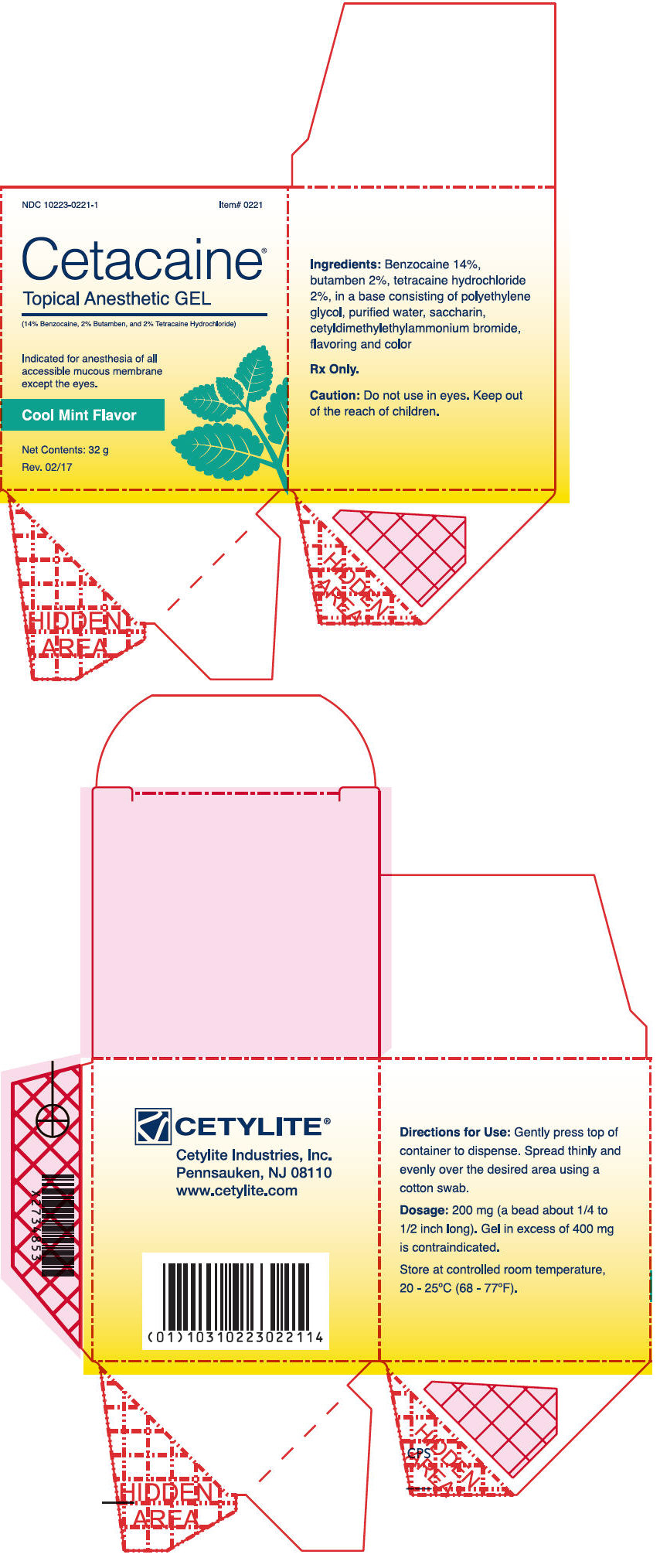
Cetacaine Topical Anesthetic Benzocaine, Butamben, and Tetracaine Hydrochloride .028 g/.2g; .004 g/.2g; .004 g/.2g Gel — NDC 10223-0221-1 (Billing 10223-0221-01)
This is a package of Cetacaine Topical Anesthetic Benzocaine, Butamben, and Tetracaine Hydrochloride .028 g/.2g; .004 g/.2g; .004 g/.2g Gel from Cetylite Industries, Inc., marketed since Jan 1960 and currently FDA-listed. It is this product's only package size.
NDC database record
One package, one record: these facts belong to NDC 10223-0221-1 alone.
- Record
- FDA NDC Directory package listing · Human prescription drug
- Code segments
- 10223 labeler · 0221 product · 1 package
- Package marketed since
- Jan 1, 1960
- Sample package
- No — commercial package
- Listing certified through
- Dec 31, 2026
- Barcode (UPC-A, from the NDC)
- 3 1022302211 7
- FDA record last changed
- Sep 24, 2026
Identity & classification
Regulatory identifiers FDA, NLM and CMS codes for this package
Drug-database identifiers Medi-Span GPI and First Databank GCN / HICL / AHFS classification
- GPI-14 (Medi-Span): 90859903404020
- RxCUI (RxNorm): 209970
Where does this data come from?
- FDA openFDA NDC Directory · synced Oct 1, 2026
- FDA label on DailyMed · label index refreshed Oct 6, 2026
- RxNorm (NLM RxNav) · catalog refreshed Oct 1, 2026
- Medi-Span GPI (licensed)
- First Databank (licensed) · refreshed Oct 1, 2026
RxNorm drug class
This medicine belongs to the Ester Local Anesthetic class.
Where does this data come from?
- RxClass (NLM) · catalog refreshed Oct 1, 2026
Clinical
Cetacaine is a topical gel containing three local anesthetic ingredients: benzocaine, butamben, and tetracaine hydrochloride. These agents are typically used to numb the skin and mucous membranes on contact, reducing pain and discomfort during minor procedures or exams. This product is marketed without an approved FDA application.
Patient education
Supplement & herbal interactions
Where does this data come from?
- MedlinePlus (NLM) · refreshed Oct 1, 2026
- FDA label on DailyMed · label index refreshed Oct 6, 2026
Ask a licensed pharmacist directly — free, answered by our team.
Pricing
A drug doesn't have one price. Each row is a different public payment system, and none is what you'd pay at the counter — that depends on your insurance. The ⓘ on each row explains what it measures.
| Price system | Per g | Per package |
|---|---|---|
| Retail pharmacies payNADAC · weekly | Not in the retail survey — common for institutional, discontinued, or low-volume packs. | |
| Medicaid paysCMS SDUD · 12 mo | No recent Medicaid claims on file for this NDC — rare and low-volume NDCs are suppressed in the public data. | |
| Medicare drug plans payPart D · quarterly | No Part D plan price is available for this NDC in our data. | |
Where does this data come from?
- CMS NADAC weekly file
- CMS ASP pricing files · refreshed Sep 20, 2026
- CMS Medicaid State Drug Utilization Data · refreshed Oct 7, 2026
- CMS Part D plan pricing files · refreshed Sep 24, 2026
- VA National Acquisition Center price file
Packaging — all sizes for this product
| Package NDC | Description | Marketing start | Marketing end | Status |
|---|---|---|---|---|
| 10223-0221-01 You're viewing this Main listing | 1 JAR in 1 BOX / 32 g in 1 JAR | 1960-01-01 | — | Active |
Therapeutic equivalents
| Product | Labeler | Pack | NADAC/unit | TE | Status | Price vs. this |
|---|---|---|---|---|---|---|
| Cetacaine Topical Anesthetic .028 g/.2g; .004 g/.2g; .004 g/.2g 10223-0217-03 | Cetylite | 1 jar | — | — | FDA listed | — |
| Cetacaine Topical Anesthetic .028 g/.2g; .004 g/.2g; .004 g/.2gthis 10223-0221-01 | Cetylite | 1 jar | — | — | FDA listed | — |
Where does this data come from?
- FDA openFDA NDC Directory · synced Oct 1, 2026
- FDA Orange Book · refreshed Oct 3, 2026
- CMS NADAC weekly file
Availability & generic status
We did not find an FDA-approved generic match for this exact strength, form and route.
Where does this data come from?
- FDA Orange Book · refreshed Oct 3, 2026
What it looks like
Where does this data come from?
- FDA label on DailyMed · label index refreshed Oct 6, 2026
Inactive Ingredients / Excipients
Inactive ingredients, also called excipients, are components of the drug product other than the active ingredient. They may include fillers, dyes, coatings, preservatives, flavors, or other formulation ingredients.
💡 Tap an ingredient (hover on desktop) to see what it is and why it’s used.
-
UNII F5UM2KM3W7
Benzalkonium chloride is a chemical compound that works as a preservative and antimicrobial agent in medications. It prevents bacterial and fungal growth in liquid formulations to keep the product safe during storage and use.
-
UNII 7ZNQ7FIO9K
Mecetronium bromide is a synthetic antimicrobial agent used as a preservative in liquid medicines and topical products. It helps prevent bacterial and fungal growth to maintain product safety and shelf life.
-
UNII 3WJQ0SDW1A
Polyethylene glycol is a synthetic liquid or solid polymer used in medicines as a solvent, lubricant, and humectant. It helps dissolve active ingredients, reduces friction during manufacturing, and retains moisture in the final product.
-
UNII FST467XS7D
Saccharin is an artificial sweetener derived from benzoic sulfinilanide. It's added to medicines to improve taste and make them easier to take, especially in liquid or chewable formulations.
-
UNII 059QF0KO0R
Water is a liquid solvent that dissolves and mixes ingredients together in liquid medicines, syrups, and injections. It helps distribute the active drug evenly throughout the product.
5 inactive ingredients listed in the exact product block matched to this NDC.
Where does this data come from?
ingredient classCode="IACT" elements from the exact product block matched by this NDC. Label-section narrative from DailyMed / the openFDA label index is shown separately when available.- FDA label on DailyMed · label index refreshed Oct 6, 2026
- FDA openFDA NDC Directory · synced Oct 1, 2026
Inactive ingredient FAQ
Are inactive ingredients the same for every manufacturer?
Why might an inactive ingredient be missing?
Can inactive ingredients matter?
Manufacturer & labeler
More NDCs from Cetylite Industries, Inc. labeler code 10223
- Cetacaine Anesthetic Benzocaine, Butamben, and Tetracaine Hydrochloride .028 g/.2g; .004 g/.2g; .004 g/.2g Aerosol, Spray NDC 10223-0201-3
- Cetacaine Anesthetic Benzocaine, Butamben, and Tetracaine Hydrochloride .028 g/.2g; .004 g/.2g; .004 g/.2g Solution NDC 10223-0202-2
- Cetacaine Topical Anesthetic Benzocaine, Butamben, and Tetracaine Hydrochloride .028 g/.2g; .004 g/.2g; .004 g/.2g Gel NDC 10223-0217-3
- Cetacaine Anesthetic Benzocaine, Butamben, and Tetracaine Hydrochloride .028 g/.2g; .004 g/.2g; .004 g/.2g Solution NDC 10223-0225-1
- Cetacaine Anesthetic Benzocaine, Butamben, and Tetracaine Hydrochloride .028 g/.2g; .004 g/.2g; .004 g/.2g Solution NDC 10223-0226-1
Where does this data come from?
- FDA openFDA NDC Directory · synced Oct 1, 2026
- Drugs@FDA
Full prescribing information FDA SPL
🎯 Indications and Usage ▾
Indications Cetacaine Topical Anesthetic Gel is a topical anesthetic indicated for the production of anesthesia of all accessible mucous membrane except the eyes. Cetacaine Topical Anesthetic Gel is indicated for use to control pain and for use for surgical or endoscopic procedures, or other procedures in the ear, nose, mouth, pharynx, larynx, trachea, bronchi, and esophagus. It may also be used for vaginal or rectal procedures where feasible.
⏱️ Dosage and Administration ▾
Dosage and Administration Only a limited quantity of Cetacaine Topical Anesthetic Gel is required for anesthesia. Dispense 200 mg of gel (a bead approximately 1/4 to 1/2 inches long) by gently depressing the pump. Dispensing a bead of gel in excess of 400 mg is contraindicated.
Spread thinly and evenly over the desired area using a cotton swab. In the unlikely event that a Cetacaine Gel pump jar won't dispense, attempt the following: Using a gloved hand, depress the pump fully using the thumb and middle finger. While depressed, cover the center orifice with the index finger.
With the orifice still covered, slowly allow the pump to return to its original starting position. Repeat until Cetacaine Gel is dispensed (usually about 3-4 repeated attempts). An appropriate pediatric dosage has not been established for Cetacaine Topical Anesthetic Gel.
Dosages should be reduced in the debilitated elderly, acutely ill, and very young patients. Do not use Cetacaine Gel to treat infants or children younger than 2 years. Tissue need not be dried prior to application of Cetacaine Topical Anesthetic Gel.
Cetacaine Topical Anesthetic Gel should be applied directly to the site where pain control is required. Anesthesia is produced in approximately 30 seconds with an approximate duration of thirty to sixty minutes. Each 200 mg dose of Cetacaine Topical Anesthetic Gel contains 28 mg of benzocaine, 4 mg of butamben and 4 mg of tetracaine HCl.
⛔ Contraindications ▾
Contraindications Do not use Cetacaine Gel to treat infants or children younger than 2 years. Cetacaine is not suitable and should never be used for injection. Do not use on the eyes.
To avoid excessive systemic absorption, Cetacaine Topical Anesthetic Gel should not be applied to large areas of denuded or inflamed tissue. Cetacaine Topical Anesthetic Gel should not be administered to patients who are hypersensitive to any of its ingredients or to patients known to have cholinesterase deficiencies. Tolerance may vary with status of the patient.
Cetacaine Topical Anesthetic Gel should not be used under dentures or cotton rolls, as retention of the active gel ingredients under a denture or cotton roll could possibly cause an escharotic effect. Routine precaution for the use of any topical anesthetic should be observed when using Cetacaine Topical Anesthetic Gel.
⚠️ Warnings ▾
WARNINGS AND PRECAUTIONS Methemoglobinemia Cases of methemoglobinemia have been reported in association with local anesthetic use. Although all patients are at risk for methemoglobinemia, patients with glucose-6-phosphate dehydrogenase deficiency, congenital or idiopathic methemoglobinemia, cardiac or pulmonary compromise, infants under 6 months of age, and concurrent exposure to oxidizing agents or their metabolites are more susceptible to developing clinical manifestations of the condition. If local anesthetics must be used in these patients, close monitoring for symptoms and signs of methemoglobinemia is recommended.
Signs and symptoms of methemoglobinemia may occur immediately or may be delayed some hours after exposure and are characterized by a cyanotic skin discoloration and abnormal coloration of the blood. Methemoglobin levels may continue to rise; therefore, immediate treatment is required to avert more serious central nervous system and cardiovascular adverse effects, including seizures, coma, arrhythmias, and death. Discontinue Cetacaine and any other oxidizing agents.
Depending on the severity of the symptoms, patients may respond to supportive care, i.e., oxygen therapy, hydration. More severe symptoms may require treatment with methylene blue, exchange transfusion, or hyperbaric oxygen.
🔄 Drug Interactions ▾
DRUG INTERACTIONS Patients that are administered local anesthetics may be at increased risk of developing methemoglobinemia when concurrently exposed to the following oxidizing agents: Class Examples Nitrates/Nitrites nitroglycerin, nitroprusside, nitric oxide, nitrous oxide Local anesthetics benzocaine, lidocaine, bupivacaine, mepivacaine, tetracaine, prilocaine, procaine, articaine, ropivacaine Antineoplastic agents cyclophosphamide, flutamide, rasburicase, ifosfamide, hydroxyurea Antibiotics dapsone, sulfonamides, nitrofurantoin, para-aminosalicylic acid Antimalarials chloroquine, primaquine Anticonvulsants phenytoin, sodium valproate, phenobarbital Other drugs acetaminophen, metoclopramide, sulfa drugs (i.e., sulfasalazine), quinine
🤰 Pregnancy ▾
Use in Pregnancy Safe use of Cetacaine Topical Anesthetic Gel has not been established with respect to possible adverse effects upon fetal development. Therefore, Cetacaine Topical Anesthetic Gel should not be used during early pregnancy, unless in the judgement of a physician, the potential benefits outweigh the unknown hazards. Routine precaution for the use of any topical anesthetic should be observed when Cetacaine Topical Anesthetic Gel is used.
🧬 Mechanism of Action ▾
Action The onset of Cetacaine Topical Anesthetic Gel produced anesthesia is rapid (approximately 30 seconds) and the duration of anesthesia is typically 30-60 minutes, when used as directed. This effect is due to the rapid onset, but short duration of action of Benzocaine coupled with the slow onset, but extended duration of Tetracaine HCl and bridged by the intermediate action of Butamben. It is believed that all of these agents act by reversibly blocking nerve conduction.
Speed and duration of action is determined by the ability of the agent to be absorbed by the mucous membrane and nerve sheath and then to diffuse out, and ultimately be metabolized (primarily by plasma cholinesterases) to inert metabolites which are excreted in the urine.
📦 How Supplied / Storage and Handling ▾
How Supplied Cetacaine Topical Anesthetic Gel (Strawberry), 32 g jar NDC 10223-0217-3 Item# 0217 Cetacaine Topical Anesthetic Gel (Mint), 32 g jar NDC 10223-0221-1 Item# 0221
📋 Description ▾
Active Ingredients: in a base consisting of polyethylene glycol, purified water, saccharin, cetyldimethylethylammonium bromide, flavoring and color Benzocaine 14.0% Butamben 2.0% Tetracaine Hydrochloride 2.0%
📄 Package Label / Principal Display Panel ▾
PRINCIPAL DISPLAY PANEL - 32 g Jar Box - Strawberry NDC 10223-0217-3 Item# 0217 Cetacaine ® Topical Anesthetic GEL (14% Benzocaine, 2% Butamben, and 2% Tetracaine Hydrochloride) Indicated for anesthesia of all accessible mucous membrane except the eyes. Strawberry Flavor Net Contents: 32 g Rev. 02/17 PRINCIPAL DISPLAY PANEL - 32 g Jar Box - Strawberry
PRINCIPAL DISPLAY PANEL - 32 g Jar Box - Mint NDC 10223-0221-1 Item# 0221 Cetacaine ® Topical Anesthetic GEL (14% Benzocaine, 2% Butamben, and 2% Tetracaine Hydrochloride) Indicated for anesthesia of all accessible mucous membrane except the eyes. Cool Mint Flavor Net Contents: 32 g Rev. 02/17 PRINCIPAL DISPLAY PANEL - 32 g Jar Box - Mint
Reported adverse events (FAERS)
Top reported reactions
Reporter sex
Serious outcomes
Where does this data come from?
About this NDC listing & data coverage
Listed without an FDA application
This product's marketing category indicates it is marketed without an approved FDA application (no NDA, ANDA, or BLA on file). Having an NDC does not by itself establish FDA approval — the NDC Directory is a listing system, not an approval decision. Approval-linked data such as Orange Book therapeutic-equivalence ratings therefore does not apply.
What data is (and isn’t) available for this NDC — tap to expand
| NDC identity (package / product / labeler codes) | ✓ Available |
| Labeler | ✓ Available |
| Product & package description | ✓ Available |
| Marketing category & status | ✓ Available |
| Active ingredient / dosage form / route | ✓ Available |
| FDA label (SPL via DailyMed) | ✓ Available |
| Package photos | ✓ Available |
| Inactive ingredients (structured) | ✓ Available |
| NADAC pharmacy acquisition price (CMS) | — Not published for this NDC CMS publishes NADAC only for NDCs reported in its retail-pharmacy survey. |
| Orange Book / therapeutic-equivalence data | — Not published for this NDC Applies only to products approved under an NDA/ANDA; many listings are out of scope. |
| HCPCS J-code billing crosswalk | — Not published for this NDC Most self-administered / retail products have no J-code — that is normal. |
| Medicaid utilization (CMS SDUD) | — Not published for this NDC CMS reports utilization only for NDCs with Medicaid claims above its privacy threshold. |