
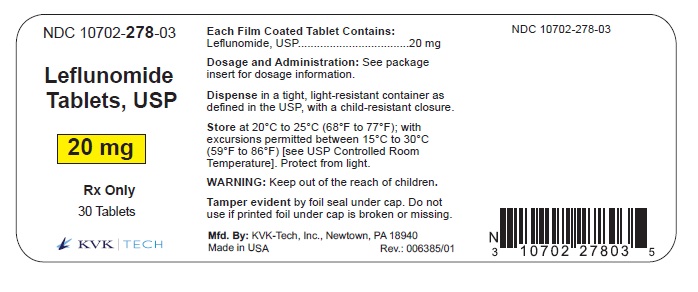
Leflunomide 20 mg Tablet, 30-count — NDC 10702-278-03 (Billing 10702-0278-03)
This is a package of 30 tablets of Leflunomide 20 mg Tablet from KVK-Tech, Inc., marketed since Jul 2020 and currently FDA-listed; retail pharmacies pay about $0.5487 per tablet (NADAC). It is this product's only package size.
NDC database record
One package, one record: these facts belong to NDC 10702-278-03 alone.
- Record
- FDA NDC Directory package listing · Human prescription drug
- Code segments
- 10702 labeler · 278 product · 03 package
- Package marketed since
- Jul 23, 2020
- Sample package
- No — commercial package
- Listing certified through
- Dec 31, 2026
- Billing quantity
- 30 EA per package
- Barcode (UPC-A, from the NDC)
- 3 1070227803 5
- FDA record last changed
- Jul 24, 2026
Identity & classification
Regulatory identifiers FDA, NLM and CMS codes for this package
Drug-database identifiers Medi-Span GPI and First Databank GCN / HICL / AHFS classification
- GSN (GCN sequence number): 040550
- GCN: 67032
- GPI-14 (Medi-Span): 66280050000320
- HICL (First Databank): 018694
- AHFS class code: 90:24.04.00
- RxCUI (RxNorm): 205284
Where does this data come from?
- FDA openFDA NDC Directory · synced Oct 8, 2026
- FDA label on DailyMed · label index refreshed Oct 8, 2026
- RxNorm (NLM RxNav) · catalog refreshed Oct 1, 2026
- Medi-Span GPI (licensed)
- First Databank (licensed) · refreshed Oct 8, 2026
RxNorm drug class
This medicine belongs to the Antirheumatic Agent class.
Where does this data come from?
- RxClass (NLM) · catalog refreshed Oct 1, 2026
Clinical
Leflunomide is used alone or in combination with other medications to treat rheumatoid arthritis (a condition in which the body attacks its own joints, causing pain, swelling, and loss of function). Leflunomide is in a class of medications called disease-modifying antirheumatic drugs (DMARDs). It works by decreasing inflammation and slowing the progress of the condition, which can help improve the physical activity of people with rheumatoid arthritis.
Read the full MedlinePlus article ↗- It treats active rheumatoid arthritis in adults. It calms the immune activity that drives joint inflammation.
- You take a tablet by mouth once a day. Some people begin with a 3-day loading period, and your prescriber decides that based on your risk. Food does not significantly change how it...
- You will have liver tests and blood counts before starting. Liver tests are repeated monthly for six months and then every 6 to 8 weeks. Your blood pressure will be checked too.
- It can cause serious harm to an unborn baby, so you need a negative pregnancy test first and effective contraception. If you want to become pregnant or get pregnant, tell your doct...
Patient education
Supplement & herbal interactions
Some supplements/herbs that may interact with Leflunomide — tap one for details:
Where does this data come from?
- MedlinePlus (NLM) · refreshed Oct 8, 2026
- FDA label on DailyMed · label index refreshed Oct 8, 2026
Ask a licensed pharmacist directly — free, answered by our team.
Pricing
A drug doesn't have one price. Each row is a different public payment system, and none is what you'd pay at the counter — that depends on your insurance. The ⓘ on each row explains what it measures.
| Price system | Per ea | Per package |
|---|---|---|
| Retail pharmacies payNADAC · weekly | $0.549 | $16.46 / 30 tablets |
| Medicaid paysCMS SDUD · 12 mo | No recent Medicaid claims on file for this NDC — rare and low-volume NDCs are suppressed in the public data. | |
| Medicare drug plans payPart D · Q2 2026 | $0.5536 | $16.61 / 30 tablets |
Where does this data come from?
- CMS NADAC weekly file · file of Nov 23, 2022
- CMS ASP pricing files · refreshed Sep 20, 2026
- CMS Medicaid State Drug Utilization Data · refreshed Oct 8, 2026
- CMS Part D plan pricing files · refreshed Sep 24, 2026
- VA National Acquisition Center price file
Packaging — all sizes for this product
| Package NDC | Description | Marketing start | Marketing end | Status |
|---|---|---|---|---|
| 10702-0278-03 You're viewing this Main listing | 30 TABLET in 1 BOTTLE | 2019-06-03 | — | Active |
Therapeutic equivalents
| Product | Labeler | Pack | NADAC/unit | TE | Status | Price vs. this |
|---|---|---|---|---|---|---|
| leflunomide 20 mg 23155-0044-03 | Heritage | 30 tablets | $0.294 | AB | Availability likely | save 46% |
| Leflunomide 20 mg 35573-0448-30 | Burel | 30 tablets | $0.294 | AB | Availability likely | save 46% |
| Leflunomide 20 mg 50268-0478-15 | AvPAK | 50 tablets | $0.294 | AB | Availability likely | save 46% |
| Leflunomide 20 mg 59651-0349-30 | Aurobindo | 30 tablets | $0.294 | AB | Availability likely | save 46% |
| Leflunomide 20 mg 60505-2503-01 | Apotex | 30 tablets | $0.294 | AB | Availability likely | save 46% |
| Leflunomide 20 mg 62135-0794-30 | Chartwell | 30 tablets | $0.294 | AB | Availability likely | save 46% |
| Leflunomide 20 mg 62332-0062-30 | Alembic | 30 tablets | $0.294 | AB | Availability likely | save 46% |
| Leflunomide 20 mg 70748-0130-06 | Lupin | 30 tablets | $0.294 | AB | Availability likely | save 46% |
| Leflunomide 20 mgthis 10702-0278-03 | KVK-Tech, | 30 tablets | $0.549 | AB | FDA listed | — |
| Arava 20 mg 00088-2161-30 | sanofi-aventis | 30 tablets | — | AB | FDA listed | — |
| Leflunomide 20 mg 42291-0421-30 | AvKARE | 30 tablets | — | AB | FDA listed | — |
| Leflunomide 20 mg 46708-0437-30 | Alembic | 30 tablets | — | AB | FDA listed | — |
| Leflunomide 20 mg 50090-5992-00 | A-S | 30 tablets | — | AB | FDA listed | — |
| leflunomide 20 mg 50090-7537-00 | A-S | 30 tablets | — | AB | FDA listed | — |
| leflunomide 20 mg 68071-3764-09 | NuCare | 90 tablets | — | AB | FDA listed | — |
| leflunomide 20 mg 70710-1158-01 | Zydus | 100 tablets | — | AB | FDA listed | — |
| leflunomide 20 mg 70771-1492-01 | Zydus | 100 tablets | — | AB | FDA listed | — |
| Leflunomide 20 mg 71335-2256-01 | Bryant | 30 tablets | — | AB | FDA listed | — |
| leflunomide 20 mg 71335-2403-01 | Bryant | 30 tablets | — | AB | FDA listed | — |
| leflunomide 20 mg 71335-2832-01 | Bryant | 30 tablets | — | AB | FDA listed | — |
| leflunomide 20 mg 72162-2410-03 | Bryant | 30 tablets | — | AB | FDA listed | — |
Where does this data come from?
- FDA openFDA NDC Directory · synced Oct 8, 2026
- FDA Orange Book · refreshed Oct 3, 2026
- CMS NADAC weekly file · file of Nov 23, 2022
Availability & generic status
This product is an FDA-approved generic. Other versions of the same drug are listed under Therapeutic equivalents, least expensive first.
Where does this data come from?
- FDA Orange Book · refreshed Oct 3, 2026
What it looks like
Where does this data come from?
- FDA label on DailyMed · label index refreshed Oct 8, 2026
Inactive Ingredients / Excipients
Inactive ingredients, also called excipients, are components of the drug product other than the active ingredient. They may include fillers, dyes, coatings, preservatives, flavors, or other formulation ingredients.
🧪 Avoiding an ingredient? See Leflunomide inactive ingredients by manufacturer: every current product's list side by side, so you can ask your pharmacy for the version that does not list it.
💡 Tap an ingredient (hover on desktop) to see what it is and why it’s used.
-
UNII 2S7830E561
Crospovidone is a synthetic polymer derived from povidone. It acts as a disintegrant, helping the tablet or capsule break apart quickly in the stomach so the active ingredient can be absorbed.
-
UNII EX438O2MRT
Ferric oxide yellow is a naturally occurring iron compound used as a colorant in medications. It gives tablets, capsules, and other forms a yellow or golden hue for identification and appearance.
-
UNII 3NXW29V3WO
Hypromellose is a plant-based thickener made from cellulose. It's used in medicines as a binder to hold ingredients together, a coating for tablets, and a thickener for liquids.
-
UNII EWQ57Q8I5X
Lactose monohydrate is a natural sugar derived from milk. It serves as a filler and binder in tablets and capsules, helping create the proper size, texture, and consistency of the medicine.
-
UNII 70097M6I30
Magnesium stearate is a salt made from magnesium and stearic acid, a fatty substance. It's used in tablets and capsules as a lubricant and glidant to help ingredients flow smoothly during manufacturing and prevent sticking.
-
UNII 3WJQ0SDW1A
Polyethylene glycol is a synthetic liquid or solid polymer used in medicines as a solvent, lubricant, and humectant. It helps dissolve active ingredients, reduces friction during manufacturing, and retains moisture in the final product.
-
UNII FZ989GH94E
Povidone is a synthetic polymer made from a plastic-like material. It acts as a binder to hold tablet ingredients together and as a disintegrant to help the tablet break apart in your stomach so the medicine can be absorbed.
-
UNII ETJ7Z6XBU4
Silicon dioxide is a naturally occurring mineral used as a glidant and anti-caking agent. It helps powder ingredients flow smoothly and prevents clumping during manufacturing and storage.
-
UNII O8232NY3SJ
A plant-based carbohydrate derived from corn kernels. It acts as a filler to add bulk, a binder to hold ingredients together, and a disintegrant to help the tablet break apart in your stomach for absorption.
-
UNII 7SEV7J4R1U
A powder made from a naturally occurring mineral. In medicines, talc works as a glidant and anti-caking agent, helping tablets and capsules flow smoothly during manufacturing and preventing clumping.
-
UNII 15FIX9V2JP
Titanium dioxide is a bright white mineral powder commonly used as a colorant and opacifying agent. It makes pills and tablets white or lighter in color and helps make coatings non-transparent.
11 inactive ingredients listed in the exact product block matched to this NDC.
Where does this data come from?
ingredient classCode="IACT" elements from the exact product block matched by this NDC. Label-section narrative from DailyMed / the openFDA label index is shown separately when available.- FDA label on DailyMed · label index refreshed Oct 8, 2026
- FDA openFDA NDC Directory · synced Oct 8, 2026
Inactive ingredient FAQ
Are inactive ingredients the same for every manufacturer?
Why might an inactive ingredient be missing?
Can inactive ingredients matter?
Manufacturer & labeler
More NDCs from KVK-Tech, Inc. labeler code 10702
- Oxybutynin Chloride 5 mg Tablet NDC 10702-201-01
- Atovaquone Oral Suspension 750 mg/5mL Suspension NDC 10702-223-21
- Ursodiol Ursosiol 300 mg Capsule NDC 10702-237-01
- OXYCODONE AND ACETAMINOPHEN 5 mg/5mL; 325 mg/5mL Solution NDC 10702-238-50
- Butalbital, Acetaminophen and Caffeine 50 mg; 325 mg; 40 mg Tablet NDC 10702-253-01
- Leflunomide 10 mg Tablet NDC 10702-277-03
- Carmustine Kit NDC 10702-361-99
- Isoproterenol hydrochloride .2 mg/mL Injection, Solution NDC 10702-364-51
- Cyclosporine .5 mg/mL Emulsion NDC 10702-808-03
Where does this data come from?
- FDA openFDA NDC Directory · synced Oct 8, 2026
- Drugs@FDA
Full prescribing information FDA SPL
🚨 Boxed Warning ▾
WARNING: EMBRYO-FETAL TOXICITY and HEPATOTOXICITY WARNING: EMBRYO-FETAL TOXICITY and HEPATOTOXICITY Embryo-Fetal Toxicity Leflunomide tablets are contraindicated for use in pregnant women because of the potential for fetal harm. Teratogenicity and embryo-lethality occurred in animals administered leflunomide at doses lower than the human exposure level. Exclude pregnancy before the start of treatment with leflunomide tablets in females of reproductive potential.
Advise females of reproductive potential to use effective contraception during leflunomide tablets treatment and during an accelerated drug elimination procedure after leflunomide tablets treatment. Stop leflunomide tablets and use an accelerated drug elimination procedure if the patient becomes pregnant. [ see Contraindications (4), Warnings and Precautions (5.1, 5.3), Use in Special Populations (8.1, 8.3)], and Clinical Pharmacology (12.3). Hepatotoxicity Severe liver injury, including fatal liver failure, has been reported in patients treated with leflunomide tablets.
Leflunomide tablets are contraindicated in patients with severe hepatic impairment. Concomitant use of leflunomide tablets with other potentially hepatotoxic drugs may increase the risk of liver injury. Patients with pre-existing acute or chronic liver disease, or those with serum alanine aminotransferase (ALT) >2xULN before initiating treatment, are at increased risk and should not be treated with leflunomide tablets.
Monitor ALT levels at least monthly for six months after starting leflunomide tablets, and thereafter every 6-8 weeks. If leflunomide-induced liver injury is suspected, stop leflunomide tablets treatment, start an accelerated drug elimination procedure, and monitor liver tests weekly until normalized. [ see Contraindications (4), Warnings and Precautions (5.2, 5.3), Use in Special Populations (8.6) ]. WARNING: EMBRYO-FETAL TOXICITY and HEPATOTOXICITY See full prescribing information for complete boxed warning.
Embryo-Fetal Toxicity Teratogenicity and embryo-lethality occurred in animals administered leflunomide. (5.1, 8.1) Exclude pregnancy prior to initiating leflunomide tablets therapy. (5.1, 8.3) Advise use of effective contraception in females of reproductive potential during treatment and during a drug elimination procedure.
(5.1, 5.3, 8.3) Stop leflunomide tablets and use an accelerated drug elimination procedure if the patient becomes pregnant. (5.1, 5.3, 8.1) Hepatotoxicity Severe liver injury and fatal liver failure have been reported. (5.2) Avoid leflunomide tablets use in patients with pre-existing liver disease, or those with serum alanine aminotransferase (ALT) >2xULN.
(5.2, 8.6) Use caution when leflunomide tablets are given with other potentially hepatotoxic drugs. (5.2) Monitor ALT levels. Interrupt leflunomide tablets treatment if ALT elevation > 3 fold ULN.
If likely leflunomide-induced, start accelerated drug elimination procedure and monitor liver tests weekly until normalized. (5.2, 5.3)
🎯 Indications and Usage ▾
1 INDICATIONS AND USAGE Leflunomide tablets are indicated for the treatment of adults with active rheumatoid arthritis (RA). Leflunomide tablets are a pyrimidine synthesis inhibitor indicated for the treatment of adults with active rheumatoid arthritis. (1)
⏱️ Dosage and Administration ▾
2 DOSAGE AND ADMINISTRATION Loading dosage for patients at low risk for leflunomide tablets-associated hepatotoxicity and leflunomide tablets-associated myelosuppression: 100 mg daily for 3 days. (2.1) Maintenance dosage: 20 mg daily. (2.1) Maximum recommended daily dosage: 20 mg once daily.
(2.1) If 20 mg once daily is not tolerated, may decrease dosage to 10 mg once daily. (2.1) Screen patients for active and latent tuberculosis, pregnancy test (females), blood pressure, and laboratory tests before starting leflunomide tablets. (2.2)
2.1Recommended Dosage The recommended dosage of leflunomide tablets are 20 mg once daily. Treatment may be initiated with or without a loading dose, depending upon the patient’s risk of leflunomide tablets-associated hepatotoxicity and leflunomide tablets-associated myelosuppression. The loading dosage provides steady-state concentrations more rapidly.
For patients who are at low risk for leflunomide tablets-associated hepatotoxicity and leflunomide tablets- associated myelosuppression the recommended leflunomide tablets loading dosage is 100 mg once daily for 3 days. Subsequently administer 20 mg once daily. For patients at high risk for leflunomide tablets-associated hepatotoxicity (e.g., those taking concomitant methotrexate) or leflunomide tablets-associated myelosuppression (e.g., patients taking concomitant immunosuppressants), the recommended leflunomide tablets dosage is 20 mg once daily without a loading dose [ see Warnings and Precautions (5.2, 5.4) ].
The maximum recommended daily dosage is 20 mg once per day. Consider dosage reduction to 10 mg once daily for patients who are not able to tolerate 20 mg daily (i.e., for patients who experience any adverse events listed in Table 1). Monitor patients carefully after dosage reduction and after stopping therapy with leflunomide tablets, since the active metabolite of leflunomide, teriflunomide, is slowly eliminated from the plasma [ see Clinical Pharmacology (12.3) ].
After stopping leflunomide tablets treatment, an accelerated drug elimination procedure is recommended to reduce the plasma concentrations of the active metabolite, teriflunomide [ see Warnings and Precautions (5.3 )]. Without use of an accelerated drug elimination procedure, it may take up to 2 years to reach undetectable plasma teriflunomide concentrations after stopping leflunomide tablets [ see Clinical Pharmacology (12.3) ].
2.2Evaluation and Testing Prior to Starting Leflunomide Tablets Prior to starting leflunomide tablets treatment the following evaluations and tests are recommended: Evaluate patients for active tuberculosis and screen patients for latent tuberculosis infection [ see Warnings and Precautions (5.4) ] Laboratory tests including serum alanine aminotransferase (ALT); and white blood cell, hemoglobin or hematocrit, and platelet counts [ see Warnings and Precautions (5.2, 5.4) ] For females of reproductive potential, pregnancy testing [ see Warnings and Precautions (5.1) ] Check blood pressure [ see Warnings and Precautions (5.10) ]
💊 Dosage Forms and Strengths ▾
3 DOSAGE FORMS AND STRENGTHS Leflunomide Tablets are available in two strengths: Tablets: 10 mg, supplied as white, round, film-coated, biconvex tablets debossed “V55” on one side and plain on the other side. Tablets: 20 mg, supplied as yellow, triangular, film-coated, biconvex tablets debossed “V56” on one side and plain on the other side. Tablets: 10 mg, 20 mg. (3)
⛔ Contraindications ▾
4 CONTRAINDICATIONS Leflunomide Tablets are contraindicated in: Pregnant women. Leflunomide tablets may cause fetal harm. If a woman becomes pregnant while taking this drug, stop leflunomide tablets, apprise the patient of the potential hazard to the fetus, and begin a drug elimination procedure [ see Warnings and Precautions (5.1 and 5.3) and Use in Specific Populations (8.1 )].
Patients with severe hepatic impairment [ see Warnings and Precautions (5.2) ]. Patients with known hypersensitivity to leflunomide or any of the other components of leflunomide tablets. Known reactions include anaphylaxis [ see Adverse Reactions (6.1) ].
Patients being treated with teriflunomide [ see Drug Interactions (7) ]. Pregnancy. (4, 5.1, 8.1) Severe hepatic impairment.
(4, 5.2) Hypersensitivity to leflunomide tablets or any of its inactive components. (4) Current teriflunomide treatment. (4)
⚠️ Warnings and Cautions ▾
5 WARNINGS AND PRECAUTIONS After stopping leflunomide tablets, it is recommended that an accelerated drug elimination procedure be used to reduce the plasma concentrations of the active metabolite, teriflunomide. (5.3) Severe infections (including sepsis), pancytopenia, agranulocytosis and thrombocytopenia: Stop leflunomide tablets and use accelerated elimination procedure. Do not start leflunomide tablets in patients with active infection.
Monitor CBCs during treatment with leflunomide tablets. (5.4) Stevens-Johnson syndrome and toxic epidermal necrolysis: Stop leflunomide tablets and use accelerated elimination procedure. (5.5) Peripheral neuropathy: If patient develops symptoms consistent with peripheral neuropathy, evaluate patient and consider discontinuing leflunomide tablets.
(5.7) Interstitial lung disease: May be fatal. New onset or worsening symptoms may necessitate discontinuation of leflunomide tablets and initiation of accelerated elimination procedure. (5.8) Increased blood pressure: Monitor and treat.
(5.10)
5.1Embryo-Fetal Toxicity Leflunomide tablets may cause fetal harm when administered to a pregnant woman. Teratogenicity and embryo-lethality occurred in animal reproduction studies with leflunomide at doses lower than the human exposure level [ see Use in Specific Populations (8.1) ]. Leflunomide tablets are contraindicated for use in pregnant women [ see Contraindications (4) ].
Exclude pregnancy before starting treatment with leflunomide tablets in females of reproductive potential [ see Dosage and Administration (2.2) ]. Advise females of reproductive potential to use effective contraception during leflunomide tablets treatment and during an accelerated drug elimination procedure after leflunomide tablets treatment [ see Use in Specific Populations (8.3) ]. If a woman becomes pregnant while taking leflunomide tablets, stop treatment with leflunomide tablets, apprise the patient of the potential risk to a fetus, and perform an accelerated drug elimination procedure to achieve non-detectable plasma concentrations of teriflunomide, the active metabolite of leflunomide [ see Warnings and Precautions (5.3) ].
Upon discontinuing leflunomide tablets, it is recommended that all females of reproductive potential undergo an accelerated drug elimination procedure. Women receiving leflunomide tablets treatment who wish to become pregnant must discontinue leflunomide tablets and undergo an accelerated drug elimination procedure, which includes verification that plasma concentrations of the active metabolite of leflunomide, teriflunomide, are less than 0.02 mg/L (0.02 mcg/mL). Based on animal data, human plasma concentrations of teriflunomide of less than 0.02 mg/L (0.02 mcg/mL) are expected to have minimal embryo-fetal risk [ see Contraindications (4), Warnings and Precautions (5.3), and Use in Specific Populations (8.1) ].
5.2Hepatotoxicity Severe liver injury, including fatal liver failure, has been reported in some patients treated with leflunomide tablets. Patients with pre-existing acute or chronic liver disease, or those with serum alanine aminotransferase (ALT) of greater than twice the upper limits of normal (>2xULN) before initiating treatment, should not be treated with leflunomide tablets. Use caution when leflunomide tablets are given with other potentially hepatotoxic drugs.
Monitoring of ALT levels is recommended at least monthly for six months after starting leflunomide tablets, and thereafter every 6-8 weeks. If ALT elevation > 3 fold ULN occurs, interrupt leflunomide tablets therapy and investigate the cause. If likely leflunomide tablets- induced, perform the accelerated drug elimination procedure and monitor liver tests weekly until normalized [ see Warnings and Precautions (5.3) ].
If leflunomide tablets-induced liver injury is unlikely because some other cause has been found, resumption of leflunomide tablets therapy may be considered. If leflunomide tablets and methotrexate are given concomitan… [Excerpted — this section continues on DailyMed.]
🤒 Adverse Reactions ▾
6 ADVERSE REACTIONS The following serious adverse reactions are described elsewhere in the labeling: Hepatotoxicity [ see Warnings and Precautions (5.2) ] Immunosuppression [ see Warnings and Precautions (5.4) ] Bone marrow suppression [ see Warnings and Precautions (5.4) ] Stevens-Johnson syndrome and toxic epidermal necrolysis [ see Warnings and Precautions (5.5) ] Peripheral neuropathy [ see Warnings and Precautions (5.7) ] Interstitial lung disease [ see Warnings and Precautions (5.8) ] The most commonly reported adverse reactions (≥10%) regardless of relation to leflunomide tablets treatment were diarrhea, respiratory infection, nausea, headache, rash, abnormal liver enzymes, dyspepsia.
(6.1) To report SUSPECTED ADVERSE REACTIONS, contact KVK-Tech, Inc. at 1-215-579-1842 or FDA at 1-800-FDA-1088 or www.fda.gov/medwatch
6.1Clinical Trials Experience Because clinical studies are conducted under widely varying conditions, adverse reaction rates observed in the clinical studies of a drug cannot be directly compared to rates in the clinical studies of another drug and may not reflect the rates observed in practice. In clinical studies (Trials 1, 2, and 3), 1,865 patients were treated with leflunomide tablets administered as either monotherapy or in combination with methotrexate or sulfasalazine. Patients ranged in age from 19 to 85 years, with an overall median age of 58 years.
The mean duration of RA was 6 years ranging from 0 to 45 years. Elevation of Liver Enzymes Treatment with leflunomide tablets were associated with elevations of liver enzymes, primarily ALT and AST, in a significant number of patients; these effects were generally reversible. Most transaminase elevations were mild (≤ 2-fold ULN) and usually resolved while continuing treatment.
Marked elevations (>3-fold ULN) occurred infrequently and reversed with dose reduction or discontinuation of treatment. Table 1 shows liver enzyme elevations seen with monthly monitoring in clinical trials Trial 1 and Trial 2. It was notable that the absence of folate use in Trial 3 was associated with a considerably greater incidence of liver enzyme elevation on methotrexate.
In a 6 month study of 263 patients with persistent active rheumatoid arthritis despite methotrexate therapy, and with normal LFTs, leflunomide tablets were administered to a group of 130 patients starting at 10 mg per day and increased to 20 mg as needed. An increase in ALT greater than or equal to three times the ULN was observed in 3.8% of patients compared to 0.8% in 133 patients continued on methotrexate with placebo. Most Common Adverse Reactions The most common adverse reactions in leflunomide tablets-treated patients with RA include diarrhea, elevated liver enzymes (ALT and AST), alopecia and rash.
Table 2 displays the most common adverse reactions in the controlled studies in patients with RA at one year (> 5% in any leflunomide tablets treatment group). Adverse events during a second year of treatment with leflunomide tablets in clinical trials were consistent with those observed during the first year of treatment and occurred at a similar or lower incidence. Less Common Adverse Reactions In addition, in controlled clinical trials, the following adverse events in the leflunomide tablets treatment group occurred at a higher incidence than in the placebo group.
These adverse events were deemed possibly related to the study drug. Blood and Lymphatic System: leukocytosis, thrombocytopenia; Cardiovascular: chest pain, palpitation, thrombophlebitis of the leg, varicose vein; Eye: blurred vision, eye disorder, papilledema, retinal disorder, retinal hemorrhage; Gastrointestinal: alkaline phosphatase increased, anorexia, bilirubinemia, flatulence, gamma-GT increased, salivary gland enlarged, sore throat, vomiting, dry mouth; General Disorders: malaise; Immune System: anaphylactic reaction; Infection: abscess, flu syndrome, vaginal moniliasis; Nervous System: dizziness, headache, somnolence; Respiratory Syst… [Excerpted — this section continues on DailyMed.]
🔄 Drug Interactions ▾
7 DRUG INTERACTIONS Following oral administration, leflunomide is metabolized to an active metabolite, teriflunomide, which is responsible for essentially all of leflunomide’s in vivo activity. Drug interaction studies have been conducted with both leflunomide tablets (leflunomide) and with its active metabolite, teriflunomide, where the metabolite was directly administered to the test subjects. Effect of potent CYP and transporter inducers Leflunomide is metabolized by CYP450 metabolizing enzymes.
Concomitant use of leflunomide tablets and rifampin, a potent inducer of CYP and transporters, increased the plasma concentration of teriflunomide by 40%. However, when co-administered with the metabolite, teriflunomide, rifampin did not affect its pharmacokinetics. No dosage adjustment is recommended for leflunomide tablets when coadministered with rifampin.
Because of the potential for leflunomide tablets concentrations to continue to increase with multiple dosing, caution should be used if patients are to be receiving both leflunomide tablets and rifampin [ see Clinical Pharmacology (12.3) ]. Effect on CYP2C8 substrates Teriflunomide is an inhibitor of CYP2C8 in vivo . In patients taking leflunomide tablets, exposure of drugs metabolized by CYP2C8 (e.g., paclitaxel, pioglitazone, repaglinide, rosiglitazone) may be increased.
Monitor these patients and adjust the dose of the concomitant drug(s) metabolized by CYP2C8 as required [ see Clinical Pharmacology (12.3) ]. Effect on warfarin Coadministration of leflunomide tablets with warfarin requires close monitoring of the international normalized ratio (INR) because teriflunomide, the active metabolite of leflunomide tablets, may decrease peak INR by approximately 25%. Effect on oral contraceptives Teriflunomide may increase the systemic exposures of ethinylestradiol and levonorgestrel.
Consideration should be given to the type or dose of contraceptives used in combination with leflunomide tablets [ see Clinical Pharmacology (12.3) ]. Effect on CYP1A2 substrates Teriflunomide, the active metabolite of leflunomide tablets, may be a weak inducer of CYP1A2 in vivo . In patients taking leflunomide tablets, exposure of drugs metabolized by CYP1A2 (e.g., alosetron, duloxetine, theophylline, tizanidine) may be reduced.
Monitor these patients and adjust the dose of the concomitant drug(s) metabolized by CYP1A2 as required [ see Clinical Pharmacology (12.3) ]. Effect on organic anion transporter 3 (OAT3) substrates Teriflunomide inhibits the activity of OAT3 in vivo . In patients taking leflunomide tablets, exposure of drugs which are OAT3 substrates (e.g., cefaclor, cimetidine, ciprofloxacin, penicillin G, ketoprofen, furosemide, methotrexate, zidovudine) may be increased.
Monitor these patients and adjust the dose of the concomitant drug(s) which are OAT3 substrates as required [ see Clinical Pharmacology (12.3) ]. Effect on BCRP and organic anion transporting polypeptide B1 and B3 (OATP1B1/1B3) substrates Teriflunomide inhibits the activity of BCRP and OATP1B1/1B3 in vivo. For a patient taking leflunomide tablets, the dose of rosuvastatin should not exceed 10 mg once daily.
For other substrates of BCRP (e.g., mitoxantrone) and drugs in the OATP family (e.g., methotrexate, rifampin), especially HMG-Co reductase inhibitors (e.g., atorvastatin, nateglinide, pravastatin, repaglinide, and simvastatin), consider reducing the dose of these drugs and monitor patients closely for signs and symptoms of increased exposures to the drugs while patients are taking leflunomide tablets [ see Clinical Pharmacology (12.3) ]. Drugs metabolized by CYP2C8 and OAT3 transporters: Monitor patients because teriflunomide may increase exposure of these drugs.
(7) Teriflunomide may increase exposure of ethinylestradiol and levonorgestrel. Choose an appropriate oral contraceptive. (7) Drugs metabolized by CYP1A2: Monitor patients because teriflunomide may decrease exposure of these drugs.
(7) Warfarin: Monitor INR as… [Excerpted — this section continues on DailyMed.]
👥 Use in Specific Populations ▾
8 USE IN SPECIFIC POPULATIONS Lactation: Discontinue breastfeeding. (8.2) Safety and effectiveness in pediatric patients <12 years of age has not been established. (8.4) See 17 for PATIENT COUNSELING INFORMATION.
8.1Pregnancy Pregnancy Exposure Registry There is a pregnancy exposure registry that monitors pregnancy outcomes in women exposed to Leflunomide tablets during pregnancy. Health care providers and patients are encouraged to report pregnancies by calling 1-877-311-8972 or visit http://www.pregnancystudies.org/participate-in-a-study/. Risk Summary Leflunomide tablets are contraindicated for use in pregnant women because of the potential for fetal harm.
In animal reproduction studies, oral administration of leflunomide during organogenesis at a dose of 1/10 of and equivalent to the maximum recommended human dose (MRHD) based on AUC, respectively in rats and rabbits, caused teratogenicity (rats and rabbits) and embryo-lethality (rats) [ see Data ]. Pregnancy exposure registry data are not available at this time to inform the presence or absence of drug-associated risk with the use of leflunomide tablets during pregnancy. The background risk of major birth defects and miscarriage for the indicated populations is unknown.
The background risk in the U.S. general population of major birth defects is 2-4% and of miscarriage is 15-20% of clinically recognized pregnancies. If this drug is used during pregnancy, or if the patient becomes pregnant while taking this drug, stop treatment with leflunomide tablets, apprise the patient of the potential hazard to a fetus, and perform the accelerated drug elimination procedure to achieve teriflunomide concentrations of less than 0.02 mg/L (0.02 mcg/mL) [ see Warnings and Precautions (5.3) ]. Clinical Considerations Fetal/Neonatal adverse reactions Lowering the plasma concentration of the active metabolite, teriflunomide, by instituting an accelerated drug elimination procedure as soon as pregnancy is detected may decrease the risk to the fetus from leflunomide tablets.
The accelerated drug elimination procedure includes verification that the plasma teriflunomide concentration is less than 0.02 mg/L. [ see Warnings and Precautions (5.3) and Clinical Pharmacology (12.3) ]. Data Animal Data In an embryofetal development study, pregnant rats administered leflunomide during organogenesis from gestation days 7 to 19 at a dose approximately 1/10 of the MRHD (on an AUC basis at a maternal oral dose of 15 mg/kg), teratogenic effects, most notably anophthalmia or microophthalmia and internal hydrocephalus, were observed.
Under these exposure conditions, leflunomide also caused a decrease in the maternal body weight and an increase in embryolethality with a decrease in fetal body weight for surviving fetuses. In an embryofetal development study, pregnant rabbits administered leflunomide during organogenesis from gestation days 6 to 18 at a dose approximately equivalent to the MRHD (on an AUC basis at a maternal oral dose of 10 mg/kg), a teratogenic finding of fused, dysplastic sternebrae was observed. Leflunomide was not teratogenic in rats and rabbits at doses approximately 1/150 and 1/10 of the MRHD, respectively (on an AUC basis at maternal oral dose of 1 mg/kg in both rats and rabbits).
In a pre- and post-natal development study, when female rats were treated leflunomide at a dose that was approximately 1/100 of the MRHD (on an AUC basis at a maternal dose of 1.25 mg/kg) beginning 14 days before mating and continuing until the end of lactation, the offspring exhibited marked (greater than 90%) decreases in postnatal survival.
8.2Lactation Risk Summary Clinical lactation studies have not been conducted to assess the presence of leflunomide tablets in human milk, the effects of leflunomide tablets on the breastfed child, or the effects of leflunomide tablets on milk production. Because of the potential for serious adverse reactions in a breastfed infant from leflunomide tablets, advise a nursin… [Excerpted — this section continues on DailyMed.]
🆘 Overdosage ▾
10 OVERDOSAGE There have been reports of chronic overdose in patients taking leflunomide tablets at daily dose up to five times the recommended daily dose and reports of acute overdose in adults and children. Adverse events were consistent with the safety profile for leflunomide tablets [ See Adverse Reactions (6) ]. The most frequent adverse events observed were diarrhea, abdominal pain, leukopenia, anemia and elevated liver function tests.
In the event of a significant overdose or toxicity, perform an accelerated drug elimination procedure to accelerate elimination [ see Warnings and Precautions (5.3) ]. Studies with both hemodialysis and CAPD (chronic ambulatory peritoneal dialysis) indicate that teriflunomide, the primary metabolite of leflunomide, is not dialyzable [ s ee Clinical Pharmacology (12.3) ].
🧬 Clinical Pharmacology ▾
12 CLINICAL PHARMACOLOGY
12.1Mechanism of Action Leflunomide is an isoxazole immunomodulatory agent that inhibits dihydroorotate dehydrogenase (a mitochondrial enzyme involved in de novo pyrimidine synthesis) and has antiproliferative activity. Several in vivo and in vitro experimental models have demonstrated an anti-inflammatory effect.
12.3Pharmacokinetics Following oral administration, leflunomide is metabolized to an active metabolite, teriflunomide, which is responsible for essentially all of leflunomide’s in vivo activity. Plasma concentrations of the parent drug, leflunomide, have been occasionally seen at very low concentrations. Studies of the pharmacokinetics of leflunomide have primarily examined the plasma concentrations of the active metabolite, teriflunomide.
Absorption Following oral administration, peak teriflunomide concentrations occurred between 6 - 12 hours after dosing. Due to the very long half-life of teriflunomide (18-19 days), a loading dose of 100 mg for 3 days was used in clinical studies to facilitate the rapid attainment of steady-state teriflunomide concentrations. Without a loading dose, it is estimated that attainment of steady- state plasma concentrations would require about two months of dosing.
The resulting plasma concentrations following both loading doses and continued clinical dosing indicate that plasma teriflunomide concentrations are dose proportional. Distribution Teriflunomide is extensively bound to plasma protein (>99%) and is mainly distributed in plasma. The volume of distribution is 11 L after a single intravenous (IV) administration.
Elimination Teriflunomide, the active metabolite of leflunomide, has a median half-life of 18-19 days in healthy volunteers. The elimination of teriflunomide can be accelerated by administration of cholestyramine or activated charcoal. Without use of an accelerated drug elimination procedure, it may take up to 2 years to reach plasma teriflunomide concentrations of less than 0.02 mg/L, due to individual variation in drug clearance [see Warnings and Precautions (5.3)].
After a single IV administration of the metabolite (teriflunomide), the total body clearance of teriflunomide was 30.5 mL/h. Metabolism In vitro inhibition studies in human liver microsomes suggest that cytochrome P450 (CYP) 1A2, 2C19 and 3A4 are involved in leflunomide metabolism. In vivo, leflunomide is metabolized to one primary (teriflunomide) and many minor metabolites.
In vitro, teriflunomide is not metabolized by CYP450 or flavin monoamine oxidase enzymes. The parent compound is rarely detectable in plasma. Excretion Teriflunomide, the active metabolite of leflunomide, is eliminated by direct biliary excretion of unchanged drug as well as renal excretion of metabolites.
Over 21 days, 60.1% of the administered dose is excreted via feces (37.5%) and urine (22.6%). After an accelerated elimination procedure with cholestyramine, an additional 23.1% was recovered (mostly in feces). Studies with both hemodialysis and CAPD (chronic ambulatory peritoneal dialysis) indicate that teriflunomide is not dialyzable.
Gender. Gender has not been shown to cause a consistent change in the in vivo pharmacokinetics of teriflunomide. Smoking.
A population based pharmacokinetic analysis of the clinical trial data indicates that smokers have a 38% increase in clearance over non-smokers; however, no difference in clinical efficacy was seen between smokers and nonsmokers. Specific Populations The Potential Effect of Other Drugs on Leflunomide Tablets • Potent CYP and transporter inducers: Following concomitant administration of a single dose of leflunomide tablets to subjects receiving multiple doses of rifampin, teriflunomide peak concentrations were increased (~40%) over those seen when leflunomide tablets were given alone [see Drug Interactions (7)]. • An in vivo interaction study with leflunomide tablets and cimetidine (non-specific weak CYP inhibitor) has demonstrated a lack of a significant im… [Excerpted — this section continues on DailyMed.]
📦 How Supplied / Storage and Handling ▾
16 HOW SUPPLIED/STORAGE AND HANDLING How Supplied Leflunomide Tablets howsupplied
📋 Description ▾
11 DESCRIPTION Leflunomide is a pyrimidine synthesis inhibitor. The chemical name for leflunomide is 4-Isoxazolecarboxamide, 5-methyl-N-[4-(trifluoromethyl)-phenyl]-. It has an empirical formula C12H9F3N2O2, a molecular weight of 270.21 and the following structural formula: Leflunomide tablets are available for oral administration as film coated tablets containing 10, or 20 mg of active drug.
Combined with leflunomide are the following inactive ingredients: colloidal silicon dioxide, crospovidone, hypromellose, lactose monohydrate, magnesium stearate, polyethylene glycol, povidone, corn starch, talc, titanium dioxide, and yellow ferric oxide (20 mg tablet only). chemicalstructure
🔬 Clinical Studies ▾
14 CLINICAL STUDIES The efficacy of leflunomide tablets in the treatment of rheumatoid arthritis (RA) was demonstrated in three controlled trials showing reduction in signs and symptoms, and inhibition of structural damage. In two placebo controlled trials, efficacy was demonstrated for improvement in physical function. In these trials, efficacy was evaluated by: 1.
Reduction of signs and symptoms Relief of signs and symptoms was assessed using the American College of Rheumatology (ACR) 20 Responder Index, a composite of clinical, laboratory, and functional measures in rheumatoid arthritis. An “ACR20 Responder” is a patient who had ≥ 20% improvement in both tender and swollen joint counts and in 3 of the following 5 criteria: physician global assessment, patient global assessment, functional ability measure [Modified Health Assessment Questionnaire (MHAQ)], visual analog pain scale, and erythrocyte sedimentation rate or C-reactive protein.
An “ACR20 Responder at Endpoint” is a patient who completed the study and was an ACR20 Responder at the completion of the study. 2. Inhibition of structural damage Inhibition of structural damage compared to control was assessed using the Sharp Score, a composite score of X-ray erosions and joint space narrowing in hands/wrists and forefeet.
3. Improvement in physical function Improvement in physical function was assessed using the Health Assessment Questionnaire (HAQ) and the Medical Outcomes Survey Short Form (SF-36). In all leflunomide tablets trials, participants of at least 18 years of age and in ARA functional class of I, II or III received an initial loading dosage of 100 mg Leflunomide per day for three days, followed by 20 mg per day thereafter.
Exclusion criteria included patients with a history of hypersensitivity to the study medication; women who were pregnant or breast feeding and men or women of child bearing age and potential who had not received contraceptives for at least 4 weeks before entering the study and to be maintained throughout the study and for at least 6 months after discontinuing treatment; Patients with a history of inflammatory disease, impaired renal function or liver impairment, cardiac failure, congenital or acquired immunodeficiency, impaired coagulation, or a history of recent major traumatic injury; and patients taking intra-articular or systemic concomitant medications which could affect the safety and/or efficacy of the study medication.
Trial 1 Trial 1, a 2 year study, randomized 482 patients with active RA of at least 6 months duration to leflunomide 20 mg/day (n=182), methotrexate 7.5 mg/week increasing to 15 mg/week (n=182), or placebo (n=118). All patients received folate 1 mg BID. The primary analysis was at 52 weeks with blinded treatment to 104 weeks.
Overall, 235 of the 508 randomized treated patients (482 in primary data analysis and an additional 26 patients), continued into a second 12 months of double-blind treatment (98 leflunomide, 101 methotrexate, 36 placebo). Leflunomide dose continued at 20 mg/day and the methotrexate dose could be increased to a maximum of 20 mg/week. In total, 190 patients (83 leflunomide, 80 methotrexate, 27 placebo) completed 2 years of double-blind treatment.
Trial 2 Trial 2 randomized 358 patients with active RA to leflunomide 20 mg/day (n=133), sulfasalazine 2.0 g/day (n=133), or placebo (n=92). Treatment duration was 24 weeks. An extension of the study was an optional 6-month blinded continuation of Trial 2 without the placebo arm, resulting in a 12-month comparison of leflunomide and sulfasalazine.
Of the 168 patients who completed 12 months of treatment, 146 patients (87%) entered a 1-year extension study of double blind active treatment; (60 leflunomide, 60 sulfasalazine, 26 placebo/sulfasalazine). Patients continued on the same daily dosage of leflunomide or sulfasalazine that they had been taking at the completion of Trial 2. A total of 121 patients (53 leflunomide, 47 sulfasalazine, 21 placebo/sulfasala… [Excerpted — this section continues on DailyMed.]
🧪 Nonclinical Toxicology ▾
13 NONCLINICAL TOXICOLOGY
13.1Carcinogenesis, Mutagenesis, Impairment of Fertility No evidence of carcinogenicity was observed in a 2-year bioassay in rats at oral doses of leflunomide up to the maximally tolerated dose of 6 mg/kg (approximately 1/40 the maximum human teriflunomide systemic exposure based on AUC). However, male mice in a 2-year bioassay exhibited an increased incidence in lymphoma at an oral dose of 15 mg/kg, the highest dose studied (1.7 times the human teriflunomide exposure based on AUC). Female mice, in the same study, exhibited a dose-related increased incidence of bronchoalveolar adenomas and carcinomas combined beginning at 1.5 mg/kg (approximately 1/10 the human teriflunomide exposure based on AUC).
The significance of the findings in mice relative to the clinical use of leflunomide tablets are not known. Leflunomide was not mutagenic in the Ames assay, the unscheduled DNA synthesis assay, or in the HGPRT gene mutation assay. In addition, leflunomide was not clastogenic in the in vivo mouse micronucleus assay or in the in vivo Chinese hamster bone marrow cell cytogenic test.
However, 4-trifluoromethylaniline (TFMA), a minor metabolite of leflunomide, was mutagenic in the Ames assay and in the HGPRT gene mutation assay, and was clastogenic in the in vitro Chinese hamster cell chromosomal aberration assay. TFMA was not clastogenic in the in vivo mouse micronucleus assay or in the in vivo Chinese hamster bone marrow cell cytogenic test. Leflunomide had no effect on fertility or reproductive performance in either male or female rats at oral doses up to 4.0 mg/kg (approximately 1/30 the human teriflunomide exposure based on AUC) [ see Use in Specific Populations (8.1, 8.6) ].
📄 Package Label / Principal Display Panel ▾
Princilap Display Panel NDC 10702- 277 -03 Leflunomide Tablets, USP 10 mg Rx Only 30 Tablets KVK-Tech containerlabel10mg
Principal Display Panel NDC 10702- 278 -03 Leflunomide Tablets, USP 20 mg Rx Only 30 Tablets KVK-Tech containerlabel20mg