
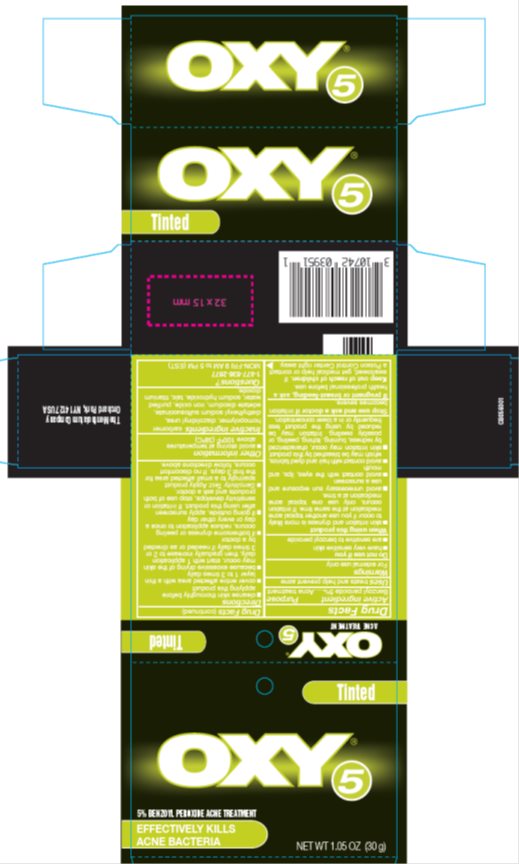
Oxy 5 Tinted benzoyl peroxide 50 mg/g Lotion — NDC 10742-8356-1 (Billing 10742-8356-01)
This is a package of Oxy 5 Tinted benzoyl peroxide 50 mg/g Lotion from The Mentholatum Company, marketed since Jul 2015 and currently FDA-listed. It is this product's only package size.
NDC database record
One package, one record: these facts belong to NDC 10742-8356-1 alone.
- Record
- FDA NDC Directory package listing · Human OTC drug
- Code segments
- 10742 labeler · 8356 product · 1 package
- Package marketed since
- Jul 1, 2015
- Sample package
- No — commercial package
- Listing certified through
- Dec 31, 2026
- Barcode (UPC-A, from the NDC)
- 3 1074283561 8
- FDA record last changed
- Jul 24, 2026
Other active recalls for Benzoyl Peroxide (different manufacturers) — 1 · tap to view
Identity & classification
Regulatory identifiers FDA, NLM and CMS codes for this package
- RxCUI (RxNorm): 106309
Where does this data come from?
- FDA openFDA NDC Directory · synced Oct 8, 2026
- FDA label on DailyMed · label index refreshed Oct 8, 2026
- RxNorm (NLM RxNav) · catalog refreshed Oct 8, 2026
- Medi-Span GPI (licensed)
- First Databank (licensed) · refreshed Oct 8, 2026
RxNorm drug class
This medicine belongs to the Peroxides class.
Where does this data come from?
- RxClass (NLM) · catalog refreshed Oct 8, 2026
Clinical
- Most products are for acne. They dry up pimples and help prevent new ones. Epsolay is a prescription cream for rosacea bumps in adults. The Folliculitis Treatment Cream products ar...
- For many acne products, start with once a day. You can move up to two or three times daily if your skin tolerates it. If you get dryness or peeling, cut back to once daily or every...
- Redness, dryness, peeling, itching, and stinging or burning are the usual ones. Using less often can help. Using another acne product at the same time makes irritation more likely.
- Stop if irritation gets severe. Stop right away and get help if you have hives, swelling or trouble breathing. Those can be signs of a serious allergic reaction.
Patient education
Supplement & herbal interactions
Some supplements/herbs that may interact with Benzoyl Peroxide — tap one for details:
Where does this data come from?
- MedlinePlus (NLM) · refreshed Oct 8, 2026
- FDA label on DailyMed · label index refreshed Oct 8, 2026
Ask a licensed pharmacist directly — free, answered by our team.
Pricing
A drug doesn't have one price. Each row is a different public payment system, and none is what you'd pay at the counter — that depends on your insurance. The ⓘ on each row explains what it measures.
| Price system | Per g | Per package |
|---|---|---|
| Retail pharmacies payNADAC · weekly | Not in the retail survey — common for institutional, discontinued, or low-volume packs. | |
| Medicaid paysCMS SDUD · 12 mo | No recent Medicaid claims on file for this NDC — rare and low-volume NDCs are suppressed in the public data. | |
| Medicare drug plans payPart D · quarterly | No Part D plan price is available for this NDC in our data. | |
Where does this data come from?
- CMS NADAC weekly file
- CMS ASP pricing files · refreshed Sep 20, 2026
- CMS Medicaid State Drug Utilization Data · refreshed Oct 9, 2026
- CMS Part D plan pricing files · refreshed Sep 24, 2026
- VA National Acquisition Center price file
Packaging — all sizes for this product
| Package NDC | Description | Marketing start | Marketing end | Status |
|---|---|---|---|---|
| 10742-8356-01 You're viewing this Main listing | 1 BOTTLE in 1 CARTON / 30 g in 1 BOTTLE | 2015-07-01 | — | Active |
Therapeutic equivalents
| Product | Labeler | Pack | NADAC/unit | TE | Status | Price vs. this |
|---|---|---|---|---|---|---|
| Rugby Benzoyl Peroxide Acne Medication 50 mg/mL 00536-1057-75 | Rugby | 1 tube | $0.067 | — | Discontinued | — |
| Rugby Benzoyl Peroxide Acne Medication 50 mg/g 00536-1467-25 | Rugby | 1 tube | $0.218 | — | Availability likely | — |
| Oxy 5 Vanishing 50 mg/g 10742-8355-01 | The | 1 bottle | — | — | FDA listed | — |
| Oxy 5 Tinted 50 mg/gthis 10742-8356-01 | The | 1 bottle | — | — | FDA listed | — |
| Anti Bac Acne Clearing 5 g/100mL 56152-4012-01 | Cosmetic | 50 ml | — | — | FDA listed | — |
| Clenziderm Therapeutic 50 mg/mL 62032-0611-01 | Obagi | 47 ml | — | — | FDA listed | — |
| Clear Cell Clarifying Acne 50 mg/g 62742-4208-01 | Allure | 7 g | — | — | FDA listed | — |
| Clear Med 5% 5 g/100mL 70764-0106-51 | CONTROL | 1 tube | — | — | FDA listed | — |
| Acne Control Serum 5 g/100g 72957-0001-01 | Private | 32 g | — | — | FDA listed | — |
| Nighttime Control 50 mg/mL 76458-0333-02 | Circadia | 1 bottle | — | — | FDA listed | — |
| Bubble Fade Away Acne Spot Treatment 50 mg/mL 83509-0003-01 | BUBBLE | 1 tube | — | — | FDA listed | — |
| Replenix Acne 50 mg/g 51326-0411-57 | Topiderm, | 57 g | — | — | FDA listed | — |
| Epsolay 50 mg/g 00299-5890-00 | Galderma | 3 g | — | — | Discontinued | — |
| Rugby Benzoyl Peroxide Acne Medication 50 mg/g 75376-0467-25 | Guangzhou | 1 tube | — | — | FDA listed | — |
Where does this data come from?
- FDA openFDA NDC Directory · synced Oct 8, 2026
- FDA Orange Book · refreshed Oct 3, 2026
- CMS NADAC weekly file
Availability & generic status
We did not find an FDA-approved generic match for this exact strength, form and route.
Where does this data come from?
- FDA Orange Book · refreshed Oct 3, 2026
Inactive Ingredients / Excipients
Inactive ingredients, also called excipients, are components of the drug product other than the active ingredient. They may include fillers, dyes, coatings, preservatives, flavors, or other formulation ingredients.
🧪 Avoiding an ingredient? See Benzoyl Peroxide inactive ingredients by manufacturer: every current product's list side by side, so you can ask your pharmacy for the version that does not list it.
💡 Tap an ingredient (hover on desktop) to see what it is and why it’s used.
-
UNII 4Q93RCW27E
A synthetic polymer made from acrylic acid that's crosslinked for stability. It acts as a thickener and gelling agent in creams and gels, helping the medicine spread evenly and maintain its texture.
-
UNII H5RIZ3MPW4
A chemical preservative used to prevent bacterial and fungal growth in medicines. It helps extend shelf life and maintain product safety during storage and use.
-
UNII F05Q2T2JA0
Docusate sodium is a stool softener compound that helps medicines dissolve and move through the digestive tract. It acts as a surfactant, reducing surface tension in the intestines, and also serves as a wetting agent in tablet formulations.
-
UNII 7FLD91C86K
Edetate disodium is a chemical compound that binds and removes certain metal ions. In medicines, it acts as a preservative and stabilizer by preventing metals like calcium from interfering with the product's shelf life and consistency.
-
UNII 1K09F3G675
Ferric oxide red is an inorganic iron compound used as a colorant in medicines. It gives tablets, capsules, or other dosage forms a red or reddish tint for identification and appearance.
-
UNII 55X04QC32I
A strong alkaline chemical used to adjust and maintain the pH balance of liquid medicines. It helps keep the medicine stable and ensures it stays effective during storage.
-
UNII 7SEV7J4R1U
A powder made from a naturally occurring mineral. In medicines, talc works as a glidant and anti-caking agent, helping tablets and capsules flow smoothly during manufacturing and preventing clumping.
-
UNII 15FIX9V2JP
Titanium dioxide is a bright white mineral powder commonly used as a colorant and opacifying agent. It makes pills and tablets white or lighter in color and helps make coatings non-transparent.
-
UNII 059QF0KO0R
Water is a liquid solvent that dissolves and mixes ingredients together in liquid medicines, syrups, and injections. It helps distribute the active drug evenly throughout the product.
9 inactive ingredients listed in the exact product block matched to this NDC.
Label-section wording can be broader than the structured product block and may mention additional formulation ingredients.
Where does this data come from?
ingredient classCode="IACT" elements from the exact product block matched by this NDC. Label-section narrative from DailyMed / the openFDA label index is shown separately when available.- FDA label on DailyMed · label index refreshed Oct 8, 2026
- FDA openFDA NDC Directory · synced Oct 8, 2026
Inactive ingredient FAQ
Are inactive ingredients the same for every manufacturer?
Why might an inactive ingredient be missing?
Can inactive ingredients matter?
Manufacturer & labeler
More NDCs from The Mentholatum Company labeler code 10742
- Phisoderm Clear Confidence Spot Treatment benzoyl peroxide 25 mg/g Cream NDC 10742-8293-1
- OXY Volcanic Ash Acne Face Wash Salicylic acid 20 mg/mL Liquid NDC 10742-8334-1
- OXY Volcanic Clay Acne Wash Salicylic acid 20 mg/g Cream NDC 10742-8338-1
- Oxy 10 Vanishing benzoyl peroxide 100 mg/g Lotion NDC 10742-8353-1
- Oxy 10 Tinted benzoyl peroxide 100 mg/g Lotion NDC 10742-8354-1
- Oxy 5 Vanishing benzoyl peroxide 50 mg/g Lotion NDC 10742-8355-1
- Mentholatum Lidocaine Heat Lidocaine HCl 40 mg/mL Cream NDC 10742-8386-1
- Phisoderm Anti-Blemish Gel Cleanser Salicylic acid 20 mg/g Gel NDC 10742-8417-1
- Phisoderm Anti Blemish Body Wash Salicylic Acid 20 mg/mL Liquid NDC 10742-8451-1
- Rohto Dual Light Relief Hypromellose, Povidone 5 mg/mL; 3 mg/mL Liquid NDC 10742-8459-1
- Softlips Raspberry dimethicone, octinoxate, octisalate, oxybenzone 20 mg/g; 75 mg/g; 30 mg/g; 30 mg/g Ointment NDC 10742-8470-1
- Softlips Watermelon dimethicone, octinoxate, octisalate, oxybenzone 20 mg/g; 75 mg/g; 30 mg/g; 30 ug/g Stick NDC 10742-8476-1
Where does this data come from?
- FDA openFDA NDC Directory · synced Oct 8, 2026
- Drugs@FDA
FDA label — Drug Facts FDA SPL
🎯 Indications and Usage ▾
Uses treats and helps prevent acne
⏱️ Dosage and Administration ▾
Directions clean skin thoroughly before applying this product cover entire affected area with a thin layer 1 to 3 times daily because excessive drying of the skin may occur, start with 1 application daily, then gradually increase to 2 or 3 times daily if needed or as directed by a doctor if bothersome dryness or peeling occurs, reduce application to once a day or every other day if going outside, apply sunscreen after using this product. If irritation or sensitivity develops, stop use of both products and ask a doctor.
⚠️ Warnings ▾
Warnings For external use only Do Not Use if you have very sensitive skin are sensitive to benzoyl peroxide When using this product skin irritation and dryness is more likely to occur if you use another topical acne medication at the same time. If irritation occurs, only use one topical acne medication at a time. avoid unnecessary sun exposure and use a sunscreen avoid contact with the eyes, lips, and mouth avoid contact with hair and dyed fabrics, which may be bleached by this product skin irritation may occur, characterized by redness, burning, itching, peeling, or possibly swelling.
Irritation may be reduced by using this product less frequently or in a lower concentration. Stop use and ask a doctor if irritation becomes severe If pregnant or breast-feeding Ask a health professional before use.
🧪 Active Ingredient ▾
Active ingredient Benzoyl peroxide 5%
🧪 Inactive Ingredients ▾
Inactive Ingredients carbomer homopolymer, diazolidinyl urea, diethylhexyl sodium sulfosuccinate, edetate disodium, iron oxide, purified water, sodium hydroxide, talc, titanium dioxide
🎯 Purpose ▾
Purpose Acne treatment
📄 Do Not Use ▾
Do Not Use if you have very sensitive skin are sensitive to benzoyl peroxide
📄 When Using This Product ▾
When using this product skin irritation and dryness is more likely to occur if you use another topical acne medication at the same time. If irritation occurs, only use one topical acne medication at a time. avoid unnecessary sun exposure and use a sunscreen avoid contact with the eyes, lips, and mouth avoid contact with hair and dyed fabrics, which may be bleached by this product skin irritation may occur, characterized by redness, burning, itching, peeling, or possibly swelling. Irritation may be reduced by using this product less frequently or in a lower concentration.
📄 Stop Use and Ask a Doctor If ▾
Stop use and ask a doctor if irritation becomes severe
🤰 If Pregnant or Breast-Feeding ▾
If pregnant or breast-feeding Ask a health professional before use.
📄 Keep Out of Reach of Children ▾
Keep Out of Reach of Children If swallowed, get medical help or contact a Poison Control Center right away.
📄 Package Label / Principal Display Panel ▾
Package/Label Principal Display Panel Oxy 5 Tinted
Medicare Part D spend CMS · PART D · 2026 (Q1)
Reported adverse events (FAERS)
Top reported reactions
Age at onset
Reporter sex
Serious outcomes
Where does this data come from?
About this NDC listing & data coverage
What data is (and isn’t) available for this NDC — tap to expand
| NDC identity (package / product / labeler codes) | ✓ Available |
| Labeler | ✓ Available |
| Product & package description | ✓ Available |
| Marketing category & status | ✓ Available |
| Active ingredient / dosage form / route | ✓ Available |
| FDA label (SPL via DailyMed) | ✓ Available |
| Package photos | ✓ Available |
| Inactive ingredients (structured) | ✓ Available |
| NADAC pharmacy acquisition price (CMS) | — Not published for this NDC CMS publishes NADAC only for NDCs reported in its retail-pharmacy survey. |
| Orange Book / therapeutic-equivalence data | — Not published for this NDC Applies only to products approved under an NDA/ANDA; many listings are out of scope. |
| HCPCS J-code billing crosswalk | — Not published for this NDC Most self-administered / retail products have no J-code — that is normal. |
| Medicaid utilization (CMS SDUD) | — Not published for this NDC CMS reports utilization only for NDCs with Medicaid claims above its privacy threshold. |