
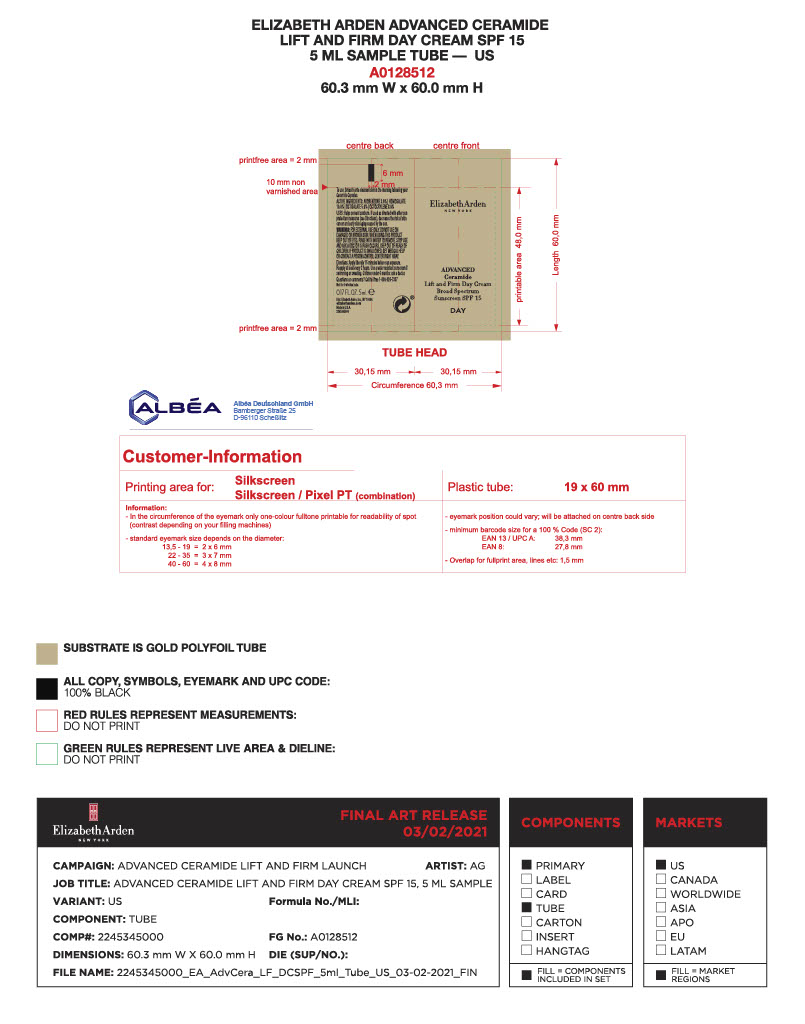
Advanced Ceramide Lift and Firm Day Cream Broad Spectrum Sunscreen SPF 15 OCTISALATE, OCTOCRYLENE, AVOBENZONE, HOMOSALATE 100 mg/g; 80 mg/g; 30 mg/g; 50 mg/g Emulsion, 15 g — NDC 10967-689-61 (Billing 10967-0689-61)
This is a package of 15 g of Advanced Ceramide Lift and Firm Day Cream Broad Spectrum Sunscreen SPF 15 OCTISALATE, OCTOCRYLENE, AVOBENZONE, HOMOSALATE 100 mg/g; 80 mg/g; 30 mg/g; 50 mg/g Emulsion from REVLON, marketed since Aug 2021 and currently FDA-listed.
NDC database record
One package, one record: these facts belong to NDC 10967-689-61 alone.
- Record
- FDA NDC Directory package listing · Human OTC drug
- Code segments
- 10967 labeler · 689 product · 61 package
- Package marketed since
- Aug 1, 2021
- Sample package
- No — commercial package
- Listing certified through
- Dec 31, 2026
- Barcode (UPC-A, from the NDC)
- 3 1096768961 4
- FDA record last changed
- Aug 27, 2026
Identity & classification
Regulatory identifiers FDA, NLM and CMS codes for this package
Where does this data come from?
- FDA openFDA NDC Directory · synced Oct 1, 2026
- FDA label on DailyMed · label index refreshed Oct 6, 2026
- RxNorm (NLM RxNav) · catalog refreshed Oct 1, 2026
- Medi-Span GPI (licensed)
- First Databank (licensed) · refreshed Oct 1, 2026
Clinical
This is an OTC monograph sunscreen emulsion applied to the skin. It contains four ultraviolet (UV) filters: homosalate, octocrylene, avobenzone, and octisalate. These ingredients function together to absorb and scatter UVA and UVB rays, and are commonly included in daytime facial moisturizers and sunscreen products to help reduce UV exposure to the skin.
Patient education
Supplement & herbal interactions
Where does this data come from?
- MedlinePlus (NLM) · refreshed Oct 1, 2026
- FDA label on DailyMed · label index refreshed Oct 6, 2026
Ask a licensed pharmacist directly — free, answered by our team.
Pricing
A drug doesn't have one price. Each row is a different public payment system, and none is what you'd pay at the counter — that depends on your insurance. The ⓘ on each row explains what it measures.
| Price system | Per mL | Per package |
|---|---|---|
| Retail pharmacies payNADAC · weekly | Not in the retail survey — common for institutional, discontinued, or low-volume packs. | |
| Medicaid paysCMS SDUD · 12 mo | No recent Medicaid claims on file for this NDC — rare and low-volume NDCs are suppressed in the public data. | |
| Medicare drug plans payPart D · quarterly | No Part D plan price is available for this NDC in our data. | |
Where does this data come from?
- CMS NADAC weekly file
- CMS ASP pricing files · refreshed Sep 20, 2026
- CMS Medicaid State Drug Utilization Data · refreshed Oct 6, 2026
- CMS Part D plan pricing files · refreshed Sep 24, 2026
- VA National Acquisition Center price file
Packaging — all sizes for this product
| Package NDC | Description | Marketing start | Marketing end | Status |
|---|---|---|---|---|
| 10967-0689-17 10967-689-17 Main listing | 50 g in 1 JAR | 2021-08-01 | — | Active |
| 10967-0689-60 10967-689-60 | 2 g in 1 PACKET | 2021-08-01 | — | Active |
| 10967-0689-61 You're viewing this | 15 g in 1 TUBE | 2021-08-01 | — | Active |
| 10967-0689-64 10967-689-64 | 5 g in 1 TUBE | 2021-08-01 | — | Active |
You're viewing one of 4 pack sizes for this product.
Pack size FAQ
What quantity is in this package?
How does this package differ from NDC 10967-0689-60?
What NDC number is used to bill for this package of Advanced Ceramide Lift and Firm Day Cream Broad Spectrum Sunscreen SPF 15 OCTISALATE, OCTOCRYLENE, AVOBENZONE, HOMOSALATE 100 mg/g; 80 mg/g; 30 mg/g; 50 mg/g Emulsion?
Therapeutic equivalents
| Product | Labeler | Pack | NADAC/unit | TE | Status | Price vs. this |
|---|---|---|---|---|---|---|
| Advanced Ceramide Lift and Firm Day Cream Broad Spectrum Sunscreen SPF 15 100 mg/g; 80 mg/g; 30 mg/g; 50 mg/gthis 10967-0689-61 | REVLON | 15 g | — | — | FDA listed | — |
Where does this data come from?
- FDA openFDA NDC Directory · synced Oct 1, 2026
- FDA Orange Book · refreshed Oct 3, 2026
- CMS NADAC weekly file
Availability & generic status
We did not find an FDA-approved generic match for this exact strength, form and route.
Where does this data come from?
- FDA Orange Book · refreshed Oct 3, 2026
Inactive Ingredients / Excipients
Inactive ingredients, also called excipients, are components of the drug product other than the active ingredient. They may include fillers, dyes, coatings, preservatives, flavors, or other formulation ingredients.
💡 Tap an ingredient (hover on desktop) to see what it is and why it’s used.
-
UNII S7ZA3CCJ4M
A synthetic polymer made from acrylic compounds and silicone, this substance forms a flexible protective coating on tablet or capsule surfaces. It helps control medicine release into your body and protects the active ingredient from moisture and air.
-
UNII 0R3VC3BV8I
A synthetic peptide made of four amino acids linked together. In medicines and cosmetics, it functions as an active-looking ingredient claimed to support skin appearance, though its primary formulation role is typically as a conditioning or texture-enhancing agent.
-
UNII VMO8OOD3V0
A synthetic peptide (short protein-like molecule) used as a thickening and film-forming agent in topical formulations. It helps create texture, improve consistency, and support the product's stability on skin.
-
UNII 9E8X80D2L0
A synthetic form of vitamin E used as an antioxidant and preservative in medications. It helps prevent the active ingredients from degrading when exposed to oxygen or light.
-
UNII 3XUS85K0RA
Butylene glycol is a clear liquid derived from petroleum or plants that acts as a humectant, solvent, and preservative booster in medicines. It helps keep formulations stable, dissolve active ingredients, and maintain moisture in topical products.
-
UNII K67N5Z1RUA
A plant-derived surfactant made from natural sugars and fatty alcohols. It helps dissolve and mix ingredients evenly throughout the medicine, acting as an emulsifier and solubilizer in liquid formulations.
-
UNII B1K89384RJ
A mixture of fatty alcohols derived from natural oils or fats, typically containing 14 to 22 carbon atoms. Used as an emollient, thickener, and emulsifier to improve texture and help blend oil and water components in formulations.
-
UNII 00YIU5438U
Caprylyl glycol is a clear liquid derived from coconut oil. In medicines, it acts as a humectant to retain moisture, a preservative booster to prevent microbial growth, and a solvent to help dissolve or mix other ingredients.
-
UNII 0A5MM307FC
A synthetic polymer that absorbs water and forms a thick, gel-like substance. In medicines, it works as a thickener and stabilizer to improve texture and help ingredients stay mixed together in creams, gels, and lotions.
-
UNII 59TL3WG5CO
A synthetic polymer made by crosslinking acrylic acid with allyl sucrose. It thickens liquids, forms gels, and helps control how fast the medicine is released in your body.
-
UNII 7CY8BVL34N
Carrageenan sodium is a thickening agent derived from red seaweed. It's used in medicines to create a gel-like consistency, improve texture, and help the product hold together in liquid or semi-solid formulations.
-
UNII 5THT33P7X7
A waxy, lipid-like substance derived from animal or plant sources. It helps soften and moisturize the skin by acting as an emollient and skin-conditioning agent in topical medicines and creams.
-
UNII F1X8L2B00J
A naturally derived fatty substance that helps bind and condition the product's texture. It works as an emollient and skin-conditioning agent in topical formulations, helping maintain moisture and smoothness.
-
UNII 4370DF050B
Ceramide NP is a waxy, lipid-based substance that mimics natural skin oils. It's used in topical formulations as an emollient and skin-conditioning agent to help soften, smooth, and protect the skin barrier.
-
UNII I670DAL4SZ
A preservative that fights bacteria and fungi. It keeps medicines and topical products stable and safe from microbial contamination during storage and use.
-
UNII 97C5T2UQ7J
Cholesterol is a fatty substance found naturally in animal tissues. In medications, it's used as an ingredient in liposomal formulations and lipid-based drug delivery systems to help encapsulate and stabilize active drugs for better absorption.
-
UNII 92RU3N3Y1O
Dimethicone is a silicone-based oil that acts as an anti-foaming agent and lubricant in medicines. It reduces gas bubbles in liquid formulations and helps coat and protect the stomach lining when ingested.
-
UNII SA6A6V432S
Dimethyl isosorbide is a clear liquid solvent derived from natural sugar sources. It helps dissolve active ingredients and improve their absorption in liquid medicines and topical products.
-
UNII 8NLQ36F6MM
Edetate disodium anhydrous is a chemical compound that binds to metal ions in a medicine. It's used as a stabilizer to prevent unwanted chemical reactions and help keep the drug product effective during storage.
-
UNII 2865993309
Ethylhexyl palmitate is an oily chemical made from palm oil and alcohol. It acts as an emollient and skin-conditioning agent in topical medicines, helping the product spread smoothly and keeping skin soft.
-
UNII PDC6A3C0OX
Glycerin is a clear, thick liquid derived from plant oils or fats. It acts as a humectant to retain moisture, a sweetener, and a solvent in medications.
-
UNII 230OU9XXE4
A waxy substance made from glycerin and stearic acid that acts as an emulsifier to blend oily and watery ingredients together. It also helps thicken and stabilize the medicine's texture.
-
UNII KEH0A3F75J
Hexylene glycol is a clear liquid alcohol used as a solvent and preservative in medicines. It helps dissolve other ingredients and keeps the product stable during storage.
-
UNII YSE9PPT4TH
Hyaluronate sodium is a natural carbohydrate that holds moisture. It's used in medicines as a lubricant, thickener, and moisture-retaining agent to improve texture and delivery of the active ingredient.
-
UNII 86FQE96TZ4
A synthetic polymer, this ingredient acts as a thickener and suspending agent in liquid formulations. It helps maintain uniform consistency and keeps particles evenly distributed throughout the medicine.
-
UNII 918X1OUF1E
Isohexadecane is a synthetic hydrocarbon oil used as an emollient and solvent in topical medicines. It helps dissolve active ingredients and improves spreadability and absorption through the skin.
-
UNII 99S85B4VEB
A plant extract from alpine edelweiss used as a natural conditioning or antioxidant ingredient in formulations to help maintain product stability and quality during storage.
-
UNII YD01N1999R
A waxy substance made from polyethylene glycol and stearic acid. It helps mix oil and water-based ingredients together and serves as an emulsifier and solubilizer in liquid and semi-solid medicines.
-
UNII HIE492ZZ3T
Phenoxyethanol is a synthetic preservative and antimicrobial agent used to prevent bacterial and fungal growth in medicines and cosmetic products, extending shelf life and maintaining product safety.
-
UNII GIN46U9Q2Q
Phytosphingosine is a naturally derived fatty compound that helps stabilize and thicken skincare and cosmetic formulations. It works as an emollient and conditioning agent to improve texture and skin feel in topical products.
-
UNII 59Z907ZB69
A synthetic silicone polymer used as a glidant and anti-caking agent. It reduces friction between particles, helping powders and tablets flow smoothly during manufacturing and use.
-
UNII 7T1F30V5YH
A synthetic emulsifier derived from sorbitol and oleic acid. It helps mix oil and water-based ingredients together and keeps them from separating in liquid formulations.
-
UNII CAL22UVI4M
A synthetic emulsifier derived from sorbitol and fatty acids. It helps mix oil and water-based ingredients together and improves the texture and stability of the medicine.
-
UNII 87GE52P74G
Sea salt is sodium chloride harvested from seawater. It acts as a flavoring agent and preservative in medications, helping enhance taste and prevent microbial growth.
-
UNII EU2PSP0G0W
Silica dimethyl silylate is a silicon-based powder that acts as a glidant and anti-caking agent. It reduces friction between particles and helps powders flow smoothly during manufacturing and tablet compression.
-
UNII 7243K85WFO
Sodium lauroyl lactylate is a mild surfactant derived from natural fats and lactic acid. It acts as an emulsifier and solubilizer to help blend oil and water-based ingredients and improve how the body absorbs the active drug.
-
UNII 5Z4DPO246A
A synthetic plastic polymer made from styrene and acrylamide monomers. It acts as a film-former and binder in tablets and capsules, helping hold ingredients together and control how quickly the medicine dissolves and releases in your body.
-
UNII 023C2WHX2V
Tromethamine is a chemical buffer that helps maintain the proper acidity level in liquid medicines. It neutralizes acids and stabilizes the solution so the medication remains effective and safe throughout its shelf life.
-
UNII 059QF0KO0R
Water is a liquid solvent that dissolves and mixes ingredients together in liquid medicines, syrups, and injections. It helps distribute the active drug evenly throughout the product.
-
UNII TTV12P4NEE
Xanthan gum is a thickening and stabilizing ingredient made from fermented corn or other sugars. It's added to medicines to improve texture, prevent separation of liquids and solids, and help the product stay consistent.
40 inactive ingredients listed in the exact product block matched to this NDC.
Label-section wording can be broader than the structured product block and may mention additional formulation ingredients.
Where does this data come from?
ingredient classCode="IACT" elements from the exact product block matched by this NDC. Label-section narrative from DailyMed / the openFDA label index is shown separately when available.- FDA label on DailyMed · label index refreshed Oct 6, 2026
- FDA openFDA NDC Directory · synced Oct 1, 2026
Inactive ingredient FAQ
Are inactive ingredients the same for every manufacturer?
Why might an inactive ingredient be missing?
Can inactive ingredients matter?
Manufacturer & labeler
More NDCs from REVLON labeler code 10967
- Mitchum Clinical Soft Solid Unscented ALUMINUM ZIRCONIUM TETRACHLOROHYDREX GLY 20.0% .2 g/g Stick NDC 10967-681-16
- Mitchum Clinical Soft Solid Clean Control ALUMINUM ZIRCONIUM TETRACHLOROHYDREX GLY 20.0% .2 g/g Stick NDC 10967-682-16
- Flawless Future Spf 30 Octinoxate, Octisalate, Oxybenzone, Avaobenzone 7.14 mg/g; 4 mg/g; 4.75 mg/g; 3 mg/g Emulsion NDC 10967-683-17
- Prevage Anti-aging eye cream SPF 15 Octinoxate, Oxybenzone 1.4 mg/g; 4.1 mg/g Cream NDC 10967-685-61
- Prevage anti aging SPF 30 OCTISALATE, OCTINOXATE, OXYBENZONE, AVOBENZONE, OCTOCRYLENE, 7.5 g/mL; 2.2 mg/mL; 5 mg/mL; 2 mg/mL; 5 mg/mL Lotion NDC 10967-686-17
- Prevage Anti-aging Moisture Cream Octinoxate, Octisalate, Oxybenzone, Octocrylene, Avobenzone 2 mg/g; 7.5 mg/g; 5 mg/g; 2.2 mg/g; 5 mg/g Cream NDC 10967-688-17
- RV Illuminance Serum Tint Broad Spectrum 15 Face foundation with SPF .868 g/28mL; .28 g/28mL; 1.54 g/28mL Cream NDC 10967-690-19
- RV Illuminance Serum Tint Broad Spectrum 15 Amber Face foundation with SPF .868 g/28mL; .28 g/28mL; 1.54 g/28mL Cream NDC 10967-691-19
- Eight Hour Lip Protectant Spf 15 Petrolatum, Oxybenzone, Octinoxate, Avobenzone 2 mg/g; 7.49475 mg/g; 3 mg/g; 30.99938 mg/g Lipstick NDC 10967-692-61
- RV Illuminance Serum Tint Broad Spectrum 15 Amber Face foundation with SPF .868 g/28mL; .28 g/28mL; 1.54 g/28mL Cream NDC 10967-693-19
- RV Illuminance Serum Tint Broad Spectrum 15 Buff Beige Face foundation with SPF .868 g/28mL; .28 g/28mL; 1.54 g/28mL Cream NDC 10967-694-19
- RV Illuminance Serum Tint Broad Spectrum 15 Cool Beige Face foundation with SPF .868 g/28mL; .28 g/28mL; 1.54 g/28mL Cream NDC 10967-695-19
Where does this data come from?
- FDA openFDA NDC Directory · synced Oct 1, 2026
- Drugs@FDA
FDA label — Drug Facts FDA SPL
🎯 Indications and Usage ▾
Helps prevent sunbunrs. If used as directed with other sun protection measures (See Directions), decreases the risk of skin cancer and early skin aging caused by the sun.
⏱️ Dosage and Administration ▾
Apply liberally 15 minutes before sun exposure.
⚠️ Warnings ▾
WARNINGS For external use only Do not use on damaged or broken skin When using this product keep out of eyes. Rinse with water to remove. Stop use and ask a doctor if rash occurs keep out of reach of children. If product is swallowed, get medical help or contact a Poison Control Center right away.
🧪 Active Ingredient ▾
ACTIVE INGREDIENTS AVOBENZONE 3.00% HOMOSALATE 10.0% OCTISALATE 5.0% OCTOCRYLENE 8.0%
🧪 Inactive Ingredients ▾
OTHER INGREDIENTS WATER/AQUA/EAU, GLYCERIN, HEXYLENE GLYCOL, DIMETHICONE, C14-22 ALCOHOLS, PEG-100 STEARATE, GLYCERYL STEARATE, STYRENE/ACRYLATES COPOLYMER, ACRYLATES/DIMETHICONE COPOLYMER, POLYMETHYLSILSESQUIXANE, ACETYL TETRAPEPTIDE-11, ACETYL TETRAPEPTIDE-9, ACRYLATES/C10-30 ALKYL ACRYLATE CROSSPOLYMER, AMMONIUM HYDROXIDE, BUTYLENE GLYCOL, C12-20 ALKYL GLUCOSIDE, CAPRYLYL GLYCOL, CARBOMER, CERAMIDE AP, CERAMIDE EOP, CERAMIDE NP, CHOLESTEROL, DIMETHYL ISOSORBIDE, DISODIUM EDTA, ETHLYHEXYL PALMITATE, HYDROXYETHYL ACRYLATE/SODIUM ACRYLOYLDIMETHYL, TAURATE COPOLYMER, ISOHEXADECANE, LEONTOPODIUM ALPINUM CALLUS CULTURE EXTRACT, MARIS SAL/SEA SALT/SEL MARIN, PHYTOSPHINGOSINE, POLYSORBATE 20, POLYSORBATE 60, SILICA DIMETHYL SILYLATE, SODIUM CARRAGEENAN, SODIUM HYALURONATE, SODIUM LAUROYL LACTYLATE, TOCOPHERYL ACETATE, TROMETHAMINE, XANTHAM GUM, FRAGRANCE, CHLORPHENESIN, PHENOXYETHANOL.
🎯 Purpose ▾
Sunscreen
📄 Keep Out of Reach of Children ▾
Keep out of the reach of children. If product is swallowed, get medical help or contact a Poison Control Center right away.
📖 Instructions for Use ▾
USES Helps prevent sunburn if used as directed with other sun protection measures (see Directions) , decreases the risk of skin cancer and early skin aging caused by the sun.
DIRECTIONS Apply liberally 15 minutes before sun exposure Reapply: - at least every 2 hours Sun Protection Measures. Spending time in the sun increases your risk of skin cancer and early skin aging. To decrease this risk, regularly use a sunscreen with a broad spectrum SPF of 15 or higher and other sun protection measures including: - Limit time in the sun, especially from 10 a.m. - 2 p.m. - Wear long-sleeve shirts, pants, hats, and sunglasses Use a water resistant sunscreen if swimming or sweating Children under 6 months: Ask a doctor.
📄 Package Label / Principal Display Panel ▾
CARTON ART 15 mL Tube
About this NDC listing & data coverage
What data is (and isn’t) available for this NDC — tap to expand
| NDC identity (package / product / labeler codes) | ✓ Available |
| Labeler | ✓ Available |
| Product & package description | ✓ Available |
| Marketing category & status | ✓ Available |
| Active ingredient / dosage form / route | ✓ Available |
| FDA label (SPL via DailyMed) | ✓ Available |
| Package photos | ✓ Available |
| Inactive ingredients (structured) | ✓ Available |
| NADAC pharmacy acquisition price (CMS) | — Not published for this NDC CMS publishes NADAC only for NDCs reported in its retail-pharmacy survey. |
| Orange Book / therapeutic-equivalence data | — Not published for this NDC Applies only to products approved under an NDA/ANDA; many listings are out of scope. |
| HCPCS J-code billing crosswalk | — Not published for this NDC Most self-administered / retail products have no J-code — that is normal. |
| Medicaid utilization (CMS SDUD) | — Not published for this NDC CMS reports utilization only for NDCs with Medicaid claims above its privacy threshold. |