
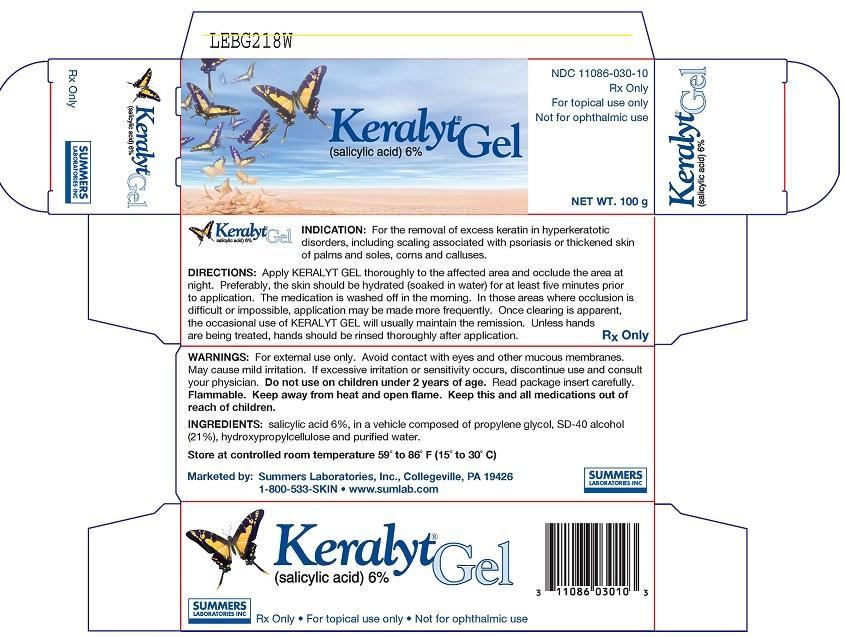
Keralyt salicylic acid 6 g/100g Gel, 100 g — NDC 11086-030-10 (Billing 11086-0030-10)
This is a package of 100 g of Keralyt salicylic acid 6 g/100g Gel from Summers Laboratories Inc, marketed since Nov 2009 and currently FDA-listed. It is the main listing for this product, which comes in 3 package sizes.
NDC database record
One package, one record: these facts belong to NDC 11086-030-10 alone.
- Record
- FDA NDC Directory package listing · Human prescription drug
- Code segments
- 11086 labeler · 030 product · 10 package
- Package marketed since
- Nov 1, 2009
- Sample package
- No — commercial package
- Listing certified through
- Dec 31, 2027
- Billing quantity
- 100 g per package
- Barcode (UPC-A, from the NDC)
- 3 1108603010 3
- FDA record last changed
- Jul 24, 2026
Identity & classification
Regulatory identifiers FDA, NLM and CMS codes for this package
Drug-database identifiers Medi-Span GPI and First Databank GCN / HICL / AHFS classification
- GSN (GCN sequence number): 015725
- GCN: 22713
- GPI-14 (Medi-Span): 90750030004005
- HICL (First Databank): 002465
- AHFS class code: 84:28.00.00
- RxCUI (RxNorm): 212332
Where does this data come from?
- FDA openFDA NDC Directory · synced Oct 1, 2026
- FDA label on DailyMed · label index refreshed Oct 6, 2026
- RxNorm (NLM RxNav) · catalog refreshed Oct 1, 2026
- Medi-Span GPI (licensed)
- First Databank (licensed) · refreshed Oct 1, 2026
RxNorm drug class
This medicine belongs to the Salicylic acid and derivatives class.
Where does this data come from?
- RxClass (NLM) · catalog refreshed Oct 1, 2026
Clinical
Topical salicylic acid is used to help clear and prevent pimples and skin blemishes in people who have acne. Topical salicylic acid is also used to treat skin conditions that involve scaling or overgrowth of skin cells such as psoriasis (a skin disease in which red, scaly patches form on some areas of the body), ichthyoses (inborn conditions that cause skin dryness and scaling), dandruff, corns, calluses, and warts on the hands or feet. Topical salicylic acid should not be used to treat genital warts, warts on the face, warts with hair growing from them, warts in the nose or mouth, moles, or b...
Read the full MedlinePlus article ↗- It is used in a facial routine for acne-prone and oil-prone skin. The routine includes a cleanser, serum, toner and emulsion. Salicylic acid helps loosen and shed dead skin cells.
- Use the cleanser morning and evening, and the serum in the morning after cleansing. Use the toner in the evening on dry skin, and the emulsion at night after cleansing. Avoid your...
- Mild stinging, burning, itching, dryness and extra peeling can happen. If dryness or peeling bothers you, try using the serum or toner every other day. If it gets excessive, stop a...
- It is best not to. Using another topical acne medication at the same time makes irritation and dryness more likely. If you get irritated, use only one at a time.
Patient education
Supplement & herbal interactions
Where does this data come from?
- MedlinePlus (NLM) · refreshed Oct 1, 2026
- FDA label on DailyMed · label index refreshed Oct 6, 2026
Ask a licensed pharmacist directly — free, answered by our team.
Pricing
A drug doesn't have one price. Each row is a different public payment system, and none is what you'd pay at the counter — that depends on your insurance. The ⓘ on each row explains what it measures.
| Price system | Per g | Per package |
|---|---|---|
| Retail pharmacies payNADAC · weekly | Not in the retail survey — common for institutional, discontinued, or low-volume packs. | |
| Medicaid paysCMS SDUD · 12 mo | No recent Medicaid claims on file for this NDC — rare and low-volume NDCs are suppressed in the public data. | |
| Medicare drug plans payPart D · quarterly | No Part D plan price is available for this NDC in our data. | |
Where does this data come from?
- CMS NADAC weekly file
- CMS ASP pricing files · refreshed Sep 20, 2026
- CMS Medicaid State Drug Utilization Data · refreshed Oct 6, 2026
- CMS Part D plan pricing files · refreshed Sep 24, 2026
- VA National Acquisition Center price file
Packaging — all sizes for this product
| Package NDC | Description | Marketing start | Marketing end | Status |
|---|---|---|---|---|
| 11086-0030-10 You're viewing this Main listing | 100 g in 1 TUBE | 2009-11-01 | — | Active |
| 11086-0030-40 11086-030-40 | 40 g in 1 TUBE | 2009-11-01 | — | Active |
| 11086-0030-60 11086-030-60 | 60 g in 1 BOTTLE, WITH APPLICATOR | 2009-11-01 | — | Active |
You're viewing the largest of 3 pack sizes for this product.
Pack size FAQ
What quantity is in this package?
How does this package differ from NDC 11086-0030-40?
What NDC number is used to bill for this package of Keralyt salicylic acid 6 g/100g Gel?
Therapeutic equivalents
| Product | Labeler | Pack | NADAC/unit | TE | Status | Price vs. this |
|---|---|---|---|---|---|---|
| Keralyt 6 g/100gthis 11086-0030-10 | Summers | 100 g | — | — | FDA listed | — |
| Salicylic Acid 60 mg/g 42192-0134-40 | Acella | 1 tube | — | — | FDA listed | — |
| Salicylic Acid 6% Gel 6 g/100mL 59088-0261-03 | PureTek | 29.57 ml | — | — | FDA listed | — |
| Salicylic Acid 6% Gel 6 g/100g 71085-0073-60 | IPG | 1 bottle | — | — | Discontinued | — |
| Salicylic Acid 6% Gel 6 g/100g 59088-0216-03 | PureTek | 28.35 g | — | — | FDA listed | — |
Where does this data come from?
- FDA openFDA NDC Directory · synced Oct 1, 2026
- FDA Orange Book · refreshed Oct 3, 2026
- CMS NADAC weekly file
Availability & generic status
We did not find an FDA-approved generic match for this exact strength, form and route.
Where does this data come from?
- FDA Orange Book · refreshed Oct 3, 2026
Inactive Ingredients / Excipients
Inactive ingredients, also called excipients, are components of the drug product other than the active ingredient. They may include fillers, dyes, coatings, preservatives, flavors, or other formulation ingredients.
🧪 Avoiding an ingredient? See Salicylic Acid Topical inactive ingredients by manufacturer: every current product's list side by side, so you can ask your pharmacy for the version that does not list it.
💡 Tap an ingredient (hover on desktop) to see what it is and why it’s used.
-
UNII 3K9958V90M
A liquid solvent derived from fermentation or chemical synthesis. In medicines, alcohol dissolves active ingredients, helps preserve the product, and improves how the body absorbs certain drugs.
-
UNII RFW2ET671P
Hydroxypropyl cellulose is a plant-derived thickening agent made from cellulose. It acts as a binder to hold tablet ingredients together and as a film-former to coat tablets or control how fast the medicine releases.
-
UNII 6DC9Q167V3
Propylene glycol is a clear liquid derived from petroleum or vegetable sources. It acts as a solvent, humectant, and preservative in medicines, helping dissolve active ingredients and maintain product stability.
-
UNII 059QF0KO0R
Water is a liquid solvent that dissolves and mixes ingredients together in liquid medicines, syrups, and injections. It helps distribute the active drug evenly throughout the product.
4 inactive ingredients listed in the exact product block matched to this NDC.
Where does this data come from?
ingredient classCode="IACT" elements from the exact product block matched by this NDC. Label-section narrative from DailyMed / the openFDA label index is shown separately when available.- FDA label on DailyMed · label index refreshed Oct 6, 2026
- FDA openFDA NDC Directory · synced Oct 1, 2026
Inactive ingredient FAQ
Are inactive ingredients the same for every manufacturer?
Why might an inactive ingredient be missing?
Can inactive ingredients matter?
Manufacturer & labeler
More NDCs from Summers Laboratories Inc labeler code 11086
Where does this data come from?
- FDA openFDA NDC Directory · synced Oct 1, 2026
- Drugs@FDA
Full prescribing information FDA SPL
🎯 Indications and Usage ▾
INDICATIONS AND USAGE - For the removal of excess keratin in hyperkeratotic disorders, including scaling associated with scalp psoriasis or thickened skin of palms and soles, corns and calluses.
⏱️ Dosage and Administration ▾
DOSAGE AND ADMINISTRATION - The preferable method of use is to apply KERALYT GEL thoroughly to the affected area and occlude the area at night. Preferably, the skin should be hydrated for at least five minutes prior to application. The medication is washed off in the morning and if excessive drying and/or irritation is observed a bland cream or lotion may be applied.
Once clearing is apparent, the occasional use of KERALYT GEL will usually maintain the remission. In those areas where occlusion is difficult or impossible, application may be made more frequently; hydration by wet packs or baths prior to application apparently enhances the effect. Unless hands are being treated, hands should be rinsed thoroughly after application.
For use as a scalp treatment: KERALYT GEL should be applied directly to the affected areas of the scalp on a frequency directed by your physician. The applicator tip will provide accurate application, avoiding contact with normal hair or skin. The gel should be washed off after 10 to 20 minutes initially, but it can be left on for up to an hour as treatment progresses.
The gel can be washed off using KERALYT SHAMPOO or warm water in a bath or shower.
⛔ Contraindications ▾
CONTRAINDICATIONS: KERALYT GEL should not be used in any patient known to be sensitive to salicylic acid or any other listed ingredient. KERALYT should not be used in children under 2 years of age.
⚠️ Warnings ▾
WARNINGS: Prolonged use over large areas, especially in children and those patients with significant renal or hepatic impairment, could result in salicylism. Concomitant use of other drugs which may contribute to elevated serum salicylate levels should be avoided where the potential for toxicity is present. In children under 12 years of age and those patients with renal or hepatic impairment, the area to be treated should be limited and the patient monitored closely for signs of salicylate toxicity: nausea, vomiting, dizziness, loss of hearing, tinnitus, lethargy, hyperpnoea, diarrhea, psychic disturbances.
In the event of salicylic acid toxicity, the use of KERALYT GEL should be discontinued. Fluids should be administered to promote urinary excretion. Treatment with sodium bicarbonate (oral or intravenous) should be instituted as appropriate.
Considering the potential risk of developing Reye’s Syndrome, salicylate products should not be administered to children or teenagers with varicella or influenza, unless directed by a physician.
🤒 Adverse Reactions ▾
ADVERSE REACTIONS: Excessive erythema and scaling conceivably could result from use on open skin lesions.
🔄 Drug Interactions ▾
Drug Interactions. (The following interactions are from a published review ⁵ and include reports concerning both oral and topical salicylate administration. The relationship of these interactions to the use of KERALYT GEL is not known.) I.
Due to the competition of salicylate with other drugs for binding to serum albumin the following drug interactions may occur: Drug Description of Interaction Tolbutamide; Sulfonylureas Hypoglycemia potentiated Methotrexate Decreases tubular reabsorption; clinical toxicity from methotrexate can result Oral Anticoagulant Increased bleeding II. Drugs changing salicylate levels by altering renal tubular reabsorption: Drug Description Corticosteroids Decreases plasma salicylate level; Tapering doses of steroids may promote salicylism Ammonium Sulfate Increases plasma salicylate level III.
Drugs with complicated interactions with salicylates: Drug Description Heparin Salicylate decreases platelet adhesiveness and interferes with hemostasis in heparin-treated patients Pyrazinamide Inhibits pyrazinamide-induced hyperuricemia Uricosuric Agents Effect of probenecid, sulfinpyrazone and phenylbutazone inhibited The following alterations of laboratory tests have been reported during salicylate therapy ⁶ : Laboratory Tests Effect of Salicylates Thyroid Function Decreased PBI; increased T 3 uptake Urinary Sugar False negative with glucose oxidase; false positive with Clinitest with high-dose salicylate therapy (2-5 g qd) 5 Hydroxyindole acetic acid False negative with fluorometric test Acetone, Ketone Bodies False positive FeCl 3 in Gerhardt reaction; red color persists with boiling 17-OH corticosteroids False reduced values with >4.8 g qd salicylate Vanilmandelic Acid False reduced values Uric Acid May increase or decrease depending on dose Prothrombin Decreased levels; slightly increased prothrombin time
🤰 Pregnancy ▾
Pregnancy (Category C): Salicylic acid has been shown to be teratogenic in rats and monkeys. It is difficult to extrapolate from oral doses of acetyl salicylic acid used in these studies to topical administration as the oral dose to monkeys may represent 4 times the maximum daily human dose of salicylic acid (as supplied in one tube, 40 g of KERALYT GEL) when applied topically over a large body surface. There are no adequate and well-controlled studies in pregnant women.
KERALYT GEL should be used during pregnancy only if the potential benefit justifies the risk to the fetus.
🆘 Overdosage ▾
OVERDOSAGE - See WARNINGS
🧬 Clinical Pharmacology ▾
CLINICAL PHARMACOLOGY: Salicylic acid has been shown to produce desquamation of the horny layer of skin while not affecting qualitative or quantitative changes in structure of the viable epidermis. ¹ , ² The mechanism of action has been attributed to a dissolution of intercellular cement substance. ³ In a study of the percutaneous absorption of salicylic acid from KERALYT GEL in four patients with extensive active psoriasis, Taylor and Halprin ⁴ showed that peak serum salicylate levels never exceeded 5 mg/100 ml even though more than 60% of the applied salicylic acid was absorbed.
Systemic toxic reactions are usually associated with much higher serum levels (30 to 40 mg/100 ml). Peak serum levels occurred within 5 hours of the topical application under occlusion. The sites were occluded for 10 hours over the entire body surface below the neck.
Since salicylates are distributed in the extracellular space, patients with a contracted extracellular space due to dehydration or diuretics have higher salicylate levels than those with a normal extracellular space. ⁵ (See PRECAUTIONS ). The major metabolites identified in the urine after topical administration are salicyluric acid (52%), salicylate glucuronides (42%), and free salicylic acid (6%). ³ The urinary metabolites after percutaneous absorption differ from those after oral salicylate administration; those derived from percutaneous absorption contain more glucuronides and less salicyluric and salicylic acid.
Almost 95% of a single dose of salicylate is excreted within 24 hours of its entrance into the extracellular space. ⁵ Fifty to eighty percent of salicylate is protein bound to albumin. Salicylates compete with the binding of several drugs and can modify the action of these drugs. By similar competitive mechanisms other drugs can influence the serum levels of salicylate. ⁵ (See PRECAUTIONS ).
📋 Description ▾
DESCRIPTION: KERALYT® is a gel for topical administration containing salicylic acid 6%, in a vehicle composed of propylene glycol, SD-40 alcohol (21%), hydroxypropylcellulose and purified water. Salicylic acid is the 2 hydroxy derivative of benzoic acid having the following structure: Salicylic acid structure
⚠️ Precautions ▾
PRECAUTIONS: For external use only. Avoid contact with eyes and other mucous membranes. Mild burning or stinging may occur.
Peeling of the skin may increase as the salicylic acid works to loosen excess keratin. If excessive burning, stinging or peeling occurs, discontinue use and consult your physician. Flammable.
Keep away from heat and open flame. Keep this and all medications out of reach of children. Drug Interactions.
(The following interactions are from a published review ⁵ and include reports concerning both oral and topical salicylate administration. The relationship of these interactions to the use of KERALYT GEL is not known.) I. Due to the competition of salicylate with other drugs for binding to serum albumin the following drug interactions may occur: Drug Description of Interaction Tolbutamide; Sulfonylureas Hypoglycemia potentiated Methotrexate Decreases tubular reabsorption; clinical toxicity from methotrexate can result Oral Anticoagulant Increased bleeding II.
Drugs changing salicylate levels by altering renal tubular reabsorption: Drug Description Corticosteroids Decreases plasma salicylate level; Tapering doses of steroids may promote salicylism Ammonium Sulfate Increases plasma salicylate level III. Drugs with complicated interactions with salicylates: Drug Description Heparin Salicylate decreases platelet adhesiveness and interferes with hemostasis in heparin-treated patients Pyrazinamide Inhibits pyrazinamide-induced hyperuricemia Uricosuric Agents Effect of probenecid, sulfinpyrazone and phenylbutazone inhibited The following alterations of laboratory tests have been reported during salicylate therapy ⁶ : Laboratory Tests Effect of Salicylates Thyroid Function Decreased PBI; increased T 3 uptake Urinary Sugar False negative with glucose oxidase; false positive with Clinitest with high-dose salicylate therapy (2-5 g qd) 5 Hydroxyindole acetic acid False negative with fluorometric test Acetone, Ketone Bodies False positive FeCl 3 in Gerhardt reaction; red color persists with boiling 17-OH corticosteroids False reduced values with >4.8 g qd salicylate Vanilmandelic Acid False reduced values Uric Acid May increase or decrease depending on dose Prothrombin Decreased levels; slightly increased prothrombin time Pregnancy (Category C): Salicylic acid has been shown to be teratogenic in rats and monkeys.
It is difficult to extrapolate from oral doses of acetyl salicylic acid used in these studies to topical administration as the oral dose to monkeys may represent 4 times the maximum daily human dose of salicylic acid (as supplied in one tube, 40 g of KERALYT GEL) when applied topically over a large body surface. There are no adequate and well-controlled studies in pregnant women. KERALYT GEL should be used during pregnancy only if the potential benefit justifies the risk to the fetus.
Nursing Mothers: Because of the potential for serious adverse reactions in nursing infants from the mother’s use of KERALYT GEL, a decision should be made whether to discontinue nursing or to discontinue the drug, taking into account the importance of the drug to the mother. Carcinogenesis, Mutagenesis, Impairment of Fertility: No data are available concerning potential carcinogenic or reproductive effects of KERALYT GEL. It has been shown to lack mutagenic potential in the Ames Salmonella test.
🍼 Nursing Mothers ▾
Nursing Mothers: Because of the potential for serious adverse reactions in nursing infants from the mother’s use of KERALYT GEL, a decision should be made whether to discontinue nursing or to discontinue the drug, taking into account the importance of the drug to the mother.
📄 Carcinogenesis, Mutagenesis, Impairment of Fertility ▾
Carcinogenesis, Mutagenesis, Impairment of Fertility: No data are available concerning potential carcinogenic or reproductive effects of KERALYT GEL. It has been shown to lack mutagenic potential in the Ames Salmonella test.
📚 References ▾
REFERENCES: Davies M, Marks R: Br J Dermatol 95: 187-192,1976. Marks R, Davies M, Cattel A: J Invest Dermatol 64: 283, 1975. Huber C, Christophers E: Arch Derm Res 257: 293-297, 1977.
Taylor JR, Halprin KM: Arch Dermatol 111: 740-743, 1975. Goldsmith LA: Int J Dermatol 18: 32-36. Wilson JG, Ritter EJ, Scott WJ, Fradlein R: Tox Appl Pharmacol 41: 67-78, 1977.
SUMMERS LABORATORIES INC Manufactured by: EMS Contract Packaging, Hatfield, PA 19440 Distributed by: Summers Laboratories, Inc. Collegeville, PA 19426 1-800-533-SKIN (7546) • www.sumlab.com KERALYT is a trademark of Summers Laboratories, Inc.
📄 Package Label / Principal Display Panel ▾
Keralyt-100g-carton Keralyt-100g-tube
Medicare Part D spend CMS · PART D · 2026 (Q1)
About this NDC listing & data coverage
Listed without an FDA application
This product's marketing category indicates it is marketed without an approved FDA application (no NDA, ANDA, or BLA on file). Having an NDC does not by itself establish FDA approval — the NDC Directory is a listing system, not an approval decision. Approval-linked data such as Orange Book therapeutic-equivalence ratings therefore does not apply.
What data is (and isn’t) available for this NDC — tap to expand
| NDC identity (package / product / labeler codes) | ✓ Available |
| Labeler | ✓ Available |
| Product & package description | ✓ Available |
| Marketing category & status | ✓ Available |
| Active ingredient / dosage form / route | ✓ Available |
| FDA label (SPL via DailyMed) | ✓ Available |
| Package photos | ✓ Available |
| Inactive ingredients (structured) | ✓ Available |
| NADAC pharmacy acquisition price (CMS) | — Not published for this NDC CMS publishes NADAC only for NDCs reported in its retail-pharmacy survey. |
| Orange Book / therapeutic-equivalence data | — Not published for this NDC Applies only to products approved under an NDA/ANDA; many listings are out of scope. |
| HCPCS J-code billing crosswalk | — Not published for this NDC Most self-administered / retail products have no J-code — that is normal. |
| Medicaid utilization (CMS SDUD) | — Not published for this NDC CMS reports utilization only for NDCs with Medicaid claims above its privacy threshold. |