
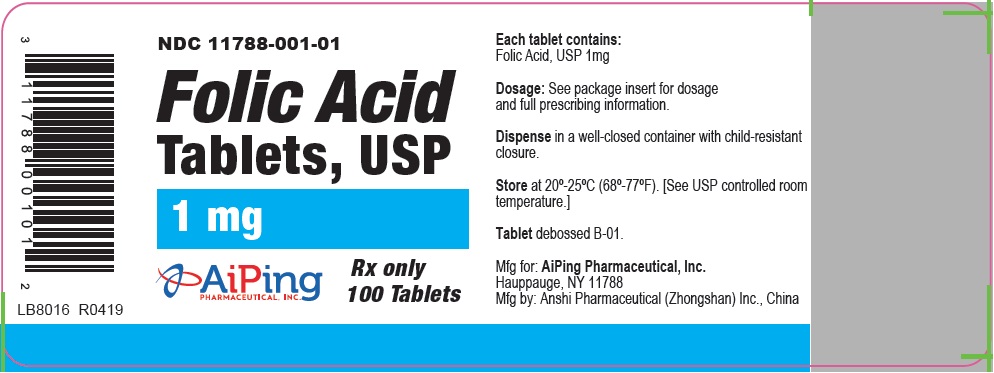
Folic Acid 1 mg Tablet, 100-count — NDC 11788-001-01 (Billing 11788-0001-01)
This is a package of 100 tablets of Folic Acid 1 mg Tablet from AiPing Pharmaceutical, Inc., no longer marketed, no longer in the FDA NDC Directory.
Identity & classification
Regulatory identifiers FDA, NLM and CMS codes for this package
Drug-database identifiers Medi-Span GPI and First Databank GCN / HICL / AHFS classification
- GSN (GCN sequence number): 002366
- GCN: 94781
- HICL (First Databank): 001062
- AHFS class code: 88:08.00.00
Where does this data come from?
- FDA openFDA NDC Directory · synced Oct 1, 2026
- FDA label on DailyMed · label index refreshed Oct 1, 2026
- RxNorm (NLM RxNav) · catalog refreshed Oct 1, 2026
- Medi-Span GPI (licensed)
- First Databank (licensed) · refreshed Oct 1, 2026
Clinical
- It treats megaloblastic anemia caused by low folic acid. This is anemia where your bone marrow makes oversized, immature red blood cells. Replacing the missing folate lets your bod...
- Take it as your prescriber directs, usually once a day. The oral solutions can be taken with or without food, and you should measure them with an oral dosing syringe from us. Injec...
- Yes, this matters. Folic acid can hide pernicious anemia, a B12 deficiency anemia, so your blood counts may improve while nerve damage keeps getting worse. Your doctor should rule...
- It's well tolerated, and side effects are mostly reported at much higher doses. These include nausea, bloating, gas, poor appetite and a bitter taste. Call your doctor right away f...
Patient education
Supplement & herbal interactions
Where does this data come from?
- MedlinePlus (NLM) · refreshed Oct 1, 2026
- FDA label on DailyMed · label index refreshed Oct 1, 2026
Ask a licensed pharmacist directly — free, answered by our team.
Pricing
A drug doesn't have one price. Each row is a different public payment system, and none is what you'd pay at the counter — that depends on your insurance. The ⓘ on each row explains what it measures.
| Price system | Per each | Per package |
|---|---|---|
| Retail pharmacies payNADAC · weekly | Not in the retail survey — common for institutional, discontinued, or low-volume packs. | |
| Medicaid paysCMS SDUD · 12 mo | No recent Medicaid claims on file for this NDC — rare and low-volume NDCs are suppressed in the public data. | |
| Medicare drug plans payPart D · quarterly | No Part D plan price is available for this NDC in our data. | |
Where does this data come from?
- CMS NADAC weekly file
- CMS ASP pricing files · refreshed Sep 20, 2026
- CMS Medicaid State Drug Utilization Data · refreshed Oct 3, 2026
- CMS Part D plan pricing files · refreshed Sep 24, 2026
- VA National Acquisition Center price file
Packaging — all sizes for this product
| Package NDC | Description | Marketing start | Marketing end | Status |
|---|---|---|---|---|
| 11788-0001-00 11788-001-00 Main listing | 139000 TABLET in 1 BOX | 2013-07-18 | — | Inactivated by FDA |
| 11788-0001-01 You're viewing this | 100 TABLET in 1 BOTTLE | 2013-07-18 | — | Inactivated by FDA |
| 11788-0001-10 11788-001-10 | 1000 TABLET in 1 BOTTLE | 2017-07-18 | — | Inactivated by FDA |
You're viewing the smallest of 3 pack sizes for this product.
Pack size FAQ
What quantity is in this package?
How does this package differ from NDC 11788-0001-10?
What NDC number is used to bill for this package of Folic Acid 1 mg Tablet?
Therapeutic equivalents
| Product | Labeler | Pack | NADAC/unit | TE | Status | Price vs. this |
|---|---|---|---|---|---|---|
| Folic Acid 1 mg 00904-7224-61 | Major | 100 tablets | $0.020 | AA | Availability likely | — |
| Folic Acid 1 mg 11534-0165-01 | SUNRISE | 100 tablets | $0.020 | AA | Availability likely | — |
| Folic Acid 1 mg 16571-0881-01 | Rising | 100 tablets | $0.020 | AA | Availability likely | — |
| Folic Acid 1 mg 53746-0361-01 | Amneal | 100 tablets | $0.020 | AA | Availability likely | — |
| Folic Acid 1 mg 58657-0151-01 | Method | 100 tablets | $0.020 | AA | Availability likely | — |
| Folic Acid 1 mg 60687-0681-01 | American | 100 tablets | $0.020 | AA | Availability likely | — |
| Folic acid 1 mg 62135-0210-01 | Chartwell | 100 tablets | $0.020 | AA | Availability likely | — |
| Folic Acid 1 mg 69315-0127-01 | Leading | 100 tablets | $0.020 | AA | Availability likely | — |
| Folic Acid 1 mg 70752-0231-10 | QUAGEN | 100 tablets | $0.020 | AA | Availability likely | — |
| Folic Acid 1 mg 72241-0050-05 | Modavar | 100 tablets | $0.020 | AA | Availability likely | — |
| Folic Acid 1 mg 00615-8589-05 | NCS | 15 tablets | — | AA | FDA listed | — |
| Folic Acid 1 mg 43063-0791-30 | PD-Rx | 30 tablets | — | AA | FDA listed | — |
| Folic Acid 1 mg 50090-3119-00 | A-S | 100 tablets | — | AA | FDA listed | — |
| Folic Acid 1 mg 50090-6760-00 | A-S | 90 tablets | — | AA | FDA listed | — |
| Folic Acid 1 mg 50090-7194-00 | A-S | 100 tablets | — | AA | FDA listed | — |
| Folic Acid 1 mg 50090-7195-00 | A-S | 90 tablets | — | AA | FDA listed | — |
| Folic Acid 1 mg 55154-2137-00 | Cardinal | 10 tablets | — | AA | FDA listed | — |
| Folic Acid 1 mg 55154-4306-00 | Cardinal | 10 tablets | — | AA | FDA listed | — |
| Folic Acid 1 mg 63629-9257-01 | Bryant | 100 tablets | — | AA | FDA listed | — |
| Folic Acid 1 mg 63629-9258-01 | Bryant | 1000 tablets | — | AA | FDA listed | — |
| Folic Acid 1 mg 65162-0361-01 | Amneal | 10 tablets | — | AA | FDA listed | — |
| Folic Acid 1 mg 66267-0217-30 | NuCare | 30 tablets | — | AA | FDA listed | — |
| Folic Acid 1 mg 67046-0719-03 | Coupler | 30 tablets | — | AA | FDA listed | — |
| Folic Acid 1 mg 67046-1449-03 | Coupler | 30 tablets | — | AA | FDA listed | — |
| Folic Acid 1 mg 68071-2992-01 | NuCare | 100 tablets | — | AA | FDA listed | — |
| Folic Acid 1 mg 68071-3513-01 | NuCare | 100 tablets | — | AA | FDA listed | — |
| Folic Acid 1 mg 68071-4602-01 | NuCare | 100 tablets | — | AA | FDA listed | — |
| Folic Acid 1 mg 68788-8557-01 | Preferred | 100 tablets | — | AA | FDA listed | — |
| Folic Acid 1 mg 68788-8827-01 | Preferred | 100 tablets | — | AA | FDA listed | — |
| Folic Acid 1 mg 70518-4338-00 | REMEDYREPACK | 100 tablets | — | AA | FDA listed | — |
| Folic Acid 1 mg 70518-4459-00 | REMEDYREPACK | 30 tablets | — | AA | FDA listed | — |
| Folic Acid 1 mg 71205-0913-00 | Proficient | 100 tablets | — | AA | FDA listed | — |
| Folic Acid 1 mg 71209-0007-05 | Cadila | 100 tablets | — | AA | FDA listed | — |
| Folic Acid 1 mg 71335-0613-01 | Bryant | 30 tablets | — | AA | FDA listed | — |
| Folic Acid 1 mg 71335-0766-01 | Bryant | 30 tablets | — | AA | FDA listed | — |
| Folic Acid 1 mg 71335-2547-01 | Bryant | 30 tablets | — | AA | FDA listed | — |
| Folic Acid 1 mg 71335-2849-01 | Bryant | 30 tablets | — | AA | FDA listed | — |
| Folic Acid 1 mg 71335-2858-01 | Bryant | 1000 tablets | — | AA | FDA listed | — |
| Folic Acid 1 mg 71335-9628-01 | Bryant | 30 tablets | — | AA | FDA listed | — |
| Folic Acid 1 mg 71610-0235-30 | Aphena | 30 tablets | — | AA | FDA listed | — |
| Folic acid 1 mg 71610-0545-30 | Aphena | 30 tablets | — | AA | FDA listed | — |
| Folic Acid 1 mg 71610-0656-30 | Aphena | 30 tablets | — | AA | FDA listed | — |
| Folic Acid 1 mg 71610-0716-30 | Aphena | 30 tablets | — | AA | FDA listed | — |
| Folic Acid 1 mg 71610-0803-30 | Aphena | 30 tablets | — | AA | FDA listed | — |
| Folic Acid 1 mg 71610-0952-04 | Aphena | 4 tablets | — | AA | FDA listed | — |
| Folic Acid 1 mg 72162-1651-00 | Bryant | 1000 tablets | — | AA | FDA listed | — |
| Folic Acid 1 mg 72162-2413-00 | Bryant | 1000 tablets | — | AA | FDA listed | — |
| Folic Acid 1 mg 72162-2556-00 | Bryant | 1000 tablets | — | AA | FDA listed | — |
| Folic Acid 1 mg 72162-2557-00 | Bryant | 1000 tablets | — | AA | FDA listed | — |
| Folic Acid 1 mg 72189-0199-30 | DIRECT | 30 tablets | — | AA | FDA listed | — |
| Folic Acid 1 mg 82804-0110-30 | Proficient | 30 tablets | — | AA | FDA listed | — |
| Folic Acid 1 mg 82868-0004-30 | Northwind | 30 tablets | — | AA | FDA listed | — |
| Folic Acid 1 mg 87441-0032-01 | Unit | 30 tablets | — | AA | FDA listed | — |
| Folic Acid 1 mgthis 11788-0001-01 | AiPing | 100 tablets | — | AA | Discontinued | — |
Where does this data come from?
- FDA openFDA NDC Directory · synced Oct 1, 2026
- FDA Orange Book · refreshed Sep 3, 2026
- CMS NADAC weekly file
Availability & generic status
This product is an FDA-approved generic. Other versions of the same drug are listed under Therapeutic equivalents, least expensive first.
Where does this data come from?
- FDA Orange Book · refreshed Sep 3, 2026
What it looks like
Where does this data come from?
- FDA label on DailyMed · label index refreshed Oct 1, 2026
Inactive Ingredients / Excipients
Inactive ingredients, also called excipients, are components of the drug product other than the active ingredient. They may include fillers, dyes, coatings, preservatives, flavors, or other formulation ingredients.
💡 Tap an ingredient (hover on desktop) to see what it is and why it’s used.
-
UNII OP1R32D61U
Microcrystalline cellulose is a purified form of cellulose, a natural fiber from plant sources. It acts as a binder and filler in tablets and capsules, helping hold ingredients together and give the medicine its shape and size.
-
UNII EWQ57Q8I5X
Lactose monohydrate is a natural sugar derived from milk. It serves as a filler and binder in tablets and capsules, helping create the proper size, texture, and consistency of the medicine.
-
UNII 70097M6I30
Magnesium stearate is a salt made from magnesium and stearic acid, a fatty substance. It's used in tablets and capsules as a lubricant and glidant to help ingredients flow smoothly during manufacturing and prevent sticking.
-
UNII 5856J3G2A2
A starch-based powder made from potatoes and processed with sodium. It acts as a disintegrant, helping the tablet or capsule break apart quickly in the stomach so the medicine can be absorbed.
4 inactive ingredients listed in the exact product block matched to this NDC.
Where does this data come from?
ingredient classCode="IACT" elements from the exact product block matched by this NDC. Label-section narrative from DailyMed / the openFDA label index is shown separately when available.- FDA label on DailyMed · label index refreshed Oct 1, 2026
- FDA openFDA NDC Directory · synced Oct 1, 2026
Inactive ingredient FAQ
Are inactive ingredients the same for every manufacturer?
Why might an inactive ingredient be missing?
Can inactive ingredients matter?
Manufacturer & labeler
Where does this data come from?
- FDA openFDA NDC Directory · synced Oct 1, 2026
- Drugs@FDA
Full prescribing information FDA SPL
🎯 Indications and Usage ▾
INDICATIONS AND USAGE Folic acid is effective in the treatment of megaloblastic anemias due to a deficiency of folic acid (as may be seen in tropical or nontropical sprue) and in anemias of nutritional origin, pregnancy, infancy, or childhood.
⏱️ Dosage and Administration ▾
DOSAGE AND ADMINISTRATION Oral administration is preferred. Although most patients with malabsorption cannot absorb food folates, they are able to absorb folic acid given orally. Parenteral administration is not advocated but may be necessary in some individuals (e.g., patients receiving parenteral or enteral alimentation).
Doses greater than 0.1 mg should not be used unless anemia due to vitamin B 12 deficiency has been ruled out or is being adequately treated with a cobalamin. Daily doses greater than 1 mg do not enhance the hematologic effect, and most of the excess is excreted unchanged in the urine. The usual therapeutic dosage in adults and children (regardless of age) is up to 1 mg daily.
Resistant cases may require larger doses. When clinical symptoms have subsided and the blood picture has become normal, a daily maintenance level should be used, i.e., 0.1 mg for infants and up to 0.3 mg for children under 4 years of age, 0.4 mg for adults and children 4 or more years of age, and 0.8 mg for pregnant and lactating women, but never less than 0.1 mg/day. Patients should be kept under close supervision and adjustment of the maintenance level made if relapse appears imminent.
In the presence of alcoholism, hemolytic anemia, anticonvulsant therapy, or chronic infection, the maintenance level may need to be increased.
⛔ Contraindications ▾
CONTRAINDICATIONS Folic acid is contraindicated in patients who have shown previous intolerance to the drug.
⚠️ Warnings ▾
WARNING Administration of folic acid alone is improper therapy for pernicious anemia and other megaloblastic anemias in which vitamin B 12 is deficient.
🤒 Adverse Reactions ▾
ADVERSE REACTIONS Allergic sensitization has been reported following both oral and parenteral administration of folic acid. Folic acid is relatively nontoxic in man. Rare instances of allergic responses to folic acid preparations have been reported and have included erythema, skin rash, itching, general malaise, and respiratory difficulty due to bronchospasm.
One patient experienced symptoms suggesting anaphylaxis following injection of the drug. Gastrointestinal side effects, including anorexia, nausea, abdominal distention, flatulence, and a bitter or bad taste, have been reported in patients receiving 15 mg folic acid daily for 1 month. Other side effects reported in patients receiving 15 mg daily include altered sleep patterns, difficulty in concentrating, irritability, overactivity, excitement, mental depression, confusion, and impaired judgment.
Decreased vitamin B 12 serum levels may occur in patients receiving prolonged folic acid therapy. In an uncontrolled study, orally administered folic acid was reported to increase the incidence of seizures in some epileptic patients receiving phenobarbital, primidone, or diphenylhydantoin. Another investigator reported decreased diphenylhydantoin serum levels in folate-deficient patients receiving diphenylhydantoin who were treated with 5 mg or 15 mg of folic acid daily.
🔄 Drug / Laboratory Test Interactions ▾
Drug Interactions There is evidence that the anticonvulsant action of phenytoin is antagonized by folic acid. A patient whose epilepsy is completely controlled by phenytoin may require increased doses to prevent convulsions if folic acid is given. Folate deficiency may result from increased loss of folate, as in renal dialysis and/or interference with metabolism (e.g., folic acid antagonists such as methotrexate); the administration of anticonvulsants, such as diphenylhydantoin, primidone, and barbiturates; alcohol consumption and, especially, alcoholic cirrhosis; and the administration of pyrimethamine and nitrofurantoin.
False low serum and red cell folate levels may occur if the patient has been taking antibiotics, such as tetracycline, which suppress the growth of Lactobacillus casei .
🤰 Pregnancy ▾
Pregnancy Teratogenic Effects Pregnancy Category A Folic acid is usually indicated in the treatment of megaloblastic anemias of pregnancy. Folic acid requirements are markedly increased during pregnancy, and deficiency will result in fetal damage (see INDICATIONS AND USAGE ). Studies in pregnant women have not shown that folic acid increases the risk of fetal abnormalities if administered during pregnancy.
If the drug is used during pregnancy, the possibility of fetal harm appears remote. Because studies cannot rule out the possibility of harm, however, folic acid should be used during pregnancy only if clearly needed.
🆘 Overdosage ▾
OVERDOSAGE Except during pregnancy and lactation, folic acid should not be given in therapeutic doses greater than 0.4 mg daily until pernicious anemia has been ruled out. Patients with pernicious anemia receiving more than 0.4 mg of folic acid daily who are inadequately treated with vitamin B 12 may show reversion of the hematologic parameters to normal, but neurologic manifestations due to vitamin B 12 deficiency will progress. Doses of folic acid exceeding the Recommended Dietary Allowance (RDA) should not be included in multivitamin preparations; if therapeutic amounts are necessary, folic acid should be given separately.
🧬 Clinical Pharmacology ▾
CLINICAL PHARMACOLOGY Folic acid acts on megaloblastic bone marrow to produce a normoblastic marrow. In man, an exogenous source of folate is required for nucleoprotein synthesis and the maintenance of normal erythropoiesis. Folic acid is the precursor of tetrahydrofolic acid, which is involved as a cofactor for transformylation reactions in the biosynthesis of purines and thymidylates of nucleic acids.
Impairment of thymidylate synthesis in patients with folic acid deficiency is thought to account for the defective deoxyribonucleic acid (DNA) synthesis that leads to megaloblast formation and megaloblastic and macrocytic anemias. Folic acid is absorbed rapidly from the small intestine, primarily from the proximal portion. Naturally occurring conjugated folates are reduced enzymatically to folic acid in the gastrointestinal tract prior to absorption.
Folic acid appears in the plasma approximately 15 to 30 minutes after an oral dose; peak levels are generally reached within 1 hour. After intravenous administration, the drug is rapidly cleared from the plasma. Cerebrospinal fluid levels of folic acid are several times greater than serum levels of the drug.
Folic acid is metabolized in the liver to 7,8-dihydrofolic acid and eventually to 5,6,7,8-tetrahydrofolic acid with the aid of reduced diphosphopyridine nucleotide (DPNH) and folate reductases. Tetrahydrofolic acid is linked in the N 5 or N 10 positions with formyl, hydroxymethyl, methyl, or formimino groups. N 5 -formyltetrahydrofolic acid is leucovorin.
Tetrahydrofolic acid derivatives are distributed to all body tissues but are stored primarily in the liver. Normal serum levels of total folate have been reported to be 5 to 15 ng/mL; normal cerebro-spinal fluid levels are approximately 16 to 21 ng/mL. Normal erythrocyte folate levels have been reported to range from 175 to 316 ng/mL.
In general, folate serum levels below 5 ng/mL indicate folate defi-ciency, and levels below 2 ng/mL usually result in megaloblastic anemia. After a single oral dose of 100 μg of folic acid in a limited number of normal adults, only a trace amount of the drug appeared in the urine. An oral dose of 5 mg in 1 study and a dose of 40 μg/kg of body weight in another study resulted in approximately 50% of the dose appearing in the urine.
After a single oral dose of 15 mg, up to 90% of the dose was recovered in the urine. A majority of the metabolic products appeared in the urine after 6 hours; excretion was generally complete within 24 hours. Small amounts of orally administered folic acid have also been recovered in the feces.
Folic acid is also excreted in the milk of lactating mothers.
📦 How Supplied / Storage and Handling ▾
HOW SUPPLIED Folic Acid Tablets, USP 1 mg are yellow, scored, round, standard convex debossed with “B”, “—“ and “01” on one side and plain on the other side supplied in bottles of 100 and 1000. 100s NDC 11788-001-01 1000s NDC 11788-001-10 Dispense in well-closed container with child-resistant closure. Store at 20°-25°C (68°-77°F). [See USP controlled room temperature.] Manufactured for: AIPING PHARMACEUTICAL, INC .
Hauppauge, NY 11788 USA By: ANSHI PHARMACEUTICAL (ZHONGSHAN) INC . Zhongshan, Guangdong 528437 P. R.
China
📋 Description ▾
DESCRIPTION Folic acid, N-[ p -[[(2-amino-4-hydroxy-6-pteridinyl) methyl]-amino]benzoyl]-L-glutamic acid, is a B complex vitamin containing a pteridine moiety linked by a methylene bridge to para-aminobenzoic acid, which is joined by a peptide linkage to glutamic acid. Conjugates of folic acid are present in a wide variety of foods, particularly liver, kidneys, yeast, and leafy green vegetables. Commercially available folic acid is prepared synthetically.
Folic acid occurs as a yellow or yellowish-orange crystalline powder and is very slightly soluble in water and insoluble in alcohol. Folic acid is readily soluble in dilute solutions of alkali hydroxides and carbonates, and solutions of the drug may be prepared with the aid of sodium hydroxide or sodium carbonate, thereby forming the soluble sodium salt of folic acid (sodium folate). Aqueous solutions of folic acid are heat sensitive and rapidly decompose in the presence of light and/or riboflavin; solutions should be stored in a cool place protected from light.
The structural formula of folic acid is as follows: Each tablet, for oral administration, contains 1 mg folic acid. Folic Acid Tablets, USP 1 mg contain the following inactive ingredients: lactose monohydrate, microcrystalline cellulose, sodium starch glycolate and magnesium stearate. 77a43c66-figure-01
⚠️ Precautions ▾
PRECAUTIONS General Folic acid in doses above 0.1 mg daily may obscure pernicious anemia in that hematologic remission can occur while neurologic manifestations remain progressive. There is a potential danger in administering folic acid to patients with undiagnosed anemia, since folic acid may obscure the diagnosis of pernicious anemia by alleviating the hematologic manifestations of the disease while allowing the neurologic complications to progress. This may result in severe nervous system damage before the correct diagnosis is made.
Adequate doses of vitamin B 12 may prevent, halt, or improve the neurologic changes caused by pernicious anemia. Drug Interactions There is evidence that the anticonvulsant action of phenytoin is antagonized by folic acid. A patient whose epilepsy is completely controlled by phenytoin may require increased doses to prevent convulsions if folic acid is given.
Folate deficiency may result from increased loss of folate, as in renal dialysis and/or interference with metabolism (e.g., folic acid antagonists such as methotrexate); the administration of anticonvulsants, such as diphenylhydantoin, primidone, and barbiturates; alcohol consumption and, especially, alcoholic cirrhosis; and the administration of pyrimethamine and nitrofurantoin. False low serum and red cell folate levels may occur if the patient has been taking antibiotics, such as tetracycline, which suppress the growth of Lactobacillus casei .
Carcinogenesis, Mutagenesis, Impairment of Fertility Long-term studies in animals to evaluate carcinogenic potential and studies to evaluate the mutagenic potential or effect on fertility have not been conducted. Pregnancy Teratogenic Effects Pregnancy Category A Folic acid is usually indicated in the treatment of megaloblastic anemias of pregnancy. Folic acid requirements are markedly increased during pregnancy, and deficiency will result in fetal damage (see INDICATIONS AND USAGE ).
Studies in pregnant women have not shown that folic acid increases the risk of fetal abnormalities if administered during pregnancy. If the drug is used during pregnancy, the possibility of fetal harm appears remote. Because studies cannot rule out the possibility of harm, however, folic acid should be used during pregnancy only if clearly needed.
Nursing Mothers Folic acid is excreted in the milk of lactating mothers. During lactation, folic acid requirements are markedly increased; however, amounts present in human milk are adequate to fulfill infant requirements, although supplementation may be needed in low-birth-weight infants, in those who are breast-fed by mothers with folic acid deficiency (50 μg daily), or in those with infections or prolonged diarrhea.
🍼 Nursing Mothers ▾
Nursing Mothers Folic acid is excreted in the milk of lactating mothers. During lactation, folic acid requirements are markedly increased; however, amounts present in human milk are adequate to fulfill infant requirements, although supplementation may be needed in low-birth-weight infants, in those who are breast-fed by mothers with folic acid deficiency (50 μg daily), or in those with infections or prolonged diarrhea.
📄 Carcinogenesis, Mutagenesis, Impairment of Fertility ▾
Carcinogenesis, Mutagenesis, Impairment of Fertility Long-term studies in animals to evaluate carcinogenic potential and studies to evaluate the mutagenic potential or effect on fertility have not been conducted.
📄 Package Label / Principal Display Panel ▾
PACKAGE LABEL.PRINCIPAL DISPLAY PANEL 100ct 1000ct
Medicare Part D spend CMS · PART D · 2026 (Q1)
About this NDC listing & data coverage
What data is (and isn’t) available for this NDC — tap to expand
| NDC identity (package / product / labeler codes) | ✓ Available |
| Labeler | ✓ Available |
| Product & package description | ✓ Available |
| Marketing category & status | ✓ Available |
| Active ingredient / dosage form / route | ✓ Available |
| FDA label (SPL via DailyMed) | ✓ Available |
| Package photos | ✓ Available |
| Inactive ingredients (structured) | ✓ Available |
| NADAC pharmacy acquisition price (CMS) | — Not published for this NDC CMS publishes NADAC only for NDCs reported in its retail-pharmacy survey. |
| Orange Book / therapeutic-equivalence data | ✓ Available |
| HCPCS J-code billing crosswalk | — Not published for this NDC Most self-administered / retail products have no J-code — that is normal. |
| Medicaid utilization (CMS SDUD) | — Not published for this NDC CMS reports utilization only for NDCs with Medicaid claims above its privacy threshold. |