
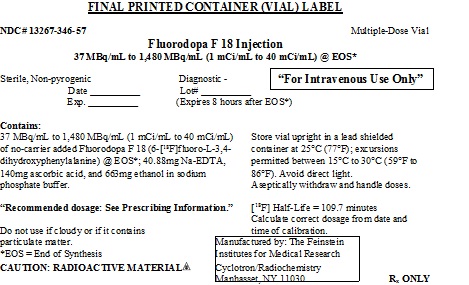
Fluorodopa F18 40 mCi/mL Injection, 30 mL
🆔 Identity & classification
Where does this data come from?
🏭 Manufacturer & labeler
Where does this data come from?
🩺 Clinical
Patient education
Supplement & herbal interactions
Where does this data come from?
Ask a licensed pharmacist directly — free, answered by our team.
🧪 Inactive Ingredients / Excipients
Inactive ingredients, also called excipients, are components of the drug product other than the active ingredient. They may include fillers, dyes, coatings, preservatives, flavors, or other formulation ingredients.
💡 Tap an ingredient (hover on desktop) to see what it is and why it’s used.
-
23.68 mg / 1 mL
UNII 3K9958V90M
A liquid solvent derived from fermentation or chemical synthesis. In medicines, alcohol dissolves active ingredients, helps preserve the product, and improves how the body absorbs certain drugs.
-
5 mg / 1 mL
UNII PQ6CK8PD0R
Ascorbic acid, also known as vitamin C, is a white crystalline powder. It serves as an antioxidant to prevent degradation of other ingredients and may also function as a preservative in the formulation.
-
1.46 mg / 1 mL
UNII 7FLD91C86K
Edetate disodium is a chemical compound that binds and removes certain metal ions. In medicines, it acts as a preservative and stabilizer by preventing metals like calcium from interfering with the product's shelf life and consistency.
3 inactive ingredients listed in the exact product block matched to this NDC.
Where does this data come from?
ingredient classCode="IACT" elements from the exact product block matched by this NDC. Label-section narrative from DailyMed / the openFDA label index is shown separately when available.Inactive ingredient FAQ
Are inactive ingredients the same for every manufacturer?
Why might an inactive ingredient be missing?
Can inactive ingredients matter?
💲 Pricing
A drug doesn't have one price. Each row is a different public payment system, and none is what you'd pay at the counter — that depends on your insurance. The ⓘ on each row explains what it measures.
| Price system | Per each | Per package |
|---|---|---|
| Retail pharmacies payNADAC · weekly | Not in the retail survey — common for institutional, discontinued, or low-volume packs. | |
| Medicaid paysCMS SDUD · 12 mo | No recent Medicaid claims on file for this NDC — rare and low-volume NDCs are suppressed in the public data. | |
| Medicare drug plans payPart D · quarterly | No Part D plan price is available for this NDC in our data. | |
Where does this data come from?
🔁 Therapeutic equivalents
| Product | Labeler | Pack | NADAC/unit | TE | Status | Price vs. this |
|---|---|---|---|---|---|---|
| Fluorodopa F18 40 mCi/mLthis 13267-0346-57 | THE | 30 ml | — | — | FDA listed | — |
Where does this data come from?
⏳ Availability & generic status
We did not find an FDA-approved generic match for this exact strength, form and route.
Where does this data come from?
📦 Packaging — all sizes for this product
| Package NDC | Description | Marketing start | Status |
|---|---|---|---|
| 13267-0346-57 You're viewing this | 30 mL in 1 VIAL, GLASS (13267-346-57) | 2019-10-10 | Active |
🧭 About this NDC listing & data coverage
What data is (and isn’t) available for this NDC — tap to expand
| NDC identity (package / product / labeler codes) | ✓ Available |
| Labeler | ✓ Available |
| Product & package description | ✓ Available |
| Marketing category & status | ✓ Available |
| Active ingredient / dosage form / route | ✓ Available |
| FDA label (SPL via DailyMed) | ✓ Available |
| Package photos | ✓ Available |
| Inactive ingredients (structured) | ✓ Available |
| NADAC pharmacy acquisition price (CMS) | — Not published for this NDC CMS publishes NADAC only for NDCs reported in its retail-pharmacy survey. |
| Orange Book / therapeutic-equivalence data | — Not published for this NDC Applies only to products approved under an NDA/ANDA; many listings are out of scope. |
| HCPCS J-code billing crosswalk | — Not published for this NDC Most self-administered / retail products have no J-code — that is normal. |
| Medicaid utilization (CMS SDUD) | — Not published for this NDC CMS reports utilization only for NDCs with Medicaid claims above its privacy threshold. |
Questions about this listing
Why is there no price listed?
Is the NDC printed on the package the same as the 11-digit billing NDC?
What do the three segments of this NDC mean?
Is this package still being marketed?
Who lists this product with the FDA?
Do I need a prescription for this product?
Where does this data come from?
📄 Full prescribing information FDA SPL
🎯 Indications and Usage ▾
1 INDICATIONS AND USAGE Fluorodopa F 18 Injection is indicated for use in positron emission tomography (PET) to visualize dopaminergic nerve terminals in the striatum for the evaluation of adult patients with suspected Parkinsonian syndromes (PS). Fluorodopa F 18 PET is an adjunct to other diagnostic evaluations. Fluorodopa F 18 Injection is a radioactive diagnostic agent indicated for use in positron emission tomography (PET) to visualize dopaminergic nerve terminals in the striatum for the evaluation of adult patients with suspected Parkinsonian syndromes (PS).
Fluorodopa F 18 PET is an adjunct to other diagnostic evaluations.
⏱️ Dosage and Administration ▾
2 DOSAGE AND ADMINISTRATION • The recommended adult dose is 185 megabecquerels (MBq) [5 millicuries (mCi)] by intravenous injection infused over 1 minute. ( 2.2 ) • Use aseptic techniques and radiation shielding to maintain sterility during all operations involved in the manipulation and administration of Fluorodopa F 18 Injection. ( 2.1 , 2.2 ) • Instruct patients to void immediately before imaging and start imaging at approximately 80 minutes post administration (with a 9 second CT scan for attenuation correction) followed by 3D PET scan from 80 to 100 minutes post administration.
( 2.5 ) • See full prescribing information for additional preparation, administration, imaging and radiation dosimetry information. ( 2 )
2.1Radiation Safety - Drug Handling • Handle Fluorodopa F 18 Injection with appropriate safety measures to minimize radiation exposure [see Warnings and Precautions ( 5.1 )] . Use waterproof gloves, effective shielding and appropriate safety measures to avoid unnecessary radiation exposure to the patient, occupational workers, clinical personnel, and other persons.
2.2Recommended Dosage and Administration Recommended Dose • The recommended dose for adults is 185 megabecquerels (MBq) [5 millicuries (mCi)] administered as an intravenous injection infused over 1 minute. • Minimize the dose of Fluorodopa F 18 Injection consistent with the objectives of the procedure and the nature of the imaging cameras employed. Administration • Use aseptic techniques and radiation shielding during all operations involved in the manipulation and administration of Fluorodopa F 18 Injection. • Calculate the necessary volume to administer based on calibration time and dose. • Inspect Fluorodopa F 18 Injection visually and do not use the drug if the solution contains particulate matter or is discolored. • Measure the patient dose immediately prior to administration in a dose calibrator. • Dispose of unused drug in compliance with applicable regulations.
2.3Patient Preparation Hydration • Patients must have nothing to eat or drink, except water for 4 hours before administration • To minimize the radiation absorbed dose to the bladder, instruct patient to: o hydrate 4 hours prior to the administration of Fluorodopa F 18 Injection and continue hydration after the study. o void 70 minutes after administration of Fluorodopa F 18 Injection and as frequently thereafter as possible for the next 12 hours. Pre-medication and Medication Withdrawal • Carbidopa blocks systemic/peripheral decarboxylation of Fluorodopa F 18 Injection to increase uptake in the brain.
Administer 150 mg of Carbidopa orally at least 60 minutes (and no longer than 120 minutes) prior to the administration of Fluorodopa F 18 Injection. • Instruct the patient to discontinue medications for the treatment of Parkinson’s disease 12 hours prior to administration of Fluorodopa F 18 Injection [see Drug Interactions ( 7 )] .
2.4Radiation Dosimetry The estimated human absorbed radiation dose for 10 human subjects (8 men and 2 women; mean age 50 ±8.8 yr) from intravenous administration of Fluorodopa F 18 Injection is shown in Table 1. In subjects who voided at 40 min post-injection, the radiation absorbed dose to the bladder wall was 50% lower than the radiation absorbed dose in subjects who voided at 2 hours post-injection. The identified critical organ is the urinary bladder.
Table 1. Estimated Absorbed Radiation Dose (mGy/MBq) for Adult Patients after Intravenous Administration of Fluorodopa F 18 Injection a Organ Absorbed Dose per unit activity (mGy/MBq) Urinary bladder wall
0.30 Heart wall
0.01 Pancreas
0.01 Spleen
0.01 Lungs
0.01 Kidneys
0.03 Ovaries
0.02 Uterus
0.03 Lower Large Intestine wall
0.02 Liver
0.01 Gallbladder wall
0.01 Small Intestine
0.01 Upper Large Intestine wall
0.01 Stomach wall
0.01 Adrenals
0.01 Testes
0.01 Red marrow
0.01 Thymus
0.01 Thyroid
0.01 Muscle
0.01 Bone surfaces
0.01 Breast
0.01 Skin
0.01 Brain
0.01 Remaining organs
0.01 Effective dose (mSv/MBq)…
💊 Dosage Forms and Strengths ▾
3 DOSAGE FORMS AND STRENGTHS Injection: clear, colorless solution containing 37 MBq/mL to 1,480 MBq/mL (1 mCi/mL to 40 mCi/mL) of Fluorodopa F 18 Injection, at calibration time in a multiple-dose glass vial. Injection: clear, colorless solution in a multiple-dose glass vial containing 37 MBq/mL to 1,480 MBq/mL (1 mCi/mL to 40 mCi/mL) of Fluorodopa F 18 Injection. ( 3 )
⛔ Contraindications ▾
4 CONTRAINDICATIONS None None
⚠️ Warnings and Cautions ▾
5 WARNINGS AND PRECAUTIONS Radiation risks: Use smallest dose necessary for imaging and ensure safe handling to protect the patient and healthcare worker from radiation exposure. ( 5.1 )
5.1Radiation Risks Fluorodopa F 18 Injection use contributes to a patient’s overall long-term radiation exposure, which is associated with an increased risk of cancer. Use the smallest dose necessary for imaging and ensure safe handling to protect the patient and health care worker [see Dosage and Administration ( 2.1 , 2.2 )] .
5.1Radiation Risks Fluorodopa F 18 Injection use contributes to a patient’s overall long-term radiation exposure, which is associated with an increased risk of cancer. Use the smallest dose necessary for imaging and ensure safe handling to protect the patient and health care worker [see Dosage and Administration ( 2.1 , 2.2 )] .
🤒 Adverse Reactions ▾
6 ADVERSE REACTIONS Injection site pain occurred with administration based on a review of the published literature. ( 6.2 ) To report SUSPECTED ADVERSE REACTIONS, contact The Feinstein Institutes for Medical Research at 516-562-1052 or FDA at 1-800-FDA-1088 or www.fda.gov/medwatch .
6.1Clinical Trials Experience Because clinical trials are conducted under widely varying conditions, adverse reaction rates observed in the clinical trials of a drug cannot be directly compared to rates in the clinical trials of another drug and may not reflect the rates observed in practice. No adverse reactions have been reported for Fluorodopa F 18 Injection based on an open-label clinical trial in 68 patients [see Clinical Studies ( 14 ) ] and additional clinical experience in 53 patients.
6.2Postmarketing Experience The following adverse reactions have been identified during post approval of use of Fluorodopa F 18 Injection outside of the United States. Because these reactions are reported voluntarily from a population of uncertain size, it is not always possible to reliably estimate their frequency or establish a causal relationship to drug exposure. General Disorders and Administration Site Conditions: Pain
6.1Clinical Trials Experience Because clinical trials are conducted under widely varying conditions, adverse reaction rates observed in the clinical trials of a drug cannot be directly compared to rates in the clinical trials of another drug and may not reflect the rates observed in practice. No adverse reactions have been reported for Fluorodopa F 18 Injection based on an open-label clinical trial in 68 patients [see Clinical Studies ( 14 ) ] and additional clinical experience in 53 patients.
6.2Postmarketing Experience The following adverse reactions have been identified during post approval of use of Fluorodopa F 18 Injection outside of the United States. Because these reactions are reported voluntarily from a population of uncertain size, it is not always possible to reliably estimate their frequency or establish a causal relationship to drug exposure. General Disorders and Administration Site Conditions: Pain
🔄 Drug Interactions ▾
7 DRUG INTERACTIONS Aromatic L-amino acid decarboxylase (AADC) inhibitors Prior to Fluorodopa F 18 Injection administration, use of AADC inhibitors (e.g. carbidopa, benserazide etc.) may increase Fluorodopa F 18 bioavailability to the brain by inhibiting peripheral decarboxylase activity and restricting peripheral Fluorodopa F 18 metabolism [see Dosage and Administration ( 2.3 )] . Dopamine agonists, dopamine reuptake inhibitors, dopamine releasing agents (DRAs), peripheral catechol-O-methyltransferase (COMT) inhibitors, and monoamine oxidase (MAO) inhibitors Therapy for Parkinson’s syndromes includes dopamine agonists, dopamine reuptake inhibitors, dopamine releasing agents (DRAs) such as psychostimulants of the amphetamine class, peripheral catechol-O-methyltransferase (COMT) inhibitors, and monoamine oxidase (MAO) inhibitors.
Whether discontinuation of these drugs prior to Fluorodopa F 18 administration may minimize the interference with a Fluorodopa F 18 image is not fully known; however, if use of these drugs can be safely suspended, discontinue use 12 hours before administration of Fluorodopa F18 Injection [see Dosage and Administration ( 2.3 )] .
👥 Use in Specific Populations ▾
8 USE IN SPECIFIC POPULATIONS • Lactation: To decrease radiation exposure to a nursing infant, advise a lactating woman to pump and discard breastmilk for at least 24 hours (12 half-lives) after administration of Fluorodopa F 18 Injection. ( 8.2 )
8.1Pregnancy Risk Summary There are no available data on Fluorodopa F 18 Injection use in pregnant women. Additionally, animal reproductive and developmental toxicity studies have not been conducted with Fluorodopa F 18 Injection. However, all radiopharmaceuticals, including Fluorodopa F 18 Injection, have a potential to cause fetal harm depending on the stage of fetal development, and the magnitude of the radiation dose.
If considering Fluorodopa F 18 Injection administration to a pregnant woman, inform the patient about the potential for adverse pregnancy outcomes based on the radiation dose from the drug and the gestational timing of exposure. The estimated background risk of major birth defects and miscarriage for the indicated population is unknown. All pregnancies have a background risk of birth defect, loss, or other adverse outcomes.
In the U.S. general population, the estimated background risks of major birth defects and miscarriage in clinically recognized pregnancies are 2 to 4% and 15 to 20%, respectively, regardless of drug exposure.
8.2Lactation Risk Summary No data are available regarding the presence of Fluorodopa F 18 Injection in human milk, the effects of the drug on the breastfed child, or the effects of the drug on milk production. Exposure of Fluorodopa F 18 Injection to a breast fed infant can be minimized by temporary discontinuation of breastfeeding [see Clinical Considerations] . The developmental and health benefits of breastfeeding should be considered along with the mother’s clinical need for Fluorodopa F 18 Injection and any potential adverse effects on the breastfed child from Fluorodopa F 18 Injection or from the underlying maternal condition.
The body of scientific information related to radioactivity decay, drug tissue distribution and drug elimination shows that less than 0.01% of the radioactivity administered remains in the body after 24 hours. Clinical Considerations To decrease radiation exposure to a nursing infant, advise a lactating woman to pump and discard breastmilk for at least 24 hours (12 half-lives) after administration of Fluorodopa F 18 Injection.
8.4Pediatric Use The safety and effectiveness of Fluorodopa F 18 Injection for visualization of dopaminergic neurons in the striatum has not been established in pediatric patients.
8.1Pregnancy Risk Summary There are no available data on Fluorodopa F 18 Injection use in pregnant women. Additionally, animal reproductive and developmental toxicity studies have not been conducted with Fluorodopa F 18 Injection. However, all radiopharmaceuticals, including Fluorodopa F 18 Injection, have a potential to cause fetal harm depending on the stage of fetal development, and the magnitude of the radiation dose.
If considering Fluorodopa F 18 Injection administration to a pregnant woman, inform the patient about the potential for adverse pregnancy outcomes based on the radiation dose from the drug and the gestational timing of exposure. The estimated background risk of major birth defects and miscarriage for the indicated population is unknown. All pregnancies have a background risk of birth defect, loss, or other adverse outcomes.
In the U.S. general population, the estimated background risks of major birth defects and miscarriage in clinically recognized pregnancies are 2 to 4% and 15 to 20%, respectively, regardless of drug exposure.
8.2Lactation Risk Summary No data are available regarding the presence of Fluorodopa F 18 Injection in human milk, the effects of the drug on the breastfed child, or the effects of the drug on milk production. Exposure of Fluorodopa F 18 Injection to a breast fed infant can be minimized by temporary discontinuation of breastfeeding [see Clinical Considerations] .…
🧬 Clinical Pharmacology ▾
12 CLINICAL PHARMACOLOGY
12.1Mechanism of Action In dopaminergic nerve terminals in the brain, Fluorodopa (FDOPA) F 18 is decarboxylated by amino acid decarboxylase to Fluorodopamine (FDA) F 18 and stored in presynaptic vesicles in the brain. The accumulation of F 18 FDA in the striatum is visually detected in the PET scan.
12.2Pharmacodynamics Optimal PET imaging is achieved between 75 to 90 minutes after administration of Fluorodopa F 18 Injection based on its pharmacokinetics. The relationship between Fluorodopa F 18 dose and plasma concentration is not fully characterized.
12.3Pharmacokinetics Distribution Following the intravenous administration, Fluorodopa F 18 is cleared from the blood with a biologic half-life of about 1 to 3 hours. The time course of “background” brain radioactivity after Fluorodopa F 18 was evaluated. F 18 activity in the cerebellum was greater than the parietal or occipital cortex during the first 30 minutes after Fluorodopa F 18 suggesting regional differences in amino acid transport.
Elimination Fluorodopa F 18 is cleared from the blood and tissue within 24 hours. Metabolism: Fluorodopa F 18 is decarboxylated by aromatic amino acid decarboxylase in the striatum to Fluorodopamine F 18. Fluorodopamine F 18 is also metabolized via monoamine oxidase to yield [ 18 F] 6-fluoro-3,4-dihydroxyphenylacetic acid ( 18 FDOPAC) and subsequently by COMT to yield [ 18 F]6-fluorohomovanillic acid ( 18 FHVA).
Elimination: 80% of the radioactivity is eliminated through the urine. Urine radioactivity peaks at about 30 minutes post-injection. The radiation absorbed dose to the bladder wall is reduced by emptying the bladder just before scanning.
12.1Mechanism of Action In dopaminergic nerve terminals in the brain, Fluorodopa (FDOPA) F 18 is decarboxylated by amino acid decarboxylase to Fluorodopamine (FDA) F 18 and stored in presynaptic vesicles in the brain. The accumulation of F 18 FDA in the striatum is visually detected in the PET scan.
12.2Pharmacodynamics Optimal PET imaging is achieved between 75 to 90 minutes after administration of Fluorodopa F 18 Injection based on its pharmacokinetics. The relationship between Fluorodopa F 18 dose and plasma concentration is not fully characterized.
12.3Pharmacokinetics Distribution Following the intravenous administration, Fluorodopa F 18 is cleared from the blood with a biologic half-life of about 1 to 3 hours. The time course of “background” brain radioactivity after Fluorodopa F 18 was evaluated. F 18 activity in the cerebellum was greater than the parietal or occipital cortex during the first 30 minutes after Fluorodopa F 18 suggesting regional differences in amino acid transport.
Elimination Fluorodopa F 18 is cleared from the blood and tissue within 24 hours. Metabolism: Fluorodopa F 18 is decarboxylated by aromatic amino acid decarboxylase in the striatum to Fluorodopamine F 18. Fluorodopamine F 18 is also metabolized via monoamine oxidase to yield [ 18 F] 6-fluoro-3,4-dihydroxyphenylacetic acid ( 18 FDOPAC) and subsequently by COMT to yield [ 18 F]6-fluorohomovanillic acid ( 18 FHVA).
Elimination: 80% of the radioactivity is eliminated through the urine. Urine radioactivity peaks at about 30 minutes post-injection. The radiation absorbed dose to the bladder wall is reduced by emptying the bladder just before scanning.
📦 How Supplied / Storage and Handling ▾
16 HOW SUPPLIED/STORAGE AND DRUG HANDLING Fluorodopa F 18 Injection (NDC 13267-346-57) is supplied as a clear, colorless injection in a septum capped glass vial containing between 37 MBq/mL to 1,480 MBq/mL (1 mCi/mL to 40 mCi/mL), of Fluorodopa F 18 at calibration time, in 28 mL ±1 mL. Storage Store the Fluorodopa F 18 Injection vial upright in a lead shielded container at 25°C (77°F); excursions permitted between 15ºC to 30°C (59ºF to 86°F). Avoid direct light.
The expiration date and time are provided on the container label. Use Fluorodopa F 18 Injection within 8 hours from the time of the end of synthesis (EOS). Handling This radiopharmaceutical is for distribution and use by persons licensed authorized by the U.S.
Nuclear Regulatory Commission or the relevant regulatory authority of an Agreement State. Store and dispose of Fluorodopa F 18 in compliance with the appropriate regulations of the government agency authorized to license the use of this radionuclide.
📋 Description ▾
11 DESCRIPTION
11.1Chemical Characteristics Fluorodopa F 18 Injection is a radioactive diagnostic agent used in PET imaging. The active ingredient 6-[ 18 F] Fluoro-L-3, 4-dihydroxyphenylalanine has the molecular formula of C 9 H 10 FNO 4 with a molecular weight of 214.18, and has the following chemical structure: Fluorodopa F 18 Injection is a sterile, pyrogen-free, clear, colorless solution. Each mL contains between 37 MBq/mL to 1,480 MBq/mL (1 mCi/mL to 40 mCi/mL) of no-carrier added Fluorodopa F 18 (6-[ 18 F] Fluoro-L-3, 4-dihydroxyphenylalanine) at the end of synthesis (EOS).
There is 40.88 mg Na-EDTA, 140 mg ascorbic acid, and 663 mg ethanol in 28 mL ±1 mL sodium phosphate buffer. The pH of the solution is between 3 and 5. FDOPA Structure
11.2Physical Characteristics Fluorine F 18 is a cyclotron produced radionuclide that decays by positron emission to Oxygen O 18 (stable) and has a physical half-life of 109.7 minutes. The principal photons useful for imaging are the dual 511 keV gamma photons, which are produced and emitted simultaneously in opposite direction following positron-electron annihilation (Table 2). Table 2.
Principal Radiation Emission Data for Fluoride F 18 Radiation/Emission % Per Disintegration Mean Energy Positron(+) 96.73 249.8 keV Gamma(±) * 193.46 511.0 keV * Produced by positron annihilation
11.3External Radiation The point source air-kerma coefficient for F 18 is 3.75 × 10 -17 Gy m 2 / (Bq s). The half-value layer (HVL) for the 511 keV photons is 5 mm lead (Pb). The range of attenuation coefficients for this radionuclide as a function of lead shield thickness is shown in Table 3.
For example, the interposition of a 9 mm thickness of Pb, with a coefficient of attenuation of 0.25, will decrease the external radiation by 75%. Table 3. Radiation Attenuation of 511 keV Photons by lead (Pb) shielding Shield thickness (Pb) mm Coefficient of Attenuation 0 0.00 5 0.50 9 0.25 15 0.10 29 0.01 39 0.001 52 0.0001 For use in correcting for physical decay of this radionuclide, the fractions remaining at selected intervals after calibration are shown in Table 4.
Table 4. Physical Decay Chart for Fluorine F 18 Time Since Calibration Fraction Remaining 0 * 1.000 15 min 0.909 30 min 0.826 60 min 0.683 110 min 0.500 220 min 0.250 440 min 0.060 12 hours 0.011 24 hours 0.0001 * Calibration time
11.1Chemical Characteristics Fluorodopa F 18 Injection is a radioactive diagnostic agent used in PET imaging. The active ingredient 6-[ 18 F] Fluoro-L-3, 4-dihydroxyphenylalanine has the molecular formula of C 9 H 10 FNO 4 with a molecular weight of 214.18, and has the following chemical structure: Fluorodopa F 18 Injection is a sterile, pyrogen-free, clear, colorless solution. Each mL contains between 37 MBq/mL to 1,480 MBq/mL (1 mCi/mL to 40 mCi/mL) of no-carrier added Fluorodopa F 18 (6-[ 18 F] Fluoro-L-3, 4-dihydroxyphenylalanine) at the end of synthesis (EOS).
There is 40.88 mg Na-EDTA, 140 mg ascorbic acid, and 663 mg ethanol in 28 mL ±1 mL sodium phosphate buffer. The pH of the solution is between 3 and 5. FDOPA Structure
11.2Physical Characteristics Fluorine F 18 is a cyclotron produced radionuclide that decays by positron emission to Oxygen O 18 (stable) and has a physical half-life of 109.7 minutes. The principal photons useful for imaging are the dual 511 keV gamma photons, which are produced and emitted simultaneously in opposite direction following positron-electron annihilation (Table 2). Table 2.
Principal Radiation Emission Data for Fluoride F 18 Radiation/Emission % Per Disintegration Mean Energy Positron(+) 96.73 249.8 keV Gamma(±) * 193.46 511.0 keV * Produced by positron annihilation
11.3External Radiation The point source air-kerma coefficient for F 18 is 3.75 × 10 -17 Gy m 2 / (Bq s). The half-value layer (HVL) for the 511 keV photons is 5 mm lead (Pb). The range of attenuation coefficients for this radionuclide as a function of lead shield thickness is shown in Table 3. For example, the interpositio…
💬 Information for Patients ▾
17 PATIENT COUNSELING INFORMATION Patient Preparation Instruct patients to: • Drink water in the 4 hours before their PET study and continue hydration with water or other fluids (as tolerated) after the study. • Void 70 minutes after the administration of Fluorodopa F 18, before the start of the imaging study, and as frequently as possible after the study is complete for a total of 12 hours [see Dosage and Administration ( 2.3 )] . Lactation To decrease radiation exposure to a nursing infant, advise a lactating woman to pump and discard breastmilk for at least 24 hours (12 half-lives) after administration of Fluorodopa F 18 Injection.
( 8.2 )