
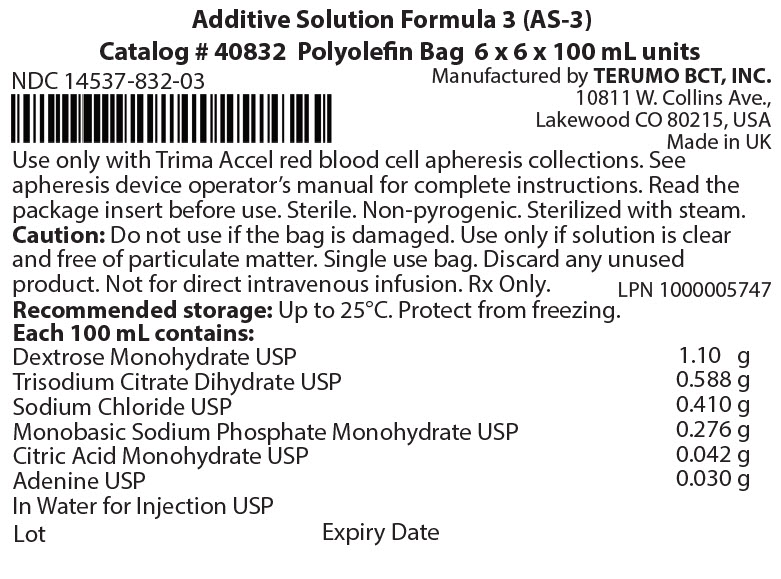
Additive Formula 3 Dextrose Monohydrate, TRISODIUM CITRATE DIHYDRATE, Sodium Chloride, SODIUM PHOSPHATE, MONOBASIC, MONOHYDRATE, Citric Acid Monohydrate, and Adenine 1.1 g/100mL; .59 g/100mL; .41 g/100mL; .28 g/100mL; .042 g/100mL; .03 g/100mL Solution
🆔 Identity & classification
Where does this data come from?
🏭 Manufacturer & labeler
Where does this data come from?
🩺 Clinical
Patient education
Supplement & herbal interactions
Where does this data come from?
Ask a licensed pharmacist directly — free, answered by our team.
🧪 Inactive Ingredients / Excipients
Inactive ingredients, also called excipients, are components of the drug product other than the active ingredient. They may include fillers, dyes, coatings, preservatives, flavors, or other formulation ingredients.
💡 Tap an ingredient (hover on desktop) to see what it is and why it’s used.
-
UNII 059QF0KO0R
Water is a liquid solvent that dissolves and mixes ingredients together in liquid medicines, syrups, and injections. It helps distribute the active drug evenly throughout the product.
1 inactive ingredient listed in the exact product block matched to this NDC.
Where does this data come from?
ingredient classCode="IACT" elements from the exact product block matched by this NDC. Label-section narrative from DailyMed / the openFDA label index is shown separately when available.Inactive ingredient FAQ
Are inactive ingredients the same for every manufacturer?
Why might an inactive ingredient be missing?
Can inactive ingredients matter?
💲 Pricing
A drug doesn't have one price. Each row is a different public payment system, and none is what you'd pay at the counter — that depends on your insurance. The ⓘ on each row explains what it measures.
| Price system | Per mL | Per package |
|---|---|---|
| Retail pharmacies payNADAC · weekly | Not in the retail survey — common for institutional, discontinued, or low-volume packs. | |
| Medicaid paysCMS SDUD · 12 mo | No recent Medicaid claims on file for this NDC — rare and low-volume NDCs are suppressed in the public data. | |
| Medicare drug plans payPart D · quarterly | No Part D plan price is available for this NDC in our data. | |
Where does this data come from?
🔁 Therapeutic equivalents
| Product | Labeler | Pack | NADAC/unit | TE | Status | Price vs. this |
|---|---|---|---|---|---|---|
| Additive Formula 3 1.1 g/100mL; .59 g/100mL; .41 g/100mL; .28 g/100mL; .042 g/100mL; .03 g/100mLthis 14537-0832-03 | Terumo | 6 pouches | — | — | FDA listed | — |
| Additive Formula 3 1.1 g/100mL; .59 g/100mL; .41 g/100mL; .28 g/100mL; .042 g/100mL; .03 g/100mL 14537-0833-03 | Terumo | 200 ml | — | — | FDA listed | — |
Where does this data come from?
⏳ Availability & generic status
We did not find an FDA-approved generic match for this exact strength, form and route.
Where does this data come from?
📦 Packaging — all sizes for this product
| Package NDC | Description | Marketing start | Status |
|---|---|---|---|
| 14537-0832-03 You're viewing this | 6 POUCH in 1 CASE (14537-832-03) / 6 BAG in 1 POUCH (14537-832-01) / 100 mL in 1 BAG (14537-832-00) | 2002-05-29 | Active |
🧭 About this NDC listing & data coverage
What data is (and isn’t) available for this NDC — tap to expand
| NDC identity (package / product / labeler codes) | ✓ Available |
| Labeler | ✓ Available |
| Product & package description | ✓ Available |
| Marketing category & status | ✓ Available |
| Active ingredient / dosage form / route | ✓ Available |
| FDA label (SPL via DailyMed) | ✓ Available |
| Package photos | ✓ Available |
| Inactive ingredients (structured) | ✓ Available |
| NADAC pharmacy acquisition price (CMS) | — Not published for this NDC CMS publishes NADAC only for NDCs reported in its retail-pharmacy survey. |
| Orange Book / therapeutic-equivalence data | — Not published for this NDC Applies only to products approved under an NDA/ANDA; many listings are out of scope. |
| HCPCS J-code billing crosswalk | — Not published for this NDC Most self-administered / retail products have no J-code — that is normal. |
| Medicaid utilization (CMS SDUD) | — Not published for this NDC CMS reports utilization only for NDCs with Medicaid claims above its privacy threshold. |
Questions about this listing
Why is there no price listed?
Is the NDC printed on the package the same as the 11-digit billing NDC?
What do the three segments of this NDC mean?
Is this package still being marketed?
Who lists this product with the FDA?
Do I need a prescription for this product?
Where does this data come from?
📄 Full prescribing information FDA SPL
🎯 Indications and Usage ▾
1 INDICATIONS AND USAGE Use only with Trima Accel red blood cell (RBC) apheresis collections. [See Dosage and Administration (2) .] Use only with Trima Accel red blood cell (RBC) apheresis collections. ( 1 )
⏱️ Dosage and Administration ▾
2 DOSAGE AND ADMINISTRATION AS-3 is added to tubing sets after apheresis collections, after the donor has been disconnected. ( 2 ) AS-3 may only be used with the Trima Accel apheresis device. For instructions on the use of the solution see the device operator's manual. ( 2.1 ) Follow the directions for connecting the AS-3 bag to the tubing set of a blood collection system. ( 2.2 )
2.1General Dosing Information ADDITIVE SOLUTION FORMULA 3 (AS-3) is connected to the tubing set used for an apheresis RBC collection procedure after the collection has been completed. For automated RBC procedures, the recommended dose is determined by the apheresis device and metered into the tubing set by the apheresis device. To add the product manually, refer to the apheresis system operator's manual to determine the recommended dose.
For instructions on the use of the solution with the apheresis device and tubing set, see the device operator's manual.
2.2Administration Directions for connecting the ADDITIVE SOLUTION FORMULA 3 (AS-3) bag to the apheresis device. Automated RBC additive solution procedures: Connect ADDITIVE SOLUTION FORMULA 3 (AS-3) after the collection is over and the donor is disconnected. For automated addition of the product, the system will prompt you to connect the bag.
Remove the overwrap by pulling down at notch, and remove the AS-3 bag. Before use, perform the following checks: Ensure that the solution is the ADDITIVE SOLUTION FORMULA 3 (AS-3) and is within the expiration date. Inspect the bag in good light.
Do not use if the container is damaged, leaking or if there is any visible sign of deterioration. Check for leaks by gently squeezing the bag. If leaks are found, discard the bag.
Inspect the solution in good light. Use only if solution is clear and free of particulate matter. Bags showing cloudiness, haze, or particulate matter should not be used.
Protect from sharp objects. Remove the protective cap from the port on the bag. Connect the bag to the complementary luer of the apheresis device tubing set using aseptic technique and hang the solution.
Break the frangible connector. When you break frangible connectors, bend them in both directions to ensure that you break them completely. Failure to do so may result in restricted flow.
Proceed according to the apheresis device operator's manual. Manual RBC additive solution procedures: Connect ADDITIVE SOLUTION FORMULA 3 (AS-3) after the collection is over and the donor is disconnected. Seal the RBC product lines as close to the cassette as possible.
Remove the overwrap by pulling down at notch, and remove the ADDITIVE SOLUTION FORMULA 3 bag. Before use, perform the following checks: Ensure that the solution is the ADDITIVE SOLUTION FORMULA 3 (AS-3) and is within the expiration date. Inspect the bag in good light.
Do not use if the container is damaged, leaking or if there is any visible sign of deterioration. Check for leaks by gently squeezing the bag. If leaks are found, discard the bag.
Inspect the solution in good light. Use only if solution is clear and free of particulate matter. Bags showing cloudiness, haze, or particulate matter should not be used.
Protect from sharp objects. Remove the protective cap from the port on the bag. Insert the spike of the apheresis device tubing set into the spike port of the solution bag using aseptic technique and then hang the solution.
Proceed according to the apheresis device operator's manual.
💊 Dosage Forms and Strengths ▾
3 DOSAGE FORMS AND STRENGTHS 100 mL, 200 mL and 350 mL ADDITIVE SOLUTION FORMULA 3 (AS-3) products are sterile solutions in a Polyolefin bag. Each 100 mL contains: Dextrose Monohydrate USP 1.10 g; Trisodium Citrate Dihydrate USP 0.59 g; Sodium Chloride USP 0.41 g; Monobasic Sodium Phosphate Monohydrate USP 0.28 g; Citric Acid Monohydrate USP 0.042 g; Adenine USP 0.03 g; and Water for Injection USP. 100 mL, 200 mL, or 350 mL sterile fluid in a Polyolefin bag.
( 3 )
⛔ Contraindications ▾
4 CONTRAINDICATIONS DO NOT INFUSE ADDITIVE SOLUTION FORMULA 3 (AS-3) DIRECTLY TO THE DONOR. DO NOT INFUSE AS-3 DIRECTLY TO THE DONOR. ( 4 )
⚠️ Warnings and Cautions ▾
5 WARNINGS AND PRECAUTIONS Verify that the AS-3 bag has been securely attached to the system tubing set. Use aseptic technique throughout all procedures to ensure product quality. Do not reuse.
Discard unused or partially used solution bags. Verify that the AS-3 bag has been securely attached to the system tubing set. Use aseptic technique throughout all procedures to ensure product quality.
( 5 ) Do not reuse. Discard unused or partially used solution bags.
🤒 Adverse Reactions ▾
6 ADVERSE REACTIONS Citrate reactions or toxicity may occur with the infusion of blood products to patients. The recipient of the blood containing citrate should be monitored for the signs and symptoms of citrate toxicity. The signs and symptoms of citrate toxicity begin with paresthesia, a "tingling" sensation around the mouth or in the extremities, followed by severe reactions that are characterized by hypotension and possible cardiac arrhythmia.
Citrate toxicity may occur more frequently in patients who are hypothermic, have impaired liver or renal function, or have low calcium levels because of an underlying disease. Citrate reactions or toxicity may occur with the infusion of blood containing citrate. The recipient of the blood containing citrate should be monitored for the signs and symptoms of citrate toxicity.
( 6 ) To report SUSPECTED ADVERSE REACTIONS, contact Terumo BCT, Inc. at 1-877-339-4228 or FDA at 1-800-FDA-1088 or www.fda.gov/medwatch .
👥 Use in Specific Populations ▾
8 USE IN SPECIFIC POPULATIONS ADDITIVE SOLUTION FORMULA 3 (AS-3) has not been studied in controlled clinical trials with specific populations.
🧬 Clinical Pharmacology ▾
12 CLINICAL PHARMACOLOGY
12.1Mechanism of Action ADDITIVE SOLUTION FORMULA 3 acts to preserve and extend the shelf life of packed RBC products for later transfusion to patients. The following ingredients are key components of the solution: Adenine to support adenosine triphosphate (ATP) levels Citrate for membrane protection, anticoagulation and pH regulation Sodium (Sodium Chloride and Sodium Citrate) and dextrose for isotonicity Dextrose for RBC nutrition This solution has no pharmacological effect.
🧬 Mechanism of Action ▾
12.1Mechanism of Action ADDITIVE SOLUTION FORMULA 3 acts to preserve and extend the shelf life of packed RBC products for later transfusion to patients. The following ingredients are key components of the solution: Adenine to support adenosine triphosphate (ATP) levels Citrate for membrane protection, anticoagulation and pH regulation Sodium (Sodium Chloride and Sodium Citrate) and dextrose for isotonicity Dextrose for RBC nutrition This solution has no pharmacological effect.
📦 How Supplied / Storage and Handling ▾
16 HOW SUPPLIED/STORAGE AND HANDLING ADDITIVE SOLUTION FORMULA 3 (AS-3) is a clear solution supplied in sterile and non-pyrogenic Polyolefin bags. SIZE CATALOG NUMBER NDC NUMBER QUANTITY PER CASE 100 mL 40832 14537-832-03 36 200 mL 40833 14537-833-03 30 350 mL 40834 14537-834-03 24 STORAGE Up to 25 °C. Protect from freezing.
📦 Storage and Handling ▾
STORAGE Up to 25 °C. Protect from freezing.
📋 Description ▾
11 DESCRIPTION ADDITIVE SOLUTION FORMULA 3 (AS-3) is designed to be added to packed RBC collected in apheresis procedures, and acts to preserve and extend the shelf life of packed RBC products for later transfusion to patients. The solution is intended to be metered by an apheresis device during apheresis procedures or added manually after a collection. Additive Solution Formula 3 (AS-3) is a clear solution that is steam-sterilized and non-pyrogenic.
It does not contain bacteriostatic or antimicrobial agents. The formulas of the active ingredients are provided in Table 1. Table 1: Active Ingredients Ingredients Molecular Formula Molecular Weight Dextrose Monohydrate USP C 6 H 12 O 6 ∙ H 2 O 198.17 Trisodium Citrate Dihydrate USP C 6 H 9 Na 3 O 9 294.10 Sodium Chloride USP NaCl
58.44Monobasic Sodium Phosphate Monohydrate USP NaH 2 PO 4 ∙ H 2 O 137.99 Citric Acid Monohydrate USP C 6 H 8 0 7 ∙ H 2 O 210.14 Adenine USP C 5 H 5 N 5 135.13 Water for Injection USP H 2 O
18.00Each 100 mL of ADDITIVE SOLUTION FORMULA 3 (AS-3) contains: Dextrose Monohydrate USP 1.10 g; Trisodium Citrate Dihydrate USP 0.59 g; Sodium Chloride USP 0.41 g; Monobasic Sodium Phosphate Monohydrate USP 0.28 g; Citric Acid Monohydrate USP 0.042 g; Adenine USP 0.03 g; and Water for Injection USP. ADDITIVE SOLUTION FORMULA 3 is available in three volumes: 100 mL, 200 mL and 350 mL. The 100 mL bags are individually wrapped with a clear plastic film.
Six individually wrapped bags are then vacuum-sealed in a foil pouch, which serves as a vapor barrier to prevent water loss during storage. After you remove the individual solution bags from the foil pouch, you can either leave them in the clear plastic film or remove and discard it. Once the foil pouch has been opened, use all six of the solution bags within 2 weeks.
The 200 mL and 350 mL bags are individually wrapped with a clear plastic film. These larger volumes do not require the additional vapor barrier. Once the clear plastic film has been removed, use the solution within 2 weeks.
The Polyolefin bag is not made with natural rubber latex. The bag is made from a multilayered film. It contains materials that have been tested to demonstrate the suitability of the container for storing pharmaceutical solutions.
The bag is nontoxic and biologically inert. The bag-solution unit is a closed system and is not dependent upon entry of external air during administration.