
Fluorescein 250 mg/mL Injection — NDC 14789-123-05 (Billing 14789-0123-05)
This is a package of Fluorescein 250 mg/mL Injection from Nexus Pharmaceuticals LLC, marketed since Oct 2023 and currently FDA-listed. It is this product's only package size.
NDC database record
One package, one record: these facts belong to NDC 14789-123-05 alone.
- Record
- FDA NDC Directory package listing · Human prescription drug
- Code segments
- 14789 labeler · 123 product · 05 package
- Package marketed since
- Oct 24, 2023
- Sample package
- No — commercial package
- Listing certified through
- Dec 31, 2026
- Barcode (UPC)
- 0314789122052
- FDA record last changed
- Jul 24, 2026
Identity & classification
Regulatory identifiers FDA, NLM and CMS codes for this package
Drug-database identifiers Medi-Span GPI and First Databank GCN / HICL / AHFS classification
- GSN (GCN sequence number): 006831
- GCN: 27761
- HICL (First Databank): 002908
- AHFS class code: 36:58.00.00
Where does this data come from?
- FDA openFDA NDC Directory · synced Oct 1, 2026
- FDA label on DailyMed · label index refreshed Oct 5, 2026
- RxNorm (NLM RxNav) · catalog refreshed Oct 1, 2026
- Medi-Span GPI (licensed)
- First Databank (licensed) · refreshed Oct 1, 2026
Clinical
Patient education
Supplement & herbal interactions
Where does this data come from?
- MedlinePlus (NLM) · refreshed Oct 1, 2026
- FDA label on DailyMed · label index refreshed Oct 5, 2026
Ask a licensed pharmacist directly — free, answered by our team.
Pricing
A drug doesn't have one price. Each row is a different public payment system, and none is what you'd pay at the counter — that depends on your insurance. The ⓘ on each row explains what it measures.
| Price system | Per each | Per package |
|---|---|---|
| Retail pharmacies payNADAC · weekly | Not in the retail survey — common for institutional, discontinued, or low-volume packs. | |
| Medicaid paysCMS SDUD · 12 mo | No recent Medicaid claims on file for this NDC — rare and low-volume NDCs are suppressed in the public data. | |
| Medicare drug plans payPart D · quarterly | No Part D plan price is available for this NDC in our data. | |
Where does this data come from?
- CMS NADAC weekly file
- CMS ASP pricing files · refreshed Sep 20, 2026
- CMS Medicaid State Drug Utilization Data · refreshed Oct 5, 2026
- CMS Part D plan pricing files · refreshed Sep 24, 2026
- VA National Acquisition Center price file
Packaging — all sizes for this product
| Package NDC | Description | Marketing start | Marketing end | Status |
|---|---|---|---|---|
| 14789-0123-05 You're viewing this Main listing | 10 VIAL in 1 CARTON / 2 mL in 1 VIAL | 2023-10-24 | — | Active |
Therapeutic equivalents
| Product | Labeler | Pack | NADAC/unit | TE | Status | Price vs. this |
|---|---|---|---|---|---|---|
| Fluorescein 250 mg/mLthis 14789-0123-05 | Nexus | 10 vials | — | AP | FDA listed | — |
Where does this data come from?
- FDA openFDA NDC Directory · synced Oct 1, 2026
- FDA Orange Book · refreshed Oct 3, 2026
- CMS NADAC weekly file
Availability & generic status
This product is an FDA-approved generic. Other versions of the same drug are listed under Therapeutic equivalents, least expensive first.
Where does this data come from?
- FDA Orange Book · refreshed Oct 3, 2026
Inactive Ingredients / Excipients
Inactive ingredients, also called excipients, are components of the drug product other than the active ingredient. They may include fillers, dyes, coatings, preservatives, flavors, or other formulation ingredients.
💡 Tap an ingredient (hover on desktop) to see what it is and why it’s used.
-
UNII QTT17582CB
A strong acid used to adjust and maintain the proper pH level in liquid medicines, ensuring stability and preventing breakdown of active ingredients.
-
UNII 55X04QC32I
A strong alkaline chemical used to adjust and maintain the pH balance of liquid medicines. It helps keep the medicine stable and ensures it stays effective during storage.
-
UNII 059QF0KO0R
Water is a liquid solvent that dissolves and mixes ingredients together in liquid medicines, syrups, and injections. It helps distribute the active drug evenly throughout the product.
3 inactive ingredients listed in the exact product block matched to this NDC.
Where does this data come from?
ingredient classCode="IACT" elements from the exact product block matched by this NDC. Label-section narrative from DailyMed / the openFDA label index is shown separately when available.- FDA label on DailyMed · label index refreshed Oct 5, 2026
- FDA openFDA NDC Directory · synced Oct 1, 2026
Inactive ingredient FAQ
Are inactive ingredients the same for every manufacturer?
Why might an inactive ingredient be missing?
Can inactive ingredients matter?
Manufacturer & labeler
More NDCs from Nexus Pharmaceuticals LLC labeler code 14789
- Potassium Chloride 7.45 mg/mL Injection NDC 14789-109-10
- Levetiracetam in Sodium Chloride 5 mg/mL Injection NDC 14789-110-05
- Tranexamic Acid 10 mg/mL Injection, Solution NDC 14789-115-05
- Methylene Blue 5 mg/mL Injection, Solution NDC 14789-119-05
- Papaverine Hydrochloride 30 mg/mL Injection NDC 14789-121-05
- Fluorescein 500 mg/mL Injection NDC 14789-122-05
- Cyclophosphamide 200 mg/mL Injection NDC 14789-125-05
- Cyclophosphamide 200 mg/mL Injection NDC 14789-126-05
- Phenobarbital Sodium 65 mg/mL Injection, Solution NDC 14789-127-05
- Phenobarbital Sodium 130 mg/mL Injection, Solution NDC 14789-128-05
- Tacrolimus 5 mg/mL Injection NDC 14789-135-05
- BACLOFEN 2000 ug/mL Injection NDC 14789-161-05
Where does this data come from?
- FDA openFDA NDC Directory · synced Oct 1, 2026
- Drugs@FDA
Full prescribing information FDA SPL
🎯 Indications and Usage ▾
1. INDICATIONS & USAGE Fluoresecin Injection 10%, , (100 mg/mL) and Fluorescein Injection 25% (250 mg/mL) is indicated in diagnostic fluorescein angiography or angioscopy of the retina and iris vasculature. Fluorescein Injection, USP is indicated in diagnostic fluorescein angiography or angioscopy of the retina and iris vasculature. ( 1 )
⏱️ Dosage and Administration ▾
2. DOSAGE & ADMINISTRATION The normal adult dose of Fluorescein Injection 10%, is 5 mL (500 mg) and of Fluorescein Injection 25%, is 2 mL (500 mg) via intravenous administration. ( 2.1 ) For children, the dose should be calculated on the basis of 35 mg for each ten pounds of body weight (7.7 mg/kg body weight). ( 2.2 ) Do not mix or dilute with other solutions or drugs. ( 2.2 )
2.1Dosing Adult Dose The recommended dosage of Fluorescein Injection 10% (100 mg/mL) and of Fluorescein Injection 25% (250 mg/mL) is 500 mg via intravenous administration. Pediatric Dose For children, the dose is 7.7 mg/kg (actual body weight) up to a maximum of 500 mg, via intravenous infusion calculated on the basis of 35 mg for each 10 lbs. (4.54 kg) of body weight.
2.2Preparation for Administration Parenteral drug products should be inspected visually for particulate matter and discoloration prior to administration. Do not mix or dilute with other solutions or drugs. Discard unused portion.
2.3Administration Inject the dose (over 5-10 seconds is normally recommended) into the antecubital vein, after taking precautions to avoid extravasation. A syringe, fi led with Fluorescein, may be attached to transparent tubing and a 23 gauge butterfly needle for injection. Insert the needle and draw the patient's blood to the hub of the syringe so that a small air bubble separates the patient's blood in the tubing from the fluorescein.
With the room lights on, slowly inject the blood back into the vein while watching the skin over the needle tip. If the needle has extravasated, the patient's blood will be seen to bulge the skin and the injection should be stopped before any fluorescein is injected. When assured that extravasation has not occurred, the room light may be turned off and the fluorescein injection completed.
Luminescence usually appears in the retina and choroidal vessels in 7 to 14 seconds and can be observed by standard viewing equipment. Reduction in dose from 500 mg to 200 mg Fluorescein Injection, 10% may be appropriate in cases when a highly sensitive imaging system e.g., scanning laser ophthalmoscope is used.
💊 Dosage Forms and Strengths ▾
3. DOSAGE FORMS & STRENGTHS Fluorescein Injection 10%, 100 mg/mL in a 5 mL single-dose vial. Fluorescein Injection 25%, 250 mg/mL in a 2 mL single-dose vial. Fluorescein Injection 10%, 100 mg/mL in a 5 mL single dose vial ( 3 ) Fluorescein Injection 25%, 250 mg/mL in a 2 mL single dose vial ( 3 )
⛔ Contraindications ▾
4. CONTRAINDICATIONS Hypersensitivity to any component of this product. ( 4.1 )
4.1Hypersensitivity Fluorescein Injection, USP is contraindicated in patients with known hypersensitivity to fluorescein sodium or any other ingredients in this product. Rare cases of death due to anaphylaxis have been reported [see WARNINGS AND PRECAUTIONS ( 5.1 ) and ADVERSE REACTIONS ( 6.2 )] .
⚠️ Warnings and Cautions ▾
5. WARNINGS AND PRECAUTIONS Respiratory reactions. ( 5.1 ) Severe local tissue damage. ( 5.2 )
5.1Respiratory Reactions Caution should be exercised in patients with a history of allergy or bronchial asthma. An emergency tray should always be available. If a potential allergy is suspected, an intradermal skin test may be performed prior to intravenous administration, i.e., 0.05 mL injected intradermally to be evaluated 30 to 60 minutes following injection.
Given the sensitivity and specificity of skin testing, a negative skin test is not proof that a patient is not allergic to fluorescein.
5.2Severe local tissue damage Extravasation during injection can result in severe local tissue damage due to high pH of fluorescein solution. The following complications resulting from extravasation of fluorescein have been noted to occur: Sloughing of the skin, superficial phlebitis, subcutaneous granuloma, and toxic neuritis along the median nerve in the antecubital area. Complications resulting from extravasation can cause severe pain in the arm for up to several hours.
When extravasation occurs, the injection should be discontinued and conservative measures to treat damaged tissue and to relieve pain should be implemented. [see ADMINISTRATION ( 2.3 ) and ADVERSE REACTIONS ( 6.6 )] .
🤒 Adverse Reactions ▾
6. ADVERSE REACTIONS The most common adverse reactions include skin discoloration, urine discoloration, nausea, vomiting, and gastrointestinal distress. ( 6 ) To report SUSPECTED ADVERSE REACTIONS, contact Lambda Therapeutics Limited at 1-855-642-2594or email: [email protected] or FDA at 1-800-FDA-1088 or www.fda.gov/medwatch ( 6 )
6.1Skin and urine discoloration The most common reaction is discoloration of the skin and urine. Skin will attain a temporary ye lowish discoloration. Urine attains a bright ye llow color. Discoloration of the skin usually fades in 6 to 12 hours and usually fades in urine in 24 to 36 hours.
6.2Gastrointestinal Reaction The next most common adverse reaction is nausea. Vomiting, and gastrointestinal distress have also occurred. A strong taste may develop after injection.
6.3Hypersensitivity Reactions Symptoms and signs of hypersensitivity have occurred. Generalized hives and itching, bronchospasm and anaphylaxis have been reported. [see CONTRAINDICATIONS ( 4.1 ) and WARNINGS AND PRECAUTIONS ( 5.1 )] .
6.4Cardiopulmonary Reactions Syncope and hypotension may occur. Cardiac arrest, basilar artery ischemia, severe shock and death may occur rarely [see WARNINGS AND PRECAUTIONS ( 5.1 )] .
6.5Neurologic Reactions Headache may occur. Convulsions may rarely occur following injection.
6.6Thrombophlebitis Thrombophlebitis at the injection site has been reported. Extravasation of the solution at the injection site causes intense pain at the site and a dull aching pain in the injected arm. [see ADMINISTRATION ( 2.3 ) and WARNINGS AND PRECAUTIONS ( 5.2 )] .
👥 Use in Specific Populations ▾
8. USE IN SPECIFIC POPULATIONS Caution should be exercised when fluorescein sodium is administered to a nursing woman. ( 8.3 )
8.1Pregnancy Pregnancy Category C. Adequate animal reproduction studies have not been conducted with fluorescein sodium. It is also not known whether fluorescein sodium can cause fetal harm when administered to a pregnant woman. Fluorescein sodium should be given to a pregnant woman only if clearly needed.
8.3Nursing Mothers Fluorescein sodium has been demonstrated to be excreted in human milk. Caution should be exercised when fluorescein sodium is administered to a nursing woman.
8.4Pediatric Use Pediatric patients have been included in clinical studies. No overall differences in safety or effectiveness have been observed between pediatric and adult patients.
8.5Geriatric Use No overall differences in safety or effectiveness have been observed between elderly and other adult patients.
🤰 Pregnancy ▾
8.1Pregnancy Pregnancy Category C. Adequate animal reproduction studies have not been conducted with fluorescein sodium. It is also not known whether fluorescein sodium can cause fetal harm when administered to a pregnant woman. Fluorescein sodium should be given to a pregnant woman only if clearly needed.
🧒 Pediatric Use ▾
8.4Pediatric Use Pediatric patients have been included in clinical studies. No overall differences in safety or effectiveness have been observed between pediatric and adult patients.
🧓 Geriatric Use ▾
8.5Geriatric Use No overall differences in safety or effectiveness have been observed between elderly and other adult patients.
🧬 Clinical Pharmacology ▾
12. CLINICAL PHARMACOLOGY
12.1Mechanism of Action Fluorescein sodium responds to electromagnetic radiation and light between the wavelengths of 465 to 490 nm and fluoresces, i.e., emits light at wavelengths of 520 to530 nm. Thus, the hydrocarbon is excited by blue light and emits light that appears yellowish green. Following intravenous injection of fluorescein sodium in an aqueous solution, the unbound fraction of the fluorescein can be excited with a blue light flash from a fundus camera as it circulates through the ocular vasculature, and the ye lowish green fluorescence of the dye is captured by the camera.
In the fundus, the fluorescence of the dye demarcates the retinal and/or choroidal vasculature under observation, distinguishing it from adjacent areas/structures.
12.3Pharmacokinetics Distribution. Within 7 to 14 seconds after IV administration into the antecubital vein, fluorescein usually appears in the central retinal artery of the eye. Within a few minutes of IV administration of fluorescein sodium, a ye lowish discoloration of the skin occurs, which begins to fade 6 to 12 hours after dosing.
Various estimates of volume of distribution indicate that fluorescein distributes into interstitial space (0.5 L/kg). Metabolism. Fluorescein is metabolized to fluorescein monoglucuronide.
After IV administration of fluorescein sodium (14 mg/kg) to 7 healthy subjects, approximately 80% of fluorescein in plasma was converted to glucuronide conjugate after a period of 1 hour post dose. Excretion. Fluorescein and its metabolite are mainly eliminated via renal excretion.
After IV administration, the urine remains slightly fluorescent for 24 to 36 hours. A renal clearance of 1.75 mL/min/kg and a hepatic clearance (due to conjugation) of 1.50 mL/min/kg have been estimated. The systemic clearance of fluorescein was essentia ly complete by 48 to 72 hours after administration of 500 mg fluorescein.
🧬 Mechanism of Action ▾
12.1Mechanism of Action Fluorescein sodium responds to electromagnetic radiation and light between the wavelengths of 465 to 490 nm and fluoresces, i.e., emits light at wavelengths of 520 to530 nm. Thus, the hydrocarbon is excited by blue light and emits light that appears yellowish green. Following intravenous injection of fluorescein sodium in an aqueous solution, the unbound fraction of the fluorescein can be excited with a blue light flash from a fundus camera as it circulates through the ocular vasculature, and the ye lowish green fluorescence of the dye is captured by the camera.
In the fundus, the fluorescence of the dye demarcates the retinal and/or choroidal vasculature under observation, distinguishing it from adjacent areas/structures.
📦 How Supplied / Storage and Handling ▾
16. HOW SUPPLIED Fluorescein Injection 10%, is supplied in a single-dose 5 mL glass vial with a gray bromobutyl serum siliconized stopper and orange flip-off cap. It contains a sterile dark reddish orange solution of fluorescein sodium.
(NDC 14789-122-05) 5 mL, single dose vials in a package of 10. Fluorescein Injection 25%, is supplied in a single-dose 2 mL glass vial with a gray bromobutyl serum siliconized stopper and orange flip-off cap. It contains a sterile dark reddish orange solution of fluorescein sodium.
(NDC 14789-123-05) 2 mL, single dose vials in a package of 10. Fluorescein Injection, USP should be stored at 20° to 25°C (68° to 77°F) [see USP Controlled Room Temperature]. Protect from freezing.
📋 Description ▾
11. DESCRIPTION Fluorescein Injection, is a sterile solution for use intravenously as a diagnostic aid. It is a dark reddish orange solution with a pH of 8.3 to 9.8 and an osmolality of 572 to 858 mOsm/kg for the 10% and 1800 to 2200 mOsm/kg for the 25%.
Its chemical name is spiro[isobenzofuran-1 (3H),9'-[9H]xanthene]-3-one,3'6'- dihydroxy, disodium salt. The active ingredient is represented by the chemical structure: MW = 376.27 Fluorescein Injection 10% contains: Active: fluorescein sodium (equivalent to fluorescein 10 % w/v, 100 mg/mL) Inactives: Sodium Hydroxide and/or Hydrochloric Acid may be used to adjust pH (8.3 to 9.8), and Water for Injection. Fluorescein Injection 25% contains: Active: fluorescein sodium (equivalent to fluorescein 25% w/v, 250 mg/mL) Inactives: Sodium Hydroxide and/or Hydrochloric Acid may be used to adjust pH (8.3 to 9.8), and Water for Injection.
Chemical Structure
💬 Information for Patients ▾
17. PATIENT COUNSELING INFORMATION After administration of Fluorescein sodium, skin will attain a temporary yellowish discoloration. Urine attains a bright yellow color.
Discoloration of the skin usually fades in 6 to 12 hours and usually fades in urine in 24 to 36 hours. [see WARNINGS AND PRECAUTIONS AND ADVERSE REACTIONS ( 6.1 )] . Rx only Manufactured in Italy for: Nexus Pharmaceuticals LLC. 400 Knightsbridge Parkway Lincolnshire, IL 60069 FLRPI01ITR01 Rev.
05/2023
🍼 Nursing Mothers ▾
8.3Nursing Mothers Fluorescein sodium has been demonstrated to be excreted in human milk. Caution should be exercised when fluorescein sodium is administered to a nursing woman.
🧬 Pharmacokinetics ▾
12.3Pharmacokinetics Distribution. Within 7 to 14 seconds after IV administration into the antecubital vein, fluorescein usually appears in the central retinal artery of the eye. Within a few minutes of IV administration of fluorescein sodium, a ye lowish discoloration of the skin occurs, which begins to fade 6 to 12 hours after dosing.
Various estimates of volume of distribution indicate that fluorescein distributes into interstitial space (0.5 L/kg). Metabolism. Fluorescein is metabolized to fluorescein monoglucuronide.
After IV administration of fluorescein sodium (14 mg/kg) to 7 healthy subjects, approximately 80% of fluorescein in plasma was converted to glucuronide conjugate after a period of 1 hour post dose. Excretion. Fluorescein and its metabolite are mainly eliminated via renal excretion.
After IV administration, the urine remains slightly fluorescent for 24 to 36 hours. A renal clearance of 1.75 mL/min/kg and a hepatic clearance (due to conjugation) of 1.50 mL/min/kg have been estimated. The systemic clearance of fluorescein was essentia ly complete by 48 to 72 hours after administration of 500 mg fluorescein.
🧪 Nonclinical Toxicology ▾
13. NONCLINICAL TOXICOLOGY
13.1Carcinogenesis, Mutagenesis, Impairment of Fertility There have been no long-term studies done using fluorescein in animals to evaluate carcinogenic potential.
📄 Carcinogenesis, Mutagenesis, Impairment of Fertility ▾
13.1Carcinogenesis, Mutagenesis, Impairment of Fertility There have been no long-term studies done using fluorescein in animals to evaluate carcinogenic potential.
📄 Package Label / Principal Display Panel ▾
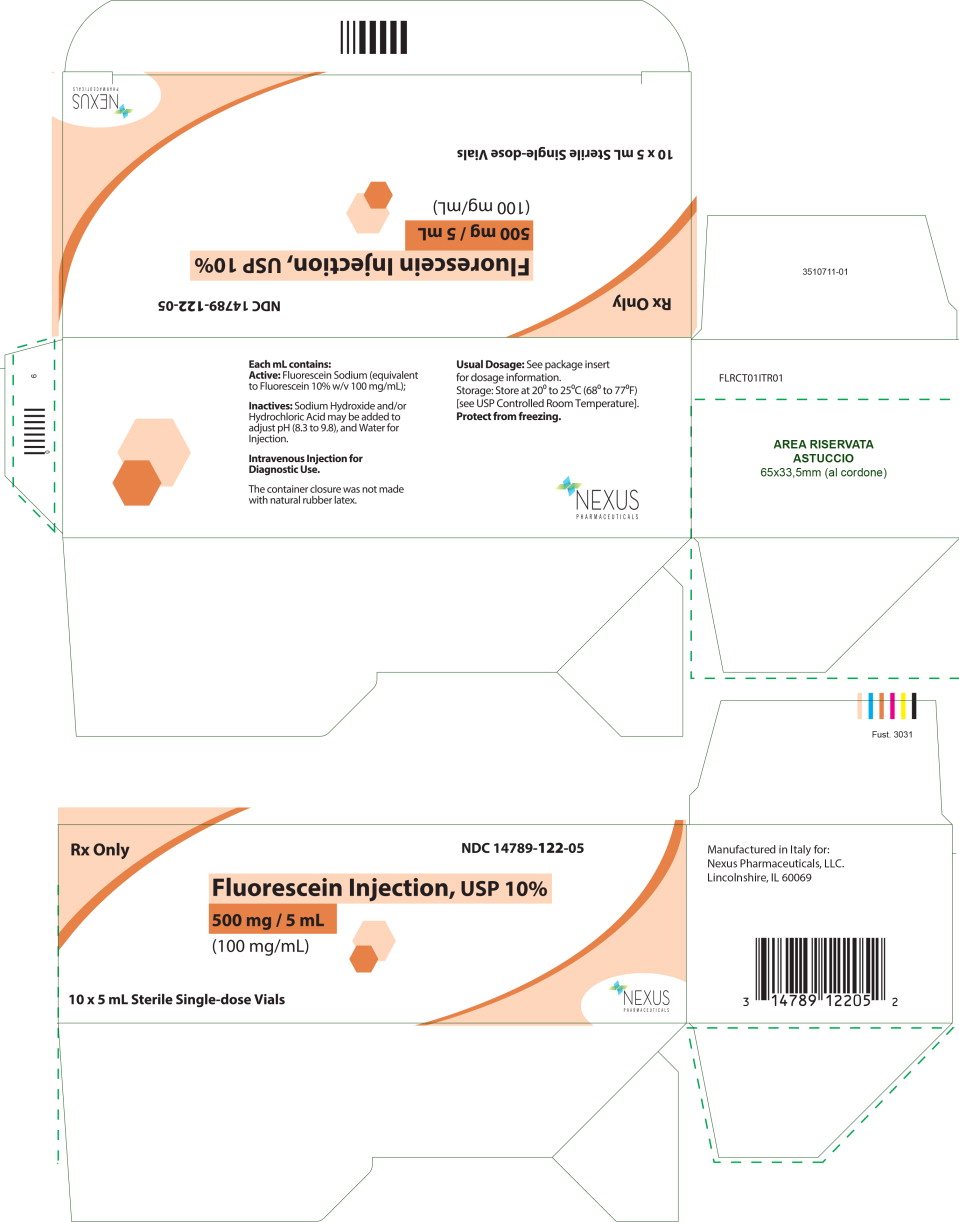
Principal Display Panel – 5 mL Carton Label Rx Only NDC 14789-122-05 Fluorescein Injection, USP 10% 500 mg / 5 mL (100 mg/mL) 10 x 5 mL Sterile Single-dose Vials NEXUS PHARMACEUTICALS Principal Display Panel – 5 mL Carton Label
Principal Display Panel – 5 mL Vial Label NDC 14789-122-07 Rx Only Fluorescein Injection, USP 10% 500 mg/5 mL (100 mg/mL) 5 mL Sterile Single-dose Vial For Intravenous Injection. Discard unused portion NEXUS PHARMACEUTICALS Principal Display Panel – 5 mL Vial Label
About this NDC listing & data coverage
What data is (and isn’t) available for this NDC — tap to expand
| NDC identity (package / product / labeler codes) | ✓ Available |
| Labeler | ✓ Available |
| Product & package description | ✓ Available |
| Marketing category & status | ✓ Available |
| Active ingredient / dosage form / route | ✓ Available |
| FDA label (SPL via DailyMed) | ✓ Available |
| Package photos | ✓ Available |
| Inactive ingredients (structured) | ✓ Available |
| NADAC pharmacy acquisition price (CMS) | — Not published for this NDC CMS publishes NADAC only for NDCs reported in its retail-pharmacy survey. |
| Orange Book / therapeutic-equivalence data | ✓ Available |
| HCPCS J-code billing crosswalk | — Not published for this NDC Most self-administered / retail products have no J-code — that is normal. |
| Medicaid utilization (CMS SDUD) | — Not published for this NDC CMS reports utilization only for NDCs with Medicaid claims above its privacy threshold. |