
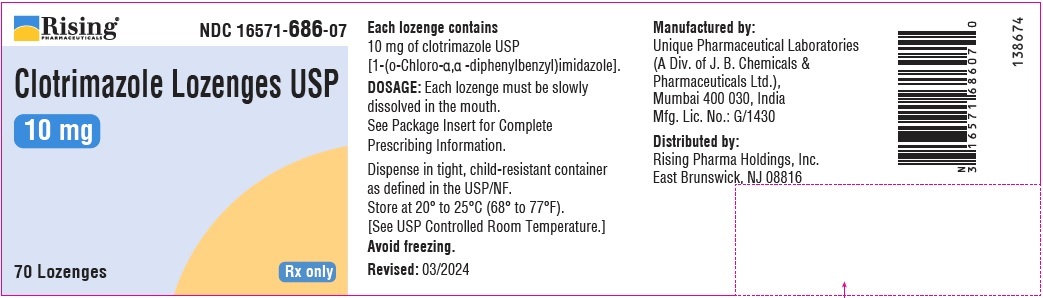
Clotrimazole 10 mg Lozenge, 70-count — NDC 16571-686-07 (Billing 16571-0686-07)
This is a package of 70 lozenges of Clotrimazole 10 mg Lozenge from Rising Pharma Holdings, Inc., marketed since May 2024 and currently FDA-listed; retail pharmacies pay about $0.2923 per lozenge (NADAC). It is the main listing for this product, which comes in 2 package sizes.
NDC database record
One package, one record: these facts belong to NDC 16571-686-07 alone.
- Record
- FDA NDC Directory package listing · Human prescription drug
- Code segments
- 16571 labeler · 686 product · 07 package
- Package marketed since
- May 1, 2024
- Sample package
- No — commercial package
- Listing certified through
- Dec 31, 2026
- Billing quantity
- 70 EA per package
- Barcode (UPC-A, from the NDC)
- 3 1657168607 0
- Medicaid fills, this package
- 4,938 prescriptions in the last four reported quarters
- FDA record last changed
- Jul 24, 2026
Other active recalls for Clotrimazole (different manufacturers) — 2 · tap to view
Identity & classification
Regulatory identifiers FDA, NLM and CMS codes for this package
Drug-database identifiers Medi-Span GPI and First Databank GCN / HICL / AHFS classification
- GSN (GCN sequence number): 009553
- GCN: 07590
- GPI-14 (Medi-Span): 88100020004805
- HICL (First Databank): 004137
- AHFS class code: 84:04.08.08
- RxCUI (RxNorm): 309371
Where does this data come from?
- FDA openFDA NDC Directory · synced Oct 8, 2026
- FDA label on DailyMed · label index refreshed Oct 8, 2026
- RxNorm (NLM RxNav) · catalog refreshed Oct 1, 2026
- Medi-Span GPI (licensed)
- First Databank (licensed) · refreshed Oct 8, 2026
RxNorm drug class
This medicine belongs to the Azole Antifungal class.
Where does this data come from?
- RxClass (NLM) · catalog refreshed Oct 1, 2026
Clinical
- It treats fungal and yeast infections. Skin products treat athlete's foot, jock itch and ringworm. Vaginal creams treat vaginal yeast infections, and CLOTIC ear solution treats fun...
- Wash and dry the area, then apply a thin layer twice a day, morning and night. Most labels say about 4 weeks for athlete's foot and ringworm and 2 weeks for jock itch. See a doctor...
- The skin products listed here say they are not effective on the scalp or nails. If the infection is there, check with your doctor.
- With CLOTIC ear solution, the reported ones were headache, pain where it goes in, ringing in the ear and tingling. Vaginal cream can briefly increase burning or itching. Call your...
Patient education
Supplement & herbal interactions
Some supplements/herbs that may interact with Clotrimazole — tap one for details:
Where does this data come from?
- MedlinePlus (NLM) · refreshed Oct 8, 2026
- FDA label on DailyMed · label index refreshed Oct 8, 2026
Ask a licensed pharmacist directly — free, answered by our team.
Pricing
A drug doesn't have one price. Each row is a different public payment system, and none is what you'd pay at the counter — that depends on your insurance. The ⓘ on each row explains what it measures.
| Price system | Per ea | Per package |
|---|---|---|
| Retail pharmacies payNADAC · weekly | $0.292 | $20.46 / 70 lozenges |
| Medicaid paysCMS SDUD · 12 mo | $0.4822 | $33.75 / 70 lozenges |
| Medicare drug plans payPart D · Q2 2026 | $0.5447 | $38.13 / 70 lozenges |
Where does this data come from?
- CMS NADAC weekly file · file of Oct 7, 2026
- CMS ASP pricing files · refreshed Sep 20, 2026
- CMS Medicaid State Drug Utilization Data · through Q1 2026
- CMS Part D plan pricing files · refreshed Sep 24, 2026
- VA National Acquisition Center price file
Packaging — all sizes for this product
| Package NDC | Description | Per unit | Per pack | Marketing start | Marketing end | Status |
|---|---|---|---|---|---|---|
| 16571-0686-07 You're viewing this Main listing | 70 LOZENGE in 1 BOTTLE | $0.2923 / ea | $20.46 | 2024-05-01 | — | Active |
| 16571-0686-14 16571-686-14 | 140 LOZENGE in 1 BOTTLE | $0.2923 / ea | $40.92 | 2024-05-01 | — | Active |
You're viewing the smallest of 2 pack sizes for this product.
This pack has the lowest per-ea cost of the 2 priced pack sizes ($0.2923 NADAC).
In Medicaid, this is the most-dispensed pack of this product — about 97% of fills over the last four reported quarters. See all packs ↓
Pack size FAQ
What quantity is in this package?
How does this package differ from NDC 16571-0686-14?
What NDC number is used to bill for this package of Clotrimazole 10 mg Lozenge?
Prices are the latest CMS NADAC pharmacy acquisition cost per NDC; per-pack figures are per-unit × pack quantity, shown only when the pack is denominated in the same measure NADAC prices.
Therapeutic equivalents
| Product | Labeler | Pack | NADAC/unit | TE | Status | Price vs. this |
|---|---|---|---|---|---|---|
| Clotrimazole 10 mg 00054-4146-22 | Hikma | 70 lozenges | $0.292 | AB | Availability likely | — |
| Clotrimazole 10 mg 00574-0107-14 | Padagis | 140 lozenges | $0.292 | AB | Availability likely | — |
| Clotrimazole 10 mgthis 16571-0686-07 | Rising | 70 lozenges | $0.292 | AB | Availability likely | — |
Where does this data come from?
- FDA openFDA NDC Directory · synced Oct 8, 2026
- FDA Orange Book · refreshed Oct 3, 2026
- CMS NADAC weekly file · file of Oct 7, 2026
Availability & generic status
This product is an FDA-approved generic. Other versions of the same drug are listed under Therapeutic equivalents, least expensive first.
Where does this data come from?
- FDA Orange Book · refreshed Oct 3, 2026
What it looks like
Where does this data come from?
- FDA label on DailyMed · label index refreshed Oct 8, 2026
Inactive Ingredients / Excipients
Inactive ingredients, also called excipients, are components of the drug product other than the active ingredient. They may include fillers, dyes, coatings, preservatives, flavors, or other formulation ingredients.
🧪 Avoiding an ingredient? See Clotrimazole inactive ingredients by manufacturer: every current product's list side by side, so you can ask your pharmacy for the version that does not list it.
💡 Tap an ingredient (hover on desktop) to see what it is and why it’s used.
-
UNII M28OL1HH48
Croscarmellose sodium is a plant-based substance derived from cellulose. It acts as a disintegrant, helping tablets and capsules break down quickly in the digestive system so the medicine can be absorbed.
-
UNII G263MI44RU
Dextrates are a carbohydrate mixture made from corn or potato starch. They work as fillers and binders in tablets and capsules to add bulk and help hold the medicine together.
-
UNII 70097M6I30
Magnesium stearate is a salt made from magnesium and stearic acid, a fatty substance. It's used in tablets and capsules as a lubricant and glidant to help ingredients flow smoothly during manufacturing and prevent sticking.
-
UNII OP1R32D61U
Microcrystalline cellulose is a purified form of cellulose, a natural fiber from plant sources. It acts as a binder and filler in tablets and capsules, helping hold ingredients together and give the medicine its shape and size.
-
UNII U725QWY32X
Povidone K30 is a synthetic polymer made from petroleum. It acts as a binder to hold tablet ingredients together and as a disintegrant to help the tablet break apart in the stomach so the medicine can be absorbed.
5 inactive ingredients listed in the exact product block matched to this NDC.
Where does this data come from?
ingredient classCode="IACT" elements from the exact product block matched by this NDC. Label-section narrative from DailyMed / the openFDA label index is shown separately when available.- FDA label on DailyMed · label index refreshed Oct 8, 2026
- FDA openFDA NDC Directory · synced Oct 8, 2026
Inactive ingredient FAQ
Are inactive ingredients the same for every manufacturer?
Why might an inactive ingredient be missing?
Can inactive ingredients matter?
Manufacturer & labeler
More NDCs from Rising Pharma Holdings, Inc. labeler code 16571
- Carbamazepine 100 mg Tablet, Extended Release NDC 16571-680-01
- Carbamazepine 200 mg Tablet, Extended Release NDC 16571-681-01
- Carbamazepine 400 mg Tablet, Extended Release NDC 16571-682-01
- Clomipramine Hydrochloride 25 mg Capsule NDC 16571-683-01
- Clomipramine Hydrochloride 50 mg Capsule NDC 16571-684-01
- Clomipramine Hydrochloride 75 mg Capsule NDC 16571-685-01
- Fenoprofen Calcium 400 mg Capsule NDC 16571-688-09
- Carbidopa, Levodopa and Entacapone 12.5 mg; 50 mg; 200 mg Tablet, Film Coated NDC 16571-689-01
- Carbidopa, Levodopa and Entacapone 18.75 mg; 75 mg; 200 mg Tablet, Film Coated NDC 16571-690-01
- Carbidopa, Levodopa and Entacapone 25 mg; 100 mg; 200 mg Tablet, Film Coated NDC 16571-691-01
- Carbidopa, Levodopa and Entacapone 31.25 mg; 125 mg; 200 mg Tablet, Film Coated NDC 16571-692-01
- Carbidopa, Levodopa and Entacapone 37.5 mg; 150 mg; 200 mg Tablet, Film Coated NDC 16571-693-01
Where does this data come from?
- FDA openFDA NDC Directory · synced Oct 8, 2026
- Drugs@FDA
Full prescribing information FDA SPL
🎯 Indications and Usage ▾
INDICATIONS AND USAGE Clotrimazole Lozenges are indicated for the local treatment of oropharyngeal candidiasis. The diagnosis should be confirmed by a KOH smear and/or culture prior to treatment. Clotrimazole Lozenges are also indicated prophylactically to reduce the incidence of oropharyngeal candidiasis in patients immunocompromised by conditions that include chemotherapy, radiotherapy, or steroid therapy utilized in the treatment of leukemia, solid tumors, or renal transplantation.
There are no data from adequate and well-controlled trials to establish the safety and efficacy of this product for prophylactic use in patients immunocompromised by etiologies other than those listed in the previous sentence. (See DOSAGE AND ADMINISTRATION .)
⏱️ Dosage and Administration ▾
DOSAGE AND ADMINISTRATION Clotrimazole Lozenges are administered only as a lozenge that must be slowly dissolved in the mouth. The recommended dose is one lozenge five times a day for fourteen consecutive days. Only limited data are available on the safety and effectiveness of the clotrimazole lozenge after prolonged administration; therefore, therapy should be limited to short term use, if possible.
For prophylaxis to reduce the incidence of oropharyngeal candidiasis in patients immunocompromised by conditions that include chemotherapy, radiotherapy, or steroid therapy utilized in the treatment of leukemia, solid tumors, or renal transplantation, the recommended dose is one lozenge three times daily for the duration of chemotherapy or until steroids are reduced to maintenance levels.
⛔ Contraindications ▾
CONTRAINDICATIONS Clotrimazole Lozenges are contraindicated in patients who are hypersensitive to any of its components.
⚠️ Warnings ▾
WARNING Clotrimazole Lozenges are not indicated for the treatment of systemic mycoses including systemic candidiasis.
🤒 Adverse Reactions ▾
ADVERSE REACTIONS Abnormal liver function tests have been reported in patients treated with clotrimazole lozenges; elevated SGOT levels were reported in about 15% of patients in the clinical trials (See PRECAUTIONS ). Nausea, vomiting, unpleasant mouth sensations and pruritus have also been reported with the use of the lozenge. To report SUSPECTED ADVERSE REACTIONS, contact Rising Pharma Holdings, Inc. at 1-844-874-7464 or FDA at 1-800-FDA-1088 or www.fda.gov/medwatch
🤰 Pregnancy ▾
Use In Pregnancy Pregnancy Category C: Clotrimazole has been shown to be embryotoxic in rats and mice when given in doses 100 times the adult human dose (in mg/kg), possibly secondary to maternal toxicity. The drug was not teratogenic in mice, rabbits, and rats when given in doses up to 200, 180, and 100 times the human dose. Clotrimazole given orally to mice from nine weeks before mating through weaning at a dose 120 times the human dose was associated with impairment of mating, decreased number of viable young, and decreased survival to weaning.
No effects were observed at 60 times the human dose. When the drug was given to rats during a similar time period at 50 times the human dose, there was a slight decrease in the number of pups per litter and decreased pup viability. There are no adequate and well controlled studies in pregnant women.
Clotrimazole lozenges should be used during pregnancy only if the potential benefit justifies the potential risk to the fetus.
🧒 Pediatric Use ▾
Pediatric Use Safety and effectiveness of clotrimazole in children below the age of 3 years have not been established; therefore, its use in such patients is not recommended. The safety and efficacy of the prophylactic use of clotrimazole lozenges in children have not been established.
🧓 Geriatric Use ▾
Geriatric Use Clinical studies of clotrimazole did not include sufficient numbers of subjects aged 65 and over to determine whether they respond differently from younger subjects. Other reported clinical experience has not identified differences in responses between the elderly and younger patients.
🆘 Overdosage ▾
OVERDOSAGE No data available.
🧬 Clinical Pharmacology ▾
CLINICAL PHARMACOLOGY Clotrimazole is a broad-spectrum antifungal agent that inhibits the growth of pathogenic yeasts by altering the permeability of cell membranes. The action of clotrimazole is fungistatic at concentrations of drug up to 20 mcg/mL and may be fungicidal in vitro against Candida albicans and other species of the genus Candida at higher concentrations. No single-step or multiple-step resistance to clotrimazole has developed during successive passages of Candida albicans in the laboratory; however, individual organism tolerance has been observed during successive passages in the laboratory.
Such in vitro tolerance has resolved once the organism has been removed from the antifungal environment. After oral administration of a 10 mg clotrimazole lozenge to healthy volunteers, concentrations sufficient to inhibit most species of Candida persist in saliva for up to three hours following the approximately 30 minutes needed for a lozenge to dissolve. The long term persistence of drug in saliva appears to be related to the slow release of clotrimazole from the oral mucosa to which the drug is apparently bound.
Repetitive dosing at three hour intervals maintains salivary levels above the minimum inhibitory concentrations of most strains of Candida ; however, the relationship between in vitro susceptibility of pathogenic fungi to clotrimazole and prophylaxis or cure of infections in humans has not been established. In another study, the mean serum concentrations were 4.98 ± 3.7 and 3.23 ± 1.4 nanograms/mL of clotrimazole at 30 and 60 minutes, respectively, after administration as a lozenge.
📦 How Supplied / Storage and Handling ▾
HOW SUPPLIED Clotrimazole Lozenges USP 10 mg lozenge is supplied as white to off white, round, flat face beveled edge lozenge debossed with “227” on one side and “P” on the other side. NDC 16571-686-07: Bottle of 70 Lozenges with child-resistant closure. NDC 16571-686-14: Bottle of 140 Lozenges with child-resistant closure. Store at 20° to 25°C (68° to 77°F). [See USP Controlled Room Temperature.] Avoid freezing.
📦 Storage and Handling ▾
Store at 20° to 25°C (68° to 77°F). [See USP Controlled Room Temperature.] Avoid freezing.
📋 Description ▾
DESCRIPTION Each Clotrimazole lozenge USP contains 10 mg clotrimazole USP [1-(o-chloro-α,α-diphenylbenzyl) imidazole], a synthetic antifungal agent, for topical use in the mouth. Structural Formula: Chemical Formula: C 22 H 17 ClN 2 The lozenge dosage form is a large, slowly dissolving lozenge containing 10 mg of clotrimazole USP dispersed in croscarmellose sodium, dextrates, magnesium stearate, microcrystalline cellulose and povidone. clotrimazole-structure.jpg
⚠️ Precautions ▾
PRECAUTIONS Abnormal liver function tests have been reported in patients treated with clotrimazole lozenges; elevated SGOT levels were reported in about 15% of patients in the clinical trials. In most cases the elevations were minimal and it was often impossible to distinguish effects of clotrimazole from those of other therapy and the underlying disease (malignancy in most cases). Periodic assessment of hepatic function is advisable particularly in patients with pre-existing hepatic impairment.
Since patients must be instructed to allow each lozenge to dissolve slowly in the mouth in order to achieve maximum effect of the medication, they must be of such an age and physical and/or mental condition to comprehend such instructions. Carcinogenesis An 18 month dosing study with clotrimazole in rats has not revealed any carcinogenic effect. Use In Pregnancy Pregnancy Category C: Clotrimazole has been shown to be embryotoxic in rats and mice when given in doses 100 times the adult human dose (in mg/kg), possibly secondary to maternal toxicity.
The drug was not teratogenic in mice, rabbits, and rats when given in doses up to 200, 180, and 100 times the human dose. Clotrimazole given orally to mice from nine weeks before mating through weaning at a dose 120 times the human dose was associated with impairment of mating, decreased number of viable young, and decreased survival to weaning. No effects were observed at 60 times the human dose.
When the drug was given to rats during a similar time period at 50 times the human dose, there was a slight decrease in the number of pups per litter and decreased pup viability. There are no adequate and well controlled studies in pregnant women. Clotrimazole lozenges should be used during pregnancy only if the potential benefit justifies the potential risk to the fetus.
Pediatric Use Safety and effectiveness of clotrimazole in children below the age of 3 years have not been established; therefore, its use in such patients is not recommended. The safety and efficacy of the prophylactic use of clotrimazole lozenges in children have not been established. Geriatric Use Clinical studies of clotrimazole did not include sufficient numbers of subjects aged 65 and over to determine whether they respond differently from younger subjects.
Other reported clinical experience has not identified differences in responses between the elderly and younger patients.
🔒 Drug Abuse and Dependence ▾
DRUG ABUSE AND DEPENDENCE No data available.
📄 Carcinogenesis, Mutagenesis, Impairment of Fertility ▾
Carcinogenesis An 18 month dosing study with clotrimazole in rats has not revealed any carcinogenic effect.
📄 Package Label / Principal Display Panel ▾
PRINCIPAL DISPLAY PANEL NDC 16571- 686 -07 Clotrimazole Lozenges USP 10 mg 70 Lozenges clotrimazole-70