
Sulfamylon mafenide acetate 85 mg/g Cream, 453.6 g — NDC 16571-723-48 (Billing 16571-0723-48)
This is a package of 453.6 g of Sulfamylon mafenide acetate 85 mg/g Cream from Rising Pharma Holdings, Inc., marketed since May 2020 and currently FDA-listed.
NDC database record
One package, one record: these facts belong to NDC 16571-723-48 alone.
- Record
- FDA NDC Directory package listing · Human prescription drug
- Code segments
- 16571 labeler · 723 product · 48 package
- Package marketed since
- May 18, 2020
- Sample package
- No — commercial package
- Listing certified through
- Dec 31, 2026
- Billing quantity
- 454 g per package
- Barcode (UPC-A, from the NDC)
- 3 1657172348 5
- FDA record last changed
- Jul 24, 2026
Identity & classification
Regulatory identifiers FDA, NLM and CMS codes for this package
Drug-database identifiers Medi-Span GPI and First Databank GCN / HICL / AHFS classification
- GSN (GCN sequence number): 007668
- GCN: 31620
- GPI-14 (Medi-Span): 90450010103710
- HICL (First Databank): 003346
- AHFS class code: 84:04.04.00
- RxCUI (RxNorm): 201185
Where does this data come from?
- FDA openFDA NDC Directory · synced Oct 8, 2026
- FDA label on DailyMed · label index refreshed Oct 8, 2026
- RxNorm (NLM RxNav) · catalog refreshed Oct 1, 2026
- Medi-Span GPI (licensed)
- First Databank (licensed) · refreshed Oct 8, 2026
RxNorm drug class
This medicine belongs to the Methylated Sulfonamide Antibacterial class.
Where does this data come from?
- RxClass (NLM) · catalog refreshed Oct 1, 2026
Clinical
Patient education
Supplement & herbal interactions
Where does this data come from?
- MedlinePlus (NLM) · refreshed Oct 8, 2026
- FDA label on DailyMed · label index refreshed Oct 8, 2026
Ask a licensed pharmacist directly — free, answered by our team.
Pricing
A drug doesn't have one price. Each row is a different public payment system, and none is what you'd pay at the counter — that depends on your insurance. The ⓘ on each row explains what it measures.
| Price system | Per g | Per package |
|---|---|---|
| Retail pharmacies payNADAC · weekly | Not in the retail survey — common for institutional, discontinued, or low-volume packs. | |
| Medicaid paysCMS SDUD · 12 mo | No recent Medicaid claims on file for this NDC — rare and low-volume NDCs are suppressed in the public data. | |
| Medicare drug plans payPart D · Q2 2026 | $1.26 | $570.22 / 453.6 g |
Where does this data come from?
- CMS NADAC weekly file
- CMS ASP pricing files · refreshed Sep 20, 2026
- CMS Medicaid State Drug Utilization Data · refreshed Oct 8, 2026
- CMS Part D plan pricing files · refreshed Sep 24, 2026
- VA National Acquisition Center price file
Packaging — all sizes for this product
| Package NDC | Description | Per unit | Per pack | Marketing start | Marketing end | Status |
|---|---|---|---|---|---|---|
| 16571-0723-12 16571-723-12 | 1 TUBE in 1 CARTON / 113.4 g in 1 TUBE | — | — | 2020-05-18 | — | Active |
| 16571-0723-48 You're viewing this | 453.6 g in 1 JAR | — | — | 2020-05-18 | — | Active |
| 16571-0723-60 16571-723-60 Main listing | 1 TUBE in 1 CARTON / 56.7 g in 1 TUBE | $1.23 / g | $69.98 | 2020-05-18 | — | Active |
Pack size FAQ
What quantity is in this package?
How does this package differ from NDC 16571-0723-12?
What NDC number is used to bill for this package of Sulfamylon mafenide acetate 85 mg/g Cream?
Prices are the latest CMS NADAC pharmacy acquisition cost per NDC; per-pack figures are per-unit × pack quantity, shown only when the pack is denominated in the same measure NADAC prices.
Therapeutic equivalents
| Product | Labeler | Pack | NADAC/unit | TE | Status | Price vs. this |
|---|---|---|---|---|---|---|
| Sulfamylon 85 mg/gthis 16571-0723-48 | Rising | 453.6 g | — | — | FDA listed | — |
Where does this data come from?
- FDA openFDA NDC Directory · synced Oct 8, 2026
- FDA Orange Book · refreshed Oct 3, 2026
- CMS NADAC weekly file
Availability & generic status
We did not find an FDA-approved generic match for this exact strength, form and route.
Where does this data come from?
- FDA Orange Book · refreshed Oct 3, 2026
What it looks like
Where does this data come from?
- FDA label on DailyMed · label index refreshed Oct 8, 2026
Inactive Ingredients / Excipients
Inactive ingredients, also called excipients, are components of the drug product other than the active ingredient. They may include fillers, dyes, coatings, preservatives, flavors, or other formulation ingredients.
💡 Tap an ingredient (hover on desktop) to see what it is and why it’s used.
-
UNII 936JST6JCN
Cetyl alcohol is a waxy, fatty substance derived from plant or animal sources. It acts as an emulsifier and thickener in medicines, helping blend oil and water components and giving products a smooth, creamy texture.
-
UNII 7FLD91C86K
Edetate disodium is a chemical compound that binds and removes certain metal ions. In medicines, it acts as a preservative and stabilizer by preventing metals like calcium from interfering with the product's shelf life and consistency.
-
UNII PDC6A3C0OX
Glycerin is a clear, thick liquid derived from plant oils or fats. It acts as a humectant to retain moisture, a sweetener, and a solvent in medications.
-
UNII A2I8C7HI9T
Methylparaben is a preservative derived from benzoic acid that prevents growth of bacteria, fungi, and mold in medicines. It extends the product's shelf life and maintains safety during storage.
-
UNII 2P9L47VI5E
A waxy compound made by combining polyethylene glycol with stearic acid. It acts as an emulsifier and thickener, helping blend oil and water-based ingredients and giving the medicine a smooth, stable consistency.
-
UNII 13A4J4NH9I
A synthetic emulsifier derived from stearic acid and polyethylene glycol. It helps mix oil and water-based ingredients together in liquid medicines and creams to create a smooth, uniform product.
-
UNII Z8IX2SC1OH
Propylparaben is a chemical preservative used to prevent bacterial and fungal growth in medicines and personal care products. It helps extend shelf life and maintain product safety during storage.
-
UNII 4VON5FNS3C
Sodium metabisulfite is a preservative derived from sulfur compounds. It prevents microbial growth and oxidation in medicines, helping extend shelf life and maintain product stability.
-
UNII 2KR89I4H1Y
Stearyl alcohol is a waxy, fatty substance derived from natural oils or made synthetically. It acts as an emulsifier and thickener in medicines, helping mix ingredients together and give the product the right texture.
-
UNII 059QF0KO0R
Water is a liquid solvent that dissolves and mixes ingredients together in liquid medicines, syrups, and injections. It helps distribute the active drug evenly throughout the product.
10 inactive ingredients listed in the exact product block matched to this NDC.
Where does this data come from?
ingredient classCode="IACT" elements from the exact product block matched by this NDC. Label-section narrative from DailyMed / the openFDA label index is shown separately when available.- FDA label on DailyMed · label index refreshed Oct 8, 2026
- FDA openFDA NDC Directory · synced Oct 8, 2026
Inactive ingredient FAQ
Are inactive ingredients the same for every manufacturer?
Why might an inactive ingredient be missing?
Can inactive ingredients matter?
Manufacturer & labeler
More NDCs from Rising Pharma Holdings, Inc. labeler code 16571
- Quetiapine Fumarate 25 mg Tablet, Film Coated NDC 16571-717-01
- Quetiapine Fumarate 50 mg Tablet, Film Coated NDC 16571-718-01
- Quetiapine Fumarate 100 mg Tablet, Film Coated NDC 16571-719-01
- Quetiapine Fumarate 200 mg Tablet, Film Coated NDC 16571-720-01
- Quetiapine Fumarate 300 mg Tablet, Film Coated NDC 16571-721-01
- Quetiapine Fumarate 400 mg Tablet, Film Coated NDC 16571-722-01
- Chlorzoxazone 375 mg Tablet NDC 16571-725-01
- Chlorzoxazone 500 mg Tablet NDC 16571-726-01
- Chlorzoxazone 750 mg Tablet NDC 16571-727-01
- Methylergonovine Maleate .2 mg Tablet NDC 16571-735-01
- Propafenone Hydrochloride 225 mg Capsule, Extended Release NDC 16571-736-06
- Propafenone Hydrochloride 325 mg Capsule, Extended Release NDC 16571-737-06
Where does this data come from?
- FDA openFDA NDC Directory · synced Oct 8, 2026
- Drugs@FDA
Full prescribing information FDA SPL
🎯 Indications and Usage ▾
INDICATIONS AND USAGE SULFAMYLON Cream is a topical agent indicated for adjunctive therapy of patients with second- and third-degree burns.
⏱️ Dosage and Administration ▾
DOSAGE AND ADMINISTRATION Prompt institution of appropriate measures for controlling shock and pain is of prime importance. The burn wounds are then cleansed and debrided, and SULFAMYLON Cream is applied with a sterile gloved hand. Satisfactory results can be achieved with application of the cream once or twice daily, to a thickness of approximately 1/16 inch; thicker application is not recommended.
The burned areas should be covered with SULFAMYLON Cream at all times. Therefore, whenever necessary, the cream should be reapplied to any areas from which it has been removed (e.g., by patient activity). The routine of administration can be accomplished in minimal time, since dressings usually are not required, if individual patient demands make them necessary, however, only a thin layer of dressings should be used.
When feasible, the patient should be bathed daily to aid in debridement. A whirlpool bath is particularly helpful, but the patient may be bathed in bed or in a shower. The duration of therapy with SULFAMYLON Cream depends on each patient’s requirements.
Treatment is usually continued until healing is progressing well or until the burn site is ready for grafting. SULFAMYLON Cream should not be withdrawn from the therapeutic regimen while there is the possibility of infection. However, if allergic manifestations occur during treatment with SULFAMYLON Cream, discontinuation of treatment should be considered.
If acidosis occurs and becomes difficult to control, particularly in patients with pulmonary dysfunction, discontinuing therapy SULFAMYLON Cream for 24 to 48 hours while continuing fluid therapy may aid in restoring acid-base balance.
⛔ Contraindications ▾
CONTRAINDICATIONS SULFAMYLON is contraindicated in patients who are hypersensitive to it. It is not known whether there is cross sensitivity to other sulfonamides.
⚠️ Warnings ▾
WARNINGS Fatal hemolytic anemia with disseminated intravascular coagulation, presumably related to a glucose-6-phosphate dehydrogenase deficiency, has been reported following therapy with SULFAMYLON Cream. Contains sodium metabisulfite, a sulfite that may cause allergic-type reactions including anaphylactic symptoms and life-threatening or less severe asthmatic episodes in certain susceptible people. The overall prevalence of sulfite sensitivity in the general population is unknown and probably low.
Sulfite sensitivity is seen more frequently in asthmatic than in nonasthmatic people.
🤒 Adverse Reactions ▾
ADVERSE REACTIONS It is frequently difficult to distinguish between an adverse reaction to SULFAMYLON Cream and the effect of a severe burn. A single case of bone marrow depression and a single case of acute attack of porphyria have been reported following therapy with SULFAMYLON Cream. Fatal hemolytic anemia with disseminated intravascular coagulation, presumably related to a glucose-6-phosphate dehydrogenase deficiency, has been reported following therapy with SULFAMYLON Cream.
Dermatologic: The most frequently reported reaction was pain on application or a burning sensation. Rare occurrences are excoriation of new skin and bleeding of skin. Allergic: Rash itching, facial edema, swelling, hive, blisters, erythema, and eosinophilia.
Respiratory: Tachypnea or hyperventilation, decrease in arterial pCO 2 . Metabolic: Acidosis, increase in serum chloride. Accidental ingestion of SULFAMYLON Cream has been reported to cause diarrhea.
To report SUSPECTED ADVERSE REACTIONS, contact Rising Pharma Holdings, Inc. at 1-844-874-7464 or FDA at 1-800-FDA-1088 or www.fda.gov/medwatch.
🧬 Clinical Pharmacology ▾
CLINICAL PHARMACOLOGY SULFAMYLON Cream, applied topically produces a marked reduction in the bacterial population present in the avascular tissues of second- and third-degree burns. Reduction in bacterial growth after application of SULFAMYLON Cream has also been reported to permit spontaneous healing of deep partial-thickness burns, and thus prevent conversion of burn wounds from partial-thickness to full-thickness. It should be noted, however, that delayed eschar separation has occurred in some cases.
Absorption and Metabolism Applied topically, SULFAMYLON Cream diffuses through devascularized areas, is absorbed, and rapidly converted to a metabolite (ρ-carboxybenzenesulfonamide) which is cleared through the kidneys. SULFAMYLON is active in the presence of pus and serum, and its activity is not altered by changes in the acidity of the environment. Antibacterial Activity SULFAMYLON exerts bacteriostatic action against many gram-negative and gram-positive organisms, including Pseudomonas aeruginosa and certain strains of anaerobes.
📦 How Supplied / Storage and Handling ▾
HOW SUPPLIED 16 oz. Plastic Jar (453.6 g) - NDC 16571-723-48 4 oz. Tube (113.4 g) - NDC 16571-723-12 2 oz. Tube (56.7 g) - NDC 16571-723-60 Avoid exposure to excessive heat (temperature above 104° F or 40° C). For External Use Only. Keep this and all medications out of the reach of children. Rx only Manufactured for: Rising Pharma Holdings, Inc. East Brunswick, NJ 08816 Revised: 08/2020 PIR72348-00
📋 Description ▾
DESCRIPTION SULFAMYLON Cream is a soft, white, nonstaining, water-miscible, anti-infective cream for topical administration to burn wounds. SULFAMYLON Cream spreads easily, and can be washed off readily with water. It has a slight acetic odor.
Each gram of SULFAMYLON Cream contains mafenide acetate equivalent to 85 mg of the base. The cream vehicle consists of cetyl alcohol, steryl alcohol, cetyl esters wax, polyoxyl 40 stearate, polyoxyl 8 stearate, glycerin, and water, with methylparaben, propylparaben, sodium metabisulfite, and edetate disodium as preservatives. Chemically, mafenide acetate is α-Amino-ρ-toluenesulfonamide monoacetate and has the following structural formula: mafenide-struc
⚠️ Precautions ▾
PRECAUTIONS SULFAMYLON and its metabolite, ρ-carboxybenzenesulfonamide, inhibit carbonic anhydrase, which may result in metabolic acidosis, usually compensated by hyperventilation. In the presence of impaired renal function, high blood levels of SULFAMYLON and its metabolite may exaggerate the carbonic anhydrase inhibition. Therefore, close monitoring of acid-base balance is necessary, particularly in patients with extensive second-degree or partial-thickness burns and in those with pulmonary or renal dysfunction.
Some burn patients treated with SULFAMYLON Cream have also been reported to manifest an unexplained syndrome of marked hyperventilation with resulting respiratory alkalosis (slightly alkaline blood pH, low arterial pCO 2 , and decreased total CO 2 ); change in arterial pO 2 is variable. The etiology and significance of these findings are unknown. Mafenide acetate cream should be used with caution in burn patients with acute renal failure.
SULFAMYLON Cream should be administered with caution to patients with history of hypersensitivity to mafenide. It is not known whether there is cross sensitivity to other sulfonamides. Fungal colonization in and below eschar may occur concomitantly with reduction of bacterial growth in the burn wound.
However, fungal dissemination through the infected burn wound is rare. Carcinogenesis, Mutagenesis, Impairment of Fertility No long-term animal studies have been performed to evaluate the drug’s potential in these areas. Pregnancy Animal reproduction studies have not been conducted with SULFAMYLON.
It is also not known whether SULFAMYLON can cause fetal harm when administered to a pregnant woman or can affect reproduction capacity. Therefore, the preparation is not recommended for the treatment of a women of childbearing potential, unless the burned area covers more than 20% of the total body surface, or the need for the therapeutic benefit of SULFAMYLON Cream is, in the physician’s judgment, greater than the possible risk to the fetus. Nursing Mothers It is not known whether mafenide acetate is excreted in human milk.
Because many drugs are excreted in human milk and because of the potential for serious adverse reaction in nursing infants from SULFAMYLON, a decision should be made whether to discontinue nursing or to discontinue the drug, taking into account the importance of the drug to the mother. Pediatric Use Same as for adults. (See DOSAGE AND ADMINISTRATION .)
📄 Package Label / Principal Display Panel ▾
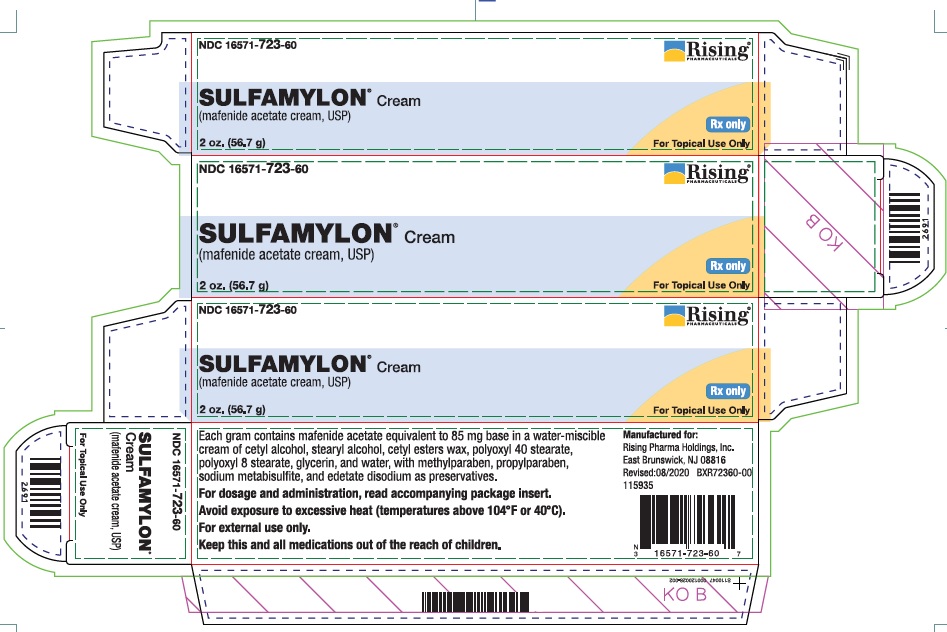
PACKAGE LABEL.PRINCIPAL DISPLAY PANEL NDC 16571-723-60 Rising ® SULFAMYLON ® Cream (mafenide acetate cream, USP) Rx only 2 oz. (56.7 g) For Topical Use Only Each gram contains mafenide acetate equivalent to 85 mg base in a water-miscible cream of cetyl alcohol, stearyl alcohol, cetyl esters wax, polyoxyl 40 stearate, polyoxyl 8 stearate, glycerin, and water, with methylparaben, propylparaben, sodium metabisulfite, and edetate disodium as preservatives. For dosage and administration, read accompanying package insert.
Avoid exposure to excessive heat (temperatures above 104°F or 40°C). For external use only. Keep this and all medications out of the reach of children. mafenide-2oz-carton-label
Medicaid utilization by pack size
Medicare Part D spend CMS · PART D · 2026 (Q1)
About this NDC listing & data coverage
What data is (and isn’t) available for this NDC — tap to expand
| NDC identity (package / product / labeler codes) | ✓ Available |
| Labeler | ✓ Available |
| Product & package description | ✓ Available |
| Marketing category & status | ✓ Available |
| Active ingredient / dosage form / route | ✓ Available |
| FDA label (SPL via DailyMed) | ✓ Available |
| Package photos | ✓ Available |
| Inactive ingredients (structured) | ✓ Available |
| NADAC pharmacy acquisition price (CMS) | — Not published for this NDC CMS publishes NADAC only for NDCs reported in its retail-pharmacy survey. |
| Orange Book / therapeutic-equivalence data | — Not published for this NDC Applies only to products approved under an NDA/ANDA; many listings are out of scope. |
| HCPCS J-code billing crosswalk | — Not published for this NDC Most self-administered / retail products have no J-code — that is normal. |
| Medicaid utilization (CMS SDUD) | — Not published for this NDC CMS reports utilization only for NDCs with Medicaid claims above its privacy threshold. |