
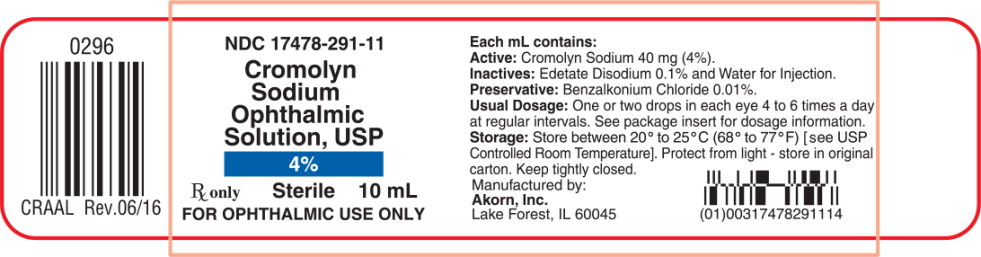
Cromolyn Sodium 40 mg/mL Solution/ Drops — NDC 17478-291-11 (Billing 17478-0291-11)
This is a package of Cromolyn Sodium 40 mg/mL Solution/ Drops from Akorn, no longer marketed, no longer in the FDA NDC Directory; retail pharmacies pay about $0.5730 per mL (NADAC). It is this product's only package size.
NDC database record
One package, one record: these facts belong to NDC 17478-291-11 alone.
- Record
- FDA NDC Directory package listing · Human prescription drug
- Code segments
- 17478 labeler · 291 product · 11 package
- Barcode (UPC-A, from the NDC)
- 3 1747829111 4
- FDA record last changed
- Jul 14, 2026
Identity & classification
Regulatory identifiers FDA, NLM and CMS codes for this package
Drug-database identifiers Medi-Span GPI and First Databank GCN / HICL / AHFS classification
- GSN (GCN sequence number): 044694
- GCN: 69069
- HICL (First Databank): 004526
- AHFS class code: 48:10.32.00
Where does this data come from?
- FDA openFDA NDC Directory · synced Oct 8, 2026
- FDA label on DailyMed · label index refreshed Oct 8, 2026
- RxNorm (NLM RxNav) · catalog refreshed Oct 1, 2026
- Medi-Span GPI (licensed)
- First Databank (licensed) · refreshed Oct 8, 2026
Clinical
- It's actually for a specific group of recurring seasonal allergic eye conditions called vernal keratoconjunctivitis, vernal conjunctivitis, and vernal keratitis. 'Vernal' means the...
- What exactly is this eye drop treating — is it just regular eye allergies?
- Most people start to notice less itching, tearing, redness, and discharge within a few days of using the drops consistently. That said, for some people it can take up to six weeks...
- How long before these drops actually start helping?
Patient education
Supplement & herbal interactions
Some supplements/herbs that may interact with Cromolyn Sodium — tap one for details:
Where does this data come from?
- MedlinePlus (NLM) · refreshed Oct 8, 2026
- FDA label on DailyMed · label index refreshed Oct 8, 2026
Ask a licensed pharmacist directly — free, answered by our team.
Pricing
A drug doesn't have one price. Each row is a different public payment system, and none is what you'd pay at the counter — that depends on your insurance. The ⓘ on each row explains what it measures.
| Price system | Per mL | Per package |
|---|---|---|
| Retail pharmacies payNADAC · weekly | $0.573 | $5.73 / 10 ml |
| Medicaid paysCMS SDUD · 12 mo | No recent Medicaid claims on file for this NDC — rare and low-volume NDCs are suppressed in the public data. | |
| Medicare drug plans payPart D · quarterly | No Part D plan price is available for this NDC in our data. | |
Where does this data come from?
- CMS NADAC weekly file · file of Nov 23, 2022
- CMS ASP pricing files · refreshed Sep 20, 2026
- CMS Medicaid State Drug Utilization Data · refreshed Oct 8, 2026
- CMS Part D plan pricing files · refreshed Sep 24, 2026
- VA National Acquisition Center price file
Packaging — all sizes for this product
| Package NDC | Description | Marketing start | Marketing end | Status |
|---|---|---|---|---|
| 17478-0291-11 You're viewing this Main listing | 1 BOTTLE, DROPPER in 1 CARTON / 10 mL in 1 BOTTLE, DROPPER | 1998-04-29 | — | Inactivated by FDA |
Therapeutic equivalents
| Product | Labeler | Pack | NADAC/unit | TE | Status | Price vs. this |
|---|---|---|---|---|---|---|
| Cromolyn Sodium 40 mg/mLthis 17478-0291-11 | Akorn | 1 bottle | $0.573 | — | Discontinued | — |
Where does this data come from?
- FDA openFDA NDC Directory · synced Oct 8, 2026
- FDA Orange Book · refreshed Oct 3, 2026
- CMS NADAC weekly file · file of Nov 23, 2022
Availability & generic status
This product is an FDA-approved generic. Other versions of the same drug are listed under Therapeutic equivalents, least expensive first.
Where does this data come from?
- FDA Orange Book · refreshed Oct 3, 2026
Inactive Ingredients / Excipients
Inactive ingredients, also called excipients, are components of the drug product other than the active ingredient. They may include fillers, dyes, coatings, preservatives, flavors, or other formulation ingredients.
🧪 Avoiding an ingredient? See Cromolyn Ophthalmic inactive ingredients by manufacturer: every current product's list side by side, so you can ask your pharmacy for the version that does not list it.
Where does this data come from?
IACT rows and label-wide narrative are kept separate; availability and product-level specificity depend on the submitted label.- FDA label on DailyMed · label index refreshed Oct 8, 2026
- FDA openFDA NDC Directory · synced Oct 8, 2026
Inactive ingredient FAQ
Are inactive ingredients the same for every manufacturer?
Why might an inactive ingredient be missing?
Can inactive ingredients matter?
Manufacturer & labeler
Where does this data come from?
- FDA openFDA NDC Directory · synced Oct 8, 2026
- Drugs@FDA
Full prescribing information FDA SPL
🎯 Indications and Usage ▾
INDICATIONS AND USAGE Cromolyn Sodium Ophthalmic Solution is indicated in the treatment of vernal keratoconjunctivitis, vernal conjunctivitis, and vernal keratitis.
⏱️ Dosage and Administration ▾
DOSAGE AND ADMINISTRATION The dose is 1 or 2 drops in each eye 4 to 6 times a day at regular intervals. One drop contains approximately 1.6 mg cromolyn sodium. Patients should be advised that the effect of Cromolyn Sodium Ophthalmic Solution therapy is dependent upon its administration at regular intervals, as directed.
Symptomatic response to therapy (decreased itching, tearing, redness, and discharge) is usually evident within a few days, but longer treatment for up to six weeks is sometimes required. Once symptomatic improvement has been established, therapy should be continued for as long as needed to sustain improvement. If required, corticosteroids may be used concomitantly with Sodium Chloride Ophthalmic Solution.
⛔ Contraindications ▾
CONTRAINDICATIONS Cromolyn Sodium Ophthalmic Solution is contraindicated in those patients who have shown hypersensitivity to cromolyn sodium or to any of the other ingredients.
🤒 Adverse Reactions ▾
ADVERSE REACTIONS The most frequently reported adverse reaction attributed to the use of cromolyn sodium, on the basis of reoccurrence following readministration, is transient ocular stinging or burning upon instillation. The following adverse reactions have been reported as infrequent events. It is unclear whether they are attributed to the drug: Conjunctival injection; watery eyes; itchy eyes; dryness around the eye; puffy eyes; eye irritation; and styes.
Immediate hypersensitivity reactions have been reported rarely and include dyspnea, edema, and rash.
🤰 Pregnancy ▾
Pregnancy Teratogenic Effects: Pregnancy Category B. Reproduction studies with cromolyn sodium administered subcutaneously to pregnant mice and rats at maximum daily doses of 540 mg/kg (1620 mg/m 2 ) and 164 mg/kg (984 mg/m 2 ), respectively, and intravenously to rabbits at a maximum daily dose of 485 mg/kg (5820 mg/m 2 ) produced no evidence of fetal malformation. These doses represent approximately 57, 35, and 205 times the maximum daily human dose, respectively, on a mg/m 2 basis.
Adverse fetal effects (increased resorption and decreased fetal weight) were noted only at the very high parenteral doses that produced maternal toxicity. There are, however, no adequate and well controlled studies in pregnant women. Because animal reproduction studies are not always predictive of human response, this drug should be used during pregnancy only if clearly needed.
Nursing Mothers: It is not known whether this drug is excreted in human milk. Because many drugs are excreted in human milk, caution should be exercised when Cromolyn Sodium Ophthalmic Solution is administered to a nursing woman. Pediatric Use: Safety and effectiveness in children below the age of 4 years have not been established.
🧒 Pediatric Use ▾
Pediatric Use: Safety and effectiveness in children below the age of 4 years have not been established.
🧬 Clinical Pharmacology ▾
CLINICAL PHARMACOLOGY In vitro and in vivo animal studies have shown that cromolyn sodium inhibits the degranulation of sensitized mast cells which occurs after exposure to specific antigens. Cromolyn sodium acts by inhibiting the release of histamine and SRS-A (slow-reacting substance of anaphylaxis) from the mast cell. Another activity demonstrated in vitro is the capacity of cromolyn sodium to inhibit the degranulation of non-sensitized rat mast cells by phospholipase A and the subsequent release of chemical mediators.
Another study showed that cromolyn sodium did not inhibit the enzymatic activity of released phospholipase A on its specific substrate. Cromolyn sodium has no intrinsic vasoconstrictor, antihistamine, or anti-inflammatory activity. Cromolyn sodium is poorly absorbed.
When multiple doses of cromolyn sodium ophthalmic solution are instilled into normal rabbit eyes, less than 0.07% of the administered dose of cromolyn sodium is absorbed into the systemic circulation (presumably by way of the eye, nasal passages: buccal cavity and gastrointestinal tract). Trace amounts (less than 0.01%) of the cromolyn sodium dose penetrate into the aqueous humor and clearance from this chamber is virtually complete within 24 hours after treatment is stopped. In normal volunteers, analysis of drug excretion indicates that approximately 0.03% of cromolyn sodium is absorbed following administration to the eye.
📦 How Supplied / Storage and Handling ▾
HOW SUPPLIED Cromolyn Sodium Ophthalmic Solution USP 4% is supplied as 10 mL of solution in an opaque polyethylene bottle with a controlled dropper tip. NDC 17478-291-11 Storage: Store at 20° to 25°C (68° to 77°F) [see USP Controlled Room Temperature]. Protect from light-store in original carton.
Keep tightly closed. Keep out of reach of children. Akorn Manufactured By: AKORN, INC.
Lake Forest, IL 60045 CR00N Rev. 06/16 PHARMACIST – DETACH HERE AND GIVE INSTRUCTIONS TO PATIENTS
📦 Storage and Handling ▾
Storage: Store at 20° to 25°C (68° to 77°F) [see USP Controlled Room Temperature]. Protect from light-store in original carton. Keep tightly closed. Keep out of reach of children. Akorn Manufactured By: AKORN, INC. Lake Forest, IL 60045 CR00N Rev. 06/16 PHARMACIST – DETACH HERE AND GIVE INSTRUCTIONS TO PATIENTS
📋 Description ▾
DESCRIPTION Cromolyn Sodium Ophthalmic Solution USP, 4% is a clear, colorless, sterile solution intended for topical ophthalmic use. Cromolyn Sodium is represented by the following structural formula: Chemical Name: disodium 5-5' - [(2-hydroxytrimethylene)dioxy] bis [4-oxo-4H-1- benzopyran -2-carboxylate]. Pharmacologic Category: Mast cell stabilizer.
Each mL contains: Active: Cromolyn sodium 40 mg (4%); Inactives: Edetate disodium 0.1% and Water for Injection. It has a pH of 4.0 to 7.0; Preservative: Benzalkonium chloride 0.01%. Structural Formula
💬 Information for Patients ▾
Information for Patients: Patients should be advised to follow the patient instructions listed on the Information for Patient's sheet. Users of contact lenses should refrain from wearing lenses while exhibiting the signs and symptoms of vernal keratoconjunctivitis, vernal conjunctivitis, or vernal keratitis. Do not wear contact lenses during treatment with Cromolyn Sodium Ophthalmic Solution.
⚠️ Precautions ▾
PRECAUTIONS General: Patients may experience a transient stinging or burning sensation following application of Cromolyn Sodium Ophthalmic Solution. The recommended frequency of administration should not be exceeded (see DOSAGE AND ADMINISTRATION ). Information for Patients: Patients should be advised to follow the patient instructions listed on the Information for Patient's sheet.
Users of contact lenses should refrain from wearing lenses while exhibiting the signs and symptoms of vernal keratoconjunctivitis, vernal conjunctivitis, or vernal keratitis. Do not wear contact lenses during treatment with Cromolyn Sodium Ophthalmic Solution. Carcinogenesis, Mutagenesis, and Impairment of Fertility: Long term studies of Cromolyn Sodium in mice (12 months intraperitoneal administration at doses up to 150 mg/kg three days per week): hamsters (intraperitoneal administration at doses up to 52.6 mg/kg three days per week for 15 weeks followed by 17.5 mg/kg three days per week for 37 weeks), and rats (18 months subcutaneous administration at doses up to 75 mg/kg six days per week) showed no neoplastic effects.
The average daily maximum dose levels administered in these studies were 192.9 mg/m 2 for mice, 47.2 mg/m 2 for hamsters and 385.8 mg/m 2 for rats. These doses correspond to approximately 6.8,1.7, and 14 times the maximum daily human dose of 28 mg/m 2 . Cromolyn Sodium showed no mutagenic potential in the Ames Salmonella /microsome plate assays, mitotic gene conversion in Saccharomyces cerevisiae and in an In vitro cytogenetic study in human peripheral lymphocytes.
No evidence of impaired fertility was shown in laboratory reproduction studies conducted subcutaneously in rats at the highest doses tested, 175 mg/kg/day (1050 mg/m 2 ) in males and 100 mg/kg/day (600 mg/m 2 ) in females. These doses are approximately 37 and 21 times the maximum daily human dose, respectively, based on mg/m 2 . Pregnancy Teratogenic Effects: Pregnancy Category B.
Reproduction studies with cromolyn sodium administered subcutaneously to pregnant mice and rats at maximum daily doses of 540 mg/kg (1620 mg/m 2 ) and 164 mg/kg (984 mg/m 2 ), respectively, and intravenously to rabbits at a maximum daily dose of 485 mg/kg (5820 mg/m 2 ) produced no evidence of fetal malformation. These doses represent approximately 57, 35, and 205 times the maximum daily human dose, respectively, on a mg/m 2 basis. Adverse fetal effects (increased resorption and decreased fetal weight) were noted only at the very high parenteral doses that produced maternal toxicity.
There are, however, no adequate and well controlled studies in pregnant women. Because animal reproduction studies are not always predictive of human response, this drug should be used during pregnancy only if clearly needed. Nursing Mothers: It is not known whether this drug is excreted in human milk.
Because many drugs are excreted in human milk, caution should be exercised when Cromolyn Sodium Ophthalmic Solution is administered to a nursing woman. Pediatric Use: Safety and effectiveness in children below the age of 4 years have not been established.
🍼 Nursing Mothers ▾
Nursing Mothers: It is not known whether this drug is excreted in human milk. Because many drugs are excreted in human milk, caution should be exercised when Cromolyn Sodium Ophthalmic Solution is administered to a nursing woman.
📄 Carcinogenesis, Mutagenesis, Impairment of Fertility ▾
Carcinogenesis, Mutagenesis, and Impairment of Fertility: Long term studies of Cromolyn Sodium in mice (12 months intraperitoneal administration at doses up to 150 mg/kg three days per week): hamsters (intraperitoneal administration at doses up to 52.6 mg/kg three days per week for 15 weeks followed by 17.5 mg/kg three days per week for 37 weeks), and rats (18 months subcutaneous administration at doses up to 75 mg/kg six days per week) showed no neoplastic effects. The average daily maximum dose levels administered in these studies were 192.9 mg/m 2 for mice, 47.2 mg/m 2 for hamsters and 385.8 mg/m 2 for rats.
These doses correspond to approximately 6.8,1.7, and 14 times the maximum daily human dose of 28 mg/m 2 . Cromolyn Sodium showed no mutagenic potential in the Ames Salmonella /microsome plate assays, mitotic gene conversion in Saccharomyces cerevisiae and in an In vitro cytogenetic study in human peripheral lymphocytes. No evidence of impaired fertility was shown in laboratory reproduction studies conducted subcutaneously in rats at the highest doses tested, 175 mg/kg/day (1050 mg/m 2 ) in males and 100 mg/kg/day (600 mg/m 2 ) in females.
These doses are approximately 37 and 21 times the maximum daily human dose, respectively, based on mg/m 2 .
📄 Patient Package Insert ▾
Information for the Patient Cromolyn Sodium Ophthalmic Solution USP, 4% Sterile It is important to use Cromolyn Sodium Ophthalmic Solution regularly , as directed by your physician. Thoroughly wash your hands. Remove safety seal ( Figure 1 ).
Remove cap ( Figure 2 ). Sit or stand comfortably, with your head tilted back ( Figure 3 ). Open eyes, look up, and draw the lower lid of your eye down gently with your index finger ( Figure 4 ).
Hold the Cromolyn Sodium Ophthalmic Solution bottle upside down. Place dropper tip as close as possible to the lower eyelid and gently squeeze out the prescribed number of drops ( Figure 5 ). Do not touch the eye or eyelid with the dropper tip.
Blink a few times to make sure the eye is covered with the solution. Close your eye and remove any excess solution with a clean tissue. Repeat process in the other eye.
Special Tips: Avoid placing Cromolyn Sodium Ophthalmic Solution directly on the cornea (the area just over the pupil), because it is especially sensitive. You will find the administration of eye drops more comfortable if you place the drops just inside the lower eyelid as shown in Figure 5 on the previous page. To avoid contamination of the solution, do not touch dropper tip to the eye, fingers, or any other surface.
Replace cap after use. It is recommended that any remaining contents be discarded after the treatment period prescribed by your physician. Store at 20° to 25°C (68° to 77°F) [see USP Controlled Room Temperature].
Protect from light — store in original carton. Keep tightly closed and out of the reach of children. Do not use with any other ocular medication unless directed by your physician.
Do not wear contact lenses during treatment with Cromolyn Sodium Ophthalmic Solution. Akorn Manufactured By: AKORN, INC. Lake Forest, IL 60045 Rev.
06/16 Figure 1 Figure 2 Figure 3 Figure 4 Figure 5
📄 Package Label / Principal Display Panel ▾
Principal Display Panel Text for Container Label: NDC 17478-291-11 Cromolyn Sodium Ophthalmic Solution, USP 4% Rx only Sterile 10 mL FOR OPHTHALMIC USE ONLY Principal Display Panel Text for Container Label
Principal Display Panel Text for Carton Label: NDC 17478-291-11 Cromolyn Sodium Ophthalmic Solution, USP 4% FOR OPHTHALMIC USE ONLY Sterile 10 mL Rx only Akorn Logo Principal Display Panel Text for Carton Label
Medicare Part D spend CMS · PART D · 2026 (Q1)
About this NDC listing & data coverage
What data is (and isn’t) available for this NDC — tap to expand
| NDC identity (package / product / labeler codes) | ✓ Available |
| Labeler | ✓ Available |
| Product & package description | ✓ Available |
| Marketing category & status | ✓ Available |
| Active ingredient / dosage form / route | ✓ Available |
| FDA label (SPL via DailyMed) | ✓ Available |
| Package photos | ✓ Available |
| Inactive ingredients (structured) | — Not published for this NDC The labeler did not submit a structured excipient list, or no SPL is available. |
| NADAC pharmacy acquisition price (CMS) | ✓ Available |
| Orange Book / therapeutic-equivalence data | — Not published for this NDC Applies only to products approved under an NDA/ANDA; many listings are out of scope. |
| HCPCS J-code billing crosswalk | — Not published for this NDC Most self-administered / retail products have no J-code — that is normal. |
| Medicaid utilization (CMS SDUD) | — Not published for this NDC CMS reports utilization only for NDCs with Medicaid claims above its privacy threshold. |