
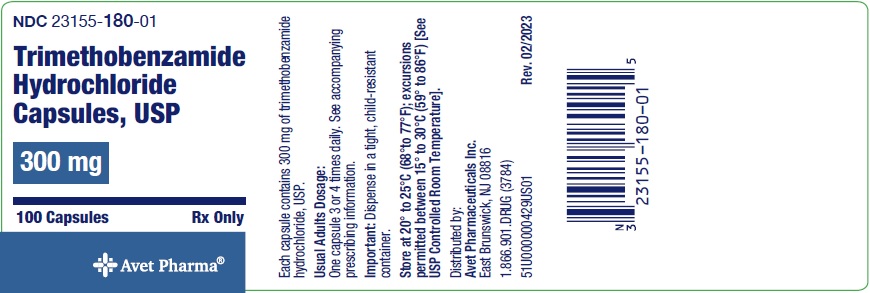
Trimethobenzamide Hydrochloride 300 mg Capsule, 100-count — NDC 23155-180-01 (Billing 23155-0180-01)
This is a package of 100 capsules of Trimethobenzamide Hydrochloride 300 mg Capsule from Heritage Pharmaceuticals Inc. d/b/a Avet Pharmaceuticals Inc., marketed since Nov 2023 and currently FDA-listed. It is this product's only package size.
NDC database record
One package, one record: these facts belong to NDC 23155-180-01 alone.
- Record
- FDA NDC Directory package listing · Human prescription drug
- Code segments
- 23155 labeler · 180 product · 01 package
- Package marketed since
- Nov 21, 2023
- Sample package
- No — commercial package
- Listing certified through
- Dec 31, 2026
- Barcode (UPC)
- 0323155180015
- FDA record last changed
- Jul 24, 2026
Identity & classification
Regulatory identifiers FDA, NLM and CMS codes for this package
- RxCUI (RxNorm): 860771
Where does this data come from?
- FDA openFDA NDC Directory · synced Oct 8, 2026
- FDA label on DailyMed · label index refreshed Oct 6, 2026
- RxNorm (NLM RxNav) · catalog refreshed Oct 1, 2026
- Medi-Span GPI (licensed)
- First Databank (licensed) · refreshed Oct 8, 2026
RxNorm drug class
This medicine belongs to the Antiemetic class.
Where does this data come from?
- RxClass (NLM) · catalog refreshed Oct 1, 2026
Clinical
- It's an anti-nausea medication approved for adults to treat two specific situations: nausea and vomiting after surgery, and nausea caused by gastroenteritis — that stomach bug that...
- What exactly does trimethobenzamide treat?
- That depends on what you're taking. Trimethobenzamide can interact with a number of common drugs — including sleep aids, opioid painkillers, anti-anxiety medications, and antipsych...
- Can I take this with my other medications?
Patient education
Supplement & herbal interactions
Where does this data come from?
- MedlinePlus (NLM) · refreshed Oct 1, 2026
- FDA label on DailyMed · label index refreshed Oct 6, 2026
Ask a licensed pharmacist directly — free, answered by our team.
Pricing
A drug doesn't have one price. Each row is a different public payment system, and none is what you'd pay at the counter — that depends on your insurance. The ⓘ on each row explains what it measures.
| Price system | Per each | Per package |
|---|---|---|
| Retail pharmacies payNADAC · weekly | Not in the retail survey — common for institutional, discontinued, or low-volume packs. | |
| Medicaid paysCMS SDUD · 12 mo | No recent Medicaid claims on file for this NDC — rare and low-volume NDCs are suppressed in the public data. | |
| Medicare drug plans payPart D · Q2 2026 | $1.44 | $143.71 / 100 capsules |
Where does this data come from?
- CMS NADAC weekly file
- CMS ASP pricing files · refreshed Sep 20, 2026
- CMS Medicaid State Drug Utilization Data · refreshed Oct 8, 2026
- CMS Part D plan pricing files · refreshed Sep 24, 2026
- VA National Acquisition Center price file
Packaging — all sizes for this product
| Package NDC | Description | Marketing start | Marketing end | Status |
|---|---|---|---|---|
| 23155-0180-01 You're viewing this Main listing | 100 CAPSULE in 1 BOTTLE | 2023-11-21 | — | Active |
Therapeutic equivalents
| Product | Labeler | Pack | NADAC/unit | TE | Status | Price vs. this |
|---|---|---|---|---|---|---|
| Trimethobenzamide Hydrochloride 300 mg 62135-0773-30 | Chartwell | 30 capsules | $18.000 | AB | Availability likely | — |
| Trimethobenzamide Hydrochloride 300 mgthis 23155-0180-01 | Heritage | 100 capsules | — | AB | FDA listed | — |
| Trimethobenzamide Hydrochloride 300 mg 43386-0660-03 | Lupin | 30 capsules | — | AB | FDA listed | — |
| Trimethobenzamide Hydrochloride 300 mg 71335-0800-01 | Bryant | 10 capsules | — | AB | FDA listed | — |
Where does this data come from?
- FDA openFDA NDC Directory · synced Oct 8, 2026
- FDA Orange Book · refreshed Oct 3, 2026
- CMS NADAC weekly file
Availability & generic status
This product is an FDA-approved generic. Other versions of the same drug are listed under Therapeutic equivalents, least expensive first.
Where does this data come from?
- FDA Orange Book · refreshed Oct 3, 2026
Inactive Ingredients / Excipients
Inactive ingredients, also called excipients, are components of the drug product other than the active ingredient. They may include fillers, dyes, coatings, preservatives, flavors, or other formulation ingredients.
🧪 Avoiding an ingredient? See Trimethobenzamide inactive ingredients by manufacturer: every current product's list side by side, so you can ask your pharmacy for the version that does not list it.
💡 Tap an ingredient (hover on desktop) to see what it is and why it’s used.
-
UNII 5138Q19F1X
Ammonia is a colorless gas made from nitrogen and hydrogen. It's used in medicines as a pH buffer to maintain the correct acidity level and help keep the product stable.
-
UNII 8PJ61P6TS3
Butyl alcohol is a clear liquid organic solvent derived from petroleum or natural sources. In medicines, it helps dissolve active ingredients and serves as a solvent in liquid formulations and some topical products.
-
UNII 767IP0Y5NH
A synthetic red colorant used to give medicines their color. It helps patients identify their medication and makes the product visually appealing.
-
UNII 3K9958V90M
A liquid solvent derived from fermentation or chemical synthesis. In medicines, alcohol dissolves active ingredients, helps preserve the product, and improves how the body absorbs certain drugs.
-
UNII H3R47K3TBD
FD&C Blue No. 1 is a synthetic blue dye approved for use in foods and medicines. It serves as a colorant to give the medication its distinctive appearance and help with product identification.
-
UNII 2G86QN327L
Gelatin is a protein derived from animal collagen, commonly used in medicines as a gelling agent and capsule material. It helps create soft or hard capsule shells that hold and release medication, and can also thicken liquid formulations.
-
UNII ND2M416302
Isopropyl alcohol is a clear liquid solvent derived from petroleum. In medicines, it dissolves active ingredients and other components, helps the product flow smoothly, and aids in sterilization during manufacturing.
-
UNII EWQ57Q8I5X
Lactose monohydrate is a natural sugar derived from milk. It serves as a filler and binder in tablets and capsules, helping create the proper size, texture, and consistency of the medicine.
-
UNII 70097M6I30
Magnesium stearate is a salt made from magnesium and stearic acid, a fatty substance. It's used in tablets and capsules as a lubricant and glidant to help ingredients flow smoothly during manufacturing and prevent sticking.
-
UNII WZH3C48M4T
Potassium hydroxide is a strong alkaline chemical used in medicines to adjust and maintain the pH level of liquid formulations, helping keep the product stable and the active ingredients effective.
-
UNII 6DC9Q167V3
Propylene glycol is a clear liquid derived from petroleum or vegetable sources. It acts as a solvent, humectant, and preservative in medicines, helping dissolve active ingredients and maintain product stability.
-
UNII 46N107B71O
Shellac is a natural resin secreted by the lac beetle. It's used as a coating on tablets and capsules to control how quickly the medicine dissolves and to improve appearance and stability.
-
UNII 368GB5141J
A detergent and foaming agent derived from coconut or palm oil. In medications, it helps break down and mix oil and water-based ingredients, aids in tablet disintegration, and improves how the drug dissolves and spreads in the mouth or digestive system.
-
UNII O8232NY3SJ
A plant-based carbohydrate derived from corn kernels. It acts as a filler to add bulk, a binder to hold ingredients together, and a disintegrant to help the tablet break apart in your stomach for absorption.
-
UNII 15FIX9V2JP
Titanium dioxide is a bright white mineral powder commonly used as a colorant and opacifying agent. It makes pills and tablets white or lighter in color and helps make coatings non-transparent.
15 inactive ingredients listed in the exact product block matched to this NDC.
Where does this data come from?
ingredient classCode="IACT" elements from the exact product block matched by this NDC. Label-section narrative from DailyMed / the openFDA label index is shown separately when available.- FDA label on DailyMed · label index refreshed Oct 6, 2026
- FDA openFDA NDC Directory · synced Oct 8, 2026
Inactive ingredient FAQ
Are inactive ingredients the same for every manufacturer?
Why might an inactive ingredient be missing?
Can inactive ingredients matter?
Manufacturer & labeler
More NDCs from Heritage Pharmaceuticals Inc. d/b/a Avet Pharmac... labeler code 23155
- Doxycycline Hyclate Delayed Release 150 mg Tablet, Delayed Release NDC 23155-143-01
- Acarbose 25 mg Tablet NDC 23155-147-01
- Acarbose 50 mg Tablet NDC 23155-148-01
- Acarbose 100 mg Tablet NDC 23155-149-01
- Tranexamic Acid 1 g/10mL Injection, Solution NDC 23155-166-41
- Zoledronic acid 4 mg/5mL Injection, Solution, Concentrate NDC 23155-170-31
- bupropion Hydrochloride 75 mg Tablet NDC 23155-191-01
- bupropion Hydrochloride 100 mg Tablet NDC 23155-192-01
- COLISTIMETHATE SODIUM 150 mg/4mL Injection, Powder, Lyophilized, For Solution NDC 23155-193-31
- Nifedipine 10 mg Capsule NDC 23155-194-01
- Nifedipine 20 mg Capsule NDC 23155-195-01
- CIDOFOVIR DIHYDRATE 375 mg/5mL Injection, Solution NDC 23155-216-31
Where does this data come from?
- FDA openFDA NDC Directory · synced Oct 8, 2026
- Drugs@FDA
Full prescribing information FDA SPL
🎯 Indications and Usage ▾
1 INDICATIONS AND USAGE Trimethobenzamide hydrochloride capsules are indicated in adults for the treatment of postoperative nausea and vomiting and for nausea associated with gastroenteritis. Limitation of Use: Trimethobenzamide hydrochloride capsules are not recommended for use in pediatric patients due to the risk of extrapyramidal signs and symptoms and other serious central nervous system (CNS) effects, and the risk of exacerbation of the underlying disease in pediatric patients with Reye’s syndrome or other hepatic impairment.
Trimethobenzamide hydrochloride capsules are an antiemetic indicated in adults for the treatment of postoperative nausea and vomiting and for nausea associated with gastroenteritis. ( 1 ) Limitation of Use: Trimethobenzamide hydrochloride capsule is not recommended for use in pediatric patients due to the risk of extrapyramidal signs and symptoms and other serious central nervous system (CNS) effects and the risk of exacerbation of the underlying disease in pediatric patients with Reye’s syndrome or other hepatic impairment.
( 1 , 8.4 )
⏱️ Dosage and Administration ▾
2 DOSAGE AND ADMINISTRATION The recommended adult dosage is 300 mg orally three or four times daily. ( 2.1 ) Geriatric patients and/or patients with renal impairment (creatinine clearance 70 mL/min/1.73m 2 or less): Reduce the daily dosage by increasing the dosing interval; monitor renal function. ( 2.2 , 8.5 , 8.6 ) Select the lowest effective daily dosage and adjust as needed based upon therapeutic response and tolerability. ( 2.1 , 2.2 )
2.1Recommended Adult Dosage The recommended adult dosage is 300 mg orally three or four times daily. Select the lowest effective daily dosage and adjust as needed based upon therapeutic response and tolerability.
2.2Dosage Adjustment for Geriatric Patients and/or Patients with Renal Impairment In geriatric patients and/or in patients with renal impairment (creatinine clearance 70 mL/min/1.73m 2 or less), reduce the daily dosage of trimethobenzamide hydrochloride capsules by increasing the dosing interval and adjust as needed based upon therapeutic response and tolerability. Monitor renal function [see Use in Specific Populations ( 8.5 , 8.6 )] .
💊 Dosage Forms and Strengths ▾
3 DOSAGE FORMS AND STRENGTHS Capsules: 300 mg trimethobenzamide hydrochloride; size ‘1’, two-piece purple opaque cap and purple opaque body, hard gelatin capsules, printed in white with “HP” on cap and in white with “180” on body, filled with white to off-white granular powder. Capsules: 300 mg of trimethobenzamide hydrochloride ( 3 )
⛔ Contraindications ▾
4 CONTRAINDICATIONS Trimethobenzamide hydrochloride capsules are contraindicated in patients with known hypersensitivity to trimethobenzamide [see Adverse Reactions ( 6 )] . Known hypersensitivity to trimethobenzamide ( 4 )
⚠️ Warnings and Cautions ▾
5 WARNINGS AND PRECAUTIONS Acute Dystonic Reactions and Other Extrapyramidal Symptoms (EPS): Depending on the severity of symptoms, reduce the dosage or discontinue the drug. Treat acute dystonic reactions with anticholinergics. Avoid trimethobenzamide hydrochloride capsules in patients receiving other drugs that are likely to cause EPS.
( 5.1 , 7.2 ) Masking of Other Serious Disorders: EPS and other CNS symptoms in patients treated with trimethobenzamide hydrochloride capsules may be confused with CNS signs of undiagnosed primary disease (e.g., encephalopathy, metabolic imbalance, Reye’s Syndrome). If CNS symptoms occur, evaluate the risks and benefits of continuing trimethobenzamide hydrochloride capsules. ( 5.2 , 7.2 ) Other CNS Reactions: Coma, depression of mood, disorientation, and seizures have been reported.
The recent use of other drugs that cause CNS depression or EPS symptoms may also increase the risk; consider reducing the dosage or discontinuing the drug. ( 5.3 , 7.1 , 7.2 ) Hepatotoxicity: Avoid use in patients whose signs and symptoms suggest the presence of hepatic impairment. Discontinue trimethobenzamide hydrochloride capsules in patients who develop impaired liver function while on treatment.
( 5.4 , 8.7 ) Effects on the Ability to Drive or Operate Machinery: Mental and/or physical abilities may be impaired. Concomitant use of other drugs that cause CNS depression or EPS symptoms may increase this effect; either trimethobenzamide hydrochloride capsules or the other interacting drug should be chosen, depending on the importance of the drug to the patient. ( 5.5 , 7.1 , 7.2 )
5.1Acute Dystonic Reactions and Other Extrapyramidal Symptoms (EPS) Extrapyramidal symptoms (EPS), manifested primarily as acute dystonic reactions, may occur with trimethobenzamide hydrochloride capsules. Dystonic reactions may include sudden onset of muscular spasms, especially in the head and neck or opisthotonos. Other EPS include laryngospasm, dysphagia, and oculogyric crisis.
Involuntary spasms of the tongue and mouth may lead to difficulty in speaking and swallowing. Anticholinergic drugs can be used to treat acute dystonic reactions. EPS may also include akathisia, restlessness, akinesia, and other parkinsonian-like symptoms (e.g., tremor).
Depending on the severity of symptoms, reduce the daily dosage of trimethobenzamide hydrochloride capsules by increasing the dosing interval or discontinue trimethobenzamide hydrochloride capsules [see Dosage and Administration ( 2.1 )] . Avoid trimethobenzamide hydrochloride capsules in patients receiving other drugs that are likely to cause EPS (e.g. antipsychotics) [see Drug Interactions ( 7.2 )] .
5.2Masking of Other Serious Disorders EPS and other CNS symptoms which can occur in patients treated with trimethobenzamide hydrochloride capsules may be confused with CNS signs of undiagnosed primary disease (e.g., encephalopathy, metabolic imbalance, Reye’s syndrome) [see Warnings and Precautions ( 5.1 , 5.3 )] . If CNS symptoms occur, evaluate the risks and benefits of continuing trimethobenzamide hydrochloride capsules for each patient.
5.3Other CNS Reactions Other serious CNS adverse reactions such as coma, depression of mood, disorientation, and seizures have been reported with trimethobenzamide hydrochloride capsules administration. The recent use of other drugs that cause CNS depression or EPS symptoms (e.g., alcohol, sedatives, hypnotics, opiates, anxiolytics, antipsychotics, and anticholinergics) may also increase the risk for these serious CNS reactions [see Warnings and Precautions ( 5.1 , 5.5 )] . Consider reducing the daily dosage of trimethobenzamide hydrochloride capsules by increasing the dosing interval or discontinuing the drug [see Dosage and Administration ( 2.1 ), Drug Interactions ( 7.1 , 7.2 )] .
5.4Hepatotoxicity Trimethobenzamide hydrochloride is potentially hepatotoxic [see Adverse Reactions ( 6 )] . Avoid use of Trimethobenzamide hydrochloride capsules in patients… [Excerpted — this section continues on DailyMed.]
🤒 Adverse Reactions ▾
6 ADVERSE REACTIONS The following adverse reactions from voluntary reports or clinical studies have been reported with trimethobenzamide. Because many of these reactions were reported voluntarily from a population of uncertain size, it is not always possible to reliably estimate their frequency or establish a causal relationship to drug exposure. Nervous system disorders: Parkinson-like symptoms, coma, convulsions, opisthotonos, dizziness, drowsiness, headache, [see Warnings and Precautions ( 5.1 , 5.2 , 5.3 )] Psychiatric disorders: disorientation, depression of mood Eye disorders: blurred vision Hematologic disorders: blood dyscrasias Hepatobiliary disorders: jaundice [see Warnings and Precautions ( 5.4 )] Immune system disorders: hypersensitivity, including angioedema and allergic-type skin reactions Gastrointestinal disorders: diarrhea Musculoskeletal disorders: muscle cramps Adverse reactions include hypersensitivity reactions and Parkinson-like symptoms; blood dyscrasias, blurring of vision, coma, convulsions, depression of mood, diarrhea, disorientation, dizziness, drowsiness, headache, jaundice, muscle cramps, and opisthotonos.
( 6 ) To report SUSPECTED ADVERSE REACTIONS, contact Avet Pharmaceuticals Inc. at 1-866-901-DRUG (3784) or FDA at 1-800-FDA-1088 or www.fda.gov/medwatch.
🔄 Drug Interactions ▾
7 DRUG INTERACTIONS Alcohol : May cause drowsiness; avoid concomitant use. ( 7.1 ) Other Drugs that Cause CNS Depression or EPS: Either trimethobenzamide hydrochloride capsules or the other interacting drug should be chosen, depending on the importance of the drug to the patient. If CNS-acting drugs cannot be avoided, monitor patients for CNS adverse reactions. ( 7.2 )
7.1Alcohol Alcohol may increase the CNS depressant effects of trimethobenzamide hydrochloride capsules and may cause drowsiness [see Warnings and Precautions ( 5.3 , 5.5 )] . Avoid concomitant use of trimethobenzamide hydrochloride capsules with alcohol.
7.2Other Drugs that Cause CNS Depression or EPS The concurrent use of trimethobenzamide hydrochloride capsules with other drugs that cause CNS depression or EPS (e.g., sedatives, hypnotics, opiates, anxiolytics, antipsychotics, and anticholinergics, may potentiate the effects of trimethobenzamide hydrochloride capsules [see Warnings and Precautions ( 5.1 , 5.2 , 5.3 , 5.5 )] . Either trimethobenzamide hydrochloride capsules or the other interacting drug should be chosen, depending on the importance of the drug to the patient.
If CNS-acting drugs cannot be avoided, monitor patients for CNS adverse reactions.
👥 Use in Specific Populations ▾
8 USE IN SPECIFIC POPULATIONS
8.1Pregnancy Risk Summary The limited available data with trimethobenzamide in pregnant women are not sufficient to inform a drug-associated risk for major birth defects and miscarriage. No adverse developmental effect was observed in animal reproduction studies with administration of trimethobenzamide hydrochloride during organogenesis in pregnant rats at doses 0.16 and 0.8 times the recommended human dose (RHD) and in pregnant rabbits at doses 1.6 times the RHD [see Data ] . The estimated background risk of major birth defects and miscarriage for the indicated population is unknown.
All pregnancies have a background risk of birth defect, loss, or other adverse outcomes. In the U.S. general population, the estimated background risk of major birth defects and miscarriage in clinically recognized pregnancies is 2 to 4% and 15 to 20%, respectively. Data Animal Data Reproduction studies with trimethobenzamide hydrochloride were conducted in rats and rabbits following administration of trimethobenzamide hydrochloride during organogenesis and no adverse developmental effect was observed in either species.
The only effects observed were an increased percentage of embryonic resorptions or stillborn pups in rats administered 20 mg/kg and 100 mg/kg (0.16 and 0.8 times the RHD of 1200 mg/day, based on body surface area) and increased resorptions in rabbits receiving 100 mg/kg (1.6 times the RHD of 1200 mg/day, based on body surface area). In each study, these adverse effects were attributed to one or two dams. 8.2 Lactation Risk Summary There is no information on the presence of trimethobenzamide in human milk, the effects of trimethobenzamide hydrochloride capsule on the breastfed infant or the effects of trimethobenzamide hydrochloride capsule on milk production.
The lack of clinical data during lactation precludes a clear determination of the risk of trimethobenzamide hydrochloride capsules to an infant during lactation; therefore, the developmental and health benefits of breastfeeding should be considered along with the mother's clinical need for trimethobenzamide hydrochloride capsules and any potential adverse effects on the breastfed infant from trimethobenzamide hydrochloride capsules or from the underlying maternal condition.
8.4Pediatric Use The safety and effectiveness of trimethobenzamide hydrochloride capsules in pediatric patients has not been established. Trimethobenzamide hydrochloride capsules are not recommended for use in pediatric patients due to the risk of EPS and other serious CNS effects, and the risk of exacerbation of underlying disease in pediatric patients with Reye’s Syndrome, or other hepatic impairment [see Warnings and Precautions ( 5.1 , 5.2 , 5.3 , 5.4 )] .
8.5Geriatric Use Clinical studies of trimethobenzamide did not include sufficient numbers of patients aged 65 years and over to determine whether they respond differently from younger patients. Although there are studies reported in the literature that included geriatric patients 65 years and older with younger patients, it is not known if there are differences in efficacy or safety parameters for geriatric and non-geriatric patients treated with trimethobenzamide hydrochloride capsules. Trimethobenzamide is excreted by the kidney, and the risk of adverse reactions to this drug may be greater in patients with impaired renal function.
Because geriatric patients are more likely to have decreased renal function, reduce the daily dosage of trimethobenzamide hydrochloride capsules by increasing the dosing interval and adjust as needed based upon therapeutic response and tolerability. Monitor renal function [see Dosage and Administration ( 2.2 ), Use in Specific Populations ( 8.6 )] .
8.6Renal Impairment Trimethobenzamide is eliminated by renal excretion [see Clinical Pharmacology ( 12.3 )] . In patients with renal impairment (creatinine clearance 70 mL/min/1.73m 2 or less), reduce the daily dosage by increasing the dosin… [Excerpted — this section continues on DailyMed.]
🧬 Clinical Pharmacology ▾
12 CLINICAL PHARMACOLOGY
12.1Mechanism of Action The mechanism of action of trimethobenzamide as determined in animals is obscure, but may involve the chemoreceptor trigger zone (CTZ), an area in the medulla oblongata through which emetic impulses are conveyed to the vomiting center; direct impulses to the vomiting center apparently are not similarly inhibited. In dogs pretreated with trimethobenzamide HCl, the emetic response to apomorphine is inhibited, while little or no protection is afforded against emesis induced by intragastric copper sulfate.
12.3Pharmacokinetics Absorption The pharmacokinetics of trimethobenzamide in healthy adult subjects were compared when trimethobenzamide hydrochloride capsule was administered as a 300 mg oral capsule or a 200 mg (100 mg/mL) intramuscular injection. The time to reach maximum plasma concentration (T max ) was about 30 minutes after intramuscular injection compared to about 45 minutes after oral capsule administration. The plasma concentration-time profile of trimethobenzamide was similar between the two formulations.
Elimination The mean elimination half-life of trimethobenzamide is 7 to 9 hours. Metabolism The major pathway of trimethobenzamide metabolism is through oxidation resulting in the formation of trimethobenzamide N-oxide metabolite. The pharmacologic activity of this major metabolite has not been evaluated.
Excretion Between 30 to 50% of a single dose in humans is excreted unchanged in the urine within 48 to 72 hours. Specific Populations Sex Systemic exposure to trimethobenzamide was similar between men (N=40) and women (N=28). Following a single 300 mg capsule oral administration, the respective mean (SD) C max of trimethobenzamide were 3.5 (1.1) and 4.2 (1.6) micrograms/mL in male and female subjects.
The respective mean (SD) of AUC 0-∞ of trimethobenzamide were 10 (2.7) and 10.4 (2.7) micrograms×hour/mL in male and female subjects. Race Pharmacokinetics appeared to be similar for Caucasians (N=53) and African Americans (N=12). Following a single 300 mg capsule oral administration, the respective mean (SD) C max of trimethobenzamide was 3.8 (1.3) micrograms/mL in Caucasians and 3.9 (1.7) micrograms/mL in African Americans.
The respective mean (SD) AUC 0-∞ of trimethobenzamide was 10.4 (2.8) micrograms×hour/mL in Caucasians and 9.8 (2.5) micrograms×hour/mL in African Americans.
📦 How Supplied / Storage and Handling ▾
16 HOW SUPPLIED/STORAGE AND HANDLING Trimethobenzamide hydrochloride capsules are available as a capsule for oral use with an size ‘1’, two-piece purple opaque cap and purple opaque body, hard gelatin capsules, printed in white with “HP” on cap and in white with “180” on body, filled with white to off-white granular powder. Each capsule contains 300 mg of trimethobenzamide hydrochloride. NDC Number Strength Package 23155-180-01 300 mg capsules bottles of 100 Store at 20° to 25°C (68° to 77°F); excursions permitted between 15° to 30°C (59° to 86°F) [See USP Controlled Room Temperature].
📋 Description ▾
11 DESCRIPTION Chemically, trimethobenzamide hydrochloride is N-[ p -[2-(dimethylamino)ethoxy]benzyl]-3,4,5-trimethoxybenzamide monohydrochloride. It has a molecular weight of 424.93 and the following structural formula: Capsules: Each capsule for oral use contains trimethobenzamide hydrochloride USP equivalent to 300 mg. The capsule has an opaque purple cap marked “HP” and an opaque purple body marked “180”.
The inactive ingredients are lactose monohydrate, magnesium stearate, and corn starch. The capsule shell contains the following ingredients: gelatin, titanium dioxide, D&C Red No. 28, and FDC Blue No.
1, and sodium lauryl sulfate. White ink contains the following ingredients: Shellac, dehydrated alcohol, isopropyl alcohol, butyl alcohol, propylene glycol, ammonium hydroxide, potassium hydroxide and titanium dioxide. chemical-structure
📄 Package Label / Principal Display Panel ▾
PACKAGE LABEL.PRINCIPAL DISPLAY PANEL - 300 mg NDC 23155- 180 -01 Trimethobenzamide Hydrochloride Capsules, USP 300 mg 100 Capsules Rx Only 300mg-100s
Reported adverse events (FAERS)
Top reported reactions
Age at onset
Reporter sex
Serious outcomes
Where does this data come from?
About this NDC listing & data coverage
What data is (and isn’t) available for this NDC — tap to expand
| NDC identity (package / product / labeler codes) | ✓ Available |
| Labeler | ✓ Available |
| Product & package description | ✓ Available |
| Marketing category & status | ✓ Available |
| Active ingredient / dosage form / route | ✓ Available |
| FDA label (SPL via DailyMed) | ✓ Available |
| Package photos | ✓ Available |
| Inactive ingredients (structured) | ✓ Available |
| NADAC pharmacy acquisition price (CMS) | — Not published for this NDC CMS publishes NADAC only for NDCs reported in its retail-pharmacy survey. |
| Orange Book / therapeutic-equivalence data | ✓ Available |
| HCPCS J-code billing crosswalk | — Not published for this NDC Most self-administered / retail products have no J-code — that is normal. |
| Medicaid utilization (CMS SDUD) | — Not published for this NDC CMS reports utilization only for NDCs with Medicaid claims above its privacy threshold. |