
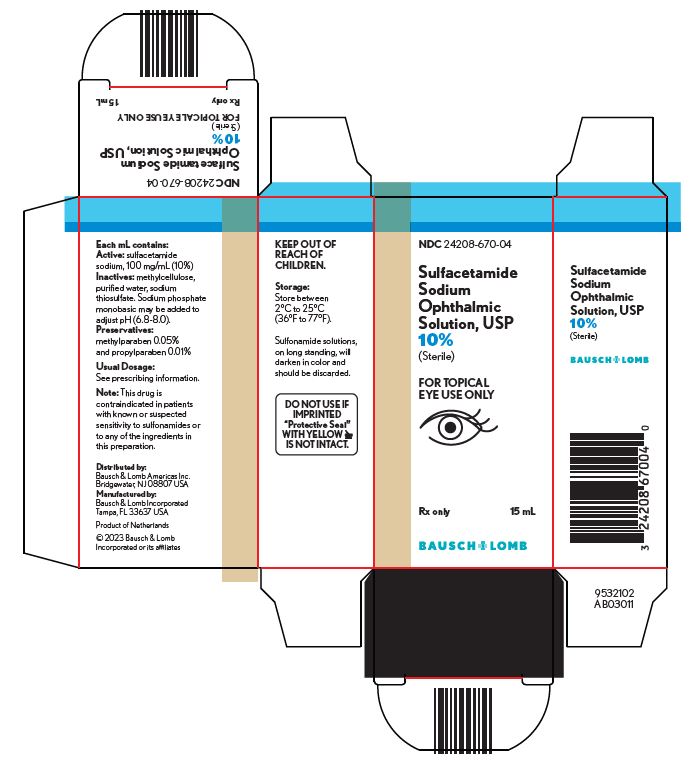
Sulfacetamide Sodium 100 mg/mL Solution/ Drops — NDC 24208-670-04 (Billing 24208-0670-04)
This is a package of Sulfacetamide Sodium 100 mg/mL Solution/ Drops from Bausch & Lomb Incorporated, marketed since Dec 1994 and currently FDA-listed; retail pharmacies pay about $1.96 per mL (NADAC). It is this product's only package size.
Identity & classification
Regulatory identifiers FDA, NLM and CMS codes for this package
Drug-database identifiers Medi-Span GPI and First Databank GCN / HICL / AHFS classification
- GSN (GCN sequence number): 007920
- GCN: 33340
- GPI-14 (Medi-Span): 86102010102010
- HICL (First Databank): 003345
- AHFS class code: 52:04.04.00
- RxCUI (RxNorm): 1006120
Where does this data come from?
- FDA openFDA NDC Directory · synced Oct 1, 2026
- FDA label on DailyMed · label index refreshed Oct 1, 2026
- RxNorm (NLM RxNav) · catalog refreshed Oct 1, 2026
- Medi-Span GPI (licensed)
- First Databank (licensed) · refreshed Oct 1, 2026
RxNorm drug class
This medicine belongs to the Sulfonamide Antibacterial class.
Where does this data come from?
- RxClass (NLM) · catalog refreshed Oct 1, 2026
Clinical
Ophthalmic sulfacetamide stops the growth of bacteria that cause certain eye infections. It is used to treat eye infections and to prevent them after injuries.
Read the full MedlinePlus article ↗- It treats conjunctivitis (pink eye) and other superficial eye infections caused by susceptible bacteria. It is also used with sulfonamide medicine given through the body for tracho...
- You place one or two drops into the lower pocket of the affected eye. For pink eye, that's usually every two to three hours at first. Your doctor may space the doses out as you imp...
- The most common are irritation, stinging and burning in the eye. Some people notice eye redness or a secondary infection. These are usually the things to mention to your pharmacist...
- Stop the drops and call right away if you get a skin rash or any sign of an allergic reaction. Rarely, sulfa drugs cause serious, even fatal, reactions affecting the skin, liver or...
Patient education
Supplement & herbal interactions
Where does this data come from?
- MedlinePlus (NLM) · refreshed Oct 1, 2026
- FDA label on DailyMed · label index refreshed Oct 1, 2026
Ask a licensed pharmacist directly — free, answered by our team.
Pricing
A drug doesn't have one price. Each row is a different public payment system, and none is what you'd pay at the counter — that depends on your insurance. The ⓘ on each row explains what it measures.
| Price system | Per mL | Per package |
|---|---|---|
| Retail pharmacies payNADAC · weekly | $1.962 | $29.43 / 15 ml |
| Medicaid paysCMS SDUD · 12 mo | $2.51 | $37.59 / 15 ml |
| Medicare drug plans payPart D · Q2 2026 | $1.86 | $27.95 / 15 ml |
Where does this data come from?
- CMS NADAC weekly file · file of Sep 30, 2026
- CMS ASP pricing files · refreshed Sep 20, 2026
- CMS Medicaid State Drug Utilization Data · through Q1 2026
- CMS Part D plan pricing files · refreshed Sep 24, 2026
- VA National Acquisition Center price file
Packaging — all sizes for this product
| Package NDC | Description | Marketing start | Marketing end | Status |
|---|---|---|---|---|
| 24208-0670-04 You're viewing this Main listing | 1 BOTTLE, DROPPER in 1 CARTON / 15 mL in 1 BOTTLE, DROPPER | 1994-12-28 | — | Active |
Therapeutic equivalents
| Product | Labeler | Pack | NADAC/unit | TE | Status | Price vs. this |
|---|---|---|---|---|---|---|
| Sulfacetamide Sodium 100 mg/mLthis 24208-0670-04 | Bausch | 1 bottle | $1.962 | AT | Availability likely | — |
| Sulfacetamide Sodium 100 mg/mL 50090-0246-00 | A-S | 1 bottle | — | AT | FDA listed | — |
| Sulfacetamide Sodium 100 mg/mL 68071-5123-05 | NuCare | 15 ml | — | AT | FDA listed | — |
| Sulfacetamide Sodium 100 mg/mL 68788-9871-01 | Preferred | 15 ml | — | AT | FDA listed | — |
| Sulfacetamide Sodium 100 mg/mL 71205-0689-15 | Proficient | 1 bottle | — | AT | FDA listed | — |
| Sulfacetamide Sodium 100 mg/mL 76420-0076-15 | Asclemed | 15 ml | — | AT | FDA listed | — |
| Sulfacetamide Sodium 100 mg/mL 76420-0090-15 | Asclemed | 15 ml | — | AT | FDA listed | — |
Where does this data come from?
- FDA openFDA NDC Directory · synced Oct 1, 2026
- FDA Orange Book · refreshed Oct 3, 2026
- CMS NADAC weekly file · file of Sep 30, 2026
Availability & generic status
This product is an FDA-approved generic. Other versions of the same drug are listed under Therapeutic equivalents, least expensive first.
Where does this data come from?
- FDA Orange Book · refreshed Oct 3, 2026
Inactive Ingredients / Excipients
Inactive ingredients, also called excipients, are components of the drug product other than the active ingredient. They may include fillers, dyes, coatings, preservatives, flavors, or other formulation ingredients.
💡 Tap an ingredient (hover on desktop) to see what it is and why it’s used.
-
UNII 4GFU244C4J
Methylcellulose is a plant-based thickening agent made from cellulose. It acts as a binder to hold pill ingredients together and as a bulking agent to add texture and consistency to liquid or semi-solid medicines.
-
UNII A2I8C7HI9T
Methylparaben is a preservative derived from benzoic acid that prevents growth of bacteria, fungi, and mold in medicines. It extends the product's shelf life and maintains safety during storage.
-
UNII Z8IX2SC1OH
Propylparaben is a chemical preservative used to prevent bacterial and fungal growth in medicines and personal care products. It helps extend shelf life and maintain product safety during storage.
-
UNII KH7I04HPUU
A salt compound made from sodium and phosphoric acid, used as a buffer to help maintain a stable pH level in the medicine, and sometimes as a binder or filler in tablets and capsules.
-
UNII HX1032V43M
Sodium thiosulfate is a salt compound used in medicines as a buffer and pH regulator. It helps stabilize the medication and may also serve as a preservative or antioxidant to maintain product quality.
-
UNII 059QF0KO0R
Water is a liquid solvent that dissolves and mixes ingredients together in liquid medicines, syrups, and injections. It helps distribute the active drug evenly throughout the product.
6 inactive ingredients listed in the exact product block matched to this NDC.
Where does this data come from?
ingredient classCode="IACT" elements from the exact product block matched by this NDC. Label-section narrative from DailyMed / the openFDA label index is shown separately when available.- FDA label on DailyMed · label index refreshed Oct 1, 2026
- FDA openFDA NDC Directory · synced Oct 1, 2026
Inactive ingredient FAQ
Are inactive ingredients the same for every manufacturer?
Why might an inactive ingredient be missing?
Can inactive ingredients matter?
Manufacturer & labeler
Where does this data come from?
- FDA openFDA NDC Directory · synced Oct 1, 2026
- Drugs@FDA
Full prescribing information FDA SPL
🎯 Indications and Usage ▾
INDICATIONS AND USAGE Sulfacetamide sodium ophthalmic solution USP, 10% is indicated for the treatment of conjunctivitis and other superficial ocular infections due to susceptible microorganisms, and as an adjunctive in systemic sulfonamide therapy of trachoma: Escherichia coli, Staphylococcus aureus, Streptococcus pneumoniae, Streptococcus (viridans group), Haemophilus influenzae, Klebsiella species, and Enterobacter species. Topically applied sulfonamides do not provide adequate coverage against Neisseria species, Serratia marcescens and Pseudomonas aeruginosa .
A significant percentage of staphylococcal isolates are completely resistant to sulfa drugs.
⏱️ Dosage and Administration ▾
DOSAGE AND ADMINISTRATION For conjunctivitis and other superficial ocular infections: Instill one or two drops into the conjunctival sac(s) of the affected eye(s) every two to three hours initially. Dosages may be tapered by increasing the time interval between doses as the condition responds. The usual duration of treatment is seven to ten days.
For trachoma: Instill two drops into the conjunctival sac(s) of the affected eye(s) every two hours. Topical administration must be accompanied by systemic administration.
⛔ Contraindications ▾
CONTRAINDICATIONS Sulfacetamide sodium ophthalmic solution USP, 10% is contraindicated in individuals who have a hypersensitivity to sulfonamides or to any ingredient of the preparation.
⚠️ Warnings ▾
WARNINGS FOR TOPICAL EYE USE ONLY - NOT FOR INJECTION. FATALITIES HAVE OCCURRED, ALTHOUGH RARELY, DUE TO SEVERE REACTIONS TO SULFONAMIDES INCLUDING STEVENS-JOHNSON SYNDROME, TOXIC EPIDERMAL NECROLYSIS, FULMINANT HEPATIC NECROSIS, AGRANULOCYTOSIS, APLASTIC ANEMIA AND OTHER BLOOD DYSCRASIAS. Sensitizations may recur when a sulfonamide is readministered, irrespective of the route of administration.
Sensitivity reactions have been reported in individuals with no prior history of sulfonamide hypersensitivity. At the first sign of hypersensitivity, skin rash or other serious reaction, discontinue use of this preparation.
🤒 Adverse Reactions ▾
ADVERSE REACTIONS Bacterial and fungal corneal ulcers have developed during treatment with sulfonamide ophthalmic preparations. The most frequently reported reactions are local irritation, stinging and burning. Less commonly reported reactions include non-specific conjunctivitis, conjunctival hyperemia, secondary infections and allergic reactions.
Fatalities have occurred, although rarely, due to severe reactions to sulfonamides including Stevens-Johnson syndrome, toxic epidermal necrolysis, fulminant hepatic necrosis, agranulocytosis, aplastic anemia, and other blood dyscrasias (see WARNINGS ). To report SUSPECTED ADVERSE REACTIONS, contact Bausch & Lomb Incorporated at 1-800-553-5340 or FDA at 1-800-FDA-1088 or www.fda.gov/medwatch .
🔄 Drug Interactions ▾
Drug Interactions Sulfacetamide preparations are incompatible with silver preparations.
🤰 Pregnancy ▾
Pregnancy Animal reproduction studies have not been conducted with sulfonamide ophthalmic preparations. Kernicterus may occur in the newborn as a result of treatment of a pregnant woman at term with orally administered sulfonamides. There are no adequate and well-controlled studies of sulfonamide ophthalmic preparations in pregnant women, and it is not known whether topically applied sulfonamides can cause fetal harm when administered to a pregnant woman.
This product should be used in pregnancy only if the potential benefit justifies the potential risk to the fetus.
🧒 Pediatric Use ▾
Pediatric Use Safety and effectiveness in infants below the age of two months have not been established.
🧬 Clinical Pharmacology ▾
CLINICAL PHARMACOLOGY Microbiology: The sulfonamides are bacteriostatic agents and the spectrum of activity is similar for all. Sulfonamides inhibit bacterial synthesis of dihydrofolic acid by preventing the condensation of the pteridine with aminobenzoic acid through competitive inhibition of the enzyme dihydropteroate synthetase. Resistant strains have altered dihydropteroate synthetase with reduced affinity for sulfonamides or produce increased quantities of aminobenzoic acid.
Topically applied sulfonamides are considered active against susceptible strains of the following common bacterial eye pathogens: Escherichia coli, Staphylococcus aureus, Streptococcus pneumoniae, Streptococcus (viridans group), Haemophilus influenzae, Klebsiella species, and Enterobacter species. Topically applied sulfonamides do not provide adequate coverage against Neisseria species, Serratia marcescens and Pseudomonas aeruginosa . A significant percentage of staphylococcal isolates are completely resistant to sulfa drugs.
📦 How Supplied / Storage and Handling ▾
HOW SUPPLIED Sulfacetamide sodium ophthalmic solution USP, 10% is supplied in a plastic squeeze bottle with a controlled drop tip in the following size: NDC 24208-670-04 15 mL bottle Storage: Store between 2°C to 25°C (36°F to 77°F). Sulfonamide solutions, on long standing, will darken in color and should be discarded. Keep out of reach of children.
Distributed by: Bausch & Lomb Americas Inc. Bridgewater, NJ 08807 USA Manufactured by: Bausch & Lomb Incorporated Tampa, FL 33637 USA © 2023 Bausch & Lomb Incorporated or its affiliates Revised: August 2023 9113204 (Folded) 9113304 (Flat) donotuse
📋 Description ▾
DESCRIPTION Sulfacetamide sodium ophthalmic solution USP, 10% is a sterile, topical antibacterial agent for ophthalmic use. The active ingredient is represented by the following structural formula: Chemical name: N -Sulfanilylacetamide monosodium salt monohydrate. Each mL contains: Active: sulfacetamide sodium, 100 mg/mL (10%); Inactives: methylcellulose, purified water, sodium thiosulfate.
Sodium phosphate monobasic may be added to adjust pH (6.8-8.0). Preservatives: methylparaben 0.05% and propylparaben 0.01%. The osmolality range is 700-1300 mOsm/kg. chem
💬 Information for Patients ▾
Information for Patients To avoid contamination, do not touch tip of container to the eye, eyelid or any surface.
⚠️ Precautions ▾
PRECAUTIONS General Prolonged use of topical antibacterial agents may give rise to overgrowth of nonsusceptible organisms including fungi. Bacterial resistance to sulfonamides may also develop. The effectiveness of sulfonamides may be reduced by the para-aminobenzoic acid present in purulent exudates.
Sensitization may recur when a sulfonamide is readministered irrespective of the route of administration and cross-sensitivity between different sulfonamides may occur. At the first sign of hypersensitivity, increase in purulent discharge, or aggravation of inflammation or pain, the patient should discontinue use of the medication and consult a physician (see WARNINGS ). Information for Patients To avoid contamination, do not touch tip of container to the eye, eyelid or any surface.
Drug Interactions Sulfacetamide preparations are incompatible with silver preparations. Carcinogenesis, Mutagenesis, Impairment of Fertility No studies have been conducted in animals or in humans to evaluate the possibility of these effects with ocularly administered sulfacetamide. Rats appear to be especially susceptible to the goitrogenic effects of sulfonamides, and long-term oral administration of sulfonamides has resulted in thyroid malignancies in these animals.
Pregnancy Animal reproduction studies have not been conducted with sulfonamide ophthalmic preparations. Kernicterus may occur in the newborn as a result of treatment of a pregnant woman at term with orally administered sulfonamides. There are no adequate and well-controlled studies of sulfonamide ophthalmic preparations in pregnant women, and it is not known whether topically applied sulfonamides can cause fetal harm when administered to a pregnant woman.
This product should be used in pregnancy only if the potential benefit justifies the potential risk to the fetus. Nursing Mothers Systemically administered sulfonamides are capable of producing kernicterus in infants of lactating women. Because of the potential for the development of kernicterus in neonates, a decision should be made whether to discontinue nursing or discontinue the drug taking into account the importance of the drug to the mother.
Pediatric Use Safety and effectiveness in infants below the age of two months have not been established.
🍼 Nursing Mothers ▾
Nursing Mothers Systemically administered sulfonamides are capable of producing kernicterus in infants of lactating women. Because of the potential for the development of kernicterus in neonates, a decision should be made whether to discontinue nursing or discontinue the drug taking into account the importance of the drug to the mother.
📄 Carcinogenesis, Mutagenesis, Impairment of Fertility ▾
Carcinogenesis, Mutagenesis, Impairment of Fertility No studies have been conducted in animals or in humans to evaluate the possibility of these effects with ocularly administered sulfacetamide. Rats appear to be especially susceptible to the goitrogenic effects of sulfonamides, and long-term oral administration of sulfonamides has resulted in thyroid malignancies in these animals.
📄 Package Label / Principal Display Panel ▾
PACKAGE/LABEL PRINCIPAL DISPLAY PANEL NDC 24208-670-04 Sulfacetamide Sodium Ophthalmic Solution, USP 10% (Sterile) FOR TOPICAL EYE USE ONLY Eye image symbol Rx only 15 mL BAUSCH + LOMB 9532102 AB0301 CARTON