
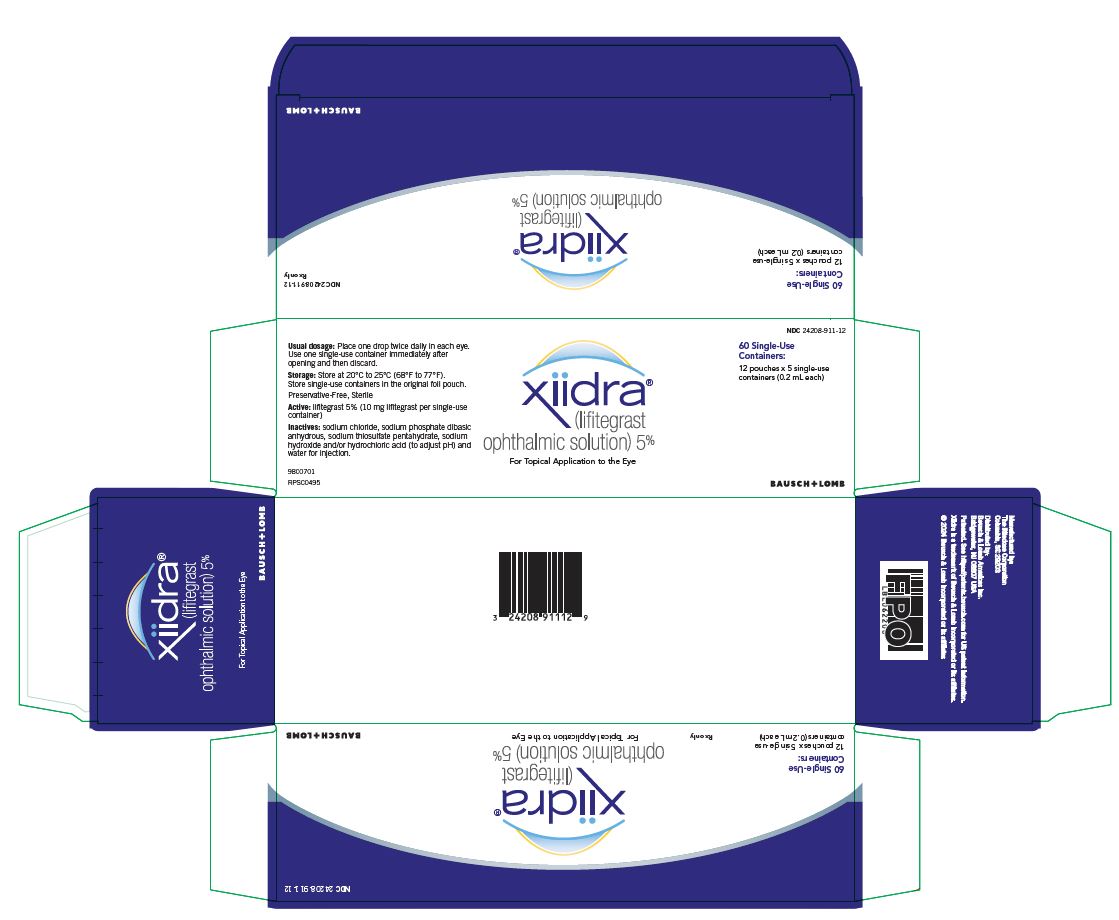
Xiidra Lifitegrast 50 mg/mL Solution/ Drops
🆔 Identity & classification
Where does this data come from?
🏷️ RxNorm drug class
This medicine belongs to the Lymphocyte Function-Associated Antigen-1 Antagonist class.
Where does this data come from?
🏭 Manufacturer & labeler
Where does this data come from?
🩺 Clinical
Ophthalmic lifitegrast is used to treat the signs and symptoms of dry eye disease. Lifitegrast is in a class of medications called lymphocyte function-associated antigen-1 (LFA-1) antagonist. Lifitegrast works by reducing the swelling in the eye tissues.
Read the full MedlinePlus article ↗- No, Xiidra is quite different from artificial tears. It's a prescription eye drop specifically designed to treat dry eye disease by reducing inflammation on the surface of your eye...
- What is Xiidra actually for — is it just artificial tears?
- That strange taste — often described as bitter or unpleasant — is one of the most commonly reported side effects of Xiidra, affecting anywhere from about 5 to 25 out of 100 people....
- Why do I get a weird taste in my mouth after using the drops?
Patient education
Supplement & herbal interactions
Some supplements/herbs that may interact with Lifitegrast — tap one for details:
Where does this data come from?
Ask a licensed pharmacist directly — free, answered by our team.
🧪 Inactive Ingredients / Excipients
Inactive ingredients, also called excipients, are components of the drug product other than the active ingredient. They may include fillers, dyes, coatings, preservatives, flavors, or other formulation ingredients.
💡 Tap an ingredient (hover on desktop) to see what it is and why it’s used.
-
UNII QTT17582CB
A strong acid used to adjust and maintain the proper pH level in liquid medicines, ensuring stability and preventing breakdown of active ingredients.
-
UNII 451W47IQ8X
Sodium chloride is common table salt. It's used in medicines as a buffer to maintain proper pH, as a filler to add bulk, or to adjust the osmotic balance in liquid formulations.
-
UNII 55X04QC32I
A strong alkaline chemical used to adjust and maintain the pH balance of liquid medicines. It helps keep the medicine stable and ensures it stays effective during storage.
-
UNII 22ADO53M6F
A mineral salt derived from phosphoric acid, used as a buffer to maintain the pH balance of the medication and help stabilize the active ingredients.
-
UNII HX1032V43M
Sodium thiosulfate is a salt compound used in medicines as a buffer and pH regulator. It helps stabilize the medication and may also serve as a preservative or antioxidant to maintain product quality.
-
UNII 059QF0KO0R
Water is a liquid solvent that dissolves and mixes ingredients together in liquid medicines, syrups, and injections. It helps distribute the active drug evenly throughout the product.
6 inactive ingredients listed in the exact product block matched to this NDC.
Where does this data come from?
ingredient classCode="IACT" elements from the exact product block matched by this NDC. Label-section narrative from DailyMed / the openFDA label index is shown separately when available.Inactive ingredient FAQ
Are inactive ingredients the same for every manufacturer?
Why might an inactive ingredient be missing?
Can inactive ingredients matter?
💲 Pricing
A drug doesn't have one price. Each row is a different public payment system, and none is what you'd pay at the counter — that depends on your insurance. The ⓘ on each row explains what it measures.
| Price system | Per ea | Per package |
|---|---|---|
| Retail pharmacies payNADAC · weekly | $11.831 | $709.87 / 60 ampules |
| Medicaid paysCMS SDUD · 12 mo | $54.07 | $3,244.23 / 60 ampules |
| Medicare drug plans payPart D · Q2 2026 | $11.85 | $711.28 / 60 ampules |
Where does this data come from?
🔁 Therapeutic equivalents
| Product | Labeler | Pack | NADAC/unit | TE | Status | Price vs. this |
|---|---|---|---|---|---|---|
| Xiidra 50 mg/mL 00078-0911-12 | Novartis | 12 pouches | $11.831 | — | Availability likely | — |
| Xiidra 50 mg/mLthis 24208-0911-12 | Bausch | 12 pouches | $11.831 | — | Availability likely | — |
| Lifitegrast 50 mg/mL 59651-0450-60 | Aurobindo | 60 pouches | — | — | FDA listed | — |
Where does this data come from?
⏳ Availability & generic status
The FDA lists approved generic versions of this medicine, but that does not always mean a pharmacy can get one today. Patent rules, launch agreements, supply and pricing can affect when generics actually arrive.
Why the date isn’t exact: Generic timing can change because patents may be challenged, settled, licensed, added, removed, or worked around with a narrower label — and FDA approval does not always mean a pharmacy can get the generic today.
🛈 What do these terms mean?
- Patent
- Legal protection listed in the Orange Book that may delay generic approval or launch. Issued by the U.S. Patent & Trademark Office.
- Substance patent
- Covers the active drug molecule itself — the hardest to design around. A generic generally can’t launch until it expires.
- Formulation (product) patent
- Covers a specific formulation or dosage form. A generic can sometimes work around it with a different formulation.
- Method-of-use patent
- A patent covering one specific approved use of the drug — not necessarily the whole molecule. A generic can sometimes launch with a “skinny label” that carves out the protected use and keeps the others.
- Skinny label
- A generic label that omits a still-patented use when the FDA allows it — letting a generic reach the market for the unprotected uses.
- Exclusivity
- FDA-granted marketing protection, separate from patents — e.g. 5-yr new chemical entity, 7-yr orphan drug, or a +6-month pediatric extension.
- Paragraph IV
- A generic applicant’s formal challenge to a listed patent. It can potentially lead to earlier generic entry, but often involves litigation or a settlement.
- RLD / RS
- Reference Listed Drug — the brand product the FDA uses as the reference for generic applications. Reference Standard — the product the FDA expects generics to compare against in bioequivalence testing.
- TE / AB rating
- FDA therapeutic-equivalence rating. An AB rating generally means the FDA considers a generic therapeutically equivalent to — and substitutable for — the brand.
- LOE (loss of exclusivity)
- The latest patent or exclusivity currently listed — the loss-of-exclusivity / latest-listed-protection date shown on this page. Paragraph-IV challenges and settlements can move the real date earlier; FDA approval and a manufacturer’s decision to market can move it later.
Built from the FDA Orange Book. The bars above are scaled to each protection’s expiry; the red LOE marker is the last one to lapse.
| Patent | Type | Use code | Expires |
|---|---|---|---|
| US 8168655 ↗ | Method of use | U-1880 | May 9, 2029 |
| US 9447077 ↗ | Method of use | U-1900 | Apr 15, 2029 |
| US 8367701 ↗ | Method of use | U-1880 | Apr 15, 2029 |
| US 8592450 ↗ | Method of use | U-1880 | May 17, 2026 |
| US 9890141 ↗ | Drug substance | — | Oct 21, 2030 |
| US 8927574 ↗ | Drug product | — | Nov 12, 2030 |
| US 9085553 ↗ | Drug product | — | Jul 25, 2033 |
| US 7314938 ↗ | Drug substance | — | Jun 25, 2029 |
| US 11058677 ↗ | Drug product | — | Dec 18, 2033 |
| US 9353088 ↗ | Drug product | — | Oct 21, 2030 |
| US 8084047 ↗ | Drug substance | — | May 17, 2026 |
Is there a generic version of XIIDRA 5% EYE DROPS?
The FDA approved a generic — why can’t I get it at my pharmacy yet?
Why do different websites show different generic release dates?
What does “FDA listed” mean?
What does a patent or protection date mean here?
What does “current Orange Book estimate” mean?
Can a generic come out before the last patent expires?
Can a generic come out after the listed dates?
What is the difference between patents and exclusivity?
Why are there multiple patent dates?
Where does this data come from?
🗺️ Medicaid utilization & spend
💊 Medicaid utilization by pack size
📊 Medicare Part D spend CMS · PART D · 2026 (Q1)
📦 Packaging — all sizes for this product
| Package NDC | Description | Per unit | Per pack | Marketing start | Status |
|---|---|---|---|---|---|
| 24208-0911-12 You're viewing this | 12 POUCH in 1 CARTON (24208-911-12) / 5 AMPULE in 1 POUCH (24208-911-05) / .2 mL in 1 AMPULE | $11.83 / ea | $709.87 | 2024-01-02 | Active |
| 24208-0911-94 | 4 POUCH in 1 CARTON (24208-911-94) / 5 AMPULE in 1 POUCH (24208-911-95) / .2 mL in 1 AMPULE | — | — | 2024-01-02 | Active |
In Medicaid, this is the most-dispensed pack of this product — about 100% of fills over the last four reported quarters. See all packs ↓
Pack size FAQ
What quantity is in NDC 24208-0911-12?
What NDC number is used to bill for this package of Xiidra Lifitegrast 50 mg/mL Solution/ Drops?
Prices are the latest CMS NADAC pharmacy acquisition cost per NDC; per-pack figures are per-unit × pack quantity, shown only when the pack is denominated in the same measure NADAC prices.
📄 Full prescribing information FDA SPL
🎯 Indications and Usage ▾
1 INDICATIONS AND USAGE Xiidra ® (lifitegrast ophthalmic solution) 5% is indicated for the treatment of the signs and symptoms of dry eye disease (DED). Xiidra (lifitegrast ophthalmic solution) 5% is a lymphocyte function-associated antigen-1 (LFA-1) antagonist indicated for the treatment of the signs and symptoms of dry eye disease (DED). ( 1 )
⏱️ Dosage and Administration ▾
2 DOSAGE AND ADMINISTRATION Instill one drop of Xiidra twice daily (approximately 12 hours apart) into each eye using a single-use container. Discard the single‑use container immediately after using in each eye. Contact lenses should be removed prior to the administration of Xiidra and may be reinserted 15 minutes following administration. One drop twice daily in each eye (approximately 12 hours apart). ( 2 )
💊 Dosage Forms and Strengths ▾
3 DOSAGE FORMS AND STRENGTHS Ophthalmic solution containing lifitegrast 50 mg/mL (5%). Ophthalmic solution containing lifitegrast 50 mg/mL (5%). ( 3 )
⛔ Contraindications ▾
4 CONTRAINDICATIONS Xiidra is contraindicated in patients with known hypersensitivity to lifitegrast or to any of the other ingredients in the formulation [see Adverse Reactions (6.2) ]. Hypersensitivity. ( 4 )
🤒 Adverse Reactions ▾
6 ADVERSE REACTIONS The following serious adverse reactions are described elsewhere in the labeling: Hypersensitivity [see Contraindications (4) ] The most common adverse reactions (incidence 5%-25%) following the use of Xiidra were instillation-site irritation, dysgeusia, and decreased visual acuity ( 6 ) To report SUSPECTED ADVERSE REACTIONS, contact Bausch & Lomb Incorporated at 1-800-553-5340 or FDA at 1-800-FDA-1088 or www.fda.gov/medwatch.
6.1Clinical Trials Experience Because clinical trials are conducted under widely varying conditions, adverse reaction rates observed in clinical trials of a drug cannot be directly compared to rates in the clinical trials of another drug and may not reflect the rates observed in practice. In five clinical trials of DED conducted with lifitegrast ophthalmic solution, 1401 patients received at least one dose of lifitegrast (1287 of which received lifitegrast 5%). The majority of patients (84%) had less than or equal to 3 months of treatment exposure.
One hundred-seventy patients were exposed to lifitegrast for approximately 12 months. The majority of the treated patients were female (77%). The most common adverse reactions reported in 5%-25% of patients were instillation-site irritation, dysgeusia, and reduced visual acuity.
Other adverse reactions reported in 1%-5% of the patients were blurred vision, conjunctival hyperemia, eye irritation, headache, increased lacrimation, eye discharge, eye discomfort, eye pruritus, and sinusitis.
6.2Postmarketing Experience The following adverse reactions have been identified during post-approval use of Xiidra. Because these reactions are reported voluntarily from a population of uncertain size, it is not always possible to reliably estimate their frequency or establish a causal relationship to drug exposure. Rare serious cases of hypersensitivity, including anaphylactic reaction, bronchospasm, respiratory distress, pharyngeal edema, swollen tongue, urticaria, allergic conjunctivitis, dyspnea, angioedema, and allergic dermatitis have been reported.
Eye swelling and rash have also been reported [see Contraindications (4) ]
👥 Use in Specific Populations ▾
8 USE IN SPECIFIC POPULATIONS
8.1Pregnancy Risk Summary There are no available data on Xiidra use in pregnant women to inform any drug-associated risks. Intravenous (IV) administration of lifitegrast to pregnant rats, from premating through gestation day 17, did not produce teratogenicity at clinically relevant systemic exposures. Intravenous administration of lifitegrast to pregnant rabbits during organogenesis produced an increased incidence of omphalocele at the lowest dose tested, 3 mg/kg/day (400-fold the human plasma exposure at the recommended human ophthalmic dose [RHOD], based on the area under the curve [AUC] level).
Since human systemic exposure to lifitegrast following ocular administration of Xiidra at the RHOD is low, the applicability of animal findings to the risk of Xiidra use in humans during pregnancy is unclear [see Clinical Pharmacology (12.3) ] Data Animal Data Lifitegrast administered daily by IV injection to rats, from premating through gestation day 17, caused an increase in mean pre-implantation loss and an increased incidence of several minor skeletal anomalies at 30 mg/kg/day, representing 5,400-fold the human plasma exposure at the RHOD of Xiidra, based on AUC.
No teratogenicity was observed in the rat at 10 mg/kg/day (460-fold the human plasma exposure at the RHOD, based on AUC). In the rabbit, an increased incidence of omphalocele was observed at the lowest dose tested, 3 mg/kg/day (400-fold the human plasma exposure at the RHOD, based on AUC), when administered by IV injection daily from gestation days 7 through 19. A fetal no observed adverse effect level (NOAEL) was not identified in the rabbit.
8.2Lactation Risk Summary There are no data on the presence of lifitegrast in human milk, the effects on the breastfed infant, or the effects on milk production. However, systemic exposure to lifitegrast from ocular administration is low [see Clinical Pharmacology ( 12.3 )] . The developmental and health benefits of breastfeeding should be considered, along with the mother’s clinical need for Xiidra and any potential adverse effects on the breastfed child from Xiidra.
8.4Pediatric Use Safety and efficacy in pediatric patients below the age of 17 years have not been established.
8.5Geriatric Use No overall differences in safety or effectiveness have been observed between elderly and younger adult patients.
🤰 Pregnancy ▾
8.1Pregnancy Risk Summary There are no available data on Xiidra use in pregnant women to inform any drug-associated risks. Intravenous (IV) administration of lifitegrast to pregnant rats, from premating through gestation day 17, did not produce teratogenicity at clinically relevant systemic exposures. Intravenous administration of lifitegrast to pregnant rabbits during organogenesis produced an increased incidence of omphalocele at the lowest dose tested, 3 mg/kg/day (400-fold the human plasma exposure at the recommended human ophthalmic dose [RHOD], based on the area under the curve [AUC] level).
Since human systemic exposure to lifitegrast following ocular administration of Xiidra at the RHOD is low, the applicability of animal findings to the risk of Xiidra use in humans during pregnancy is unclear [see Clinical Pharmacology (12.3) ] Data Animal Data Lifitegrast administered daily by IV injection to rats, from premating through gestation day 17, caused an increase in mean pre-implantation loss and an increased incidence of several minor skeletal anomalies at 30 mg/kg/day, representing 5,400-fold the human plasma exposure at the RHOD of Xiidra, based on AUC.
No teratogenicity was observed in the rat at 10 mg/kg/day (460-fold the human plasma exposure at the RHOD, based on AUC). In the rabbit, an increased incidence of omphalocele was observed at the lowest dose tested, 3 mg/kg/day (400-fold the human plasma exposure at the RHOD, based on AUC), when administered by IV injection daily from gestation days 7 through 19. A fetal no observed adverse effect level (NOAEL) was not identified in the rabbit.
🧒 Pediatric Use ▾
8.4Pediatric Use Safety and efficacy in pediatric patients below the age of 17 years have not been established.
🧓 Geriatric Use ▾
8.5Geriatric Use No overall differences in safety or effectiveness have been observed between elderly and younger adult patients.
🧬 Clinical Pharmacology ▾
12 CLINICAL PHARMACOLOGY
12.1Mechanism of Action Lifitegrast binds to the integrin LFA-1, a cell surface protein found on leukocytes and blocks the interaction of LFA-1 with its cognate ligand intercellular adhesion molecule‑1 (ICAM-1). ICAM-1 may be overexpressed in corneal and conjunctival tissues in DED. LFA-1/ICAM-1 interaction can contribute to the formation of an immunological synapse resulting in T‑cell activation and migration to target tissues.
In vitro studies demonstrated that lifitegrast may inhibit T-cell adhesion to ICAM-1 in a human T-cell line and may inhibit secretion of inflammatory cytokines in human peripheral blood mononuclear cells. The exact mechanism of action of lifitegrast in DED is not known.
12.3Pharmacokinetics In a subset of DED patients (n = 47) enrolled in a Phase 3 trial, the pre-dose (trough) plasma concentrations of lifitegrast were measured after 180 and 360 days of topical ocular dosing (one drop twice daily) with Xiidra (lifitegrast ophthalmic solution) 5%. A total of nine of the 47 patients (19%) had plasma lifitegrast trough concentrations above 0.5 ng/mL (the lower limit of assay quantitation). Trough plasma concentrations that could be quantitated ranged from 0.55 ng/mL to 3.74 ng/mL.
🧬 Mechanism of Action ▾
12.1Mechanism of Action Lifitegrast binds to the integrin LFA-1, a cell surface protein found on leukocytes and blocks the interaction of LFA-1 with its cognate ligand intercellular adhesion molecule‑1 (ICAM-1). ICAM-1 may be overexpressed in corneal and conjunctival tissues in DED. LFA-1/ICAM-1 interaction can contribute to the formation of an immunological synapse resulting in T‑cell activation and migration to target tissues.
In vitro studies demonstrated that lifitegrast may inhibit T-cell adhesion to ICAM-1 in a human T-cell line and may inhibit secretion of inflammatory cytokines in human peripheral blood mononuclear cells. The exact mechanism of action of lifitegrast in DED is not known.
📦 How Supplied / Storage and Handling ▾
16 HOW SUPPLIED/STORAGE AND HANDLING Xiidra (lifitegrast ophthalmic solution) 5% (50 mg/mL) is supplied in a foil pouch containing 5 low-density polyethylene 0.2 mL single-use containers. Carton of 60 single-use containers NDC 24208-911-12 Storage: Store at 20°C to 25°C (68°F to 77°F). Store single-use containers in the original foil pouch.
📋 Description ▾
11 DESCRIPTION The chemical name for lifitegrast is (S)-2-(2-(benzofuran-6-carbonyl)-5,7-dichloro-1,2,3,4-tetrahydroisoquinoline-6-carboxamido)-3-(3-(methylsulfonyl)phenyl)propanoic acid. The molecular formula of lifitegrast is C 29 H 24 Cl 2 N 2 O 7 S and its molecular weight is 615.5 g/mol. The structural formula of lifitegrast is: *Chiral center Lifitegrast is a white to off-white powder, which is soluble in water.
Xiidra (lifitegrast ophthalmic solution) 5% is a lymphocyte function-associated antigen-1 (LFA-1) antagonist supplied as a sterile, clear, colorless to slightly brownish-yellow colored, isotonic solution of lifitegrast with a pH of 7.0-8.0, and an osmolality range of 200-330 mOsmol/kg. Xiidra contains Active: lifitegrast 50 mg/mL; Inactives: sodium chloride, sodium phosphate dibasic anhydrous, sodium thiosulfate pentahydrate, and water for injection. Sodium hydroxide and/or hydrochloric acid (to adjust pH). chem
💬 Information for Patients ▾
17 PATIENT COUNSELING INFORMATION Advise patients to read the FDA‑approved patient labeling (Patient Information and Instructions for Use). Handling the Single-use Container Advise patients not to touch the tip of the single-use container to their eye or to any surface, in order to avoid eye injury or contamination of the solution. Use With Contact Lenses Advise patients that contact lenses should be removed prior to administration of Xiidra and can be reinserted 15 minutes after administration [see Dosage and Administration ( 2 ) ].
Administration Advise patients that the solution from one single-use container is to be used immediately after opening. It can be used to dose both eyes. The single-use container, including any remaining contents should be discarded immediately after administration [see Dosage and Administration (2) ].
Storage Information Instruct patients to store single-use containers in the original foil pouch until ready to use [see How Supplied/Storage and Handling (16) ]. Distributed by: Bausch & Lomb Americas Inc. Bridgewater, NJ 08807 USA Patented.
See https://patents.bausch.com for US patent information. Xiidra is a trademark of Bausch & Lomb Incorporated or its affiliates. © 2023 Bausch & Lomb Incorporated or its affiliates 9800800 PATIENT INFORMATION XIIDRA ® (ZYE-druh) (lifitegrast ophthalmic solution) 5% for topical ophthalmic use What is Xiidra? Xiidra is a prescription eye drop solution used to treat the signs and symptoms of dry eye disease (DED).
It is not known if Xiidra is safe and effective in children under 17 years of age. Do not use Xiidra: If you are allergic to lifitegrast or any of the other ingredients in Xiidra, see “What are the ingredients in Xiidra?” Before you use Xiidra, tell your doctor if you: are using any other eye drops wear contact lenses are pregnant or plan to become pregnant. It is not known if Xiidra will harm your unborn baby. are breastfeeding or plan to breastfeed.
It is not known if Xiidra passes into your breast milk. Talk to your doctor about the best way to feed your baby if you use Xiidra. How should I use Xiidra?
See the complete Instructions for Use at the end of this Patient Information leaflet for detailed instructions about the right way to use Xiidra. Use Xiidra as your doctor tells you. Use one drop of Xiidra in each eye, two times each day, about 12 hours apart.
Use Xiidra right away after opening. Throw away the single‑use container and any unused solution after you have applied the dose to both eyes. Do not save any unused Xiidra for later.
What are the possible side effects of Xiidra? The most common side effects of Xiidra include eye irritation, discomfort, or blurred vision when the drops are applied to the eyes, and an unusual taste sensation (dysgeusia). Seek medical care immediately if you get any symptoms of wheezing, difficulty breathing, or swollen tongue.
These are not all the possible side effects of Xiidra. Tell your doctor if you have any side effects that bother you. You may report side effects to FDA at 1‑800‑FDA‑1088.
How should I store Xiidra? Store Xiidra at room temperature between 68°F to 77°F (20°C to 25°C). Store Xiidra in the original foil pouch to protect it from light.
Do not open the Xiidra foil pouch until you are ready to use the eye drops. Return unused single‑use containers to their original foil pouch to protect from excessive light exposure. Keep Xiidra and all medicines out of the reach of children.
General information about the safe and effective use of Xiidra. Medicines are sometimes prescribed for purposes other than those listed in a Patient Information leaflet. You can ask your pharmacist or doctor for information about Xiidra that is written for health professionals.
Do not use Xiidra for a condition for which it was not prescribed. Do not give Xiidra to other people, even if they have the same symptoms you have. It may harm them.
What are the ingredients in Xiidra? Active ingredient: lifitegrast Inactive ingredient…