
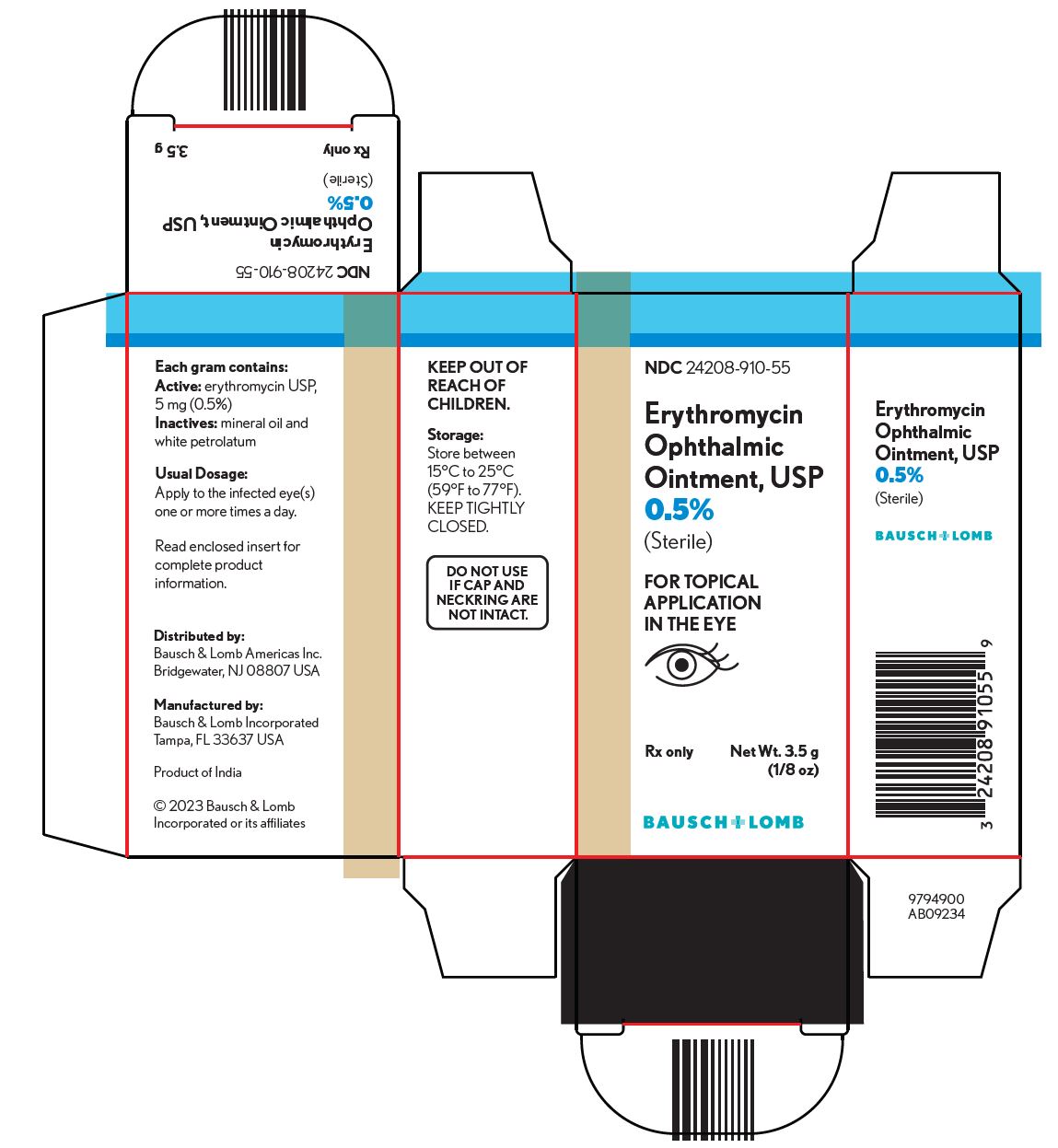
Erythromycin 5 mg/g Ointment, 1 tube — NDC 24208-910-55 (Billing 24208-0910-55)
This is a package of 1 tube of Erythromycin 5 mg/g Ointment from Bausch & Lomb Incorporated, marketed since Jul 1994 and currently FDA-listed; retail pharmacies pay about $2.83 per g (NADAC). It is the main listing for this product, which comes in 2 package sizes.
NDC database record
One package, one record: these facts belong to NDC 24208-910-55 alone.
- Record
- FDA NDC Directory package listing · Human prescription drug
- Code segments
- 24208 labeler · 910 product · 55 package
- Package marketed since
- Jul 29, 1994
- Sample package
- No — commercial package
- Listing certified through
- Dec 31, 2027
- Barcode (UPC-A, from the NDC)
- 3 2420891055 9
- Medicaid fills, this package
- 564,867 prescriptions in the last four reported quarters
- FDA record last changed
- Sep 17, 2026
Other active recalls for Erythromycin (different manufacturers) — 2 · tap to view
Identity & classification
Regulatory identifiers FDA, NLM and CMS codes for this package
Drug-database identifiers Medi-Span GPI and First Databank GCN / HICL / AHFS classification
- GSN (GCN sequence number): 007948
- GCN: 33540
- HICL (First Databank): 004022
- AHFS class code: 08:12.12.04
- RxCUI (RxNorm): 310149
Where does this data come from?
- FDA openFDA NDC Directory · synced Oct 8, 2026
- FDA label on DailyMed · label index refreshed Oct 8, 2026
- RxNorm (NLM RxNav) · catalog refreshed Oct 1, 2026
- Medi-Span GPI (licensed)
- First Databank (licensed) · refreshed Oct 8, 2026
RxNorm drug class
This medicine belongs to the Macrolide class.
Where does this data come from?
- RxClass (NLM) · catalog refreshed Oct 1, 2026
Clinical
- It’s an antibiotic for infections caused by susceptible bacteria. By mouth, it’s used for mild to moderate upper respiratory tract infections. The IV form covers additional infecti...
- It depends on the product. Ery-tab delayed-release tablets can be taken with or without meals, but work best on an empty stomach. Erythromycin ethylsuccinate tablets and suspension...
- Stomach upset is the most common. That includes nausea, vomiting, belly pain, diarrhea and loss of appetite. These tend to be more likely at higher doses. Call your doctor if they...
- Call for severe or lasting diarrhea, hives or swelling, a severe skin rash, a racing or irregular heartbeat, fainting, yellow skin or eyes, or hearing changes. These can signal ser...
Patient education
Supplement & herbal interactions
Some supplements/herbs that may interact with Erythromycin — tap one for details:
Erythromycin may be associated with lower levels of 7 nutrients — worth a chat with your pharmacist, not a cause for alarm.
Where does this data come from?
- MedlinePlus (NLM) · refreshed Oct 8, 2026
- FDA label on DailyMed · label index refreshed Oct 8, 2026
Ask a licensed pharmacist directly — free, answered by our team.
Pricing
A drug doesn't have one price. Each row is a different public payment system, and none is what you'd pay at the counter — that depends on your insurance. The ⓘ on each row explains what it measures.
| Price system | Per g | Per package |
|---|---|---|
| Retail pharmacies payNADAC · weekly | $2.827 | $9.89 / 3.5 g |
| Medicaid paysCMS SDUD · 12 mo | $4.61 | $16.13 / 3.5 g |
| Medicare drug plans payPart D · Q2 2026 | $3.24 | $11.34 / 3.5 g |
Where does this data come from?
- CMS NADAC weekly file · file of Oct 7, 2026
- CMS ASP pricing files · refreshed Sep 20, 2026
- CMS Medicaid State Drug Utilization Data · through Q1 2026
- CMS Part D plan pricing files · refreshed Sep 24, 2026
- VA National Acquisition Center price file
Packaging — all sizes for this product
| Package NDC | Description | Per unit | Per pack | Marketing start | Marketing end | Status |
|---|---|---|---|---|---|---|
| 24208-0910-19 24208-910-19 | 50 TUBE in 1 BOX / 1 g in 1 TUBE | $6.83 / g | $341.70 | 1994-07-29 | — | Active |
| 24208-0910-55 You're viewing this Main listing | 1 TUBE in 1 CARTON / 3.5 g in 1 TUBE | $2.83 / g | $9.89 | 1994-07-29 | — | Active |
This pack has the lowest per-g cost of the 2 priced pack sizes ($2.83 NADAC).
In Medicaid, this is the most-dispensed pack of this product — about 99% of fills over the last four reported quarters. See all packs ↓
Pack size FAQ
What quantity is in this package?
How does this package differ from NDC 24208-0910-19?
What NDC number is used to bill for this package of Erythromycin 5 mg/g Ointment?
Prices are the latest CMS NADAC pharmacy acquisition cost per NDC; per-pack figures are per-unit × pack quantity, shown only when the pack is denominated in the same measure NADAC prices.
Therapeutic equivalents
| Product | Labeler | Pack | NADAC/unit | TE | Status | Price vs. this |
|---|---|---|---|---|---|---|
| Erythromycin 5 mg/gthis 24208-0910-55 | Bausch | 1 tube | $2.827 | AT | Availability likely | — |
| Erythromycin 5 mg/g 70244-0031-01 | Sentiss | 50 tubes | $6.834 | AT | Availability likely | +142% |
| Erythromycin 5 mg/g 72485-0670-31 | ARMAS | 50 tubes | $6.834 | AT | Availability likely | +142% |
| Erythromycin 5 mg/g 48102-0057-11 | Fera | 50 tubes | — | — | FDA listed | — |
| Erythromycin 5 mg/g 50090-1484-00 | A-S | 1 tube | — | AT | FDA listed | — |
| erythromycin 5 mg/g 50090-1958-00 | A-S | 1 tube | — | — | FDA listed | — |
| Erythromycin 5 mg/g 55154-7850-00 | Cardinal | 10 tubes | — | AT | FDA listed | — |
| Erythromycin 5 mg/g 60760-0670-35 | ST. | 1 tube | — | AT | FDA listed | — |
| Erythromycin 5 mg/g 61919-0090-35 | Direct | 3.5 g | — | AT | FDA listed | — |
| Erythromycin 5 mg/g 63187-0267-35 | Proficient | 1 tube | — | AT | FDA listed | — |
| Erythromycin 5 mg/g 63187-0608-35 | Proficient | 1 tube | — | AT | FDA listed | — |
| Erythromycin 5 mg/g 66267-0975-35 | NuCare | 3.5 g | — | AT | FDA listed | — |
| Erythromycin 5 mg/g 67296-2128-03 | Redpharm | 1 tube | — | AT | FDA listed | — |
| Erythromycin 5 mg/g 68071-3992-02 | NuCare | 1 tube | — | AT | FDA listed | — |
| Erythromycin 5 mg/g 68071-4228-03 | NuCare | 3.5 g | — | AT | FDA listed | — |
| erythromycin 5 mg/g 68071-4803-03 | NuCare | 3.5 g | — | — | FDA listed | — |
| Erythromycin 5 mg/g 68788-9328-03 | Preferred | 1 tube | — | AT | FDA listed | — |
| Erythromycin 5 mg/g 70518-0465-00 | REMEDYREPACK | 1 tube | — | AT | FDA listed | — |
| Erythromycin 5 mg/g 76420-0196-03 | Asclemed | 1 tube | — | AT | FDA listed | — |
| Erythromycin 5 mg/g 76420-0212-30 | Asclemed | 1 tube | — | AT | FDA listed | — |
| erythromycin 5 mg/g 76420-0612-03 | Asclemed | 1 tube | — | — | FDA listed | — |
| Erythromycin 5 mg/g 85766-0248-55 | Sportpharm | 1 tube | — | AT | FDA listed | — |
Where does this data come from?
- FDA openFDA NDC Directory · synced Oct 8, 2026
- FDA Orange Book · refreshed Oct 3, 2026
- CMS NADAC weekly file · file of Oct 7, 2026
Availability & generic status
This product is an FDA-approved generic. Other versions of the same drug are listed under Therapeutic equivalents, least expensive first.
Where does this data come from?
- FDA Orange Book · refreshed Oct 3, 2026
Inactive Ingredients / Excipients
Inactive ingredients, also called excipients, are components of the drug product other than the active ingredient. They may include fillers, dyes, coatings, preservatives, flavors, or other formulation ingredients.
🧪 Avoiding an ingredient? See Erythromycin inactive ingredients by manufacturer: every current product's list side by side, so you can ask your pharmacy for the version that does not list it.
💡 Tap an ingredient (hover on desktop) to see what it is and why it’s used.
-
UNII T5L8T28FGP
Mineral oil is a clear, odorless liquid derived from crude oil. It acts as a lubricant and emollient in medications, helping pills slide smoothly during manufacturing and aiding moisture retention in topical products.
-
UNII 4T6H12BN9U
Petrolatum is a purified mineral oil-based jelly derived from petroleum. In medicines, it acts as an emollient, lubricant, and moisture barrier to soften skin, reduce friction, and help prevent water loss from formulations.
2 inactive ingredients listed in the exact product block matched to this NDC.
Where does this data come from?
ingredient classCode="IACT" elements from the exact product block matched by this NDC. Label-section narrative from DailyMed / the openFDA label index is shown separately when available.- FDA label on DailyMed · label index refreshed Oct 8, 2026
- FDA openFDA NDC Directory · synced Oct 8, 2026
Inactive ingredient FAQ
Are inactive ingredients the same for every manufacturer?
Why might an inactive ingredient be missing?
Can inactive ingredients matter?
Manufacturer & labeler
More NDCs from Bausch & Lomb Incorporated labeler code 24208
- Timoptic Timolol Maleate 2.5 mg/mL Solution NDC 24208-812-05
- Timoptic Timolol Maleate 5 mg/mL Solution NDC 24208-813-05
- Timoptic-XE Timolol Maleate 2.5 mg/mL Solution NDC 24208-814-25
- Timoptic-XE Timolol Maleate 5 mg/mL Solution NDC 24208-816-05
- Atropine Sulfate 10 mg/g Ointment NDC 24208-825-55
- Neomycin Polymyxin B Sulfates and Dexamethasone Neomycin sulfate, Polymyxin B Sulfate 3.5 mg/mL; 10000 [USP'U]/mL; 1 mg/mL Suspension/ Drops NDC 24208-830-60
- Xiidra Lifitegrast 50 mg/mL Solution/ Drops NDC 24208-911-12
- Atropine Sulfate 10 mg/mL Solution NDC 24208-965-01
- Olopatadine Hydrochloride Ophthalmic Solution 1 mg/mL Solution NDC 24208-966-01
- OLOPATADINE HYDROCHLORIDE 2 mg/mL Solution NDC 24208-967-01
Where does this data come from?
- FDA openFDA NDC Directory · synced Oct 8, 2026
- Drugs@FDA
Full prescribing information FDA SPL
🎯 Indications and Usage ▾
INDICATIONS AND USAGE For the treatment of superficial ocular infections involving the conjunctiva and/or cornea caused by organisms susceptible to erythromycin. For prophylaxis of ophthalmia neonatorum due to N. gonorrhoeae or C. trachomatis . The effectiveness of erythromycin in the prevention of ophthalmia caused by penicillinase-producing N. gonorrhoeae is not established.
For infants born to mothers with clinically apparent gonorrhea, intravenous or intramuscular injections of aqueous crystalline penicillin G should be given: a single dose of 50,000 units for term infants or 20,000 units for infants of low birth weight. Topical prophylaxis alone is inadequate for these infants.
⏱️ Dosage and Administration ▾
DOSAGE AND ADMINISTRATION In the treatment of superficial ocular infections, erythromycin ophthalmic ointment approximately 1 cm in length should be applied directly to the infected eye(s) up to six times daily, depending on the severity of the infection. For prophylaxis of neonatal gonococcal or chlamydial ophthalmia, a ribbon of ointment approximately 1 cm in length should be instilled into each lower conjunctival sac. The ointment should not be flushed from the eye following instillation.
A new tube should be used for each infant.
⛔ Contraindications ▾
CONTRAINDICATIONS This drug is contraindicated in patients with a history of hypersensitivity to erythromycin.
🤒 Adverse Reactions ▾
ADVERSE REACTIONS The most frequently reported adverse reactions are minor ocular irritations, redness, and hypersensitivity reactions. To report SUSPECTED ADVERSE REACTIONS, contact Bausch & Lomb Incorporated at 1-800-553-5340 or FDA at 1-800-FDA-1088 or www.fda.gov/medwatch.
🧬 Clinical Pharmacology ▾
CLINICAL PHARMACOLOGY Microbiology Erythromycin inhibits protein synthesis without affecting nucleic acid synthesis. Erythromycin is usually active against the following organisms in vitro and in clinical infections: Streptococcus pyogenes (group A β-hemolytic), Alpha-hemolytic streptococci (viridans group); Staphylococcus aureus, including penicillinase-producing strains (methicillin-resistant staphylococci are uniformly resistant to erythromycin); Streptococcus pneumoniae; Mycoplasma pneumoniae (Eaton Agent, PPLO); Haemophilus influenzae (not all strains of this organism are susceptible at the erythromycin concentrations ordinarily achieved); Treponema pallidum; Corynebacterium diphtheriae; Neisseria gonorrhoeae; Chlamydia trachomatis .
📦 How Supplied / Storage and Handling ▾
HOW SUPPLIED Erythromycin ophthalmic ointment USP, 0.5% is available in the following sizes: 3.5 g (1/8 oz) in a tamper-resistant tube – NDC 24208-910-55 1 g in a tamper-resistant tube (1 carton of 50 tubes) – NDC 24208-910-19 Storage: Store between 15°C to 25°C (59°F to 77°F). Keep out of reach of children. Distributed by: Bausch & Lomb Americas Inc.
Bridgewater, NJ 08807 USA Manufactured by : Bausch & Lomb Incorporated Tampa, FL 33637 USA © 2025 Bausch & Lomb Incorporated or its affiliates Revised: March 2025 9819800 (Folded) 9819900 (Flat) TEStatementAlum
📋 Description ▾
DESCRIPTION Erythromycin ophthalmic ointment, USP belongs to the macrolide group of antibiotics. The sterile ophthalmic ointment flows freely over the conjunctiva. Erythromycin base, as crystals or powder, is slightly soluble in water, moderately soluble in ether, and readily soluble in alcohol or chloroform.
Erythromycin is an antibiotic produced from a strain of Streptomyces erythraeus . It is basic and readily forms a salt when combined with an acid. It has the following structural formula: Molecular Formula: C 37 H 67 NO 13 Mol.
Wt. 733.94 Chemical Name: ((3R ● ,4S ● ,5S ● ,6R ● ,7R ● ,9R ● ,11R ● ,12R ● ,13S ● ,14R ● )-4-[(2,6-dideoxy-3- C -methyl-3- 0 -methyl-α-L- ribo -hexopyranosyl)oxy]-14-ethyl-7,12,13-trihydroxy-3,5,7,9,11,13-hexamethyl-6-[[3,4,6-trideoxy-3-(dimethylamino)- β -D- xylo -hexopyranosyl] oxy]oxacyclotetradecane-2,10-dione) Each gram contains: Active: erythromycin USP, 5 mg (0.5%); Inactives: mineral oil and white petrolatum. ChemStructure
⚠️ Precautions ▾
PRECAUTIONS General The use of antimicrobial agents may be associated with the overgrowth of non-susceptible organisms including fungi; in such a case, antibiotic administration should be stopped and appropriate measures taken. Information for Patients: Avoid contaminating the applicator tip with material from the eye, fingers, or other source. Carcinogenesis, Mutagenesis, Impairment of Fertility: Two year oral studies conducted in rats with erythromycin did not provide evidence of tumorigenicity.
Mutagenicity studies have not been conducted. No evidence of impaired fertility that appeared related to erythromycin was reported in animal studies. Pregnancy: Reproduction studies have been performed in rats, mice, and rabbits using erythromycin and its various salts and esters, at doses that were several multiples of the usual human dose.
No evidence of harm to the fetus that appeared related to erythromycin was reported in these studies. There are, however, no adequate and well-controlled studies in pregnant women. Because animal reproductive studies are not always predictive of human response, the erythromycins should be used during pregnancy only if clearly needed.
Nursing Mothers: Caution should be exercised when erythromycin is administered to a nursing woman. Pediatric Use: See INDICATIONS AND USAGE and DOSAGE AND ADMINISTRATION .
📄 Package Label / Principal Display Panel ▾
PACKAGE/LABEL PRINCIPAL DISPLAY PANEL NDC 24208-910-55 Erythromycin Ophthalmic Ointment, USP 0.5% (Sterile) FOR TOPICAL APPLICATION IN THE EYE (eye image) Rx only Net Wt. 35 g (1.8 oz) BAUSCH + LOMB 9794900 Carton