
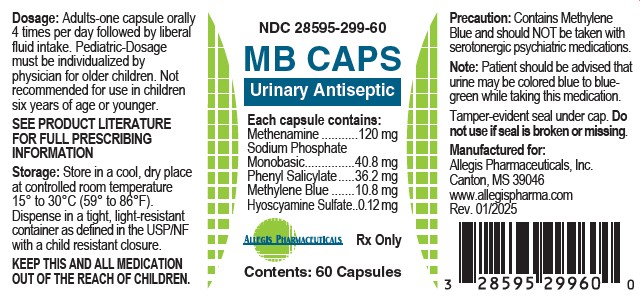
Mb Caps methenamine, sodium phosphate, monobasic, monohydrate, phenyl salicylate, methylene blue, and hyoscyamine sulfate 120 mg; 40.8 mg; 36.2 mg; 10.8 mg; .12 mg Capsule, 60-count — NDC 28595-299-60 (Billing 28595-0299-60)
This is a package of 60 capsules of Mb Caps methenamine, sodium phosphate, monobasic, monohydrate, phenyl salicylate, methylene blue, and hyoscyamine sulfate 120 mg; 40.8 mg; 36.2 mg; 10.8 mg; .12 mg Capsule from Allegis Pharmaceuticals, LLC, marketed since Feb 2025 and currently FDA-listed. It is this product's only package size.
NDC database record
One package, one record: these facts belong to NDC 28595-299-60 alone.
- Record
- FDA NDC Directory package listing · Human prescription drug
- Code segments
- 28595 labeler · 299 product · 60 package
- Package marketed since
- Feb 25, 2025
- Sample package
- No — commercial package
- Listing certified through
- Dec 31, 2026
- Billing quantity
- 60 EA per package
- Barcode (UPC-A, from the NDC)
- 3 2859529960 0
- Medicaid fills, this package
- 43 prescriptions in the last four reported quarters
- FDA record last changed
- Aug 27, 2026
Identity & classification
Regulatory identifiers FDA, NLM and CMS codes for this package
Drug-database identifiers Medi-Span GPI and First Databank GCN / HICL / AHFS classification
- GSN (GCN sequence number): 085037
- GCN: 54476
- GPI-14 (Medi-Span): 16992005200130
- HICL (First Databank): 034934
- AHFS class code: 08:36.00.00
- RxCUI (RxNorm): 2637557
Where does this data come from?
- FDA openFDA NDC Directory · synced Oct 8, 2026
- FDA label on DailyMed · label index refreshed Oct 8, 2026
- RxNorm (NLM RxNav) · catalog refreshed Oct 8, 2026
- Medi-Span GPI (licensed)
- First Databank (licensed) · refreshed Oct 8, 2026
RxNorm drug class
This medicine belongs to the Belladonna alkaloids, tertiary amines class.
Where does this data come from?
- RxClass (NLM) · catalog refreshed Oct 8, 2026
Clinical
MB CAPS is an oral capsule containing multiple active ingredients. Methenamine functions as a urinary antiseptic, while methylene blue is used as a urinary tract disinfectant and dye. Phenyl salicylate is typically included for its mild analgesic properties, and hyoscyamine sulfate is an anticholinergic agent commonly used to reduce urinary tract spasms. Sodium phosphate monobasic helps acidify urine. This product is marketed without an approved FDA application.
Patient education
Supplement & herbal interactions
Where does this data come from?
- MedlinePlus (NLM) · refreshed Oct 8, 2026
- FDA label on DailyMed · label index refreshed Oct 8, 2026
Ask a licensed pharmacist directly — free, answered by our team.
Pricing
A drug doesn't have one price. Each row is a different public payment system, and none is what you'd pay at the counter — that depends on your insurance. The ⓘ on each row explains what it measures.
| Price system | Per each | Per package |
|---|---|---|
| Retail pharmacies payNADAC · weekly | Not in the retail survey — common for institutional, discontinued, or low-volume packs. | |
| Medicaid paysCMS SDUD · 12 mo | $16.64 | $998.30 / 60 capsules |
| Medicare drug plans payPart D · quarterly | No Part D plan price is available for this NDC in our data. | |
Where does this data come from?
- CMS NADAC weekly file
- CMS ASP pricing files · refreshed Sep 20, 2026
- CMS Medicaid State Drug Utilization Data · through Q4 2025
- CMS Part D plan pricing files · refreshed Sep 24, 2026
- VA National Acquisition Center price file
Packaging — all sizes for this product
| Package NDC | Description | Marketing start | Marketing end | Status |
|---|---|---|---|---|
| 28595-0299-60 You're viewing this Main listing | 60 CAPSULE in 1 BOTTLE | 2025-02-25 | — | Active |
Therapeutic equivalents
| Product | Labeler | Pack | NADAC/unit | TE | Status | Price vs. this |
|---|---|---|---|---|---|---|
| Urimar-T Caps 120 mg/1; 40.8 mg/1; 36.2 mg/1; 10.8 mg/1; .12 mg 28595-0224-60 | Allegis | 60 capsules | — | — | FDA listed | — |
| Mb Caps 120 mg/1; 40.8 mg/1; 36.2 mg/1; 10.8 mg/1; .12 mgthis 28595-0299-60 | Allegis | 60 capsules | — | — | FDA listed | — |
Where does this data come from?
- FDA openFDA NDC Directory · synced Oct 8, 2026
- FDA Orange Book · refreshed Oct 3, 2026
- CMS NADAC weekly file
Availability & generic status
We did not find an FDA-approved generic match for this exact strength, form and route.
Where does this data come from?
- FDA Orange Book · refreshed Oct 3, 2026
What it looks like
Where does this data come from?
- FDA label on DailyMed · label index refreshed Oct 8, 2026
Inactive Ingredients / Excipients
Inactive ingredients, also called excipients, are components of the drug product other than the active ingredient. They may include fillers, dyes, coatings, preservatives, flavors, or other formulation ingredients.
💡 Tap an ingredient (hover on desktop) to see what it is and why it’s used.
-
UNII 2S7830E561
Crospovidone is a synthetic polymer derived from povidone. It acts as a disintegrant, helping the tablet or capsule break apart quickly in the stomach so the active ingredient can be absorbed.
-
UNII H3R47K3TBD
FD&C Blue No. 1 is a synthetic blue dye approved for use in foods and medicines. It serves as a colorant to give the medication its distinctive appearance and help with product identification.
-
UNII PN2ZH5LOQY
A synthetic red dye approved by the FDA for use in foods, medicines, and cosmetics. It serves as a colorant to make tablets, capsules, and liquids visually distinctive for product identification.
-
UNII 2G86QN327L
Gelatin is a protein derived from animal collagen, commonly used in medicines as a gelling agent and capsule material. It helps create soft or hard capsule shells that hold and release medication, and can also thicken liquid formulations.
-
UNII EWQ57Q8I5X
Lactose monohydrate is a natural sugar derived from milk. It serves as a filler and binder in tablets and capsules, helping create the proper size, texture, and consistency of the medicine.
-
UNII 70097M6I30
Magnesium stearate is a salt made from magnesium and stearic acid, a fatty substance. It's used in tablets and capsules as a lubricant and glidant to help ingredients flow smoothly during manufacturing and prevent sticking.
-
UNII OP1R32D61U
Microcrystalline cellulose is a purified form of cellulose, a natural fiber from plant sources. It acts as a binder and filler in tablets and capsules, helping hold ingredients together and give the medicine its shape and size.
-
UNII 3WJQ0SDW1A
Polyethylene glycol is a synthetic liquid or solid polymer used in medicines as a solvent, lubricant, and humectant. It helps dissolve active ingredients, reduces friction during manufacturing, and retains moisture in the final product.
-
UNII 15FIX9V2JP
Titanium dioxide is a bright white mineral powder commonly used as a colorant and opacifying agent. It makes pills and tablets white or lighter in color and helps make coatings non-transparent.
9 inactive ingredients listed in the exact product block matched to this NDC.
Where does this data come from?
ingredient classCode="IACT" elements from the exact product block matched by this NDC. Label-section narrative from DailyMed / the openFDA label index is shown separately when available.- FDA label on DailyMed · label index refreshed Oct 8, 2026
- FDA openFDA NDC Directory · synced Oct 8, 2026
Inactive ingredient FAQ
Are inactive ingredients the same for every manufacturer?
Why might an inactive ingredient be missing?
Can inactive ingredients matter?
Manufacturer & labeler
More NDCs from Allegis Pharmaceuticals, LLC labeler code 28595
- Orudis Ketoprofen 75 mg Capsule NDC 28595-031-60
- Hydrocortisone Acetate Cream 20 mg/g Cream NDC 28595-050-01
- Nitroglycerin Lingual 400 ug Spray NDC 28595-120-12
- Urimar-T Caps methenamine, sodium phosphate, monobasic, monohydrate, phenyl salicylate, methylene blue, and hyoscyamine sulfate 120 mg; 40.8 mg; 36.2 mg; 10.8 mg; .12 mg Capsule NDC 28595-224-60
- HISTEX-DM New Formulation DEXTROMETHORPHAN HBr, PSEUDOEPHEDRINE HCI, and TRIPROLIDINE HCI 20 mg/5mL; 30 mg/5mL; 2.5 mg/5mL Syrup NDC 28595-310-16
- sulfacetamide sodium and sulfur Sodium Sulfacetamide - 90 mg/mL; 42.5 mg/mL Suspension NDC 28595-501-08
- Spinosad 9 mg/mL Suspension NDC 28595-570-04
- Mag 440 Megnesium Oxide 440 mg Tablet NDC 28595-710-40
- HISTEX TRIPROLIDINE HYDROCHLORIDE 2.5 mg/5mL Syrup NDC 28595-802-08
- HISTEX-DM DEXTROMETHORPHAN HYDROBROMIDE, PHENYLEPHRINE HYDROCHLORIDE, and TRIPROLIDINE HYDROCHLORIDE 20 mg/5mL; 10 mg/5mL; 2.5 mg/5mL Syrup NDC 28595-804-16
Where does this data come from?
- FDA openFDA NDC Directory · synced Oct 8, 2026
- Drugs@FDA
Full prescribing information FDA SPL
🎯 Indications and Usage ▾
INDICATIONS AND USAGE MB CAPS is indicated for the treatment of symptoms of irritative voiding. Indicated for the relief of local symptoms, such as inflammation, hypermotility, and pain, which accompany lower urinary tract infections. Indicated for the relief of urinary tract symptoms caused by diagnostic procedures.
⏱️ Dosage and Administration ▾
DOSAGE AND ADMINISTRATION Adults: One capsule orally 4 times per day followed by liberal fluid intake. Pediatric: Dosage must be individualized by physician for older children. Not recommended for use in children six years of age or younger.
⛔ Contraindications ▾
CONTRAINDICATIONS MB CAPS is contraindicated in patients with a hypersensitivity to any of the ingredients. Risk-benefit should be considered when the following medical problems exist: Cardiac disease (especially cardiac arrhythmias, congestive heart failure, coronary heart disease, and mitral stenosis); gastrointestinal tract obstructive disease; glaucoma; myasthenia gravis; acute urinary retention may be precipitated in obstructive uropathy (such as bladder neck obstruction due to prostatic hypertrophy).
⚠️ Warnings ▾
WARNINGS Do not exceed recommended dosage. If rapid pulse, dizziness, or blurring of vision occurs, discontinue use immediately . KEEP THIS AND ALL MEDICATIONS OUT OF THE REACH OF CHILDREN. IN CASE OF ACCIDENTAL OVERDOSE, SEEK PROFESSIONAL ASSISTANCE OR CONTACT A POISON CONTROL CENTER IMMEDIATELY.
🤒 Adverse Reactions ▾
ADVERSE REACTIONS Cardiovascular - rapid pulse, flushing Central Nervous System - blurred vision, dizziness, drowsiness Respiratory - shortness of breath or troubled breathing Genitourinary - difficult micturition, acute urinary retention Gastrointestinal - dry mouth, nausea and vomiting Serious allergic reactions to this drug are rare. Seek immediate medical attention if you notice symptoms of a serious allergic reaction, including itching, rash, severe dizziness, swelling or trouble breathing. This medication can cause urine and sometimes stools to turn blue to blue-green.
This effect is harmless and will subside after medication is stopped. Call your doctor or physician for medical advice about side effects. To report SUSPECTED ADVERSE REACTIONS, contact Allegis Pharmaceuticals, LLC at 1-866-633-9033, or FDA at 1-800-FDA-1088, www.fda.gov/medwatch.
🔄 Drug Interactions ▾
DRUG INTERACTIONS Drug Interactions Although the exact mechanism of this drug interaction is unknown, methylene blue inhibits the action of monoamine oxidase A— an enzyme responsible for breaking down serotonin in the brain. It is believed that when methylene blue is given to patients taking serotonergic psychiatric medications, high levels of serotonin can build up in the brain, causing toxicity. This is referred to as Serotonin Syndrome.
Signs and symptoms of Serotonin Syndrome include mental changes (confusion, hyperactivity, memory problems), muscle twitching, excessive sweating, shivering or shaking, diarrhea, trouble with coordination, and/or fever. Additional Information for Healthcare Professionals Methylene blue can interact with serotonergic psychiatric medications and cause serious CNS toxicity. In emergency situations requiring life-threatening or urgent treatment with methylene blue (as described above), the availability of alternative interventions should be considered and the benefit of methylene blue treatment should be weighed against the risk of serotonin toxicity.
If methylene blue must be administered to a patient receiving a serotonergic drug, the serotonergic drug must be immediately stopped, and the patient should be closely monitored for emergent symptoms of CNS toxicity for two weeks (five weeks if fluoxetine [Prozac] was taken), or until 24 hours after the last dose of methylene blue, whichever comes first. In non-emergency situations when non-urgent treatment with methylene blue is contemplated and planned, the serotonergic psychiatric medication should be stopped to allow its activity in the brain to dissipate.
Most serotonergic psychiatric drugs should be stopped at least 2 weeks in advance of methylene blue treatment. Fluoxetine (Prozac), which has a longer half-life compared to similar drugs, should be stopped at least 5 weeks in advance. Treatment with the serotonergic psychiatric medication may be resumed 24 hours after the last dose of methylene blue.
Serotonergic psychiatric medications should not be started in a patient receiving methylene blue. Wait until 24 hours after the last dose of methylene blue before starting the antidepressant. Educate your patients to recognize the symptoms of serotonin toxicity or CNS toxicity and advise them to contact a healthcare professional immediately if they experience any symptoms while taking serotonergic psychiatric medications or methylene blue.
As a result of hyoscyamine's effects on gastrointestinal motility and gastric emptying, absorption of other oral medications may be decreased during concurrent use with this combination medication. Urinary alkalizers and thiazide diuretics May cause the urine to become alkaline reducing the effectiveness of methenamine by inhibiting its conversion to formaldehyde. Antimuscarinics Concurrent use may intensify antimuscarinic effects of hyoscyamine because of secondary antimuscarinic activities of these medications.
Antacids/antidiarrheals Concurrent use may reduce absorption of hyoscyamine resulting in decreased therapeutic effectiveness. Concurrent use with antacids may cause urine to become alkaline reducing the effectiveness of methenamine by inhibiting its conversion to formaldehyde. Doses of these medications should be spaced 1 hour apart from doses of hyoscyamine.
Antimyasthenics Concurrent use with hyoscyamine may further reduce intestinal motility, therefore, caution is recommended. Ketoconazole and hyoscyamine may cause increased gastrointestinal pH. Concurrent administration with hyoscyamine may result in marked reduction in the absorption of ketoconazole.
Patients should be advised to take this combination at least 2 hours after ketoconazole. Monoamine oxidase (MAO) inhibitors Concurrent use with hyoscyamine may intensify antimuscarinic side effects. Opioid (narcotic) analgesics may result in increased risk of severe constipation.
Sulfonamides These drugs may precipitate with formaldehyde in the urine… [Excerpted — this section continues on DailyMed.]
🤰 Pregnancy ▾
Pregnancy Reproduction (FDA Pregnancy Category C) Hyoscyamine and methenamine cross the placenta. Studies have not been done in either animals or humans. It is not known whether MB CAPS can cause fetal harm when administered to a pregnant woman or can affect reproduction capacity. MB CAPS should be given to a pregnant woman only if clearly needed.
🧒 Pediatric Use ▾
Pediatric Infants and young children are especially susceptible to the toxic effect of the belladonna alkaloids.
🧓 Geriatric Use ▾
Geriatric Use with caution in elderly patients as they may respond to the usual doses of the belladonna alkaloids with excitement, agitation, drowsiness, or confusion.
🆘 Overdosage ▾
OVERDOSAGE Emesis or gastric lavage. Slow intravenous administration of physostigmine in doses of 1 to 4 mg (0.5 to 1 mg in children) repeated as needed in one to two hours to reverse severe antimuscarinic symptoms. Administration of small doses of diazepam to control excitement and seizures.
Artificial respiration with oxygen if needed for respiratory depression. Adequate hydration. Symptomatic treatment as necessary.
If overdose is suspected, contact the poison control center at 1-800-222-1222, or your local emergency room immediately.
🧬 Clinical Pharmacology ▾
CLINICAL PHARMACOLOGY METHENAMINE degrades in an acidic urine environment releasing formaldehyde which provides bactericidal or bacteriostatic action. It is well absorbed from the gastrointestinal tract. 70 to 90% reaches the urine unchanged at which point it is hydrolyzed if the urine is acidic.
Within 24 hours it is almost completely (90%) excreted; of this amount at pH 5, approximately 20% is formaldehyde. Protein binding - some formaldehyde is bound to substances in the urine and surrounding tissues. Methenamine is freely distributed to body tissue and fluids but is not clinically significant as it does not hydrolyze at a pH greater than 6.8.
SODIUM PHOSPHATE MONOBASIC an acidifier, helps to maintain an acid pH in the urine necessary for the degradation of methenamine. PHENYL SALICYLATE releases salicylate, a mild analgesic for pain. METHYLENE BLUE possesses weak antiseptic properties.
It is well absorbed by the gastrointestinal tract and is rapidly reduced to leukomethylene blue which is stabilized in some combination form in the urine. 75% is excreted unchanged. HYOSCYAMINE SULFATE is a parasympatholytic drug which relaxes smooth muscles and thus produces an antispasmotic effect.
It is well absorbed from the gastrointestinal tract and is rapidly distributed throughout the body tissues. Most is excreted in the urine within 12 hours, 13% to 50% being unchanged. Protein binding for hyoscyamine sulfate is moderate and biotransformation is hepatic.
📦 How Supplied / Storage and Handling ▾
HOW SUPPLIED MB CAPS are light blue capsules imprinted with 299, available in bottles of 60 capsules, (NDC: 28595-299-60). STORAGE Store in a cool, dry place at controlled room temperature 15° to 30°C (59° to 86°F). Keep container tightly closed. Protect from moisture and direct sunlight. Dispense in a tight, light-resistant container as defined in the USP/NF with a child resistant closure. WARNING: Keep this and all drugs out of reach of children. Rx Only
📦 Storage and Handling ▾
STORAGE Store in a cool, dry place at controlled room temperature 15° to 30°C (59° to 86°F). Keep container tightly closed. Protect from moisture and direct sunlight. Dispense in a tight, light-resistant container as defined in the USP/NF with a child resistant closure. WARNING: Keep this and all drugs out of reach of children. Rx Only
STORAGE Store in a cool, dry place at controlled room temperature 15 ° to 30 ° C (59 ° to 86 ° F). Keep container tightly closed. Protect from moisture and direct sunlight. Dispense in a tight, light-resistant container as defined in the USP/NF with a child resistant closure. WARNING: Keep this and all drugs out of reach of children. Rx Only
📋 Description ▾
DESCRIPTION MB CAPS for oral administration. Each capsule contains: Methenamine 120 mg Sodium Phosphate Monobasic 40.8 mg Phenyl Salicylate 36.2 mg Methylene Blue 10.8 mg Hyoscyamine Sulfate 0.12 mg Inactive ingredients: lactose monohydrate, polyethylene glycol, crospovidone, magnesium stearate, silicified microcrystalline cellulose, FD&C Blue #1, FD&C Red #3, titanium dioxide, gelatin.
⚠️ Precautions ▾
PRECAUTIONS MB CAPS contains methylene blue and should NOT be taken with serotonergic psychiatric medications. Cross sensitivity and/or related problems Patients intolerant of other belladonna alkaloids or other salicylates may be intolerant of this medication also. Delay in gastric emptying could complicate the management of gastric ulcers.
Pregnancy Reproduction (FDA Pregnancy Category C) Hyoscyamine and methenamine cross the placenta. Studies have not been done in either animals or humans. It is not known whether MB CAPS can cause fetal harm when administered to a pregnant woman or can affect reproduction capacity.
MB CAPS should be given to a pregnant woman only if clearly needed. Nursing mothers Methenamine and traces of hyoscyamine are excreted in breast milk. Caution should be exercised when MB CAPS are administered to a nursing mother.
Prolonged use There have been no studies to establish the safety of prolonged use in humans. No known long-term animal studies have been performed to evaluate carcinogenic potential. Pediatric Infants and young children are especially susceptible to the toxic effect of the belladonna alkaloids.
Geriatric Use with caution in elderly patients as they may respond to the usual doses of the belladonna alkaloids with excitement, agitation, drowsiness, or confusion.
🍼 Nursing Mothers ▾
Nursing mothers Methenamine and traces of hyoscyamine are excreted in breast milk. Caution should be exercised when MB CAPS are administered to a nursing mother.
🔒 Drug Abuse and Dependence ▾
Drug Abuse And Dependence A dependence on the use of MB CAPS has not been reported and due to the nature of its ingredients, abuse of MB CAPS is not expected.
📄 Package Label / Principal Display Panel ▾
Label
Medicaid utilization & spend
About this NDC listing & data coverage
Listed without an FDA application
This product's marketing category indicates it is marketed without an approved FDA application (no NDA, ANDA, or BLA on file). Having an NDC does not by itself establish FDA approval — the NDC Directory is a listing system, not an approval decision. Approval-linked data such as Orange Book therapeutic-equivalence ratings therefore does not apply.
What data is (and isn’t) available for this NDC — tap to expand
| NDC identity (package / product / labeler codes) | ✓ Available |
| Labeler | ✓ Available |
| Product & package description | ✓ Available |
| Marketing category & status | ✓ Available |
| Active ingredient / dosage form / route | ✓ Available |
| FDA label (SPL via DailyMed) | ✓ Available |
| Package photos | ✓ Available |
| Inactive ingredients (structured) | ✓ Available |
| NADAC pharmacy acquisition price (CMS) | — Not published for this NDC CMS publishes NADAC only for NDCs reported in its retail-pharmacy survey. |
| Orange Book / therapeutic-equivalence data | — Not published for this NDC Applies only to products approved under an NDA/ANDA; many listings are out of scope. |
| HCPCS J-code billing crosswalk | — Not published for this NDC Most self-administered / retail products have no J-code — that is normal. |
| Medicaid utilization (CMS SDUD) | ✓ Available |