
HomeNDC LookupIngredientsFluocinonide › 40032-0095-60
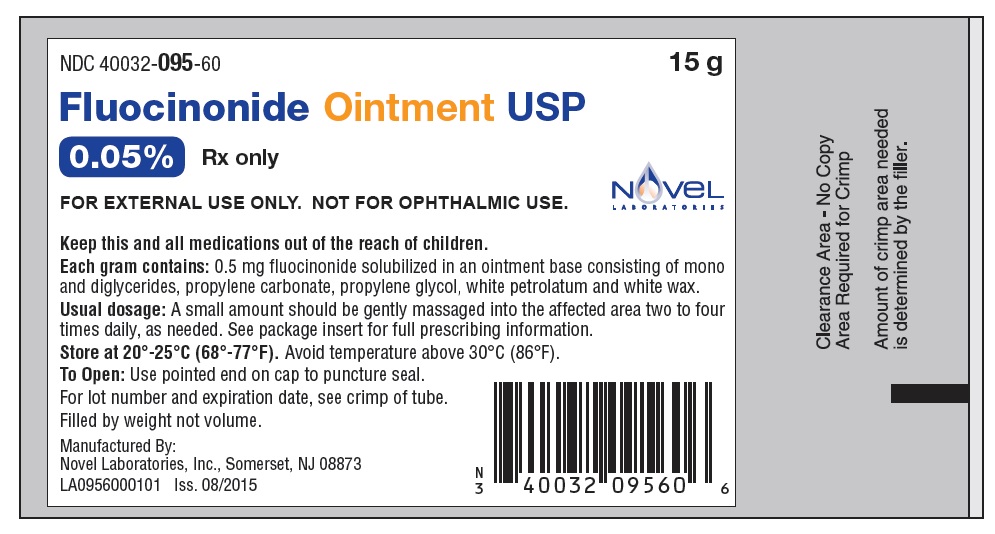
Fluocinonide 0.5 mg/g Ointment — NDC 40032-0095-60 package photo

Fluocinonide 0.5 mg/g Ointment

by Novel Laboratories, Inc. · 1 TUBE in 1 CARTON (40032-095-60) / 15 g in 1 TUBE
NDC 40032-0095-60
🏷️ FDA NDC (as labeled) 40032-095-60 billing pads the product segment with a zero
This package
Contains15 g in 1 tube Pack sizes2 compare ↓
Also comes in: 60 g 40032-0095-61
Rx only Generic Discontinued Non-controlled ⚠ Inactivated by FDA
🗂️ Data synced Jul 14, 2026 · sources: openFDA · FDA label (DailyMed) · FDA Orange & Purple Book · First Databank · CMS NADAC, ASP, Medicare & Medicaid · RxNorm
📋 All sources & update times →
⚠️
Other active recalls for Fluocinonide (different manufacturers) — 3 · tap to view
These affect other manufacturers’ products for the same ingredient — not necessarily the exact NDC on this page.
Class II · Mar 25, 2026 — Failed Viscosity Specifications: Out of Specification results, above the specification limit, in viscosity, noted during stability testing. (SUN PHARMACEUTICAL INDUSTRIES INC) · FDA recall D-0476-2026
Class II · Mar 25, 2026 — Failed Viscosity Specifications: Out of Specification results, above the specification limit, in viscosity, noted during stability testing. (SUN PHARMACEUTICAL INDUSTRIES INC) · FDA recall D-0477-2026
Class II · Mar 25, 2026 — Failed Viscosity Specifications: Out of Specification results, above the specification limit, in viscosity, noted during stability testing. (SUN PHARMACEUTICAL INDUSTRIES INC) · FDA recall D-0475-2026
Each entry is an official FDA enforcement report — look up any recall number in the FDA recall database ↗
⚠️
Excluded from the active FDA NDC Directory. FDA inactivated this product’s listing record, so it is excluded from the active NDC Directory. The listing was last certified through Dec 2023. A label may still appear on DailyMed, but the NDC is no longer in the current FDA NDC Directory. Search the FDA NDC Directory ↗

🆔 Identity & classification

FDA NDC (as labeled) 40032-095-60
Product NDC 40032-095
11-digit billing NDC 40032009560
Application # ANDA207538
SPL Set ID ee0ffda0-c09c-4f64-a7c6-efb1bb24eee2
Established class (EPC) Corticosteroid Hormone Receptor Agonists [MoA], Corticosteroid
DEA schedule Non-controlled
Marketing category ANDA
Marketing status Discontinued
FDA listing status Inactivated by FDA (certified through Dec 2023)
Route TOPICAL
Dosage form OINTMENT
Substance FLUOCINONIDE
TE code (Orange Book) AB · RLD · RS
Why two NDCs? The FDA registers this code as 40032-095-60 — a 5-3-2 layout, and that's what's printed on the package and shown on DailyMed. For insurance claims, every NDC is standardized to a uniform 11-digit 5-4-2 format by adding a zero to the product segment → 40032-0095-60. Same drug, same package — only the format differs.
Where does this data come from?
Identifiers from the FDA openFDA NDC Directory and Structured Product Labeling; RxCUI from RxNorm (NLM); GPI from Medi-Span; GCN / HIC / AHFS / legend from First Databank.

🏭 Manufacturer & labeler

LabelerNovel Laboratories, Inc.
Application holderCHARTWELL RX SCIENCES LLC
FDA applicationANDA207538 (ANDA)
Labeler code40032
Product typeHuman Prescription Drug
Portfolio22 products on file
The labeler markets the product; the application holder owns the FDA approval. They’re often the same company but can differ (e.g. a repackager or an authorized generic). A mailing address / phone appears here when the manufacturer includes it in the product’s FDA label (not all do).
Where does this data come from?
Labeler, application holder and registered establishment from the FDA openFDA NDC Directory and Drugs@FDA; address/contact from the product’s FDA label.

🩺 Clinical

📗 Our plain-language guide HelloPharmacist
  • Fluocinonide is used to calm inflamed, itchy skin — things like eczema (atopic dermatitis), psoriasis, and other inflammatory skin conditions that respond to steroid treatment. It...
  • What skin problems does fluocinonide actually treat?
  • Use a thin layer — just enough to cover the affected area — and rub it in gently. How often you apply it depends on your product and condition: some people use it once a day, other...
  • That's a really common feeling with skin conditions, but with the 0.1% strength products, treatment beyond 2 consecutive weeks is generally not recommended because of the risk of t...
📖 Read our full Fluocinonide guide →
Where does this data come from?
Plain-language summary from MedlinePlus (U.S. National Library of Medicine); supplement & herbal interactions and nutrient depletion data from the Natural Medicines database; our full guide is HelloPharmacist editorial content.

🧪 Inactive Ingredients / Excipients

Inactive ingredients, also called excipients, are components of the drug product other than the active ingredient. They may include fillers, dyes, coatings, preservatives, flavors, or other formulation ingredients.

💡 Tap an ingredient (hover on desktop) to see what it is and why it’s used.

  • UNII 230OU9XXE4
    A waxy substance made from glycerin and stearic acid that acts as an emulsifier to blend oily and watery ingredients together. It also helps thicken and stabilize the medicine's texture.
  • UNII 4T6H12BN9U
    Petrolatum is a purified mineral oil-based jelly derived from petroleum. In medicines, it acts as an emollient, lubricant, and moisture barrier to soften skin, reduce friction, and help prevent water loss from formulations.
  • UNII 8D08K3S51E
    Propylene carbonate is a clear liquid solvent derived from propylene. It helps dissolve or suspend active ingredients in liquid medicines and can improve how well the product flows and mixes.
  • UNII 6DC9Q167V3
    Propylene glycol is a clear liquid derived from petroleum or vegetable sources. It acts as a solvent, humectant, and preservative in medicines, helping dissolve active ingredients and maintain product stability.
  • UNII 7G1J5DA97F
    White wax is a refined, bleached plant-based or mineral wax that serves as a coating and hardening agent in medicines. It helps control how fast the drug dissolves and improves the product's texture and appearance.

5 inactive ingredients listed in the exact product block matched to this NDC.

Where does this data come from?
Data sourced from official FDA Structured Product Labeling (SPL) via DailyMedingredient classCode="IACT" elements from the exact product block matched by this NDC. Label-section narrative from DailyMed / the openFDA label index is shown separately when available.

Inactive ingredient FAQ

Are inactive ingredients the same for every manufacturer?
No. Inactive ingredients can differ by manufacturer, dosage form, strength, and package / product version.
Why might an inactive ingredient be missing?
Some SPLs do not provide a complete structured inactive-ingredient list, and older or unusual labels may only include the information in narrative text.
Can inactive ingredients matter?
Yes. They can matter for allergies, intolerances, dyes, gluten / lactose concerns, preservatives, and formulation differences — but confirm with a pharmacist or the manufacturer when it’s clinically important.

💲 Pricing

A drug doesn't have one price. Each row is a different public payment system, and none is what you'd pay at the counter — that depends on your insurance. The ⓘ on each row explains what it measures.

Price systemPer gPer package
Retail pharmacies payNADAC · weekly Not in the retail survey — common for institutional, discontinued, or low-volume packs.
Medicaid paysCMS SDUD · 12 mo No recent Medicaid claims on file for this NDC — rare and low-volume NDCs are suppressed in the public data.
Medicare drug plans payPart D · quarterly No Part D plan price is available for this NDC in our data.
ℹ️
No price is published for this exact package yet. CMS surveys NADAC per package size, so a different pack of the same drug often has one.
Try another pack size: 60 g
Where does this data come from?
NADAC (National Average Drug Acquisition Cost) is the CMS weekly pharmacy-acquisition-cost survey — what pharmacies pay. ASP (Average Sales Price) is the CMS Medicare Part B drug-payment file, published quarterly. Medicaid pays is computed by us from CMS State Drug Utilization Data (total reimbursed ÷ units, trailing 12 months) — gross of rebates and inclusive of dispensing fees, so it reflects what Medicaid paid, not an acquisition cost. Medicare drug plans pay is the median negotiated point-of-sale unit cost across plans listing this NDC in the CMS quarterly Prescription Drug Plan pricing files, before rebates. The VA pays is the federal contract price (FSS, and the statutory Big 4 ceiling where listed) from the VA National Acquisition Center pharmaceutical price file. All are free public government data; each measures a different payer, so the figures are not directly comparable.

🔁 Therapeutic equivalents

ProductLabelerPackNADAC/unitTEStatusPrice vs. this
Fluocinonide 0.5 mg/gthis 40032-0095-60 Novel 1 tube AB Discontinued
About this product: this is a generic version of the medicine. FDA equivalence ratings are shown when available, and other versions are listed above, least expensive first.
Where does this data come from?
Equivalents are other NDCs of the same ingredient, form and route from the openFDA NDC Directory, ranked least-expensive-first by NADAC. Therapeutic-equivalence (AB) ratings come from the FDA Orange Book; biologics use the FDA Purple Book for biosimilar & interchangeable status.

Availability & generic status

📍
2026
Currently FDA-listed
listed with the FDA
🔓
·
Generic on the market
this product is a generic
This is a generic drug

This product is an FDA-approved generic. Other versions of the same drug are listed under Therapeutic equivalents, least expensive first.

Where does this data come from?
Patents and exclusivity from the FDA Orange Book (small-molecule drugs), refreshed from public FDA data. Generic launch timing is an estimate, not a guarantee.

📊 Medicare Part D spend CMS · PART D · 2026 (Q1)

Medicare Part D (outpatient prescription) spending for Fluocinonide — the program that covers self-administered drugs. 13 manufacturers.
⚠️ Drug-level data: CMS publishes Part D spending by drug, not by NDC — these figures combine every manufacturer, strength and package size sold under the name Fluocinonide. That’s a different level of aggregation than the Medicaid card above, which is specific to this exact 11-digit NDC (pack size included), so the two aren’t directly comparable.
Period
Total Part D spend
$6.96M
Claims incl. refills
176.2K
Beneficiaries
135.8K
Spend / beneficiary
$51.22
Spend / claim
$39.49
Trend by period
💵 About the dollar figures: spending is what Part D plans paid before confidential manufacturer rebates, so the program’s real net cost is lower. A blank patient count means fewer than 11 people — CMS hides counts that small to protect privacy. Source: CMS Medicare Quarterly Part D Spending by Drug (data.cms.gov), updated quarterly.

📦 Packaging — all sizes for this product

Package NDCDescription Marketing startStatus
40032-0095-60 You're viewing this 1 TUBE in 1 CARTON (40032-095-60) / 15 g in 1 TUBE 2017-07-31 Inactivated by FDA
40032-0095-61 1 TUBE in 1 CARTON (40032-095-61) / 60 g in 1 TUBE 2017-07-31 Inactivated by FDA

Pack size FAQ

What quantity is in NDC 40032-0095-60?
NDC 40032-0095-60 is listed by the FDA — 1 tube in 1 carton / 15 g in 1 tube.
What NDC number is used to bill for this package of Fluocinonide 0.5 mg/g Ointment?
Bill NDC 40032-0095-60 — the 11-digit billing format is 40032009560. Pharmacy and medical claims use the 11-digit form; the FDA label may print a shorter form of the same code.

🧭 About this NDC listing & data coverage

Finished prescription product No longer marketed (per FDA listing data)
What data is (and isn’t) available for this NDC — tap to expand
NDC identity (package / product / labeler codes) ✓ Available
Labeler ✓ Available
Product & package description ✓ Available
Marketing category & status ✓ Available
Active ingredient / dosage form / route ✓ Available
FDA label (SPL via DailyMed) ✓ Available
Package photos ✓ Available
Inactive ingredients (structured) ✓ Available
NADAC pharmacy acquisition price (CMS) — Not published for this NDC CMS publishes NADAC only for NDCs reported in its retail-pharmacy survey.
Orange Book / therapeutic-equivalence data ✓ Available
HCPCS J-code billing crosswalk — Not published for this NDC Most self-administered / retail products have no J-code — that is normal.
Medicaid utilization (CMS SDUD) — Not published for this NDC CMS reports utilization only for NDCs with Medicaid claims above its privacy threshold.
“Not published” reflects what the public FDA / CMS / NLM sources provide for this exact package code — it is a property of the data feeds, not a judgment about the product.

Questions about this listing

Why is there no price listed?
The pricing shown on our NDC pages comes from CMS NADAC, a voluntary survey of retail community pharmacy invoices. CMS does not publish a NADAC for every NDC — packages outside the retail survey (institutional and hospital products, bulk packages, discontinued items, and many OTC items) may never receive one. A missing price reflects the survey's scope, not this product's actual cost, and does not mean the product is free or unavailable.
What does the discontinued status mean for this NDC?
The labeler reported a marketing end date (or the listing was delisted), so this specific package is no longer actively marketed. Remaining stock may still be dispensed for a time, and the NDC stays valid for historical records and claims — but data feeds (pricing, labeling) typically stop updating for it. Other package sizes or other manufacturers' versions of the same medication may still be marketed — see the equivalents section where available.
Is the NDC printed on the package the same as the 11-digit billing NDC?
Yes, they identify this exact package in different formats. The FDA registers it as 40032-095-60, which is what is printed on the packaging and shown on DailyMed. Insurance claims use a fixed 11-digit 5-4-2 format, so the short segment is padded with a leading zero: 40032-0095-60, written without dashes as 40032009560. The Identity section at the top of this page lists every form of this code.
What do the three segments of this NDC mean?
In 40032-0095-60, the first segment (40032) is the labeler code FDA assigned to Novel Laboratories, Inc.; the middle segment (0095) identifies this specific product — its ingredient, strength, and dosage form; and the last segment (60) identifies this exact package size and type. Together they name one specific package of one specific product.
Does this product come in other package sizes?
Yes — the FDA directory lists 1 other package presentation of this same product, including 1 tube (40032-0095-61). Each has its own NDC and its own page — see the package list near the top of this page.
Who lists this product with the FDA?
Novel Laboratories, Inc. is the labeler of record for this NDC — the company under whose FDA-assigned code the package is listed. The labeler may be the manufacturer itself or a distributor marketing the product under its own code.
Do I need a prescription for this product?
This NDC is listed with FDA as a prescription product, so it is dispensed under a prescriber's order. Your pharmacist can tell you whether any over-the-counter forms of the same medication exist.
This page identifies an FDA-listed package (the NDC) and reports public regulatory and pricing data about the listing. It is reference information, not a medical recommendation — talk to your pharmacist or prescriber about your own medication.
Where does this data come from?
Listing facts (marketing category, packager status, marketing dates) from the FDA openFDA NDC Directory; label availability from DailyMed; pricing coverage from CMS NADAC; equivalence scope from the FDA Orange Book.

📄 Full prescribing information FDA SPL

The complete FDA label for this product — the official prescribing information, verbatim, section by section. Jump with a chip, search within the label, or expand everything.
🎯 Indications and Usage 21 words

INDICATIONS AND USAGE Fluocinonide Ointment USP, 0.05% is indicated for the relief of the inflammatory and pruritic manifestations of corticosteroid-responsive dermatoses.

⏱️ Dosage and Administration 62 words

DOSAGE AND ADMINISTRATION Fluocinonide Ointment USP, 0.05% is generally applied to the affected area as a thin film from two to four times daily depending on the severity of the condition. Occlusive dressings may be used for the management of psoriasis or recalcitrant conditions. If an infection develops, the use of the occlusive dressings should be discontinued and appropriate antimicrobial therapy instituted.

Contraindications 21 words

CONTRAINDICATIONS Topical corticosteroids are contraindicated in those patients with a history of hypersensitivity to any of the components of the preparations.

🤒 Adverse Reactions 59 words

ADVERSE REACTIONS The following local adverse reactions are reported infrequently with topical corticosteroids, but may occur more frequently with the use of occlusive dressings. These reactions are listed in an approximate decreasing order of occurrence: Burning Itching Irritation Dryness Folliculitis Hypertrichosis Acneiform Eruptions Hypopigmentation Perioral Dermatitis Allergic Contact Dermatitis Maceration of the Skin Secondary Infection Skin Atrophy Striae Miliaria

🆘 Overdosage 17 words

OVERDOSAGE Topically applied corticosteroids can be absorbed in sufficient amounts to produce systemic effects (see PRECAUTIONS ).

🧬 Clinical Pharmacology 192 words

CLINICAL PHARMACOLOGY Topical corticosteroids share anti-inflammatory, anti-pruritic and vasoconstrictive actions. The mechanism of anti-inflammatory activity of the topical corticosteroids is unclear. Various laboratory methods, including vasoconstrictor assays, are used to compare and predict potencies and/or clinical efficacies of the topical corticosteroids.

There is some evidence to suggest that a recognizable correlation exists between vasoconstrictor potency and therapeutic efficacy in man. Pharmacokinetics The extent of percutaneous absorption of topical corticosteroids is determined by many factors including the vehicle, the integrity of the epidermal barrier, and the use of occlusive dressings. Topical corticosteroids can be absorbed from normal intact skin.

Inflammation and/or other disease processes in the skin increase percutaneous absorption. Occlusive dressings substantially increase the percutaneous absorption of topical corticosteroids. Thus, occlusive dressings may be a valuable therapeutic adjunct for treatment of resistant dermatoses (see DOSAGE AND ADMINISTRATION ).

Once absorbed through the skin, topical corticosteroids are handled through pharmacokinetic pathways similar to systemically administered corticosteroids. Corticosteroids are bound to plasma proteins in varying degrees. Corticosteroids are metabolized primarily in the liver and are then excreted by the kidneys.

Some of the topical corticosteroids and their metabolites are also excreted into the bile.

📦 How Supplied / Storage and Handling 40 words

HOW SUPPLIED Fluocinonide Ointment, 0.05% is supplied in 15 g Tube – NDC 40032-095-60 60 g Tube – NDC 40032-095-61 Store at 20°-25°C (68°-77°F). Avoid temperature over 30°C (86°F). Manufactured by: Novel Laboratories, Inc. Somerset, NJ 08873 PI0950000103 Rev. 11/2017

📋 Description 89 words

DESCRIPTION Fluocinonide Ointment USP, 0.05% is intended for topical administration. The active component is the corticosteroid fluocinonide, which is the 21-acetate ester of fluocinolone acetonide and has the chemical name pregna-1,4-diene-3,20-dione,21-(acetyloxy) -6,9-difluoro-11-hydroxy-16,17-[(1-methylethylidene)bis(oxy)]-,(6α,11β,16α)-. It has the following chemical structure: Fluocinonide Ointment USP, 0.05% contains fluocinonide 0.5 mg/g in a specially formulated ointment base consisting of mono and di glycerides, propylene carbonate, propylene glycol, white petrolatum and white wax.

It provides the occlusive and emollient effects desirable in an ointment. In this formulation, the active ingredient is totally in solution. 19b891ae-figure-01

Source: FDA Structured Product Labeling, mirrored from DailyMed / openFDA. Prefer the government’s original formatting? View this label on DailyMed ↗
For educational and professional reference only — not medical advice. Pricing reflects published NADAC and CMS ASP (free public data) and may differ from your acquisition cost; always verify before billing or dispensing.