
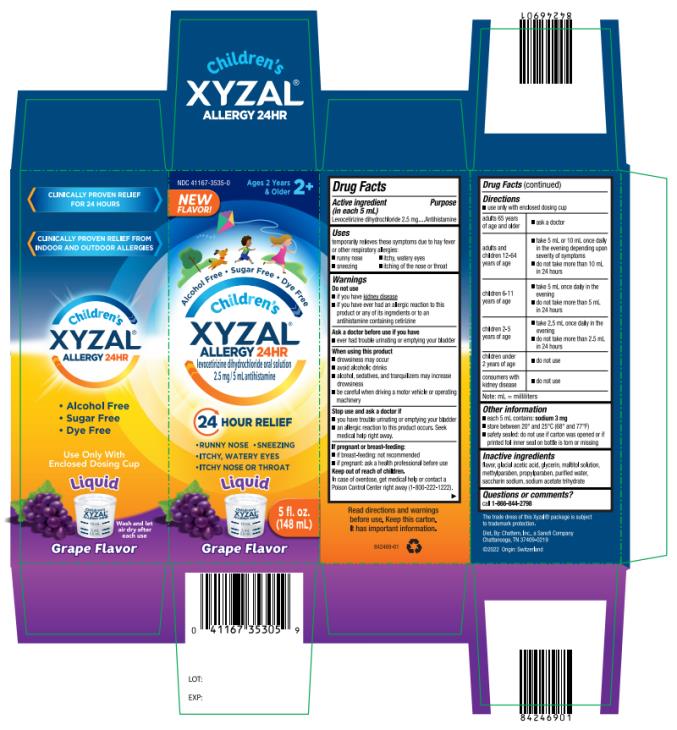
Childrens Xyzal Allergy Levocetirizine dihydrochloride 2.5 mg/5mL Solution — NDC 41167-3533-0 (Billing 41167-3533-00)
This is a package of Childrens Xyzal Allergy Levocetirizine dihydrochloride 2.5 mg/5mL Solution from Chattem, Inc., marketed since Jan 2024 and currently FDA-listed. It is the main listing for this product, which comes in 2 package sizes.
Identity & classification
Regulatory identifiers FDA, NLM and CMS codes for this package
Drug-database identifiers Medi-Span GPI and First Databank GCN / HICL / AHFS classification
- GSN (GCN sequence number): 062168
- GCN: 97950
- HICL (First Databank): 022959
- AHFS class code: 04:08.00.00
- RxCUI (RxNorm): 855168
Where does this data come from?
- FDA openFDA NDC Directory · synced Oct 1, 2026
- FDA label on DailyMed · label index refreshed Oct 1, 2026
- RxNorm (NLM RxNav) · catalog refreshed Oct 1, 2026
- Medi-Span GPI (licensed)
- First Databank (licensed) · refreshed Oct 1, 2026
RxNorm drug class
This medicine belongs to the Histamine-1 Receptor Antagonist class.
Where does this data come from?
- RxClass (NLM) · catalog refreshed Oct 1, 2026
Clinical
Levocetirizine is used to treat allergy symptoms: sneezing runny nose itching of the nose or throat red, itchy, or watery eyes It is also used to treat symptoms of urticaria (hives). Levocetirizine is in a class of medications called antihistamines. It works by blocking the action of histamine, a substance in the body that causes allergic symptoms.
Read the full MedlinePlus article ↗- Levocetirizine treats seasonal and perennial allergic rhinitis — basically hay fever and year-round indoor allergies — relieving symptoms like runny nose, sneezing, and itchy, wate...
- It can, yes — drowsiness is the most commonly reported side effect and tends to be more noticeable at higher doses. That's why it's recommended to take it in the evening. Until you...
- Yes, you can take levocetirizine with or without food — it's flexible that way. If you take the tablet with a high-fat meal, it might take a little longer to kick in and the peak l...
- This is an important one to flag with your doctor before you start. Levocetirizine is mainly cleared from your body through the kidneys, so if your kidney function is reduced, the...
Patient education
Supplement & herbal interactions
Some supplements/herbs that may interact with Levocetirizine Dihydrochloride — tap one for details:
Where does this data come from?
- MedlinePlus (NLM) · refreshed Oct 1, 2026
- FDA label on DailyMed · label index refreshed Oct 1, 2026
Ask a licensed pharmacist directly — free, answered by our team.
Pricing
A drug doesn't have one price. Each row is a different public payment system, and none is what you'd pay at the counter — that depends on your insurance. The ⓘ on each row explains what it measures.
| Price system | Per mL | Per package |
|---|---|---|
| Retail pharmacies payNADAC · weekly | Not in the retail survey — common for institutional, discontinued, or low-volume packs. | |
| Medicaid paysCMS SDUD · 12 mo | No recent Medicaid claims on file for this NDC — rare and low-volume NDCs are suppressed in the public data. | |
| Medicare drug plans payPart D · quarterly | No Part D plan price is available for this NDC in our data. | |
Where does this data come from?
- CMS NADAC weekly file
- CMS ASP pricing files · refreshed Sep 20, 2026
- CMS Medicaid State Drug Utilization Data · refreshed Oct 2, 2026
- CMS Part D plan pricing files · refreshed Sep 24, 2026
- VA National Acquisition Center price file
Packaging — all sizes for this product
| Package NDC | Description | Marketing start | Marketing end | Status |
|---|---|---|---|---|
| 41167-3533-00 You're viewing this Main listing | 1 BOTTLE in 1 CARTON / 148 mL in 1 BOTTLE | 2024-01-04 | — | Active |
| 41167-3533-01 41167-3533-1 | 1 BOTTLE in 1 CARTON / 295 mL in 1 BOTTLE | 2026-01-01 | — | Active |
Pack size FAQ
What quantity is in this package?
What NDC number is used to bill for this package of Childrens Xyzal Allergy Levocetirizine dihydrochloride 2.5 mg/5mL Solution?
Therapeutic equivalents
| Product | Labeler | Pack | NADAC/unit | TE | Status | Price vs. this |
|---|---|---|---|---|---|---|
| levocetirizine dihydrochloride 2.5 mg/5mL 31722-0659-31 | Camber | 1 bottle | $0.166 | AA | Availability likely | — |
| levocetirizine dihydrochloride .5 mg/mL 45802-0680-28 | Padagis | 148 ml | $0.166 | AA | Availability likely | — |
| Levocetirizine Dihydrochloride .5 mg/mL 62135-0917-38 | Chartwell | 148 ml | $0.166 | AA | Availability likely | — |
| Childrens Xyzal Allergy 2.5 mg/5mLthis 41167-3533-00 | Chattem, | 1 bottle | — | — | FDA listed | — |
| Childrens Xyzal Allergy 2.5 mg/5mL 41167-3535-00 | Chattem, | 1 bottle | — | — | FDA listed | — |
| Xyzal .5 mg/mL 41167-5804-05 | Chattem, | 1 bottle | — | — | FDA listed | — |
| levocetirizine dihydrochloride .5 mg/mL 63629-2533-01 | Bryant | 1 bottle | — | AA | FDA listed | — |
| levocetirizine dihydrochloride .5 mg/mL 72162-1424-02 | Bryant | 148 ml | — | AA | FDA listed | — |
Where does this data come from?
- FDA openFDA NDC Directory · synced Oct 1, 2026
- FDA Orange Book · refreshed Sep 3, 2026
- CMS NADAC weekly file
Availability & generic status
FDA-approved generic versions are listed, and recent pricing/market data suggests they may be available — see Therapeutic equivalents.
Why the date isn’t exact: Generic timing can change because patents may be challenged, settled, licensed, added, removed, or worked around with a narrower label — and FDA approval does not always mean a pharmacy can get the generic today.
🛈 What do these terms mean?
- Patent
- Legal protection listed in the Orange Book that may delay generic approval or launch. Issued by the U.S. Patent & Trademark Office.
- Substance patent
- Covers the active drug molecule itself — the hardest to design around. A generic generally can’t launch until it expires.
- Formulation (product) patent
- Covers a specific formulation or dosage form. A generic can sometimes work around it with a different formulation.
- Method-of-use patent
- A patent covering one specific approved use of the drug — not necessarily the whole molecule. A generic can sometimes launch with a “skinny label” that carves out the protected use and keeps the others.
- Skinny label
- A generic label that omits a still-patented use when the FDA allows it — letting a generic reach the market for the unprotected uses.
- Exclusivity
- FDA-granted marketing protection, separate from patents — e.g. 5-yr new chemical entity, 7-yr orphan drug, or a +6-month pediatric extension.
- Paragraph IV
- A generic applicant’s formal challenge to a listed patent. It can potentially lead to earlier generic entry, but often involves litigation or a settlement.
- RLD / RS
- Reference Listed Drug — the brand product the FDA uses as the reference for generic applications. Reference Standard — the product the FDA expects generics to compare against in bioequivalence testing.
- TE / AB rating
- FDA therapeutic-equivalence rating. An AB rating generally means the FDA considers a generic therapeutically equivalent to — and substitutable for — the brand.
- LOE (loss of exclusivity)
- The latest patent or exclusivity currently listed — the loss-of-exclusivity / latest-listed-protection date shown on this page. Paragraph-IV challenges and settlements can move the real date earlier; FDA approval and a manufacturer’s decision to market can move it later.
Built from the FDA Orange Book. The bars above are scaled to each protection’s expiry; the red LOE marker is the last one to lapse.
| Patent | Type | Use code | Expires |
|---|---|---|---|
| US 8633194 ↗ | Drug product | — | Oct 16, 2027 |
Is there a generic version of XYZAL 2.5 MG/5 ML SOLUTION?
The FDA approved a generic — why can’t I get it at my pharmacy yet?
Why do different websites show different generic release dates?
What does “FDA listed” mean?
What does a patent or protection date mean here?
What does “current Orange Book estimate” mean?
Can a generic come out before the last patent expires?
Can a generic come out after the listed dates?
What is the difference between patents and exclusivity?
Why are there multiple patent dates?
Where does this data come from?
- FDA Orange Book · refreshed Sep 3, 2026
What it looks like
Where does this data come from?
- FDA label on DailyMed · label index refreshed Oct 1, 2026
Inactive Ingredients / Excipients
Inactive ingredients, also called excipients, are components of the drug product other than the active ingredient. They may include fillers, dyes, coatings, preservatives, flavors, or other formulation ingredients.
💡 Tap an ingredient (hover on desktop) to see what it is and why it’s used.
-
UNII Q40Q9N063P
Acetic acid is a weak organic acid commonly used in medicines as a buffer and pH adjuster. It helps maintain the proper acidity level to ensure the drug remains stable and effective in its formulation.
-
UNII PDC6A3C0OX
Glycerin is a clear, thick liquid derived from plant oils or fats. It acts as a humectant to retain moisture, a sweetener, and a solvent in medications.
-
UNII D65DG142WK
Maltitol is a sugar alcohol made by hydrogenating maltose. It's used as a sweetener and filler in medicines to improve taste and add bulk to tablets and capsules.
-
UNII A2I8C7HI9T
Methylparaben is a preservative derived from benzoic acid that prevents growth of bacteria, fungi, and mold in medicines. It extends the product's shelf life and maintains safety during storage.
-
UNII Z8IX2SC1OH
Propylparaben is a chemical preservative used to prevent bacterial and fungal growth in medicines and personal care products. It helps extend shelf life and maintain product safety during storage.
-
UNII SB8ZUX40TY
Saccharin sodium is an artificial sweetener made from saccharin salt. It's added to medicines to improve taste, especially in liquid formulations for children or bitter drugs.
-
UNII 4550K0SC9B
Sodium acetate is a salt derived from acetic acid. It acts as a buffer to help maintain the medicine's pH stability and may serve as a preservative or solubilizer in liquid formulations.
-
UNII 059QF0KO0R
Water is a liquid solvent that dissolves and mixes ingredients together in liquid medicines, syrups, and injections. It helps distribute the active drug evenly throughout the product.
8 inactive ingredients listed in the exact product block matched to this NDC.
Label-section wording can be broader than the structured product block and may mention additional formulation ingredients.
Where does this data come from?
ingredient classCode="IACT" elements from the exact product block matched by this NDC. Label-section narrative from DailyMed / the openFDA label index is shown separately when available.- FDA label on DailyMed · label index refreshed Oct 1, 2026
- FDA openFDA NDC Directory · synced Oct 1, 2026
Inactive ingredient FAQ
Are inactive ingredients the same for every manufacturer?
Why might an inactive ingredient be missing?
Can inactive ingredients matter?
Manufacturer & labeler
Where does this data come from?
- FDA openFDA NDC Directory · synced Oct 1, 2026
- Drugs@FDA
FDA label — Drug Facts FDA SPL
🎯 Indications and Usage ▾
Use s temporarily relieves these symptoms due to hay fever or other respiratory allergies: ■ runny nose ■ sneezing ■ itchy, watery eyes ■ itching of the nose or throat
⏱️ Dosage and Administration ▾
Directions ■ use only with enclosed dosing cup adults 65 years of age and older ■ ask a doctor adults and children 12-64 years of age ■ take 5 mL or 10 mL once daily in the evening depending upon severity of symptoms ■ do not take more than 10 mL in 24 hours children 6-11 years of age ■ take 5 mL once daily in the evening ■ do not take more than 5 mL in 24 hours children 2-5 years of age ■ take 2.5 mL once daily in the evening ■ do not take more than 2.5 mL in 24 hours children under 2 years of age ■ do not use consumers with kidney disease ■ do not use Note: mL=milliliters
⚠️ Warnings ▾
Warnings Do not use ■ if you have kidney disease ■ if you have ever had an allergic reaction to this product or any of its ingredients or to an antihistamine containing cetirizine Ask a doctor before use if you have ■ ever had trouble urinating or emptying your bladder When using this product ■ drowsiness may occur ■ avoid alcoholic drinks ■ alcohol, sedatives, and tranquilizers may increase drowsiness ■ be careful when driving a motor vehicle or operating machinery ■ in rare cases, you may experience itching after stopping levocetirizine.
Consult your healthcare provider if this happens. Stop use and ask a doctor if ■ you have trouble urinating or emptying your bladder ■ an allergic reaction to this product occurs. Seek medical help right away.
If pregnant or breast - feeding: ■ if breast-feeding: not recommended ■ if pregnant: ask a health professional before use Keep out of reach of children. In case of overdose, get medical help or contact a Poison Control Center right away (1-800-222-1222).
🧪 Active Ingredient ▾
Active i ngredient (in each 5 mL ) Levocetirizine dihydrochloride 2.5 mg
🧪 Inactive Ingredients ▾
Inactive ingredients flavor, glacial acetic acid, glycerin, maltitol solution, methylparaben, propylparaben, purified water, saccharin sodium, sodium acetate trihydrate
🎯 Purpose ▾
Purpose Antihistamine
📄 Do Not Use ▾
Do not use ■ if you have kidney disease ■ if you have ever had an allergic reaction to this product or any of its ingredients or to an antihistamine containing cetirizine
📄 Ask a Doctor Before Use If ▾
Ask a doctor before use if you have ■ ever had trouble urinating or emptying your bladder
📄 When Using This Product ▾
When using this product ■ drowsiness may occur ■ avoid alcoholic drinks ■ alcohol, sedatives, and tranquilizers may increase drowsiness ■ be careful when driving a motor vehicle or operating machinery ■ in rare cases, you may experience itching after stopping levocetirizine. Consult your healthcare provider if this happens.
📄 Stop Use and Ask a Doctor If ▾
Stop use and ask a doctor if ■ you have trouble urinating or emptying your bladder ■ an allergic reaction to this product occurs. Seek medical help right away.
🤰 If Pregnant or Breast-Feeding ▾
If pregnant or breast - feeding: ■ if breast-feeding: not recommended ■ if pregnant: ask a health professional before use
📄 Keep Out of Reach of Children ▾
Keep out of reach of children. In case of overdose, get medical help or contact a Poison Control Center right away (1-800-222-1222).
📄 Questions or Comments ▾
Questions or comments? call 1-8 66 - 844 - 2798
📄 Package Label / Principal Display Panel ▾
PRINCIPAL DISPLAY PANEL Children’s Xyzal Allergy 24HR Liquid Grape Flavor PRINCIPAL DISPLAY PANEL Children’s Xyzal Allergy 24HR Liquid Grape Flavor
PRINCIPAL DISPLAY PANEL Children’s Xyzal Allergy 24HR Liquid Tutti Frutti Flavor PRINCIPAL DISPLAY PANEL Children’s Xyzal Allergy 24HR Liquid Tutti Frutti Flavor
PRINCIPAL DISPLAY PANEL Children’s Xyzal Allergy 24HR Liquid Bubble Gum Flavor PRINCIPAL DISPLAY PANEL Children’s Xyzal Allergy 24HR Liquid Bubble Gum Flavor
Medicare Part D spend CMS · PART D · 2026 (Q1)
About this NDC listing & data coverage
What data is (and isn’t) available for this NDC — tap to expand
| NDC identity (package / product / labeler codes) | ✓ Available |
| Labeler | ✓ Available |
| Product & package description | ✓ Available |
| Marketing category & status | ✓ Available |
| Active ingredient / dosage form / route | ✓ Available |
| FDA label (SPL via DailyMed) | ✓ Available |
| Package photos | ✓ Available |
| Inactive ingredients (structured) | ✓ Available |
| NADAC pharmacy acquisition price (CMS) | — Not published for this NDC CMS publishes NADAC only for NDCs reported in its retail-pharmacy survey. |
| Orange Book / therapeutic-equivalence data | ✓ Available |
| HCPCS J-code billing crosswalk | — Not published for this NDC Most self-administered / retail products have no J-code — that is normal. |
| Medicaid utilization (CMS SDUD) | — Not published for this NDC CMS reports utilization only for NDCs with Medicaid claims above its privacy threshold. |