
Allegra-D Allergy and Congestion fexofenadine hydrochloride and pseudoephedrine 180 mg; 240 mg Tablet, Film Coated, Extended Release — NDC 41167-4320-5 (Billing 41167-4320-05)
This is a package of Allegra-D Allergy and Congestion fexofenadine hydrochloride and pseudoephedrine 180 mg; 240 mg Tablet, Film Coated, Extended Release from Chattem, Inc., marketed since Mar 2011 and currently FDA-listed. It is the main listing for this product, which comes in 2 package sizes.
NDC database record
One package, one record: these facts belong to NDC 41167-4320-5 alone.
- Record
- FDA NDC Directory package listing · Human OTC drug
- Code segments
- 41167 labeler · 4320 product · 5 package
- Package marketed since
- Mar 3, 2011
- Sample package
- No — commercial package
- Listing certified through
- Dec 31, 2027
- Barcode (UPC-A, from the NDC)
- 3 4116743205 2
- FDA record last changed
- Jul 24, 2026
Identity & classification
Regulatory identifiers FDA, NLM and CMS codes for this package
Drug-database identifiers Medi-Span GPI and First Databank GCN / HICL / AHFS classification
- GSN (GCN sequence number): 058869
- GCN: 24394
- GPI-14 (Medi-Span): 43993002687520
- HICL (First Databank): 016846
- AHFS class code: 04:08.00.00
- RxCUI (RxNorm): 997415
Where does this data come from?
- FDA openFDA NDC Directory · synced Oct 1, 2026
- FDA label on DailyMed · label index refreshed Oct 6, 2026
- RxNorm (NLM RxNav) · catalog refreshed Oct 1, 2026
- Medi-Span GPI (licensed)
- First Databank (licensed) · refreshed Oct 1, 2026
RxNorm drug class
This medicine belongs to the Histamine-1 Receptor Antagonist class.
Where does this data come from?
- RxClass (NLM) · catalog refreshed Oct 1, 2026
Clinical
- It actually tackles two things at once. The fexofenadine part is an antihistamine that helps with allergy symptoms like runny nose, sneezing, itchy and watery eyes, and itching of...
- What exactly does this medication do — does it just help with allergies?
- Yes, it really does matter. You should take this tablet on an empty stomach with a full glass of water. Also, use water specifically — do not take it with fruit juice. Taking it wi...
- Does it matter when I take it — like with food or on an empty stomach?
Patient education
Supplement & herbal interactions
Where does this data come from?
- MedlinePlus (NLM) · refreshed Oct 1, 2026
- FDA label on DailyMed · label index refreshed Oct 6, 2026
Ask a licensed pharmacist directly — free, answered by our team.
Pricing
A drug doesn't have one price. Each row is a different public payment system, and none is what you'd pay at the counter — that depends on your insurance. The ⓘ on each row explains what it measures.
| Price system | Per each | Per package |
|---|---|---|
| Retail pharmacies payNADAC · weekly | Not in the retail survey — common for institutional, discontinued, or low-volume packs. | |
| Medicaid paysCMS SDUD · 12 mo | No recent Medicaid claims on file for this NDC — rare and low-volume NDCs are suppressed in the public data. | |
| Medicare drug plans payPart D · quarterly | No Part D plan price is available for this NDC in our data. | |
Where does this data come from?
- CMS NADAC weekly file
- CMS ASP pricing files · refreshed Sep 20, 2026
- CMS Medicaid State Drug Utilization Data · refreshed Oct 6, 2026
- CMS Part D plan pricing files · refreshed Sep 24, 2026
- VA National Acquisition Center price file
Packaging — all sizes for this product
| Package NDC | Description | Marketing start | Marketing end | Status |
|---|---|---|---|---|
| 41167-4320-05 You're viewing this Main listing | 2 BLISTER PACK in 1 CARTON / 5 TABLET, FILM COATED, EXTENDED RELEASE in 1 BLISTER PACK | 2011-03-03 | — | Active |
| 41167-4320-07 41167-4320-7 | 3 BLISTER PACK in 1 CARTON / 5 TABLET, FILM COATED, EXTENDED RELEASE in 1 BLISTER PACK | 2011-03-03 | — | Active |
Pack size FAQ
What quantity is in this package?
What NDC number is used to bill for this package of Allegra-D Allergy and Congestion fexofenadine hydrochloride and pseudoephedrine 180 mg; 240 mg Tablet, Film Coated, Extended Release?
Therapeutic equivalents
| Product | Labeler | Pack | NADAC/unit | TE | Status | Price vs. this |
|---|---|---|---|---|---|---|
| Fexofenadine HCl and Pseudoephedrine HCl 180 mg/1; 240 mg 00363-0049-10 | Walgreens | 5 tablets | — | — | Discontinued | — |
| Allegra-D Allergy and Congestion 180 mg/1; 240 mgthis 41167-4320-05 | Chattem, | 5 tablets | — | — | FDA listed | — |
| Fexofenadine HCl and Pseudoephedrine HCl 180 mg/1; 240 mg 43598-0892-07 | Dr.Reddy's | 5 tablets | — | — | Discontinued | — |
| Fexofenadine HCl and Pseudoephedrine HCl 180 mg/1; 240 mg 51316-0018-10 | CVS | 5 tablets | — | — | Discontinued | — |
| Fexofenadine HCl and Pseudoephedrine HCI 180 mg/1; 240 mg 55111-0557-07 | Dr.Reddy's | 5 tablets | — | — | FDA listed | — |
| Fexofenadine Hydrochloride and Pseudoephedrine Hydrochloride 180 mg/1; 240 mg 58602-0844-60 | Aurohealth | 5 tablets | — | — | FDA listed | — |
| Fexofenadine HCl and Pseudoephedrine HCl 180 mg/1; 240 mg 79903-0255-10 | Walmart | 5 tablets | — | — | Discontinued | — |
| Fexofenadine Hydrochloride and Pseudoephedrine Hydrochloride 180 mg/1; 240 mg 00363-0270-10 | WALGREEN | 5 tablets | — | — | FDA listed | — |
Where does this data come from?
- FDA openFDA NDC Directory · synced Oct 1, 2026
- FDA Orange Book · refreshed Oct 3, 2026
- CMS NADAC weekly file
Availability & generic status
FDA-approved generic versions are listed, and recent pricing/market data suggests they may be available — see Therapeutic equivalents.
Where does this data come from?
- FDA Orange Book · refreshed Oct 3, 2026
What it looks like
Where does this data come from?
- FDA label on DailyMed · label index refreshed Oct 6, 2026
Inactive Ingredients / Excipients
Inactive ingredients, also called excipients, are components of the drug product other than the active ingredient. They may include fillers, dyes, coatings, preservatives, flavors, or other formulation ingredients.
🧪 Avoiding an ingredient? See Fexofenadine and Pseudoephedrine inactive ingredients by manufacturer: every current product's list side by side, so you can ask your pharmacy for the version that does not list it.
💡 Tap an ingredient (hover on desktop) to see what it is and why it’s used.
-
UNII 1364PS73AF
Acetone is a clear, volatile liquid solvent. In medications, it helps dissolve or extract active ingredients during manufacturing and may be used in certain liquid formulations or coating processes.
-
UNII LMI26O6933
Alumina is a white powder form of aluminum oxide. It's used as a filler to add bulk to tablets and capsules, and sometimes as a thickening or anti-caking agent in powdered formulations.
-
UNII 3J2P07GVB6
Cellulose acetate is a plant-derived polymer made by chemically modifying cellulose fibers. In medications, it serves as a film-coating material for tablets and capsules to protect the drug, control release, and improve appearance.
-
UNII OP1R32D61U
Microcrystalline cellulose is a purified form of cellulose, a natural fiber from plant sources. It acts as a binder and filler in tablets and capsules, helping hold ingredients together and give the medicine its shape and size.
-
UNII D9C330MD8B
Copovidone is a synthetic polymer made by combining two types of plastic-like molecules. It acts as a binder and film-former to help hold tablet ingredients together and improve how the medicine dissolves in your body.
-
UNII M28OL1HH48
Croscarmellose sodium is a plant-based substance derived from cellulose. It acts as a disintegrant, helping tablets and capsules break down quickly in the digestive system so the medicine can be absorbed.
-
UNII H3R47K3TBD
FD&C Blue No. 1 is a synthetic blue dye approved for use in foods and medicines. It serves as a colorant to give the medication its distinctive appearance and help with product identification.
-
UNII XM0M87F357
A dark iron oxide compound that gives medicines their black or dark color. It's used as a colorant in tablets and capsules to help identify the product and make it visually distinctive.
-
UNII 3NXW29V3WO
Hypromellose is a plant-based thickener made from cellulose. It's used in medicines as a binder to hold ingredients together, a coating for tablets, and a thickener for liquids.
-
UNII ND2M416302
Isopropyl alcohol is a clear liquid solvent derived from petroleum. In medicines, it dissolves active ingredients and other components, helps the product flow smoothly, and aids in sterilization during manufacturing.
-
UNII 70097M6I30
Magnesium stearate is a salt made from magnesium and stearic acid, a fatty substance. It's used in tablets and capsules as a lubricant and glidant to help ingredients flow smoothly during manufacturing and prevent sticking.
-
UNII 3WJQ0SDW1A
Polyethylene glycol is a synthetic liquid or solid polymer used in medicines as a solvent, lubricant, and humectant. It helps dissolve active ingredients, reduces friction during manufacturing, and retains moisture in the final product.
-
UNII FZ989GH94E
Povidone is a synthetic polymer made from a plastic-like material. It acts as a binder to hold tablet ingredients together and as a disintegrant to help the tablet break apart in your stomach so the medicine can be absorbed.
-
UNII 6DC9Q167V3
Propylene glycol is a clear liquid derived from petroleum or vegetable sources. It acts as a solvent, humectant, and preservative in medicines, helping dissolve active ingredients and maintain product stability.
-
UNII ETJ7Z6XBU4
Silicon dioxide is a naturally occurring mineral used as a glidant and anti-caking agent. It helps powder ingredients flow smoothly and prevents clumping during manufacturing and storage.
-
UNII 451W47IQ8X
Sodium chloride is common table salt. It's used in medicines as a buffer to maintain proper pH, as a filler to add bulk, or to adjust the osmotic balance in liquid formulations.
-
UNII 7SEV7J4R1U
A powder made from a naturally occurring mineral. In medicines, talc works as a glidant and anti-caking agent, helping tablets and capsules flow smoothly during manufacturing and preventing clumping.
-
UNII 15FIX9V2JP
Titanium dioxide is a bright white mineral powder commonly used as a colorant and opacifying agent. It makes pills and tablets white or lighter in color and helps make coatings non-transparent.
-
UNII XHX3C3X673
Triacetin is a clear, oily liquid made from glycerin and acetic acid. It works as a plasticizer and solvent in medicines, helping soften coatings and improve how liquids mix together in formulations.
-
UNII 059QF0KO0R
Water is a liquid solvent that dissolves and mixes ingredients together in liquid medicines, syrups, and injections. It helps distribute the active drug evenly throughout the product.
20 inactive ingredients listed in the exact product block matched to this NDC.
Label-section wording can be broader than the structured product block and may mention additional formulation ingredients.
Where does this data come from?
ingredient classCode="IACT" elements from the exact product block matched by this NDC. Label-section narrative from DailyMed / the openFDA label index is shown separately when available.- FDA label on DailyMed · label index refreshed Oct 6, 2026
- FDA openFDA NDC Directory · synced Oct 1, 2026
Inactive ingredient FAQ
Are inactive ingredients the same for every manufacturer?
Why might an inactive ingredient be missing?
Can inactive ingredients matter?
Manufacturer & labeler
More NDCs from Chattem, Inc. labeler code 41167
- Allegra Allergy fexofenadine hydrochloride 60 mg Tablet, Film Coated NDC 41167-4131-2
- Childrens Allegra Hives fexofenadine HCl 30 mg/5mL Suspension NDC 41167-4227-1
- Childrens Allegra Allergy Fexofenadine Hydrochloride 30 mg Tablet, Orally Disintegrating NDC 41167-4232-1
- Childrens Allegra Allergy Fexofenadine Hydrochloride 30 mg/5mL Suspension NDC 41167-4244-1
- Childrens Allegra Allergy Fexofenadine Hydrochloride 30 mg/5mL Suspension NDC 41167-4246-2
- Allegra-D Allergy and Congestion fexofenadine hydrochloride and pseudoephedrine 60 mg; 120 mg Tablet, Film Coated, Extended Release NDC 41167-4310-2
- Nasacort Allergy 24HR Triamcinolone Acetonide 55 ug Spray, Metered NDC 41167-5800-1
- Xyzal levocetirizine dihydrochloride 5 mg Tablet, Film Coated NDC 41167-5803-9
- Xyzal levocetirizine dihydrochloride .5 mg/mL Solution NDC 41167-5804-5
- Selsun Blue Itchy Dry Scalp PYRITHIONE ZINC .01 g/mL Shampoo NDC 41167-6020-3
- Selsun Blue Moisturizing Selenium Sulfide 1 g/100mL Shampoo NDC 41167-6032-0
- Selsun Blue Medicated Selenium Sulfide 1 g/100mL Shampoo NDC 41167-6061-1
Where does this data come from?
- FDA openFDA NDC Directory · synced Oct 1, 2026
- Drugs@FDA
FDA label — Drug Facts FDA SPL
🎯 Indications and Usage ▾
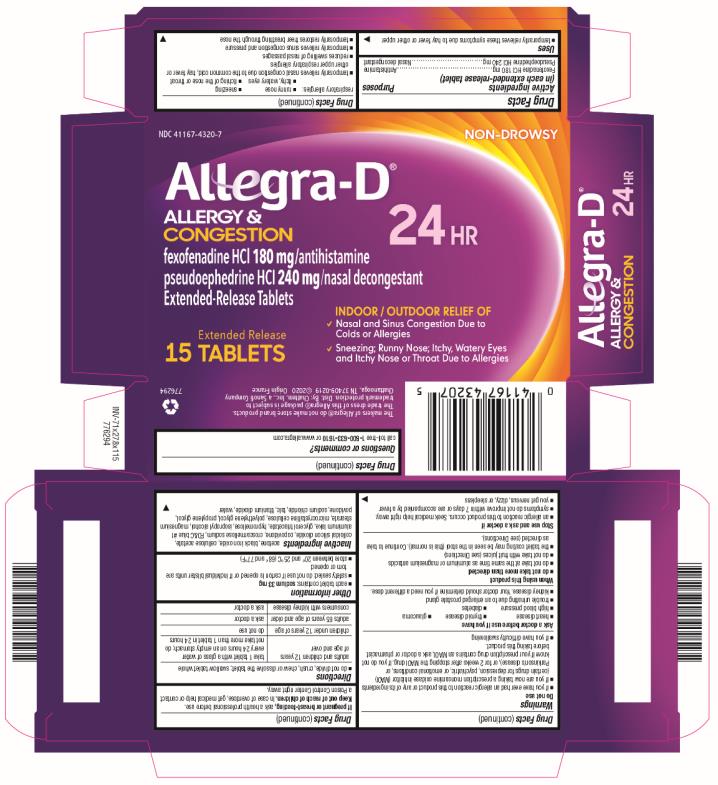
Uses temporarily relieves these symptoms due to hay fever or other upper respiratory allergies: ▪ runny nose ▪ sneezing ▪ itchy, watery eyes ▪ itching of the nose or throat temporarily relieves nasal congestion due to the common cold, hay fever or other upper respiratory allergies reduces swelling of nasal passages temporarily relieves sinus congestion and pressure temporarily restores freer breathing through the nose
⏱️ Dosage and Administration ▾
Directions do not divide, crush, chew or dissolve the tablet; swallow tablet whole adults and children 12 years of age and over take 1 tablet with a glass of water every 24 hours on an empty stomach; do not take more than 1 tablet in 24 hours children under 12 years of age do not use adults 65 years of age and older ask a doctor consumers with kidney disease ask a doctor
⚠️ Warnings ▾
Warnings Do not use if you have ever had an allergic reaction to this product or any of its ingredients if you are now taking a prescription monoamine oxidase inhibitor (MAOI) (certain drugs for depression, psychiatric, or emotional conditions, or Parkinson’s disease), or for 2 weeks after stopping the MAOI drug. If you do not know if your prescription drug contains an MAOI, ask a doctor or pharmacist before taking this product. If you have difficulty swallowing Ask a doctor before use if you have heart disease thyroid disease glaucoma high blood pressure diabetes trouble urinating due to an enlarged prostate gland kidney disease.
Your doctor should determine if you need a different dose. When using this product do not take more than directed do not take at the same time as aluminum or magnesium antacids do not take with fruit juices (see Directions ) the tablet coating may be seen in the stool (this is normal). Continue to take as directed (see Directions ).
Stop use and ask a doctor if an allergic reaction to this product occurs. Seek medical help right away. symptoms do not improve within 7 days or are accompanied by a fever you get nervous, dizzy, or sleepless If pregnant or breast-feeding, ask a health professional before use. Keep out of reach of children.
In case of overdose, get medical help or contact a Poison Control Center right away.
🧪 Active Ingredient ▾
Active ingredients (in each extended-release tablet) Fexofenadine HCl 180 mg
Active ingredients (in each extended-release tablet) Pseudoephedrine HCl 240 mg
🧪 Inactive Ingredients ▾
Inactive ingredients acetone, black iron oxide, cellulose acetate, colloidal silicon dioxide, copovidone, croscarmellose sodium, FD&C blue #1 aluminum lake, glycerol triacetate, hypromellose, isopropyl alcohol, magnesium stearate, microcrystalline cellulose, polyethylene glycol, propylene glycol, povidone, sodium chloride, talc, titanium dioxide, water
🎯 Purpose ▾
Purpose Antihistamine
Purpose Nasal decongestant
📄 Do Not Use ▾
Do not use if you have ever had an allergic reaction to this product or any of its ingredients if you are now taking a prescription monoamine oxidase inhibitor (MAOI) (certain drugs for depression, psychiatric, or emotional conditions, or Parkinson’s disease), or for 2 weeks after stopping the MAOI drug. If you do not know if your prescription drug contains an MAOI, ask a doctor or pharmacist before taking this product. If you have difficulty swallowing
📄 Ask a Doctor Before Use If ▾
Ask a doctor before use if you have heart disease thyroid disease glaucoma high blood pressure diabetes trouble urinating due to an enlarged prostate gland kidney disease. Your doctor should determine if you need a different dose.
📄 When Using This Product ▾
When using this product do not take more than directed do not take at the same time as aluminum or magnesium antacids do not take with fruit juices (see Directions ) the tablet coating may be seen in the stool (this is normal). Continue to take as directed (see Directions ).
📄 Stop Use and Ask a Doctor If ▾
Stop use and ask a doctor if an allergic reaction to this product occurs. Seek medical help right away. symptoms do not improve within 7 days or are accompanied by a fever you get nervous, dizzy, or sleepless
🤰 If Pregnant or Breast-Feeding ▾
If pregnant or breast-feeding, ask a health professional before use.
📄 Keep Out of Reach of Children ▾
Keep out of reach of children. In case of overdose, get medical help or contact a Poison Control Center right away.
📄 Questions or Comments ▾
Questions or comments? call toll-free 1-800-633-1610 or www.allegra.com
📄 Package Label / Principal Display Panel ▾
PRINCIPAL DISPLAY PANEL NDC 41167-4320-7 NON-DROWSY Allegra-D ® ALLERGY & CONGESTION fexofenadine HCl 180 mg/antihistamine pseudoephedrine HCl 240 mg/nasal decongestant Extended Release Tablets 15 Tablets PRINCIPAL DISPLAY PANEL NDC 41167-4320-7 NON-DROWSY Allegra-D® ALLERGY & CONGESTION fexofenadine HCl 180 mg/antihistamine pseudoephedrine HCl 240 mg/nasal decongestant Extended Release Tablets 15 Tablets
Reported adverse events (FAERS)
Top reported reactions
Age at onset
Reporter sex
Serious outcomes
Where does this data come from?
About this NDC listing & data coverage
What data is (and isn’t) available for this NDC — tap to expand
| NDC identity (package / product / labeler codes) | ✓ Available |
| Labeler | ✓ Available |
| Product & package description | ✓ Available |
| Marketing category & status | ✓ Available |
| Active ingredient / dosage form / route | ✓ Available |
| FDA label (SPL via DailyMed) | ✓ Available |
| Package photos | ✓ Available |
| Inactive ingredients (structured) | ✓ Available |
| NADAC pharmacy acquisition price (CMS) | — Not published for this NDC CMS publishes NADAC only for NDCs reported in its retail-pharmacy survey. |
| Orange Book / therapeutic-equivalence data | — Not published for this NDC Applies only to products approved under an NDA/ANDA; many listings are out of scope. |
| HCPCS J-code billing crosswalk | — Not published for this NDC Most self-administered / retail products have no J-code — that is normal. |
| Medicaid utilization (CMS SDUD) | — Not published for this NDC CMS reports utilization only for NDCs with Medicaid claims above its privacy threshold. |