Therapeutic class — broad (HIC1)Skin/Subcutaneous Tissue
HIC2 codeL5
Therapeutic class — intermediate (HIC2)Keratolytics/Keratoplastics
HIC3 codeL5A
Therapeutic class — specific (HIC3)Keratolytics
AHFS code84:28.00.00
AHFS classKeratolytic Agents
FDB label nameSALICYLIC ACID 27.5% LIQUID
FDB brand nameSalicylic Acid
Legend statusF — Federal legend — prescription drug or device
Why two NDCs?
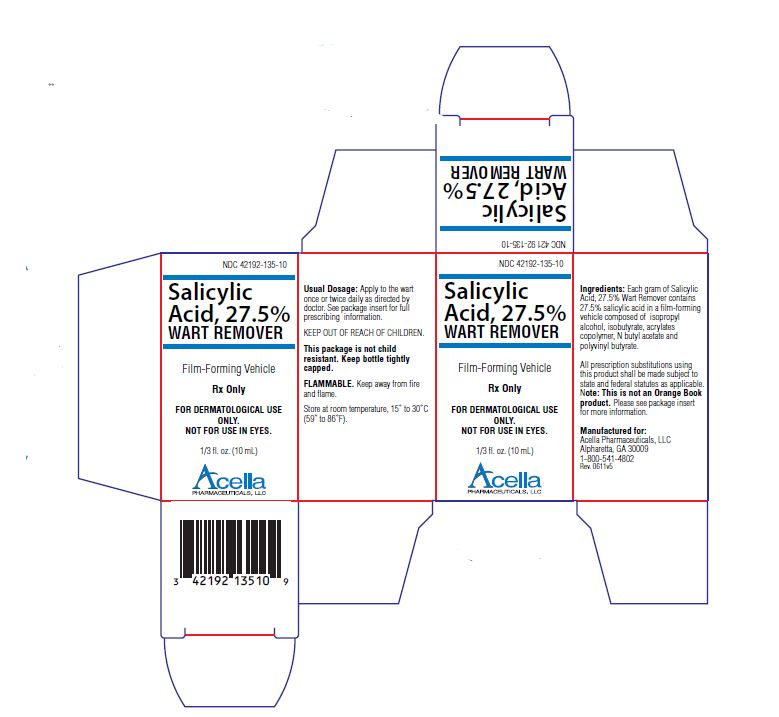
The FDA registers this code as 42192-135-10 — a 5-3-2 layout, and that's what's printed on the package and shown on DailyMed. For insurance claims, every NDC is standardized to a uniform 11-digit 5-4-2 format by adding a zero to the product segment → 42192-0135-10. Same drug, same package — only the format differs.
Where does this data come from?
Identifiers from the FDA openFDA NDC Directory and Structured Product Labeling; RxCUI from RxNorm (NLM); GPI from Medi-Span; GCN / HIC / AHFS / legend from First Databank.
🏷️RxNorm drug class
This medicine belongs to the Salicylic acid and derivatives class.
Drug family (ATC)Salicylic acid and derivatives, Other antifungals for topical use, Antiinflammatory agents, non-steroids
Where does this data come from?
Therapeutic classes from RxNorm RxClass (U.S. National Library of Medicine) — Established Pharmacologic Class (FDA), ATC drug family (WHO) and mechanism of action, matched by this product’s RxCUI.
The labeler markets the product; the application holder owns the FDA approval. They’re often the same company but can differ (e.g. a repackager or an authorized generic). A mailing address / phone appears here when the manufacturer includes it in the product’s FDA label (not all do).
Where does this data come from?
Labeler, application holder and registered establishment from the FDA openFDA NDC Directory and Drugs@FDA; address/contact from the product’s FDA label.
🩺 Clinical
Label name SALICYLIC ACID 27.5% LIQUIDIngredient Salicylic Acid
📖 What it is MedlinePlus · NLM
Topical salicylic acid is used to help clear and prevent pimples and skin blemishes in people who have acne. Topical salicylic acid is also used to treat skin conditions that involve scaling or overgrowth of skin cells such as psoriasis (a skin disease in which red, scaly patches form on some areas of the body), ichthyoses (inborn conditions that cause skin dryness and scaling), dandruff, corns, calluses, and warts on the hands or feet. Topical salicylic acid should not be used to treat genital warts, warts on the face, warts with hair growing from them, warts in the nose or mouth, moles, or b...
It's designed to treat acne. Salicylic acid helps by loosening and removing dead skin cells that clog pores — the buildup that leads to breakouts. The multi-step system on this lab...
What is this salicylic acid product actually supposed to do for my skin?
Some mild tingling, stinging, and peeling is actually expected — that's the salicylic acid doing its job by clearing away dead skin cells. But if the burning or peeling feels exces...
My skin feels like it's burning and peeling. Is that normal?
Plain-language summary from MedlinePlus (U.S. National Library of Medicine); supplement & herbal interactions and nutrient depletion data from the Natural Medicines database; our full guide is HelloPharmacist editorial content.
💬 Questions about SALICYLIC ACID?
Ask a licensed pharmacist directly — free, answered by our team.
Inactive ingredients, also called excipients, are components of the drug product
other than the active ingredient. They may include fillers, dyes, coatings, preservatives, flavors,
or other formulation ingredients.
💡 Tap an ingredient (hover on desktop) to see what it is and why it’s used.
UNII 464P5N1905
Butyl acetate is a clear liquid solvent derived from acetic acid and butanol. In medications, it's used primarily in coatings and varnishes to help dissolve and apply protective or delayed-release layers on tablets and capsules.
UNII ND2M416302
Isopropyl alcohol is a clear liquid solvent derived from petroleum. In medicines, it dissolves active ingredients and other components, helps the product flow smoothly, and aids in sterilization during manufacturing.
2 inactive ingredients listed in the exact product block matched to this NDC.
Where does this data come from?
Data sourced from official FDA Structured Product Labeling (SPL) via DailyMed — ingredient classCode="IACT" elements from the exact product block matched by this NDC. Label-section narrative from DailyMed / the openFDA label index is shown separately when available.
Inactive ingredient FAQ
Are inactive ingredients the same for every manufacturer?
No. Inactive ingredients can differ by manufacturer, dosage form, strength, and package / product version.
Why might an inactive ingredient be missing?
Some SPLs do not provide a complete structured inactive-ingredient list, and older or unusual labels may only include the information in narrative text.
Can inactive ingredients matter?
Yes. They can matter for allergies, intolerances, dyes, gluten / lactose concerns, preservatives, and formulation differences — but confirm with a pharmacist or the manufacturer when it’s clinically important.
💲 Pricing
A drug doesn't have one price. Each row is a different public payment system, and none is what you'd pay at the counter — that depends on your insurance. The ⓘ on each row explains what it measures.
Price system
Per mL
Per package
Retail pharmacies payNADAC · weekly
$5.544
$55.44 / 10 ml
Medicaid paysCMS SDUD · 12 mo
$11.42
$114.23 / 10 ml
Medicare drug plans payPart D · quarterly
No Part D plan price is available for this NDC in our data.
NADAC price history (per mL) — tap or hover for the price & month
▲ Up 11% over the last 9 months.
Where does this data come from?
NADAC (National Average Drug Acquisition Cost) is the CMS weekly pharmacy-acquisition-cost survey — what pharmacies pay. ASP (Average Sales Price) is the CMS Medicare Part B drug-payment file, published quarterly. Medicaid pays is computed by us from CMS State Drug Utilization Data (total reimbursed ÷ units, trailing 12 months) — gross of rebates and inclusive of dispensing fees, so it reflects what Medicaid paid, not an acquisition cost. Medicare drug plans pay is the median negotiated point-of-sale unit cost across plans listing this NDC in the CMS quarterly Prescription Drug Plan pricing files, before rebates. The VA pays is the federal contract price (FSS, and the statutory Big 4 ceiling where listed) from the VA National Acquisition Center pharmaceutical price file. All are free public government data; each measures a different payer, so the figures are not directly comparable.
About this product: other versions of the same ingredient, strength and form are listed above, least expensive first, with FDA equivalence ratings where available.
Where does this data come from?
Equivalents are other NDCs of the same ingredient, form and route from the openFDA NDC Directory, ranked least-expensive-first by NADAC. Therapeutic-equivalence (AB) ratings come from the FDA Orange Book; biologics use the FDA Purple Book for biosimilar & interchangeable status.
⏳ Availability & generic status
🏛️
2011
On the market since
Oct 2011
📍
2026
Currently FDA-listed
15 years listed
🔒
·
No generic listed yet
brand only
ℹ️No FDA-approved generic found
We did not find an FDA-approved generic match for this exact strength, form and route.
Where does this data come from?
Patents and exclusivity from the FDA Orange Book (small-molecule drugs), refreshed from public FDA data. Generic launch timing is an estimate, not a guarantee.
🗺️ Medicaid utilization & spend
📍 This exact package only: Medicaid data is reported per full 11-digit NDC — labeler, product and pack size — so every number here is for 42192-0135-10, not the drug overall. Other pack sizes report separately.
💊 Pharmacy benefit only: These are Medicaid outpatient pharmacy claims, billed by NDC. They exclude the medical benefit — clinic- or hospital-administered drugs billed under HCPCS J-codes — so drugs used mostly that way (e.g. Avastin, Lucentis, Keytruda) can look low or missing here. That’s expected, not an error.
📅 Q1 2025 – Q4 2025 · 4 quarters of data
ⓘ The newest quarter is usually incomplete when first published; states restate recent quarters in later CMS releases, so the latest figures typically revise upward. State coverage-policy changes can also shift quarter-to-quarter totals.
Prescriptions last 4 qtrs
4.4K
Units reimbursed last 4 qtrs
45.9K
Gross reimbursed last 4 qtrs
$524.4K
Avg / prescription
$119.92
Avg / unit
$11.4230
Latest quarter Q4 2025
1.1KRx
Medicaid pays / mL
$11.4230
gross reimbursed
vs
NADAC / mL
$5.5444
acquisition cost
=
Spread
+$5.8786
+106% vs cost
What Medicaid paid per mL (before rebates; includes the pharmacy’s dispensing fee) compared with NADAC — the average price pharmacies pay to buy the drug. A positive spread means Medicaid reimbursed more than the purchase price, before manufacturer rebates.
Fee-for-service vs managed care ⓘ
90% MCO
Fee-for-service · 438 Rx Managed care · 3,935 Rx
State Medicaid map
Units reimbursed · per 100k residents
2.078.7
gray = no data reported ⓘ
Colors are per 100,000 residents, so big states don’t automatically dominate. Tap or hover a state for its actual totals.
Tap or hover a state
…for its Medicaid breakdown
Prescriptions—
Units—
Reimbursed—
🏆 Top states by units · per 100k residents
1Texas78.7 /100k
2Kentucky64.1 /100k
3Connecticut60.0 /100k
4Vermont58.7 /100k
5Illinois57.5 /100k
6Louisiana25.6 /100k
7Tennessee21.0 /100k
8Maryland16.6 /100k
National units — by quarter
💵 About the dollar figures: “reimbursed” is what Medicaid paid pharmacies before confidential manufacturer rebates, so the program’s real net cost is lower than these numbers. Fee-for-service and managed-care claims are combined unless split above. Source: CMS State Drug Utilization Data; per-100k rates use 2023 Census population estimates.
📊 Medicare Part D spend CMS · PART D · 2026 (Q1)
Medicare Part D (outpatient prescription) spending for Salicylic Acid — the program that covers self-administered drugs. 2 manufacturers.
⚠️ Drug-level data: CMS publishes Part D spending by drug, not by NDC — these figures combine every manufacturer, strength and package size sold under the name Salicylic Acid. That’s a different level of aggregation than the Medicaid card above, which is specific to this exact 11-digit NDC (pack size included), so the two aren’t directly comparable.
Period
Total Part D spend
$11.2K
Claims incl. refills
43
Beneficiaries
35
Spend / beneficiary
$319.01
Spend / claim
$259.66
Trend by period
💵 About the dollar figures: spending is what Part D plans paid before confidential manufacturer rebates, so the program’s real net cost is lower. A blank patient count means fewer than 11 people — CMS hides counts that small to protect privacy. Source: CMS Medicare Quarterly Part D Spending by Drug (data.cms.gov), updated quarterly.
🔬 Reported adverse events (FAERS)
Read carefully: FAERS reports are voluntary and unverified. Counts are not incidence, do not establish causation, are subject to reporting bias, and cannot be used to compare one drug to another. Shown for signal context only. Reports for SALICYLIC ACID — the ingredient across all brands.
Top reported reactions
Dry Skin12,766
Erythema12,318
Acne11,763
Skin Burning Sensation11,557
Skin Irritation7,730
Skin Exfoliation5,759
Rash4,766
Age at onset
Neonate7
Infant1
Child16
Adolescent30
Adult334
Elderly131
Reporter sex
Male · 27%
Female · 73%
Unknown · 0%
Serious outcomes
Hospitalization800
Life-threatening214
Reports over time (by year) — tap or hover for the count & year
Most recent year is provisional (FAERS lags ~3 months).
Where does this data come from?
Adverse-event reports from the FDA Adverse Event Reporting System (FAERS) via openFDA. FAERS reports are voluntary and unverified — counts are not incidence and don’t establish causation.
📦 Packaging — all sizes for this product
Package NDC
Description
Marketing start
Status
42192-0135-10 You're viewing this
1 BOTTLE, WITH APPLICATOR in 1 CARTON (42192-135-10) / 10 mL in 1 BOTTLE, WITH APPLICATOR
2011-10-10
Active
🧭 About this NDC listing & data coverage
Finished prescription productMarketed without an FDA application
Listed without an FDA application
This product's marketing category indicates it is marketed without an approved FDA application (no NDA, ANDA, or BLA on file). Having an NDC does not by itself establish FDA approval — the NDC Directory is a listing system, not an approval decision. Approval-linked data such as Orange Book therapeutic-equivalence ratings therefore does not apply.
What data is (and isn’t) available for this NDC — tap to expand
NDC identity (package / product / labeler codes)
✓ Available
Labeler
✓ Available
Product & package description
✓ Available
Marketing category & status
✓ Available
Active ingredient / dosage form / route
✓ Available
FDA label (SPL via DailyMed)
✓ Available
Package photos
✓ Available
Inactive ingredients (structured)
✓ Available
NADAC pharmacy acquisition price (CMS)
✓ Available
Orange Book / therapeutic-equivalence data
— Not published for this NDCApplies only to products approved under an NDA/ANDA; many listings are out of scope.
HCPCS J-code billing crosswalk
— Not published for this NDCMost self-administered / retail products have no J-code — that is normal.
Medicaid utilization (CMS SDUD)
✓ Available
“Not published” reflects what the public FDA / CMS / NLM sources provide for this exact package code — it is a property of the data feeds, not a judgment about the product.
Questions about this listing
Is this NDC FDA-approved?
An NDC listing does not by itself establish FDA approval — the NDC Directory records that a product is listed with FDA, not that it was reviewed and approved. This listing's marketing category is "Unapproved Drug Other". Products approved under an application carry an NDA, ANDA, or BLA number.
Is the NDC printed on the package the same as the 11-digit billing NDC?
Yes, they identify this exact package in different formats. The FDA registers it as 42192-135-10, which is what is printed on the packaging and shown on DailyMed. Insurance claims use a fixed 11-digit 5-4-2 format, so the short segment is padded with a leading zero: 42192-0135-10, written without dashes as 42192013510. The Identity section at the top of this page lists every form of this code.
What do the three segments of this NDC mean?
In 42192-0135-10, the first segment (42192) is the labeler code FDA assigned to Acella Pharmaceuticals, LLC; the middle segment (0135) identifies this specific product — its ingredient, strength, and dosage form; and the last segment (10) identifies this exact package size and type. Together they name one specific package of one specific product.
Is this package still being marketed?
Yes, per the latest FDA NDC Directory data on this page it is currently marketed — but Acella Pharmaceuticals, LLC has reported a marketing end date of 2027-07-31, after which this package is expected to stop being marketed. The directory data on this page refreshes weekly.
Who lists this product with the FDA?
Acella Pharmaceuticals, LLC is the labeler of record for this NDC — the company under whose FDA-assigned code the package is listed. The labeler may be the manufacturer itself or a distributor marketing the product under its own code.
Do I need a prescription for this product?
This NDC is listed with FDA as a prescription product, so it is dispensed under a prescriber's order. Your pharmacist can tell you whether any over-the-counter forms of the same medication exist.
This page identifies an FDA-listed package (the NDC) and reports public regulatory and pricing data about the listing. It is reference information, not a medical recommendation — talk to your pharmacist or prescriber about your own medication.
Where does this data come from?
Listing facts (marketing category, packager status, marketing dates) from the FDA openFDA NDC Directory; label availability from DailyMed; pricing coverage from CMS NADAC; equivalence scope from the FDA Orange Book.
📄 Full prescribing information FDA SPL
The complete FDA label for this product — the official prescribing information, verbatim, section by section. Jump with a chip, search within the label, or expand everything.
INDICATIONS AND USES: Salicylic Acid, 27.5% Wart Remover is indicated for the topical treatment and removal of common warts and plantar warts.
⏱️Dosage and Administration107 words▾
DOSAGE AND ADMINISTRATION: Prior to application of Salicylic Acid, 27.5% Wart Remover, soak wart in warm water for five minutes. Remove any loosened tissue by gently rubbing with a brush, wash cloth or emery board. Dry thoroughly.
Using the brush applicator supplied, apply twice to entire wart surface, allowing the first application to dry before applying the second. Treatment should be once or twice a day and should continue as directed by physician. Be careful not to apply to surrounding skin.
Clinically visible improvement will normally occur during the first or second week of therapy. Maximum resolution may be expected after four to six weeks of use.
⛔Contraindications42 words▾
CONTRAINDICATIONS: Salicylic Acid, 27.5% Wart Remover should not be used by diabetics or patients with impaired blood circulation. Salicylic Acid, 27.5% Wart Remover should not be used on moles, birthmarks, unusual warts with hair growing from them or warts on the face.
🤒Adverse Reactions47 words▾
ADVERSE REACTIONS: A localized irritant reaction may occur if Salicylic Acid, 27.5% Wart Remover is applied to the normal skin surrounding the wart. Any irritation may normally be controlled by temporarily discontinuing use and by applying the medication only to the wart site when treatment is resumed.
🧬Clinical Pharmacology41 words▾
CLINICAL PHARMACOLOGY: Although the exact mode of action for salicylic acid in the treatment of warts is not known, its activity appears to be associated with its keratolytic action which results in mechanical removal of epidermal cells infected with wart viruses.
📦How Supplied / Storage and Handling20 words▾
HOW SUPPLIED: Salicylic Acid, 27.5% Wart Remover is supplied in 10 mL amber bottles with a brush applicator, (NDC 42192-135-10).
📦Storage and Handling22 words▾
Store at controlled room temperature, 15º - 30º (59º - 86ºF). MANUFACTURED FOR: Acella Pharmaceuticals, LLC Alpharetta, GA 30009 1-800-541-4802 Rev. 0611
📋Description76 words▾
DESCRIPTION: Salicylic Acid, 27.5% Wart Remover is a topical preparation containing 27.5% salicylic acid in a film-forming vehicle composed of isopropyl alcohol, isobutyrate, acrylates copolymer, N butyl acetate and polyvinyl butyrate. The pharmacologic activity of Salicylic Acid, 27.5% Wart Remover is generally attributed to the keratolytic activity of salicylic acid which is incorporated into a film-forming vehicle designed to cover the wart without the need for a bandage. The structural formula of salicylic acid is: mm1
No label section mentions that — try another word, or open the full label on DailyMed below.
Glossary — plain-language definitions of medical terms used in this label:
Adverse Reactions: Unwanted or harmful effects that people experienced while taking a medicine, listed on its official label.
Clinical Pharmacology: The label section explaining how a medicine works in the body and how the body processes it.
Contraindications: A list of situations or health conditions in which a medicine should not be used because the chance of harm is too high.
Dosage and Administration: The label section explaining how much of a medicine to use and how to take or give it.
NDC: A unique number that identifies a specific medicine, its maker, strength, and package size.
topical: Applied onto the skin, eyes, or another body surface to work mainly where it is placed.
Source: FDA Structured Product Labeling, mirrored from DailyMed / openFDA.
Prefer the government’s original formatting? View this label on DailyMed ↗
For educational and professional reference only — not medical advice. Pricing reflects published
NADAC and CMS ASP (free public data) and may differ from your acquisition cost; always verify before billing or dispensing.