
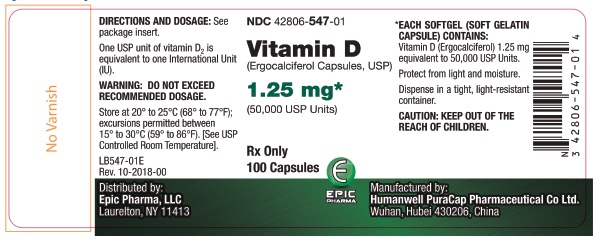
Ergocalciferol Capsules, 1.25 mg Capsule, 100-count — NDC 42806-547-01 (Billing 42806-0547-01)
This is a package of 100 capsules of Ergocalciferol Capsules, 1.25 mg Capsule from Epic Pharma LLC, marketed since Dec 2018 and currently FDA-listed; retail pharmacies pay about $0.1136 per capsule (NADAC). It is the main listing for this product, which comes in 2 package sizes.
NDC database record
One package, one record: these facts belong to NDC 42806-547-01 alone.
- Record
- FDA NDC Directory package listing · Human prescription drug
- Code segments
- 42806 labeler · 547 product · 01 package
- Package marketed since
- Dec 10, 2018
- Sample package
- No — commercial package
- Listing certified through
- Dec 31, 2026
- Billing quantity
- 100 EA per package
- Barcode (UPC-A, from the NDC)
- 3 4280654701 4
- Medicaid fills, this package
- 2,942,001 prescriptions in the last four reported quarters
- FDA record last changed
- Jul 24, 2026
Identity & classification
Regulatory identifiers FDA, NLM and CMS codes for this package
Drug-database identifiers Medi-Span GPI and First Databank GCN / HICL / AHFS classification
- GSN (GCN sequence number): 002169
- GCN: 94422
- GPI-14 (Medi-Span): 77202030000110
- HICL (First Databank): 000995
- AHFS class code: 88:16.00.00
- RxCUI (RxNorm): 1367410
Where does this data come from?
- FDA openFDA NDC Directory · synced Oct 8, 2026
- FDA label on DailyMed · label index refreshed Oct 6, 2026
- RxNorm (NLM RxNav) · catalog refreshed Oct 1, 2026
- Medi-Span GPI (licensed)
- First Databank (licensed) · refreshed Oct 8, 2026
RxNorm drug class
This medicine belongs to the Provitamin D2 Compound class.
Where does this data come from?
- RxClass (NLM) · catalog refreshed Oct 1, 2026
Clinical
Ergocalciferol is used in the treatment of hypoparathyroidism (condition in which the body does not produce enough parathyroid hormone), refractory rickets (softening and weakening of bones that does not respond to treatment), and familial hypophosphatemia (rickets or osteomalacia caused by an inherited condition with a decreased ability to break down vitamin D in the body). Ergocalciferol is in a class of medications called vitamin D analogs. It works by helping the body to use more of the calcium found in foods or supplements.
Read the full MedlinePlus article ↗- It is vitamin D2, and it is prescribed for hypoparathyroidism, vitamin D resistant rickets, and familial hypophosphatemia. Your doctor will explain which one applies to you.
- Take it by mouth as a capsule, exactly as your prescriber directs. Your dose is individualized, so don't change it on your own. Make sure you get enough calcium, and keep your bloo...
- The safe range for vitamin D is narrow, and too much can raise your calcium too high. Blood calcium and phosphorus are checked every 2 weeks or more often. Bone X-rays are done mon...
- Nausea, poor appetite, constipation, weight loss, and vague aches or weakness can signal too much vitamin D. Heavy thirst and frequent urination are also warning signs. Call me or...
Patient education
Supplement & herbal interactions
Where does this data come from?
- MedlinePlus (NLM) · refreshed Oct 1, 2026
- FDA label on DailyMed · label index refreshed Oct 6, 2026
Ask a licensed pharmacist directly — free, answered by our team.
Pricing
A drug doesn't have one price. Each row is a different public payment system, and none is what you'd pay at the counter — that depends on your insurance. The ⓘ on each row explains what it measures.
| Price system | Per ea | Per package |
|---|---|---|
| Retail pharmacies payNADAC · weekly | $0.114 | $11.36 / 100 capsules |
| Medicaid paysCMS SDUD · 12 mo | $1.37 | $136.65 / 100 capsules |
| Medicare drug plans payPart D · quarterly | No Part D plan price is available for this NDC in our data. | |
Where does this data come from?
- CMS NADAC weekly file · file of Oct 7, 2026
- CMS ASP pricing files · refreshed Sep 20, 2026
- CMS Medicaid State Drug Utilization Data · through Q1 2026
- CMS Part D plan pricing files · refreshed Sep 24, 2026
- VA National Acquisition Center price file
Packaging — all sizes for this product
| Package NDC | Description | Per unit | Per pack | Marketing start | Marketing end | Status |
|---|---|---|---|---|---|---|
| 42806-0547-01 You're viewing this Main listing | 100 CAPSULE in 1 BOTTLE | $0.1136 / ea | $11.36 | 2018-12-10 | — | Active |
| 42806-0547-05 42806-547-05 | 500 CAPSULE in 1 BOTTLE | $0.1136 / ea | $56.81 | 2018-12-10 | — | Active |
You're viewing the smallest of 2 pack sizes for this product.
This pack has the lowest per-ea cost of the 2 priced pack sizes ($0.1136 NADAC).
In Medicaid, this is the most-dispensed pack of this product — about 90% of fills over the last four reported quarters. See all packs ↓
Pack size FAQ
What quantity is in this package?
How does this package differ from NDC 42806-0547-05?
What NDC number is used to bill for this package of Ergocalciferol Capsules, 1.25 mg Capsule?
Prices are the latest CMS NADAC pharmacy acquisition cost per NDC; per-pack figures are per-unit × pack quantity, shown only when the pack is denominated in the same measure NADAC prices.
Therapeutic equivalents
| Product | Labeler | Pack | NADAC/unit | TE | Status | Price vs. this |
|---|---|---|---|---|---|---|
| Ergocalciferol 1.25 mg 13668-0757-01 | Torrent | 100 capsules | $0.114 | AA | Availability likely | — |
| Ergocalciferol Capsules, 1.25 mgthis 42806-0547-01 | Epic | 100 capsules | $0.114 | AA | Availability likely | — |
| Vitamin D 1.25 mg 50268-0297-15 | AvPAK | 50 capsules | $0.114 | AA | Availability likely | — |
| Ergocalciferol 1.25 mg 62135-0439-90 | Chartwell | 90 capsules | $0.114 | AA | Availability likely | — |
| Vitamin D 1.25 mg 64380-0737-06 | Strides | 100 capsules | $0.114 | AA | Availability likely | — |
| Ergocalciferol 1.25 mg 69452-0151-20 | Bionpharma | 100 capsules | $0.114 | AA | Availability likely | — |
| Ergocalciferol 1.25 mg 42291-0266-01 | AvKARE | 100 capsules | — | AA | FDA listed | — |
| Ergocalciferol 1.25 mg 43063-0711-12 | PD-Rx | 12 capsules | — | AA | FDA listed | — |
| Ergocalciferol 1.25 mg 43353-0238-03 | Aphena | 3 capsules | — | AA | FDA listed | — |
| Ergocalciferol 1.25 mg 50090-5844-01 | A-S | 8 capsules | — | AA | FDA listed | — |
| Vitamin D 1.25 mg 51407-0700-01 | Golden | 100 capsules | — | AA | FDA listed | — |
| Ergocalciferol Capsules, 1.25 mg 51655-0730-80 | Northwind | 8 capsules | — | AA | FDA listed | — |
| Vitamin D 1.25 mg 51655-0774-27 | Northwind | 12 capsules | — | AA | FDA listed | — |
| Ergocalciferol 1.25 mg 60760-0152-12 | St. | 12 capsules | — | AA | FDA listed | — |
| Vitamin D 1.25 mg 61919-0702-04 | DirectRX | 4 capsules | — | AA | FDA listed | — |
| Vitamin D 1.25 mg 63187-0519-06 | Proficient | 6 capsules | — | AA | FDA listed | — |
| Ergocalciferol 1.25 mg 63629-2447-01 | Bryant | 100 capsules | — | AA | FDA listed | — |
| Ergocalciferol 1.25 mg 63629-7913-01 | Bryant | 90 capsules | — | AA | FDA listed | — |
| Ergocalciferol 1.25 mg 68071-1951-02 | NuCare | 12 capsules | — | AA | FDA listed | — |
| Ergocalciferol 1.25 mg 68071-2295-01 | NuCare | 100 capsules | — | AA | FDA listed | — |
| Ergocalciferol Capsules, 1.25 mg 68788-4042-01 | Preferred | 100 capsules | — | AA | FDA listed | — |
| Ergocalciferol 1.25 mg 68788-4092-01 | Preferred | 100 capsules | — | AA | FDA listed | — |
| Vitamin D 1.25 mg 68788-7627-01 | Preferred | 100 capsules | — | AA | FDA listed | — |
| Ergocalciferol 1.25 mg 70518-0177-03 | REMEDYREPACK | 1 capsule | — | AA | Discontinued | — |
| Vitamin D 1.25 mg 70518-1878-01 | REMEDYREPACK | 12 capsules | — | AA | FDA listed | — |
| Ergocalciferol Capsules, 1.25 mg 70518-3472-00 | REMEDYREPACK | 4 capsules | — | AA | Discontinued | — |
| Ergocalciferol Capsules, 1.25 mg 71205-0676-30 | Proficient | 30 capsules | — | AA | FDA listed | — |
| Ergocalciferol 1.25 mg 71335-0062-00 | Bryant | 45 capsules | — | AA | FDA listed | — |
| Vitamin D 1.25 mg 71335-0278-00 | Bryant | 45 capsules | — | AA | FDA listed | — |
| Ergocalciferol 1.25 mg 71335-1691-00 | Bryant | 45 capsules | — | AA | FDA listed | — |
| Ergocalciferol 1.25 mg 71335-1699-01 | Bryant | 90 capsules | — | AA | FDA listed | — |
| Ergocalciferol Capsules, 1.25 mg 71335-2003-01 | Bryant | 4 capsules | — | AA | FDA listed | — |
| Ergocalciferol 1.25 mg 71335-2246-01 | Bryant | 4 capsules | — | AA | FDA listed | — |
| Vitamin D 1.25 mg 71610-0552-04 | Aphena | 4 capsules | — | AA | FDA listed | — |
| Ergocalciferol 1.25 mg 71610-0712-03 | Aphena | 3 capsules | — | AA | FDA listed | — |
| Vitamin D 1.25 mg 72789-0249-01 | PD-Rx | 100 capsules | — | AA | FDA listed | — |
| Ergocalciferol (Vitamin D2) 1.25 mg 80425-0130-03 | Advanced | 12 capsules | — | AA | FDA listed | — |
| Ergocalciferol Capsules, 1.25 mg 53401-0021-08 | Aphena | 8 capsules | — | AA | FDA listed | — |
Where does this data come from?
- FDA openFDA NDC Directory · synced Oct 8, 2026
- FDA Orange Book · refreshed Oct 3, 2026
- CMS NADAC weekly file · file of Oct 7, 2026
Availability & generic status
This product is an FDA-approved generic. Other versions of the same drug are listed under Therapeutic equivalents, least expensive first.
Where does this data come from?
- FDA Orange Book · refreshed Oct 3, 2026
What it looks like
Where does this data come from?
- FDA label on DailyMed · label index refreshed Oct 6, 2026
Inactive Ingredients / Excipients
Inactive ingredients, also called excipients, are components of the drug product other than the active ingredient. They may include fillers, dyes, coatings, preservatives, flavors, or other formulation ingredients.
🧪 Avoiding an ingredient? See Ergocalciferol inactive ingredients by manufacturer: every current product's list side by side, so you can ask your pharmacy for the version that does not list it.
💡 Tap an ingredient (hover on desktop) to see what it is and why it’s used.
-
UNII REK4960K2U
Butylated hydroxyanisole is a synthetic preservative that prevents oils and fats in medicines from spoiling or becoming rancid. It keeps the medicine stable and extends its shelf life.
-
UNII 35SW5USQ3G
A synthetic yellow dye used to color medicines. It helps make tablets, capsules, and liquids visually distinct so patients can easily identify their medication.
-
UNII 92RU3N3Y1O
Dimethicone is a silicone-based oil that acts as an anti-foaming agent and lubricant in medicines. It reduces gas bubbles in liquid formulations and helps coat and protect the stomach lining when ingested.
-
UNII H3R47K3TBD
FD&C Blue No. 1 is a synthetic blue dye approved for use in foods and medicines. It serves as a colorant to give the medication its distinctive appearance and help with product identification.
-
UNII 2G86QN327L
Gelatin is a protein derived from animal collagen, commonly used in medicines as a gelling agent and capsule material. It helps create soft or hard capsule shells that hold and release medication, and can also thicken liquid formulations.
-
UNII PDC6A3C0OX
Glycerin is a clear, thick liquid derived from plant oils or fats. It acts as a humectant to retain moisture, a sweetener, and a solvent in medications.
-
UNII 6DC9Q167V3
Propylene glycol is a clear liquid derived from petroleum or vegetable sources. It acts as a solvent, humectant, and preservative in medicines, helping dissolve active ingredients and maintain product stability.
-
UNII 46N107B71O
Shellac is a natural resin secreted by the lac beetle. It's used as a coating on tablets and capsules to control how quickly the medicine dissolves and to improve appearance and stability.
-
UNII 241ATL177A
Soybean oil is a natural plant oil derived from soybean seeds. It's used in medicines as a solvent and carrier to help dissolve or suspend active ingredients and improve how the body absorbs them.
-
UNII 15FIX9V2JP
Titanium dioxide is a bright white mineral powder commonly used as a colorant and opacifying agent. It makes pills and tablets white or lighter in color and helps make coatings non-transparent.
10 inactive ingredients listed in the exact product block matched to this NDC.
Where does this data come from?
ingredient classCode="IACT" elements from the exact product block matched by this NDC. Label-section narrative from DailyMed / the openFDA label index is shown separately when available.- FDA label on DailyMed · label index refreshed Oct 6, 2026
- FDA openFDA NDC Directory · synced Oct 8, 2026
Inactive ingredient FAQ
Are inactive ingredients the same for every manufacturer?
Why might an inactive ingredient be missing?
Can inactive ingredients matter?
Manufacturer & labeler
More NDCs from Epic Pharma LLC labeler code 42806
- Phentermine Hydrochloride 37.5 mg Capsule NDC 42806-524-01
- Doxepin Hydrochloride 10 mg Capsule NDC 42806-529-01
- Doxepin Hydrochloride 25 mg Capsule NDC 42806-530-01
- Doxepin Hydrochloride 50 mg Capsule NDC 42806-531-01
- Doxepin Hydrochloride 75 mg Capsule NDC 42806-532-01
- Doxepin Hydrochloride 100 mg Capsule NDC 42806-533-01
- Dutasteride .5 mg Capsule, Liquid Filled NDC 42806-549-09
- OMEGA-3-ACID Ethyl Esters 1 g Capsule, Liquid Filled NDC 42806-552-12
- Oseltamivir Phosphate 30 mg Capsule NDC 42806-553-01
- Oseltamivir Phosphate 45 mg Capsule NDC 42806-554-01
- Oseltamivir Phosphate 75 mg Capsule NDC 42806-555-01
- Icosapent Ethyl .5 g Capsule, Liquid Filled NDC 42806-559-24
Where does this data come from?
- FDA openFDA NDC Directory · synced Oct 8, 2026
- Drugs@FDA
Full prescribing information FDA SPL
🎯 Indications and Usage ▾
INDICATIONS AND USAGE Ergocalciferol Capsules are indicated for use in the treatment of hypoparathyroidism, refractory rickets, also known as vitamin D resistant rickets, and familial hypophosphatemia.
⏱️ Dosage and Administration ▾
DOSAGE AND ADMINISTRATION THE RANGE BETWEEN THERAPEUTIC AND TOXIC DOSES IS NARROW. Vitamin D Resistant Rickets : 12,000 to 500,000 IU units daily. Hypoparathyroidism: 50,000 to 200,000 IU units daily concomitantly with calcium lactate 4 g, six times per day.
DOSAGE MUST BE INDIVIDUALIZED UNDER CLOSE MEDICAL SUPERVISION. Calcium intake should be adequate. Blood calcium and phosphorus determinations must be made every 2 weeks or more frequently if necessary.
X-rays of the bones should be taken every month until condition is corrected and stabilized.
⛔ Contraindications ▾
CONTRAINDICATIONS Ergocalciferol Capsules are contraindicated in patients with hypercalcemia, malabsorption syndrome, abnormal sensitivity to the toxic effects of vitamin D, and hypervitaminosis D.
⚠️ Warnings ▾
WARNINGS Hypersensitivity to vitamin D may be one etiologic factor in infants with idiopathic hypercalcemia. In these cases vitamin D must be strictly restricted. Keep out of the reach of children.
🤒 Adverse Reactions ▾
ADVERSE REACTIONS Hypervitaminosis D is characterized by effects on the following organ system: Renal: Impairment of renal function with polyuria, nocturia, polydipsia, hypercalciuria, reversible azotemia, hypertension, nephrocalcinosis, generalized vascular calcification, or irreversible renal insufficiency which may result in death. CNS: Mental retardation. Soft Tissues: Widespread calcification of the soft tissues, including the heart, blood vessels, renal tubules, and lungs.
Skeletal: Bone demineralization (osteoporosis) in adults occurs concomitantly. Decline in the average rate of linear growth and increased mineralization of bones in infants and children (dwarfism) vague aches, stiffness, and weakness. Gastrointestinal: Nausea, anorexia, constipation.
Metabolic: Mild acidosis, anemia, weight loss.
🔄 Drug Interactions ▾
Drug Interactions Mineral oil interferes with the absorption of fat-soluble vitamins,including vitamin D preparations. Administration of thiazide diuretics to hypoparathyroid patients who are concurrently being treated with Ergocalciferol Capsules may cause hypercalcemia.
🤰 Pregnancy ▾
Pregnancy Pregnancy Category C Animal reproduction studies have shown fetal abnormalities in several species associated with hypervitaminosis D. These are similar to the supravalvular aortic stenosis syndrome described in infants by Black in England (1963). This syndrome was characterized by supravalvular aortic stenosis, elfin facies, and mental retardation.
For the protection of the fetus, therefore, the use of vitamin D in excess of the recommended dietary allowance during normal pregnancy should be avoided unless, in the judgment of the physician, potential benefits in a specific, unique case outweigh the significant hazards involved. The safety in excess of 400 IU of vitamin D daily during pregnancy has not been established.
🧒 Pediatric Use ▾
Pediatric Use Pediatric doses must be individualized (see DOSAGE AND ADMINISTRATION).
🧓 Geriatric Use ▾
Geriatric Use Clinical studies of Ergocalciferol Capsules did not include sufficient numbers of subjects aged 65 and over to determine whether they respond differently from younger subjects. Other reported clinical experience has not identified differences in responses between the elderly and younger patients. A few published reports have suggested that the absorption of orally administered vitamin D may be attenuated in elderly compared to younger, individuals.
In general, dose selection for an elderly patient should be cautious, usually starting at the low end of the dosing range, reflecting the greater frequency of decreased hepatic, renal, or cardiac function, and of concomitant disease or other drug therapy.
🆘 Overdosage ▾
OVERDOSAGE The effects of administered vitamin D can persist for two or more months after cessation of treatment. Hypervitaminosis D is characterized by: 1. Hypercalcemia with anorexia, nausea, weakness, weight loss, vague aches and stiffness, constipation, mental retardation, anemia, and mild acidosis.
2. Impairment of renal function with polyuria, nocturia, polydipsia, hypercalciuria, reversible azotemia, hypertension, nephrocalcinosis, generalized vascular calcification, or irreversible renal insufficiency which may result in death. 3.
Widespread calcification of the soft tissues, including the heart, blood vessels, renal tubules, and lungs. Bone demin- eralization (osteoporosis) in adults occurs concomitantly. 4.
Decline in the average rate of linear growth and increased mineralization of bones in infants and children (dwarfism). The treatment of hypervitaminosis D with hypercalcemia consists in immediate withdrawal of the vitamin, a low calcium diet, generous intake of fluids, along with symptomatic and supportive treatment. Hypercalcemic crisis with dehydration, stupor, coma, and azotemia requires more vigorous treatment.
The first step should be hydration of the patient. Intravenous saline may quickly and significantly increase urinary calcium excretion. A loop diuretic (furosemide or ethacrynic acid) may be given with the saline infusion to further increase renal calcium excretion.
Other reported therapeutic measures include dialysis or the administration of citrates, sulfates, phosphates, corticosteroids, EDTA (ethylenediaminetetraacetic acid), and mithramycin via appropriate regimens. With appropriate therapy, recovery is the usual outcome when no permanent damage has occurred. Deaths via renal or cardiovascular failure have been reported.
The LD50 in animals is unknown. The toxic oral dose of ergocalciferol in the dog is 4 mg/kg.
🧬 Clinical Pharmacology ▾
CLINICAL PHARMACOLOGY The in vivo synthesis of the major biologically active metabolites of vitamin D occurs in two steps. The first hydroxylation of ergocalciferol takes place in the liver (to 25-hydroxyvitamin D) and the second in the kidneys (to 1,25-dihydroxyvitamin D). Vitamin D metabolites promote the active absorption of calcium and phosphorus by the small intestine, thus elevating serum calcium and phosphate levels sufficiently to permit bone mineralization.
Vitamin D metabolites also mobilize calcium and phosphate from bone and probably increase the reabsorption of calcium and perhaps also of phosphate by the renal tubules. There is a time lag of 10 to 24 hours between the administration of vitamin D and the initiation of its action in the body due to the necessity of synthesis of the active metabolites in the liver and kidneys. Parathyroid hormone is responsible for the regulation of this metabolism in the kidneys.
📦 How Supplied / Storage and Handling ▾
HOW SUPPLIED Capsules of 1.25 mg (50,000 IU vitamin D) of ergocalciferol, USP are clear green oval softgel capsules filled with a clear to pale yellow Bottle of 100 capsules (NDC 42806-547-01) Bottle of 500 capsules (NDC 42806-547-05) Store at 20° - 25°C (68° - 77°F); excursions permitted between 15° - 30°C (59° - 86°F). [See USP Controlled Room Temperature] Protect from light and moisture. Dispense in a tight, light-resistant container as defined in the USP. Manufactured by: Humanwell PuraCap Pharmaceutical Co Ltd.
Wuhan, Hubei 430206, China Distributed by: Epic Pharma, LLC Laurelton, NY 11413 PI547102018E Rev. 10-2018-00
📋 Description ▾
DESCRIPTION Ergocalciferol Capsules, USP is a synthetic calcium regulator for oral administration. Ergocalciferol is a white, colorless crystal, insoluble in water, soluble in organic solvents, and slightly soluble in vegetable oils. It is affected by air and by light.
Ergosterol or provitamin D 2 is found in plants and yeast and has no antirachitic activity. There are more than 10 substances belonging to a group of steroid compounds, classified as having vitamin D or antirachitic activity. One USP unit of vitamin D 2 is equivalent to one International Unit (IU), and 1 mcg of vitamin D 2 is equal to 40 IU.
Each capsule contains 1.25 mg (50,000 International Units vitamin D) of ergocalciferol, USP, in an edible vegetable oil. Ergocalciferol, also called vitamin D 2 , is 9, 10-secoergosta-5, 7, 10(19), 22-tetraen-3-ol, (3ß, 5Z, 7E, 22E)-; (C 28 H 44 O) with a molecular weight of 396.65, and has the following structural formula: Inactive Ingredients: Butylated hydroxytoluene, D&C Yellow #10, FD&C Blue #1, Gelatin, Glycerin, Propylene Glycol, Shellac, Simethicone, Soybean oil and Titanium Dioxide. chemical-formula.jpg
⚠️ Precautions ▾
PRCAUTIONS General Vitamin D administration from fortified foods, dietarysupplements, self-administered and prescription drug sources should be evaluated. Therapeutic dosage should be readjusted as soon as there is clinical improvement. Dosage levels must be individualized and great care exercised to prevent serious toxic effects.
IN VITAMIN D RESISTANT RICKETS THE RANGE BETWEEN THERAPEUTIC AND TOXIC DOSES IS NARROW. When high therapeutic doses are used progress should be followed with frequent blood calcium determinations. In the treatment of hypoparathyroidism, intravenous calcium, parathyroid hormone, and/or dihydrotachysterol may be required.
Maintenance of a normal serum phosphorus level by dietary phosphate restriction and/or administration of aluminum gels as intestinal phosphate binders in those patients with hyperphosphatemia as frequently seen in renal osteodystrophy is essential to prevent metastatic calcification. Adequate dietary calcium is necessary for clinical response to vitamin D therapy. Protect from light.
Drug Interactions Mineral oil interferes with the absorption of fat-soluble vitamins,including vitamin D preparations. Administration of thiazide diuretics to hypoparathyroid patients who are concurrently being treated with Ergocalciferol Capsules may cause hypercalcemia. Carcinogenesis, Mutagenesis, Impairment of Fertility No long-term animal studies have been performed to evaluate the drug's potential in these areas.
Pregnancy Pregnancy Category C Animal reproduction studies have shown fetal abnormalities in several species associated with hypervitaminosis D. These are similar to the supravalvular aortic stenosis syndrome described in infants by Black in England (1963). This syndrome was characterized by supravalvular aortic stenosis, elfin facies, and mental retardation.
For the protection of the fetus, therefore, the use of vitamin D in excess of the recommended dietary allowance during normal pregnancy should be avoided unless, in the judgment of the physician, potential benefits in a specific, unique case outweigh the significant hazards involved. The safety in excess of 400 IU of vitamin D daily during pregnancy has not been established. Nursing Mothers Caution should be exercised when Ergocalciferol Capsules are administered to a nursing woman.
In a mother given large doses of vitamin D, 25-hydroxycholecalciferol appeared in the milk and caused hypercalcemia in her child. Monitoring of the infant's serum calcium concentration is required in that case (Goldberg, 1972). Pediatric Use Pediatric doses must be individualized (see DOSAGE AND ADMINISTRATION).
Geriatric Use Clinical studies of Ergocalciferol Capsules did not include sufficient numbers of subjects aged 65 and over to determine whether they respond differently from younger subjects. Other reported clinical experience has not identified differences in responses between the elderly and younger patients. A few published reports have suggested that the absorption of orally administered vitamin D may be attenuated in elderly compared to younger, individuals.
In general, dose selection for an elderly patient should be cautious, usually starting at the low end of the dosing range, reflecting the greater frequency of decreased hepatic, renal, or cardiac function, and of concomitant disease or other drug therapy.
🍼 Nursing Mothers ▾
Nursing Mothers Caution should be exercised when Ergocalciferol Capsules are administered to a nursing woman. In a mother given large doses of vitamin D, 25-hydroxycholecalciferol appeared in the milk and caused hypercalcemia in her child. Monitoring of the infant's serum calcium concentration is required in that case (Goldberg, 1972).
📄 Carcinogenesis, Mutagenesis, Impairment of Fertility ▾
Carcinogenesis, Mutagenesis, Impairment of Fertility No long-term animal studies have been performed to evaluate the drug's potential in these areas.
📄 Package Label / Principal Display Panel ▾
PACKAGE/LABEL PRINCIPAL DISPLAY PANEL label-ergo-100 tablets