
Benzonatate 200 mg Capsule, 100-count — NDC 42806-715-01 (Billing 42806-0715-01)
This is a package of 100 capsules of Benzonatate 200 mg Capsule from Epic Pharma LLC, marketed since Dec 2018 and currently FDA-listed; retail pharmacies pay about $0.1013 per capsule (NADAC). It is the main listing for this product, which comes in 2 package sizes.
Other active recalls for Benzonatate (different manufacturers) — 1 · tap to view
Identity & classification
Regulatory identifiers FDA, NLM and CMS codes for this package
Drug-database identifiers Medi-Span GPI and First Databank GCN / HICL / AHFS classification
- GSN (GCN sequence number): 044168
- GCN: 93007
- HICL (First Databank): 001929
- AHFS class code: 48:08.00.00
- RxCUI (RxNorm): 197397
Where does this data come from?
- FDA openFDA NDC Directory · synced Oct 1, 2026
- FDA label on DailyMed · label index refreshed Oct 1, 2026
- RxNorm (NLM RxNav) · catalog refreshed Oct 1, 2026
- Medi-Span GPI (licensed)
- First Databank (licensed) · refreshed Oct 1, 2026
RxNorm drug class
This medicine belongs to the Non-narcotic Antitussive class.
Where does this data come from?
- RxClass (NLM) · catalog refreshed Oct 1, 2026
Clinical
Benzonatate is used to relieve cough. Benzonatate is in a class of medications called antitussives (cough suppressants). It works by reducing the cough reflex in the lungs and air passages.
Read the full MedlinePlus article ↗- No, benzonatate is not related to codeine or narcotic cough medicines. Instead of working on your brain, it acts more like a local anesthetic inside your airways — it numbs the ner...
- What exactly does benzonatate do — is it like cough syrup with codeine?
- This is one of the most important things to know about benzonatate. The medicine inside acts like a numbing agent — if the capsule breaks open in your mouth, it can rapidly numb yo...
- Why does my pharmacist keep telling me not to chew the capsule?
Patient education
Supplement & herbal interactions
Some supplements/herbs that may interact with Benzonatate — tap one for details:
Where does this data come from?
- MedlinePlus (NLM) · refreshed Oct 1, 2026
- FDA label on DailyMed · label index refreshed Oct 1, 2026
Ask a licensed pharmacist directly — free, answered by our team.
Pricing
A drug doesn't have one price. Each row is a different public payment system, and none is what you'd pay at the counter — that depends on your insurance. The ⓘ on each row explains what it measures.
| Price system | Per ea | Per package |
|---|---|---|
| Retail pharmacies payNADAC · weekly | $0.101 | $10.13 / 100 capsules |
| Medicaid paysCMS SDUD · 12 mo | $0.4093 | $40.93 / 100 capsules |
| Medicare drug plans payPart D · quarterly | No Part D plan price is available for this NDC in our data. | |
Where does this data come from?
- CMS NADAC weekly file · file of Sep 30, 2026
- CMS ASP pricing files · refreshed Sep 20, 2026
- CMS Medicaid State Drug Utilization Data · through Q4 2025
- CMS Part D plan pricing files · refreshed Sep 24, 2026
- VA National Acquisition Center price file
Packaging — all sizes for this product
| Package NDC | Description | Per unit | Per pack | Marketing start | Marketing end | Status |
|---|---|---|---|---|---|---|
| 42806-0715-01 You're viewing this Main listing | 100 CAPSULE in 1 BOTTLE | $0.1013 / ea | $10.13 | 2018-12-21 | — | Active |
| 42806-0715-05 42806-715-05 | 500 CAPSULE in 1 BOTTLE | $0.1013 / ea | $50.65 | 2018-12-21 | — | Active |
You're viewing the smallest of 2 pack sizes for this product.
This pack has the lowest per-ea cost of the 2 priced pack sizes ($0.1013 NADAC).
In Medicaid, this is the most-dispensed pack of this product — about 55% of fills over the last four reported quarters. See all packs ↓
Pack size FAQ
What quantity is in this package?
How does this package differ from NDC 42806-0715-05?
What NDC number is used to bill for this package of Benzonatate 200 mg Capsule?
Prices are the latest CMS NADAC pharmacy acquisition cost per NDC; per-pack figures are per-unit × pack quantity, shown only when the pack is denominated in the same measure NADAC prices.
Therapeutic equivalents
| Product | Labeler | Pack | NADAC/unit | TE | Status | Price vs. this |
|---|---|---|---|---|---|---|
| Benzonatate 200 mg 23155-0899-01 | Heritage | 100 capsules | $0.101 | AA | Availability likely | — |
| Benzonatate 200 mg 31722-0958-01 | Camber | 100 capsules | $0.101 | AA | Availability likely | — |
| Benzonatate 200 mgthis 42806-0715-01 | Epic | 100 capsules | $0.101 | AA | Availability likely | — |
| Benzonatate 200 mg 49483-0947-01 | TIME | 100 capsules | $0.101 | AA | Availability likely | — |
| Benzonatate 200 mg 62135-0441-31 | Chartwell | 300 capsules | $0.101 | AA | Availability likely | — |
| Benzonatate 200 mg 64380-0713-06 | Strides | 100 capsules | $0.101 | AA | Availability likely | — |
| Benzonatate 200 mg 64980-0635-01 | Rising | 100 capsules | $0.101 | AA | Availability likely | — |
| Benzonatate 200 mg 67877-0575-01 | Ascend | 100 capsules | $0.101 | AA | Availability likely | — |
| Benzonatate 200 mg 68382-0091-01 | Zydus | 100 capsules | $0.101 | AA | Availability likely | — |
| Benzonatate 200 mg 69452-0144-20 | Bionpharma | 100 capsules | $0.101 | AA | Availability likely | — |
| Benzonatate 200 mg 51224-0001-50 | TAGI | 100 capsules | $0.120 | AA | FDA listed | +19% |
| Benzonatate 200 mg 25000-0003-03 | MARKSANS | 30 capsules | — | AA | FDA listed | — |
| Benzonatate 200 mg 42291-0092-01 | AvKARE | 100 capsules | — | AA | FDA listed | — |
| Benzonatate 200 mg 42708-0082-21 | QPharma, | 21 capsules | — | AA | FDA listed | — |
| Benzonatate 200 mg 42708-0171-21 | QPharma | 21 capsules | — | AA | FDA listed | — |
| Benzonatate 200 mg 50090-6080-00 | A-S | 30 capsules | — | AA | FDA listed | — |
| Benzonatate 200 mg 50090-6294-00 | A-S | 30 capsules | — | AA | FDA listed | — |
| Benzonatate 200 mg 51655-0762-20 | Northwind | 20 capsules | — | AA | FDA listed | — |
| Benzonatate 200 mg 51655-0776-52 | Northwind | 30 capsules | — | AA | FDA listed | — |
| Benzonatate 200 mg 60429-0914-01 | Golden | 100 capsules | — | AA | FDA listed | — |
| Benzonatate 200 mg 63187-0606-14 | Proficient | 14 capsules | — | AA | FDA listed | — |
| Benzonatate 200 mg 63629-1229-01 | Bryant | 100 capsules | — | AA | FDA listed | — |
| Benzonatate 200 mg 63629-2475-01 | Bryant | 500 capsules | — | AA | FDA listed | — |
| Benzonatate 200 mg 63629-2476-01 | Bryant | 100 capsules | — | AA | FDA listed | — |
| Benzonatate 200 mg 65162-0537-10 | Amneal | 100 capsules | — | AA | FDA listed | — |
| Benzonatate 200 mg 65841-0843-01 | Zydus | 100 capsules | — | AA | FDA listed | — |
| Benzonatate 200 mg 67296-1464-03 | RedPharm | 30 capsules | — | AA | FDA listed | — |
| Benzonatate 200 mg 67296-1751-03 | RedPharm | 30 capsules | — | AA | FDA listed | — |
| Benzonatate 200 mg 67296-1833-03 | Redpharm | 30 capsules | — | AA | FDA listed | — |
| Benzonatate 200 mg 67296-2153-01 | Redpharm | 15 capsules | — | AA | FDA listed | — |
| Benzonatate 200 mg 67296-2202-03 | Redpharm | 30 capsules | — | AA | FDA listed | — |
| Benzonatate 200 mg 67296-2244-05 | Redpharm | 15 capsules | — | AA | Discontinued | — |
| Benzonatate 200 mg 68071-1395-03 | NuCare | 30 capsules | — | AA | FDA listed | — |
| Benzonatate 200 mg 68071-2562-03 | NuCare | 30 capsules | — | AA | FDA listed | — |
| Benzonatate 200 mg 68094-0901-50 | Precision | 100 capsules | — | AA | FDA listed | — |
| Benzonatate 200 mg 68788-8329-01 | Preferred | 15 capsules | — | AA | FDA listed | — |
| Benzonatate 200 mg 68788-8336-01 | Preferred | 15 capsules | — | AA | FDA listed | — |
| Benzonatate 200 mg 68788-8405-01 | Preferred | 15 capsules | — | AA | FDA listed | — |
| Benzonatate 200 mg 70518-2491-00 | REMEDYREPACK | 30 capsules | — | AA | Discontinued | — |
| Benzonatate 200 mg 70518-4182-00 | REMEDYREPACK | 30 capsules | — | AA | FDA listed | — |
| Benzonatate 200 mg 70518-4497-00 | REMEDYREPACK | 20 capsules | — | AA | FDA listed | — |
| benzonatate 200 mg 71205-0037-10 | Proficient | 10 capsules | — | — | FDA listed | — |
| Benzonatate 200 mg 71205-0605-10 | Proficient | 10 capsules | — | AA | FDA listed | — |
| Benzonatate 200 mg 71205-0643-10 | Proficient | 10 capsules | — | AA | FDA listed | — |
| Benzonatate 200 mg 71205-0673-06 | Proficient | 6 capsules | — | AA | FDA listed | — |
| Benzonatate 200 mg 71205-0887-00 | Proficient | 100 capsules | — | AA | FDA listed | — |
| benzonatate 200 mg 71205-0972-00 | Proficient | 100 capsules | — | — | FDA listed | — |
| Benzonatate 200 mg 71335-0031-01 | Bryant | 30 capsules | — | AA | FDA listed | — |
| benzonatate 200 mg 71335-0725-01 | Bryant | 30 capsules | — | — | FDA listed | — |
| Benzonatate 200 mg 71335-1553-01 | Bryant | 30 capsules | — | AA | FDA listed | — |
| Benzonatate 200 mg 71335-1880-01 | Bryant | 30 capsules | — | AA | FDA listed | — |
| Benzonatate 200 mg 71335-2021-01 | Bryant | 30 capsules | — | AA | FDA listed | — |
| Benzonatate 200 mg 71335-2486-00 | Bryant | 6 capsules | — | AA | FDA listed | — |
| Benzonatate 200 mg 71335-2590-00 | Bryant | 6 capsules | — | AA | FDA listed | — |
| Benzonatate 200 mg 71335-2788-01 | Bryant | 21 capsules | — | AA | FDA listed | — |
| Benzonatate 200 mg 71335-2790-01 | Bryant | 21 capsules | — | AA | FDA listed | — |
| Benzonatate 200 mg 71335-2853-01 | Bryant | 100 capsules | — | AA | FDA listed | — |
| Benzonatate 200 mg 72162-1316-01 | Bryant | 100 capsules | — | AA | FDA listed | — |
| Benzonatate 200 mg 72162-1560-01 | Bryant | 100 capsules | — | AA | FDA listed | — |
| Benzonatate 200 mg 72189-0192-20 | DIRECT | 20 capsules | — | AA | FDA listed | — |
| Benzonatate 200 mg 72189-0606-20 | Direct_rx | 20 capsules | — | AA | FDA listed | — |
| Benzonatate 200 mg 72789-0232-21 | PD-Rx | 21 capsules | — | AA | FDA listed | — |
| Benzonatate 200 mg 72865-0119-01 | XLCare | 100 capsules | — | AA | FDA listed | — |
| Benzonatate 200 mg 76420-0804-01 | Asclemed | 100 capsules | — | AA | FDA listed | — |
| Benzonatate 200 mg 85766-0068-01 | Sportpharm | 100 capsules | — | AA | FDA listed | — |
| Benzonatate 200 mg 85766-0090-01 | Sportpharm | 100 capsules | — | AA | FDA listed | — |
| Benzonatate 200 mg 71335-3169-01 | Bryant | 21 capsules | — | AA | FDA listed | — |
Where does this data come from?
- FDA openFDA NDC Directory · synced Oct 1, 2026
- FDA Orange Book · refreshed Oct 3, 2026
- CMS NADAC weekly file · file of Sep 30, 2026
Availability & generic status
This product is an FDA-approved generic. Other versions of the same drug are listed under Therapeutic equivalents, least expensive first.
Where does this data come from?
- FDA Orange Book · refreshed Oct 3, 2026
What it looks like
Where does this data come from?
- FDA label on DailyMed · label index refreshed Oct 1, 2026
Inactive Ingredients / Excipients
Inactive ingredients, also called excipients, are components of the drug product other than the active ingredient. They may include fillers, dyes, coatings, preservatives, flavors, or other formulation ingredients.
💡 Tap an ingredient (hover on desktop) to see what it is and why it’s used.
-
UNII 35SW5USQ3G
A synthetic yellow dye used to color medicines. It helps make tablets, capsules, and liquids visually distinct so patients can easily identify their medication.
-
UNII 2G86QN327L
Gelatin is a protein derived from animal collagen, commonly used in medicines as a gelling agent and capsule material. It helps create soft or hard capsule shells that hold and release medication, and can also thicken liquid formulations.
-
UNII PDC6A3C0OX
Glycerin is a clear, thick liquid derived from plant oils or fats. It acts as a humectant to retain moisture, a sweetener, and a solvent in medications.
-
UNII N6K5787QVP
Light mineral oil is a clear, odorless liquid derived from petroleum. In medicines, it acts as a lubricant and emollient to help the product spread smoothly and improve texture.
-
UNII 6DC9Q167V3
Propylene glycol is a clear liquid derived from petroleum or vegetable sources. It acts as a solvent, humectant, and preservative in medicines, helping dissolve active ingredients and maintain product stability.
-
UNII 46N107B71O
Shellac is a natural resin secreted by the lac beetle. It's used as a coating on tablets and capsules to control how quickly the medicine dissolves and to improve appearance and stability.
-
UNII 1DI56QDM62
A natural fatty substance from soybeans that helps mix oil and water-based ingredients together. It acts as an emulsifier and lubricant in medicines to improve texture and help the product break down properly in your body.
-
UNII 15FIX9V2JP
Titanium dioxide is a bright white mineral powder commonly used as a colorant and opacifying agent. It makes pills and tablets white or lighter in color and helps make coatings non-transparent.
-
UNII 059QF0KO0R
Water is a liquid solvent that dissolves and mixes ingredients together in liquid medicines, syrups, and injections. It helps distribute the active drug evenly throughout the product.
9 inactive ingredients listed in the exact product block matched to this NDC.
Where does this data come from?
ingredient classCode="IACT" elements from the exact product block matched by this NDC. Label-section narrative from DailyMed / the openFDA label index is shown separately when available.- FDA label on DailyMed · label index refreshed Oct 1, 2026
- FDA openFDA NDC Directory · synced Oct 1, 2026
Inactive ingredient FAQ
Are inactive ingredients the same for every manufacturer?
Why might an inactive ingredient be missing?
Can inactive ingredients matter?
Manufacturer & labeler
Where does this data come from?
- FDA openFDA NDC Directory · synced Oct 1, 2026
- Drugs@FDA
Full prescribing information FDA SPL
🎯 Indications and Usage ▾
INDICATIONS AND USAGE Benzonatate capsules, USP are indicated for the symptomatic relief of cough.
⏱️ Dosage and Administration ▾
DOSAGE AND ADMINISTRATION Adults and Children over 10 years of age: Usual dose is one 100 mg or 200 mg capsule three times a day as needed for cough. If necessary to control cough, up to 600 mg daily in three divided doses may be given. Benzonatate capsules should be swallowed whole. Benzonatate capsules are not to be broken, chewed, dissolved, cut or crushed.
⛔ Contraindications ▾
CONTRAINDICATIONS Hypersensitivity to benzonatate or related compounds.
⚠️ Warnings ▾
WARNINGS Hypersensitivity Severe hypersensitivity reactions (including bronchospasm, laryngospasm and cardiovascular collapse) have been reported which are possibly related to local anesthesia from sucking or chewing the capsule instead of swallowing it. Severe reactions have required intervention with vasopressor agents and supportive measures. Psychiatric Effects Isolated instances of bizarre behavior, including mental confusion and visual hallucinations, have also been reported in patients taking Benzonatate capsules in combination with other prescribed drugs.
Accidental Ingestion and Death in Children Keep benzonatate capsules out of reach of children. Accidental ingestion of benzonatate capsules resulting in death has been reported in children below age 10. Signs and symptoms of overdose have been reported within 15-20 minutes and death has been reported within one hour of ingestion.
If accidental ingestion occurs, seek medical attention immediately (see OVERDOSAGE ).
🤒 Adverse Reactions ▾
ADVERSE REACTIONS Potential Adverse Reactions to benzonatate capsules may include: Hypersensitivity reactions including bronchospasm, laryngospasm, cardiovascular collapse possibly related to local anesthesia from chewing or sucking the capsule. CNS sedation; headache; dizziness; mental confusion; visual hallucinations. GI constipation; nausea; GI upset.
Dermatologic pruritus; skin eruptions. Other nasal congestion; sensation of burning in the eyes; vague “chilly” sensation; numbness of the chest; hypersensitivity. Deliberate or accidental overdose has resulted in death, particularly in children.
Hypersensitivity reactions including bronchospasm, laryngospasm, cardiovascular collapse possibly related to local anesthesia from chewing or sucking the capsule.
🤰 Pregnancy ▾
Usage in Pregnancy PREGNANCY CATEGORY C Animal reproduction studies have not been conducted with benzonatate capsules. It is also not known whether benzonatate capsules can cause fetal harm when administered to a pregnant woman or can affect reproduction capacity. Benzonatate capsules should be given to a pregnant woman only if clearly needed.
🧒 Pediatric Use ▾
Pediatric Use Safety and effectiveness in children below the age of 10 have not been established. Accidental ingestion resulting in death has been reported in children below age 10. Keep out of reach of children.
🆘 Overdosage ▾
OVERDOSAGE Intentional and unintentional overdose may result in death, particularly in children. The drug is chemically related to tetracaine and other topical anesthetics and shares various aspects of their pharmacology and toxicology. Drugs of this type are generally well absorbed after ingestion.
Signs and Symptoms The signs and symptoms of overdose of benzonatate capsules have been reported within 15-20 minutes. If capsules are chewed or dissolved in the mouth, oropharyngeal anesthesia will develop rapidly, which may cause choking and airway compromise. CNS stimulation may cause restlessness and tremors which may proceed to clonic convulsions followed by profound CNS depression.
Convulsions, coma, cerebral edema and cardiac arrest leading to death have been reported within 1 hour of ingestion. Treatment In case of overdose, seek medical attention immediately. Evacuate gastric contents and administer copious amounts of activated charcoal slurry.
Even in the conscious patient, cough and gag reflexes may be so depressed as to necessitate special attention to protection against aspiration of gastric contents and orally administered materials. Convulsions should be treated with a short-acting barbiturate given intravenously and carefully titrated for the smallest effective dosage. Intensive support of respiration and cardiovascular-renal function is an essential feature of the treatment of severe intoxication from overdosage.
Do not use CNS stimulants.
🧬 Clinical Pharmacology ▾
CLINICAL PHARMACOLOGY Benzonatate capsules act peripherally by anesthetizing the stretch receptors located in the respiratory passages, lungs, and pleura by dampening their activity and thereby reducing the cough reflex at its source. It begins to act within 15 to 20 minutes and its effect lasts for 3 to 8 hours. Benzonatate capsules have no inhibitory effect on the respiratory center in recommended dosage.
📦 How Supplied / Storage and Handling ▾
HOW SUPPLIED Benzonatate Capsules USP, 100 mg are clear yellow, oval-shaped softgel capsules imprinted with “PC14” and are supplied as follows: NDC 42806-714-01 in bottle of 100 capsules NDC 42806-714-05 in bottle of 500 capsules Benzonatate Capsules USP, 200 mg are clear yellow, oval-shaped softgel capsules imprinted with “PC15” and are supplied as follows: NDC 42806-715-01 in bottle of 100 capsules NDC 42806-715-05 in bottle of 500 capsules Store at 20˚ to 25˚ C (68˚ to 77˚ F) [see USP Controlled Room Temperature].
PROTECT FROM LIGHT Dispense in tight (USP), child-resistant containers. Rx Only Distributed by: Epic Pharma, LLC Laurelton, NY 11413 Product of Taiwan. Rev.
06-2025-00 ZLN029
📋 Description ▾
DESCRIPTION Benzonatate capsules, USP, a non-narcotic oral antitussive agent, is 2, 5, 8, 11, 14, 17, 20, 23, 26- onaoxaoctacosan-28-ylp-(butylamino) benzoate; with a molecular weight of 603.7. Each benzonatate capsules, USP for oral administration contains 100 mg or 200 mg benzonatate, USP. In addition, each capsule contains the following inactive ingredients: D&C Yellow #10, gelatin, glycerin, lecithin, light mineral oil, propylene glycol, purified water, shellac glaze, titanium dioxide, and white edible ink. structure formula
💬 Information for Patients ▾
Information for Patients: Swallow benzonatate capsules whole. Do not break, chew, dissolve, cut, or crush benzonatate capsules. Release of benzonatate from the capsule in the mouth can produce a temporary local anesthesia of the oral mucosa and choking could occur.
If numbness or tingling of the tongue, mouth, throat, or face occurs, refrain from oral ingestion of food or liquids until the numbness has resolved. If the symptoms worsen or persist, seek medical attention. Keep benzonatate capsules out of reach of children.
Accidental ingestion resulting in death has been reported in children. Signs and symptoms of overdose have been reported within 15-20 minutes and death has been reported within one hour of ingestion. Signs and symptoms may include restlessness, tremors, convulsions, coma and cardiac arrest.
If accidental ingestion occurs, seek medical attention immediately. Overdosage resulting in death may occur in adults. Do not exceed a single dose of 200 mg and a total daily dosage of 600 mg.
If you miss a dose of benzonatate capsules, skip that dose and take the next dose at the next scheduled time. Do not take 2 doses of benzonatate capsules at one time.
⚠️ Precautions ▾
PRECAUTIONS Benzonatate is chemically related to anesthetic agents of the para-amino-benzoic acid class (e.g. procaine; tetracaine) and has been associated with adverse CNS effects possibly related to a prior sensitivity to related agents or interaction with concomitant medication. Information for Patients: Swallow benzonatate capsules whole. Do not break, chew, dissolve, cut, or crush benzonatate capsules.
Release of benzonatate from the capsule in the mouth can produce a temporary local anesthesia of the oral mucosa and choking could occur. If numbness or tingling of the tongue, mouth, throat, or face occurs, refrain from oral ingestion of food or liquids until the numbness has resolved. If the symptoms worsen or persist, seek medical attention.
Keep benzonatate capsules out of reach of children. Accidental ingestion resulting in death has been reported in children. Signs and symptoms of overdose have been reported within 15-20 minutes and death has been reported within one hour of ingestion.
Signs and symptoms may include restlessness, tremors, convulsions, coma and cardiac arrest. If accidental ingestion occurs, seek medical attention immediately. Overdosage resulting in death may occur in adults.
Do not exceed a single dose of 200 mg and a total daily dosage of 600 mg. If you miss a dose of benzonatate capsules, skip that dose and take the next dose at the next scheduled time. Do not take 2 doses of benzonatate capsules at one time.
Usage in Pregnancy PREGNANCY CATEGORY C Animal reproduction studies have not been conducted with benzonatate capsules. It is also not known whether benzonatate capsules can cause fetal harm when administered to a pregnant woman or can affect reproduction capacity. Benzonatate capsules should be given to a pregnant woman only if clearly needed.
Nursing Mothers It is not known whether this drug is excreted in human milk. Because many drugs are excreted in human milk caution should be exercised when benzonatate capsules are administered to a nursing woman. Carcinogenesis, Mutagenesis, Impairment of Fertility Carcinogenicity, mutagenicity, and reproduction studies have not been conducted with benzonatate capsules..
Pediatric Use Safety and effectiveness in children below the age of 10 have not been established. Accidental ingestion resulting in death has been reported in children below age 10. Keep out of reach of children.
🍼 Nursing Mothers ▾
Nursing Mothers It is not known whether this drug is excreted in human milk. Because many drugs are excreted in human milk caution should be exercised when benzonatate capsules are administered to a nursing woman.
📄 Carcinogenesis, Mutagenesis, Impairment of Fertility ▾
Carcinogenesis, Mutagenesis, Impairment of Fertility Carcinogenicity, mutagenicity, and reproduction studies have not been conducted with benzonatate capsules..
📄 Package Label / Principal Display Panel ▾
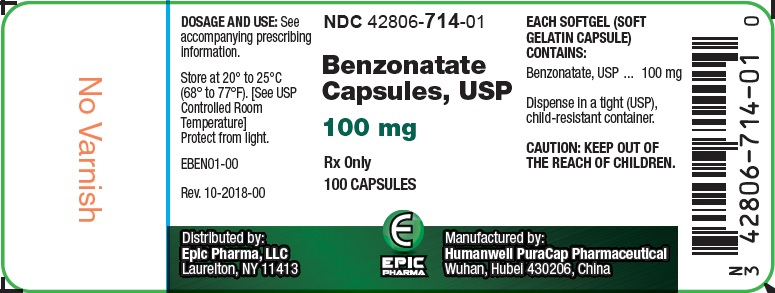
PACKAGE/LABEL PRINCIPAL DISPLAY PANEL - 100 mg 500ct benzonatate-100mg-100ct
PACKAGE/LABEL PRINCIPAL DISPLAY PANEL – 200 mg 500ct benzonatate-200mg-500ct