
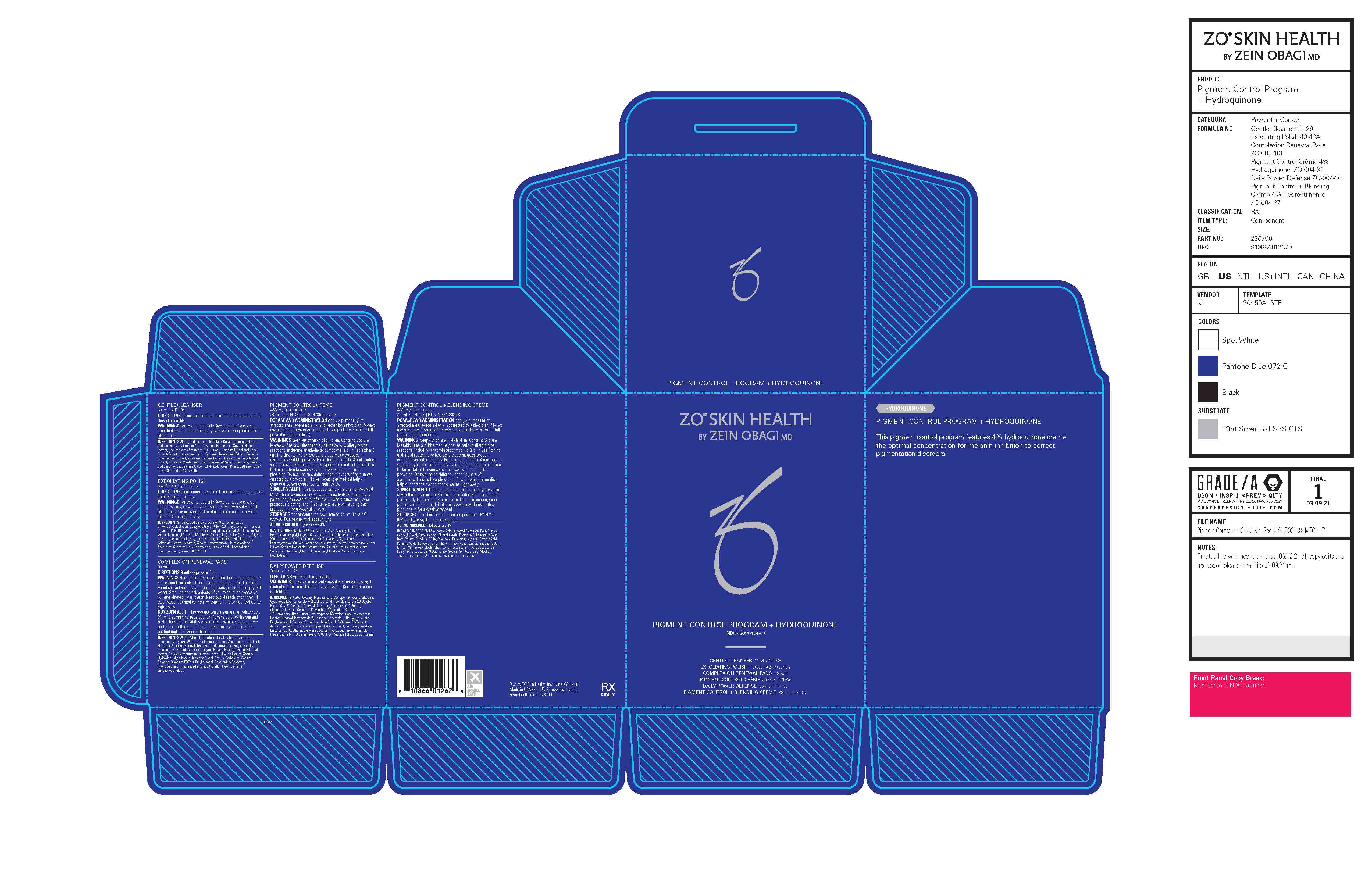
ZO Skin Health Pigment Control Program Plus Hydroquinone Kit
🆔 Identity & classification
Where does this data come from?
🏷️ RxNorm drug class
This medicine belongs to the Melanin Synthesis Inhibitor class.
Where does this data come from?
🏭 Manufacturer & labeler
Where does this data come from?
🩺 Clinical
This is a kit product containing hydroquinone, a topical depigmenting agent typically used to lighten areas of darkened skin. The product is marketed without an approved FDA application. Hydroquinone is commonly used in skincare regimens intended to address uneven skin tone or hyperpigmentation. This kit combines multiple components as part of a comprehensive skincare program.
Patient education
Supplement & herbal interactions
Where does this data come from?
Ask a licensed pharmacist directly — free, answered by our team.
🧪 Inactive Ingredients / Excipients
Inactive ingredients, also called excipients, are components of the drug product other than the active ingredient. They may include fillers, dyes, coatings, preservatives, flavors, or other formulation ingredients.
Where does this data come from?
IACT rows and label-wide narrative are kept separate; availability and product-level specificity depend on the submitted label.Inactive ingredient FAQ
Are inactive ingredients the same for every manufacturer?
Why might an inactive ingredient be missing?
Can inactive ingredients matter?
💲 Pricing
A drug doesn't have one price. Each row is a different public payment system, and none is what you'd pay at the counter — that depends on your insurance. The ⓘ on each row explains what it measures.
| Price system | Per each | Per package |
|---|---|---|
| Retail pharmacies payNADAC · weekly | Not in the retail survey — common for institutional, discontinued, or low-volume packs. | |
| Medicaid paysCMS SDUD · 12 mo | No recent Medicaid claims on file for this NDC — rare and low-volume NDCs are suppressed in the public data. | |
| Medicare drug plans payPart D · quarterly | No Part D plan price is available for this NDC in our data. | |
Where does this data come from?
🔁 Therapeutic equivalents
| Product | Labeler | Pack | NADAC/unit | TE | Status | Price vs. this |
|---|---|---|---|---|---|---|
| ZO Skin Health Pigment Control Program Plus Hydroquinonethis 42851-0200-60 | ZO | 1 patch | — | — | FDA listed | — |
Where does this data come from?
⏳ Availability & generic status
We did not find an FDA-approved generic match for this exact strength, form and route.
Where does this data come from?
🔬 Reported adverse events (FAERS)
Top reported reactions
Age at onset
Reporter sex
Serious outcomes
Where does this data come from?
📦 Packaging — all sizes for this product
| Package NDC | Description | Marketing start | Status |
|---|---|---|---|
| 42851-0200-60 You're viewing this | 1 KIT in 1 CARTON (42851-200-60) * 1 PATCH in 1 JAR * 30 mL in 1 BOTTLE, PLASTIC * 30 mL in 1 BOTTLE, PLASTIC * 30 mL in 1 BOTTLE, PUMP * 16.2 g in 1 JAR * 60 mL in 1 TUBE | 2021-03-09 | Active |
🧭 About this NDC listing & data coverage
Listed without an FDA application
This product's marketing category indicates it is marketed without an approved FDA application (no NDA, ANDA, or BLA on file). Having an NDC does not by itself establish FDA approval — the NDC Directory is a listing system, not an approval decision. Approval-linked data such as Orange Book therapeutic-equivalence ratings therefore does not apply.
Kit / multi-component package
This NDC identifies a kit — a package containing more than one component. Structured data (pricing, ingredients, equivalents) is often reported per component rather than for the kit NDC itself, which can make this page look thinner than the components' own pages.
What data is (and isn’t) available for this NDC — tap to expand
| NDC identity (package / product / labeler codes) | ✓ Available |
| Labeler | ✓ Available |
| Product & package description | ✓ Available |
| Marketing category & status | ✓ Available |
| Active ingredient / dosage form / route | ✓ Available |
| FDA label (SPL via DailyMed) | ✓ Available |
| Package photos | ✓ Available |
| Inactive ingredients (structured) | — Not published for this NDC The labeler did not submit a structured excipient list, or no SPL is available. |
| NADAC pharmacy acquisition price (CMS) | — Not published for this NDC CMS publishes NADAC only for NDCs reported in its retail-pharmacy survey. |
| Orange Book / therapeutic-equivalence data | — Not published for this NDC Applies only to products approved under an NDA/ANDA; many listings are out of scope. |
| HCPCS J-code billing crosswalk | — Not published for this NDC Most self-administered / retail products have no J-code — that is normal. |
| Medicaid utilization (CMS SDUD) | — Not published for this NDC CMS reports utilization only for NDCs with Medicaid claims above its privacy threshold. |
Questions about this listing
Is this NDC FDA-approved?
Why is there no price listed?
Is the NDC printed on the package the same as the 11-digit billing NDC?
What do the three segments of this NDC mean?
Is this package still being marketed?
Who lists this product with the FDA?
Do I need a prescription for this product?
Where does this data come from?
📄 Full prescribing information FDA SPL
🎯 Indications and Usage ▾
INDICATIONS AND USAGE Pigment Control Creme is indicated in the gradual bleaching of hyperpigmentation, skin conditions such as chloasma, melasma, freckles, senile lentigines, and other unwanted areas of melanin hyperpigmentation.
INDICATIONS AND USAGE For the gradual bleaching of hyperpigmented skin conditions such as cholasma, melasma, freckles, senile lentigines, and other unwanted areas of melanin hyperpigmentation.
⏱️ Dosage and Administration ▾
DRUG DOSAGE AND ADMINISTRATION A thin layer of Pigment Control Creme (Hydroquinone USP, 4%) should be applied to the affected area twice daily or as directed by a physician. If no improvement is seen after 8-12 weeks of treatment, use of this product should be discontinued. There is no recommended dosage for pediatric patients under 12 years of age except under the advice and supervision of a physician.
DRUG DOSAGE AND ADMINISTRATION A thin application of Pigment Control + Blending Creme should be applied to the affected area twice daily or as directed by a physician. Consult product label for instructions on whether to rub in or not. There is no recommendation for children under 12 years of age except under the advice and supervision of a physician.
⛔ Contraindications ▾
CONTRAINDICATIONS Prior history of sensitivity or allergic reaction to this product or any of its ingredients. The safety of topical Hydroquinone use during pregnancy or in children (12 years and under) has not been established.
CONTRAINDICATIONS Prior history of sensitivity or allergic reaction to hydroquinone or to any other ingredient in this product. The safety of topical hydroquinone use during pregnancy or in children (12 years and under) has not been established.
⚠️ Warnings ▾
WARNINGS Hydroquinone is a skin bleaching agent which may produce undesired effects if not used as directed. The physician should be familiar with the contents of this insert before prescribing or dispensing this product. Contains sodium metabisulfite, a sulfite that may cause allergic-type reactions including anaphylactic symptoms and life-threatening or less severe asthmatic episodes in certain susceptible people.
The overall prevalence of sulfite sensitivity in the general population is unknown and probably low. Sulfite sensitivity is seen more frequently in asthmatic than in non-asthmatic people. Avoid unnecessary sun exposure, use an effective broad-spectrum sunscreen agent or protective clothing should be worn to cover bleached skin to prevent re-pigmentation from occurring.
Hydroquinone may produce exogenous ochronosis, a gradual blue-black darkening of the skin. If this condition occurs, discontinue treatment and consult your physician. Avoid contact with eyes and mucous membranes.
Keep out of reach of children. In case of accidental ingestion, call a physician or a poison control center immediately.
WARNINGS Hydroquinone is a skin bleaching agent which may produce undesired effects if not used as directed. The physician should be familiar with the contents of this insert before prescribing or dispensing this product. Contains sodium metabisulfite, a sulfite that may cause allergic-type reactions including anaphylactic symptoms and life-threatening or less severe asthmatic episodes in certain susceptible people.
The overall prevalence of sulfite sensitivity in the general population is unknown and probably low. Sulfite sensitivity is seen more frequently in asthmatic than in non-asthmatic people. Avoid unnecessary sun exposure, use an effective broad-spectrum sunscreen agent or protective clothing should be worn to cover bleached skin to prevent re-pigmentation from occurring.
Hydroquinone may produce exogenous ochronosis, a gradual blue-black darkening of the skin. If this condition occurs, discontinue treatment and consult your physician. Avoid contact with eyes and mucous membranes.
Keep out of reach of children. In case of accidental ingestion, call a physician or a poison control center immediately.
🤒 Adverse Reactions ▾
Adverse Reactions The following reactions have been reported: dryness and fissuring of paranasal and infraorbital areas, erythema, and stinging. Occasional hypersensitivity (localized contact dermatitis) may develop. If this occurs, the medication should be discontinued, and the physician notified immediately.
Adverse Reactions The following reactions have been reported: dryness and fissuring of paranasal and infraorbital areas, erythema, and stinging. Occasional hypersensitivity (localized contact dermatitis) may develop. If this occurs, the medication should be discontinued, and the physician notified immediately.
🔄 Drug Interactions ▾
Drug Interactions Patients are cautioned on concomitant use of medications that are known to be photosensitizing.
Drug Interactions Patients are cautioned on concomitant use of medications that are known to be photosensitizing.
🤰 Pregnancy ▾
Pregnancy Category C Animal reproduction studies have not been conducted with topical hydroquinone. It is also not known whether topical hydroquinone can cause fetal harm when administered to a pregnant woman or can affect reproduction capacity. Topical hydroquinone should be given to a pregnant woman only if clearly needed.
Pregnancy Category C Animal reproduction studies have not been conducted with topical hydroquinone. It is also not known whether topical hydroquinone can cause fetal harm when administered to a pregnant woman or can affect reproduction capacity. Topical hydroquinone should be given to a pregnant woman only if clearly needed.
🧒 Pediatric Use ▾
Pediatric Use Safety and effectiveness for pediatric patients below the age of 12 years have not been established.
Pediatric Use Safety and effectiveness for pediatric patients below the age of 12 years have not been established.
🆘 Overdosage ▾
Overdosage There have been no system reactions reported from the use of topical hydroquinone. However, treatment should be limited to relatively small areas of the body at one time, since some patients experience a transient skin reddening and a mild burning sensation which does not preclude treatment.
Overdosage There have been no system reactions reported from the use of topical hydroquinone. However, treatment should be limited to relatively small areas of the body at one time, since some patients experience a transient skin reddening and a mild burning sensation which does not preclude treatment.
🧬 Clinical Pharmacology ▾
CLINICAL PHARMACOLOGY Topical application of hydroquinone produces a reversible depigmentation of the skin by inhibition of the enzymatic oxidation of tyrosine to 3,4-dihydroxyphenylalanine (DOPA) and suppression of other melanocyte metabolic processes. Exposure to sunlight or ultraviolet light will cause re-pigmentation of bleached areas, which may be prevented by the use of the sunscreen agents.
CLINICAL PHARMACOLOGY Topical application of hydroquinone produces a reversible depigmentation of the skin by inhibition of the enzymatic oxidation of tyrosine to 3,4-dihydroxyphenylalanine (DOPA) and suppression of other melanocyte metabolic processes. Exposure to sunlight or ultraviolet light will cause re-pigmentation of bleached areas, which may be prevented by the use of the sunscreen agents.
📦 How Supplied / Storage and Handling ▾
HOW SUPPLIED Pigment Control Creme (Hydroquinone USP, 4%) is available as follows:
2.7Fl. Oz. (80 mL) Bottle / NDC 42851-037-80 1.0 fl oz/30 ml Bottle / NDC 42851-037-30 STORAGE Store at controlled room temperature: 15°-30°C (59°-86°F)
HOW SUPPLIED Pigment Control + Blending Creme (Hydroquinone USP, 4%) is available as follows:
2.7Fl. Oz. (80 mL) Bottle / NDC 42851-036-80
1.0Fl. Oz (30 mL) Bottle / NDC 42851-036-30 STORAGE Store at controlled room temperature: 15°-30°C (59°-86°F)
📦 Storage and Handling ▾
STORAGE Store at controlled room temperature: 15°-30°C (59°-86°F)
STORAGE Store at controlled room temperature: 15°-30°C (59°-86°F)
📋 Description ▾
DESCRIPTION Hydroquinone is 1,4-benzendiol, with a chemical formula of C6H6O2 and a molecular weight of 110.11. The structural formula is: Each gram of Pigment Control Creme (Hydroquinone USP, 4%) contains Hydroquinone USP 40 mg/gm in a base of Purified Water, Ascorbic Acid, Ascorbyl Palmitate, Beta-Glucan, Caprylyl Glycol, Cetyl Alcohol, Chlorphenesin, Dioscorea Villosa (Wild Yam) Root Extract, Disodium EDTA, Glycerin, Glycolic Acid, Phenoxyethanol, Quillaja Saponaria Bark Extract, Smilax Aristolochiifolia Root Extract, Sodium Hydroxide, Sodium Lauryl Sulfate, Sodium Metabisulfite, Sodium Sulfite, Stearyl Alcohol, Tocopheryl Acetate, Yucca Schidigera Root Extract.
Chemical Structure
DESCRIPTION Hydroquinone is 1,4-benzendiol, with a chemical formula of C6H6O2 and a molecular weight of 110.11. The structural formula is: Each gram of Pigment Control + Blending Creme contains Hydroquinone USP 40mg/gm in a base of Ascorbic Acid, Ascorbyl Palmitate, Beta-Glucan, Caprylyl Glycol, Cetyl Alcohol, Chlorphenesin, Dioscorea Villosa (Wild Yam) Root Extract, Disodium EDTA, Ethylhexyl Palmitate, Glycerin, Glycolic Acid, Palmitic Acid, Phenoxyethanol, Phenyl Trimethicone, Purified Water, Quillaja Saponaria Bark Extract, Smilax Aristolochiifolia Root Extract, Sodium Hydroxide, Sodium Lauryl Sulfate, Sodium Metabisulfite, Sodium Sulfite, Stearyl Alcohol, Tocopheryl Acetate, Yucca Schidigera Root Extract.
Chemical Structure