
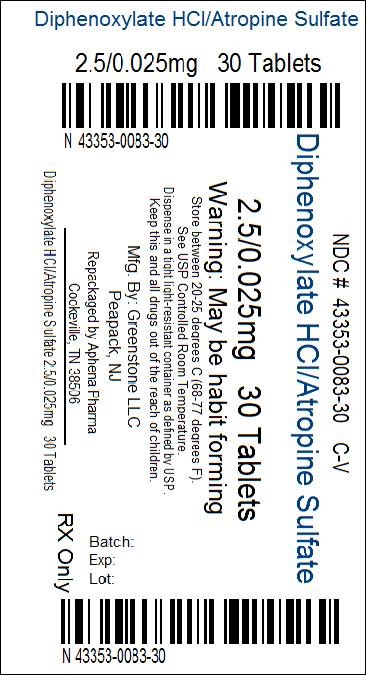
Diphenoxylate Hydrochloride and Atropine Sulfate 2.5 mg; .025 mg Tablet, 30-count — NDC 43353-083-30 (Billing 43353-0083-30)
This is a package of 30 tablets of Diphenoxylate Hydrochloride and Atropine Sulfate 2.5 mg; .025 mg Tablet from Aphena Pharma Solutions - Tennessee, LLC, marketed since Feb 2013 and currently FDA-listed. It is the main listing for this product, which comes in 6 package sizes.
NDC database record
One package, one record: these facts belong to NDC 43353-083-30 alone.
- Record
- FDA NDC Directory package listing · Human prescription drug
- Code segments
- 43353 labeler · 083 product · 30 package
- Package marketed since
- Jul 13, 2015
- Sample package
- No — commercial package
- Listing certified through
- Dec 31, 2026
- Billing quantity
- 30 EA per package
- Barcode (UPC-A, from the NDC)
- 3 4335308330 7
- FDA record last changed
- Aug 27, 2026
Identity & classification
Regulatory identifiers FDA, NLM and CMS codes for this package
Drug-database identifiers Medi-Span GPI and First Databank GCN / HICL / AHFS classification
- GSN (GCN sequence number): 002841
- GCN: 65030
- GPI-14 (Medi-Span): 47100010100310
- HICL (First Databank): 001235
- AHFS class code: 12:08.08.00
- RxCUI (RxNorm): 1190572
Where does this data come from?
- FDA openFDA NDC Directory · synced Oct 8, 2026
- FDA label on DailyMed · label index refreshed Oct 6, 2026
- RxNorm (NLM RxNav) · catalog refreshed Oct 1, 2026
- Medi-Span GPI (licensed)
- First Databank (licensed) · refreshed Oct 8, 2026
RxNorm drug class
This medicine belongs to the Anticholinergic class.
Where does this data come from?
- RxClass (NLM) · catalog refreshed Oct 1, 2026
Clinical
Diphenoxylate is used along with other treatments such as fluid and electrolyte replacement for the treatment of diarrhea. Diphenoxylate should not be given to children younger than 2 years of age. Diphenoxylate is in a class of medications called antidiarrheal agents. It works by decreasing activity of the bowel.
Read the full MedlinePlus article ↗Patient education
Supplement & herbal interactions
Where does this data come from?
- MedlinePlus (NLM) · refreshed Oct 1, 2026
- FDA label on DailyMed · label index refreshed Oct 6, 2026
Ask a licensed pharmacist directly — free, answered by our team.
Pricing
A drug doesn't have one price. Each row is a different public payment system, and none is what you'd pay at the counter — that depends on your insurance. The ⓘ on each row explains what it measures.
| Price system | Per each | Per package |
|---|---|---|
| Retail pharmacies payNADAC · weekly | Not in the retail survey — common for institutional, discontinued, or low-volume packs. | |
| Medicaid paysCMS SDUD · 12 mo | No recent Medicaid claims on file for this NDC — rare and low-volume NDCs are suppressed in the public data. | |
| Medicare drug plans payPart D · Q2 2026 | $0.2597 | $7.79 / 30 tablets |
Where does this data come from?
- CMS NADAC weekly file
- CMS ASP pricing files · refreshed Sep 20, 2026
- CMS Medicaid State Drug Utilization Data · refreshed Oct 8, 2026
- CMS Part D plan pricing files · refreshed Sep 24, 2026
- VA National Acquisition Center price file
Packaging — all sizes for this product
| Package NDC | Description | Marketing start | Marketing end | Status |
|---|---|---|---|---|
| 43353-0083-30 You're viewing this Main listing | 30 TABLET in 1 BOTTLE | 2015-07-13 | — | Active |
| 43353-0083-53 43353-083-53 | 60 TABLET in 1 BOTTLE | 2015-07-14 | — | Active |
| 43353-0083-60 43353-083-60 | 90 TABLET in 1 BOTTLE | 2015-07-13 | — | Active |
| 43353-0083-70 43353-083-70 | 120 TABLET in 1 BOTTLE | 2015-07-13 | — | Active |
| 43353-0083-80 43353-083-80 | 180 TABLET in 1 BOTTLE | 2015-08-15 | — | Active |
| 43353-0083-90 43353-083-90 | 240 TABLET in 1 BOTTLE | 2015-07-27 | — | Active |
You're viewing the smallest of 6 pack sizes for this product.
Pack size FAQ
What quantity is in this package?
How does this package differ from NDC 43353-0083-53?
What NDC number is used to bill for this package of Diphenoxylate Hydrochloride and Atropine Sulfate 2.5 mg; .025 mg Tablet?
Therapeutic equivalents
Where does this data come from?
- FDA openFDA NDC Directory · synced Oct 8, 2026
- FDA Orange Book · refreshed Oct 3, 2026
- CMS NADAC weekly file
Availability & generic status
FDA-approved generic versions are listed, and recent pricing/market data suggests they may be available — see Therapeutic equivalents.
Where does this data come from?
- FDA Orange Book · refreshed Oct 3, 2026
What it looks like
Where does this data come from?
- FDA label on DailyMed · label index refreshed Oct 6, 2026
Inactive Ingredients / Excipients
Inactive ingredients, also called excipients, are components of the drug product other than the active ingredient. They may include fillers, dyes, coatings, preservatives, flavors, or other formulation ingredients.
💡 Tap an ingredient (hover on desktop) to see what it is and why it’s used.
-
UNII 5C5403N26O
Acacia is a natural gum derived from acacia tree sap. It serves as a binder, thickener, and emulsifier to help hold ingredients together, improve texture, and stabilize the medicine.
-
UNII 70097M6I30
Magnesium stearate is a salt made from magnesium and stearic acid, a fatty substance. It's used in tablets and capsules as a lubricant and glidant to help ingredients flow smoothly during manufacturing and prevent sticking.
-
UNII 506T60A25R
Sorbitol is a natural sugar alcohol derived from glucose. It serves as a sweetener, humectant, and bulking agent in medications to improve taste and help maintain moisture in the product.
-
UNII O8232NY3SJ
A plant-based carbohydrate derived from corn kernels. It acts as a filler to add bulk, a binder to hold ingredients together, and a disintegrant to help the tablet break apart in your stomach for absorption.
-
UNII C151H8M554
A natural sugar derived from sugar cane or sugar beets. It's used as a sweetener, filler, and binder to improve taste, add bulk, and help hold tablet or capsule ingredients together.
-
UNII 7SEV7J4R1U
A powder made from a naturally occurring mineral. In medicines, talc works as a glidant and anti-caking agent, helping tablets and capsules flow smoothly during manufacturing and preventing clumping.
6 inactive ingredients listed in the exact product block matched to this NDC.
Where does this data come from?
ingredient classCode="IACT" elements from the exact product block matched by this NDC. Label-section narrative from DailyMed / the openFDA label index is shown separately when available.- FDA label on DailyMed · label index refreshed Oct 6, 2026
- FDA openFDA NDC Directory · synced Oct 8, 2026
Inactive ingredient FAQ
Are inactive ingredients the same for every manufacturer?
Why might an inactive ingredient be missing?
Can inactive ingredients matter?
Manufacturer & labeler
More NDCs from Aphena Pharma Solutions - Tennessee, LLC labeler code 43353
- Warfarin Sodium 4 mg Tablet NDC 43353-033-30
- Warfarin Sodium 7.5 mg Tablet NDC 43353-053-30
- Warfarin Sodium 10 mg Tablet NDC 43353-054-30
- Furosemide 40 mg Tablet NDC 43353-069-30
- Gabapentin 300 mg Capsule NDC 43353-075-30
- Gabapentin 400 mg Capsule NDC 43353-081-60
- valproic acid 250 mg Capsule NDC 43353-085-53
- Citalopram Hydrobromide 40 mg Tablet NDC 43353-112-15
- Hydralazine Hydrochloride 100 mg Tablet NDC 43353-124-05
- Temazepam 7.5 mg Capsule NDC 43353-152-30
- Sodium Bicarbonate 650 mg Tablet NDC 43353-162-53
- Allopurinol 300 mg Tablet NDC 43353-186-60
Where does this data come from?
- FDA openFDA NDC Directory · synced Oct 8, 2026
- Drugs@FDA
Full prescribing information FDA SPL
🎯 Indications and Usage ▾
INDICATIONS AND USAGE Diphenoxylate hydrochloride is effective as adjunctive therapy in the management of diarrhea.
⏱️ Dosage and Administration ▾
DOSAGE AND ADMINISTRATION DO NOT EXCEED RECOMMENDED DOSAGE. Adults The recommended initial dosage is two diphenoxylate hydrochloride tablets four times daily . Most patients will require this dosage until initial control has been achieved, after which the dosage may be reduced to meet individual requirements.
Control may often be maintained with as little as 5 mg (two tablets) daily. Clinical improvement of acute diarrhea is usually observed within 48 hours. If clinical improvement of chronic diarrhea after treatment with a maximum daily dose of 20 mg of diphenoxylate hydrochloride is not observed within 10 days, symptoms are unlikely to be controlled by further administration.
Children Diphenoxylate hydrochloride is not recommended in children under 2 years of age and should be used with special caution in young children (see Warnings and Precautions ). The nutritional status and degree of dehydration must be considered. Do not use diphenoxylate hydrochloride tablets for children under 13 years of age .
KEEP THIS AND ALL MEDICATIONS OUT OF THE REACH OF CHILDREN.
⛔ Contraindications ▾
CONTRAINDICATIONS Diphenoxylate hydrochloride is contraindicated in patients with: Known hypersensitivity to diphenoxylate or atropine. Obstructive jaundice. Diarrhea associated with pseudomembranous enterocolitis or enterotoxin-producing bacteria.
⚠️ Warnings ▾
WARNINGS DIPHENOXYLATE HYDROCHLORIDE IS NOT AN INNOCUOUS DRUG AND DOSAGE RECOMMENDATIONS SHOULD BE STRICTLY ADHERED TO, ESPECIALLY IN CHILDREN. DIPHENOXYLATE HYDROCHLORIDE IS NOT RECOMMENDED FOR CHILDREN UNDER 2 YEARS OF AGE. OVERDOSAGE MAY RESULT IN SEVERE RESPIRATORY DEPRESSION AND COMA, POSSIBLY LEADING TO PERMANENT BRAIN DAMAGE OR DEATH (SEE OVERDOSAGE ).
THEREFORE, KEEP THIS MEDICATION OUT OF THE REACH OF CHILDREN. THE USE OF DIPHENOXYLATE HYDROCHLORIDE SHOULD BE ACCOMPANIED BY APPROPRIATE FLUID AND ELECTROLYTE THERAPY, WHEN INDICATED. IF SEVERE DEHYDRATION OR ELECTROLYTE IMBALANCE IS PRESENT, DIPHENOXYLATE HYDROCHLORIDE SHOULD BE WITHHELD UNTIL APPROPRIATE CORRECTIVE THERAPY HAS BEEN INITIATED.
DRUG-INDUCED INHIBITION OF PERISTALSIS MAY RESULT IN FLUID RETENTION IN THE INTESTINE, WHICH MAY FURTHER AGGRAVATE DEHYDRATION AND ELECTROLYTE IMBALANCE. DIPHENOXYLATE HYDROCHLORIDE SHOULD BE USED WITH SPECIAL CAUTION IN YOUNG CHILDREN BECAUSE THIS AGE GROUP MAY BE PREDISPOSED TO DELAYED DIPHENOXYLATE TOXICITY AND BECAUSE OF THE GREATER VARIABILITY OF RESPONSE IN THIS AGE GROUP. Antiperistaltic agents may prolong and/or worsen diarrhea associated with organisms that penetrate the intestinal mucosa (toxigenic E. coli, Salmonella, Shigella), and pseudomembranous enterocolitis associated with broad-spectrum antibiotics.
Antiperistaltic agents should not be used in these conditions. In some patients with acute ulcerative colitis, agents that inhibit intestinal motility or prolong intestinal transit time have been reported to induce toxic megacolon. Consequently, patients with acute ulcerative colitis should be carefully observed and diphenoxylate hydrochloride therapy should be discontinued promptly if abdominal distention occurs or if other untoward symptoms develop.
Since the chemical structure of diphenoxylate hydrochloride is similar to that of meperidine hydrochloride, the concurrent use of diphenoxylate hydrochloride with monoamine oxidase (MAO) inhibitors may, in theory, precipitate hypertensive crisis. Diphenoxylate hydrochloride should be used with extreme caution in patients with advanced hepatorenal disease and in all patients with abnormal liver function since hepatic coma may be precipitated. Diphenoxylate hydrochloride may potentiate the action of barbiturates, tranquilizers, and alcohol.
Therefore, the patient should be closely observed when any of these are used concomitantly.
🤒 Adverse Reactions ▾
ADVERSE REACTIONS At therapeutic doses, the following have been reported; they are listed in decreasing order of severity, but not of frequency: Nervous system: numbness of extremities, euphoria, depression, malaise/lethargy, confusion, sedation/drowsiness, dizziness, restlessness, headache. Allergic: anaphylaxis, angioneurotic edema, urticaria, swelling of the gums, pruritus. Gastrointestinal system: toxic megacolon, paralytic ileus, pancreatitis, vomiting, nausea, anorexia, abdominal discomfort.
The following atropine sulfate effects are listed in decreasing order of severity, but not of frequency: hyperthermia, tachycardia, urinary retention, flushing, dryness of the skin and mucous membranes. These effects may occur, especially in children. THIS MEDICATION SHOULD BE KEPT IN A CHILD-RESISTANT CONTAINER AND OUT OF THE REACH OF CHILDREN SINCE AN OVERDOSAGE MAY RESULT IN SEVERE RESPIRATORY DEPRESSION AND COMA, POSSIBLY LEADING TO PERMANENT BRAIN DAMAGE OR DEATH.
🔄 Drug Interactions ▾
Drug interactions Known drug interactions include barbiturates, tranquilizers, and alcohol. Diphenoxylate hydrochloride may interact with MAO inhibitors (see Warnings ). In studies with male rats, diphenoxylate hydrochloride was found to inhibit the hepatic microsomal enzyme system at a dose of 2 mg/kg/day.
Therefore, diphenoxylate has the potential to prolong the biological half-lives of drugs for which the rate of elimination is dependent on the microsomal drug metabolizing enzyme system.
🤰 Pregnancy ▾
Pregnancy Pregnancy Category C Diphenoxylate hydrochloride has been shown to have an effect on fertility in rats when given in doses 50 times the human dose (see above discussion ). Other findings in this study include a decrease in maternal weight gain of 30% at 20 mg/kg/day and of 10% at 4 mg/kg/day. At 10 times the human dose (4 mg/kg/day), average litter size was slightly reduced.
Teratology studies were conducted in rats, rabbits, and mice with diphenoxylate hydrochloride at oral doses of 0.4 to 20 mg/kg/day. Due to experimental design and small numbers of litters, embryotoxic, fetotoxic, or teratogenic effects cannot be adequately assessed. However, examination of the available fetuses did not reveal any indication of teratogenicity.
There are no adequate and well-controlled studies in pregnant women. Diphenoxylate hydrochloride should be used during pregnancy only if the anticipated benefit justifies the potential risk to the fetus.
🧒 Pediatric Use ▾
Pediatric use Diphenoxylate hydrochloride may be used as an adjunct to the treatment of diarrhea but should be accompanied by appropriate fluid and electrolyte therapy, if needed. DIPHENOXYLATE HYDROCHLORIDE IS NOT RECOMMENDED FOR CHILDREN UNDER 2 YEARS OF AGE. Diphenoxylate hydrochloride should be used with special caution in young children because of the greater variability of response in this age group.
See Warnings and Dosage and Administration . In case of accidental ingestion by children, see Overdosage for recommended treatment.
🆘 Overdosage ▾
OVERDOSAGE RECOMMENDED DOSAGE SCHEDULES SHOULD BE STRICTLY FOLLOWED. THIS MEDICATION SHOULD BE KEPT IN A CHILD-RESISTANT CONTAINER AND OUT OF THE REACH OF CHILDREN, SINCE AN OVERDOSAGE MAY RESULT IN SEVERE, EVEN FATAL, RESPIRATORY DEPRESSION. Diagnosis Initial signs of overdosage may include dryness of the skin and mucous membranes, mydriasis, restlessness, flushing, hyperthermia, and tachycardia followed by lethargy or coma, hypotonic reflexes, nystagmus, pinpoint pupils, and respiratory depression.
Respiratory depression may be evidenced as late as 30 hours after ingestion and may recur despite an initial response to narcotic antagonists. TREAT ALL POSSIBLE DIPHENOXYLATE HYDROCHLORIDE OVERDOSAGES AS SERIOUS AND MAINTAIN MEDICAL OBSERVATION FOR AT LEAST 48 HOURS, PREFERABLY UNDER CONTINUOUS HOSPITAL CARE. Treatment In the event of overdose, induction of vomiting, gastric lavage, establishment of a patent airway, and possibly mechanically assisted respiration are advised.
In vitro and animal studies indicate that activated charcoal may significantly decrease the bioavailability of diphenoxylate. In noncomatose patients, a slurry of 100 g of activated charcoal can be administered immediately after the induction of vomiting or gastric lavage. A pure narcotic antagonist (e.g., naloxone) should be used in the treatment of respiratory depression caused by diphenoxylate hydrochloride.
When a narcotic antagonist is administered intravenously, the onset of action is generally apparent within two minutes. It may also be administered subcutaneously or intramuscularly, providing a slightly less rapid onset of action but a more prolonged effect. To counteract respiratory depression caused by diphenoxylate hydrochloride overdosage, the following dosage schedule for the narcotic antagonist naloxone hydrochloride should be followed: Adult dosage An initial dose of 0.4 mg to 2 mg of naloxone hydrochloride may be administered intravenously.
If the desired degree of counteraction and improvement in respiratory functions is not obtained, it may be repeated at 2- to 3-minute intervals. If no response is observed after 10 mg of naloxone hydrochloride has been administered, the diagnosis of narcotic-induced or partial narcotic-induced toxicity should be questioned. Intramuscular or subcutaneous administration may be necessary if the intravenous route is not available.
Children The usual initial dose in children is 0.01 mg/kg body weight given I.V. If this dose does not result in the desired degree of clinical improvement, a subsequent dose of 0.1 mg/kg body weight may be administered. If an I.V. route of administration is not available, naloxone hydrochloride may be administered I.M. or S.C. in divided doses.
If necessary, naloxone hydrochloride can be diluted with sterile water for injection. Following initial improvement of respiratory function, repeated doses of naloxone hydrochloride may be required to counteract recurrent respiratory depression. Supplemental intramuscular doses of naloxone hydrochloride may be utilized to produce a longer-lasting effect.
Since the duration of action of diphenoxylate hydrochloride is longer than that of naloxone hydrochloride, improvement of respiration following administration may be followed by recurrent respiratory depression. Consequently, continuous observation is necessary until the effect of diphenoxylate hydrochloride on respiration has passed. This effect may persist for many hours.
The period of observation should extend over at least 48 hours, preferably under continuous hospital care. Although signs of overdosage and respiratory depression may not be evident soon after ingestion of diphenoxylate hydrochloride, respiratory depression may occur from 12 to 30 hours later.
🧬 Clinical Pharmacology ▾
CLINICAL PHARMACOLOGY Diphenoxylate is rapidly and extensively metabolized in man by ester hydrolysis to diphenoxylic acid (difenoxine), which is biologically active and the major metabolite in the blood. After a 5-mg oral dose of carbon-14 labeled diphenoxylate hydrochloride in ethanolic solution was given to three healthy volunteers, an average of 14% of the drug plus its metabolites was excreted in the urine and 49% in the feces over a four-day period. Urinary excretion of the unmetabolized drug constituted less than 1% of the dose, and diphenoxylic acid plus its glucuronide conjugate constituted about 6% of the dose.
In a 16-subject crossover bioavailability study, a linear relationship in the dose range of 2.5 to 10 mg was found between the dose of diphenoxylate hydrochloride (given as diphenoxylate hydrochloride liquid) and the peak plasma concentration, the area under the plasma concentration-time curve, and the amount of diphenoxylic acid excreted in the urine. In the same study the bioavailability of the tablet compared with an equal dose of the liquid was approximately 90%. The average peak plasma concentration of diphenoxylic acid following ingestion of four 2.5-mg tablets was 163 ng/ml at about 2 hours, and the elimination half-life of diphenoxylic acid was approximately 12 to 14 hours.
In dogs, diphenoxylate hydrochloride has a direct effect on circular smooth muscle of the bowel that conceivably results in segmentation and prolongation of gastrointestinal transit time. The clinical antidiarrheal action of diphenoxylate hydrochloride may thus be a consequence of enhanced segmentation that allows increased contact of the intraluminal contents with the intestinal mucosa.
📦 How Supplied / Storage and Handling ▾
HOW SUPPLIED Tablets — round, white, with SEARLE debossed on one side and 61 on the other side and containing 2.5 mg of diphenoxylate hydrochloride and 0.025 mg of atropine sulfate, supplied as: NDC Number Size 59762-1061-1 bottle of 100 59762-1061-2 bottle of 1000
📋 Description ▾
DESCRIPTION Each diphenoxylate hydrochloride and atropine sulfate tablet contains: diphenoxylate hydrochloride 2.5 mg atropine sulfate 0.025 mg Diphenoxylate hydrochloride, an antidiarrheal, is ethyl 1-(3-cyano-3,3-diphenylpropyl)-4-phenylisonipecotate monohydrochloride and has the following structural formula: Atropine sulfate, an anticholinergic, is endo-(±)-α-(hydroxymethyl) benzeneacetic acid 8-methyl-8-azabicyclo[3.2.1] oct-3-yl ester sulfate (2:1) (salt) monohydrate and has the following structural formula: A subtherapeutic amount of atropine sulfate is present to discourage deliberate overdosage.
Inactive ingredients of diphenoxylate hydrochloride tablets include acacia, corn starch, magnesium stearate, sorbitol, sucrose, and talc. Chemical Structure Chemical Structure
💬 Information for Patients ▾
Information for patients INFORM THE PATIENT (PARENT OR GUARDIAN) NOT TO EXCEED THE RECOMMENDED DOSAGE AND TO KEEP DIPHENOXYLATE HYDROCHLORIDE OUT OF THE REACH OF CHILDREN AND IN A CHILD-RESISTANT CONTAINER. INFORM THE PATIENT OF THE CONSEQUENCES OF OVERDOSAGE, INCLUDING SEVERE RESPIRATORY DEPRESSION AND COMA, POSSIBLY LEADING TO PERMANENT BRAIN DAMAGE OR DEATH. Diphenoxylate hydrochloride may produce drowsiness or dizziness.
The patient should be cautioned regarding activities requiring mental alertness, such as driving or operating dangerous machinery. Potentiation of the action of alcohol, barbiturates, and tranquilizers with concomitant use of diphenoxylate hydrochloride should be explained to the patient. The physician should also provide the patient with other information in this labeling, as appropriate.
⚠️ Precautions ▾
PRECAUTIONS General Since a subtherapeutic dose of atropine has been added to the diphenoxylate hydrochloride, consideration should be given to the precautions relating to the use of atropine. In children, diphenoxylate hydrochloride should be used with caution since signs of atropinism may occur even with recommended doses, particularly in patients with Down's syndrome. Information for patients INFORM THE PATIENT (PARENT OR GUARDIAN) NOT TO EXCEED THE RECOMMENDED DOSAGE AND TO KEEP DIPHENOXYLATE HYDROCHLORIDE OUT OF THE REACH OF CHILDREN AND IN A CHILD-RESISTANT CONTAINER.
INFORM THE PATIENT OF THE CONSEQUENCES OF OVERDOSAGE, INCLUDING SEVERE RESPIRATORY DEPRESSION AND COMA, POSSIBLY LEADING TO PERMANENT BRAIN DAMAGE OR DEATH. Diphenoxylate hydrochloride may produce drowsiness or dizziness. The patient should be cautioned regarding activities requiring mental alertness, such as driving or operating dangerous machinery.
Potentiation of the action of alcohol, barbiturates, and tranquilizers with concomitant use of diphenoxylate hydrochloride should be explained to the patient. The physician should also provide the patient with other information in this labeling, as appropriate. Drug interactions Known drug interactions include barbiturates, tranquilizers, and alcohol.
Diphenoxylate hydrochloride may interact with MAO inhibitors (see Warnings ). In studies with male rats, diphenoxylate hydrochloride was found to inhibit the hepatic microsomal enzyme system at a dose of 2 mg/kg/day. Therefore, diphenoxylate has the potential to prolong the biological half-lives of drugs for which the rate of elimination is dependent on the microsomal drug metabolizing enzyme system.
Carcinogenesis, mutagenesis, impairment of fertility No long-term study in animals has been performed to evaluate carcinogenic potential. Diphenoxylate hydrochloride was administered to male and female rats in their diets to provide dose levels of 4 and 20 mg/kg/day throughout a three-litter reproduction study. At 50 times the human dose (20 mg/kg/day), female weight gain was reduced and there was a marked effect on fertility as only 4 of 27 females became pregnant in three test breedings.
The relevance of this finding to usage of diphenoxylate hydrochloride in humans is unknown. Pregnancy Pregnancy Category C Diphenoxylate hydrochloride has been shown to have an effect on fertility in rats when given in doses 50 times the human dose (see above discussion ). Other findings in this study include a decrease in maternal weight gain of 30% at 20 mg/kg/day and of 10% at 4 mg/kg/day.
At 10 times the human dose (4 mg/kg/day), average litter size was slightly reduced. Teratology studies were conducted in rats, rabbits, and mice with diphenoxylate hydrochloride at oral doses of 0.4 to 20 mg/kg/day. Due to experimental design and small numbers of litters, embryotoxic, fetotoxic, or teratogenic effects cannot be adequately assessed.
However, examination of the available fetuses did not reveal any indication of teratogenicity. There are no adequate and well-controlled studies in pregnant women. Diphenoxylate hydrochloride should be used during pregnancy only if the anticipated benefit justifies the potential risk to the fetus.
Nursing mothers Caution should be exercised when diphenoxylate hydrochloride is administered to a nursing woman, since the physicochemical characteristics of the major metabolite, diphenoxylic acid, are such that it may be excreted in breast milk and since it is known that atropine is excreted in breast milk. Pediatric use Diphenoxylate hydrochloride may be used as an adjunct to the treatment of diarrhea but should be accompanied by appropriate fluid and electrolyte therapy, if needed. DIPHENOXYLATE HYDROCHLORIDE IS NOT RECOMMENDED FOR CHILDREN UNDER 2 YEARS OF AGE.
Diphenoxylate hydrochloride should be used with special caution in young children because of the greater variability of response in this age group. See Warnings and Dosage and Administration . I… [Excerpted — this section continues on DailyMed.]
🍼 Nursing Mothers ▾
Nursing mothers Caution should be exercised when diphenoxylate hydrochloride is administered to a nursing woman, since the physicochemical characteristics of the major metabolite, diphenoxylic acid, are such that it may be excreted in breast milk and since it is known that atropine is excreted in breast milk.
🔒 Drug Abuse and Dependence ▾
DRUG ABUSE AND DEPENDENCE Controlled substance Diphenoxylate hydrochloride is classified as a Schedule V controlled substance by federal regulation. Diphenoxylate hydrochloride is chemically related to the narcotic analgesic meperidine. Drug abuse and dependence In doses used for the treatment of diarrhea, whether acute or chronic, diphenoxylate has not produced addiction.
Diphenoxylate hydrochloride is devoid of morphine-like subjective effects at therapeutic doses. At high doses it exhibits codeine-like subjective effects. The dose which produces antidiarrheal action is widely separated from the dose which causes central nervous system effects.
The insolubility of diphenoxylate hydrochloride in commonly available aqueous media precludes intravenous self-administration. A dose of 100 to 300 mg/day, which is equivalent to 40 to 120 tablets, administered to humans for 40 to 70 days, produced opiate withdrawal symptoms. Since addiction to diphenoxylate hydrochloride is possible at high doses, the recommended dosage should not be exceeded.
🔒 Controlled Substance ▾
Controlled substance Diphenoxylate hydrochloride is classified as a Schedule V controlled substance by federal regulation. Diphenoxylate hydrochloride is chemically related to the narcotic analgesic meperidine.
📄 Carcinogenesis, Mutagenesis, Impairment of Fertility ▾
Carcinogenesis, mutagenesis, impairment of fertility No long-term study in animals has been performed to evaluate carcinogenic potential. Diphenoxylate hydrochloride was administered to male and female rats in their diets to provide dose levels of 4 and 20 mg/kg/day throughout a three-litter reproduction study. At 50 times the human dose (20 mg/kg/day), female weight gain was reduced and there was a marked effect on fertility as only 4 of 27 females became pregnant in three test breedings.
The relevance of this finding to usage of diphenoxylate hydrochloride in humans is unknown.
📄 Package Label / Principal Display Panel ▾
PRINCIPAL DISPLAY PANEL NDC 43353-083 - Diphenoxylate Hydrochloride and Atropine Sulfate Tablets 2.5/0.025mg - Rx Only Bottle Label 2.5/0.025mg
About this NDC listing & data coverage
What data is (and isn’t) available for this NDC — tap to expand
| NDC identity (package / product / labeler codes) | ✓ Available |
| Labeler | ✓ Available |
| Product & package description | ✓ Available |
| Marketing category & status | ✓ Available |
| Active ingredient / dosage form / route | ✓ Available |
| FDA label (SPL via DailyMed) | ✓ Available |
| Package photos | ✓ Available |
| Inactive ingredients (structured) | ✓ Available |
| NADAC pharmacy acquisition price (CMS) | — Not published for this NDC CMS publishes NADAC only for NDCs reported in its retail-pharmacy survey. |
| Orange Book / therapeutic-equivalence data | ✓ Available |
| HCPCS J-code billing crosswalk | — Not published for this NDC Most self-administered / retail products have no J-code — that is normal. |
| Medicaid utilization (CMS SDUD) | — Not published for this NDC CMS reports utilization only for NDCs with Medicaid claims above its privacy threshold. |