
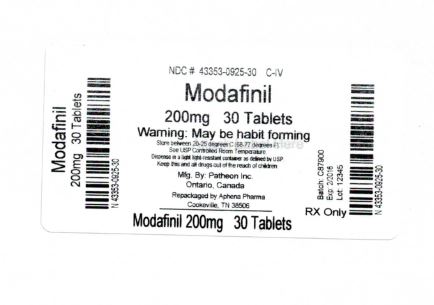
modafinil 200 mg Tablet, 30-count — NDC 43353-925-30 (Billing 43353-0925-30)
This is a package of 30 tablets of modafinil 200 mg Tablet from Aphena Pharma Solutions - Tennessee, LLC, marketed since Mar 2012 and currently FDA-listed. It is the main listing for this product, which comes in 2 package sizes.
NDC database record
One package, one record: these facts belong to NDC 43353-925-30 alone.
- Record
- FDA NDC Directory package listing · Human prescription drug
- Code segments
- 43353 labeler · 925 product · 30 package
- Package marketed since
- Apr 17, 2014
- Sample package
- No — commercial package
- Listing certified through
- Dec 31, 2026
- Billing quantity
- 30 EA per package
- Barcode (UPC-A, from the NDC)
- 3 4335392530 0
- FDA record last changed
- Jul 24, 2026
Identity & classification
Regulatory identifiers FDA, NLM and CMS codes for this package
Drug-database identifiers Medi-Span GPI and First Databank GCN / HICL / AHFS classification
- GSN (GCN sequence number): 041478
- GCN: 26102
- GPI-14 (Medi-Span): 61400024000320
- HICL (First Databank): 010865
- AHFS class code: 28:20.80.00
- RxCUI (RxNorm): 205324
Where does this data come from?
- FDA openFDA NDC Directory · synced Oct 8, 2026
- FDA label on DailyMed · label index refreshed Oct 6, 2026
- RxNorm (NLM RxNav) · catalog refreshed Oct 1, 2026
- Medi-Span GPI (licensed)
- First Databank (licensed) · refreshed Oct 8, 2026
RxNorm drug class
This medicine belongs to the Sympathomimetic-like Agent class.
Where does this data come from?
- RxClass (NLM) · catalog refreshed Oct 1, 2026
Clinical
- It helps adults stay awake when they have excessive sleepiness from narcolepsy, obstructive sleep apnea, or shift work disorder. In sleep apnea, it treats the sleepiness but not th...
- Take it once a day by mouth. For narcolepsy or sleep apnea, take it in the morning. For shift work disorder, take it about an hour before your shift starts. Follow your prescriptio...
- Common ones are headache, nausea, nervousness, anxiety, trouble sleeping, dizziness, and diarrhea. Most are mild to moderate. Let me know if they bother you or don't go away.
- Yes. Stop the medicine and get help if you see any rash, or swelling of your face, lips, or throat. Also call if you notice new depression, mania, or odd thinking, or if you get ch...
Patient education
Supplement & herbal interactions
Some supplements/herbs that may interact with Modafinil — tap one for details:
Where does this data come from?
- MedlinePlus (NLM) · refreshed Oct 1, 2026
- FDA label on DailyMed · label index refreshed Oct 6, 2026
Ask a licensed pharmacist directly — free, answered by our team.
Pricing
A drug doesn't have one price. Each row is a different public payment system, and none is what you'd pay at the counter — that depends on your insurance. The ⓘ on each row explains what it measures.
| Price system | Per each | Per package |
|---|---|---|
| Retail pharmacies payNADAC · weekly | Not in the retail survey — common for institutional, discontinued, or low-volume packs. | |
| Medicaid paysCMS SDUD · 12 mo | No recent Medicaid claims on file for this NDC — rare and low-volume NDCs are suppressed in the public data. | |
| Medicare drug plans payPart D · Q2 2026 | $0.5456 | $16.37 / 30 tablets |
Where does this data come from?
- CMS NADAC weekly file
- CMS ASP pricing files · refreshed Sep 20, 2026
- CMS Medicaid State Drug Utilization Data · refreshed Oct 8, 2026
- CMS Part D plan pricing files · refreshed Sep 24, 2026
- VA National Acquisition Center price file
Packaging — all sizes for this product
| Package NDC | Description | Marketing start | Marketing end | Status |
|---|---|---|---|---|
| 43353-0925-30 You're viewing this Main listing | 30 TABLET in 1 BOTTLE, PLASTIC | 2014-04-17 | — | Active |
| 43353-0925-53 43353-925-53 | 60 TABLET in 1 BOTTLE, PLASTIC | 2014-04-17 | — | Active |
You're viewing the smallest of 2 pack sizes for this product.
Pack size FAQ
What quantity is in this package?
How does this package differ from NDC 43353-0925-53?
What NDC number is used to bill for this package of modafinil 200 mg Tablet?
Therapeutic equivalents
| Product | Labeler | Pack | NADAC/unit | TE | Status | Price vs. this |
|---|---|---|---|---|---|---|
| Modafinil 200 mg 00904-6792-04 | Major | 30 tablets | $0.344 | AB | Availability likely | — |
| Modafinil 200 mg 50268-0571-12 | AvPAK | 20 tablets | $0.344 | AB | Availability likely | — |
| Modafinil 200 mg 60505-2527-01 | Apotex | 100 tablets | $0.344 | AB | Availability likely | — |
| Modafinil 200 mg 65862-0602-01 | Aurobindo | 100 tablets | $0.344 | — | Availability likely | — |
| Modafinil 200 mg 68084-0721-21 | American | 30 tablets | $0.344 | AB | Availability likely | — |
| Modafinil 200 mg 69452-0343-13 | Bionpharma | 30 tablets | $0.344 | AB | Availability likely | — |
| Modafinil 200 mg 72578-0006-01 | Viona | 100 tablets | $0.344 | AB | Availability likely | — |
| Modafinil 200 mg 55253-0802-30 | CIMA | 30 tablets | $0.356 | AB | Discontinued | — |
| Modafinil 200 mg 60505-4852-03 | Apotex | 30 tablets | $80.349 | — | Availability likely | — |
| Modafinil 200 mg 63459-0201-30 | Cephalon, | 30 tablets | $80.349 | — | Availability likely | — |
| Modafinil 200 mg 23155-0605-01 | Heritage | 100 tablets | — | AB | FDA listed | — |
| Modafinil 200 mg 23155-0862-01 | Heritage | 100 tablets | — | AB | FDA listed | — |
| modafinil 200 mgthis 43353-0925-30 | Aphena | 30 tablets | — | AB | FDA listed | — |
| Modafinil 200 mg 46708-0386-10 | Alembic | 100 tablets | — | AB | FDA listed | — |
| Modafinil 200 mg 51407-0961-30 | Golden | 30 tablets | — | AB | FDA listed | — |
| Modafinil 200 mg 57237-0155-01 | Rising | 100 tablets | — | AB | FDA listed | — |
| Provigil 200 mg 60429-0010-30 | Golden | 30 tablets | — | AB | FDA listed | — |
| Modafinil 200 mg 62332-0386-10 | Alembic | 100 tablets | — | AB | FDA listed | — |
| Modafinil 200 mg 63629-7315-01 | Bryant | 30 tablets | — | AB | FDA listed | — |
| Modafinil 200 mg 68788-8280-03 | Preferred | 30 tablets | — | AB | FDA listed | — |
| Modafinil 200 mg 68788-8653-03 | Preferred | 30 tablets | — | AB | FDA listed | — |
| Modafinil 200 mg 70771-1052-01 | Zydus | 100 tablets | — | AB | FDA listed | — |
| Modafinil 200 mg 71205-0544-30 | Proficient | 30 tablets | — | AB | FDA listed | — |
| Modafinil 200 mg 71335-1173-01 | Bryant | 30 tablets | — | AB | Discontinued | — |
| Modafinil 200 mg 71335-2258-00 | Bryant | 100 tablets | — | AB | FDA listed | — |
| Modafinil 200 mg 71335-2501-00 | Bryant | 100 tablets | — | AB | FDA listed | — |
| Modafinil 200 mg 71610-0685-30 | Aphena | 30 tablets | — | AB | FDA listed | — |
| Modafinil 200 mg 71610-0873-30 | Aphena | 30 tablets | — | AB | FDA listed | — |
| Modafinil 200 mg 71610-0989-30 | Aphena | 30 tablets | — | AB | FDA listed | — |
| Modafinil 200 mg 71610-0991-30 | Aphena | 30 tablets | — | AB | FDA listed | — |
| Modafinil 200 mg 82804-0126-30 | Proficient | 30 tablets | — | AB | FDA listed | — |
| Modafinil 200 mg 87063-0309-01 | ASCLEMED | 100 tablets | — | AB | FDA listed | — |
| Modafinil 200 mg 87063-0307-01 | ASCLEMED | 100 tablets | — | AB | FDA listed | — |
Where does this data come from?
- FDA openFDA NDC Directory · synced Oct 8, 2026
- FDA Orange Book · refreshed Oct 3, 2026
- CMS NADAC weekly file
Availability & generic status
FDA-approved generic versions are listed, and recent pricing/market data suggests they may be available — see Therapeutic equivalents.
Where does this data come from?
- FDA Orange Book · refreshed Oct 3, 2026
Inactive Ingredients / Excipients
Inactive ingredients, also called excipients, are components of the drug product other than the active ingredient. They may include fillers, dyes, coatings, preservatives, flavors, or other formulation ingredients.
🧪 Avoiding an ingredient? See Modafinil inactive ingredients by manufacturer: every current product's list side by side, so you can ask your pharmacy for the version that does not list it.
💡 Tap an ingredient (hover on desktop) to see what it is and why it’s used.
-
UNII OP1R32D61U
Microcrystalline cellulose is a purified form of cellulose, a natural fiber from plant sources. It acts as a binder and filler in tablets and capsules, helping hold ingredients together and give the medicine its shape and size.
-
UNII M28OL1HH48
Croscarmellose sodium is a plant-based substance derived from cellulose. It acts as a disintegrant, helping tablets and capsules break down quickly in the digestive system so the medicine can be absorbed.
-
UNII J2B2A4N98G
Lactose is a natural sugar derived from milk. In medications, it serves as a filler and binder to add bulk and help hold tablet or capsule ingredients together during manufacturing.
-
UNII 70097M6I30
Magnesium stearate is a salt made from magnesium and stearic acid, a fatty substance. It's used in tablets and capsules as a lubricant and glidant to help ingredients flow smoothly during manufacturing and prevent sticking.
-
UNII FZ989GH94E
Povidone is a synthetic polymer made from a plastic-like material. It acts as a binder to hold tablet ingredients together and as a disintegrant to help the tablet break apart in your stomach so the medicine can be absorbed.
-
UNII O8232NY3SJ
A plant-based carbohydrate derived from corn kernels. It acts as a filler to add bulk, a binder to hold ingredients together, and a disintegrant to help the tablet break apart in your stomach for absorption.
6 inactive ingredients listed in the exact product block matched to this NDC.
Where does this data come from?
ingredient classCode="IACT" elements from the exact product block matched by this NDC. Label-section narrative from DailyMed / the openFDA label index is shown separately when available.- FDA label on DailyMed · label index refreshed Oct 6, 2026
- FDA openFDA NDC Directory · synced Oct 8, 2026
Inactive ingredient FAQ
Are inactive ingredients the same for every manufacturer?
Why might an inactive ingredient be missing?
Can inactive ingredients matter?
Manufacturer & labeler
More NDCs from Aphena Pharma Solutions - Tennessee, LLC labeler code 43353
- Diazepam 2 mg Tablet NDC 43353-825-30
- Omeprazole 40 mg Capsule, Delayed Release NDC 43353-829-60
- Atenolol 50 mg Tablet NDC 43353-834-30
- Metolazone 2.5 mg Tablet NDC 43353-890-09
- Terbinafine Hydrochloride 250 mg Tablet NDC 43353-893-16
- Chantix varenicline tartrate 1 mg Tablet, Film Coated NDC 43353-899-05
- Metolazone 5 mg Tablet NDC 43353-931-09
- Alfuzosin hydrochloride 10 mg Tablet, Extended Release NDC 43353-945-16
- Carbamazepine 200 mg Tablet NDC 43353-953-53
- Propranolol Hydrochloride 20 mg Tablet NDC 43353-961-60
- Oxybutynin Chloride 5 mg Tablet NDC 43353-978-92
- Meloxicam 15 mg Tablet NDC 43353-979-30
Where does this data come from?
- FDA openFDA NDC Directory · synced Oct 8, 2026
- Drugs@FDA
Full prescribing information FDA SPL
🎯 Indications and Usage ▾
INDICATIONS AND USAGE Modafinil is indicated to improve wakefulness in adult patients with excessive sleepiness associated with narcolepsy, obstructive sleep apnea, and shift work disorder. In OSA, modafinil is indicated as an adjunct to standard treatment(s) for the underlying obstruction. If continuous positive airway pressure (CPAP) is the treatment of choice for a patient, a maximal effort to treat with CPAP for an adequate period of time should be made prior to initiating modafinil.
If modafinil is used adjunctively with CPAP, the encouragement of and periodic assessment of CPAP compliance is necessary. In all cases, careful attention to the diagnosis and treatment of the underlying sleep disorder(s) is of utmost importance. Prescribers should be aware that some patients may have more than one sleep disorder contributing to their excessive sleepiness.
The effectiveness of modafinil in long-term use (greater than 9 weeks in Narcolepsy clinical trials and 12 weeks in OSA and SWD clinical trials) has not been systematically evaluated in placebo-controlled trials. The physician who elects to prescribe modafinil for an extended time in patients with Narcolepsy, OSA, or SWD should periodically reevaluate long-term usefulness for the individual patient.
⏱️ Dosage and Administration ▾
DOSAGE AND ADMINISTRATION The recommended dose of modafinil is 200 mg given once a day. For patients with narcolepsy and OSA, modafinil should be taken as a single dose in the morning. For patients with SWD, modafinil should be taken approximately 1 hour prior to the start of their work shift.
Doses up to 400 mg/day, given as a single dose, have been well tolerated, but there is no consistent evidence that this dose confers additional benefit beyond that of the 200 mg dose (See CLINICAL PHARMACOLOGY and CLINICAL TRIALS ). General Considerations Dosage adjustment should be considered for concomitant medications that are substrates for CYP3A4, such as triazolam and cyclosporine (See PRECAUTIONS, Drug Interactions ). Drugs that are largely eliminated via CYP2C19 metabolism, such as diazepam, propranolol, phenytoin (also via CYP2C9) or S-mephenytoin may have prolonged elimination upon coadministration with modafinil and may require dosage reduction and monitoring for toxicity.
In patients with severe hepatic impairment, the dose of modafinil should be reduced to one-half of that recommended for patients with normal hepatic function (See CLINICAL PHARMACOLOGY and PRECAUTIONS ). There is inadequate information to determine safety and efficacy of dosing in patients with severe renal impairment (See CLINICAL PHARMACOLOGY and PRECAUTIONS ). In elderly patients, elimination of modafinil and its metabolites may be reduced as a consequence of aging.
Therefore, consideration should be given to the use of lower doses in this population (See CLINICAL PHARMACOLOGY and PRECAUTIONS ).
⛔ Contraindications ▾
CONTRAINDICATIONS Modafinil is contraindicated in patients with known hypersensitivity to modafinil, armodafinil or its inactive ingredients.
⚠️ Warnings ▾
WARNINGS Serious Rash, including Stevens-Johnson Syndrome Serious rash requiring hospitalization and discontinuation of treatment has been reported in adults and children in association with the use of modafinil. Modafinil is not approved for use in pediatric patients for any indication. In clinical trials of modafinil, the incidence of rash resulting in discontinuation was approximately 0.8% (13 per 1,585) in pediatric patients (age <17 years); these rashes included 1 case of possible Stevens-Johnson Syndrome (SJS) and 1 case of apparent multi-organ hypersensitivity reaction.
Several of the cases were associated with fever and other abnormalities (e.g., vomiting, leukopenia). The median time to rash that resulted in discontinuation was 13 days. No such cases were observed among 380 pediatric patients who received placebo.
No serious skin rashes have been reported in adult clinical trials (0 per 4,264) of modafinil. Rare cases of serious or life-threatening rash, including SJS, Toxic Epidermal Necrolysis (TEN), and Drug Rash with Eosinophilia and Systemic Symptoms (DRESS) have been reported in adults and children in worldwide post-marketing experience. The reporting rate of TEN and SJS associated with modafinil use, which is generally accepted to be an underestimate due to underreporting, exceeds the background incidence rate.
Estimates of the background incidence rate for these serious skin reactions in the general population range between 1 to 2 cases per million-person years. There are no factors that are known to predict the risk of occurrence or the severity of rash associated with modafinil. Nearly all cases of serious rash associated with modafinil occurred within 1 to 5 weeks after treatment initiation.
However, isolated cases have been reported after prolonged treatment (e.g., 3 months). Accordingly, duration of therapy cannot be relied upon as a means to predict the potential risk heralded by the first appearance of a rash. Although benign rashes also occur with modafinil, it is not possible to reliably predict which rashes will prove to be serious.
Accordingly, modafinil should ordinarily be discontinued at the first sign of rash, unless the rash is clearly not drug-related. Discontinuation of treatment may not prevent a rash from becoming life-threatening or permanently disabling or disfiguring. Angioedema and Anaphylactoid Reactions One serious case of angioedema and one case of hypersensitivity (with rash, dysphagia, and bronchospasm), were observed among 1,595 patients treated with armodafinil, the R enantiomer of modafinil (which is the racemic mixture).
No such cases were observed in modafinil clinical trials. However, angioedema has been reported in postmarketing experience with modafinil. Patients should be advised to discontinue therapy and immediately report to their physician any signs or symptoms suggesting angioedema or anaphylaxis (e.g., swelling of face, eyes, lips, tongue or larynx ; difficulty in swallowing or breathing; hoarseness).
Multi-organ Hypersensitivity Reactions Multi-organ hypersensitivity reactions, including at least one fatality in postmarketing experience, have occurred in close temporal association (median time to detection 13 days: range 4-33) to the initiation of modafinil. Although there have been a limited number of reports, multi-organ hypersensitivity reactions may result in hospitalization or be life-threatening. There are no factors that are known to predict the risk of occurrence or the severity of multi-organ hypersensitivity reactions associated with modafinil.
Signs and symptoms of this disorder were diverse; however, patients typically, although not exclusively, presented with fever and rash associated with other organ system involvement. Other associated manifestations included myocarditis, hepatitis, liver function test abnormalities, hematological abnormalities (e.g., eosinophilia, leukopenia, thrombocytopenia), pruritus, and asthenia. Because multi-organ hypersensiti… [Excerpted — this section continues on DailyMed.]
🤒 Adverse Reactions ▾
ADVERSE REACTIONS Modafinil has been evaluated for safety in over 3500 patients, of whom more than 2000 patients with excessive sleepiness associated with primary disorders of sleep and wakefulness were given at least one dose of modafinil. In clinical trials, modafinil has been found to be generally well tolerated and most adverse experiences were mild to moderate. The most commonly observed adverse events (≥5%) associated with the use of modafinil more frequently than placebo-treated patients in the placebo-controlled clinical studies in primary disorders of sleep and wakefulness were headache, nausea, nervousness, rhinitis, diarrhea, back pain, anxiety, insomnia, dizziness, and dyspepsia.
The adverse event profile was similar across these studies. In the placebo-controlled clinical trials, 74 of the 934 patients (8%) who received modafinil discontinued due to an adverse experience compared to 3% of patients that received placebo. The most frequent reasons for discontinuation that occurred at a higher rate for modafinil than placebo patients were headache (2%), nausea, anxiety, dizziness, insomnia, chest pain and nervousness (each <1%).
In a Canadian clinical trial, a 35 year old obese narcoleptic male with a prior history of syncopal episodes experienced a 9-second episode of asystole after 27 days of modafinil treatment (300 mg/day in divided doses). Incidence in Controlled Trials The following table (Table 3) presents the adverse experiences that occurred at a rate of 1% or more and were more frequent in adult patients treated with modafinil than in placebo-treated patients in the principal, placebo-controlled clinical trials. The prescriber should be aware that the figures provided below cannot be used to predict the frequency of adverse experiences in the course of usual medical practice, where patient characteristics and other factors may differ from those occurring during clinical studies.
Similarly, the cited frequencies cannot be directly compared with figures obtained from other clinical investigations involving different treatments, uses, or investigators. Review of these frequencies, however, provides prescribers with a basis to estimate the relative contribution of drug and non-drug factors to the incidence of adverse events in the population studied. Table 3.
Incidence Of Treatment-Emergent Adverse Experiences In Parallel-Group, Placebo-Controlled Clinical Trials 1 With Modafinil In Adults With Narcolepsy, OSA, and SWD (200mg, 300mg and 400mg)* Body System Preferred Term Modafinil (n = 934) Placebo (n = 567) Body as a Whole Headache 34% 23% Back Pain 6% 5% Flu Syndrome 4% 3% Chest Pain 3% 1% Chills 1% 0% Neck Rigidity 1% 0% Cardiovascular Hypertension 3% 1% Tachycardia 2% 1% Palpitation 2% 1% Vasodilatation 2% 0% Digestive Nausea 11% 3% Diarrhea 6% 5% Dyspepsia 5% 4% Dry Mouth 4% 2% Anorexia 4% 1% Constipation 2% 1% Abnormal Liver Function 2 2% 1% Flatulence 1% 0% Mouth Ulceration 1% 0% Thirst 1% 0% Hemic/Lymphatic Eosinophilia 1% 0% Metabolic/Nutritional Edema 1% 0% Nervous Nervousness 7% 3% Insomnia 5% 1% Anxiety 5% 1% Dizziness 5% 4% Depression 2% 1% Paresthesia 2% 0% Somnolence 2% 1% Hypertonia 1% 0% Dyskinesia 3 1% 0% Hyperkinesia 1% 0% Agitation 1% 0% Confusion 1% 0% Tremor 1% 0% Emotional Lability 1% 0% Vertigo 1% 0% Respiratory Rhinitis 7% 6% Pharyngitis 4% 2% Lung Disorder 2% 1% Epistaxis 1% 0% Asthma 1% 0% Skin/Appendages Sweating 1% 0% Herpes Simplex 1% 0% Special Senses Amblyopia 1% 0% Abnormal Vision 1% 0% Taste Perversion 1% 0% Eye Pain 1% 0% Urogenital Urine Abnormality 1% 0% Hematuria 1% 0% Pyuria 1% 0% * Six double-blind, placebo-controlled clinical studies in narcolepsy, OSA, and SWD.
1 Events reported by at least 1% of patients treated with modafinil that were more frequent than in the placebo group are included; incidence is rounded to the nearest 1%. The adverse experience terminology is coded using a standard modified COSTART Dictionary. Events for which the modafinil incidence was at leas… [Excerpted — this section continues on DailyMed.]
🤰 Pregnancy ▾
Pregnancy Pregnancy Category C: In studies conducted in rats and rabbits, developmental toxicity was observed at clinically relevant exposures. Modafinil (50, 100, or 200 mg/kg/day) administered orally to pregnant rats throughout the period of organogenesis caused, in the absence of maternal toxicity, an increase in resorptions and an increased incidence of visceral and skeletal variations in the offspring at the highest dose. The higher no-effect dose for rat embryofetal developmental toxicity was associated with a plasma modafinil exposure approximately 0.5 times the AUC in humans at the recommended daily dose (RHD) of 200 mg.
However, in a subsequent study of up to 480 mg/kg/day (plasma modafinil exposure approximately 2 times the AUC in humans at the RHD) no adverse effects on embryofetal development were observed. Modafinil administered orally to pregnant rabbits throughout the period of organogenesis at doses of 45, 90, and 180 mg/kg/day increased the incidences of fetal structural alterations and embryofetal death at the highest dose. The highest no-effect dose for developmental toxicity was associated with a plasma modafinil AUC approximately equal to the AUC in humans at the RHD.
Oral administration of armodafinil (the R-enantiomer of modafinil; 60, 200, or 600 mg/kg/day) to pregnant rats throughout the period of organogenesis resulted in increased incidences of fetal visceral and skeletal variations at the intermediate dose or greater and decreased fetal body weights at the highest dose. The no-effect dose for rat embryofetal developmental toxicity was associated with a plasma armodafinil exposure (AUC) approximately one-tenth times the AUC for armodafinil in humans treated with modafinil at the RHD.
Modafinil administration to rats throughout gestation and lactation at oral doses of up to 200 mg/kg/day resulted in decreased viability in the offspring at doses greater than 20 mg/kg/day (plasma modafinil AUC approximately 0.1 times the AUC in humans at the RHD). No effects on postnatal developmental and neurobehavioral parameters were observed in surviving offspring. There are no adequate and well-controlled studies in pregnant women.
Two cases of intrauterine growth retardation and one case of spontaneous abortion have been reported in association with armodafinil and modafinil. Although the pharmacology of modafinil and armodafinil is not identical to that of the sympathomimetic amines, they do share some pharmacologic properties with this class. Certain of these drugs have been associated with intrauterine growth retardation and spontaneous abortions.
Whether the cases reported are drug-related is unknown. Modafinil should be used during pregnancy only if the potential benefit justifies the potential risk to the fetus. Pregnancy Registry: A pregnancy registry has been established to collect information on the pregnancy outcomes of women exposed to modafinil.
Healthcare providers are encouraged to register pregnant patients, or pregnant women may enroll themselves in the registry by calling 1-866-404-4106 (toll free).
🧒 Pediatric Use ▾
Pediatric Use Safety and effectiveness in pediatric patients, below age 17, have not been established. Serious skin rashes, including erythema multiforme major (EMM) and Stevens-Johnson Syndrome (SJS) have been associated with modafinil use in pediatric patients (see WARNINGS, Serious Rash, including Stevens-Johnson Syndrome ). In a controlled 6-week study, 165 pediatric patients (aged 5-17 years) with narcolepsy were treated with modafinil (n=123), or placebo (n=42).
There were no statistically significant differences favoring modafinil over placebo in prolonging sleep latency as measured by MSLT, or in perceptions of sleepiness as determined by the clinical global impression-clinician scale (CGI-C). In the controlled and open-label clinical studies, treatment emergent adverse events of the psychiatric and nervous system included Tourette’s syndrome, insomnia, hostility, increased cataplexy, increased hypnagogic hallucinations and suicidal ideation. Transient leukopenia, which resolved without medical intervention, was also observed.
In the controlled clinical study, 3 of 38 girls, ages 12 or older, treated with modafinil experienced dysmenorrhea compared to 0 of 10 girls who received placebo. There were three 7 to 9 week, double-blind, placebo-controlled, parallel group studies in children and adolescents (aged 6-17 years) with Attention-Deficit Hyperactivity Disorder (ADHD, DSM-IV). Two of the studies were flexible-dose studies (up to 425 mg/day), and the third was a fixed-dose study (340 mg/day for patients <30 kg and 425 mg/day for patients ≥30 kg).
Although these studies showed statistically significant differences favoring modafinil over placebo in reducing ADHD symptoms as measured by the ADHD-RS (school version), there were 3 cases of serious rash including one case of possible SJS among 933 patients exposed to modafinil in this program. Modafinil is not approved for use in pediatric patients for any indication, including ADHD (see WARNINGS, Serious Rash, including Stevens-Johnson Syndrome ).
🧓 Geriatric Use ▾
Geriatric Use Experience in a limited number of patients who were greater than 65 years of age in clinical trials showed an incidence of adverse experiences similar to other age groups. In elderly patients, elimination of modafinil and its metabolites may be reduced as a consequence of aging. Therefore, consideration should be given to the use of lower doses in this population (See CLINICAL PHARMACOLOGY and PRECAUTIONS ).
🆘 Overdosage ▾
OVERDOSAGE Human Experience In clinical trials, a total of 151 protocol-specified doses ranging from 1000 to 1600 mg/day (5 to 8 times the recommended daily dose of 200 mg) have been administered to 32 subjects, including 13 subjects who received doses of 1000 or 1200 mg/day for 7 to 21 consecutive days. In addition, several intentional acute overdoses occurred; the two largest being 4500 mg and 4000 mg taken by two subjects participating in foreign depression studies. None of these study subjects experienced any unexpected or life-threatening effects.
Adverse experiences that were reported at these doses included excitation or agitation, insomnia, and slight or moderate elevations in hemodynamic parameters. Other observed high-dose effects in clinical studies have included anxiety, irritability, aggressiveness, confusion, nervousness, tremor, palpitations, sleep disturbances, nausea, diarrhea and decreased prothrombin time. From post-marketing experience, there have been no reports of fatal overdoses involving modafinil alone (doses up to 12 grams).
Overdoses involving multiple drugs, including modafinil, have resulted in fatal outcomes. Symptoms most often accompanying modafinil overdose, alone or in combination with other drugs have included: insomnia; central nervous system symptoms such as restlessness, disorientation, confusion, excitation and hallucination; digestive changes such as nausea and diarrhea; and cardiovascular changes such as tachycardia, bradycardia, hypertension and chest pain. Cases of accidental ingestion/overdose have been reported in children as young as 11 months of age.
The highest reported accidental ingestion on a mg/kg basis occurred in a three-year-old boy who ingested 800-1000 mg (50-63 mg/kg) of modafinil. The child remained stable. The symptoms associated with overdose in children were similar to those observed in adults.
Overdose Management No specific antidote to the toxic effects of modafinil overdose has been identified to date. Such overdoses should be managed with primarily supportive care, including cardiovascular monitoring. If there are no contraindications, induced emesis or gastric lavage should be considered.
There are no data to suggest the utility of dialysis or urinary acidification or alkalinization in enhancing drug elimination. The physician should consider contacting a poison-control center on the treatment of any overdose.
Human Experience In clinical trials, a total of 151 protocol-specified doses ranging from 1000 to 1600 mg/day (5 to 8 times the recommended daily dose of 200 mg) have been administered to 32 subjects, including 13 subjects who received doses of 1000 or 1200 mg/day for 7 to 21 consecutive days. In addition, several intentional acute overdoses occurred; the two largest being 4500 mg and 4000 mg taken by two subjects participating in foreign depression studies. None of these study subjects experienced any unexpected or life-threatening effects.
Adverse experiences that were reported at these doses included excitation or agitation, insomnia, and slight or moderate elevations in hemodynamic parameters. Other observed high-dose effects in clinical studies have included anxiety, irritability, aggressiveness, confusion, nervousness, tremor, palpitations, sleep disturbances, nausea, diarrhea and decreased prothrombin time. From post-marketing experience, there have been no reports of fatal overdoses involving modafinil alone (doses up to 12 grams).
Overdoses involving multiple drugs, including modafinil, have resulted in fatal outcomes. Symptoms most often accompanying modafinil overdose, alone or in combination with other drugs have included: insomnia; central nervous system symptoms such as restlessness, disorientation, confusion, excitation and hallucination; digestive changes such as nausea and diarrhea; and cardiovascular changes such as tachycardia, bradycardia, hypertension and chest pain. Cases of accidental ingestion/overdose have been reported in childr… [Excerpted — this section continues on DailyMed.]
🧬 Clinical Pharmacology ▾
CLINICAL PHARMACOLOGY The precise mechanism(s) through which modafinil promotes wakefulness is unknown. Modafinil has wake-promoting actions similar to sympathomimetic agents like amphetamine and methylphenidate, although the pharmacologic profile is not identical to that of sympathomimetic amines. Modafinil has weak to negligible interactions with receptors for norepinephrine, serotonin, dopamine, GABA, adenosine, histamine-3, melatonin, and benzodiazepines.
Modafinil also does not inhibit the activities of MAO-B or phosphodiesterases II-V. Modafinil-induced wakefulness can be attenuated by the α 1 -adrenergic receptor antagonist prazosin; however, modafinil is inactive in other in vitro assay systems known to be responsive to α-adrenergic agonists, such as the rat vas deferens preparation. Modafinil is not a direct- or indirect-acting dopamine receptor agonist.
However, in vitro, modafinil binds to the dopamine transporter and inhibits dopamine reuptake. This activity has been associated in vivo with increased extracellular dopamine levels in some brain regions of animals. In genetically engineered mice lacking the dopamine transporter (DAT), modafinil lacked wake-promoting activity, suggesting that this activity was DAT-dependent.
However, the wake-promoting effects of modafinil, unlike those of amphetamine, were not antagonized by the dopamine receptor antagonist haloperidol in rats. In addition, alpha-methyl-p-tyrosine, a dopamine synthesis inhibitor, blocks the action of amphetamine, but does not block locomotor activity induced by modafinil. In the cat, equal wakefulness-promoting doses of methylphenidate and amphetamine increased neuronal activation throughout the brain.
Modafinil at an equivalent wakefulness-promoting dose selectively and prominently increased neuronal activation in more discrete regions of the brain. The relationship of this finding in cats to the effects of modafinil in humans is unknown. In addition to its wake-promoting effects and ability to increase locomotor activity in animals, modafinil produces psychoactive and euphoric effects, alterations in mood, perception, thinking, and feelings typical of other CNS stimulants in humans.
Modafinil has reinforcing properties, as evidenced by its self-administration in monkeys previously trained to self-administer cocaine. Modafinil was also partially discriminated as stimulant-like. The optical enantiomers of modafinil have similar pharmacological actions in animals.
Two major metabolites of modafinil, modafinil acid and modafinil sulfone, do not appear to contribute to the CNS-activating properties of modafinil. Pharmacokinetics Modafinil is a racemic compound, whose enantiomers have different pharmacokinetics (e.g., the half-life of the l -isomer is approximately three times that of the d- isomer in adult humans). The enantiomers do not interconvert.
At steady state, total exposure to the l- isomer is approximately three times that for the d -isomer. The trough concentration (C minss ) of circulating modafinil after once daily dosing consists of 90% of the l -isomer and 10% of the d -isomer. The effective elimination half-life of modafinil after multiple doses is about 15 hours.
The enantiomers of modafinil exhibit linear kinetics upon multiple dosing of 200-600 mg/day once daily in healthy volunteers. Apparent steady states of total modafinil and l- (-)-modafinil are reached after 2-4 days of dosing. Absorption Absorption of modafinil tablets is rapid, with peak plasma concentrations occurring at 2-4 hours.
The bioavailability of modafinil tablets is approximately equal to that of an aqueous suspension. The absolute oral bioavailability was not determined due to the aqueous insolubility (<1 mg/mL) of modafinil, which precluded intravenous administration. Food has no effect on overall modafinil bioavailability; however, its absorption (t max ) may be delayed by approximately one hour if taken with food.
Distribution Modafinil is well distributed in bod… [Excerpted — this section continues on DailyMed.]
📦 How Supplied / Storage and Handling ▾
HOW SUPPLIED Repackaged by Aphena Pharma Solutions - TN. See Repackaging Information for available configurations. 100 mg Each capsule-shaped, white, uncoated tablet is debossed with "PROVIGIL" on one side and "100 MG" on the other.
NDC 55253-801-30 - Bottles of 30 NDC 55253-801-90 - Bottles of 90 200 mg Each capsule-shaped, white, scored, uncoated tablet is debossed with "PROVIGIL" on one side and "200 MG" on the other. NDC 55253-802-30 - Bottles of 30 NDC 55253-802-90 - Bottles of 90 Store at 20 o to 25 o C (68 o to 77 o F).
📋 Description ▾
DESCRIPTION Modafinil is a wakefulness-promoting agent for oral administration. Modafinil is a racemic compound. The chemical name for modafinil is 2-[(diphenylmethyl)sulfinyl]acetamide.
The molecular formula is C 15 H 15 NO 2 S and the molecular weight is 273.35. The chemical structure is: Modafinil is a white to off-white, crystalline powder that is practically insoluble in water and cyclohexane. It is sparingly to slightly soluble in methanol and acetone.
Modafinil tablets contain 100 mg or 200 mg of modafinil and the following inactive ingredients: lactose monohydrate, microcrystalline cellulose, pregelatinized starch, croscarmellose sodium, povidone, and magnesium stearate. chemical structure
💬 Information for Patients ▾
Information for Patients Physicians are advised to discuss the following issues with patients for whom they prescribe modafinil. Modafinil is indicated for patients who have abnormal levels of sleepiness. Modafinil has been shown to improve, but not eliminate this abnormal tendency to fall asleep.
Therefore, patients should not alter their previous behavior with regard to potentially dangerous activities (e.g., driving, operating machinery) or other activities requiring appropriate levels of wakefulness, until and unless treatment with modafinil has been shown to produce levels of wakefulness that permit such activities. Patients should be advised that modafinil is not a replacement for sleep. Patients should be informed that it may be critical that they continue to take their previously prescribed treatments (e.g., patients with OSA receiving CPAP should continue to do so).
Patients should be informed of the availability of a Medication Guide, and they should be instructed to read it prior to taking modafinil. The complete text of the Medication Guide is provided at the end of this labeling. Patients should be advised to contact their physician if they experience chest pain, rash, depression, anxiety, or signs of psychosis or mania.
Pregnancy Patients should be advised to notify their physician if they become pregnant or intend to become pregnant during therapy. Patients should be cautioned regarding the potential increased risk of pregnancy when using steroidal contraceptives (including depot or implantable contraceptives) with modafinil and for one month after discontinuation of therapy (See Carcinogenesis, Mutagenesis, Impairment of Fertility and Pregnancy ). Nursing Patients should be advised to notify their physician if they are breast feeding an infant.
Concomitant Medications Patients should be advised to inform their physician if they are taking, or plan to take, any prescription or over-the-counter drugs, because of the potential for interactions between modafinil and other drugs. Alcohol Patients should be advised that the use of modafinil in combination with alcohol has not been studied. Patients should be advised that it is prudent to avoid alcohol while taking modafinil.
Allergic Reactions Patients should be advised to stop taking modafinil and to notify their physician if they develop a rash, hives, mouth sores, blisters, peeling skin, trouble swallowing or breathing or a related allergic phenomenon.
Pregnancy Patients should be advised to notify their physician if they become pregnant or intend to become pregnant during therapy. Patients should be cautioned regarding the potential increased risk of pregnancy when using steroidal contraceptives (including depot or implantable contraceptives) with modafinil and for one month after discontinuation of therapy (See Carcinogenesis, Mutagenesis, Impairment of Fertility and Pregnancy ).
Nursing Patients should be advised to notify their physician if they are breast feeding an infant.
Concomitant Medications Patients should be advised to inform their physician if they are taking, or plan to take, any prescription or over-the-counter drugs, because of the potential for interactions between modafinil and other drugs.
Alcohol Patients should be advised that the use of modafinil in combination with alcohol has not been studied. Patients should be advised that it is prudent to avoid alcohol while taking modafinil.
Allergic Reactions Patients should be advised to stop taking modafinil and to notify their physician if they develop a rash, hives, mouth sores, blisters, peeling skin, trouble swallowing or breathing or a related allergic phenomenon.
💬 Medication Guide ▾
Medication Guide Modafinil Tablets C-IV Read the Medication Guide that comes with modafinil tablets before you start taking it and each time you get a refill. There may be new information. This Medication Guide does not take the place of talking with your doctor about your condition or treatment.
What is the most important information I should know about modafinil tablets? Modafinil tablets may cause serious side effects including a serious rash or a serious allergic reaction that may affect parts of your body such as your liver or blood cells. Any of these may need to be treated in a hospital and may be life-threatening.
Stop taking modafinil tablets and call your doctor right away or get emergency help if you have any of these symptoms: skin rash, hives, sores in your mouth, or your skin blisters and peels swelling of your face, eyes, lips, tongue, or throat trouble swallowing or breathing fever, shortness of breath, swelling of the legs, yellowing of the skin or whites of the eyes, or dark urine. If you have a severe rash with modafinil tablets, stopping the medicine may not keep the rash from becoming life-threatening or causing you to be permanently disabled or disfigured.
Modafinil tablets are not approved for use in children for any medical condition. It is not known if modafinil tablets are safe or if they work in children under the age of 17. What are modafinil tablets?
Modafinil tablets are a prescription medicine used to improve wakefulness in adults who are very sleepy due to one of the following diagnosed sleep disorders: narcolepsy obstructive sleep apnea (OSA). Modafinil tablets are used with other medical treatments for this sleep disorder. Modafinil tablets do not take the place of using your CPAP machine or other treatments that your doctor has prescribed for this condition.
It is important that you continue to use these treatments as prescribed by your doctor. shift work disorder (SWD) Modafinil tablets will not cure these sleep disorders. Modafinil tablets may help the sleepiness caused by these conditions, but it may not stop all your sleepiness. Modafinil tablets do not take the place of getting enough sleep.
Follow your doctor’s advice about good sleep habits and using other treatments. Who should not take modafinil tablets? Do not take modafinil tablets if you: are allergic to any of its ingredients.
See the end of this Medication Guide for a complete list of ingredients in modafinil tablets. have had a rash or allergic reaction to either modafinil (PROVIGIL ® ) or armodafinil (NUVIGIL ® ). These medicines are very similar. What should I tell my doctor before taking modafinil tablets?
Tell your doctor about all of your medical conditions including, if you: have a history of mental health problems, including psychosis have heart problems or had a heart attack have high blood pressure. Your blood pressure may need to be checked more often while taking modafinil tablets. have liver or kidney problems have a history of drug or alcohol abuse or addiction are pregnant or planning to become pregnant. It is not known if modafinil tablets will harm your unborn baby.
Pregnancy Registry : There is a registry for women who become pregnant during treatment with modafinil tablets. The purpose of this registry is to collect information about the safety of modafinil tablets during pregnancy. Contact the registry as soon as you learn that you are pregnant, or ask your doctor to contact the registry for you.
You or your doctor can get information and enroll you in the registry by calling 1-866-404-4106. are breastfeeding. It is not known if modafinil tablets pass into your milk. Talk to your doctor about the best way to feed your baby if you take modafinil tablets.
Tell your doctor about all the medicines you take , including prescription and non-prescription medicines, vitamins, and herbal supplements. Modafinil tablets and many other medicines can interact with each other, sometimes causing side effects. Modafinil tabl… [Excerpted — this section continues on DailyMed.]
⚠️ Precautions ▾
PRECAUTIONS Diagnosis of Sleep Disorders Modafinil should be used only in patients who have had a complete evaluation of their excessive sleepiness, and in whom a diagnosis of either narcolepsy, OSA, and/or SWD has been made in accordance with ICSD or DSM diagnostic criteria (See CLINICAL TRIALS ). Such an evaluation usually consists of a complete history and physical examination, and it may be supplemented with testing in a laboratory setting. Some patients may have more than one sleep disorder contributing to their excessive sleepiness (e.g., OSA and SWD coincident in the same patient).
General Although modafinil has not been shown to produce functional impairment, any drug affecting the CNS may alter judgment, thinking or motor skills. Patients should be cautioned about operating an automobile or other hazardous machinery until they are reasonably certain that modafinil therapy will not adversely affect their ability to engage in such activities. CPAP Use in Patients with OSA In OSA, modafinil is indicated as an adjunct to standard treatment(s) for the underlying obstruction.
If continuous positive airway pressure (CPAP) is the treatment of choice for a patient, a maximal effort to treat with CPAP for an adequate period of time should be made prior to initiating modafinil. If modafinil is used adjunctively with CPAP, the encouragement of and periodic assessment of CPAP compliance is necessary. Cardiovascular System Modafinil has not been evaluated in patients with a recent history of myocardial infarction or unstable angina, and such patients should be treated with caution.
In clinical studies of modafinil, signs and symptoms including chest pain, palpitations, dyspnea and transient ischemic T-wave changes on ECG were observed in three subjects in association with mitral valve prolapse or left ventricular hypertrophy. It is recommended that modafinil tablets not be used in patients with a history of left ventricular hypertrophy or in patients with mitral valve prolapse who have experienced the mitral valve prolapse syndrome when previously receiving CNS stimulants. Such signs may include but are not limited to ischemic ECG changes, chest pain, or arrhythmia.
If new onset of any of these symptoms occurs, consider cardiac evaluation. Blood pressure monitoring in short-term (<3 months) controlled trials showed no clinically significant changes in mean systolic and diastolic blood pressure in patients receiving modafinil as compared to placebo. However, a retrospective analysis of the use of antihypertensive medication in these studies showed that a greater proportion of patients on modafinil required new or increased use of antihypertensive medications (2.4%) compared to patients on placebo (0.7%).
The differential use was slightly larger when only studies in OSA were included, with 3.4% of patients on modafinil and 1.1% of patients on placebo requiring such alterations in the use of antihypertensive medication. Increased monitoring of blood pressure may be appropriate in patients on modafinil. Patients Using Steroidal Contraceptives The effectiveness of steroidal contraceptives may be reduced when used with modafinil tablets and for one month after discontinuation of therapy (See PRECAUTIONS, Drug Interactions ).
Alternative or concomitant methods of contraception are recommended for patients treated with modafinil tablets, and for one month after discontinuation of modafinil. Patients Using Cyclosporine The blood levels of cyclosporine may be reduced when used with modafinil (See PRECAUTIONS, Drug Interactions ). Monitoring of circulating cyclosporine concentrations and appropriate dosage adjustment for cyclosporine should be considered when these drugs are used concomitantly.
Patients with Severe Hepatic Impairment In patients with severe hepatic impairment, with or without cirrhosis (See CLINICAL PHARMACOLOGY ), modafinil should be administered at a reduced dose (See DOSAGE AND ADMINISTRATION ). Patients with Severe Renal… [Excerpted — this section continues on DailyMed.]
🍼 Nursing Mothers ▾
Nursing Mothers It is not known whether modafinil or its metabolites are excreted in human milk. Because many drugs are excreted in human milk, caution should be exercised when modafinil tablets are administered to a nursing woman.
🔬 Clinical Studies ▾
CLINICAL TRIALS The effectiveness of modafinil in reducing excessive sleepiness has been established in the following sleep disorders: narcolepsy, obstructive sleep apnea (OSA), and shift work disorder (SWD). Narcolepsy The effectiveness of modafinil in reducing the excessive sleepiness (ES) associated with narcolepsy was established in two US 9-week, multicenter, placebo-controlled, two-dose (200 mg per day and 400 mg per day) parallel-group, double-blind studies of outpatients who met the ICD-9 and American Sleep Disorders Association criteria for narcolepsy (which are also consistent with the American Psychiatric Association DSM-IV criteria).
These criteria include either 1) recurrent daytime naps or lapses into sleep that occur almost daily for at least three months, plus sudden bilateral loss of postural muscle tone in association with intense emotion (cataplexy) or 2) a complaint of excessive sleepiness or sudden muscle weakness with associated features: sleep paralysis, hypnagogic hallucinations, automatic behaviors, disrupted major sleep episode; and polysomnography demonstrating one of the following: sleep latency less than 10 minutes or rapid eye movement (REM) sleep latency less than 20 minutes.
In addition, for entry into these studies, all patients were required to have objectively documented excessive daytime sleepiness, a Multiple Sleep Latency Test (MSLT) with two or more sleep onset REM periods, and the absence of any other clinically significant active medical or psychiatric disorder. The MSLT, an objective daytime polysomnographic assessment of the patient’s ability to fall asleep in an unstimulating environment, measures latency (in minutes) to sleep onset averaged over 4 test sessions at 2-hour intervals following nocturnal polysomnography.
For each test session, the subject was told to lie quietly and attempt to sleep. Each test session was terminated after 20 minutes if no sleep occurred or 15 minutes after sleep onset. In both studies, the primary measures of effectiveness were 1) sleep latency, as assessed by the Maintenance of Wakefulness Test (MWT) and 2) the change in the patient’s overall disease status, as measured by the Clinical Global Impression of Change (CGI-C).
For a successful trial, both measures had to show significant improvement. The MWT measures latency (in minutes) to sleep onset averaged over 4 test sessions at 2 hour intervals following nocturnal polysomnography. For each test session, the subject was asked to attempt to remain awake without using extraordinary measures.
Each test session was terminated after 20 minutes if no sleep occurred or 10 minutes after sleep onset. The CGI-C is a 7-point scale, centered at No Change , and ranging from Very Much Worse to Very Much Improved . Patients were rated by evaluators who had no access to any data about the patients other than a measure of their baseline severity.
Evaluators were not given any specific guidance about the criteria they were to apply when rating patients. Other assessments of effect included the Multiple Sleep Latency Test (MSLT), Epworth Sleepiness Scale (ESS; a series of questions designed to assess the degree of sleepiness in everyday situations), the Steer Clear Performance Test (SCPT; a computer-based evaluation of a patient’s ability to avoid hitting obstacles in a simulated driving situation), standard nocturnal polysomnography, and patient’s daily sleep log.
Patients were also assessed with the Quality of Life in Narcolepsy (QOLIN) scale, which contains the validated SF-36 health questionnaire. Both studies demonstrated improvement in objective and subjective measures of excessive daytime sleepiness for both the 200 mg and 400 mg doses compared to placebo. Patients treated with either dose of modafinil showed a statistically significantly enhanced ability to remain awake on the MWT (all p values <0.001) at weeks 3, 6, 9, and final visit compared to placebo and a statistically significantly greater global improvem… [Excerpted — this section continues on DailyMed.]
🔒 Drug Abuse and Dependence ▾
DRUG ABUSE AND DEPENDENCE Controlled Substance Class Modafinil is listed in Schedule IV of the Controlled Substances Act. Abuse Potential and Dependence In addition to its wakefulness-promoting effect and increased locomotor activity in animals, in humans, modafinil produces psychoactive and euphoric effects, alterations in mood, perception, thinking and feelings typical of other CNS stimulants. In in vitro binding studies, modafinil binds to the dopamine reuptake site and causes an increase in extracellular dopamine, but no increase in dopamine release.
Modafinil is reinforcing, as evidenced by its self-administration in monkeys previously trained to self-administer cocaine. In some studies, modafinil was also partially discriminated as stimulant-like. Physicians should follow patients closely, especially those with a history of drug and/or stimulant (e.g., methylphenidate, amphetamine, or cocaine) abuse.
Patients should be observed for signs of misuse or abuse (e.g., incrementation of doses or drug-seeking behavior). The abuse potential of modafinil (200, 400, and 800 mg) was assessed relative to methylphenidate (45 and 90 mg) in an inpatient study in individuals experienced with drugs of abuse. Results from this clinical study demonstrated that modafinil produced psychoactive and euphoric effects and feelings consistent with other scheduled CNS stimulants (methylphenidate).
Withdrawal The effects of modafinil withdrawal were monitored following 9 weeks of modafinil use in one US Phase 3 controlled clinical trial. No specific symptoms of withdrawal were observed during 14 days of observation, although sleepiness returned in narcoleptic patients.
🔒 Controlled Substance ▾
Controlled Substance Class Modafinil is listed in Schedule IV of the Controlled Substances Act.
📄 Carcinogenesis, Mutagenesis, Impairment of Fertility ▾
Carcinogenesis, Mutagenesis, Impairment of Fertility Carcinogenesis Carcinogenicity studies were conducted in which modafinil was administered in the diet to mice for 78 weeks and to rats for 104 weeks at doses of 6, 30, and 60 mg/kg/day. The highest dose studied is 1.5 (mouse) or 3 (rat) times greater than the recommended adult human daily dose of modafinil (200 mg) on a mg/m 2 basis. There was no evidence of tumorigenesis associated with modafinil administration in these studies.
However, since the mouse study used an inadequate high dose that was not representative of a maximum tolerated dose, a subsequent carcinogenicity study was conducted in the Tg.AC transgenic mouse. Doses evaluated in the Tg.AC assay were 125, 250, and 500 mg/kg/day, administered dermally. There was no evidence of tumorigenicity associated with modafinil administration; however, this dermal model may not adequately assess the carcinogenic potential of an orally administered drug.
Mutagenesis Modafinil demonstrated no evidence of mutagenic or clastogenic potential in a series of in vitro (i.e., bacterial reverse mutation assay, mouse lymphoma tk assay, chromosomal aberration assay in human lymphocytes, cell transformation assay in BALB/3T3 mouse embryo cells) assays in the absence or presence of metabolic activation, or in vivo (mouse bone marrow micronucleus) assays. Modafinil was also negative in the unscheduled DNA synthesis assay in rat hepatocytes. Impairment of Fertility Oral administration of modafinil (doses of up to 480 mg/kg/day) to male and female rats prior to and throughout mating, and continuing in females through day 7 of gestation produced an increase in the time to mate at the highest dose; no effects were observed on other fertility or reproductive parameters.
The no-effect dose of 240 mg/kg/day was associated with a plasma modafinil exposure (AUC) approximately equal to that in humans at the recommended dose of 200 mg.
📄 Package Label / Principal Display Panel ▾
PRINCIPAL DISPLAY PANEL - 200mg NDC 43353-925 - Modafinil 200mg - Rx Only Bottle Label 200mg
Medicare Part D spend CMS · PART D · 2026 (Q1)
About this NDC listing & data coverage
What data is (and isn’t) available for this NDC — tap to expand
| NDC identity (package / product / labeler codes) | ✓ Available |
| Labeler | ✓ Available |
| Product & package description | ✓ Available |
| Marketing category & status | ✓ Available |
| Active ingredient / dosage form / route | ✓ Available |
| FDA label (SPL via DailyMed) | ✓ Available |
| Package photos | ✓ Available |
| Inactive ingredients (structured) | ✓ Available |
| NADAC pharmacy acquisition price (CMS) | — Not published for this NDC CMS publishes NADAC only for NDCs reported in its retail-pharmacy survey. |
| Orange Book / therapeutic-equivalence data | ✓ Available |
| HCPCS J-code billing crosswalk | — Not published for this NDC Most self-administered / retail products have no J-code — that is normal. |
| Medicaid utilization (CMS SDUD) | — Not published for this NDC CMS reports utilization only for NDCs with Medicaid claims above its privacy threshold. |