
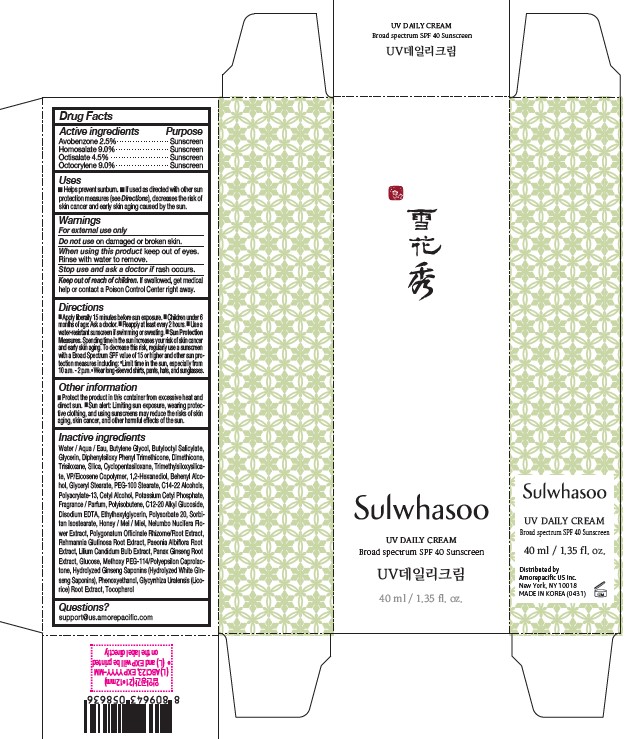
Sulwhasoo UV Daily Cream Avobenzone, Homosalate, Octisalate, Octocrylene 3.6 g/40mL; 1.8 g/40mL; 1 g/40mL; 3.6 g/40mL Cream
🆔 Identity & classification
Where does this data come from?
🏭 Manufacturer & labeler
Where does this data come from?
🩺 Clinical
This is a topical cream sunscreen marketed as an over-the-counter monograph product. It contains four UV-filtering ingredients: avobenzone, homosalate, octisalate, and octocrylene. These ingredients are commonly used together in sunscreen formulations to absorb and scatter ultraviolet radiation from the sun. The product is applied to the skin as a protective barrier against UV exposure.
Patient education
Supplement & herbal interactions
Where does this data come from?
Ask a licensed pharmacist directly — free, answered by our team.
🧪 Inactive Ingredients / Excipients
Inactive ingredients, also called excipients, are components of the drug product other than the active ingredient. They may include fillers, dyes, coatings, preservatives, flavors, or other formulation ingredients.
💡 Tap an ingredient (hover on desktop) to see what it is and why it’s used.
-
UNII TR046Y3K1G
A liquid alcohol derived from petroleum or plant sources. It acts as a solvent and humectant in medicines, helping dissolve active ingredients and retain moisture in the formulation.
-
UNII 5SL0G7R0OK
A simple sugar made from corn or other plants, used in medicines as a filler and sweetener. It helps create the right texture and taste in tablets, powders, and liquid formulations.
-
UNII CUQ3A77YXI
Panax ginseng root is a plant extract traditionally used in herbal preparations. In medications, it may serve as an active botanical ingredient or be included for flavoring and as a natural preservative or binder in formulations.
-
UNII 3XUS85K0RA
Butylene glycol is a clear liquid derived from petroleum or plants that acts as a humectant, solvent, and preservative booster in medicines. It helps keep formulations stable, dissolve active ingredients, and maintain moisture in topical products.
-
UNII 2EH13UN8D3
A synthetic compound used as a solvent and penetration enhancer in topical formulations. It helps dissolve active ingredients and allows them to penetrate the skin more effectively.
-
UNII K67N5Z1RUA
A plant-derived surfactant made from natural sugars and fatty alcohols. It helps dissolve and mix ingredients evenly throughout the medicine, acting as an emulsifier and solubilizer in liquid formulations.
-
UNII B1K89384RJ
A mixture of fatty alcohols derived from natural oils or fats, typically containing 14 to 22 carbon atoms. Used as an emollient, thickener, and emulsifier to improve texture and help blend oil and water components in formulations.
-
UNII 936JST6JCN
Cetyl alcohol is a waxy, fatty substance derived from plant or animal sources. It acts as an emulsifier and thickener in medicines, helping blend oil and water components and giving products a smooth, creamy texture.
-
UNII 0THT5PCI0R
A silicone-based liquid that helps distribute active ingredients evenly throughout topical products. It acts as a solvent and emollient, allowing medicines to spread smoothly on skin while improving texture and absorption.
-
UNII 92RU3N3Y1O
Dimethicone is a silicone-based oil that acts as an anti-foaming agent and lubricant in medicines. It reduces gas bubbles in liquid formulations and helps coat and protect the stomach lining when ingested.
-
UNII I445L28B12
A silicone-based compound that acts as a lubricant and glidant in tablet and capsule formulations. It reduces friction between particles and on equipment surfaces, helping medicines flow smoothly during manufacturing and tablet compression.
-
UNII 9G1OE216XY
Docosanol is a waxy, fatty alcohol derived from plant sources. It acts as an emollient and thickener in topical medicines, helping to soften the skin and improve product texture and stability.
-
UNII 7FLD91C86K
Edetate disodium is a chemical compound that binds and removes certain metal ions. In medicines, it acts as a preservative and stabilizer by preventing metals like calcium from interfering with the product's shelf life and consistency.
-
UNII 147D247K3P
Ethylhexylglycerin is a synthetic preservative used to prevent bacteria and mold from growing in medicines and personal care products. It helps keep the product safe and stable throughout its shelf life.
-
UNII PDC6A3C0OX
Glycerin is a clear, thick liquid derived from plant oils or fats. It acts as a humectant to retain moisture, a sweetener, and a solvent in medications.
-
UNII 230OU9XXE4
A waxy substance made from glycerin and stearic acid that acts as an emulsifier to blend oily and watery ingredients together. It also helps thicken and stabilize the medicine's texture.
-
UNII 42B5YD8F0K
A plant extract from licorice root used in traditional medicine. In formulations, it may serve as a flavoring agent, sweetener, or soothing ingredient to improve taste and texture.
-
UNII Y9H1V576FH
Honey is a natural sweetener made by bees from flower nectar. In medicines, it adds sweetness to improve taste and may help soothe throat irritation in lozenges or syrups.
-
UNII AHG15J8AM0
A plant extract from the white lily bulb used in traditional formulations. It may serve as a skin-conditioning agent or natural ingredient to support texture and consistency in topical or oral products.
-
UNII 61W322NLDV
A plant extract from sacred lotus flowers. Used as a natural colorant, fragrance, or skin-conditioning agent in topical formulations.
-
UNII 3Z3866YW6P
A plant extract from peony root used in traditional herbal formulations. It may function as a flavoring agent, natural colorant, or botanical ingredient to support the product's herbal composition.
-
UNII YD01N1999R
A waxy substance made from polyethylene glycol and stearic acid. It helps mix oil and water-based ingredients together and serves as an emulsifier and solubilizer in liquid and semi-solid medicines.
-
UNII HIE492ZZ3T
Phenoxyethanol is a synthetic preservative and antimicrobial agent used to prevent bacterial and fungal growth in medicines and cosmetic products, extending shelf life and maintaining product safety.
-
UNII KPF03O64AZ
A plant extract from Solomon's seal root. It may be used as a natural flavoring agent, fragrance component, or traditional ingredient in herbal formulations.
-
UNII YR8AQ94O31
A synthetic rubber polymer used as a binder and thickening agent in tablets and capsules. It helps hold ingredients together and may be used to control how quickly the medicine releases in your body.
-
UNII 7T1F30V5YH
A synthetic emulsifier derived from sorbitol and oleic acid. It helps mix oil and water-based ingredients together and keeps them from separating in liquid formulations.
-
UNII 03KCY6P7UT
A waxy compound derived from cetyl alcohol and phosphoric acid. It acts as an emulsifier to help blend oil and water ingredients, and as a thickener to give the medicine its proper texture and consistency.
-
UNII 1BEM3U6LQQ
A plant extract from rehmannia root, traditionally used in herbal medicine. In pharmaceutical products, it may serve as an active botanical ingredient or functional additive, though its specific role depends on the formulation type.
-
UNII ETJ7Z6XBU4
Silicon dioxide is a naturally occurring mineral used as a glidant and anti-caking agent. It helps powder ingredients flow smoothly and prevents clumping during manufacturing and storage.
-
UNII 01S2G2C1E4
Sorbitan isostearate is an emulsifier derived from sorbitol and isostearic acid. It helps mix oil and water-based ingredients together and keeps them blended throughout the medicine's shelf life.
-
UNII R0ZB2556P8
Tocopherol is a form of vitamin E derived from plant oils. It acts as an antioxidant in medicines to prevent oils and fats from breaking down and spoiling during storage.
-
UNII 25LXE464L2
A silicone-based polymer used as a glidant and anti-caking agent in solid dosage forms. It reduces friction between particles and prevents clumping, helping powders flow smoothly during manufacturing and tablet compression.
-
UNII 9G1ZW13R0G
A silicone-based polymer that reduces surface tension and improves how liquid medicines spread and are absorbed. It acts as a wetting agent and surfactant in topical formulations.
-
UNII 035MV9S1C3
A plastic-like polymer made from two chemical compounds joined together. It acts as a binder and film-former in tablets and capsules, helping hold ingredients together and create a protective coating on the medicine's surface.
-
UNII 059QF0KO0R
Water is a liquid solvent that dissolves and mixes ingredients together in liquid medicines, syrups, and injections. It helps distribute the active drug evenly throughout the product.
35 inactive ingredients listed in the exact product block matched to this NDC.
Label-section wording can be broader than the structured product block and may mention additional formulation ingredients.
Where does this data come from?
ingredient classCode="IACT" elements from the exact product block matched by this NDC. Label-section narrative from DailyMed / the openFDA label index is shown separately when available.Inactive ingredient FAQ
Are inactive ingredients the same for every manufacturer?
Why might an inactive ingredient be missing?
Can inactive ingredients matter?
💲 Pricing
A drug doesn't have one price. Each row is a different public payment system, and none is what you'd pay at the counter — that depends on your insurance. The ⓘ on each row explains what it measures.
| Price system | Per g | Per package |
|---|---|---|
| Retail pharmacies payNADAC · weekly | Not in the retail survey — common for institutional, discontinued, or low-volume packs. | |
| Medicaid paysCMS SDUD · 12 mo | No recent Medicaid claims on file for this NDC — rare and low-volume NDCs are suppressed in the public data. | |
| Medicare drug plans payPart D · quarterly | No Part D plan price is available for this NDC in our data. | |
Where does this data come from?
🔁 Therapeutic equivalents
| Product | Labeler | Pack | NADAC/unit | TE | Status | Price vs. this |
|---|---|---|---|---|---|---|
| Sulwhasoo UV Daily Cream 3.6 g/40mL; 1.8 g/40mL; 1 g/40mL; 3.6 g/40mLthis 43419-0085-19 | Amorepacific | 1 tube | — | — | FDA listed | — |
Where does this data come from?
⏳ Availability & generic status
We did not find an FDA-approved generic match for this exact strength, form and route.
Where does this data come from?
📦 Packaging — all sizes for this product
| Package NDC | Description | Marketing start | Status |
|---|---|---|---|
| 43419-0085-19 You're viewing this | 1 TUBE in 1 CARTON (43419-085-19) / 40 mL in 1 TUBE | 2022-05-31 | Active |
🧭 About this NDC listing & data coverage
What data is (and isn’t) available for this NDC — tap to expand
| NDC identity (package / product / labeler codes) | ✓ Available |
| Labeler | ✓ Available |
| Product & package description | ✓ Available |
| Marketing category & status | ✓ Available |
| Active ingredient / dosage form / route | ✓ Available |
| FDA label (SPL via DailyMed) | ✓ Available |
| Package photos | ✓ Available |
| Inactive ingredients (structured) | ✓ Available |
| NADAC pharmacy acquisition price (CMS) | — Not published for this NDC CMS publishes NADAC only for NDCs reported in its retail-pharmacy survey. |
| Orange Book / therapeutic-equivalence data | — Not published for this NDC Applies only to products approved under an NDA/ANDA; many listings are out of scope. |
| HCPCS J-code billing crosswalk | — Not published for this NDC Most self-administered / retail products have no J-code — that is normal. |
| Medicaid utilization (CMS SDUD) | — Not published for this NDC CMS reports utilization only for NDCs with Medicaid claims above its privacy threshold. |
Questions about this listing
Is this NDC FDA-approved?
Why is there no price listed?
Is the NDC printed on the package the same as the 11-digit billing NDC?
What do the three segments of this NDC mean?
Is this package still being marketed?
Who lists this product with the FDA?
Do I need a prescription for this product?
Where does this data come from?
📄 FDA label — Drug Facts FDA SPL
🎯 Indications and Usage ▾
Uses Helps prevent sunburn. If used as directed with other sun protection measures (see Directions ), decreases the risk of skin cancer and early skin aging caused by the sun.
⏱️ Dosage and Administration ▾
Direction Apply liberally 15 minutes before sun exposure. Children under 6 months of age: Ask a doctor. Reapply at least every 2 hours.
Use a water-resistant sunscreen if swimming or sweating. Sun Protection Measures. Spending time in the sun increases your risk of skin cancer and early skin aging.
To decrease this risk, regularly use a sunscreen with a Broad Spectrum SPF value of 15 or higher and other sun protection measures including: Limit time in the sun, especially from 10 a.m. - 2 p.m. Wear long-sleeved shirts, pants, hats, and sunglasses.
⚠️ Warnings ▾
Warnings For external use only Do not use on damanged or broken skin. When using this product keep out of eyes. Rinse with water to remove. Stop use and ask a doctor if rash occurs.
📦 Storage and Handling ▾
Other information Protect the product in this container from excessive heat and direct sun. Sun alert: Limiting sun exposure, wearing protective clothing, and using sunscreens may reduce the risks of skin aging, skin cancer, and other harmful effects of the sun.
🧪 Active Ingredient ▾
ACTIVE INGREDIENTS Avobenzone 2.5% Homosalate 9.0% Octisalate 4.5% Octocrylene 9.0%
🧪 Inactive Ingredients ▾
Inactive ingredients Water, Butylene Glycol, C12-15 Alkyl Benzoate, Cyclopentasiloxane, Phenyl Trimethicone, Cyclohexasiloxane, Glycyrrhiza Uralensis (Licorice) Root Extract, 1,2-hexanediol, Camellia Sinensis Leaf Extract, Glyceryl Stearate, Panax Ginseng Root Extract, PEG-100 Stearate, Methoxy PEG-114/polyepsilon Caprolactone, Cetearyl Alcohol, Cetyl Alcohol, Aluminum Stearate, Polyhydroxystearic Acid, PEG-40 Stearate, Alumina, Phenoxyethanol, Fragrance, Hydroxyethyl Acrylate/ sodium Acryloyldimethyl Taurate Copolymer, Polyacrylate-13, Polygonatum Officinale Rhizome/root Extract, Rehmannia Glutinosa Root Extract, Lilium Tigrinum Flower/leaf/stem Extract, Paeonia Albiflora Root Extract, Nelumbo Nucifera Seed Extract, Stearic Acid, Chrysanthemum Morifolium Flower Extract, Citrus Unshiu Peel Extract, Xanthan Gum, Polyisobutene, Coix Lacryma-jobi Ma-yuen Seed Extract, Adenophora Stricta Root Extract, Glycerin, Ophiopogon Japonicus Root Extract, Honey, Carbomer, Polymethyl Methacrylate, Machilus Thunbergii Bark Extract, Ethylhexylglycerin, Paeonia Suffruticosa Root Extract, Lycium Chinense Root Extract, Propanediol, Angelica Tenuissima Root Extract, Disodium EDTA, Polysorbate 20, Silica, Natto Gum, Dimethicone, Beta-glucan, Triethoxycaprylylsilane, Myristic Acid, Stearyl Behenate, Polyglyceryl-3 Methylglucose Distearate, Hydroxypropyl Bispalmitamide MEA, Inulin Lauryl Carbamate
🎯 Purpose ▾
PURPOSE Sunscreen