
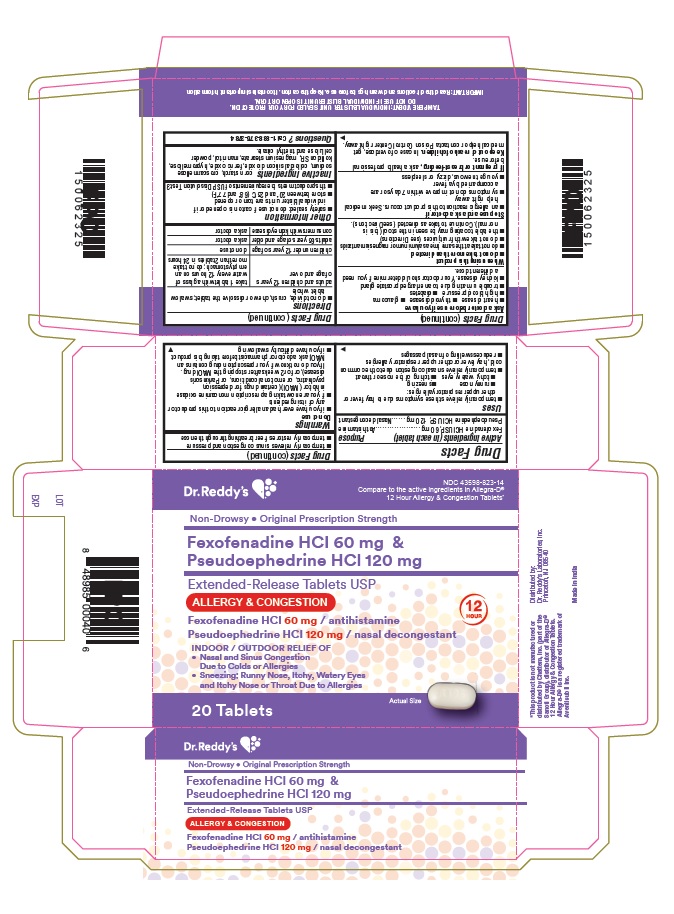
Fexofenadine HCl and Pseudoephedrine HCI 60 mg; 120 mg Tablet, Extended Release — NDC 43598-823-14 (Billing 43598-0823-14)
This is a package of Fexofenadine HCl and Pseudoephedrine HCI 60 mg; 120 mg Tablet, Extended Release from Dr. Reddy's Laboratories Inc., marketed since Oct 2022 and currently FDA-listed; retail pharmacies pay about $0.4832 per unit (NADAC). It is the main listing for this product, which comes in 4 package sizes.
Past resolved recalls for this product (2)
Identity & classification
Regulatory identifiers FDA, NLM and CMS codes for this package
Drug-database identifiers Medi-Span GPI and First Databank GCN / HICL / AHFS classification
- GSN (GCN sequence number): 036868
- GCN: 63565
- GPI-14 (Medi-Span): 43993002687420
- HICL (First Databank): 016846
- AHFS class code: 04:08.00.00
Where does this data come from?
- FDA openFDA NDC Directory · synced Oct 1, 2026
- FDA label on DailyMed · label index refreshed Oct 1, 2026
- RxNorm (NLM RxNav) · catalog refreshed Oct 1, 2026
- Medi-Span GPI (licensed)
- First Databank (licensed) · refreshed Oct 1, 2026
Clinical
The combination of fexofenadine and pseudoephedrine is used to treat allergy or cold symptoms: runny nose sneezing congestion (stuffy nose, sinus pressure) red, itchy, or watery eyes itching of the nose, throat, or roof of the mouth Fexofenadine is in a class of medications called antihistamines. It works by blocking the effects of histamine, a substance in the body that causes allergy symptoms. Pseudoephedrine is in a class of medications called decongestants. It works by causing narrowing of the blood vessels in the nasal passages to relieve congestion.
Read the full MedlinePlus article ↗- It actually tackles two things at once. The fexofenadine part is an antihistamine that helps with allergy symptoms like runny nose, sneezing, itchy and watery eyes, and itching of...
- What exactly does this medication do — does it just help with allergies?
- Yes, it really does matter. You should take this tablet on an empty stomach with a full glass of water. Also, use water specifically — do not take it with fruit juice. Taking it wi...
- Does it matter when I take it — like with food or on an empty stomach?
Patient education
Supplement & herbal interactions
Where does this data come from?
- MedlinePlus (NLM) · refreshed Oct 1, 2026
- FDA label on DailyMed · label index refreshed Oct 1, 2026
Ask a licensed pharmacist directly — free, answered by our team.
Pricing
A drug doesn't have one price. Each row is a different public payment system, and none is what you'd pay at the counter — that depends on your insurance. The ⓘ on each row explains what it measures.
| Price system | Per ea | Per package |
|---|---|---|
| Retail pharmacies payNADAC · weekly | $0.483 | $9.66 / 20 tablets |
| Medicaid paysCMS SDUD · 12 mo | $0.3760 | $7.52 / 20 tablets |
| Medicare drug plans payPart D · quarterly | No Part D plan price is available for this NDC in our data. | |
Where does this data come from?
- CMS NADAC weekly file · file of Sep 30, 2026
- CMS ASP pricing files · refreshed Sep 20, 2026
- CMS Medicaid State Drug Utilization Data · through Q4 2025
- CMS Part D plan pricing files · refreshed Sep 24, 2026
- VA National Acquisition Center price file
Packaging — all sizes for this product
| Package NDC | Description | Per unit | Per pack | Marketing start | Marketing end | Status |
|---|---|---|---|---|---|---|
| 43598-0823-14 You're viewing this Main listing | 4 BLISTER PACK in 1 CARTON / 5 TABLET, EXTENDED RELEASE in 1 BLISTER PACK | $0.4832 / ea | $9.66 | 2019-07-18 | — | Active |
| 43598-0823-31 43598-823-31 | 6 BLISTER PACK in 1 CARTON / 5 TABLET, EXTENDED RELEASE in 1 BLISTER PACK | $0.4832 / ea | $14.50 | 2019-07-18 | — | Active |
| 43598-0823-35 43598-823-35 | 2 BLISTER PACK in 1 CARTON / 5 TABLET, EXTENDED RELEASE in 1 BLISTER PACK | $0.4832 / ea | $4.83 | 2019-10-31 | — | Active |
| 43598-0823-40 43598-823-40 | 35 TABLET, EXTENDED RELEASE in 1 CARTON | — | — | — | — | Active |
This pack has the lowest per-ea cost of the 3 priced pack sizes ($0.4832 NADAC).
Pack size FAQ
What quantity is in this package?
What NDC number is used to bill for this package of Fexofenadine HCl and Pseudoephedrine HCI 60 mg; 120 mg Tablet, Extended Release?
Prices are the latest CMS NADAC pharmacy acquisition cost per NDC; per-pack figures are per-unit × pack quantity, shown only when the pack is denominated in the same measure NADAC prices.
Therapeutic equivalents
Where does this data come from?
- FDA openFDA NDC Directory · synced Oct 1, 2026
- FDA Orange Book · refreshed Sep 3, 2026
- CMS NADAC weekly file · file of Sep 30, 2026
Availability & generic status
FDA-approved generic versions are listed, and recent pricing/market data suggests they may be available — see Therapeutic equivalents.
Where does this data come from?
- FDA Orange Book · refreshed Sep 3, 2026
What it looks like
Where does this data come from?
- FDA label on DailyMed · label index refreshed Oct 1, 2026
Inactive Ingredients / Excipients
Inactive ingredients, also called excipients, are components of the drug product other than the active ingredient. They may include fillers, dyes, coatings, preservatives, flavors, or other formulation ingredients.
💡 Tap an ingredient (hover on desktop) to see what it is and why it’s used.
-
UNII M28OL1HH48
Croscarmellose sodium is a plant-based substance derived from cellulose. It acts as a disintegrant, helping tablets and capsules break down quickly in the digestive system so the medicine can be absorbed.
-
UNII 1K09F3G675
Ferric oxide red is an inorganic iron compound used as a colorant in medicines. It gives tablets, capsules, or other dosage forms a red or reddish tint for identification and appearance.
-
UNII 3NXW29V3WO
Hypromellose is a plant-based thickener made from cellulose. It's used in medicines as a binder to hold ingredients together, a coating for tablets, and a thickener for liquids.
-
UNII 70097M6I30
Magnesium stearate is a salt made from magnesium and stearic acid, a fatty substance. It's used in tablets and capsules as a lubricant and glidant to help ingredients flow smoothly during manufacturing and prevent sticking.
-
UNII 3OWL53L36A
A natural sugar alcohol derived from seaweed or synthesized in the lab. It's used as a filler to add bulk, a sweetener in sugar-free formulas, and a disintegrant to help tablets break apart in the stomach.
-
UNII SMD1X3XO9M
Powdered cellulose is a fine, plant-based powder made from purified wood fibers. In medicines, it acts as a filler to add bulk and volume, and helps tablets or capsules hold together during manufacturing and storage.
-
UNII ETJ7Z6XBU4
Silicon dioxide is a naturally occurring mineral used as a glidant and anti-caking agent. It helps powder ingredients flow smoothly and prevents clumping during manufacturing and storage.
-
UNII O8232NY3SJ
A plant-based carbohydrate derived from corn kernels. It acts as a filler to add bulk, a binder to hold ingredients together, and a disintegrant to help the tablet break apart in your stomach for absorption.
-
UNII 8Z96QXD6UM
Triethyl citrate is a clear liquid derived from citric acid. It acts as a plasticizer and solvent in tablet coatings and film formulations, helping the coating remain flexible and adhere properly to the medicine.
9 inactive ingredients listed in the exact product block matched to this NDC.
Label-section wording can be broader than the structured product block and may mention additional formulation ingredients.
Where does this data come from?
ingredient classCode="IACT" elements from the exact product block matched by this NDC. Label-section narrative from DailyMed / the openFDA label index is shown separately when available.- FDA label on DailyMed · label index refreshed Oct 1, 2026
- FDA openFDA NDC Directory · synced Oct 1, 2026
Inactive ingredient FAQ
Are inactive ingredients the same for every manufacturer?
Why might an inactive ingredient be missing?
Can inactive ingredients matter?
Manufacturer & labeler
Where does this data come from?
- FDA openFDA NDC Directory · synced Oct 1, 2026
- Drugs@FDA
Full FDA label FDA SPL
🎯 Indications and Usage ▾
Use(s) temporarily relieves these symptoms due to hay fever or other upper respiratory allergies: runny nose sneezing itchy, watery eyes itching of the nose or throat temporarily relives nasal congestion due to the common cold, hay fever or other upper respiratory allergies reduces swelling of nasal passages temporarily relieves sinus congestion and pressure temporarily restores freer breathing through the nose
⏱️ Dosage and Administration ▾
Directions do not divide, crush, chew or dissolve the tablet; swallow tablet whole adults and children 12 years of age and over take 1 tablet with a glass of water every 12 hours on an empty stomach; do not take more than 2 tablets in 24 hours children under 12 years of age do not use adults 65 years of age and older ask a doctor consumers with kidney disease ask a doctor
⚠️ Warnings ▾
Warnings Do not use if you have ever had an allergic reaction to this product or any of its ingredients if you are now taking a prescription monoamine oxidase inhibitor (MAOI) (certain drugs for depression, psychiatric, or emotional conditions, or Parkinson’s disease), or for 2 weeks after stopping the MAOI drug. If you do not know if your prescription drug contains an MAOI, ask a doctor or pharmacist before taking this product. if you have difficulty swallowing Ask a doctor before use if you have heart disease thyroid disease glaucoma high blood pressure diabetes trouble urinating due to an enlarged prostate gland kidney disease.
Your doctor should determine if you need a different dose. When using this product do not take more than directed do not take at the same time as aluminum or magnesium antacids do not take with fruit juices (see Directions) the tablet coating may be seen in the stool (this is normal). Continue to take as directed (see Directions).
Stop use and ask doctor if an allergic reaction to this product occurs. Seek medical help right away. symptoms do not improve within 7 days or are accompanied by a fever you get nervous, dizzy, or sleepless If pregnant or breast-feeding ask a health professional before use. Keep out of reach of children In case of overdose, get medical help or contact a Poison Control Center right away.
🧪 Active Ingredient ▾
Active ingredient(s) Fexofenadine HCl USP, 60 mg Pseudoephedrine HCl USP,120 mg
🧪 Inactive Ingredients ▾
Inactive ingredients corn starch, croscarmellose sodium, colloidal silicon dioxide, ferric oxide, hypromellose, kollidon SR, magnesium stearate, mannitol, powder cellulose and triethyl citrate.
🎯 Purpose ▾
Purpose Antihistamine Nasal decongestant
📄 Do Not Use ▾
Do not use if you have ever had an allergic reaction to this product or any of its ingredients if you are now taking a prescription monoamine oxidase inhibitor (MAOI) (certain drugs for depression, psychiatric, or emotional conditions, or Parkinson’s disease), or for 2 weeks after stopping the MAOI drug. If you do not know if your prescription drug contains an MAOI, ask a doctor or pharmacist before taking this product. if you have difficulty swallowing
📄 Ask a Doctor Before Use If ▾
Ask a doctor before use if you have heart disease thyroid disease glaucoma high blood pressure diabetes trouble urinating due to an enlarged prostate gland kidney disease. Your doctor should determine if you need a different dose.
📄 When Using This Product ▾
When using this product do not take more than directed do not take at the same time as aluminum or magnesium antacids do not take with fruit juices (see Directions) the tablet coating may be seen in the stool (this is normal). Continue to take as directed (see Directions).
📄 Stop Use and Ask a Doctor If ▾
Stop use and ask doctor if an allergic reaction to this product occurs. Seek medical help right away. symptoms do not improve within 7 days or are accompanied by a fever you get nervous, dizzy, or sleepless
🤰 If Pregnant or Breast-Feeding ▾
If pregnant or breast-feeding ask a health professional before use.
📄 Keep Out of Reach of Children ▾
Keep out of reach of children In case of overdose, get medical help or contact a Poison Control Center right away.
📄 Questions or Comments ▾
Questions? Call 1-888-375-3784 Distributed by: Dr. Reddy’s Laboratories, Inc. Princeton, NJ 08540 Made in India
📄 Package Label / Principal Display Panel ▾
Principal Display Panel Blister carton
Medicaid utilization & spend
Medicaid utilization by pack size
About this NDC listing & data coverage
What "drug for further processing" means
FDA lists this package under the "drug for further processing" marketing category: Dr. Reddy's Laboratories Inc. supplies it to other companies for further processing or repackaging (blister cards that are later repackaged or co-packaged are a common example). The units themselves are a finished dosage form — which is why pricing or Medicaid data can still appear — but this exact package code may not be the presentation a retail pharmacy dispenses.
What data is (and isn’t) available for this NDC — tap to expand
| NDC identity (package / product / labeler codes) | ✓ Available |
| Labeler | ✓ Available |
| Product & package description | ✓ Available |
| Marketing category & status | ✓ Available |
| Active ingredient / dosage form / route | ✓ Available |
| FDA label (SPL via DailyMed) | ✓ Available |
| Package photos | ✓ Available |
| Inactive ingredients (structured) | ✓ Available |
| NADAC pharmacy acquisition price (CMS) | ✓ Available |
| Orange Book / therapeutic-equivalence data | — Not published for this NDC Applies only to products approved under an NDA/ANDA; many listings are out of scope. |
| HCPCS J-code billing crosswalk | — Not published for this NDC Most self-administered / retail products have no J-code — that is normal. |
| Medicaid utilization (CMS SDUD) | ✓ Available |