
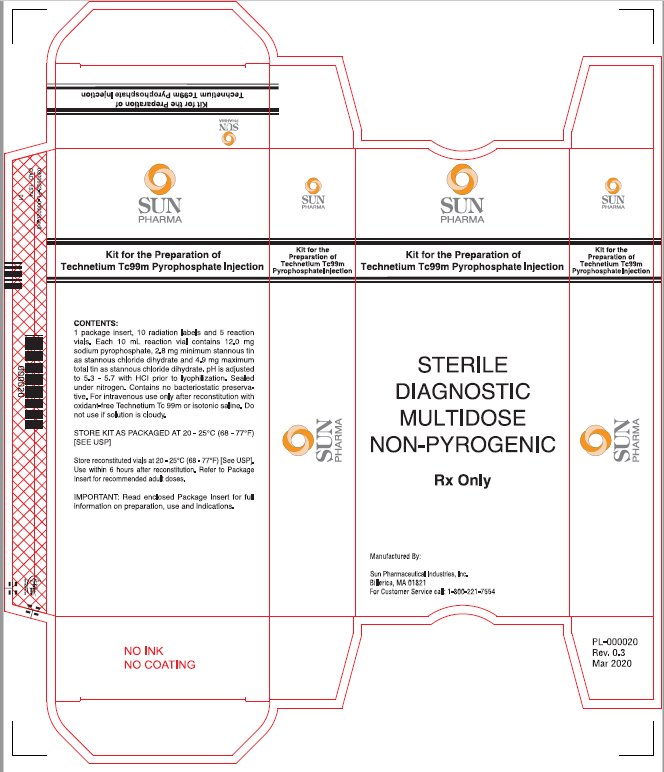
Kit for the Preparation of Technetium Tc99m Pyrophosphate 12 mg/10mL Injection — NDC 45567-0060-1 (Billing 45567-0060-01)
This is a package of Kit for the Preparation of Technetium Tc99m Pyrophosphate 12 mg/10mL Injection from Sun Pharmaceutical Industries, Inc., marketed since Jun 1987 and currently FDA-listed. It is the main listing for this product, which comes in 2 package sizes.
Identity & classification
Regulatory identifiers FDA, NLM and CMS codes for this package
Drug-database identifiers Medi-Span GPI and First Databank GCN / HICL / AHFS classification
- GSN (GCN sequence number): 066246
- GCN: 28479
- GPI-14 (Medi-Span): 94359070406400
- HICL (First Databank): 036423
- AHFS class code: 36:18.00.00
Where does this data come from?
- FDA openFDA NDC Directory · synced Oct 1, 2026
- FDA label on DailyMed · label index refreshed Oct 1, 2026
- RxNorm (NLM RxNav) · catalog refreshed Oct 1, 2026
- Medi-Span GPI (licensed)
- First Databank (licensed) · refreshed Oct 1, 2026
Clinical
Patient education
Supplement & herbal interactions
Where does this data come from?
- MedlinePlus (NLM) · refreshed Oct 1, 2026
- FDA label on DailyMed · label index refreshed Oct 1, 2026
Ask a licensed pharmacist directly — free, answered by our team.
Pricing
A drug doesn't have one price. Each row is a different public payment system, and none is what you'd pay at the counter — that depends on your insurance. The ⓘ on each row explains what it measures.
| Price system | Per each | Per package |
|---|---|---|
| Retail pharmacies payNADAC · weekly | Not in the retail survey — common for institutional, discontinued, or low-volume packs. | |
| Medicaid paysCMS SDUD · 12 mo | No recent Medicaid claims on file for this NDC — rare and low-volume NDCs are suppressed in the public data. | |
| Medicare drug plans payPart D · quarterly | No Part D plan price is available for this NDC in our data. | |
Where does this data come from?
- CMS NADAC weekly file
- CMS ASP pricing files · refreshed Sep 20, 2026
- CMS Medicaid State Drug Utilization Data · refreshed Oct 3, 2026
- CMS Part D plan pricing files · refreshed Sep 24, 2026
- VA National Acquisition Center price file
Packaging — all sizes for this product
| Package NDC | Description | Marketing start | Marketing end | Status |
|---|---|---|---|---|
| 45567-0060-01 You're viewing this Main listing | 5 VIAL, MULTI-DOSE in 1 KIT / 10 mL in 1 VIAL, MULTI-DOSE | 1987-06-30 | — | Active |
| 45567-0060-02 45567-0060-2 | 30 VIAL, MULTI-DOSE in 1 KIT / 10 mL in 1 VIAL, MULTI-DOSE | 1987-06-30 | — | Active |
Pack size FAQ
What quantity is in this package?
What NDC number is used to bill for this package of Kit for the Preparation of Technetium Tc99m Pyrophosphate 12 mg/10mL Injection?
Therapeutic equivalents
| Product | Labeler | Pack | NADAC/unit | TE | Status | Price vs. this |
|---|---|---|---|---|---|---|
| Kit for the Preparation of Technetium Tc99m Pyrophosphate 12 mg/10mLthis 45567-0060-01 | Sun | 5 vials | — | AP | FDA listed | — |
Where does this data come from?
- FDA openFDA NDC Directory · synced Oct 1, 2026
- FDA Orange Book · refreshed Oct 3, 2026
- CMS NADAC weekly file
Availability & generic status
We did not find an FDA-approved generic match for this exact strength, form and route.
Where does this data come from?
- FDA Orange Book · refreshed Oct 3, 2026
Inactive Ingredients / Excipients
Inactive ingredients, also called excipients, are components of the drug product other than the active ingredient. They may include fillers, dyes, coatings, preservatives, flavors, or other formulation ingredients.
💡 Tap an ingredient (hover on desktop) to see what it is and why it’s used.
-
2.8 mg / 10 mL
UNII 1BQV3749L5
Stannous chloride is a tin-based chemical compound used as a reducing agent and antioxidant in pharmaceuticals. It helps prevent oxidation of active ingredients and stabilizes certain formulations, particularly in products requiring preservation of potency.
1 inactive ingredient listed in the exact product block matched to this NDC.
Where does this data come from?
ingredient classCode="IACT" elements from the exact product block matched by this NDC. Label-section narrative from DailyMed / the openFDA label index is shown separately when available.- FDA label on DailyMed · label index refreshed Oct 1, 2026
- FDA openFDA NDC Directory · synced Oct 1, 2026
Inactive ingredient FAQ
Are inactive ingredients the same for every manufacturer?
Why might an inactive ingredient be missing?
Can inactive ingredients matter?
Manufacturer & labeler
Where does this data come from?
- FDA openFDA NDC Directory · synced Oct 1, 2026
- Drugs@FDA
Full prescribing information FDA SPL
🎯 Indications and Usage ▾
INDICATIONS AND USAGE Technetium Tc 99m Pyrophosphate Injection is a bone imaging agent used to demonstrate areas of altered osteogenesis, and a cardiac imaging agent used as an adjunct in the diagnosis of acute myocardial infarction. Kit for the Preparation of Technetium Tc 99m Pyrophosphate Injection is a blood pool imaging agent which may be used for gated blood pool imaging and for the detection of sites of gastrointestinal bleeding. When reconstituted with sterile non-pyrogenic isotonic saline and administered intravenously 30 minutes prior to the intravenous administration of Sodium Pertechnetate Tc 99m Injection, approximately 76% of the injected radioactivity remains in the blood pool.
⏱️ Dosage and Administration ▾
DOSAGE AND ADMINISTRATION After preparation with oxidant-free Sodium Pertechnetate Tc 99m Injection, the suggested dose range of Technetium Tc 99m Pyrophosphate Injection in the average ADULT patient (70 kg) is: Bone Imaging - 185-555 megabecquerels (5-15 mCi) Cardiac Imaging - 370-555 megabecquerels (10-15 mCi) The suggested dose range of the non-radioactive reconstituted Kit for the Preparation of Technetium Tc 99m Pyrophosphate Injection in the average ADULT patient (70 kg) is: Blood Imaging - Administer not less than one-third nor more than the total contents of one vial [555 - 740 megabecquerels (15-20mCi) of Pertechnetate Tc 99m Injection].
Bone and Cardiac Imaging Technetium Tc 99m Pyrophosphate Injection is injected intravenously over a 10 to 20 second period. For optimal results, bone imaging should be done 1 to 6 hours following administration. Cardiac imaging should be done 30 to 90 minutes following administration.
The acute myocardial infarct can be visualized from 24 hours to 6 days following onset of symptoms, with maximum localization at 48 to 72 hours. Cardiac imaging should be done with a gamma scintillation camera. It is recommended that images be made of the anterior, left anterior oblique and left lateral projections.
Blood Pool Imaging Kit for the Preparation of Technetium Tc 99m Pyrophosphate Injection may be reconstituted with sterile, non-pyrogenic isotonic saline containing no preservatives. Administer not less than one-third nor more than the total contents of one vial 30 minutes prior to the intravenous administration of 555 to 740 megabecquerels (15-20 mCi) Sodium Pertechnetate Tc 99m Injection. The non-radioactive reconstituted Kit for the Preparation of Technetium Tc 99m Pyrophosphate Injection should be injected by direct venipuncture.
Heparinized catheter systems should be avoided. Cardiac imaging should be done 10 to 30 minutes following the administration of Sodium Pertechnetate Tc 99m Injection utilizing a scintillation camera interfaced to an electrocardiographic gating device. Parenteral drug products should be inspected visually for particulate matter and discoloration prior to administration whenever solution and container permit.
The patient dose should be measured by a suitable radioactivity calibration system immediately prior to administration. Radiation Dosimetry Bone and Cardiac Imaging The effective half-life was assumed to be the physical half-life for all calculated values. The estimated radiation absorbed doses to an average ADULT patient (70 kg) from an intravenous injection of a maximum of 555 megabecquerels (15 mCi) of Technetium Tc 99m Pyrophosphate Injection are shown in Table 4.
TABLE 4: Estimated Absorbed Radiation Doses Bone and Cardiac Imaging* Technetium Tc 99m Pyrophosphate Injection Target Organ mGy/555 MBq rads/15 mCi Total Body 1.8
0.18Kidneys 3.6
0.36Red Marrow 3.5
0.35Bone Surfaces 21.1
2.11Bladder Wall 13.3
1.33Testes 1.4
0.14Ovaries 2.1
0.21Effective Dose Equivalent 3.3 mSv 0.33 rem *Based on the model in MIRD Dose Estimate Report No. 13 (J Nucl Med 30:1117-1122, 1989). Estimate calculated using phantoms of Cristy & Eckerman (Report ORNL/TM-8381/V1 & V7).
Bone and marrow model of Eckerman (Aspects of dosimetry of radionuclides within the skeleton with particular emphasis on the active marrow. In Fourth International Radiopharmaceutical Dosimetry Symposium; A.T. Schlafke-Stelson and E.E.
Watson eds. CONF-851113, Oak Ridge Associated Universities, Oak Ridge, TN 37831, 1986. pp 514-534.) used. The effective dose equivalent is a quantity which may be suitable for comparing risks of different procedures in nuclear medicine, radiology, and other applications involving ionizing radiation, but should not be construed to give information about risks to individual patients and should not be applied to situations involving radiation therapy.
Blood Pool Imaging The estimated absorbed radiation doses to an average adult patient (70 kg) from an intravenous injection… [Excerpted — this section continues on DailyMed.]
⛔ Contraindications ▾
CONTRAINDICATIONS None known.
⚠️ Warnings ▾
WARNINGS As an adjunct in the diagnosis of confirmed myocardial infarction (ECG and serum enzymes positive), the incidence of false negative images has been found to be 6 percent. False negative images can also occur if made prior to 24 hours in the evolutionary phase of the infarct or after 6 days in the resolution phase. In a limited study involving 22 patients in whom the ECG was positive and serum enzymes questionable or negative, but in whom the final diagnosis of acute myocardial infarction was made, the incidence of false negative images was 23 percent.
The incidence of false positive images has been found to be 7 to 9 percent. False positive images have also been reported following coronary by-pass graft surgery, in unstable angina pectoris, old myocardial infarcts and in cardiac contusions. Preliminary reports indicate impairment of brain scans using Sodium Pertechnetate Tc99m Injection which have been preceded by a bone scan using an agent containing stannous ions.
The impairment may result in false positive or false negative brain scans. It is recommended, where feasible, that brain scans precede bone imaging procedures. Alternately, a brain imaging agent such as Technetium Tc 99m Pentetate Injection may be employed.
The biodistribution of technetium Tc 99m pyrophosphate may be altered in the presence of high levels of certain cations (iron, calcium, and aluminum). This may result in reduced uptake of radionuclide in the skeleton and increased extraosseal uptake, which may potentially degrade imaging quality. High levels of these cations may be caused by concomitant medications or medical conditions (e.g., iron overload, hypercalcemia, etc.).
Most cases were observed after iron infusion. (See PRECAUTIONS, Drug Interactions .)
🤒 Adverse Reactions ▾
ADVERSE REACTIONS Some hypersensitivity reactions have been associated with pyrophosphate use.
🧒 Pediatric Use ▾
Pediatric use Safety and effectiveness in pediatric patients have not been established.
🧓 Geriatric Use ▾
Geriatric use Clinical studies of the Kit for the Preparation of Technetium Tc 99m Pyrophosphate Injection did not include sufficient numbers of subjects aged 65 and over to determine whether they respond differently from younger subjects. Other reported clinical experience has not identified differences in responses between the elderly and younger patients. In general, dose selection for an elderly patient should be cautious, usually starting at the low end of the dosing range, reflecting the greater frequency of decreased hepatic, renal, or cardiac function, and of concomitant disease or other drug therapy.
This drug is known to be substantially excreted by the kidney, and the risk of toxic reactions to this drug may be greater in patients with impaired renal function. Because elderly patients are more likely to have decreased renal function, care should be taken in dose selection, and it may be useful to monitor renal function.
🧬 Clinical Pharmacology ▾
CLINICAL PHARMACOLOGY When injected intravenously, Technetium Tc 99m Pyrophosphate Injection has a specific affinity for areas of osteogenesis. It is also concentrated in the injured myocardium, primarily in areas of irreversibly damaged myocardial cells. One to two hours after intravenous injection of Technetium Tc 99m Pyrophosphate Injection, an estimated 40 to 50 percent of the injected dose has been taken up by the skeleton, and approximately 0.01 to 0.02 percent per gram of acutely infarcted myocardium.
Within a period of one hour, 10 to 11 percent remains in the vascular system, declining to approximately 2 to 3 percent twenty-four hours post injection. The average urinary excretion was observed to be about 40 percent of the administered dose after 24 hours. The non-radioactive reconstituted Kit for the Preparation of Technetium Tc 99m Pyrophosphate Injection also has an affinity for red blood cells.
When administered 30 minutes prior to the intravenous administration of Sodium Pertechnetate Tc 99m Injection, approximately 76 percent of the injected activity remains in the blood pool providing excellent images of the cardiac chambers.
📦 How Supplied / Storage and Handling ▾
HOW SUPPLIED The Kit for the Preparation of Technetium Tc 99m Pyrophosphate Injection is supplied in packages of 5 or 30 sterile, non-pyrogenic, white capped 10mL vials. Each multidose vial contains 12.0 mg sodium pyrophosphate, 2.8 mg minimum stannous tin as stannous chloride dihydrate and 4.9 mg maximum total tin as stannous chloride dihydrate; pH is adjusted with hydrochloric acid to 5.3-5.7 prior to lyophilization. No bacteriostatic preservative is present.
Sealed under nitrogen. Included in each 5-vial package are one package insert and 10 radiation labels. Included in each 30-vial package are one package insert and 60 radiation labels.
Store the kit as packaged at 20-25°C (68-77°F) [See USP]. Store the reconstituted vials at 20-25°C (68-77°) [See USP]. Directions for use Bone and Cardiac Imaging Technetium Tc 99m Pyrophosphate Injection is prepared from Kit for the Preparation of Technetium Tc 99m Pyrophosphate Injection by the following aseptic procedure: Waterproof gloves should be worn during the preparation procedure.
Remove the white flip-off cap from the vial and swab the top of the vial closure with alcohol to sterilize the surface. Complete the radiation label and affix to the vial. Place the vial in an appropriate radiation shield suitably labeled and identified.
With a sterile shielded syringe, aseptically obtain 1-10 milliliters of a suitable, oxidant free, sterile and non-pyrogenic Sodium Pertechnetate Tc 99m Injection containing no more than 3.7 gigabecquerels (100 mCi). Aseptically add the Sodium Pertechnetate Tc 99m Injection to the vial. Swirl the contents of the vial for one minute and let stand for at least 10 minutes.
Record date and time of preparation. It is recommended that the radiochemical purity of the prepared radiopharmaceutical be checked prior to patient administration. Examine vial contents for particulates and discoloration prior to injection.
Withdrawals for administration must be made aseptically using a sterile shielded syringe and needle. Since the vials contain nitrogen to prevent oxidation of the complex, the vials should not be vented. If repeated withdrawals are made from a vial, the replacement of contents with air should be minimized.
Aseptically withdraw material with a sterile lead shielded syringe for use within six (6) hours of preparation. For optimal results, this time should be minimized. The vial contains no bacteriostatic preservative.
Store the reconstituted vial at 20-25°C (68-77°F) [See USP]. Discard the vial six (6) hours after reconstitution. The patient dose should be measured by suitable radioactivity calibration system immediately prior to administration.
Blood Pool Imaging The non-radioactive Kit for the Preparation of Technetium Tc 99m Pyrophosphate Injection is prepared by adhering to the following aseptic procedure: Remove the white flip-off cap from the vial and swab the top of the vial closure with alcohol to sterilize the surface. Reconstitute the reaction vial with 3 milliliters of sterile, non-pyrogenic, isotonic saline containing no preservatives. Swirl the contents of the vial for one minute and let stand for at least 10 minutes.
Record date and time of preparation. Examine vial contents for particulates and discoloration prior to injection. Withdrawals for administration must be made aseptically using a sterile syringe and needle.
Since the vials contain nitrogen to prevent oxidation of the complex, the vials should not be vented. If repeated withdrawals are made from a vial, the replacement of contents with air should be minimized. Aseptically withdraw the reconstituted non-radioactive Kit for the Preparation of Technetium Tc 99m Pyrophosphate Injection with a sterile syringe for use within six (6) hours of preparation.
For optimal results, this time should be minimized. The vial contains no bacteriostatic preservative. Store the reconstituted vial at 20-25°C (68-77°F) [See USP].
Discard the vial six (6) hours after reconstitution. Between one-third a… [Excerpted — this section continues on DailyMed.]
📋 Description ▾
DESCRIPTION Kit for the Preparation of Technetium Tc 99m Pyrophosphate Injection is a multidose reaction vial which contains the sterile, non-pyrogenic, non-radioactive ingredients necessary to produce Technetium Tc 99m Pyrophosphate Injection for diagnostic use by intravenous injection. Each 10 mL vial contains 12.0 mg of sodium pyrophosphate, 2.8 mg minimum stannous tin as stannous chloride dihydrate and 4.9 mg maximum total tin as stannous chloride dihydrate; pH is adjusted to 5.3-5.7 with hydrochloric acid prior to lyophilization.
No bacteriostatic preservative is present. Sealed under nitrogen. The chemical names are: (1) Diphosphoric acid, Ditin (2 + ) salt; (2) Ditin (2 + ) pyrophosphate (4 - ).
The structural formula is: When a solution of sterile, non-pyrogenic, oxidant-free isotonic Sodium Pertechnetate Tc 99m Injection U.S.P. is added to the vial, Technetium Tc 99m Pyrophosphate Injection is formed for intravenous injection. When a solution of sterile, non-pyrogenic, isotonic saline is added to the vial, it forms a blood pool imaging agent when Sodium Pertechnetate Tc 99m Injection is injected intravenously 30 minutes after the intravenous administration of the non-radioactive reconstituted Kit for the Preparation of Technetium Tc 99m Pyrophosphate Injection.
The precise structure of Technetium Tc 99m Pyrophosphate Injection is not known at this time. Structural Formula Physical Characteristics Technetium Tc 99m decays by isomeric transition with a physical half-life of 6.02 hours.¹ The principal photon that is useful for detection and imaging studies is listed in Table 1. TABLE 1: Principal Radiation Emission Data Radiation Mean Percent Per Disintegration Mean Energy (keV) Gamma-2 89.07 140.5 ¹Kocher DC: Radioactive decay data tables.
DOE/TIC-11026: 108, 1981 External Radiation The specific gamma ray constant for Tc 99m is
0.78R/hr-millicurie at 1 cm. The first half-value layer is 0.017 cm of lead (Pb). A range of values for the relative attenuation of the radiation emitted by this radionuclide that results from interposition of various thicknesses of Pb is shown in Table 2.
For example, the use of a 0.25 cm thickness of Pb will attenuate the radiation emitted by a factor of about 1,000. TABLE 2: Radiation Attenuation by Lead Shielding Shield Thickness (Pb) cm Coefficient of Attenuation 0.017 0.5 0.08 10 -1 0.16 10 -2 0.25 10 -3 0.33 10 -4 To correct for physical decay of this radionuclide, the fractions that remain at selected intervals after the time of calibration are shown in Table 3. TABLE 3: Physical Decay Chart: Tc 99m, half-life 6.02 hours Hours Fraction Remaining Hours Fraction Remaining 0* 1.000 7 0.447 1 0.891 8 0.398 2 0.794 9 0.355 3 0.708 10 0.316 4 0.631 11 0.282 5 0.562 12 0.251 6 0.501 * Calibration time
⚠️ Precautions ▾
PRECAUTIONS General The lyophilized contents of the Kit for the Preparation of Technetium Tc 99m Pyrophosphate Injection reaction vial are to be administered to the patient only as an intravenous solution (see Procedures for Reconstitution). Any Sodium Pertechnetate Tc 99m solution which contains an oxidizing agent is not suitable for use with Kit for the Preparation of Technetium Tc 99m Pyrophosphate Injection. When reconstituted with Sodium Pertechnetate Tc 99m, Technetium Tc 99m Pyrophosphate Injection must be used within 6 hours.
Kit for the Preparation of Technetium Tc 99m Pyrophosphate Injection may also be reconstituted with sterile, non-pyrogenic isotonic saline containing no preservatives and injected intravenously prior to the administration of Sodium Pertechnetate Tc 99m Injection. Kit for the Preparation of Technetium Tc 99m Pyrophosphate Injection contains no preservatives. Vials are sealed under nitrogen: air or oxygen is harmful to the contents of the vials and the vials should not be vented.
The components of the Kit for the Preparation of Technetium Tc 99m Pyrophosphate Injection are supplied sterile and non-pyrogenic. Aseptic procedures normally employed in making additions and withdrawals for sterile, non-pyrogenic containers should be used during addition of the Sodium Pertechnetate Tc 99m Injection and the withdrawal of doses for patient administration. Shielding should be utilized when preparing Technetium Tc 99m Pyrophosphate Injection.
Technetium Tc 99m Pyrophosphate Injection as well as other radioactive drugs must be handled with care, and appropriate safety measures should be used to minimize radiation exposure to the patients and clinical personnel consistent with proper patient management. The solution should not be used if cloudy, discolored, or found to contain particulate matter. Radiopharmaceuticals should be used only by physicians who are qualified by training and experience in the safe use and handling of radionuclides, and whose experience and training have been approved by the appropriate government agency authorized to license the use of radionuclides.
No special handling is required for the non-radioactive drug product. Bone Imaging Both prior to and following Technetium Tc 99m Pyrophosphate Injection administration, if not contraindicated for the patient’s cardiac condition, patients should be encouraged to drink fluids. Patients should void as often as possible after the Technetium Tc 99m Pyrophosphate Injection to minimize background interference and unnecessary radiation exposure from accumulation in the bladder.
Cardiac Imaging Patient’s cardiac condition should be stable before beginning the cardiac imaging procedure. Interference from chest wall lesions such as breast tumors and healing rib fractures can be minimized by employing the three recommended projections. (See DOSAGE AND ADMINISTRATION ).
False-positive and false-negative myocardial scans may occur; therefore, the diagnosis of acute myocardial infarction depends on the overall assessment of laboratory and clinical findings. Blood Pool Imaging The non-radioactive reconstituted agent should be injected by direct venipuncture. Heparinized catheter systems should be avoided, as interference with red blood cell tagging will result.
Cardiac pool imaging should be initiated 15 to 30 minutes after the administration of Sodium Pertechnetate Tc 99m Injection. The imaging of gastrointestinal bleeding is dependent on such factors as the region of imaging, rate and volume of the bleed, efficacy of the labeling of the red blood cells and timeliness of imaging. Due to these factors, images should be taken sequentially over a period of time until a positive image is obtained or clinical conditions warrant the discontinuance of the procedure.
The period of time for collecting the images may range up to 36 hours. Technetium Tc 99m Pyrophosphate Injection and the non-radioactive reconstituted Kit for the Preparation of Technetium Tc 99m Pyr… [Excerpted — this section continues on DailyMed.]
🍼 Nursing Mothers ▾
Nursing mothers Technetium Tc 99m Pyrophosphate Injection is excreted in human milk during lactation, therefore, formula feeding should be substituted for breast feeding.
📄 Carcinogenesis, Mutagenesis, Impairment of Fertility ▾
Carcinogenesis, Mutagenesis, Impairment of Fertility No long-term animal studies have been performed to evaluate carcinogenic potential or whether Technetium Tc 99m Pyrophosphate Injection affects fertility in males or females. Mutagenesis studies have not been conducted.
📄 Package Label / Principal Display Panel ▾
PACKAGE/LABEL PRINCIPAL DISPLAY PANEL- VIAL CONTAINER STERILE NON-PYROGENIC DIAGNOSTIC MULTIDOSE KIT FOR THE PREPARTION OF TECHNETIUM Tc 99m PYROPHOSPHATE INJECTION Each 10mL reaction vial contains in 12.0 mg sodium pyrophosphate, 2.8 mg minimum stannous tin as stannous chloride dihydrate and 4.9 mg maximum total tin as stannous chloride dehydrate; pH is adjusted to 5.3-5.7 with HCI prior to lyophilization. Sealed under nitrogen. Refer to Package Insert for directions for use and the recommended adult doses.
Manufactured by: Sun Pharmaceutical Industries, Inc. Billerica, MA 01821 PL-000018 Rev
0.2Mar 2020 CONTAINS NO BACTERIOSTATIC PRESERVATIVE. FOR INTRAVENOUS USE ONLY AFTER RECONSTITION WITH LABELING OXIDANT-FREE TECHENTIUM Tc 99m or ISOTONIC SALINE. . Store at 20-25°C (68-77°F) [See USP] after reconstitution and use within 6 hours. Rx Only Vial Label
Package/Label Display Panel-5 VIAL BOX Kit for the Preparation of Technetium Tc99m Pyrophosphate Injection Manufactured By: Sun Pharmaceutical Industries, Inc. Billerica, MA 01821 For Customer Service call: 1-800-221-7554 CONTENTS: 1 package insert, 10 radiation labels and 5 reaction vials. Each 10 mL reaction vial contains 12.0 mg sodium pyrophosphate, 2.8 mg minimum stannous tin as stannous chloride dehydrate and 4.9 mg maximum total tin as stannous chloride deihydrate. pH is adjusted to 5.3 – 5.7 with HCI prior to lyophilization.
Sealed under nitrogen. Contains no bacteriostatic preservative. For intravenous use only after reconstitution with oxidant-free Technetium Tc 99m or isotonic saline.
Do not use if solution is cloudy. STORE KIT AS PACKAGED AT 20-25°C (68-77°F) [SEE USP] Store reconstituted vials at 20-25°C (68-77°F) [See USP]. Use within 6 hours after reconstitution.
Refer to Package Insert for recommended adult doses. IMPORTANT: Read enclosed Package Insert for full information on preparation, use and indications. Manufactured By: Sun Pharmaceutical Industries, Inc.
Billerica, MA 01821 For Customer Service call: 1-800-221-7554 PL-000020 Rev
0.3 Mar 2020 5 Vial Carton
Package/Label Display Panel- Radiation Label CAUTION RADIOACTIVE MATERIAL STERILE, NON-PYROGENIC, DIAGNOSTIC, MULTIDOSE TECHNETIUM Tc 99m PYROPHOSPHATE INJECTION FOR INTRAVENOUS USE Total MBq (mCi)_____Volume_____ Assay_____MBq/mL(mCi/mL) as of _____ Each 10mL reaction vial contains 12.0 mg sodium pyrophosphate, 2.8 mg minimum stannous tin as stannous chloride dihydrate and 4.9 mg maximum total tin as stannous chloride dihydrate; pH is adjusted to 5.3-5.7 with HCI prior to lyophilization. Sealed under nitrogen. Contains no bacteriostatic preservative.
For intravenous use only after reconstitution with oxidant-free Technetium Tc 99m. Do not use if solution is cloudy. Store reconstituted vial at 20-25°C (68-77°F) [see USP].
Use within 6 hours after labeling with Technetium Tc 99m. Refer to Package Insert for recommended adult doses. (SEE ENCLOSED PACKAGE INSERT) RX ONLY Manufactured By: Sun Pharmaceutical Industries, Inc.
Billerica, MA 01821 PL-000019 Rev
0.2 Mar 2020 Shield Label
Package/Label Display Panel-30 Vial Box Kit for the preparation of Technetium Tc99m Pyrophosphate Injection STERILE, NON-PYROGENIC, DIAGNOSTIC, MULTIDOSE Rx only. Manufactured By: Sun Pharmaceutical Industries, Inc. Billerica, MA 01821 For Customer Service call: 1-800-221-7554 Sterile Diagnostic Multidose Non-Pyrogenic CONTENTS: 1 Package insert, 60 radiation labels and 30 reaction vials.
Each 10 mL vial contains 12.0 mg sodium pyrophosphate, 2.8 mg minimum stannous tin as stannous chloride dihydrate and 4.9 mg maximum total tin as stannous chloride dihydrate. pH is adjusted to 5.3 – 5.7 with HCI prior to lyophilization. Sealed under nitrogen. Contains no bacteriostatic preservative.
For intravenous use only after reconstitution with oxidant-free Technetium Tc 99m or isotonic saline. Do not use if solution is cloudy. Store the kit as packaged AT 20-25°C (68-77°F) [See USP] Store reconstituted vials at 20-25°C (68-77°F) [See… [Excerpted — this section continues on DailyMed.]
Reported adverse events (FAERS)
Top reported reactions
Reporter sex
Serious outcomes
Where does this data come from?
About this NDC listing & data coverage
Kit / multi-component package
This NDC identifies a kit — a package containing more than one component. Structured data (pricing, ingredients, equivalents) is often reported per component rather than for the kit NDC itself, which can make this page look thinner than the components' own pages.
What data is (and isn’t) available for this NDC — tap to expand
| NDC identity (package / product / labeler codes) | ✓ Available |
| Labeler | ✓ Available |
| Product & package description | ✓ Available |
| Marketing category & status | ✓ Available |
| Active ingredient / dosage form / route | ✓ Available |
| FDA label (SPL via DailyMed) | ✓ Available |
| Package photos | ✓ Available |
| Inactive ingredients (structured) | ✓ Available |
| NADAC pharmacy acquisition price (CMS) | — Not published for this NDC CMS publishes NADAC only for NDCs reported in its retail-pharmacy survey. |
| Orange Book / therapeutic-equivalence data | ✓ Available |
| HCPCS J-code billing crosswalk | — Not published for this NDC Most self-administered / retail products have no J-code — that is normal. |
| Medicaid utilization (CMS SDUD) | — Not published for this NDC CMS reports utilization only for NDCs with Medicaid claims above its privacy threshold. |