
Home › NDC Lookup › Ingredients › Zinc Oxide › 46122-0676-46
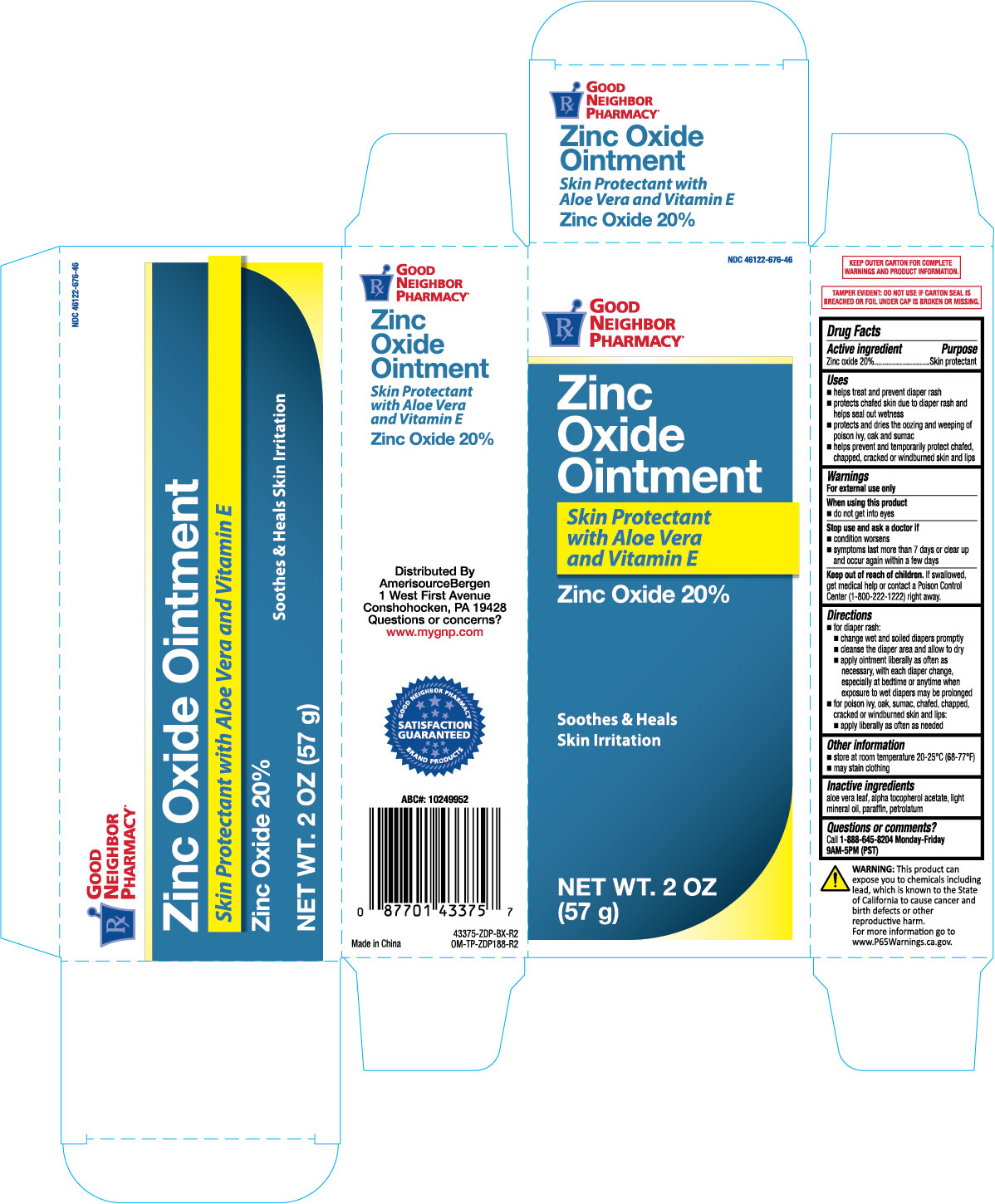
Good Neighbor Pharmacy Skin Protectant Zinc Oxide .2 g/g Ointment — NDC 46122-0676-46 package photo
Label image from the product's FDA listing (DailyMed) — may show a different pack size or an older label revision.

Good Neighbor Pharmacy Skin Protectant Zinc Oxide .2 g/g Ointment — NDC 46122-676-46 (Billing 46122-0676-46)

by AMERISOURCE BERGEN · 1 TUBE in 1 CARTON / 57 g in 1 TUBE

This is a package of Good Neighbor Pharmacy Skin Protectant Zinc Oxide .2 g/g Ointment from AMERISOURCE BERGEN, marketed since May 2021 and currently FDA-listed; retail pharmacies pay about $0.0364 per g (NADAC). It is this product's only package size.

NDC 46122-0676-46
🏷️ FDA NDC (as labeled) 46122-676-46 billing pads the product segment with a zero
OTC On market Non-controlled ⇄ Compare with another NDC
🗂️ FDA directory synced Oct 1, 2026 · this listing last changed Jul 24, 2026 · sources: openFDA · FDA label (DailyMed) · FDA Orange & Purple Book · First Databank · CMS NADAC, ASP, Medicare & Medicaid · RxNorm
📋 All sources & update times →
⚠️
Other active recalls for Zinc Oxide (different manufacturers) — 6 · tap to view
These affect other manufacturers’ products for the same ingredient — not necessarily the exact NDC on this page.
Class II · Oct 31, 2025 — cGMP deviations (Blossom Pharmaceuticals) · FDA recall D-0212-2026
Class II · Oct 31, 2025 — cGMP deviations (Blossom Pharmaceuticals) · FDA recall D-0206-2026
Class II · Oct 31, 2025 — cGMP deviations (Blossom Pharmaceuticals) · FDA recall D-0202-2026
Class II · Oct 31, 2025 — cGMP deviations (Blossom Pharmaceuticals) · FDA recall D-0207-2026
Class II · Oct 31, 2025 — cGMP deviations (Blossom Pharmaceuticals) · FDA recall D-0209-2026
Class II · Oct 31, 2025 — cGMP deviations (Blossom Pharmaceuticals) · FDA recall D-0208-2026
Each entry is an official FDA enforcement report — look up any recall number in the FDA recall database ↗

Identity & classification

Regulatory identifiers FDA, NLM and CMS codes for this package

FDA NDC (as labeled) 46122-676-46
Product NDC 46122-676
11-digit billing NDC 46122067646
NCPDP billing unit GM — per gram (weight)
RxCUI 198911
UNII SOI2LOH54Z
UPC 0087701433757
Application # M016
SPL Set ID c28e63f1-34be-9206-e053-2995a90accf6
DEA schedule Non-controlled
Marketing category OTC MONOGRAPH DRUG
Marketing status On market
FDA listing status Listed (active directory)
Marketing start 2021-05-17
Route TOPICAL
Dosage form OINTMENT
Substance ZINC OXIDE

Drug-database identifiers Medi-Span GPI and First Databank GCN / HICL / AHFS classification

GPI-14 90971020004210
GPI class GNP Zinc Oxide
GCN Seq No 005576
GCN 22080
HICL code 002361
Ingredient (HICL) Zinc Oxide
HIC1 code L
Therapeutic class — broad (HIC1) Skin/Subcutaneous Tissue
HIC2 code L3
Therapeutic class — intermediate (HIC2) Protectives
HIC3 code L3A
Therapeutic class — specific (HIC3) Protectives
AHFS code 84:24.12.00
AHFS class Basic Ointments And Protectants
FDB label name GNP ZINC OXIDE 20% OINTMENT
FDB brand name Zinc Oxide
Legend status O — Over-the-counter (OTC) drug or device
Quick answers
  • GSN (GCN sequence number): 005576
  • GCN: 22080
  • GPI-14 (Medi-Span): 90971020004210
  • HICL (First Databank): 002361
  • AHFS class code: 84:24.12.00
  • RxCUI (RxNorm): 198911
Why two NDCs? The FDA registers this code as 46122-676-46 — a 5-3-2 layout, and that's what's printed on the package and shown on DailyMed. For insurance claims, every NDC is standardized to a uniform 11-digit 5-4-2 format by adding a zero to the product segment → 46122-0676-46. Same drug, same package — only the format differs.
Where does this data come from?
Identifiers from the FDA openFDA NDC Directory and Structured Product Labeling; RxCUI from RxNorm (NLM); GPI from Medi-Span; GCN / HIC / AHFS / legend from First Databank.

Clinical

Label name GNP ZINC OXIDE 20% OINTMENT Ingredient Zinc Oxide
🧪 What is this product?

Good Neighbor Pharmacy Skin Protectant is an over-the-counter topical ointment containing zinc oxide. This product is an OTC monograph drug, meaning it is marketed under FDA's established rules for skin protectant products rather than as an individually reviewed application. Zinc oxide is commonly used in skin protectants to form a barrier on the skin surface and is typically used as a topical skin protectant for minor skin irritation.

Supplement & herbal interactions

Some supplements/herbs that may interact with Zinc oxide (OTC drug) — tap one for details:

Where does this data come from?
Plain-language summary from MedlinePlus (U.S. National Library of Medicine); supplement & herbal interactions and nutrient depletion data from the Natural Medicines database; our full guide is HelloPharmacist editorial content.

Pricing

A drug doesn't have one price. Each row is a different public payment system, and none is what you'd pay at the counter — that depends on your insurance. The ⓘ on each row explains what it measures.

Price systemPer gPer package
Retail pharmacies payNADAC · weekly $0.036 $2.07 / 57 g
Medicaid paysCMS SDUD · 12 mo $0.1423 $8.11 / 57 g
Medicare drug plans payPart D · quarterly No Part D plan price is available for this NDC in our data.
NADAC price history (per g) — tap or hover for the price & month
Jun 2022 Jan 2026 May 2026 Sep 2026 $0.036 $0.028
▲ Up 28% over the last 13 months.
Where does this data come from?
NADAC (National Average Drug Acquisition Cost) is the CMS weekly pharmacy-acquisition-cost survey — what pharmacies pay. ASP (Average Sales Price) is the CMS Medicare Part B drug-payment file, published quarterly. Medicaid pays is computed by us from CMS State Drug Utilization Data (total reimbursed ÷ units, trailing 12 months) — gross of rebates and inclusive of dispensing fees, so it reflects what Medicaid paid, not an acquisition cost. Medicare drug plans pay is the median negotiated point-of-sale unit cost across plans listing this NDC in the CMS quarterly Prescription Drug Plan pricing files, before rebates. The VA pays is the federal contract price (FSS, and the statutory Big 4 ceiling where listed) from the VA National Acquisition Center pharmaceutical price file. All are free public government data; each measures a different payer, so the figures are not directly comparable.

Packaging — all sizes for this product

Package NDCDescription Marketing startMarketing endStatus
46122-0676-46 You're viewing this Main listing 1 TUBE in 1 CARTON / 57 g in 1 TUBE 2021-07-10 — Active

Therapeutic equivalents

ProductLabelerPackNADAC/unitTEStatusPrice vs. this
Zinc Oxide 20 g/100g 68001-0533-50 BluePoint 454 g $0.015 — Availability likely save 58%
Leader Zinc Oxide 200 mg/g 70000-0334-01 Cardinal 454 g $0.015 — Availability likely save 58%
Good Neighbor Pharmacy Skin Protectant .2 g/gthis 46122-0676-46 AMERISOURCE 1 tube $0.036 — Availability likely —
Rugby Zinc Oxide 20% 20 g/100g 00536-1316-25 Rugby 72 tubes $0.061 — Availability likely +68%
Zinc Oxide 20 g/100g 68001-0532-45 BluePoint 1 tube $0.077 — Availability likely +112%
Nivagen Zinc Oxide 200 mg/g 75834-0170-01 Nivagen 28.4 g $0.105 — Availability likely +188%
Sheffield Zinc Oxide 200 mg/g 11527-0065-34 Sheffield 1 tube — — FDA listed —
CAREALL Zinc Oxide .2 g/g 51824-0032-03 New 28 g — — FDA listed —
ProCure Zinc Oxide 20 g/100g 55681-0017-01 Twin 28.3 g — — FDA listed —
Procure 20 g/100g 55681-0304-03 TWIN 28.3 g — — FDA listed —
Endit Zinc Oxide Skin Protectant 20 g/100g 64068-0402-01 Endit 454 g — — FDA listed —
Endit zinc oxide skin protection 200 mg/g 64068-0500-01 EndIt 56.7 g — — FDA listed —
Zinc Oxide .2 g/g 64772-0201-01 Derma 453.6 g — — FDA listed —
Zinc Oxide 200 mg/g 67777-0223-02 Dynarex 1 tube — — FDA listed —
Zinc Oxide 20% .2 g/g 68016-0159-02 Pharmacy 1 tube — — FDA listed —
dabur 20 g/100g 68747-3040-03 Dabur 28 g — — FDA listed —
Zinc Oxide 20% .2 g/g 69396-0021-02 Trifecta 1 tube — — FDA listed —
Zinc Oxide 20% .2 g/g 69396-0086-02 Trifecta 1 tube — — FDA listed —
zinc oxide 20% 20 g/100g 69452-0450-58 Bionpharma 425 g — — FDA listed —
Zinc Oxide 20 g/100g 69771-0109-38 Geri-Gentle 1 tube — — FDA listed —
CVS Zinc Oxide 200 mg/g 69842-0065-34 CVS 1 tube — — FDA listed —
Medpura Zinc Oxide 20% 20 g/100g 71399-0245-02 Akron 1 tube — — FDA listed —
Zinc Oxide 20% .2 g/g 83324-0052-01 Chain 1 tube — — FDA listed —
Zinc Oxide Pharma 200 mg/g 84387-0001-01 ALLIED 56.6 g — — FDA listed —
ElixirZincoCare 20 g/100g 84546-0004-01 ELIXIR 1 tube — — FDA listed —
Zinc Oxide Skin Protectant 20 g/100g 87236-0007-16 Aldermed 454 g — — FDA listed —
78 x 36 SPF 30 Active .2 g/g 58466-0109-03 Dermazone 1 tube — — FDA listed —
About this product: other versions of the same ingredient, strength and form are listed above, least expensive first, with FDA equivalence ratings where available.
Where does this data come from?
Equivalents are other NDCs of the same ingredient, form and route from the openFDA NDC Directory, ranked least-expensive-first by NADAC. Therapeutic-equivalence (AB) ratings come from the FDA Orange Book; biologics use the FDA Purple Book for biosimilar & interchangeable status.

Availability & generic status

🏛️
2021
On the market since
May 2021
📍
2026
Currently FDA-listed
5 years listed
🔒
·
No generic listed yet
brand only
ℹ️No FDA-approved generic found

We did not find an FDA-approved generic match for this exact strength, form and route.

Where does this data come from?
Patents and exclusivity from the FDA Orange Book (small-molecule drugs), refreshed from public FDA data. Generic launch timing is an estimate, not a guarantee.

Inactive Ingredients / Excipients

Inactive ingredients, also called excipients, are components of the drug product other than the active ingredient. They may include fillers, dyes, coatings, preservatives, flavors, or other formulation ingredients.

💡 Tap an ingredient (hover on desktop) to see what it is and why it’s used.

  • UNII 9E8X80D2L0
    A synthetic form of vitamin E used as an antioxidant and preservative in medications. It helps prevent the active ingredients from degrading when exposed to oxygen or light.
  • UNII ZY81Z83H0X
    Aloe vera leaf is a plant extract derived from the aloe plant. It is used in medicines as a natural moisturizer and skin-soothing agent in topical formulations.
  • UNII N6K5787QVP
    Light mineral oil is a clear, odorless liquid derived from petroleum. In medicines, it acts as a lubricant and emollient to help the product spread smoothly and improve texture.
  • UNII I9O0E3H2ZE
    Paraffin is a waxy, petroleum-derived substance used as a coating, lubricant, and hardening agent in tablets and capsules. It helps protect the medicine from moisture and gives pills a smooth finish.
  • UNII 4T6H12BN9U
    Petrolatum is a purified mineral oil-based jelly derived from petroleum. In medicines, it acts as an emollient, lubricant, and moisture barrier to soften skin, reduce friction, and help prevent water loss from formulations.

5 inactive ingredients listed in the exact product block matched to this NDC.

The official label also statesInactive ingredients.alpha.-tocopherol acetate, aloe vera leaf, light mineral oil, praffin, petrolatum

Label-section wording can be broader than the structured product block and may mention additional formulation ingredients.

Where does this data come from?
Data sourced from official FDA Structured Product Labeling (SPL) via DailyMed — ingredient classCode="IACT" elements from the exact product block matched by this NDC. Label-section narrative from DailyMed / the openFDA label index is shown separately when available.

Inactive ingredient FAQ

Are inactive ingredients the same for every manufacturer?
No. Inactive ingredients can differ by manufacturer, dosage form, strength, and package / product version.
Why might an inactive ingredient be missing?
Some SPLs do not provide a complete structured inactive-ingredient list, and older or unusual labels may only include the information in narrative text.
Can inactive ingredients matter?
Yes. They can matter for allergies, intolerances, dyes, gluten / lactose concerns, preservatives, and formulation differences — but confirm with a pharmacist or the manufacturer when it’s clinically important.

Manufacturer & labeler

LabelerAMERISOURCE BERGEN
FDA applicationM016 (OTC MONOGRAPH DRUG)
Labeler code46122
First marketedMay 2021
Product typeHuman Otc Drug
Portfolio206 products on file
The labeler markets the product; the application holder owns the FDA approval. They’re often the same company but can differ (e.g. a repackager or an authorized generic). A mailing address / phone appears here when the manufacturer includes it in the product’s FDA label (not all do).
Where does this data come from?
Labeler, application holder and registered establishment from the FDA openFDA NDC Directory and Drugs@FDA; address/contact from the product’s FDA label.

FDA label — Drug Facts FDA SPL

The complete FDA label for this product — the official Drug Facts labeling, verbatim, section by section. Jump with a chip, search within the label, or expand everything.
🎯 Indications and Usage 61 words ▾

Directions for diaper rash: change wet and soiled diapers promptly cleanse the diaper area and allow to dry apply ointment liberally as often as necessary, with each diaper change, especially at bedtime or anytime when exposure to wet diapers may be prolonged for poison ivy, oak, sumac, chafed, chapped, cracked or windburned skin and lips: apply liberally as often as needed

⏱️ Dosage and Administration 13 words ▾

Distributed by: Amerisource Bergen 1300 Morris Drive Chesterbrook, PA 19087 Made in China

⚠️ Warnings 5 words ▾

Warnings For external use only

📦 Storage and Handling 11 words ▾

Other information store at room temperature 20-25°C (68-77°F) may stain clothing

🧪 Active Ingredient 7 words ▾

Active ingredient Purpose Zinc oxide 20%...............................................Skin protectant

🧪 Inactive Ingredients 12 words ▾

Inactive ingredients .alpha.-tocopherol acetate, aloe vera leaf, light mineral oil, praffin, petrolatum

🎯 Purpose 45 words ▾

Uses helps treat and prevent diaper rash protects chafed skin due to diaper rash and helps seal out wetness protects and dries the oozing and weeping of poison ivy, oak and sumac helps prevent and temporarily protect chafed, chapped, cracked, or windburned skin and lips

📄 When Using This Product 9 words ▾

When using this product do not get into eyes

📄 Stop Use and Ask a Doctor If 25 words ▾

Stop use and ask a doctor if condition worsens symptoms last more than 7 days or clear up and occur again within a few days

📄 Keep Out of Reach of Children 20 words ▾

Keep out of reach of children. If swallowed, get medical help or contact a Poison Control Center (1-800-222-1222) right away.

📄 Package Label / Principal Display Panel 1 words ▾

43375

Source: FDA Structured Product Labeling, mirrored from DailyMed / openFDA. Prefer the government’s original formatting? View this label on DailyMed ↗

Medicaid utilization & spend

📍 This exact package only: Medicaid data is reported per full 11-digit NDC — labeler, product and pack size — so every number here is for this package alone, not the drug overall. Other pack sizes report separately.
💊 Pharmacy benefit only: These are Medicaid outpatient pharmacy claims, billed by NDC. They exclude the medical benefit — clinic- or hospital-administered drugs billed under HCPCS J-codes — so drugs used mostly that way (e.g. Avastin, Lucentis, Keytruda) can look low or missing here. That’s expected, not an error.
📅 Q1 2025 – Q1 2026 · 5 quarters of data
ⓘ The newest quarter is usually incomplete when first published; states restate recent quarters in later CMS releases, so the latest figures typically revise upward. State coverage-policy changes can also shift quarter-to-quarter totals.
Prescriptions last 4 qtrs
2.2K
Units reimbursed last 4 qtrs
134.6K
Gross reimbursed last 4 qtrs
$19.2K
Avg / prescription
$8.86
Avg / unit
$0.1423
Latest quarter Q1 2026
513Rx
Medicaid pays / g
$0.1423
gross reimbursed
vs
NADAC / g
$0.0364
acquisition cost
=
Spread
+$0.1059
+291% vs cost
What Medicaid paid per g (before rebates; includes the pharmacy’s dispensing fee) compared with NADAC — the average price pharmacies pay to buy the drug. A positive spread means Medicaid reimbursed more than the purchase price, before manufacturer rebates.
Fee-for-service vs managed care ⓘ
71% FFS 29% MCO
Fee-for-service · 1,529 Rx Managed care · 635 Rx
State Medicaid map
Alaska: no data reported AK Maine: no data reported ME Washington: no data reported WA Idaho: no data reported ID Montana: no data reported MT North Dakota: no data reported ND Minnesota: 2,937 units · 51.2 per 100k residents MN Wisconsin: no data reported WI Michigan: no data reported MI New York: 73,746 units · 377 per 100k residents NY Vermont: no data reported VT New Hampshire: no data reported NH Oregon: 13,089 units · 309 per 100k residents OR Nevada: no data reported NV Wyoming: no data reported WY South Dakota: no data reported SD Iowa: no data reported IA Illinois: 684 units · 5.5 per 100k residents IL Indiana: no data reported IN Ohio: 1,396 units · 11.8 per 100k residents OH Pennsylvania: no data reported PA New Jersey: no data reported NJ Massachusetts: 7,416 units · 106 per 100k residents MA California: no data reported CA Utah: no data reported UT Colorado: no data reported CO Nebraska: no data reported NE Missouri: no data reported MO Kentucky: 14,118 units · 312 per 100k residents KY West Virginia: no data reported WV Virginia: 12,866 units · 148 per 100k residents VA Maryland: no data reported MD Connecticut: no data reported CT Rhode Island: no data reported RI Arizona: no data reported AZ New Mexico: no data reported NM Kansas: no data reported KS Arkansas: no data reported AR Tennessee: no data reported TN North Carolina: no data reported NC South Carolina: no data reported SC Delaware: no data reported DE Oklahoma: no data reported OK Louisiana: no data reported LA Mississippi: no data reported MS Alabama: no data reported AL Georgia: 8,397 units · 76.1 per 100k residents GA D.C.: no data reported DC Hawaii: no data reported HI Texas: no data reported TX Florida: no data reported FL
Units reimbursed · per 100k residents
5.5377
gray = no data reported ⓘ
Colors are per 100,000 residents, so big states don’t automatically dominate. Tap or hover a state for its actual totals.
Tap or hover a state
…for its Medicaid breakdown
🏆 Top states by units · per 100k residents
1 New York 377 /100k
2 Kentucky 312 /100k
3 Oregon 309 /100k
4 Virginia 148 /100k
5 Massachusetts 106 /100k
6 Georgia 76.1 /100k
7 Minnesota 51.2 /100k
8 Ohio 11.8 /100k
National units — by quarter
💵 About the dollar figures: “reimbursed” is what Medicaid paid pharmacies before confidential manufacturer rebates, so the program’s real net cost is lower than these numbers. Fee-for-service and managed-care claims are combined unless split above. Source: CMS State Drug Utilization Data; per-100k rates use 2023 Census population estimates.

Reported adverse events (FAERS)

Read carefully: FAERS reports are voluntary and unverified. Counts are not incidence, do not establish causation, are subject to reporting bias, and cannot be used to compare one drug to another. Shown for signal context only. Reports for Good Neighbor Pharmacy Skin Protectant (this brand).

Top reported reactions

Macular Degeneration460
Pyrexia306
Nausea290
Pain282
Malaise261
Weight Decreased236
Therapeutic Product Effect Incomplete214

Age at onset

Neonate5
Infant8
Child28
Adolescent5
Adult110
Elderly192

Reporter sex

1,941 reports
Male · 37%
Female · 63%
Unknown · 0%

Serious outcomes

Hospitalization988
Death204
Life-threatening116
Disabling32
Reports over time (by year) — tap or hover for the count & year
2019 2021 2023 2026 272 0
Most recent year is provisional (FAERS lags ~3 months).
Where does this data come from?
Adverse-event reports from the FDA Adverse Event Reporting System (FAERS) via openFDA. FAERS reports are voluntary and unverified — counts are not incidence and don’t establish causation.
For educational and professional reference only — not medical advice. Pricing reflects published NADAC and CMS ASP (free public data) and may differ from your acquisition cost; always verify before billing or dispensing.