
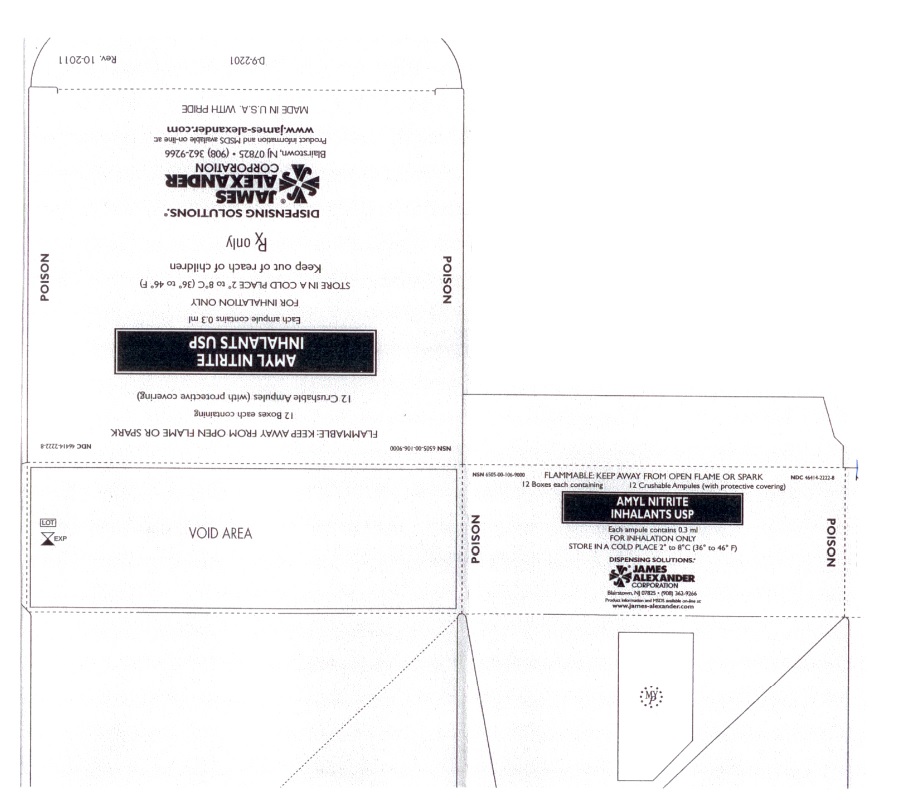
Amyl Nitrite .3 g/.3mL Inhalant, 144 ampules — NDC 46414-2222-8 (Billing 46414-2222-08)
This is a package of 144 ampules of Amyl Nitrite .3 g/.3mL Inhalant from James Alexander Corporation, marketed since Feb 1979 and currently FDA-listed. It is this product's only package size.
NDC database record
One package, one record: these facts belong to NDC 46414-2222-8 alone.
- Record
- FDA NDC Directory package listing · Human prescription drug
- Code segments
- 46414 labeler · 2222 product · 8 package
- Package marketed since
- Feb 7, 1979
- Sample package
- No — commercial package
- Listing certified through
- Dec 31, 2026
- Barcode (UPC-A, from the NDC)
- 3 4641422228 8
- FDA record last changed
- Jul 24, 2026
Identity & classification
Regulatory identifiers FDA, NLM and CMS codes for this package
- RxCUI (RxNorm): 577307
Where does this data come from?
- FDA openFDA NDC Directory · synced Oct 1, 2026
- FDA label on DailyMed · label index refreshed Oct 5, 2026
- RxNorm (NLM RxNav) · catalog refreshed Oct 1, 2026
- Medi-Span GPI (licensed)
- First Databank (licensed) · refreshed Oct 1, 2026
RxNorm drug class
This medicine belongs to the Antidotes class.
Where does this data come from?
- RxClass (NLM) · catalog refreshed Oct 1, 2026
Clinical
This is an unapproved prescription inhalant containing amyl nitrite, a volatile liquid meant to be inhaled through the nose. Amyl nitrite is a vasodilator, a type of substance that relaxes blood vessels and is typically used to lower blood pressure quickly in certain medical situations. This product is not approved by the FDA and is marketed outside the standard drug approval process.
Patient education
Supplement & herbal interactions
Where does this data come from?
- MedlinePlus (NLM) · refreshed Oct 1, 2026
- FDA label on DailyMed · label index refreshed Oct 5, 2026
Ask a licensed pharmacist directly — free, answered by our team.
Pricing
A drug doesn't have one price. Each row is a different public payment system, and none is what you'd pay at the counter — that depends on your insurance. The ⓘ on each row explains what it measures.
| Price system | Per each | Per package |
|---|---|---|
| Retail pharmacies payNADAC · weekly | Not in the retail survey — common for institutional, discontinued, or low-volume packs. | |
| Medicaid paysCMS SDUD · 12 mo | No recent Medicaid claims on file for this NDC — rare and low-volume NDCs are suppressed in the public data. | |
| Medicare drug plans payPart D · quarterly | No Part D plan price is available for this NDC in our data. | |
Where does this data come from?
- CMS NADAC weekly file
- CMS ASP pricing files · refreshed Sep 20, 2026
- CMS Medicaid State Drug Utilization Data · refreshed Oct 5, 2026
- CMS Part D plan pricing files · refreshed Sep 24, 2026
- VA National Acquisition Center price file
Packaging — all sizes for this product
| Package NDC | Description | Marketing start | Marketing end | Status |
|---|---|---|---|---|
| 46414-2222-08 You're viewing this Main listing | 144 AMPULE in 1 CARTON / .3 mL in 1 AMPULE | 1979-02-07 | — | Active |
Therapeutic equivalents
| Product | Labeler | Pack | NADAC/unit | TE | Status | Price vs. this |
|---|---|---|---|---|---|---|
| Amyl Nitrite .3 g/.3mLthis 46414-2222-08 | James | 144 ampules | — | — | FDA listed | — |
Where does this data come from?
- FDA openFDA NDC Directory · synced Oct 1, 2026
- FDA Orange Book · refreshed Oct 3, 2026
- CMS NADAC weekly file
Availability & generic status
We did not find an FDA-approved generic match for this exact strength, form and route.
Where does this data come from?
- FDA Orange Book · refreshed Oct 3, 2026
Inactive Ingredients / Excipients
Inactive ingredients, also called excipients, are components of the drug product other than the active ingredient. They may include fillers, dyes, coatings, preservatives, flavors, or other formulation ingredients.
💡 Tap an ingredient (hover on desktop) to see what it is and why it’s used.
-
UNII 84XB4DV00W
Linseed oil is a plant-based oil extracted from flax seeds. It's used in medicines as an emollient and lubricant to improve texture and help with ingredient mixing in formulations.
1 inactive ingredient listed in the exact product block matched to this NDC.
Where does this data come from?
ingredient classCode="IACT" elements from the exact product block matched by this NDC. Label-section narrative from DailyMed / the openFDA label index is shown separately when available.- FDA label on DailyMed · label index refreshed Oct 5, 2026
- FDA openFDA NDC Directory · synced Oct 1, 2026
Inactive ingredient FAQ
Are inactive ingredients the same for every manufacturer?
Why might an inactive ingredient be missing?
Can inactive ingredients matter?
Manufacturer & labeler
More NDCs from James Alexander Corporation labeler code 46414
Where does this data come from?
- FDA openFDA NDC Directory · synced Oct 1, 2026
- Drugs@FDA
Full prescribing information FDA SPL
🎯 Indications and Usage ▾
INDICATIONS AND USAGE: Amyl nitrite is indicated for the rapid relief of angina pectoris. Its effect appears within 30 seconds and lasts for approximately 3 to 5 minutes.
⏱️ Dosage and Administration ▾
DOSAGE & ADMINISTRATION: With the patient in recumbent or seated position a capsule of amyl nitrite is held away from the face, crushed between the fingers, and held under the patient's nose. Two to six inhalations of the vapors from the capsule are usually sufficient to promptly produce therapeutic effects. Caution is recommended to avoid inhalation of excessive amounts of the drug when it is administered by someone other than the patient.
If necessary, the dose may be repeated in 3 to 5 minutes.
⛔ Contraindications ▾
CONTRAINDICATIONS: Since it may increase intraocular and intracranial pressures, amyl nitrite is contraindicated or should be used with great caution in patients with glaucoma, recent head trauma or cerebral hemorrhage. Amyl nitrite can cause harm to the fetus when it is administered to a pregnant woman because it significantly reduces systemic blood pressure and blood flow on the maternal side of the placenta.
⚠️ Warnings ▾
WARNINGS: Transient episodes of dizziness, weakness, or syncope or other signs of cerebral ischemia due to postural hypotension may develop following inhalation of amyl nitrite, particularly if the patient is standing immobile. To hasten recovery, measures which facilitate venous return such as head low posture, deep breathing and movement of extremities may be used.
🤒 Adverse Reactions ▾
ADVERSE REACTIONS: Mild transitory headache, dizziness and flushing of the face are common with the use of amyl nitrite. The following adverse reactions may occur in susceptible patients: syncope, involuntary passing of urine and feces, hypotension, pallor, cold sweat, tachycardia, restlessness, weakness, vomiting and nausea. Excessively high doses of amyl nitrite administered chronically may cause methemoglobinemia.
🆘 Overdosage ▾
OVERDOSAGE: Symptoms - Inhaled doses of 5 to 10 drops of amyl nitrite may cause violent flushing of the face, accompanied by a feeling of imminent bursting of the head and very excessive heart action. The inhalation of larger amounts may produce a feeling of suffocation and muscular weakness. Symptoms comparable to shock may be produced (such as weakness, restlessness, sweating, pallor, nausea, vomiting, syncope and incontinence) attributable to pooling of blood in the postarteriolar vessels and failure of the venous blood to return to the heart.
Treatment - Measures which facilitate venous return such as head-low posture, deep breathing and movement of extremities may be used. The use of epinephrine aggravates the shock- like reaction. Methylene blue should be injected for treatment of severe methemoglobinemia with dyspnea.
For treating cyanide poisoning, methylene blue is contraindicated where nitrites cause iatrogenic methemoglobinemia.
🧬 Clinical Pharmacology ▾
CLINICAL PHARMACOLOGY: Amyl nitrite causes a non specific relaxation of smooth muscle with the most prominent actions occurring in vascular smooth muscle. This effect on vascular smooth muscle results in coronary vasodilation and decreased systemic vascular resistance and left ventricular preload and afterload. Myocardial ischemia is relieved in patients with angina pectoris, with an abatement of chest pain and possibly other related symptoms.
Amyl nitrite vapors are absorbed rapidly through the pulmonary alveoli, manifesting therapeutic effects within one minute after inhalation. The drug is metabolized rapidly, probably by hydrolytic denitration; approximately one-third of the inhaled amyl nitrite is excreted in the urine.
📦 How Supplied / Storage and Handling ▾
HOW SUPPLIED: JAMES ALEXANDER brand amyl nitrite is furnished in covered glass capsules. Each capsule contains 0.3 mL in boxes of 12. Capsule contents are FLAMMABLE and should be protected from light. Storage should be in a cold place. 2 o - 8 o C (36 o - 46 o F) The James Alexander Corporation Blairstown, New Jersey 07825. Rev. 03 July 2012 Rx only.
📋 Description ▾
DESCRIPTION: Amyl nitrite is a rapidly acting vasodilator administered by inhalation. 0.3mL is supplied in a covered thin glass capsule which is easily crushed between the fingers. Amyl nitrite is a clear, yellowish liquid having a peculiar ethereal, fruity odor. It is volatile, even at low temperatures, and is flammable. This product is stabilized with Linseed Oil Epoxy. The structural formula of amyl nitrite is: (CH 3 ) 2 CHCH 2 CH 2 ONO
⚠️ Precautions ▾
CAUTION : Amyl nitrite is very flammable. Do not use where it might become ignited. Keep away from open flame or sparks.
PRECAUTIONS : Genera l - Tolerance to amyl nitrite may develop with repeated use of the drug for prolonged periods of time. Tolerance may be minimized by beginning with the smallest effective dose and alternating the drug with another coronary vasodilator. High doses of nitrites may produce methemoglobinemia, especially in individuals with methemoglobin reductase deficiency or other metabolic abnormality that interferes with the normal conversion of methemoglobin back to haemoglobin.
Patient Information - Amyl nitrite should be taken by the patient when seated or lying down. Drug Interactions - Taking amyl nitrite after drinking alcohol may worsen side effects and may cause severe hypotension and cardiovascular collapse. Carcinogenesis, Mutagenesis, Fertility Impairment - Adequate long term studies to establish adverse carcinogenic potential of this drug have not been reported.
Pregnancy - Teratogenic effects: Category C. Animal studies have not been conducted with amyl nitrite. It is also not known whether amyl nitrite can cause fetal harm when administered to a pregnant woman or can affect reproduction capacity.
Amyl nitrite should be given to a pregnant woman only if clearly needed. Nursing Mothers - It is not known whether this drug is excreted in human milk. Because many drugs are excreted in human milk, caution should be exercised when amyl nitrite is administered to a nursing woman.
Pediatric Use - Safety and effectiveness in children have not been established.
🔒 Drug Abuse and Dependence ▾
DRUG ABUSE AND DEPENDENCE: Abuse - Volatile nitrites are abused for sexual stimulation, with headache as a common side effect. Dependence - Tolerance to nitrites can develop; conditions and duration have not been established.
📄 Package Label / Principal Display Panel ▾
Packaging image description
Packaging image description
Packaging image description
Insert image description
About this NDC listing & data coverage
Listed without an FDA application
This product's marketing category indicates it is marketed without an approved FDA application (no NDA, ANDA, or BLA on file). Having an NDC does not by itself establish FDA approval — the NDC Directory is a listing system, not an approval decision. Approval-linked data such as Orange Book therapeutic-equivalence ratings therefore does not apply.
What data is (and isn’t) available for this NDC — tap to expand
| NDC identity (package / product / labeler codes) | ✓ Available |
| Labeler | ✓ Available |
| Product & package description | ✓ Available |
| Marketing category & status | ✓ Available |
| Active ingredient / dosage form / route | ✓ Available |
| FDA label (SPL via DailyMed) | ✓ Available |
| Package photos | ✓ Available |
| Inactive ingredients (structured) | ✓ Available |
| NADAC pharmacy acquisition price (CMS) | — Not published for this NDC CMS publishes NADAC only for NDCs reported in its retail-pharmacy survey. |
| Orange Book / therapeutic-equivalence data | — Not published for this NDC Applies only to products approved under an NDA/ANDA; many listings are out of scope. |
| HCPCS J-code billing crosswalk | — Not published for this NDC Most self-administered / retail products have no J-code — that is normal. |
| Medicaid utilization (CMS SDUD) | — Not published for this NDC CMS reports utilization only for NDCs with Medicaid claims above its privacy threshold. |