
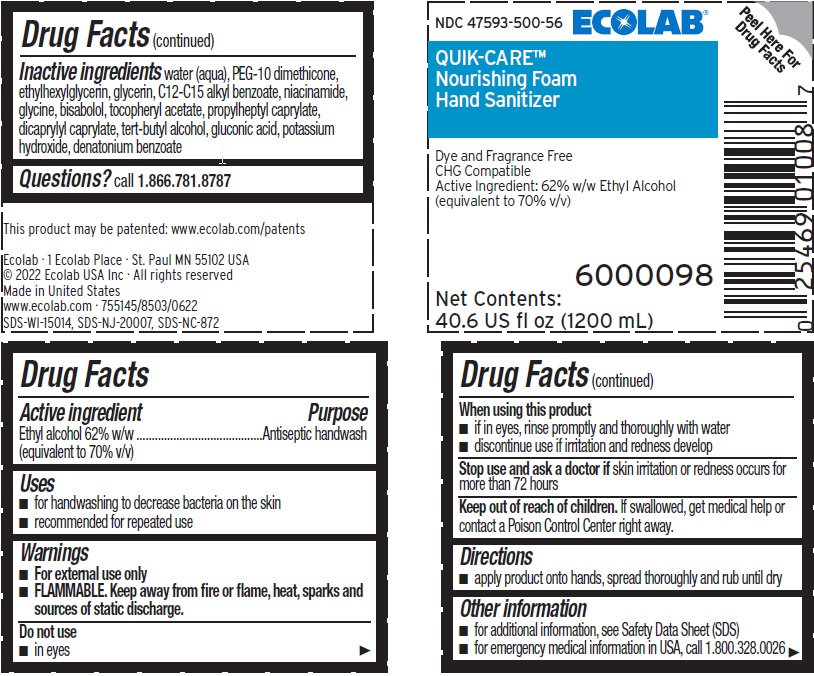
Quik-Care Nourishing Foam Hand Sanitizer Alcohol 70 mL/100mL Solution, 500 mL
🆔 Identity & classification
Where does this data come from?
🏭 Manufacturer & labeler
Where does this data come from?
🩺 Clinical
- Chemically they are related, but hand sanitizer is absolutely not safe to drink — it contains alcohol in concentrations that are toxic if swallowed and often includes other ingredi...
- Is the alcohol in hand sanitizer the same as the alcohol in a drink?
- Yes — most of these products are specifically labeled 'recommended for repeated use.' Just apply enough to cover your hands and rub until dry. If you notice skin irritation or redn...
- Can I use hand sanitizer over and over throughout the day?
Patient education
Supplement & herbal interactions
Where does this data come from?
Ask a licensed pharmacist directly — free, answered by our team.
🧪 Inactive Ingredients / Excipients
Inactive ingredients, also called excipients, are components of the drug product other than the active ingredient. They may include fillers, dyes, coatings, preservatives, flavors, or other formulation ingredients.
💡 Tap an ingredient (hover on desktop) to see what it is and why it’s used.
-
UNII 36HQN158VC
Alpha-bisabolol is a naturally derived oily liquid from plant sources. It works as a fragrance, flavor, and skin-conditioning agent in topical medicines and cosmetic products.
-
UNII 9E8X80D2L0
A synthetic form of vitamin E used as an antioxidant and preservative in medications. It helps prevent the active ingredients from degrading when exposed to oxygen or light.
-
UNII A9EJ3J61HQ
A synthetic liquid derived from benzoic acid and long-chain alcohols. It functions as a solvent and penetration enhancer in topical formulations, helping active ingredients dissolve and absorb into the skin.
-
UNII 4YK5Z54AT2
Denatonium benzoate is a bitter-tasting chemical compound added to medicines to discourage accidental ingestion, especially by children. It serves as a bittering agent with no therapeutic effect on the body.
-
UNII 609A3V1SUA
A silky liquid derived from caprylic acid that acts as an emollient and solvent in formulations. It helps dissolve active ingredients and improves the spreadability and feel of lotions, creams, and topical products.
-
UNII 147D247K3P
Ethylhexylglycerin is a synthetic preservative used to prevent bacteria and mold from growing in medicines and personal care products. It helps keep the product safe and stable throughout its shelf life.
-
UNII R4R8J0Q44B
Gluconic acid is an organic acid derived from glucose. It functions as a buffer and pH adjuster in medicines, helping maintain the product's acidity or alkalinity for stability and proper absorption.
-
UNII PDC6A3C0OX
Glycerin is a clear, thick liquid derived from plant oils or fats. It acts as a humectant to retain moisture, a sweetener, and a solvent in medications.
-
UNII TE7660XO1C
Glycine is an amino acid used in medicines as a buffer to help stabilize pH and improve taste. It may also serve as a filler or binder to give the product proper form and consistency.
-
UNII 25X51I8RD4
Niacinamide is a form of vitamin B3, a water-soluble nutrient. In medicines, it may be added as a nutritional supplement or to support skin health, though its primary role here is as an active ingredient rather than a traditional inactive filler.
-
UNII 8PR7V1SVM0
A silicone-based lubricant combined with polyethylene glycol. It reduces friction and helps the medicine flow smoothly during manufacturing and improves how the product feels when applied or swallowed.
-
UNII WZH3C48M4T
Potassium hydroxide is a strong alkaline chemical used in medicines to adjust and maintain the pH level of liquid formulations, helping keep the product stable and the active ingredients effective.
-
UNII 991Z19V2OD
Propylheptyl caprylate is a synthetic oily liquid made from fatty acids. It's used in medicines as an emollient and solvent to help dissolve active ingredients and improve how the product spreads or absorbs.
-
UNII MD83SFE959
A volatile organic liquid used as a solvent and preservative in medications. It helps dissolve active ingredients and other components, and can improve product stability and shelf life.
-
UNII 059QF0KO0R
Water is a liquid solvent that dissolves and mixes ingredients together in liquid medicines, syrups, and injections. It helps distribute the active drug evenly throughout the product.
15 inactive ingredients listed in the exact product block matched to this NDC.
Label-section wording can be broader than the structured product block and may mention additional formulation ingredients.
Where does this data come from?
ingredient classCode="IACT" elements from the exact product block matched by this NDC. Label-section narrative from DailyMed / the openFDA label index is shown separately when available.Inactive ingredient FAQ
Are inactive ingredients the same for every manufacturer?
Why might an inactive ingredient be missing?
Can inactive ingredients matter?
💲 Pricing
A drug doesn't have one price. Each row is a different public payment system, and none is what you'd pay at the counter — that depends on your insurance. The ⓘ on each row explains what it measures.
| Price system | Per mL | Per package |
|---|---|---|
| Retail pharmacies payNADAC · weekly | Not in the retail survey — common for institutional, discontinued, or low-volume packs. | |
| Medicaid paysCMS SDUD · 12 mo | No recent Medicaid claims on file for this NDC — rare and low-volume NDCs are suppressed in the public data. | |
| Medicare drug plans payPart D · quarterly | No Part D plan price is available for this NDC in our data. | |
Where does this data come from?
🔁 Therapeutic equivalents
Where does this data come from?
⏳ Availability & generic status
We did not find an FDA-approved generic match for this exact strength, form and route.
Where does this data come from?
🔬 Reported adverse events (FAERS)
Top reported reactions
Reporter sex
Serious outcomes
Where does this data come from?
📦 Packaging — all sizes for this product
| Package NDC | Description | Marketing start | Status |
|---|---|---|---|
| 47593-0500-38 You're viewing this | 500 mL in 1 BOTTLE, PLASTIC (47593-500-38) | 2013-02-01 | Discontinued by firm |
| 47593-0500-41 | 750 mL in 1 BOTTLE, PLASTIC (47593-500-41) | 2013-02-01 | Active |
| 47593-0500-55 | 1000 mL in 1 BOTTLE, PLASTIC (47593-500-55) | 2013-02-01 | Active |
| 47593-0500-56 | 1200 mL in 1 BOTTLE, PLASTIC (47593-500-56) | 2013-02-01 | Active |
| 47593-0500-57 | 535 mL in 1 BOTTLE, PLASTIC (47593-500-57) | 2013-02-01 | Active |
| 47593-0500-85 | 45 mL in 1 BOTTLE, PLASTIC (47593-500-85) | 2013-02-01 | Active |
You're viewing one of 6 pack sizes for this product.
Pack size FAQ
What quantity is in NDC 47593-0500-38?
What is the difference between NDC 47593-0500-38 and NDC 47593-0500-85?
What NDC number is used to bill for this package of Quik-Care Nourishing Foam Hand Sanitizer Alcohol 70 mL/100mL Solution?
🧭 About this NDC listing & data coverage
What data is (and isn’t) available for this NDC — tap to expand
| NDC identity (package / product / labeler codes) | ✓ Available |
| Labeler | ✓ Available |
| Product & package description | ✓ Available |
| Marketing category & status | ✓ Available |
| Active ingredient / dosage form / route | ✓ Available |
| FDA label (SPL via DailyMed) | ✓ Available |
| Package photos | ✓ Available |
| Inactive ingredients (structured) | ✓ Available |
| NADAC pharmacy acquisition price (CMS) | — Not published for this NDC CMS publishes NADAC only for NDCs reported in its retail-pharmacy survey. |
| Orange Book / therapeutic-equivalence data | — Not published for this NDC Applies only to products approved under an NDA/ANDA; many listings are out of scope. |
| HCPCS J-code billing crosswalk | — Not published for this NDC Most self-administered / retail products have no J-code — that is normal. |
| Medicaid utilization (CMS SDUD) | — Not published for this NDC CMS reports utilization only for NDCs with Medicaid claims above its privacy threshold. |
Questions about this listing
Is this NDC FDA-approved?
Why is there no price listed?
What does the discontinued status mean for this NDC?
Is the NDC printed on the package the same as the 11-digit billing NDC?
What do the three segments of this NDC mean?
Does this product come in other package sizes?
Who lists this product with the FDA?
Do I need a prescription for this product?
Where does this data come from?
📄 FDA label — Drug Facts FDA SPL
🎯 Indications and Usage ▾
Uses For handwashing to decrease bacteria on the skin Recommended for repeated use
⏱️ Dosage and Administration ▾
Directions Apply product onto hands, spread throughly and rub until dry
⚠️ Warnings ▾
Warnings For external use only FLAMMABLE, keep away from fire or flame, heat, sparks and sources of static discharge. Do not use In eyes When using this product If in eyes, rinse promptly and thoroughly with water Discontinue use if irritation and redness develop Stop use and ask a doctor if Skin irritation or redness occurs for more than 72 hours
🧪 Active Ingredient ▾
Active ingredient Ethyl alcohol 62% w/w (equivalent to 70% v/v)
🧪 Inactive Ingredients ▾
Inactive ingredients water (aqua), PEG-10 dimethicone, ethylhexylglycerin, glycerin, C12-C15 alkyl benzoate, niacinamide, glycine, bisabolol, tocopheryl acetate, propylheptyl caprylate, dicaprylyl caprylate, tert-butyl alcohol, gluconic acid, potassium hydroxide, denatonium benzoate
🎯 Purpose ▾
Purpose Antiseptic handwash