
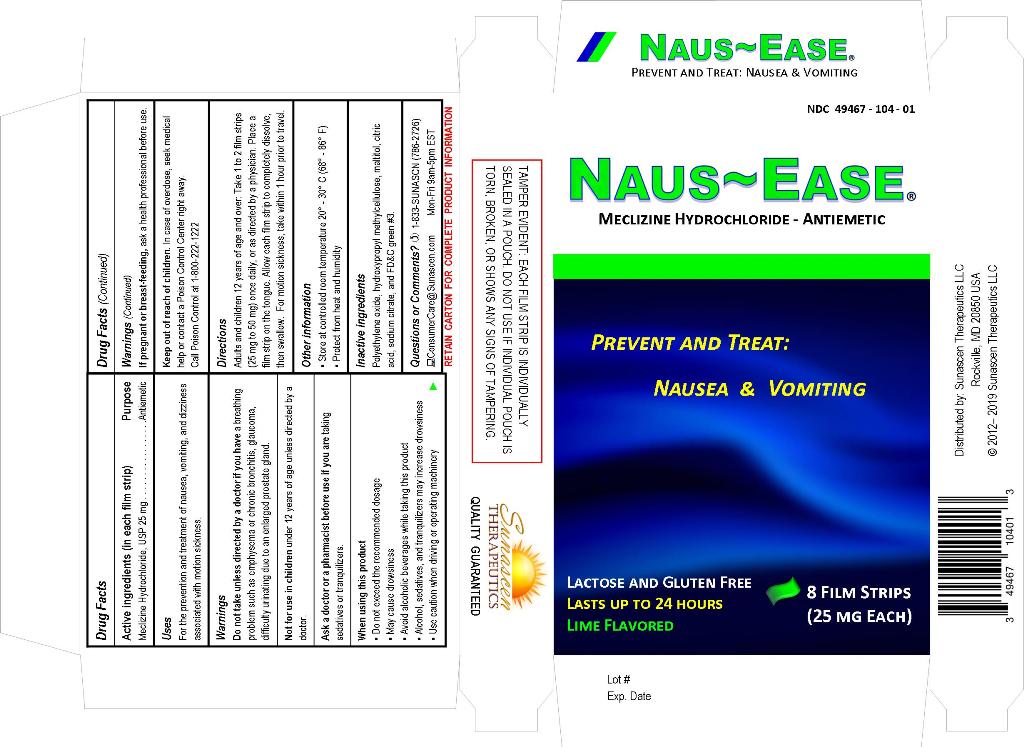
NAUS-EASE MECLIZINE HYDROCHLORIDE 25 mg Film, Soluble
Other active recalls for Meclizine Hydrochloride (different manufacturers) — 1 · tap to view
🆔 Identity & classification
Where does this data come from?
🏭 Manufacturer & labeler
Where does this data come from?
🩺 Clinical
- Meclizine is mainly used to prevent and treat the nausea, vomiting, and dizziness that comes with motion sickness — whether you're on a boat, in a car, or on a plane. It's also use...
- For the best chance of preventing motion sickness, take meclizine about one hour before you start traveling. After that first dose, you can take it once every 24 hours as needed fo...
- Yes, drowsiness is the most common side effect — it's actually worth planning around. Avoid driving or operating heavy machinery until you know how it affects you. And definitely s...
- This one requires a conversation with your doctor. Human studies haven't clearly linked meclizine to birth defects, but animal studies did show fetal harm at doses similar to what...
Patient education
Supplement & herbal interactions
Where does this data come from?
Ask a licensed pharmacist directly — free, answered by our team.
🧪 Inactive Ingredients / Excipients
Inactive ingredients, also called excipients, are components of the drug product other than the active ingredient. They may include fillers, dyes, coatings, preservatives, flavors, or other formulation ingredients.
💡 Tap an ingredient (hover on desktop) to see what it is and why it’s used.
-
UNII XF417D3PSL
Anhydrous citric acid is a sour, crystalline powder derived from citric acid with water removed. In medicines, it acts as a buffer to control pH, adds tartness to improve taste, and helps tablets disintegrate.
-
UNII RS7A450LGA
A sodium salt derived from citric acid that helps regulate acidity and maintain pH balance in the medicine. It also works as a binding agent to hold tablet ingredients together.
-
UNII 3NXW29V3WO
Hypromellose is a plant-based thickener made from cellulose. It's used in medicines as a binder to hold ingredients together, a coating for tablets, and a thickener for liquids.
-
UNII D65DG142WK
Maltitol is a sugar alcohol made by hydrogenating maltose. It's used as a sweetener and filler in medicines to improve taste and add bulk to tablets and capsules.
-
UNII 11628IH70O
Polyethylene oxide is a synthetic polymer derived from ethylene. In medicines, it acts as a binder to hold ingredients together, a thickener to adjust texture, and a disintegrant to help the tablet or capsule break apart for absorption.
5 inactive ingredients listed in the exact product block matched to this NDC.
Label-section wording can be broader than the structured product block and may mention additional formulation ingredients.
Where does this data come from?
ingredient classCode="IACT" elements from the exact product block matched by this NDC. Label-section narrative from DailyMed / the openFDA label index is shown separately when available.Inactive ingredient FAQ
Are inactive ingredients the same for every manufacturer?
Why might an inactive ingredient be missing?
Can inactive ingredients matter?
💲 Pricing
A drug doesn't have one price. Each row is a different public payment system, and none is what you'd pay at the counter — that depends on your insurance. The ⓘ on each row explains what it measures.
| Price system | Per each | Per package |
|---|---|---|
| Retail pharmacies payNADAC · weekly | Not in the retail survey — common for institutional, discontinued, or low-volume packs. | |
| Medicaid paysCMS SDUD · 12 mo | No recent Medicaid claims on file for this NDC — rare and low-volume NDCs are suppressed in the public data. | |
| Medicare drug plans payPart D · quarterly | No Part D plan price is available for this NDC in our data. | |
Where does this data come from?
🔁 Therapeutic equivalents
| Product | Labeler | Pack | NADAC/unit | TE | Status | Price vs. this |
|---|---|---|---|---|---|---|
| Naus-Ease 25 mgthis 49467-0104-01 | Sunascen | 1 film | — | — | Discontinued | — |
Where does this data come from?
⏳ Availability & generic status
We did not find an FDA-approved generic match for this exact strength, form and route.
Where does this data come from?
📦 Packaging — all sizes for this product
| Package NDC | Description | Marketing start | Status |
|---|---|---|---|
| 49467-0104-01 You're viewing this | 8 POUCH in 1 CARTON (49467-104-01) / 1 FILM, SOLUBLE in 1 POUCH | 2012-04-16 | Inactivated by FDA |
| 49467-0104-16 | 16 POUCH in 1 CARTON (49467-104-16) / 1 FILM, SOLUBLE in 1 POUCH | 2012-04-16 | Inactivated by FDA |
Pack size FAQ
What quantity is in NDC 49467-0104-01?
What NDC number is used to bill for this package of NAUS-EASE MECLIZINE HYDROCHLORIDE 25 mg Film, Soluble?
🧭 About this NDC listing & data coverage
What data is (and isn’t) available for this NDC — tap to expand
| NDC identity (package / product / labeler codes) | ✓ Available |
| Labeler | ✓ Available |
| Product & package description | ✓ Available |
| Marketing category & status | ✓ Available |
| Active ingredient / dosage form / route | ✓ Available |
| FDA label (SPL via DailyMed) | ✓ Available |
| Package photos | ✓ Available |
| Inactive ingredients (structured) | ✓ Available |
| NADAC pharmacy acquisition price (CMS) | — Not published for this NDC CMS publishes NADAC only for NDCs reported in its retail-pharmacy survey. |
| Orange Book / therapeutic-equivalence data | — Not published for this NDC Applies only to products approved under an NDA/ANDA; many listings are out of scope. |
| HCPCS J-code billing crosswalk | — Not published for this NDC Most self-administered / retail products have no J-code — that is normal. |
| Medicaid utilization (CMS SDUD) | — Not published for this NDC CMS reports utilization only for NDCs with Medicaid claims above its privacy threshold. |
Questions about this listing
Is this NDC FDA-approved?
Why is there no price listed?
What does the discontinued status mean for this NDC?
Is the NDC printed on the package the same as the 11-digit billing NDC?
What do the three segments of this NDC mean?
Does this product come in other package sizes?
Who lists this product with the FDA?
Do I need a prescription for this product?
Where does this data come from?
📄 FDA label — Drug Facts FDA SPL
🎯 Indications and Usage ▾
INDICATIONS AND USAGE For Consumers (the general public): Naus-Ease® (Meclizine Hydrochloride), USP Film Strips are used for the prevention and treatment of nausea and vomiting, or dizziness associated with motion sickness. For Health Professionals: Based on a review of Meclizine Hydrochloride, USP drug by the National Academy of Sciences – National Research Council and/or other information, FDA has classified the indications of Meclizine Hydrochloride, USP as follows: 1. The prevention and treatment (management) of nausea and vomiting, and dizziness associated with motion sickness.
2. For the treatment of vertigo.
⏱️ Dosage and Administration ▾
DOSAGE AND ADMINISTRATION (DIRECTIONS) Adults and children 12 years of age and over: Take 1 to 2 Naus-Ease® (Meclizine Hydrochloride), USP Film Strips (25 mg to 50 mg) once daily, or as directed by a physician. Place a film strip on the tongue. Allow each film strip to completely dissolve, and then swallow.
The initial dose of 25 mg to 50 mg of Naus-Ease® (Meclizine Hydrochloride), USP Film Strips should be taken one hour prior to travel for the prevention and treatment of motion sickness. Thereafter, the dose may be repeated every 24 hours for the duration of the journey.
⛔ Contraindications ▾
CONTRAINDICATIONS Meclizine Hydrochloride, USP is contraindicated in individuals who have shown a previous hypersensitivity to it.
⚠️ Warnings ▾
WARNINGS Clinical studies establishing safety and effectiveness in children under 12 years of age have not been done; therefore, usage is not recommended in children under 12 years of age unless directed by a doctor. Due to its potential anticholinergic action, do not take unless directed by a doctor if you have a breathing problem such as asthma, emphysema, or chronic bronchitis, glaucoma, or difficulty in urination due to enlargement of the prostate gland. Ask a doctor before use if you are taking sedatives or tranquilizers.
When using this product: 1. Do not exceed the recommended dosage. 2.
May cause drowsiness. 3. Patients should avoid alcoholic beverages while taking this drug.
4. Since drowsiness may, on occasion, occur with use of this drug, patients should be warned of this possibility and cautioned against driving a car or operating dangerous machinery. Therefore patients are reminded caution when driving or operating machinery.
5. Alcohol, sedatives and tranquilizers may increase drowsiness. If pregnant or breast-feeding, ask a health professional before use.
Keep out of reach of children. In case of overdose, seek medical help or contact a Poison Control Center right away. Call Poison Control at 1-800-222-1222
🤒 Adverse Reactions ▾
ADVERSE REACTIONS Anaphylactoid reaction, drowsiness, dry mouth, headache, fatigue, vomiting and, on rare occasions, blurred vision have been reported.
🤰 Pregnancy ▾
Pregnancy Use Pregnancy Category B. Reproduction studies in rats have shown cleft palates at 25 to 50 times the human dose. Epidemiological studies in pregnant women, however, do not indicate that Meclizine Hydrochloride, USP increases the risk of abnormalities when administered during pregnancy.
Despite the animal findings, it would appear that the possibility of fetal harm is remote. Nevertheless, Meclizine Hydrochloride, USP or any other medication, should be used during pregnancy only if clearly necessary, and after speaking with a health professional.
🧒 Pediatric Use ▾
Pediatric Use Clinical studies establishing safety and effectiveness in children under 12 years of age have not been done; therefore, usage is not recommended in children under 12 years of age unless directed by a doctor.
🧬 Clinical Pharmacology ▾
CLINICAL PHARMACOLOGY Meclizine Hydrochloride, USP is an antihistamine that shows marked protective activity against nebulized histamine and lethal doses of intravenously injected histamine in guinea pigs. It has a marked effect in blocking the vasodepressor response to histamine, but only a slight blocking action against acetylcholine. Its activity is relatively weak in inhibiting the spasmogenic action of histamine on isolated guinea pig ileum.
Pharmacokinetics The available pharmacokinetic information for Meclizine Hydrochloride, USP following oral administration has been summarized from published literature. Absorption Meclizine Hydrochloride, USP is absorbed after oral administration with maximum plasma concentrations reaching at a median T max value of 3 hours post-dose (range: 1.5 to 6 hours) for the tablet dosage form. Distribution Drug distribution characteristics for Meclizine Hydrochloride, USP in humans remains unknown.
Metabolism The metabolic fate of Meclizine Hydrochloride, USP in humans is unknown. In an in vitro metabolic study using human hepatic microsome and recombinant CYP enzyme, CYP 2D6 was found to be the dominant enzyme for metabolism of Meclizine Hydrochloride, USP. The genetic polymorphism of CYP2D6 that results in extensive-, poor-, intermediate- and ultrarapid metabolizer phenotypes could contribute to large inter-individual variability in Meclizine Hydrochloride, USP exposure.
Elimination Meclizine Hydrochloride, USP has a plasma elimination half-life of about 5-6 hours in humans.
📦 How Supplied / Storage and Handling ▾
HOW SUPPLIED Naus-Ease® (Meclizine Hydrochloride), USP Film Strips are available in 25mg strengths. Each Film Strip is individualy wrapped in a pouch, and is available in 8 and 16 count package sizes. 25 mg (Green rectangular shaped, with "S1" printed on each film strip) Naus-Ease® (Meclizine Hydrochloride), USP; 8 Film Strips: NDC 49467-104-01 Naus-Ease® (Meclizine Hydrochloride), USP; 16 Film Strips: NDC 49467-104-16 Distributed by: Sunascen Therapeutics LLC Rockville, MD 20850 USA
🧪 Active Ingredient ▾
ACTIVE INGREDIENTS Meclizine Hydrochloride, USP 25 mg
🧪 Inactive Ingredients ▾
INACTIVE INGREDIENTS Polyethylene oxide, Hydroxypropyl methylcellulose, Maltitol, Citric acid, Sodium citrate, and FD&C green #3.
🎯 Purpose ▾
PURPOSE Antiemetic
📋 Description ▾
DESCRIPTION Chemically, Meclizine Hydrochloride, USP is 1-( p -Chloro-α-phenylbenzyl)-4-( m -methylbenzyl) piperazine dihydrochloride monohydrate. Meclizine Hydrochloride, USP is an oral antiemetic, which is a white to slightly yellowish crystalline powder having a slight odor and is tasteless. The molecular weight is 481.89 g/mol.
It has the following structural formula: C 25 H 27 CIN 2 ·2HCl·H 2 0 M.W. 481.88544 g/mol Meclizine Hydrochloride, USP Structural Formula