
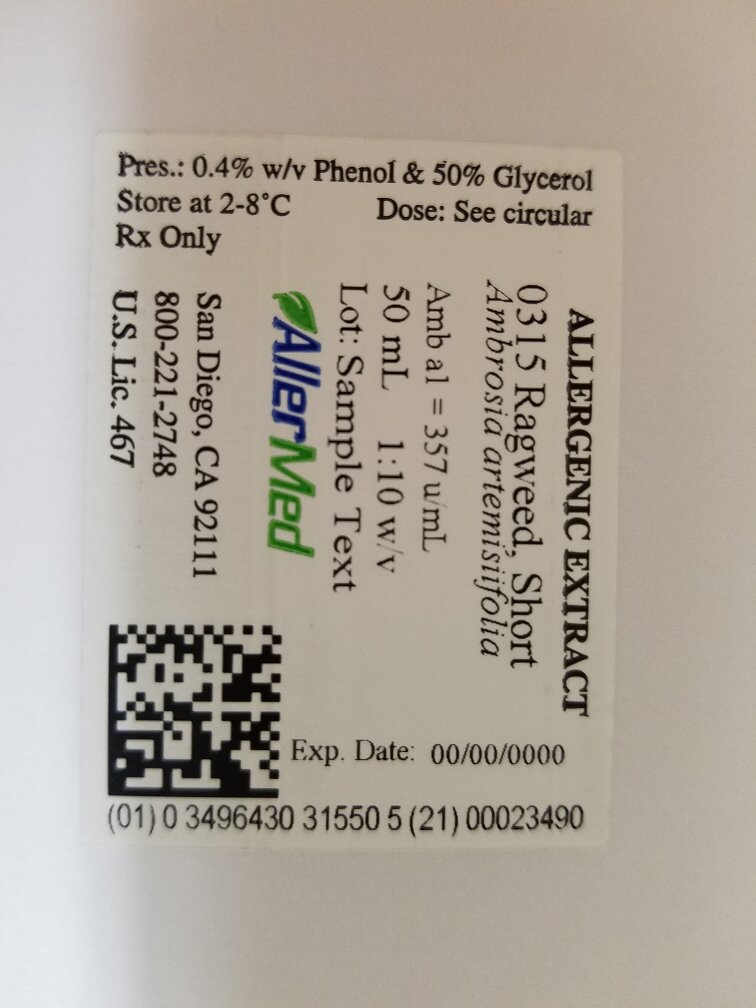
Short Ragweed Ambrosia artemisiifolia 1 g/10mL Injection, 50 mL
🆔 Identity & classification
Where does this data come from?
🏷️ RxNorm drug class
This medicine belongs to the Standardized Pollen Allergenic Extract class.
Where does this data come from?
🏭 Manufacturer & labeler
Where does this data come from?
🩺 Clinical
Patient education
Supplement & herbal interactions
Where does this data come from?
Ask a licensed pharmacist directly — free, answered by our team.
🧪 Inactive Ingredients / Excipients
Inactive ingredients, also called excipients, are components of the drug product other than the active ingredient. They may include fillers, dyes, coatings, preservatives, flavors, or other formulation ingredients.
💡 Tap an ingredient (hover on desktop) to see what it is and why it’s used.
-
5.3 mL / 10 mL
UNII PDC6A3C0OX
Glycerin is a clear, thick liquid derived from plant oils or fats. It acts as a humectant to retain moisture, a sweetener, and a solvent in medications.
-
0.4 g / 10 mL
UNII 339NCG44TV
Phenol is a chemical compound derived from coal tar or petroleum. It serves as a preservative and antimicrobial agent in medicines, helping prevent bacterial and fungal growth to keep the product stable and safe during storage.
-
0.125 g / 10 mL
UNII 8MDF5V39QO
A white powder form of baking soda that acts as a buffer and pH regulator in medicines. It helps maintain the right acid-base balance and may aid tablet disintegration.
-
0.25 g / 10 mL
UNII 451W47IQ8X
Sodium chloride is common table salt. It's used in medicines as a buffer to maintain proper pH, as a filler to add bulk, or to adjust the osmotic balance in liquid formulations.
-
UNII 059QF0KO0R
Water is a liquid solvent that dissolves and mixes ingredients together in liquid medicines, syrups, and injections. It helps distribute the active drug evenly throughout the product.
5 inactive ingredients listed in the exact product block matched to this NDC.
Where does this data come from?
ingredient classCode="IACT" elements from the exact product block matched by this NDC. Label-section narrative from DailyMed / the openFDA label index is shown separately when available.Inactive ingredient FAQ
Are inactive ingredients the same for every manufacturer?
Why might an inactive ingredient be missing?
Can inactive ingredients matter?
💲 Pricing
A drug doesn't have one price. Each row is a different public payment system, and none is what you'd pay at the counter — that depends on your insurance. The ⓘ on each row explains what it measures.
| Price system | Per each | Per package |
|---|---|---|
| Retail pharmacies payNADAC · weekly | Not in the retail survey — common for institutional, discontinued, or low-volume packs. | |
| Medicaid paysCMS SDUD · 12 mo | No recent Medicaid claims on file for this NDC — rare and low-volume NDCs are suppressed in the public data. | |
| Medicare drug plans payPart D · quarterly | No Part D plan price is available for this NDC in our data. | |
Where does this data come from?
🔁 Therapeutic equivalents
| Product | Labeler | Pack | NADAC/unit | TE | Status | Price vs. this |
|---|---|---|---|---|---|---|
| Ambrosia Artemisiifolia Pollen .1 g/mL 00268-1531-10 | ALK-Abello, | 10 ml | — | — | FDA listed | — |
| Short Ragweed 1 g/10mLthis 49643-0315-50 | Allermed | 50 ml | — | — | FDA listed | — |
Where does this data come from?
⏳ Availability & biosimilar status
Biologics have no small-molecule generics; biosimilar competition is tracked in the FDA Purple Book.
Where does this data come from?
🔬 Reported adverse events (FAERS)
Top reported reactions
Age at onset
Reporter sex
Serious outcomes
Where does this data come from?
📦 Packaging — all sizes for this product
| Package NDC | Description | Marketing start | Status |
|---|---|---|---|
| 49643-0315-05 | 5 mL in 1 VIAL, MULTI-DOSE (49643-315-05) | 1982-03-22 | Active |
| 49643-0315-10 | 10 mL in 1 VIAL, MULTI-DOSE (49643-315-10) | 1982-03-22 | Active |
| 49643-0315-30 | 30 mL in 1 VIAL, MULTI-DOSE (49643-315-30) | 1982-03-22 | Active |
| 49643-0315-50 You're viewing this | 50 mL in 1 VIAL, MULTI-DOSE (49643-315-50) | 1982-03-22 | Active |
You're viewing the largest of 4 pack sizes for this product.
Pack size FAQ
What quantity is in NDC 49643-0315-50?
What is the difference between NDC 49643-0315-50 and NDC 49643-0315-05?
What NDC number is used to bill for this package of Short Ragweed Ambrosia artemisiifolia 1 g/10mL Injection?
🧭 About this NDC listing & data coverage
What data is (and isn’t) available for this NDC — tap to expand
| NDC identity (package / product / labeler codes) | ✓ Available |
| Labeler | ✓ Available |
| Product & package description | ✓ Available |
| Marketing category & status | ✓ Available |
| Active ingredient / dosage form / route | ✓ Available |
| FDA label (SPL via DailyMed) | ✓ Available |
| Package photos | ✓ Available |
| Inactive ingredients (structured) | ✓ Available |
| NADAC pharmacy acquisition price (CMS) | — Not published for this NDC CMS publishes NADAC only for NDCs reported in its retail-pharmacy survey. |
| Orange Book / therapeutic-equivalence data | — Not published for this NDC Applies only to products approved under an NDA/ANDA; many listings are out of scope. |
| HCPCS J-code billing crosswalk | — Not published for this NDC Most self-administered / retail products have no J-code — that is normal. |
| Medicaid utilization (CMS SDUD) | — Not published for this NDC CMS reports utilization only for NDCs with Medicaid claims above its privacy threshold. |
Questions about this listing
Why is there no price listed?
Is the NDC printed on the package the same as the 11-digit billing NDC?
What do the three segments of this NDC mean?
Is this package still being marketed?
Does this product come in other package sizes?
Who lists this product with the FDA?
Do I need a prescription for this product?
Where does this data come from?
📄 Full prescribing information FDA SPL
🎯 Indications and Usage ▾
INDICATIONS Studies have shown that properly performed an interpreted skin tests with ragweed pollen extract are useful in the diagnosis of allergy to ragweed pollen 7, 8, 20, 21 . Immunotherapy with the appropriate dosage of short ragweed pollen extract is effective in reducing symptoms of hay fever and asthma resulting from exposure to short ragweed pollen (9, 10, 11), and it is believed to be effective with extract of giant ragweed, although carefully controlled studies are unavailable. However, clinical observations and known cross reactivity between short and giant ragweed pollens have led to the practice of using a mixture of the two species for skin testing and treatment 22, 23, 24, 25, 26, 27 .
This form of treatment is recommended for patients who cannot avoid exposure to pollen and who do not obtain satisfactory relief of symptoms from other medications, such as antihistamines. Immunologic changes resulting from treatment with short ragweed pollen extract are believed to include: The induction of specific anti-ragweed IgG antibodies commonly referred to as "blocking antibodies" 12, 13 . A decrease in the elevation of ragweed specific IgE during and immediately following the ragweed pollen season 14 .
A reduction of circulating anti-ragweed IgE after long-term immunotherapy 15 . A decrease in skin reactivity to the extract 16 and a decrease in leukocyte sensitivity to histamine release 17 after long-term immunotherapy.
⏱️ Dosage and Administration ▾
DOSAGE AND ADMINISTRATION DIAGNOSIS. If the extract supplied in this package is concentrated product (w/v 1:20), it should not be used for intradermal testing. Concentrated extract may be used for scratch or prick testing providing the patient is not exposed to high levels of ragweed pollen and experiencing pronounced symptoms of hay fever or asthma at the time of testing.
Extract for intradermal testing must be diluted to a strength of 0.25 units of antigen E per ml 7 . Skin tests should not be performed if the patient has taken antihistamine within 24 hours prior to testing. PROCEDURES Scratch Test: 1 drop of extract concentrate applied to a small scratch or scarification of the volar surface of the forearm or the flat aspect of the back.
Prick Test : 1 drop of extract concentrate applied to the unbroken skin of the forearm or the back followed by pricking the skin under the drop. Intradermal Test : 0.05 ml of extract containing 0.25 antigen E units per ml given intradermally on the volar surface of the forearm or outer aspect of the upper arm. This test should not be performed unless the patient is negative to a properly administered and interpreted scratch or prick test.
A final intradermal test using 0.05 ml of extract containing 2.5 antigen E units per ml may be used to rule out skin sensitivity to ragweed allergen. INTERPRETATION OF RESULTS Scratch and Prick Test A negative test shows only a slight red area at the site of scarification or prick penetration. Positive tests are scored as follows: 1+ Erythema with 5 mm wheal 2+ Erythema with 5 - 10 mm wheal 3+ Erythema with a 10 - 15 mm wheal 4+ Erythema with a wheal 15 mm (or larger) with pseudopodia Intradermal Test A negative test shows no change in the appearance and size of the 5 mm wheal created by the I.D. injection of 0.05 ml of extract.
Positive tests are scored as follows: 1+ Erythema with 10-20 mm with a 5-10 mm wheal 2+ Erythema with 20-30 mm with a 5-10 mm wheal 3+ Erythema with 30-40 mm with a 10-15 mm wheal 4+ Erythema greater than 40 mm with a 15 mm wheal (or larger) with pseudopodia IMMUNOTHERAPY Concentrated ragweed extract must be diluted before administration to new patients. As a rule, extract containing 0.01 to 0.05 units of antigen E per ml are safe to initiate immunotherapy. An intradermal skin test with the intended starting dose may be done as an additional precaution in evaluating the patient's sensitivity.
Injections should be given subcutaneously in the outer aspect of the upper arm. Care must be taken to avoid injecting the extract into a blood vessel, because of the potential hazard of anaphylaxis. Concentrated extract is usually administered once every two to four weeks at a maximum dose of 0.2 ml.
A mild burning sensation immediately following the injection of concentrated extract is due to the glycerol in the extract. It should not be interpreted as an adverse allergic response. A suggested dosage schedule is shown in the Table below.
Patients who have received allergenic extract for maintenance therapy should not be given the same dose from a fresh vial of extract. The antigen E content of ragweed pollen extract varies from lot to lot. Although the potency of fresh extract can be compared with that of previously administered product and adjusted accordingly, it is advisable to reduce the dosage of fresh extract to one-half the amount give from a previous lot.
The antigen E content of ragweed pollen extract diminishes during storage and use in the physician's office, and, therefore, may be less than that specified on the vial label. In addition, ragweed pollen extract contains other components which may contribute to the overall allergenicity of the product 18 . SUGGESTED DOSAGE SCHEDULE FOR RAGWEED EXTRACT BASED ON ANTIGEN E CONCENTRATION (units per ml ) Concentrated extracts (w/v 1:20) of short ragweed pollen usually contain between 100 and 300 units antigen E per ml.
Mixed short-giant ragweed pollen extracts contain approximately one-ha…
⛔ Contraindications ▾
CONTRAINDICATIONS There are no absolute contraindications to the use of ragweed pollen extract in the diagnosis and treatment of ragweed allergy. When used in accordance with accepted principles of skin testing and immunotherapy, the extract is considered safe and effective. Relative contraindications include (1) extreme sensitivity to the extract as demonstrated by previous anaphylaxis following skin testing or subcutaneous injection, (2) recent myocardial infarction, and (3) pregnancy (see Precautions #4).
The benefit to risk ration must be evaluated in each of the above situations. Ragweed pollen extract should not be administered to persons who are not sensitive to ragweed pollen
⚠️ Warnings ▾
WARNINGS Physicians who elect to administer ragweed pollen extract should be familiar with the clinical use of allergenic extracts and have the necessary emergency equipment and medication available to treat systemic allergic reactions. The injection of ragweed pollen extract may cause severe local and/ or systemic anaphylactic reactions in some individuals. To minimize this potential hazard, the relative sensitivity of the patient must be assessed from the allergic history and from clinical observations.
Patients should be informed of this risk prior to skin testing and immunotherapy (see adverse reactions). The dosage must be reduced when starting a patient on fresh standardized (Antigen E) extract or when transferring a patient from non-standardized to standardized extract, even though the labeled strength of the old and new vials may be the same. This is necessary due to a loss of extract potency during storage in the physician's office.
The antigen E content of old and new extract must be compared and adjusted by dosage reduction and/or dilution before new extract is administered. The amount of new extract given from the old vial, assuming both extracts contain comparable amounts of antigen E. Any evidence of a local or generalized reaction requires a reduction in dosage during the initial stages of hyposensitization as well as during maintenance therapy.
🤒 Adverse Reactions ▾
ADVERSE REACTIONS LOCAL REACTIONS. The occurrence of a hive 5 to 15 minutes after injection is usually due to leakage of extract into the skin along the needle tract. Firm pressure (not rubbing) at the site of injection immediately after withdrawal of the needle will usually prevent this reaction.
It does not require a reduction in dosage. A strong local reaction with erythema and edema which persists at the injection site for several hours indicates that too much extract has been given. Failure to note this response may result in a serious generalized reaction.
Treatment should be altered as follows: Additional injections should not be given until all evidence of the reaction has disappeared. The dosage should be reduced three levels, e.g., from 0.4 cc to 0.5 cc or the equivalent, and held at that level for two or three treatments. A second reaction at or near the dose which caused the first local response indicates that a maximum tolerated amount of extract has been reached and no further increases in dosage should be attempted.
Maintenance therapy should be continued thereafter at the highest possible non-reacting dose. SYSTEMIC REACTIONS. Systemic (generalized) reactions may range from a mild exaggeration of the patient's allergic symptoms to hives, anaphylactic shock, or even death from anaphylaxis.
Systemic reactions may occur when a previous local reaction has not been heeded, or when the extract is accidentally injected intravenously. The reaction usually occurs 5 to 20 minutes after injection. Symptoms may include sneezing, coughing, itching, shortness of breath, abdominal cramps, vomiting, diarrhea, tachycardia, hypotension, and respiratory failure in severe cases.
The reaction is usually stopped by the subcutaneous injection of epinephrine HCL 1:1,000 (See Overdosage below). The oral administration of antihistamines and the placement of a tourniquet proximal to the injection site are helpful adjuncts. In the event that additional measures are required, it may be necessary to treat the patient for bronchospasm with intravenous aminophylline, intravenous fluids and corticosteroids; for hypotension with vasopressors, volume repletion, isoproterenol and corticosteroids; for laryngeal obstruction with oxygen and tracheostomy and for cardiac arrest with cardiopulmonary resuscitation and other appropriate measures.
🆘 Overdosage ▾
OVERDOSAGE A local reaction characterized by erythema and edema that persists for several hours or longer, or a recurrence of allergic symptoms following an injection requires that the dosage be reduced. Additional extract should not be given until all evidence of a previous reaction has disappeared. Severe generalized symptoms or anaphylaxis following an injection must be treated immediately with epinephrine HCL 1:1000 as follows: Usual Dosage - Children under 12 years 0.1 to 0.2 cc; persons over 12 years 0.3 to 0.5 cc, repeated as necessary every 10 to 15 minutes.
Intravenous antihistamines and hydro-cortisone also may be used, but only after sufficient epinephrine has been give. (see Adverse Reaction Systemic). Immunotherapy after anaphylaxis should only be considered if the probable cause of anaphylaxis can be identified, such as accidental intravenous injection or failure to reduce the dosage after a previous local reaction or during periods of high external exposure to ragweed pollen.
📦 How Supplied / Storage and Handling ▾
SUPPLIED Short ragweed pollen extract and mixed short-giant ragweed pollen extract in concentrated form (w/v 1:20) are supplied in 1 ml dropper vials for scratch or prick testing and in 10 ml, and 50 ml vials for bulk use. Dilutions other than 1:20 w/v may be custom ordered.
📋 Description ▾
DESCRIPTION INGREDIENTS - Allergenic extract of short ragweed pollen is a clear, amber-colored solution prepared from the dry, defatted pollen of Ambrosia elatior . The extract contains the water extractables of the pollen, 0.25% sodium chloride, 0.125% sodium bicarbonate, 0.5% phenol and 50% glycerol by volume. Extract of mixed short-giant ragweed has the same appearance as short ragweed pollen extract and contains the same chemical ingredients.
It is prepared from equal gram weights of the pollens of Ambrosia elatior and Ambrosia trifida . STANDARDIZATION - The potency of ragweed pollen extract is based on antigen E, a protein component which is believed to be the most important allergen of short ragweed pollen. Extracts of short ragweed pollen sold in the U.S. must have a minimum antigen E content of 67.5 units per ml for a 1:20 w/v concentrate.
Extracts of mixed short-giant ragweed must have a minimum antigen E content of 33.75 units/ml for a 1:20 w/v concentrate. The importance of antigen E in ragweed allergy is based on the following observations: In vitro studies with antigen E have shown that it is capable of causing histamine release from peripheral leukocytes of ragweed sensitive persons 1 . The antigen E content of short ragweed pollen extract has been found to correlate with extract potency when measured by skin test response in persons allergic to short ragweed pollen 2 .
Immunotherapy with antigen E has been shown to be comparably effective to whole short ragweed pollen extract in reducing symptoms related to ragweed pollen exposure 3 . The weight by volume value shown on the label is a measurement of extract concentration, rather than extract potency. Weight by volume designations may be used to identify dilutions of extract for skin testing and immunotherapy, and are useful from a practical standpoint in identifying the relative strength of a given extract.
However, studies have shown that the antigen E content varies in extracts with the same weight by volume concentration 4 . EXPIRATION DATING - Expiration dating is based on the antigen E content of the extract. Extracts containing 50% glycerol by volume have longer dating periods due to the protective effects of glycerol on antigen E 5, 6 .
The expiration period of aqueous concentrate and saline dilutions of glycerinated concentrate is approximately one-half that of glycerinated extract containing comparable antigen E content. Ragweed extract should be kept at 2°C to 8°C during use and office storage to retain potency. Higher temperatures have an adverse affect on antigen E.